Nonequilibrium electron-phonon dynamics with high momentum resolution: Thermalization bottlenecks and the effects of phonon dispersion
Pith reviewed 2026-06-30 08:49 UTC · model grok-4.3
The pith
QTT-NEGF enables momentum-resolved electron-phonon simulations on 256x256 lattices that expose a hierarchy of thermalization bottlenecks extending the phonon-window effect.
A machine-rendered reading of the paper's core claim, the machinery that carries it, and where it could break.
Core claim
The quantics-tensor-train NEGF framework supplies a memory-efficient representation of two-time Green's functions that supports momentum-resolved simulations with complete electron-phonon feedback on lattices up to 256 by 256 sites. For optical phonon models this uncovers the conventional phonon-energy window together with a reduced window that separates momentum-space regions of excess and deficit electronic population, plus an independent bottleneck in phonon thermalization arising from momentum-dependent coupling to the particle-hole continuum. Acoustic phonon models instead produce a phonon-energy window whose momentum dependence follows simultaneous energy-momentum conservation, an asym
What carries the argument
Quantics-tensor-train compression of two-time Green's functions, which supplies a controllable low-rank representation that makes full momentum-dependent electron-phonon self-energy calculations tractable on large lattices.
If this is right
- Optical phonons produce both a primary energy window and a secondary reduced window that partitions momentum space into regions of population excess and deficit.
- Acoustic phonons acquire a pronounced momentum dependence in the energy window set by simultaneous energy-momentum conservation and exhibit directional scattering that traps low-momentum modes.
- Phonon thermalization for optical modes is limited by a separate bottleneck rooted in momentum-dependent coupling to the particle-hole continuum.
- High-resolution spectra show a direct link between phonon relaxation dynamics and the charge response function.
Where Pith is reading between the lines
- The same compression technique could be applied to electron-electron or electron-magnon interactions to test whether similar bottleneck hierarchies appear.
- The identified directional scattering bottleneck for acoustic modes suggests that low-momentum phonon populations may remain out of equilibrium for experimentally accessible times in materials with strong acoustic coupling.
- The correspondence between phonon and charge response implies that time-resolved charge-sensitive probes could indirectly map phonon relaxation without direct phonon detection.
Load-bearing premise
The tensor-train compression of the two-time Green's functions stays accurate and controllable when the full momentum-dependent electron-phonon self-energy is included on the studied lattice sizes and propagation times.
What would settle it
A side-by-side comparison on small lattices (where both QTT-NEGF and exact methods are feasible) that shows whether the extracted relaxation times and spectral features agree within the claimed error bars.
Figures
read the original abstract
The nonequilibrium electron-phonon interplay is central to thermalization of solids, yet the microscopic picture of transient states and relaxation pathways remains incomplete. Previous nonequilibrium Green's function (NEGF) studies were restricted to local phonons and local self-energy approximations, leaving momentum-dependent dynamics largely unexplored. In this work, we demonstrate the power of the recently developed quantics-tensor-train (QTT) NEGF framework through large-scale lattice simulations with arbitrary phonon dispersions. QTTs provide a memory-efficient representation of two-time Green's functions, enabling momentum-resolved simulations with full electron-phonon feedback on lattices up to 256x256 sites. Comparing optical and acoustic phonon models, we reveal a hierarchy of relaxation bottlenecks that extends the well-known phonon-window bottleneck effect. For optical phonons, we confirm the main phonon-energy window and uncover a reduced window separating momentum-space regions of excess and deficit electronic population. We also identify a separate bottleneck in phonon thermalization, rooted in the momentum-dependent coupling to the particle-hole continuum. For acoustic phonons, the phonon-energy window acquires pronounced momentum dependence dictated by simultaneous energy-momentum conservation. The reduced window becomes asymmetric; directional scattering between Brillouin-zone regions creates a persistent bottleneck for low-momentum phonon modes. The high momentum and frequency resolution of our spectra further reveals a direct correspondence between phonon relaxation and charge response. Our results establish QTT-NEGF simulations as a scalable and controlled framework for quantitative nonequilibrium electron-phonon dynamics, overcoming previous lattice-size and propagation-time limitations and providing accurate reference data for time-resolved spectroscopies.
Editorial analysis
A structured set of objections, weighed in public.
Referee Report
Summary. The paper claims that the quantics-tensor-train (QTT) NEGF framework enables momentum-resolved nonequilibrium simulations of electron-phonon dynamics with full feedback on lattices up to 256x256 sites. By comparing optical and acoustic phonon dispersions, it identifies a hierarchy of relaxation bottlenecks that extends the phonon-window effect, including a reduced momentum-space window for optical phonons, a phonon-thermalization bottleneck from momentum-dependent coupling, and pronounced momentum dependence plus directional scattering for acoustic phonons, with direct links to charge response.
Significance. If the numerical controls hold, the work would establish a scalable computational route to high-momentum- and frequency-resolution nonequilibrium spectra that were previously inaccessible, supplying quantitative reference data for time-resolved spectroscopies and clarifying microscopic thermalization pathways in solids.
major comments (1)
- [Methods (QTT-NEGF implementation)] The central claim that QTT compression remains accurate and controllable for the full momentum-dependent electron-phonon self-energy on 256x256 lattices and the propagation times needed to observe the reported bottlenecks is load-bearing but unsupported. No QTT ranks, singular-value thresholds, or direct benchmarks against uncompressed NEGF on smaller systems are supplied to quantify truncation error.
Simulated Author's Rebuttal
We thank the referee for the careful reading of our manuscript and the constructive feedback. We address the single major comment below.
read point-by-point responses
-
Referee: [Methods (QTT-NEGF implementation)] The central claim that QTT compression remains accurate and controllable for the full momentum-dependent electron-phonon self-energy on 256x256 lattices and the propagation times needed to observe the reported bottlenecks is load-bearing but unsupported. No QTT ranks, singular-value thresholds, or direct benchmarks against uncompressed NEGF on smaller systems are supplied to quantify truncation error.
Authors: We agree that explicit documentation of the QTT truncation controls is necessary to support the central claims. In the revised manuscript we will insert a new subsection (Methods, after the description of the QTT-NEGF algorithm) that reports: (i) the maximum QTT ranks employed (typically 12–35, momentum- and time-dependent), (ii) the singular-value threshold of 10^{-10} used throughout, and (iii) direct numerical benchmarks against uncompressed NEGF on lattices up to 32×32 for both optical- and acoustic-phonon dispersions. These benchmarks demonstrate that the relative error in the electron and phonon occupation functions remains below 0.8 % for propagation times up to 200 fs—the regime in which the reported thermalization bottlenecks are observed. Because direct uncompressed NEGF on 256×256 is computationally prohibitive, the smaller-lattice comparisons, together with the observed convergence of observables with increasing rank, constitute the quantitative control we will now provide. revision: yes
Circularity Check
No circularity: computational demonstration of QTT-NEGF method
full rationale
The paper presents large-scale numerical simulations using the QTT-NEGF framework to explore nonequilibrium electron-phonon dynamics on lattices up to 256x256. No derivation chain reduces results to inputs by construction, no fitted parameters are relabeled as predictions, and no self-citation chain is invoked to justify a uniqueness theorem or ansatz that would force the central claims. The reported hierarchy of relaxation bottlenecks emerges from explicit momentum-resolved simulations with full electron-phonon feedback; the framework itself is referenced as recently developed but the outputs (bottleneck identification, phonon-window extensions) are not equivalent to the compression method by definition. This is a standard computational physics demonstration whose validity rests on numerical controls external to any self-referential loop.
Axiom & Free-Parameter Ledger
axioms (1)
- domain assumption The quantics-tensor-train representation provides a controllable and memory-efficient approximation to the two-time Green's functions for momentum-resolved electron-phonon dynamics.
Reference graph
Works this paper leans on
-
[1]
The quench acts as a broadband perturbation and almost instantaneously generates a nonthermal electron population across the entire BZ, together with a small phonon population
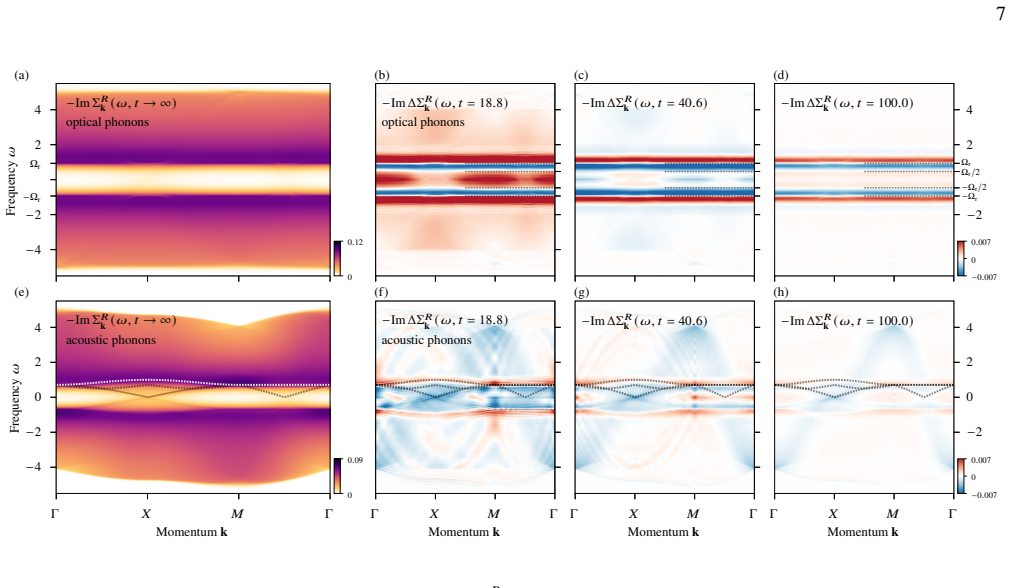
Fermion relaxation (optical phonons) Let us first focus on the fermion thermalization in the model with optical phonon modes [Video 1(a) and (b)]. The quench acts as a broadband perturbation and almost instantaneously generates a nonthermal electron population across the entire BZ, together with a small phonon population. The high-energy electrons and hol...
-
[2]
3(a), which replots Fig
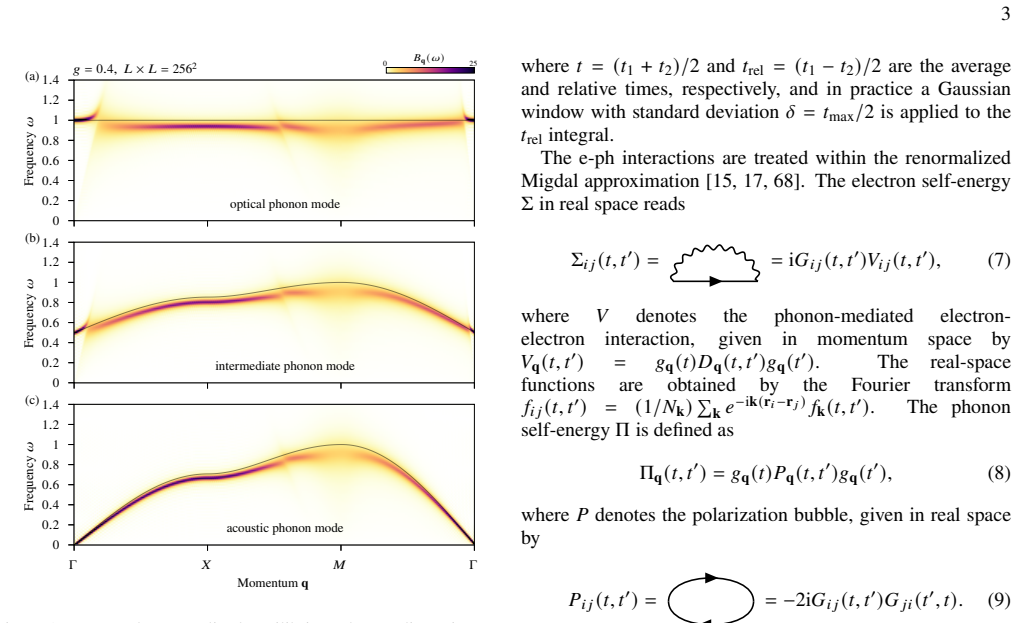
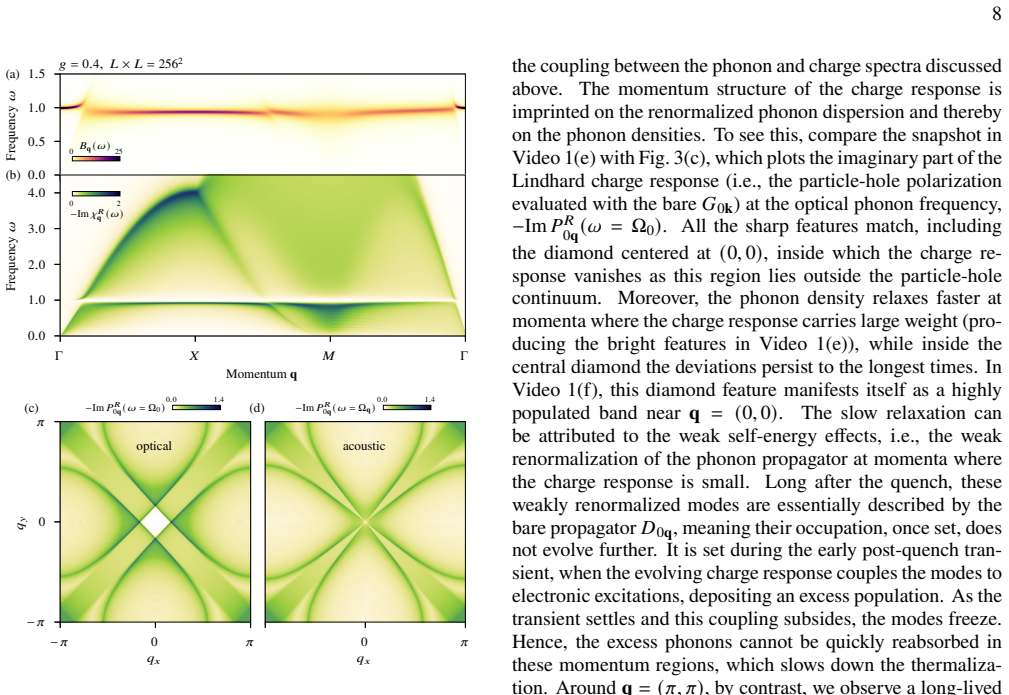
Phonon relaxation (optical phonons) To set the stage for the discussion of the relaxation of the phonon densities, we note that the momentum-dependent self- energyΠ q renders the renormalized spectrum of an optical phonon dispersive, with a minimum atq=(𝜋, 𝜋)and a max- imum nearq=(0,0)[Fig. 3(a), which replots Fig. 1(a)]. The renormalization is strongest ...
-
[3]
Fermion relaxation (acoustic phonons) We now turn to the fermion relaxation in the model with acoustic phonons [Video 1(c) and (d)]. Even though acoustic phonon modes can have arbitrarily small energiesΩ q →0, which in principle should allow electrons at any energy to relax and thus eliminate the relaxation bottleneck, this is not what we observe. Instead...
-
[4]
Here, already the initial response to the quench differs from the optical case
Phonon relaxation (acoustic phonons) We now turn to the phonon relaxation in the acoustic model. Here, already the initial response to the quench differs from the optical case. Whereas for optical phonons the quench triggers an overpopulation of phonons across the entire BZ, in the acoustic case the initial overpopulation is confined to momenta near(𝜋, 𝜋)...
-
[5]
M. I. Kaganov, I. M. Lifshitz, and L. V. Tanatarov, Sov. Phys. JETP4, 173 (1957), originally published in Zh. Eksp. Teor. Fiz. 31, 232–237 (1956)
1957
-
[6]
V. L. Ginzburg and V. P. Shabanskii, Dokl. Akad. Nauk SSSR 100, 445 (1955)
1955
-
[7]
I. M. Lifshits, M. I. Kaganov, and L. V. Tanatarov, Sov. J. At. Energy6, 261 (1960)
1960
-
[8]
S. I. Anisimov, B. L. Kapeliovich, and T. L. Perel’man, Sov. Phys. JETP39, 375 (1974)
1974
-
[9]
P. B. Allen, Phys. Rev. Lett.59, 1460 (1987)
1987
-
[10]
L. Waldecker, R. Bertoni, R. Ernstorfer, and J. Vorberger, Phys- ical Review X6(2016), 10.1103/physrevx.6.021003
-
[11]
P. Maldonado, K. Carva, M. Flammer, and P. M. Oppeneer, Physical Review B96(2017), 10.1103/physrevb.96.174439
-
[12]
Z. Lu, A. Vallabhaneni, B. Cao, and X. Ruan, Physical Review B98(2018), 10.1103/physrevb.98.134309
-
[13]
F. Caruso, D. Novko, and C. Draxl, Physical Review B101 (2020), 10.1103/physrevb.101.035128
-
[14]
D. Novko, F. Caruso, C. Draxl, and E. Cappelluti, Physical Review Letters124(2020), 10.1103/physrevlett.124.077001
-
[15]
Electron phonon coupling in ultrathin pb films on si(111): Where the heck is the energy?
M. Tajik, T. Witte, C. Brand, L. Rettig, B. Sothmann, U. Boven- siepen, and M. H. von Hoegen, “Electron phonon coupling in ultrathin pb films on si(111): Where the heck is the energy?” (2023)
2023
-
[16]
Werner and M
P. Werner and M. Eckstein, Structural Dynamics3, 023603 (2015)
2015
-
[17]
Sentef, A
M. Sentef, A. F. Kemper, B. Moritz, J. K. Freericks, Z.-X. Shen, and T. P. Devereaux, Phys. Rev. X3, 041033 (2013)
2013
-
[18]
A. F. Kemper, M. A. Sentef, B. Moritz, J. K. Freericks, and T. P. Devereaux, Phys. Rev. B90, 075126 (2014)
2014
-
[19]
Murakami, P
Y. Murakami, P. Werner, N. Tsuji, and H. Aoki, Phys. Rev. B 91, 045128 (2015)
2015
-
[20]
J. D. Rameau, S. Freutel, A. F. Kemper, M. A. Sentef, J. K. Freericks, I. Avigo, M. Ligges, L. Rettig, Y. Yoshida, H. Eisaki, J. Schneeloch, R. D. Zhong, Z. J. Xu, G. D. Gu, P. D. John- son, and U. Bovensiepen, Nature Communications7(2016), 10.1038/ncomms13761
-
[21]
Abdurazakov, D
O. Abdurazakov, D. Nevola, A. Rustagi, J. K. Freericks, D. B. Dougherty, and A. F. Kemper, Phys. Rev. B98, 245110 (2018)
2018
-
[22]
A. F. Kemper, O. Abdurazakov, and J. K. Freericks, Phys. Rev. X8, 041009 (2018)
2018
-
[23]
Werner and M
P. Werner and M. Eckstein, Phys. Rev. B88, 165108 (2013)
2013
-
[24]
Picano, F
A. Picano, F. Grandi, and M. Eckstein, Phys. Rev. B107, 245112 (2023)
2023
-
[25]
Jeckelmann and H
E. Jeckelmann and H. Fehske, La Rivista del Nuovo Cimento 30, 259 (2007)
2007
-
[26]
L. G. Caron and S. Moukouri, Phys. Rev. Lett.76, 4050 (1996)
1996
-
[27]
L. G. Caron and S. Moukouri, Phys. Rev. B56, R8471 (1997)
1997
-
[28]
Jeckelmann and S
E. Jeckelmann and S. R. White, Phys. Rev. B57, 6376 (1998)
1998
-
[29]
Jeckelmann, C
E. Jeckelmann, C. Zhang, and S. R. White, Phys. Rev. B60, 7950 (1999)
1999
-
[30]
Y. Ge, W. Li, J. Ren, and Z. Shuai, Phys. Rev. B110, 035201 (2024)
2024
-
[31]
Zhang, E
C. Zhang, E. Jeckelmann, and S. R. White, Phys. Rev. Lett.80, 2661 (1998)
1998
-
[32]
Zhang, E
C. Zhang, E. Jeckelmann, and S. R. White, Phys. Rev. B60, 14092 (1999)
1999
-
[33]
Bon ˇca, S
J. Bon ˇca, S. A. Trugman, and I. Batisti ´c, Phys. Rev. B60, 1633 (1999)
1999
-
[34]
Barford, R
W. Barford, R. J. Bursill, and M. Y. Lavrentiev, Phys. Rev. B 65, 075107 (2002)
2002
-
[35]
Wong and Z.-D
H. Wong and Z.-D. Chen, Phys. Rev. B77, 174305 (2008)
2008
-
[36]
C. Guo, A. Weichselbaum, J. von Delft, and M. Vojta, Phys. Rev. Lett.108, 160401 (2012)
2012
-
[37]
Goleˇ z, J
D. Goleˇ z, J. Bonˇca, L. Vidmar, and S. A. Trugman, Phys. Rev. Lett.109, 236402 (2012)
2012
-
[38]
Brockt, F
C. Brockt, F. Dorfner, L. Vidmar, F. Heidrich-Meisner, and E. Jeckelmann, Phys. Rev. B92, 241106 (2015)
2015
-
[39]
Dorfner, L
F. Dorfner, L. Vidmar, C. Brockt, E. Jeckelmann, and F. Heidrich-Meisner, Phys. Rev. B91, 104302 (2015)
2015
-
[40]
F. A. Y. N. Schr ¨oder and A. W. Chin, Phys. Rev. B93, 075105 (2016)
2016
-
[41]
Brockt and E
C. Brockt and E. Jeckelmann, Phys. Rev. B95, 064309 (2017)
2017
-
[43]
H. Aoki, N. Tsuji, M. Eckstein, M. Kollar, T. Oka, and P. Werner, Rev. Mod. Phys.86, 779 (2014)
2014
-
[44]
Konstantinova, J
T. Konstantinova, J. D. Rameau, A. H. Reid, O. Abdurazakov, L. Wu, R. Li, X. Shen, G. Gu, Y. Wang, T. P. Devereaux, J. K. Freericks, A. F. Kemper, H. A. D¨ urr, P. D. Johnson, and Y. Zhu, Sci. Adv.4, eaap7427 (2018)
2018
-
[45]
Sch¨ uler and P
M. Sch¨ uler and P. Werner, Phys. Rev. B96, 155122 (2017)
2017
-
[46]
Rethfeld, A
B. Rethfeld, A. Kaiser, M. Vicanek, and G. Simon, Phys. Rev. B65, 214303 (2002)
2002
-
[47]
B. Y. Mueller and B. Rethfeld, Phys. Rev. B87, 035139 (2013)
2013
-
[48]
V. V. Baranov and V. V. Kabanov, Phys. Rev. B89, 125102 (2014)
2014
-
[49]
R. Kim, V. Perebeinos, and P. Avouris, Phys. Rev. B84, 075449 (2011)
2011
-
[50]
V. A. Jhalani, J.-J. Zhou, and M. Bernardi, Nano Lett.17, 5012 (2017)
2017
-
[51]
Ono and T
S. Ono and T. Suemoto, Phys. Rev. B102, 024308 (2020)
2020
-
[52]
Tong and M
X. Tong and M. Bernardi, Phys. Rev. Res.3, 023072 (2021)
2021
-
[53]
Caruso, J
F. Caruso, J. Phys. Chem. Lett.12, 1734 (2021)
2021
-
[54]
Seiler, D
H. Seiler, D. Zahn, M. Zacharias, P.-N. Hildebrandt, T. Vasileiadis, Y. W. Windsor, Y. Qi, C. Carbogno, C. Draxl, R. Ernstorfer, and F. Caruso, Nano Lett.21, 6171 (2021)
2021
-
[55]
Caruso and D
F. Caruso and D. Novko, Adv. Phys.: X7, 2095925 (2022)
2022
-
[56]
T. Held, C. Seibel, M. Uehlein, S. T. Weber, and B. Rethfeld, J. Phys.: Condens. Matter37, 47LT01 (2025)
2025
-
[57]
F. T. Vasko and V. Ryzhii, Physical Review B77(2008), 10.1103/physrevb.77.195433
-
[58]
Marini, Journal of Physics: Conference Series427, 012003 13 (2013)
A. Marini, Journal of Physics: Conference Series427, 012003 13 (2013)
2013
-
[59]
Sangalli and A
D. Sangalli and A. Marini, EPL (Europhysics Letters)110, 47004 (2015)
2015
-
[60]
Miyamoto, A
Y. Miyamoto, A. Rubio, and D. Tom ´anek, Phys. Rev. Lett.97, 126104 (2006)
2006
-
[61]
B. F. Habenicht, S. V. Kilina, and O. V. Prezhdo, Pure Appl. Chem.80, 1433 (2008)
2008
-
[62]
Guan, X.-B
M.-X. Guan, X.-B. Liu, D.-Q. Chen, X.-Y. Li, Y.-P. Qi, Q. Yang, P.-W. You, and S. Meng, Phys. Rev. Lett.128, 015702 (2022)
2022
-
[63]
A. F. Kemper, B. Moritz, J. K. Freericks, and T. P. Devereaux, New J. Phys.15, 023003 (2013)
2013
-
[64]
´Sroda, K
M. ´Sroda, K. Inayoshi, H. Shinaoka, and P. Werner, Phys. Rev. Lett.135, 226501 (2025)
2025
-
[65]
K. Inayoshi, M. ´Sroda, A. Kauch, P. Werner, and H. Shi- naoka, “A causality-based divide-and-conquer algorithm for nonequilibrium green’s function calculations with quantics ten- sor trains,” (2025), arXiv:2509.15028 [cond-mat.str-el]
-
[66]
M. ´Sroda, K. Inayoshi, M. Sch¨ uler, H. Shinaoka, and P. Werner, “Predictor-corrector method based on dynamic mode decompo- sition for tensor-train nonequilibrium green’s function calcula- tions,” (2025), arXiv:2509.22177 [cond-mat.str-el]
-
[67]
S. Li, E. A. Nowadnick, and S. Johnston, Physical Review B92 (2015), 10.1103/physrevb.92.064301
-
[68]
E. A. Nowadnick, S. Johnston, B. Moritz, and T. P. Devereaux, Physical Review B91(2015), 10.1103/physrevb.91.165127
-
[69]
P. M. Dee, K. Nakatsukasa, Y. Wang, and S. Johnston, Physical Review B99(2019), 10.1103/physrevb.99.024514
-
[70]
B. Nosarzewski, M. Sch¨ uler, and T. P. Devereaux, Physical Review B103(2021), 10.1103/physrevb.103.024520
-
[71]
The correspondingΩ 0/𝑊ratio is in the realistic range for in- tramolecular vibrations in fullerides and𝜅-organic compounds [88, 89]
-
[72]
Migdal, Sov
A. Migdal, Sov. Phys. JETP7, 996 (1958)
1958
-
[73]
Turkowski and J
V. Turkowski and J. K. Freericks, Phys. Rev. B71, 085104 (2005)
2005
-
[74]
Shinaoka, M
H. Shinaoka, M. Wallerberger, Y. Murakami, K. Nogaki, R. Sakurai, P. Werner, and A. Kauch, Phys. Rev. X13, 021015 (2023)
2023
-
[75]
Entanglement across scales: Quantics tensor trains as a natural framework for renormalization,
S. Rohshap, J.-W. Li, A. Lorenz, S. Hasil, K. Held, A. Kauch, and M. Wallerberger, “Entanglement across scales: Quantics tensor trains as a natural framework for renormalization,” (2025), arXiv:2507.19069 [cond-mat.str-el]
-
[76]
Diagnosing phase transitions through time-scale entanglement
S. Rohshap, H. Ishida, F. Bippus, A. Kauch, K. Held, H. Shi- naoka, and M. Wallerberger, “Diagnosing phase transitions through time scale entanglement,” (2025), arXiv:2507.11276 [cond-mat.str-el]
work page internal anchor Pith review Pith/arXiv arXiv 2025
-
[77]
M. K. Ritter, Y. N´ u ˜nez Fern ´andez, M. Wallerberger, J. von Delft, H. Shinaoka, and X. Waintal, Physical Review Letters 132, 056501 (2024)
2024
-
[78]
I. V. Oseledets, SIAM Journal on Scientific Computing33, 2295 (2011)
2011
-
[79]
Dolgov and D
S. Dolgov and D. Savostyanov, Computer Physics Communica- tions246, 106869 (2020)
2020
-
[80]
N´ u˜nez Fern ´andez, M
Y. N´ u˜nez Fern ´andez, M. Jeannin, P. T. Dumitrescu, T. Kloss, J. Kaye, O. Parcollet, and X. Waintal, Physical Review X12, 041018 (2022)
2022
-
[81]
Y. N. Fern ´andez, M. K. Ritter, M. Jeannin, J.-W. Li, T. Kloss, T. Louvet, S. Terasaki, O. Parcollet, J. von Delft, H. Shinaoka, and X. Waintal, SciPost Phys.18, 104 (2025)
2025
discussion (0)
Sign in with ORCID, Apple, or X to comment. Anyone can read and Pith papers without signing in.