Tracing the Orbital Motion of the Accreting White Dwarf in EX~Hydrae with XRISM/Resolve
Pith reviewed 2026-06-30 08:52 UTC · model grok-4.3
The pith
High-resolution X-ray spectroscopy traces the white dwarf's orbital motion in EX Hydrae using iron line centroids.
A machine-rendered reading of the paper's core claim, the machinery that carries it, and where it could break.
Core claim
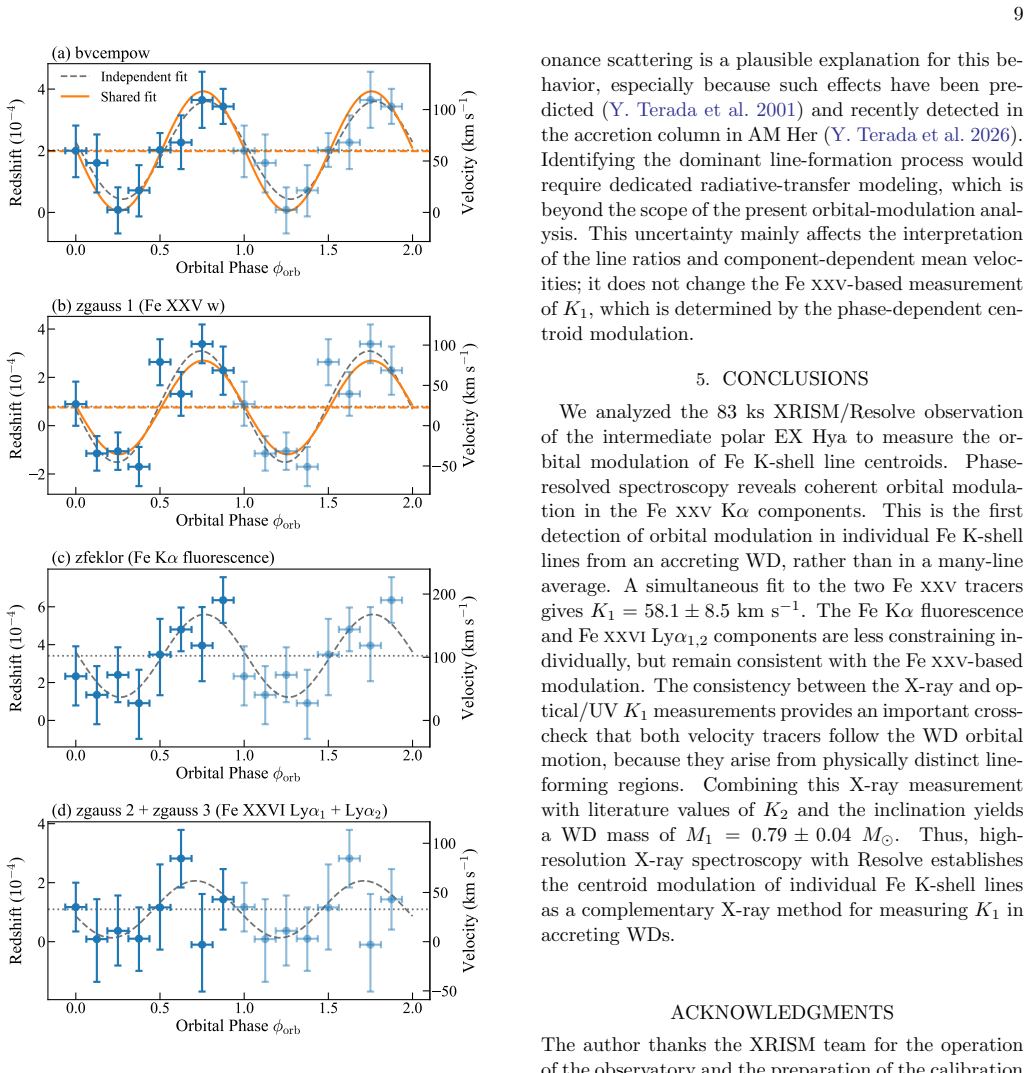
The Fe XXV Kα components show coherent orbital modulation, yielding K1 = 58.1 ± 8.5 km s^{-1}. This is the first detection of orbital modulation in individual Fe K-shell lines from an accreting WD. Combining this X-ray measurement with literature orbital parameters derives a WD mass of M1 = 0.79 ± 0.04 M⊙.
What carries the argument
The orbital modulation of the centroids of individual Fe K-shell emission lines, which provides a Doppler tracer of the white dwarf's motion.
Load-bearing premise
The observed Fe K-shell line centroids are formed in material that moves with the white dwarf and are not significantly contaminated by other emission sources.
What would settle it
A measurement showing that the Fe line centroids do not vary with the known orbital period or produce a K1 inconsistent with optical data would falsify the claim.
Figures
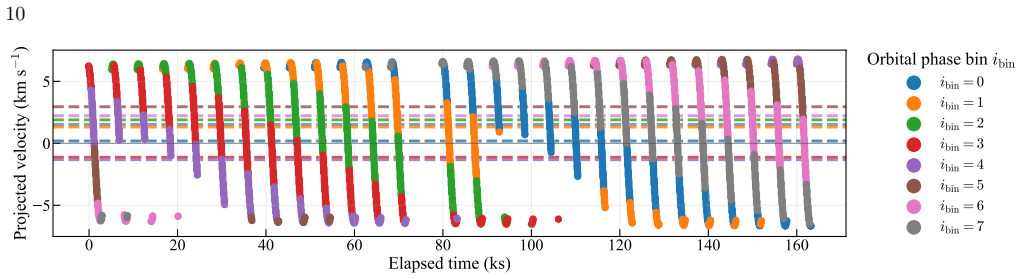
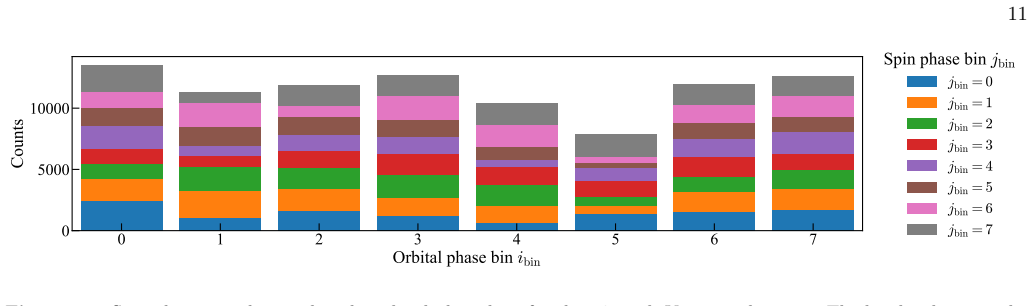
read the original abstract
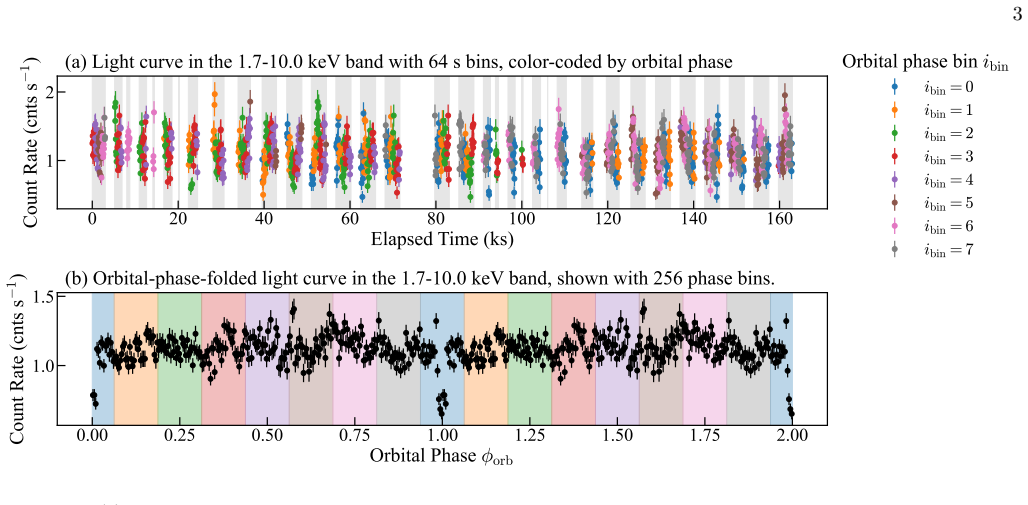
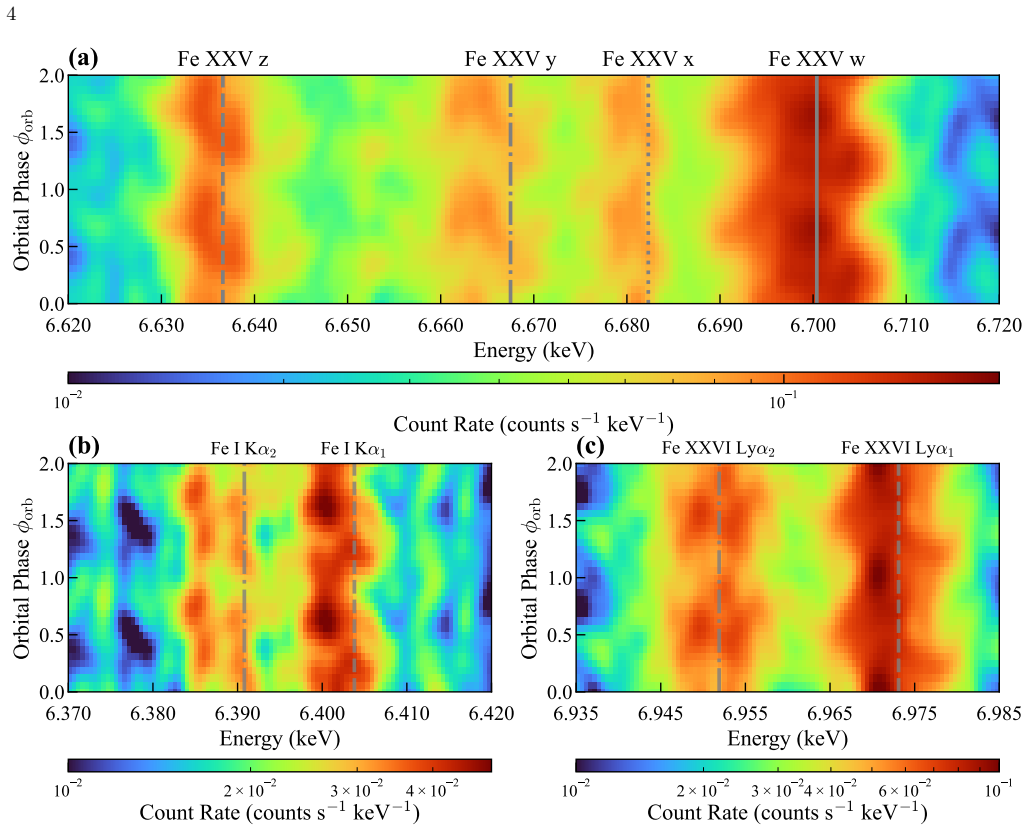
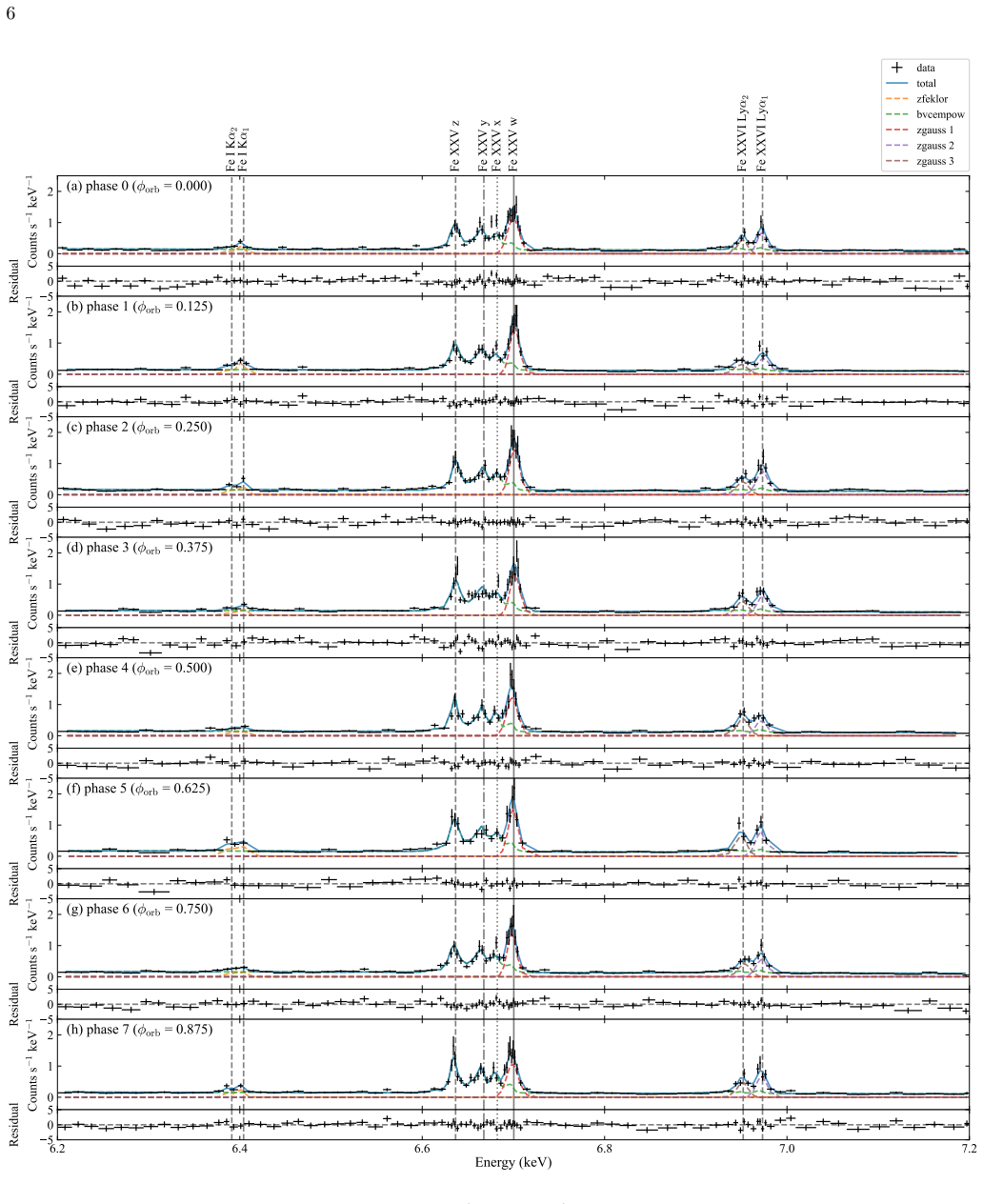
Measuring the masses of accreting white dwarfs (WDs) is crucial for understanding their evolution and the physics of accretion. High-resolution X-ray spectroscopy can trace the WD motion through Doppler shifts of emission lines formed close to the WD. We report an 83~ks XRISM/Resolve observation of the intermediate polar EX~Hydrae and measure the orbital modulation of individual Fe K-shell line centroids. The Fe~{\sc xxv} K$\alpha$ components show coherent orbital modulation, yielding $K_1 = 58.1 \pm 8.5\ \mathrm{km\ s^{-1}}$. This is the first detection of orbital modulation in individual Fe K-shell lines from an accreting WD, made possible by the high spectral resolution of Resolve and its frequent in-orbit gain calibration. The measured $K_1$ is consistent with optical/UV $K_1$ measurements, providing a cross-check that these distinct tracers follow the WD orbital motion. Combining this X-ray measurement with literature orbital parameters, we derive a WD mass of $M_1 = 0.79 \pm 0.04\ M_\odot$. These results demonstrate that high-resolution X-ray spectroscopy can use individual Fe K-shell line centroids to trace WD orbital motion in accreting WDs.
Editorial analysis
A structured set of objections, weighed in public.
Referee Report
Summary. The manuscript reports an 83 ks XRISM/Resolve observation of the intermediate polar EX Hydrae. It measures coherent orbital modulation in the centroids of individual Fe XXV Kα line components, yielding K1 = 58.1 ± 8.5 km s^{-1} (first such detection in X-rays), consistent with published optical/UV values. Combining this with literature orbital parameters, it derives a white dwarf mass M1 = 0.79 ± 0.04 M⊙ and argues that high-resolution X-ray spectroscopy can trace WD orbital motion via Fe K-shell lines.
Significance. If the K1 measurement is robust, the result provides an independent X-ray-based mass for an accreting WD and demonstrates a new observational capability enabled by Resolve's spectral resolution and gain calibration. The cross-check against optical K1 strengthens the case that the X-ray lines trace the same motion, with potential extension to other intermediate polars where optical data are limited.
major comments (1)
- [Abstract and Fe XXV Kα centroid analysis] The central claim that the measured K1 traces the WD orbital velocity (abstract; implied in the Fe XXV Kα centroid analysis) rests on the assumption that emission from the post-shock accretion column and curtains does not introduce phase-dependent centroid shifts at the orbital phases used for the fit. The manuscript notes consistency with optical K1 but does not quantify the possible contribution of bulk motion or illumination effects in these regions to the observed modulation amplitude.
minor comments (1)
- [Results section] The uncertainty on K1 (8.5 km s^{-1}) and the derived mass should be explicitly compared to the range of published optical K1 values to clarify the degree of agreement.
Simulated Author's Rebuttal
We thank the referee for their constructive review and recommendation of minor revision. We address the major comment below.
read point-by-point responses
-
Referee: [Abstract and Fe XXV Kα centroid analysis] The central claim that the measured K1 traces the WD orbital velocity (abstract; implied in the Fe XXV Kα centroid analysis) rests on the assumption that emission from the post-shock accretion column and curtains does not introduce phase-dependent centroid shifts at the orbital phases used for the fit. The manuscript notes consistency with optical K1 but does not quantify the possible contribution of bulk motion or illumination effects in these regions to the observed modulation amplitude.
Authors: We acknowledge the referee's point that the manuscript relies on the consistency with optical K1 without a quantitative assessment of potential contributions from the post-shock region. The strongest evidence remains the agreement between the X-ray-derived K1 = 58.1 ± 8.5 km s^{-1} and published optical/UV values, which would be unlikely if significant phase-dependent shifts from bulk motions were present. Nevertheless, to strengthen the paper, we will add a short discussion paragraph outlining why such effects are expected to be minimal for the Fe XXV lines formed near the WD surface, and noting the limitation. This constitutes a partial revision to address the concern explicitly. revision: partial
Circularity Check
No circularity: K1 measured directly from line centroids; M1 from standard equations with external parameters
full rationale
The derivation extracts K1=58.1±8.5 km s^{-1} by fitting the observed orbital-phase modulation of Fe XXV Kα centroid velocities in the XRISM data. The white-dwarf mass is then obtained from the standard spectroscopic mass function using this K1 together with literature values for P_orb, i, and K2. No quantity is defined in terms of itself, no fitted parameter is relabeled as a prediction, and no load-bearing premise reduces to a self-citation. The optical/UV consistency is presented only as an external cross-check. The assumption that the line-forming gas co-moves with the WD is a correctness concern, not a circularity in the reported chain.
Axiom & Free-Parameter Ledger
axioms (2)
- domain assumption The observed line centroids trace the orbital motion of the white dwarf without significant velocity contributions from other system components at the sampled phases.
- standard math Standard Keplerian binary orbit equations and published values for orbital period, inclination, and secondary velocity apply without modification.
Reference graph
Works this paper leans on
-
[1]
1973, Progress of Theoretical Physics, 49, 1184, doi: 10.1143/PTP.49.1184
Aizu, K. 1973, Progress of Theoretical Physics, 49, 1184, doi: 10.1143/PTP.49.1184
-
[2]
Allan, A., Hellier, C., & Beardmore, A. 1998, Monthly Notices of the Royal Astronomical Society, 295, 167, doi: 10.1046/j.1365-8711.1998.29511353.x
-
[3]
Arnaud, K. A. 1996, in Astronomical Data Analysis Software and Systems V, Vol. 101, 17
1996
-
[4]
2003, The Astrophysical Journal, 587, 373, doi: 10.1086/368180
Szkody, P. 2003, The Astrophysical Journal, 587, 373, doi: 10.1086/368180
-
[5]
2008, Astronomy & Astrophysics, 480, 199, doi: 10.1051/0004-6361:20079010
Beuermann, K., & Reinsch, K. 2008, Astronomy & Astrophysics, 480, 199, doi: 10.1051/0004-6361:20079010
-
[6]
2024a, Astronomy & Astrophysics, 686, A304, doi: 10.1051/0004-6361/202244473
Beuermann, K., & Reinsch, K. 2024a, Astronomy & Astrophysics, 686, A304, doi: 10.1051/0004-6361/202244473
-
[7]
2024b, Astronomy & Astrophysics, 687, A273, doi: 10.1051/0004-6361/202450486
Beuermann, K., & Reinsch, K. 2024b, Astronomy & Astrophysics, 687, A273, doi: 10.1051/0004-6361/202450486
-
[8]
1979, The Astrophysical Journal, 228, 939, doi: 10.1086/156922
Cash, W. 1979, The Astrophysical Journal, 228, 939, doi: 10.1086/156922
-
[9]
Eastman, J., Siverd, R., & Gaudi, B. S. 2010, Publications of the Astronomical Society of the Pacific, 122, 935, doi: 10.1086/655938 Echevarr´ ıa, J., Ram´ ırez-Torres, A., Michel, R., & Hern´ andez Santisteban, J. V. 2016, Monthly Notices of the Royal Astronomical Society, 461, 1576, doi: 10.1093/mnras/stw1425
-
[10]
Eckart, M. E., Brown, G. V., Chiao, M. P., et al. 2025, Journal of Astronomical Telescopes, Instruments, and Systems, 11, 042018, doi: 10.1117/1.JATIS.11.4.042018
-
[11]
Foster, A. R., Ji, L., Smith, R. K., & Brickhouse, N. S. 2012, The Astrophysical Journal, 756, 128, doi: 10.1088/0004-637X/756/2/128
-
[12]
2014a, Monthly Notices of the Royal Astronomical Society, 438, 2267, doi: 10.1093/mnras/stt2342
Hayashi, T., & Ishida, M. 2014a, Monthly Notices of the Royal Astronomical Society, 438, 2267, doi: 10.1093/mnras/stt2342
-
[13]
2014b, Monthly Notices of the Royal Astronomical Society, 441, 3718, doi: 10.1093/mnras/stu766 12
Hayashi, T., & Ishida, M. 2014b, Monthly Notices of the Royal Astronomical Society, 441, 3718, doi: 10.1093/mnras/stu766 12
-
[14]
2018, Monthly Notices of the Royal Astronomical Society, 474, 1810, doi: 10.1093/mnras/stx2766
Hayashi, T., Kitaguchi, T., & Ishida, M. 2018, Monthly Notices of the Royal Astronomical Society, 474, 1810, doi: 10.1093/mnras/stx2766
-
[15]
2024, in Space Telescopes and Instrumentation 2024: Ultraviolet to Gamma Ray, ed
Hayashi, T., Boissay-Malaquin, R., Tamura, K., et al. 2024, in Space Telescopes and Instrumentation 2024: Ultraviolet to Gamma Ray, ed. J.-W. A. Den Herder, K. Nakazawa, & S. Nikzad (Yokohama, Japan: SPIE), 58, doi: 10.1117/12.3019600
-
[16]
Hell, N., Brown, G. V., Eckart, M. E., et al. 2025, Frequently Used References For Atomic Data In X-ray Spectroscopy, arXiv, doi: 10.48550/arXiv.2506.17106 H¨ olzer, G., Fritsch, M., Deutsch, M., H¨ artwig, J., & F¨ orster, E. 1997, Physical Review A, 56, 4554, doi: 10.1103/PhysRevA.56.4554
-
[17]
Hoogerwerf, R., Brickhouse, N. S., & Mauche, C. W. 2004, The Astrophysical Journal, 610, 411, doi: 10.1086/421389
-
[18]
Ishisaki, Y., Kelley, R. L., Awaki, H., et al. 2025, Journal of Astronomical Telescopes, Instruments, and Systems, 11, 042023, doi: 10.1117/1.JATIS.11.4.042023
-
[19]
L., Ishisaki, Y., Costantini, E., et al
Kelley, R. L., Ishisaki, Y., Costantini, E., et al. 2025, Journal of Astronomical Telescopes, Instruments, and Systems, 11, 042026, doi: 10.1117/1.JATIS.11.4.042026
-
[20]
Luna, G. J. M., Mukai, K., Orio, M., & Zemko, P. 2018, The Astrophysical Journal Letters, 852, L8, doi: 10.3847/2041-8213/aaa28f
-
[21]
Mauche, C. W., & Suleimanov, V. 2015, Astronomy & Astrophysics, 578, A15, doi: 10.1051/0004-6361/201525755
-
[22]
Marsh, T. R., & Horne, K. 1988, Monthly Notices of the Royal Astronomical Society, 235, 269, doi: 10.1093/mnras/235.1.269
-
[23]
Midooka, T., Tsujimoto, M., Kitamoto, S., et al. 2021, Journal of Astronomical Telescopes, Instruments, and Systems, 7, 028005, doi: 10.1117/1.JATIS.7.2.028005
-
[24]
2025, Publications of the Astronomical Society of Japan, 77, S86, doi: 10.1093/pasj/psaf057
Miura, D., Yamaguchi, H., Ballhausen, R., et al. 2025, Publications of the Astronomical Society of Japan, 77, S86, doi: 10.1093/pasj/psaf057
-
[25]
Mochizuki, Y., Tsujimoto, M., Kelley, R. L., et al. 2024a, The Astrophysical Journal Letters, 977, L21, doi: 10.3847/2041-8213/ad946d
-
[26]
Mochizuki, Y., Tsujimoto, M., Kilbourne, C. A., et al. 2024b, in Space Telescopes and Instrumentation 2024: Ultraviolet to Gamma Ray, Vol. 13093 (SPIE), 1714–1729, doi: 10.1117/12.3019453
-
[27]
Mukai, K. 2017, Publications of the Astronomical Society of the Pacific, 129, 062001, doi: 10.1088/1538-3873/aa6736
-
[28]
Moran, C. K. J. 2002, Monthly Notices of the Royal Astronomical Society, 337, 1215, doi: 10.1046/j.1365-8711.2002.05795.x
-
[29]
Pala, A. F., G¨ ansicke, B. T., Belloni, D., et al. 2022, Monthly Notices of the Royal Astronomical Society, 510, 6110, doi: 10.1093/mnras/stab3449 Pek¨ on, Y., & Balman, S ¸. 2011, Monthly Notices of the Royal Astronomical Society, 411, 1177, doi: 10.1111/j.1365-2966.2010.17752.x
-
[30]
Porter, F. S., Kilbourne, C. A., Chiao, M. P., et al. 2025, Journal of Astronomical Telescopes, Instruments, and Systems, 11, 042016, doi: 10.1117/1.JATIS.11.4.042016
-
[31]
2009, Nature, 458, 1142, doi: 10.1038/nature07946 Rodr´ ıguez-Gil, P., G¨ ansicke, B
Revnivtsev, M., Sazonov, S., Churazov, E., et al. 2009, Nature, 458, 1142, doi: 10.1038/nature07946 Rodr´ ıguez-Gil, P., G¨ ansicke, B. T., Hagen, H.-J., et al. 2007, Monthly Notices of the Royal Astronomical Society, 377, 1747, doi: 10.1111/j.1365-2966.2007.11743.x
-
[32]
Rosen, S. R., Mason, K. O., & Cordova, F. A. 1988, Monthly Notices of the Royal Astronomical Society, 231, 549, doi: 10.1093/mnras/231.3.549
-
[33]
Ruiter, A. J., & Seitenzahl, I. R. 2025, The Astronomy and Astrophysics Review, 33, 1, doi: 10.1007/s00159-024-00158-9
-
[34]
Savoury, C. D. J., Littlefair, S. P., Dhillon, V. S., et al. 2011, Monthly Notices of the Royal Astronomical Society, 415, 2025, doi: 10.1111/j.1365-2966.2011.18707.x
-
[35]
Raymond, J. C. 2001, The Astrophysical Journal, 556, L91, doi: 10.1086/322992
work page internal anchor Pith review doi:10.1086/322992 2001
-
[36]
F., Doroshenko, V., & Werner, K
Suleimanov, V. F., Doroshenko, V., & Werner, K. 2019, Monthly Notices of the Royal Astronomical Society, 482, 3622, doi: 10.1093/mnras/sty2952
-
[37]
R., Schenker, K., Kolb, U., & Davies, M
Terada, Y., Ishida, M., Makishima, K., et al. 2001, Monthly Notices of the Royal Astronomical Society, 328, 112, doi: 10.1046/j.1365-8711.2001.04878.x
-
[38]
2026, The Astrophysical Journal, 1002, 196, doi: 10.3847/1538-4357/ae5f97
Terada, Y., Mori, K., Hayashi, T., et al. 2026, The Astrophysical Journal, 1002, 196, doi: 10.3847/1538-4357/ae5f97
-
[39]
2004, MNRAS, 350, 1301, doi: 10.1111/j.1365-2966.2004.07713.x
Thoroughgood, T. D., Dhillon, V. S., Watson, C. A., et al. 2004, Monthly Notices of the Royal Astronomical Society, 353, 1135, doi: 10.1111/j.1365-2966.2004.08135.x
-
[40]
2000, ApJ, 542, 914, doi: 10.1086/317016
Wilms, J., Allen, A., & McCray, R. 2000, The Astrophysical Journal, 542, 914, doi: 10.1086/317016
work page internal anchor Pith review doi:10.1086/317016 2000
-
[41]
Yerokhin, V. A., & Shabaev, V. M. 2015, Journal of Physical and Chemical Reference Data, 44, 033103, doi: 10.1063/1.4927487
-
[42]
Yerokhin, V. A., & Surzhykov, A. 2019, Journal of Physical and Chemical Reference Data, 48, 033104, doi: 10.1063/1.5121413 13
-
[43]
2010, Astronomy & Astrophysics, 520, A25, doi: 10.1051/0004-6361/201014542
Yuasa, T., Nakazawa, K., Makishima, K., et al. 2010, Astronomy & Astrophysics, 520, A25, doi: 10.1051/0004-6361/201014542
discussion (0)
Sign in with ORCID, Apple, or X to comment. Anyone can read and Pith papers without signing in.