Search for Diffuse Supernova Neutrino Background in the Full KamLAND Dataset with Neural-Network-Based Event Classification
Pith reviewed 2026-06-30 02:13 UTC · model grok-4.3
The pith
KamLAND observes seven events consistent with background and sets 90% CL upper limits of 38-43 per square centimeter per second on the diffuse supernova neutrino background flux.
A machine-rendered reading of the paper's core claim, the machinery that carries it, and where it could break.
Core claim
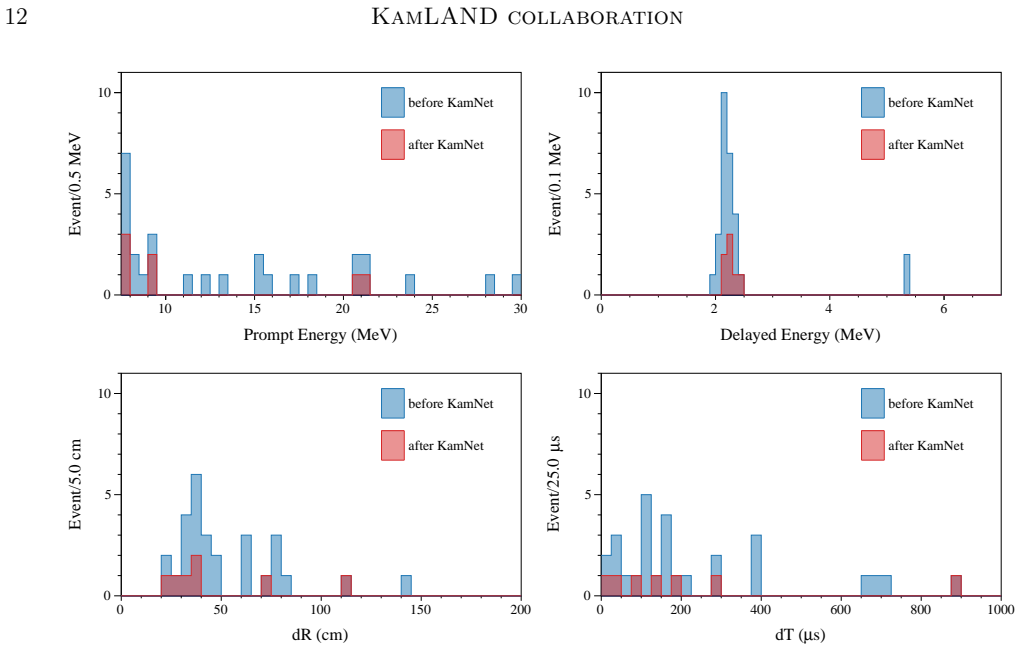
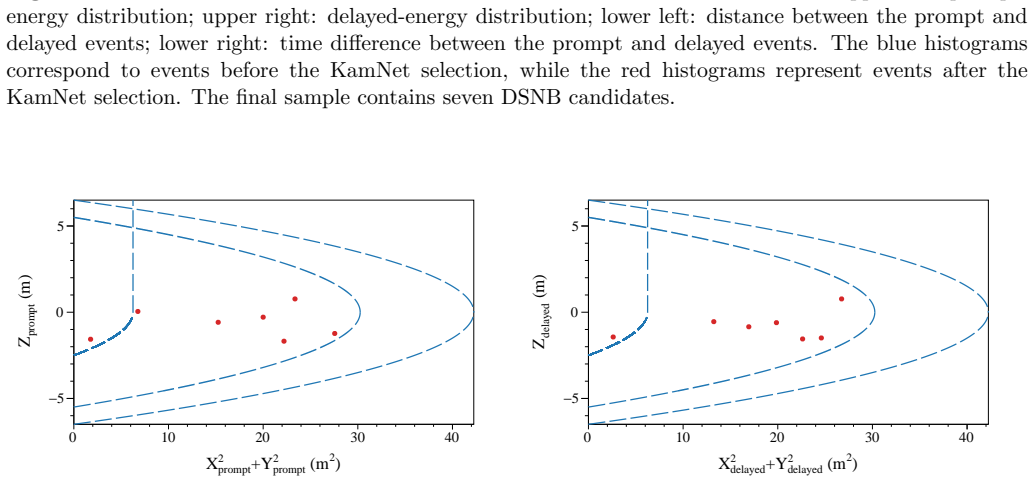
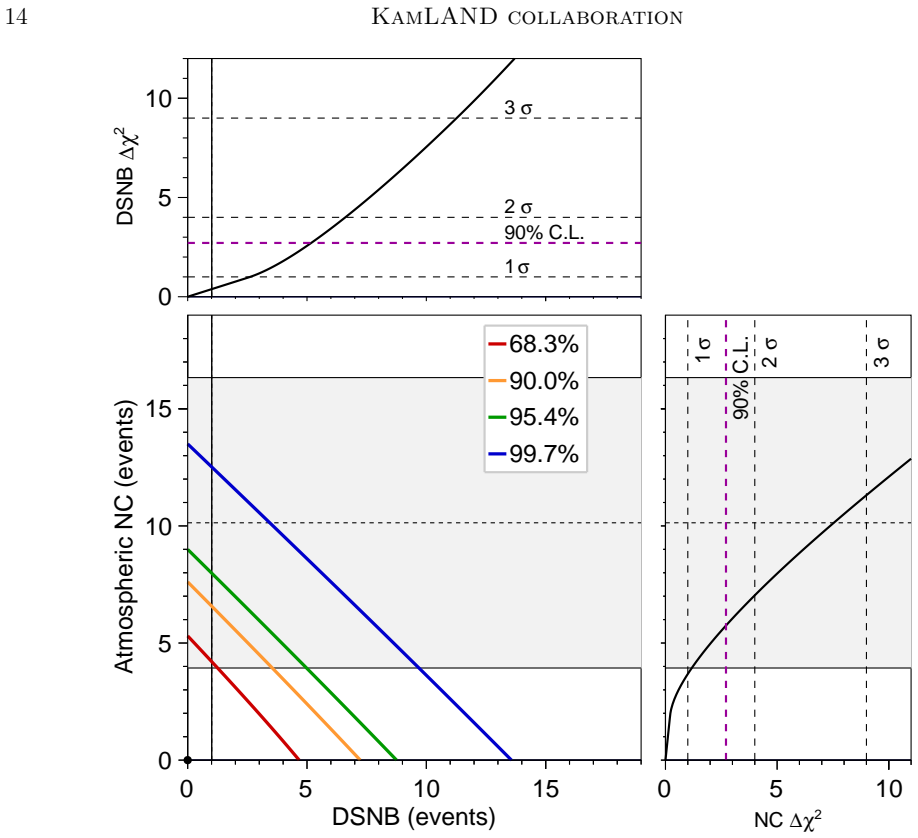
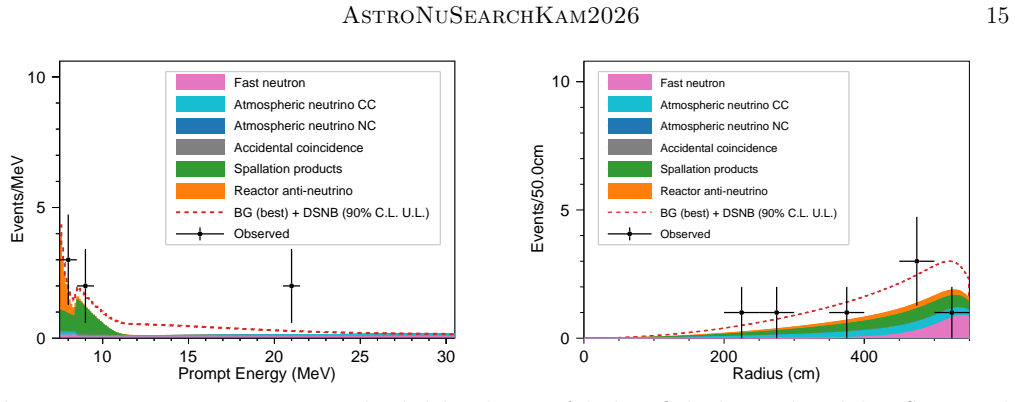
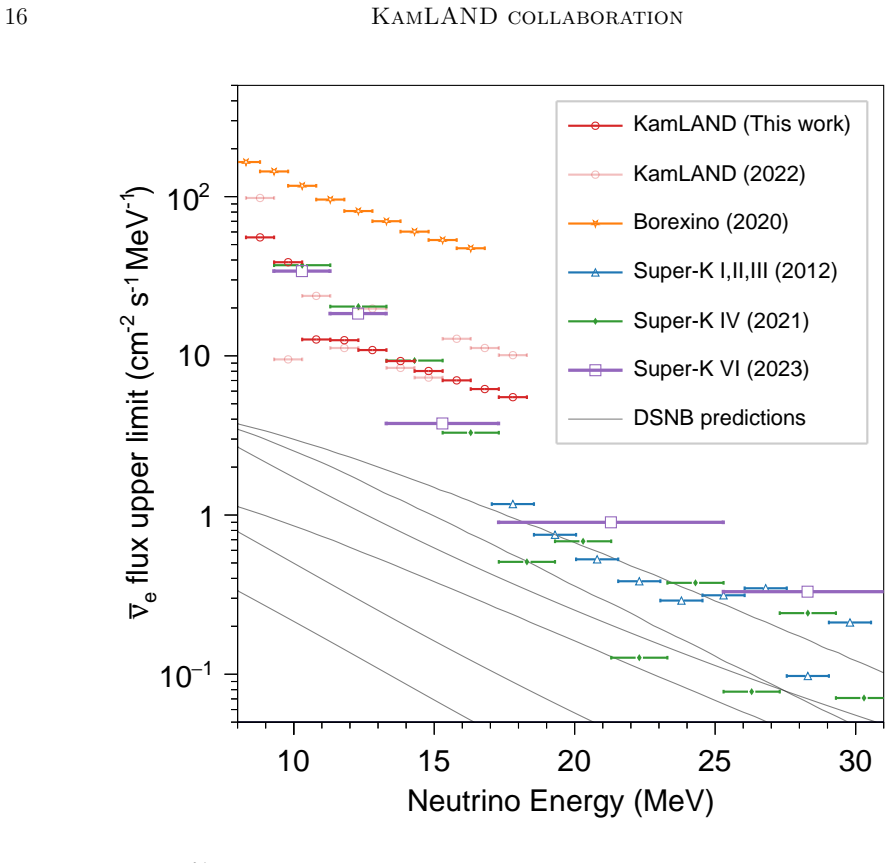
Using neural-network event classification on the full KamLAND dataset, seven inverse-beta-decay candidates are observed in the 8.3-30.8 MeV range against a background expectation of 16.2 ± 9.4 events; a fit to the energy and radial distributions finds no significant DSNB excess, yielding 90% confidence-level flux upper limits of 38-43 per square centimeter per second depending on the model, plus model-independent antineutrino flux limits that are among the strongest below 13.3 MeV.
What carries the argument
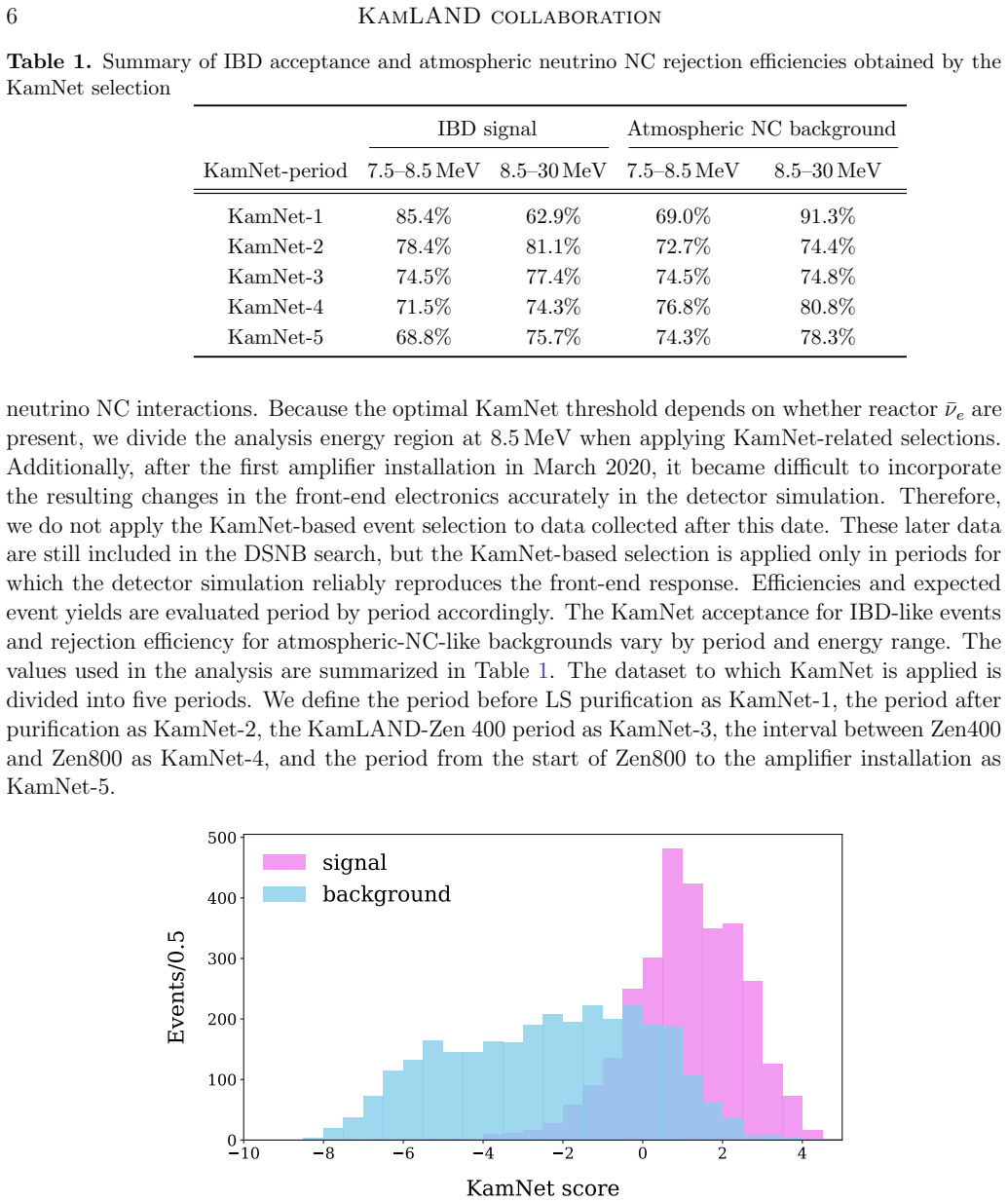
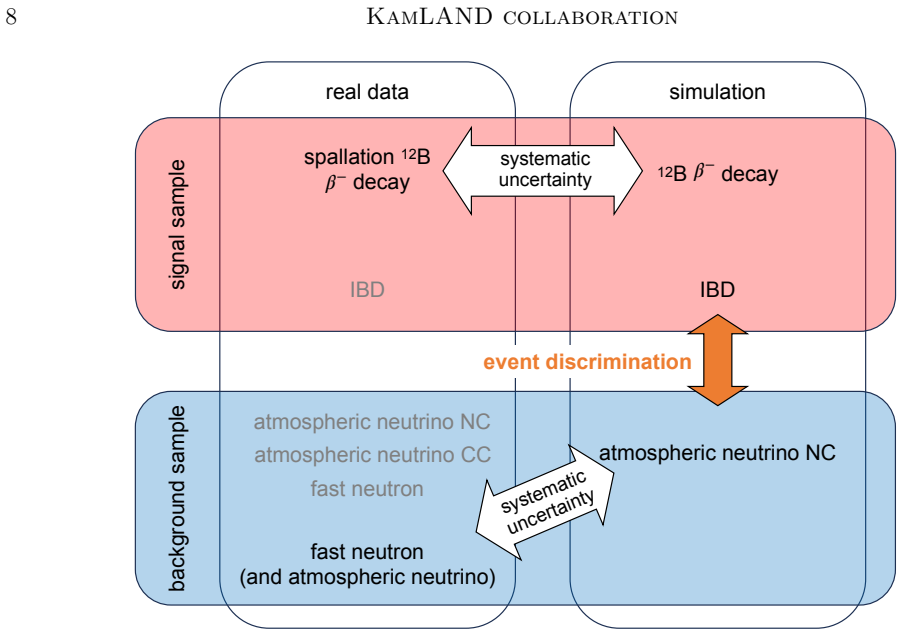
Deep neural network for inverse-beta-decay event classification that suppresses neutron-associated backgrounds while preserving signal efficiency.
If this is right
- The DSNB flux lies below the reported 90% CL limits for each tested model.
- Model-independent electron-antineutrino flux limits are among the most stringent below 13.3 MeV.
- Neural-network classification can suppress neutron backgrounds in other liquid-scintillator detectors.
- The method enables tighter DSNB searches with future higher-exposure data.
Where Pith is reading between the lines
- Combining these limits with data from water-Cherenkov detectors could further constrain the DSNB spectrum shape.
- The neural-network approach may extend to other rare-event searches where neutron backgrounds dominate.
- Updated supernova rate models or neutrino oscillation parameters could be tested against these bounds in future analyses.
Load-bearing premise
The neural network identifies inverse beta decay candidates without bias or unaccounted efficiency loss, and the background prediction of 16.2 plus or minus 9.4 events captures all relevant systematic uncertainties.
What would settle it
A statistically significant excess of events whose energy and radial distributions match a DSNB spectrum above the quoted background would contradict the no-signal result.
Figures
read the original abstract
We report a search for the diffuse supernova neutrino background (DSNB) with the KamLAND detector, targeting electron antineutrinos via inverse beta decay in the neutrino energy range of 8.3 to 30.8 MeV. Using liquid-scintillator exposures of 9.02 kton-year for 8.3 to 9.3 MeV and 9.42 kton-year for 9.3 to 30.8 MeV, we observe seven candidate events after applying a new deep-neural-network-based event classification technique. This result is consistent with the background-only expectation of 16.2 plus or minus 9.4 events, including systematic uncertainties associated with the neural-network selection. A spectral analysis of the energy and radial distributions finds no significant excess attributable to the DSNB. We therefore set 90 percent confidence-level upper limits on the DSNB flux of 38 to 43 per square centimeter per second, depending on the assumed DSNB model. We also derive model-independent 90 percent confidence-level upper limits on the electron-antineutrino flux, obtaining some of the most stringent constraints below 13.3 MeV. Beyond the DSNB search itself, this work demonstrates neural-network-based event classification as a promising approach for suppressing neutron-associated backgrounds in liquid-scintillator neutrino detectors.
Editorial analysis
A structured set of objections, weighed in public.
Referee Report
Summary. The manuscript reports a search for the diffuse supernova neutrino background (DSNB) via inverse beta decay in KamLAND, using 9.02–9.42 kton-year exposures and a new deep neural network for event classification. Seven candidate events are observed in the 8.3–30.8 MeV range, consistent with a background expectation of 16.2 ± 9.4 events that incorporates NN-related systematics. A spectral fit to energy and radial distributions finds no significant excess, yielding 90% CL upper limits of 38–43 cm⁻² s⁻¹ on the DSNB flux (model-dependent) and model-independent limits below 13.3 MeV. The work also positions NN classification as a tool for neutron-background suppression in liquid-scintillator detectors.
Significance. If the NN performance and systematic treatment are robust, the result supplies competitive DSNB constraints and illustrates a practical advance in background rejection for future experiments. The large quoted background uncertainty (~58%) already tempers the strength of the “no excess” statement, so the limits are driven more by the observed count and the spectral shape than by precise background subtraction.
major comments (1)
- [Abstract and neural-network selection description] The central claim that the background expectation of 16.2 ± 9.4 events fully captures all NN-related systematics (Abstract) is load-bearing for both the consistency statement and the derived limits. Without reported validation (e.g., signal and background efficiency versus energy or radius, or data-MC comparisons of the NN score distribution), it remains possible that an unaccounted energy- or radius-dependent mismatch between the NN response to IBD signal and the backgrounds used in training propagates into the spectral fit, weakening the “no excess” conclusion and the quoted 38–43 cm⁻² s⁻¹ bounds.
Simulated Author's Rebuttal
We thank the referee for their thorough review and for highlighting the importance of validating the neural-network (NN) systematic treatment. We address the single major comment below. Where the concern identifies a presentational gap, we have revised the manuscript to include the requested validation material; the underlying analysis and quoted limits are unchanged.
read point-by-point responses
-
Referee: The central claim that the background expectation of 16.2 ± 9.4 events fully captures all NN-related systematics (Abstract) is load-bearing for both the consistency statement and the derived limits. Without reported validation (e.g., signal and background efficiency versus energy or radius, or data-MC comparisons of the NN score distribution), it remains possible that an unaccounted energy- or radius-dependent mismatch between the NN response to IBD signal and the backgrounds used in training propagates into the spectral fit, weakening the “no excess” conclusion and the quoted 38–43 cm⁻² s⁻¹ bounds.
Authors: We agree that explicit validation strengthens the claim that the quoted uncertainty fully encompasses NN-related effects. The ±9.4 uncertainty was obtained by propagating variations in NN training samples, cut thresholds, and input-feature modeling through the full analysis chain (see Section 4.3 and Appendix B). Nevertheless, to directly address the referee’s request we have added two new figures in the revised manuscript: (i) signal and background selection efficiencies versus reconstructed energy and radial position, and (ii) data–MC comparisons of the NN output score in sideband regions. These additions confirm that residual energy- or radius-dependent discrepancies lie within the already-assigned systematic envelope. Because the spectral fit is performed on the observed event count and shape, and the background uncertainty is already large (~58 %), the 90 % CL limits of 38–43 cm⁻² s⁻¹ remain unchanged. We have also updated the abstract to reference the new validation material. revision: yes
Circularity Check
No significant circularity in derivation chain
full rationale
The paper performs an experimental search by counting candidate events after NN classification and comparing the observed number (7) and spectral distributions directly to an independently modeled background expectation (16.2 ± 9.4) that already folds in NN-related systematics. Upper limits are obtained from a standard frequentist spectral fit finding no excess; no equations, fitted parameters, or self-citations reduce the reported limits to the input data by construction. The analysis rests on external data comparison rather than any self-referential definition or ansatz.
Axiom & Free-Parameter Ledger
free parameters (1)
- neural-network decision threshold
axioms (1)
- domain assumption Inverse beta decay is the dominant and well-understood detection channel for electron antineutrinos in the 8.3-30.8 MeV range inside liquid scintillator.
Reference graph
Works this paper leans on
-
[1]
Abe, K., Bronner, C., Hayato, Y., et al. 2021, Phys. Rev. D, 104, 122002, doi: 10.1103/PhysRevD.104.122002
-
[2]
Abe, K., Abe, S., Asaoka, Y., et al. 2025a, Search for Diffuse Supernova Neutrino Background with 956.2 days of Super-Kamiokande Gadolinium Dataset. https://arxiv.org/abs/2511.02222
work page internal anchor Pith review Pith/arXiv arXiv
-
[3]
Abe, S., Enomoto, S., Furuno, K., et al. 2010, Phys. Rev. C, 81, 025807, doi: 10.1103/PhysRevC.81.025807
-
[4]
2022, The Astrophysical Journal, 934, 85, doi: 10.3847/1538-4357/ac7a3f
Abe, S., Asami, S., Eizuka, M., et al. 2022, The Astrophysical Journal, 934, 85, doi: 10.3847/1538-4357/ac7a3f
-
[5]
Abe, S., Araki, T., Chiba, K., et al. 2025b, Phys. Rev. Lett., 135, 262501, doi: 10.1103/jkf6-48j8
-
[6]
Y., Aglietta, M., Antonioli, P., et al
Agafonova, N. Y., Aglietta, M., Antonioli, P., et al. 2015, The Astrophysical Journal, 802, 47, doi: 10.1088/0004-637X/802/1/47
-
[7]
2003, Nuclear Instruments and Methods in Physics Research Section A: Accelerators,
Agostinelli, S., Allison, J., Amako, K., et al. 2003, Nuclear Instruments and Methods in Physics Research Section A: Accelerators,
2003
-
[8]
Spectrometers, Detectors and Associated Equipment, 506, 250, doi: 10.1016/S0168-9002(03)01368-8
-
[9]
2021, Astroparticle Physics, 125, 102509, doi: 10.1016/j.astropartphys.2020.102509
Agostini, M., Altenm¨ uller, K., Appel, S., et al. 2021, Astroparticle Physics, 125, 102509, doi: 10.1016/j.astropartphys.2020.102509
-
[10]
Aguilar-Arevalo, A. A., Anderson, C. E., Bazarko, A. O., et al. 2010, Phys. Rev. D, 81, 032001, doi: 10.1103/PhysRevD.81.032001
-
[11]
Aharmim, B., Ahmed, S. N., Beier, E. W., et al. 2004, Phys. Rev. D, 70, 093014, doi: 10.1103/PhysRevD.70.093014 18KamLAND collaboration
-
[12]
Aharmim, B., Ahmed, S. N., Anthony, A. E., et al. 2011, The Astrophysical Journal, 728, 83, doi: 10.1088/0004-637X/728/2/83
-
[13]
Ahrens, L. A., Aronson, S. H., Connolly, P. L., et al. 1987, Phys. Rev. D, 35, 785, doi: 10.1103/PhysRevD.35.785
-
[14]
1988, Physics Letters B, 205, 209, doi: 10.1016/0370-2693(88)91651-6
Volchenko, V. 1988, Physics Letters B, 205, 209, doi: 10.1016/0370-2693(88)91651-6
-
[15]
1997, Astroparticle Physics, 7, 357, doi: 10.1016/S0927-6505(97)00035-2
Kudryavtsev, V., & Sartorelli, G. 1997, Astroparticle Physics, 7, 357, doi: 10.1016/S0927-6505(97)00035-2
-
[16]
2023, The Astrophysical Journal, 953, 151, doi: 10.3847/1538-4357/ace3ba
Ashida, Y., Nakazato, K., & Tsujimoto, T. 2023, The Astrophysical Journal, 953, 151, doi: 10.3847/1538-4357/ace3ba
-
[17]
2020, European Physical Journal C, 80, 416, doi: 10.1140/epjc/s10052-020-7977-8
Askins, M., Bagdasarian, Z., Barros, N., et al. 2020, European Physical Journal C, 80, 416, doi: 10.1140/epjc/s10052-020-7977-8
-
[18]
Athar, M. S., Ahmad, S., & Singh, S. K. 2007, Phys. Rev. D, 75, 093003, doi: 10.1103/PhysRevD.75.093003
-
[19]
Bays, K., Iida, T., Abe, K., et al. 2012, Phys. Rev. D, 85, 052007, doi: 10.1103/PhysRevD.85.052007
-
[20]
Bionta, R. M., Blewitt, G., Bratton, C. B., et al. 1987, Phys. Rev. Lett., 58, 1494, doi: 10.1103/PhysRevLett.58.1494
-
[21]
B., Casper, D., Ciocio, A., et al
Bratton, C. B., Casper, D., Ciocio, A., et al. 1988, Phys. Rev. D, 37, 3361, doi: 10.1103/PhysRevD.37.3361
-
[22]
Cohen, T. S., Geiger, M., Koehler, J., & Welling, M. 2018, Spherical CNNs. https://arxiv.org/abs/1801.10130
work page internal anchor Pith review Pith/arXiv arXiv 2018
-
[23]
Feldman, G. J., & Cousins, R. D. 1998, Phys. Rev. D, 57, 3873, doi: 10.1103/PhysRevD.57.3873
-
[24]
2012, The Astrophysical Journal, 745, 193, doi: 10.1088/0004-637X/745/2/193
Gando, A., Gando, Y., Ichimura, K., et al. 2012, The Astrophysical Journal, 745, 193, doi: 10.1088/0004-637X/745/2/193
-
[25]
Gando, A., Gando, Y., Hanakago, H., et al. 2013, Phys. Rev. D, 88, 033001, doi: 10.1103/PhysRevD.88.033001
-
[26]
Gando, A., Gando, Y., Hachiya, T., et al. 2016, Phys. Rev. Lett., 117, 082503, doi: 10.1103/PhysRevLett.117.082503 Geographical Survey Institute of Japan. 1997, Digital Map 50 m Grid (Elevation), unpublished
-
[27]
2023, The Astrophysical Journal Letters, 951, L27, doi: 10.3847/2041-8213/acdc9e
Harada, M., Abe, K., Bronner, C., et al. 2023, The Astrophysical Journal Letters, 951, L27, doi: 10.3847/2041-8213/acdc9e
-
[28]
Hirata, K., Kajita, T., Koshiba, M., et al. 1987, Phys. Rev. Lett., 58, 1490, doi: 10.1103/PhysRevLett.58.1490
-
[29]
S., Kajita, T., Koshiba, M., et al
Hirata, K. S., Kajita, T., Koshiba, M., et al. 1988, Phys. Rev. D, 38, 448, doi: 10.1103/PhysRevD.38.448
-
[30]
Honda, M., Kajita, T., Kasahara, K., Midorikawa, S., & Sanuki, T. 2007, Phys. Rev. D, 75, 043006, doi: 10.1103/PhysRevD.75.043006
-
[31]
Horiuchi, S., Beacom, J. F., & Dwek, E. 2009, Phys. Rev. D, 79, 083013, doi: 10.1103/PhysRevD.79.083013
-
[32]
Huber, P. 2011, Phys. Rev. C, 84, 024617, doi: 10.1103/PhysRevC.84.024617
-
[33]
2007, The Astrophysical Journal, 669, 519, doi: 10.1086/521547 JUNO collaboration
Ikeda, M., Takeda, A., Fukuda, Y., et al. 2007, The Astrophysical Journal, 669, 519, doi: 10.1086/521547 JUNO collaboration. 2022, Progress in Particle and Nuclear Physics, 123, 103927, doi: 10.1016/j.ppnp.2021.103927
-
[34]
Kamyshkov, Y., & Kolbe, E. 2003, Phys. Rev. D, 67, 076007, doi: 10.1103/PhysRevD.67.076007
-
[35]
Kaplinghat, M., Steigman, G., & Walker, T. P. 2000, Phys. Rev. D, 62, 043001, doi: 10.1103/PhysRevD.62.043001
-
[36]
Li, A., Fu, Z., Grant, C., et al. 2023, Phys. Rev. C, 107, 014323, doi: 10.1103/PhysRevC.107.014323
-
[37]
S., Becker-Szendy, R., Bratton, C
Miller, R. S., Becker-Szendy, R., Bratton, C. B., et al. 1994, The Astrophysical Journal, 428, 629, doi: 10.1086/174272
-
[38]
2022, The Astrophysical Journal, 938, 35, doi: 10.3847/1538-4357/ac8f41
Mori, M., Abe, K., Hayato, Y., et al. 2022, The Astrophysical Journal, 938, 35, doi: 10.3847/1538-4357/ac8f41
-
[39]
A., Lhuillier, D., Fallot, M., et al
Mueller, T. A., Lhuillier, D., Fallot, M., et al. 2011, Phys. Rev. C, 83, 054615, doi: 10.1103/PhysRevC.83.054615
-
[40]
2015, The Astrophysical Journal, 804, 75, doi: 10.1088/0004-637X/804/1/75
Nakazato, K., Mochida, E., Niino, Y., & Suzuki, H. 2015, The Astrophysical Journal, 804, 75, doi: 10.1088/0004-637X/804/1/75
-
[41]
2013, The Astrophysical Journal Supplement Series, 205, 2, doi: 10.1088/0067-0049/205/1/2
Nakazato, K., Sumiyoshi, K., Suzuki, H., et al. 2013, The Astrophysical Journal Supplement Series, 205, 2, doi: 10.1088/0067-0049/205/1/2
-
[42]
2020, Astroparticle Physics, 117, 102404, doi: 10.1016/j.astropartphys.2019.102404
Novoseltsev, Y., Boliev, M., Dzaparova, I., et al. 2020, Astroparticle Physics, 117, 102404, doi: 10.1016/j.astropartphys.2019.102404
-
[43]
2017, PoS, ICHEP2016, 1161, doi: 10.22323/1.282.1161 AstroNuSearchKam202619
Ozaki, H., & Shirai, J. 2017, PoS, ICHEP2016, 1161, doi: 10.22323/1.282.1161 AstroNuSearchKam202619
-
[44]
2015, in Advances in Neural Information Processing Systems, ed
Shi, X., Chen, Z., Wang, H., et al. 2015, in Advances in Neural Information Processing Systems, ed. C. Cortes, N. Lawrence, D. Lee, M. Sugiyama, & R. Garnett, Vol. 28 (Curran
2015
-
[45]
1995, Astroparticle Physics, 3, 367, doi: 10.1016/0927-6505(95)00015-9
Totani, T., & Sato, K. 1995, Astroparticle Physics, 3, 367, doi: 10.1016/0927-6505(95)00015-9
discussion (0)
Sign in with ORCID, Apple, or X to comment. Anyone can read and Pith papers without signing in.