Accelerated gas flow along Ophiuchus B44 filament: Breaking Position-Position-Velocity degeneracy
Pith reviewed 2026-06-30 01:56 UTC · model grok-4.3
The pith
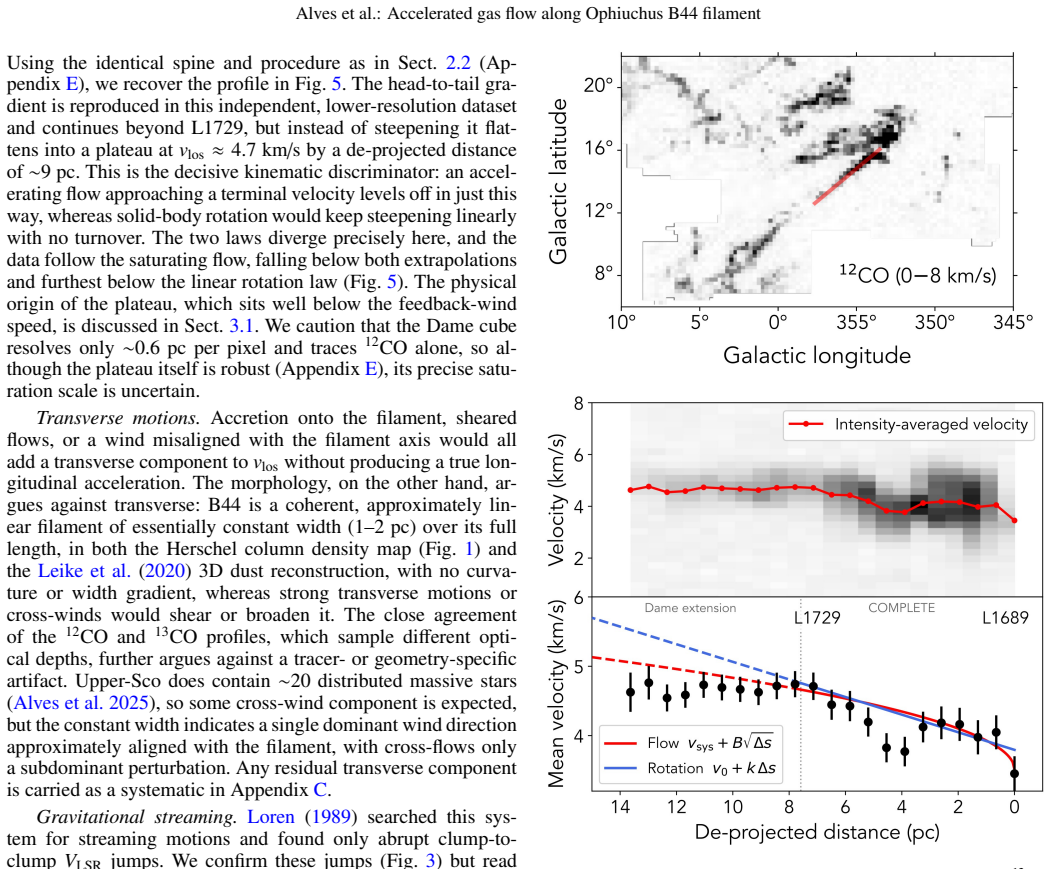
Gas in B44 flows longitudinally away from Upper-Sco stars and accelerates at 1.8 km/s/Myr after deprojection with Gaia 3D maps.
A machine-rendered reading of the paper's core claim, the machinery that carries it, and where it could break.
Core claim
Gas flows longitudinally along the B44 filament away from the massive stars in Upper-Sco; both CO tracers give consistent velocity fields; the motion is accelerated at a ~1.8 km/s/Myr; B44 is therefore an R-type filament assembled by Sco-Cen feedback on a ~3 Myr timescale; a shock with deprojected Mach number ~2 sits at the filament head; and Gaia 3D dust maps suffice to lift the line-of-sight ambiguity in coherent filaments.
What carries the argument
The deprojection of observed radial velocities into longitudinal flows along the filament axis, obtained by anchoring the filament's three-dimensional orientation to Gaia-based dust maps.
If this is right
- B44 is a present-day gas counterpart of the same feedback process that built the Sco-Cen stellar chains over the past 15 Myr.
- The filament assembly timescale of ~3 Myr lies well inside the age of the Upper-Sco massive stars.
- A density jump consistent with a Mach ~2 shock is present at the wind-facing head of B44.
- Gaia 3D dust maps can be used to deproject velocity fields in other coherent filaments and thereby test feedback scenarios.
Where Pith is reading between the lines
- The same deprojection technique could be applied to additional R-type candidates in Ophiuchus or other nearby clouds to map the full pattern of feedback-driven flows.
- If the measured acceleration is sustained, it would imply that the gas will continue to be swept outward on timescales comparable to the remaining lifetime of the Upper-Sco stars.
- The method offers a route to convert existing CO surveys into three-dimensional flow maps wherever Gaia-quality dust geometry is available.
Load-bearing premise
The three-dimensional geometry of B44 recovered from Gaia dust maps accurately represents the filament's true spatial orientation.
What would settle it
A new 3D dust map or independent geometric constraint that places B44 at a significantly different angle to the line of sight, such that the deprojected velocities become inconsistent with longitudinal flow or lose the reported acceleration.
Figures
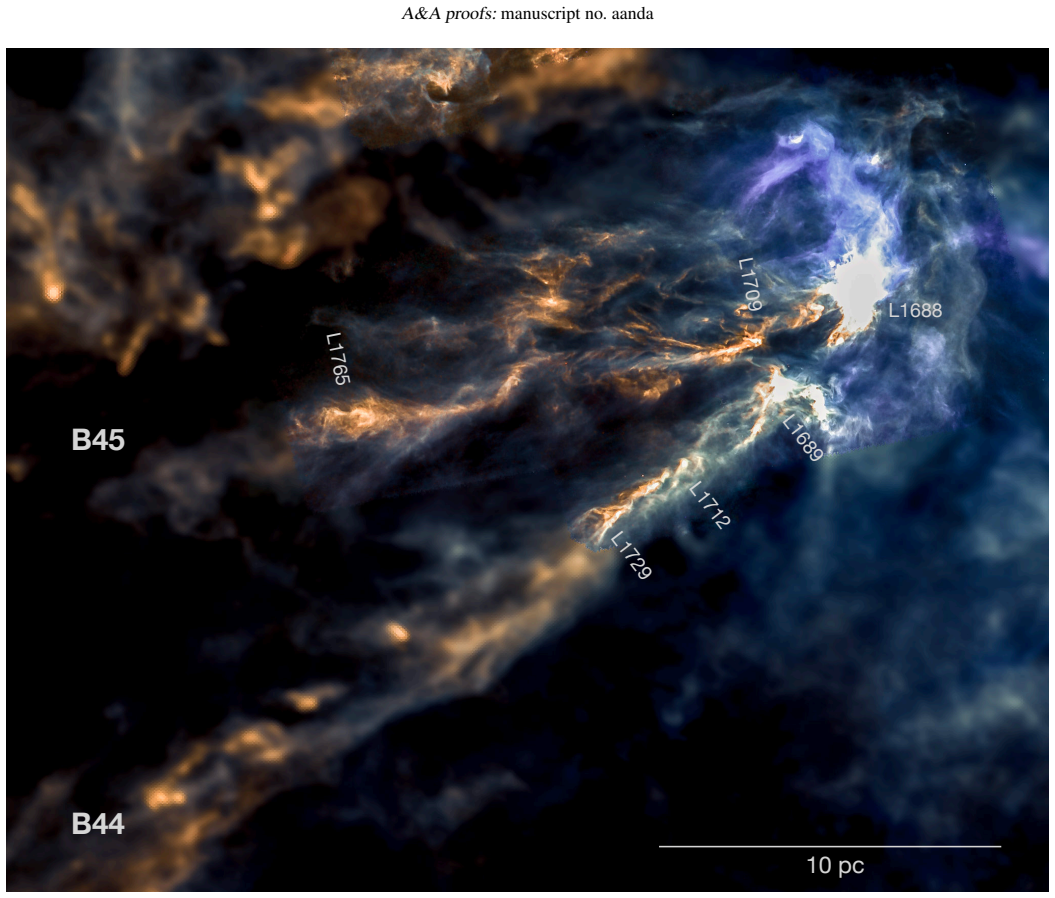
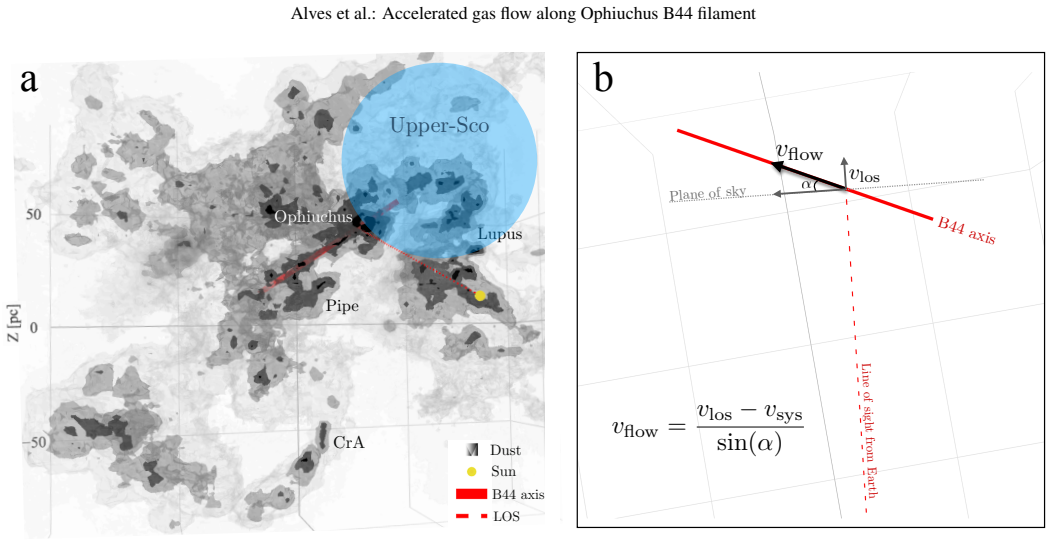
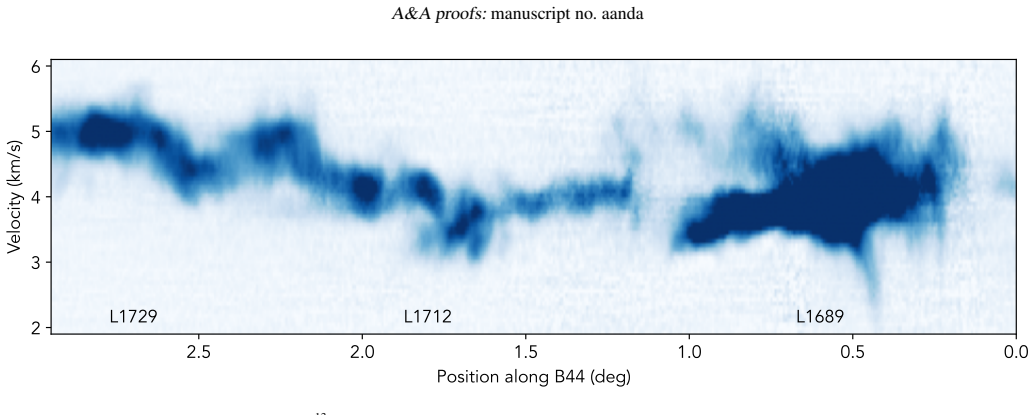
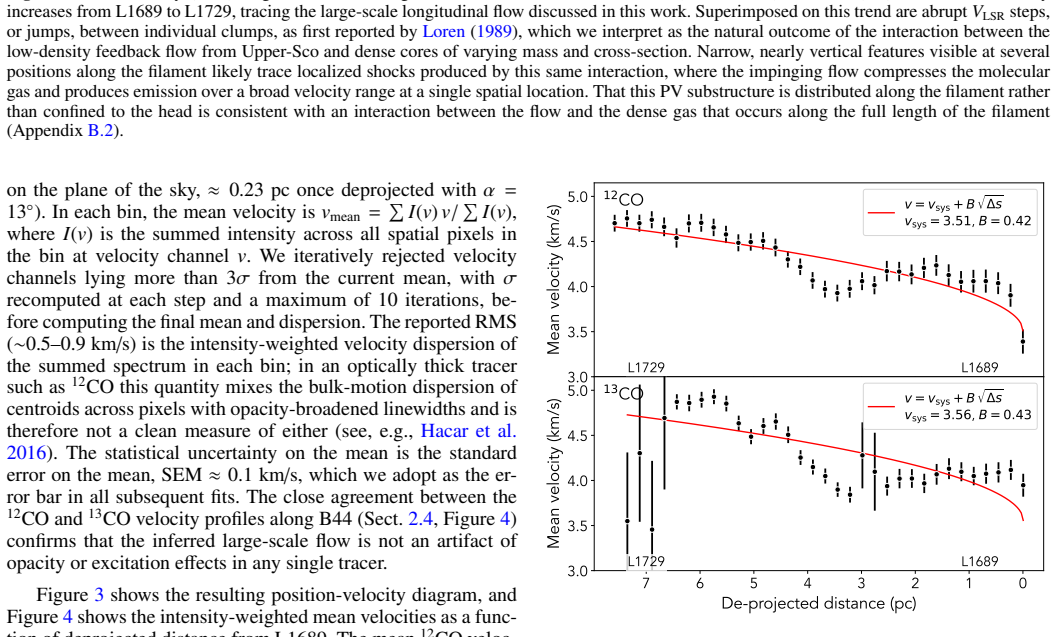
read the original abstract
(Abridged) Stellar feedback from massive stars in the Upper-Sco has been proposed to have reshaped the gas in the nearby Ophiuchus complex. In this framework, feedback organizes the gas into two filament types based on their orientation relative to the source of feedback: radial (R-type) filaments, aligned radially to the massive stars, and tangential (T-type) filaments, which are orthogonal to the feedback direction. A key prediction of this scenario is that gas within R-type filaments should flow longitudinally away from the massive stars. In this paper, we test this scenario by measuring the three-dimensional gas flow inside the potential R-type filament B44, combining the 3D orientation of the filament from Gaia-based 3D dust maps with radial velocities from CO observations. We find that gas flows longitudinally along the B44 filament away from the massive stars in Upper-Sco with both tracers yielding consistent velocity fields. This result confirms B44 is a R-type filament formed by stellar feedback from Sco-Cen with an implied filament assembly timescale of $\sim$3~Myr, well within the age of the Upper-Sco massive stars. Moreover, we find that the gas motion along B44 and away from the massive stars is accelerated with $a\sim$1.8~km/s/Myr ($\sim 6 \times 10^{-11}$~m/s$^2$). This acceleration is compatible with the accelerations recorded along the Sco-Cen cluster chains over the past $\sim$15~Myr, indicating that B44 is likely a present-day, gas-phase counterpart of the same feedback-driven process that produced those stellar sequences. We further find evidence for a shock at the wind-facing head of the filament, with a deprojected flow Mach number of $\sim$2 and a matching density jump. Our findings demonstrate that Gaia 3D dust maps can lift the line-of-sight ambiguity intrinsic to PPV spectral data, enabling direct deprojection of the gas velocity field in coherent filaments.
Editorial analysis
A structured set of objections, weighed in public.
Referee Report
Summary. The paper claims that combining the 3D spatial orientation of the B44 filament recovered from Gaia dust maps with radial velocities from CO observations demonstrates that gas flows longitudinally along the filament away from the Upper-Sco massive stars. Both tracers yield consistent velocity fields, the flow is accelerated at a~1.8 km/s/Myr, B44 is confirmed as an R-type filament assembled on a ~3 Myr timescale by stellar feedback, and a shock is identified at the wind-facing head with Mach number ~2.
Significance. If the deprojected flow direction and acceleration are robust, the result supplies direct kinematic evidence linking present-day gas flows in an R-type filament to the same feedback process that assembled Sco-Cen stellar chains over the past 15 Myr. The demonstration that Gaia 3D dust geometry can lift PPV degeneracy for coherent filaments is a methodological advance with clear applicability to other regions.
major comments (2)
- [Abstract and §3] Abstract and §3 (deprojection procedure): the central claim that the flow is directed away from Upper-Sco and accelerated at 1.8 km/s/Myr rests on the filament axis recovered from Gaia dust maps. The deprojection v_long = v_rad / cos(φ) is singular near φ=90° and sign-sensitive to rotations of only a few degrees, yet no quantitative error budget on position angle or inclination, nor any sensitivity test showing that the reported sign and acceleration remain stable within the Gaia map uncertainties, is provided.
- [Abstract] Abstract: the statement that 'both tracers yielding consistent velocity fields' is load-bearing for the claim that the geometry is reliable, but the manuscript does not report the quantitative metric of consistency (e.g., reduced χ², residual maps, or cross-correlation coefficient) between the Gaia-derived orientation and the CO velocity field after deprojection.
minor comments (2)
- [Abstract] The acceleration value is given both in km/s/Myr and in m/s²; a brief note on the conversion factor and the exact fitting procedure (linear vs. higher-order) used to obtain a~1.8 km/s/Myr would improve reproducibility.
- [Abstract] The Mach number ~2 and density jump at the filament head are stated without reference to the specific figure or table showing the shock jump conditions.
Simulated Author's Rebuttal
We thank the referee for the constructive comments highlighting the need for quantitative robustness checks on the deprojection and consistency metrics. We will revise the manuscript to incorporate error budgets, sensitivity tests, and explicit consistency measures while preserving the core findings.
read point-by-point responses
-
Referee: [Abstract and §3] Abstract and §3 (deprojection procedure): the central claim that the flow is directed away from Upper-Sco and accelerated at 1.8 km/s/Myr rests on the filament axis recovered from Gaia dust maps. The deprojection v_long = v_rad / cos(φ) is singular near φ=90° and sign-sensitive to rotations of only a few degrees, yet no quantitative error budget on position angle or inclination, nor any sensitivity test showing that the reported sign and acceleration remain stable within the Gaia map uncertainties, is provided.
Authors: We agree that an explicit error budget and sensitivity analysis are required for robustness. In the revised manuscript we will derive uncertainties on position angle and inclination directly from the Gaia 3D dust map posteriors, propagate them through the deprojection formula, and present sensitivity tests (varying φ within the map uncertainties) confirming that both the sign of the flow (away from Upper-Sco) and the acceleration value remain stable. We will also state the angular distance of the filament axis from φ=90° to address the singularity concern. revision: yes
-
Referee: [Abstract] Abstract: the statement that 'both tracers yielding consistent velocity fields' is load-bearing for the claim that the geometry is reliable, but the manuscript does not report the quantitative metric of consistency (e.g., reduced χ², residual maps, or cross-correlation coefficient) between the Gaia-derived orientation and the CO velocity field after deprojection.
Authors: We concur that a quantitative consistency metric strengthens the validation of the Gaia geometry. The revised version will include a reported metric (e.g., Pearson cross-correlation coefficient between the two deprojected velocity fields) together with a brief description of residuals, thereby quantifying the agreement between the Gaia-derived orientation and the CO data. revision: yes
Circularity Check
No circularity: independent Gaia 3D geometry and CO velocities yield deprojected flow
full rationale
The paper's central derivation combines the filament's 3D orientation recovered from Gaia-based dust maps with independent radial velocity measurements from CO observations to deproject longitudinal flows and measure acceleration. These inputs are distinct datasets; the geometry is not derived from or fitted to the velocities, and the reported acceleration (~1.8 km/s/Myr) is computed from the combined data rather than being a parameter fitted to the same observations by construction. No equations reduce the result to a tautology, no self-citation chain is load-bearing for the measurement itself, and the PPV degeneracy breaking is an application of external geometry rather than a self-referential step. The derivation remains self-contained against external benchmarks.
Axiom & Free-Parameter Ledger
axioms (2)
- domain assumption Gaia-based 3D dust maps recover the true three-dimensional orientation of the B44 filament without significant reconstruction errors
- domain assumption The filament is spatially coherent so that radial velocities can be deprojected as motion along a single axis
Reference graph
Works this paper leans on
-
[1]
Alves, J., Lombardi, M., & Lada, C. J. 2007, Astron. Astrophys., 462, L17
2007
-
[2]
Alves, J., Lombardi, M., & Lada, C. J. 2025, Astronomy & Astrophysics, 697, A208
2025
-
[3]
Beaumont, C. N., S. R. Offner, S., Shetty, R., Glover, S. C. O., & Goodman, A. A. 2013, The Astrophysical Journal, 777, 173
2013
-
[4]
& Fermi , E
Chandrasekhar , S. & Fermi , E. 1953, , 118, 113
1953
-
[5]
M., Hartmann, D., & Thaddeus, P
Dame, T. M., Hartmann, D., & Thaddeus, P. 2001, Astrophys. J., 547, 792
2001
-
[6]
1951, Physical Review, 81, 890
Davis , L. 1951, Physical Review, 81, 890
1951
-
[7]
Dent, W. R. F., Hovey, G. J., Dewdney, P. E., et al. 2009, Mon. Not. R. Astron. Soc., 395, 1805
2009
-
[8]
2024, Astronomy & Astrophysics, 685, A82
Edenhofer, G., Zucker, C., Frank, P., et al. 2024, Astronomy & Astrophysics, 685, A82
2024
-
[9]
A., Frommert, M., & Kitaura, F
Enßlin, T. A., Frommert, M., & Kitaura, F. S. 2009, Physical Review D, 80, 105005
2009
-
[10]
K., Pineda, J
Friesen, R. K., Pineda, J. E., co-PIs , et al. 2017, ApJ, 843, 63
2017
-
[11]
S., Adams, F
Gehman, C. S., Adams, F. C., & Watkins, R. 1996, The Astrophysical Journal, 472, 673
1996
-
[12]
Goldsmith, K. J. A. & Pittard, J. M. 2016, Mon. Not. R. Astron. Soc., 461, 578
2016
-
[13]
Goldsmith, K. J. A. & Pittard, J. M. 2018, Monthly Notices of the Royal Astronomical Society, 476, 2209
2018
-
[14]
A., Bastien, P., Menard, F., & Myers, P
Goodman, A. A., Bastien, P., Menard, F., & Myers, P. C. 1990, Astrophysical Journal v.448, 359, 363
1990
-
[15]
Goodman, A. A. & Heiles, C. 1994, Astrophys. J., 424, 208
1994
-
[16]
Gronke, M. & Oh, S. P. 2018, Monthly Notices of the Royal Astronomical Society: Letters, 480, L111
2018
-
[17]
Gronke, M. & Oh, S. P. 2020, Monthly Notices of the Royal Astronomical Society, 492, 1970
2020
-
[18]
2016, Astronomy & Astrophysics, 591, A104
Hacar, A., Alves, J., Burkert, A., & Goldsmith, P. 2016, Astronomy & Astrophysics, 591, A104
2016
-
[19]
Hacar, A., Alves, J., Tafalla, M., & Goicoechea, J. R. 2017, Astron. Astrophys. Suppl. Ser., 602, L2
2017
-
[20]
E., Heitsch, F., et al
Hacar, A., Clark, S. E., Heitsch, F., et al. 2023, in Protostars & Planets VII
2023
-
[21]
& Tafalla, M
Hacar, A. & Tafalla, M. 2011, Astronomy & Astrophysics, 533, A34
2011
-
[22]
2013, Astronomy and Astrophysics, 554, A55, aDS Bibcode: 2013A&A...554A..55H
Hacar, A., Tafalla, M., Kauffmann, J., & Kovács, A. 2013, Astronomy and Astrophysics, 554, A55, aDS Bibcode: 2013A&A...554A..55H
2013
-
[23]
2026, Astronomy & Astrophysics, 705, A108
Hutschenreuter, S., Alves, J., Posch, L., et al. 2026, Astronomy & Astrophysics, 705, A108
2026
-
[24]
I., McKee, C
Klein, R. I., McKee, C. F., & Colella, P. 1994, The Astrophysical Journal, 420, 213
1994
-
[25]
A., Zucker, C., et al
Konietzka, R., Goodman, A. A., Zucker, C., et al. 2024, Nature, 628, 62
2024
-
[26]
J., Lombardi, M., & Alves, J
Lada, C. J., Lombardi, M., & Alves, J. F. 2010, Astrophys. J
2010
-
[27]
H., Glatzle, M., & Enßlin, T
Leike, R. H., Glatzle, M., & Enßlin, T. A. 2020, Astronomy & Astrophysics, 639, A138
2020
-
[28]
Loren, R. B. 1989, Astrophysical Journal v.448, 338, 925
1989
-
[29]
Myers, P. C. 2009, The Astrophysical Journal, 700, 1609
2009
-
[30]
2021, The Astrophysical Journal, 907, 88
Pattle, K., Lai, S.-P., Di Francesco, J., et al. 2021, The Astrophysical Journal, 907, 88
2021
-
[31]
A., André, P., et al
Peretto, N., Fuller, G. A., André, P., et al. 2014, Astron. Astrophys. Suppl. Ser., 561, A83
2014
-
[32]
2024, Astronomy and Astrophysics, 689, A84, aDS Bibcode: 2024A&A...689A..84P
Piecka, M., Hutschenreuter, S., & Alves, J. 2024, Astronomy and Astrophysics, 689, A84, aDS Bibcode: 2024A&A...689A..84P
2024
-
[33]
E., Arzoumanian, D., André, P., et al
Pineda, J. E., Arzoumanian, D., André, P., et al. 2023, in Protostars & Planets VII
2023
-
[34]
E., Goodman, A
Pineda, J. E., Goodman, A. A., Arce, H. G., et al. 2010, The Astrophysical Journal Letters, 712, L116
2010
-
[35]
Planck Collaboration , Ade , P. A. R., Aghanim , N., et al. 2015, , 576, A104
2015
-
[36]
2025, Astronomy & Astrophysics, 693, A175
Posch, L., Alves, J., Miret-Roig, N., et al. 2025, Astronomy & Astrophysics, 693, A175
2025
-
[37]
2023, Astronomy & Astrophysics, 679, L10
Posch, L., Miret-Roig, N., Alves, J., et al. 2023, Astronomy & Astrophysics, 679, L10
2023
-
[38]
E., Alves, J., et al
Ratzenböck, S., Großschedl, J. E., Alves, J., et al. 2023 a , Astron. Astrophys., 678, 71
2023
-
[39]
E., Möller, T., et al
Ratzenböck, S., Großschedl, J. E., Möller, T., et al. 2023 b , Astron. Astrophys., 677, A59
2023
-
[40]
A., Di Francesco, J., Kirk, H., et al
Ridge, N. A., Di Francesco, J., Kirk, H., et al. 2006, Astron. J., 131, 2921
2006
-
[41]
Robitaille, T. P. et al. 2013, Astronomy & Astrophysics, 558, A33
2013
-
[42]
& Brüggen, M
Scannapieco, E. & Brüggen, M. 2015, The Astrophysical Journal, 805, 158
2015
-
[43]
D., Molinari, S., Glover, S
Soler, J. D., Molinari, S., Glover, S. C. O., et al. 2025, Astronomy & Astrophysics, 695, A222
2025
- [44]
-
[45]
Taylor, M. B. 2005, Astron. Soc. Pac. Conf. Ser., 347, 29
2005
-
[46]
1990, Publications of the Astronomical Society of Japan, 42, 69
Uchida, Y., Mizuno, A., Nozawa, S., & Fukui, Y. 1990, Publications of the Astronomical Society of Japan, 42, 69
1990
-
[47]
2023, in Astronomical Society of the Pacific Conference Series, Vol
Zucker , C., Alves , J., Goodman , A., Meingast , S., & Galli , P. 2023, in Astronomical Society of the Pacific Conference Series, Vol. 534, Protostars and Planets VII, ed. S. Inutsuka , Y. Aikawa , T. Muto , K. Tomida , & M. Tamura , 43
2023
-
[48]
2021, Astrophys
Zucker, C., Goodman, A., Alves, J., et al. 2021, Astrophys. J., 919, 35
2021
-
[49]
Protostars and Planets VII , year = 2023, editor =
The Solar Neighborhood in the Age of Gaia. Protostars and Planets VII , year = 2023, editor =. doi:10.48550/arXiv.2212.00067 , archivePrefix =. 2212.00067 , primaryClass =
-
[50]
and Fabian, A
Begelman, Mitchell C. and Fabian, A. C. , month = may, year =. Turbulent mixing layers in the interstellar and intracluster medium. , volume =. Monthly Notices of the Royal Astronomical Society , publisher =
-
[51]
Gehman, Curtis S. and Adams, Fred C. and Watkins, Richard , month = dec, year =. Linear. The Astrophysical Journal , publisher =. doi:10.1086/178098 , abstract =
-
[52]
The launching of cold clouds by galaxy outflows
Scannapieco, Evan and Brüggen, Marcus , month = may, year =. The launching of cold clouds by galaxy outflows. The Astrophysical Journal , publisher =. doi:10.1088/0004-637X/805/2/158 , language =
-
[53]
Klein, Richard I. and McKee, Christopher F. and Colella, Philip , month = jan, year =. On the. The Astrophysical Journal , publisher =. doi:10.1086/173554 , urldate =
-
[54]
Robitaille, T. P. and others , title =. Astronomy & Astrophysics , year =
-
[55]
Hacar, A. and Alves, J. and Burkert, A. and Goldsmith, P. , month = jul, year =. Opacity broadening and interpretation of suprathermal. Astronomy & Astrophysics , publisher =. doi:10.1051/0004-6361/201527319 , language =
-
[56]
Monthly Notices of the Royal Astronomical Society , author =
How cold gas continuously entrains mass and momentum from a hot wind , volume =. Monthly Notices of the Royal Astronomical Society , author =. 2020 , pages =. doi:10.1093/mnras/stz3332 , number =
-
[57]
, year = 1965, month = aug, volume =
Field, George B. , year =. Thermal. doi:10.1086/148317 , journal =
-
[58]
Monthly Notices of the Royal Astronomical Society , author =
A characteristic scale for cold gas , volume =. Monthly Notices of the Royal Astronomical Society , author =. 2018 , pages =. doi:10.1093/mnras/stx2687 , number =
-
[59]
Direct. The Astrophysical Journal Letters , author =. 2010 , pages =. doi:10.1088/2041-8205/712/1/L116 , number =
-
[60]
Publications of the Astronomical Society of Japan , author =
Velocity split along the. Publications of the Astronomical Society of Japan , author =. 1990 , pages =
1990
discussion (0)
Sign in with ORCID, Apple, or X to comment. Anyone can read and Pith papers without signing in.