A Reproducible AAVSO Johnson-V Fourier Template for the Prototype Cepheid Delta Cephei
Pith reviewed 2026-06-30 01:56 UTC · model grok-4.3
The pith
A third-order Fourier series provides a reproducible Johnson-V light curve template for Delta Cephei.
A machine-rendered reading of the paper's core claim, the machinery that carries it, and where it could break.
Core claim
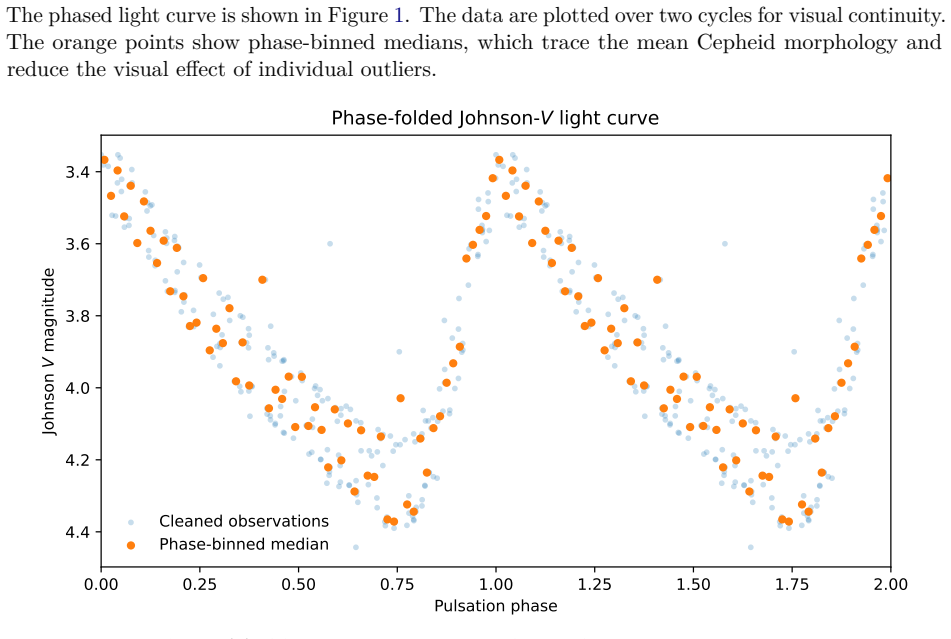
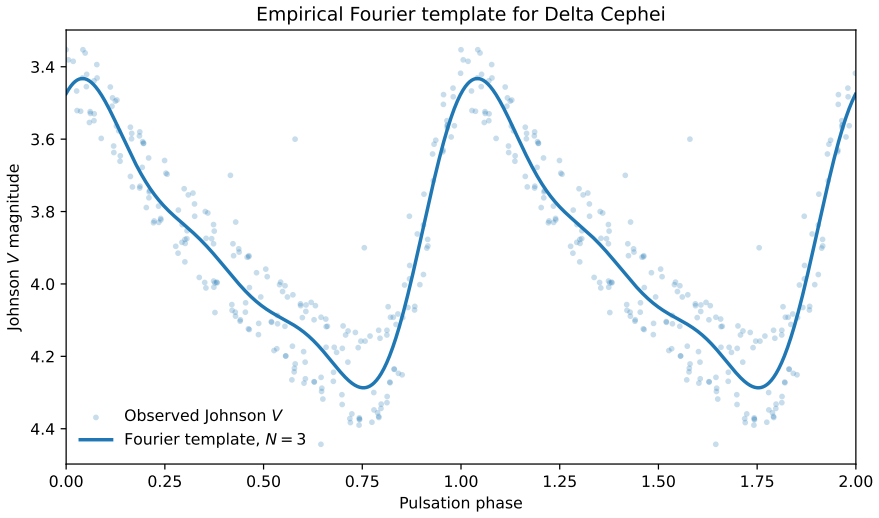
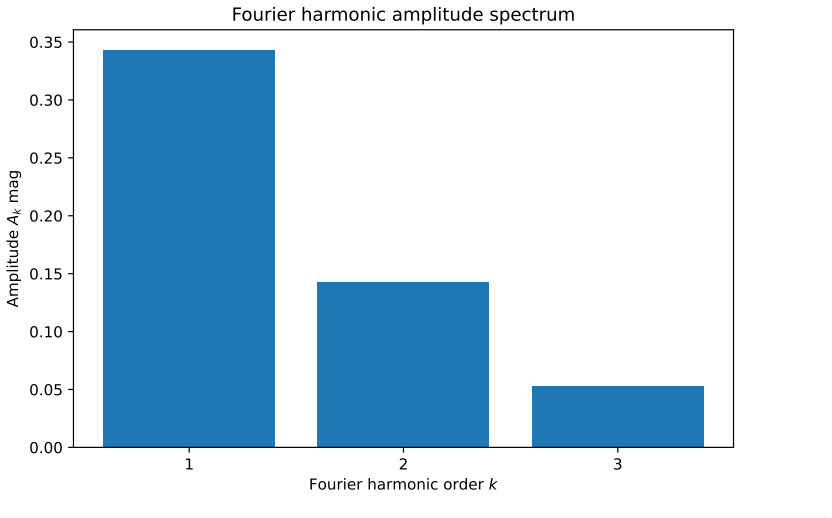
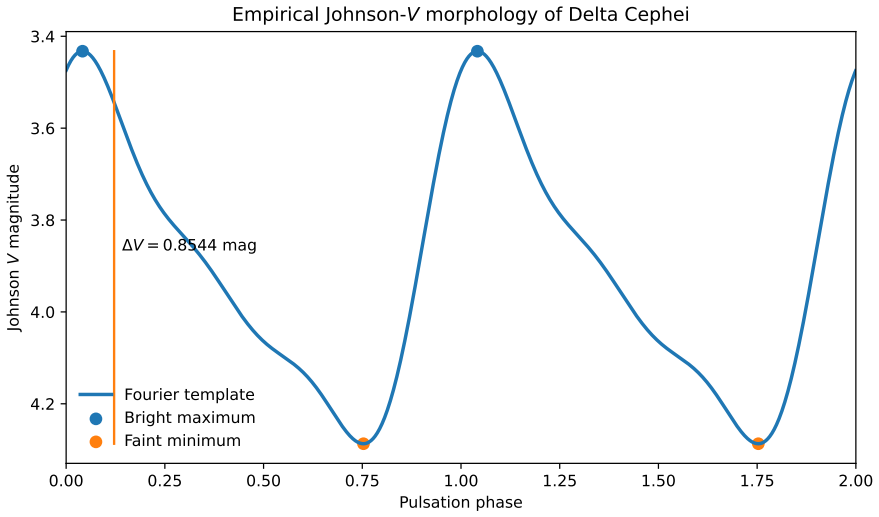
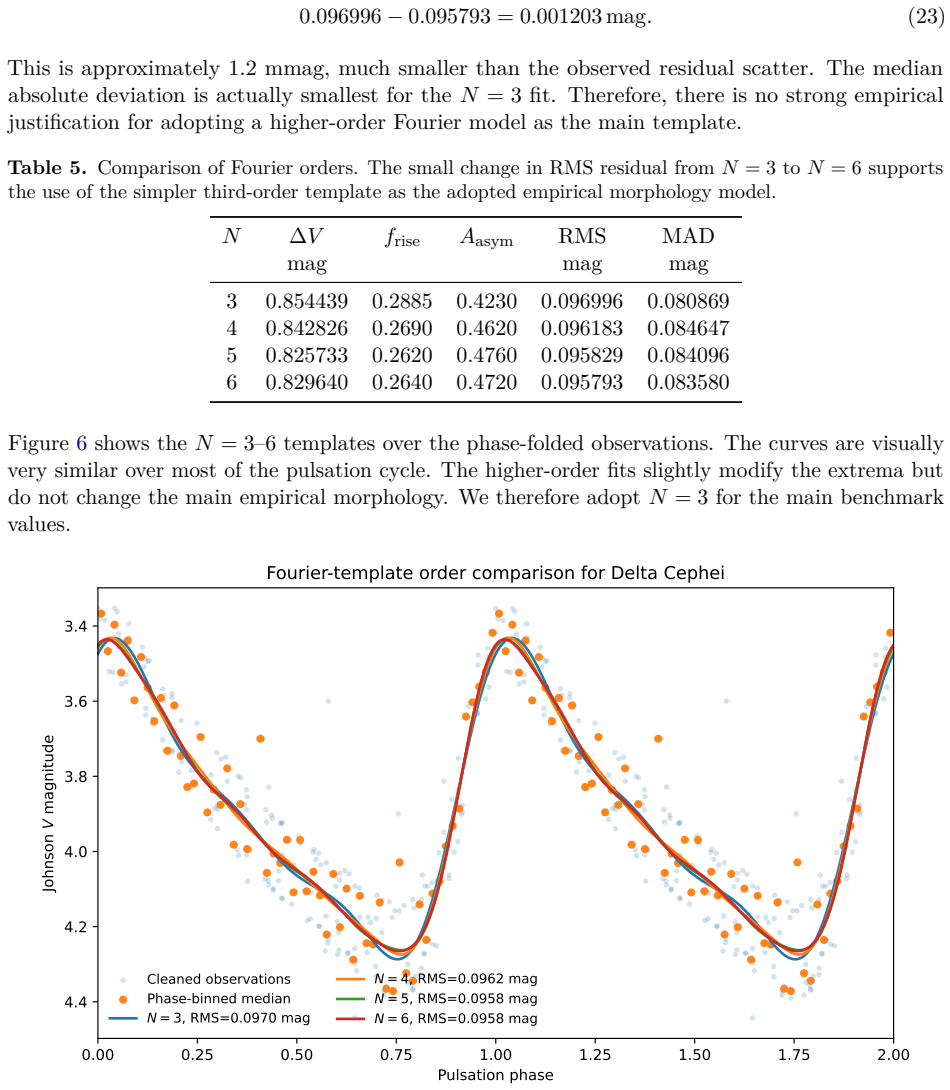
We present an empirical Fourier reconstruction of the observed Johnson-V light curve of Delta Cephei. Using an adopted period of 5.366531 d and 242 cleaned AAVSO points phased to an empirical bright-maximum epoch, a third-order Fourier model is adopted with A0 = 3.9031, A1 = 0.3434 mag, A2 = 0.1428 mag, and A3 = 0.0531 mag. This yields R21 = 0.4159, R31 = 0.1547, a full amplitude of 0.8544 mag, a rise fraction of 0.2885, and an asymmetry index of 0.4230. Higher orders add negligible improvement, so the third-order form is retained as the simplest adequate empirical template.
What carries the argument
The third-order Fourier series fit applied to the phase-folded AAVSO Johnson-V magnitudes of Delta Cephei.
If this is right
- The N=3 template supplies a direct observational target for comparison with nonlinear pulsation calculations and synthetic photometry.
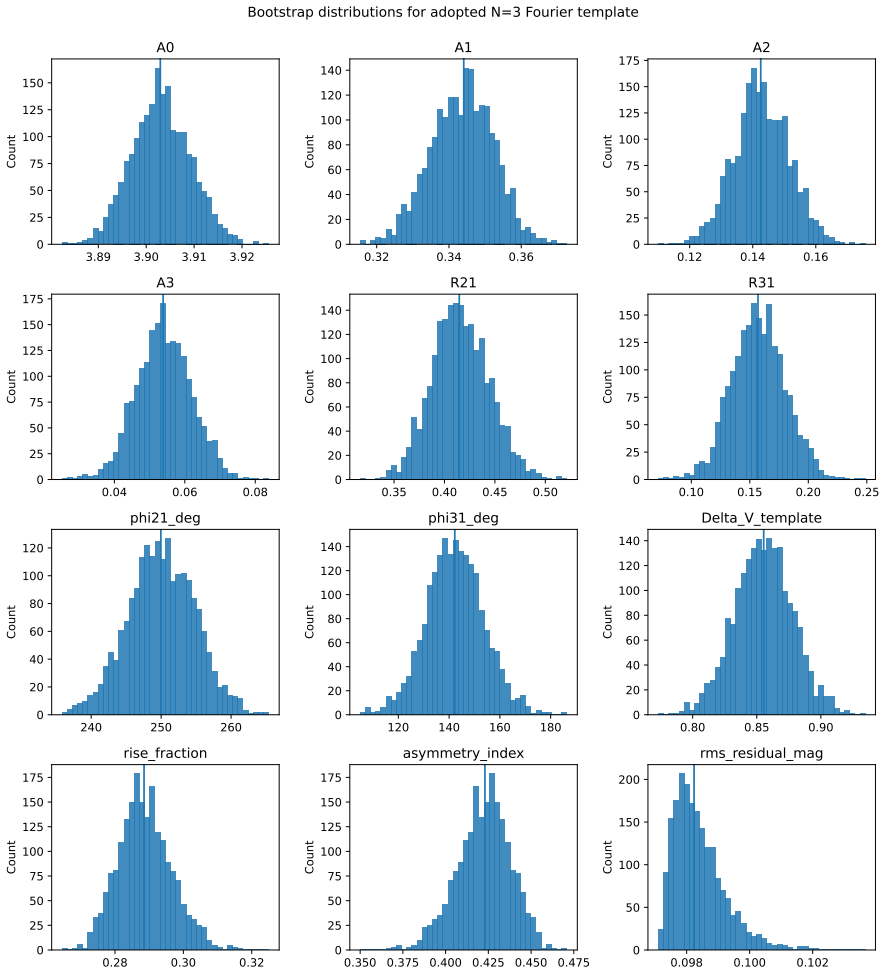
- Bootstrap uncertainties on the Fourier coefficients permit quantitative tests of how well any given model reproduces the observed morphology.
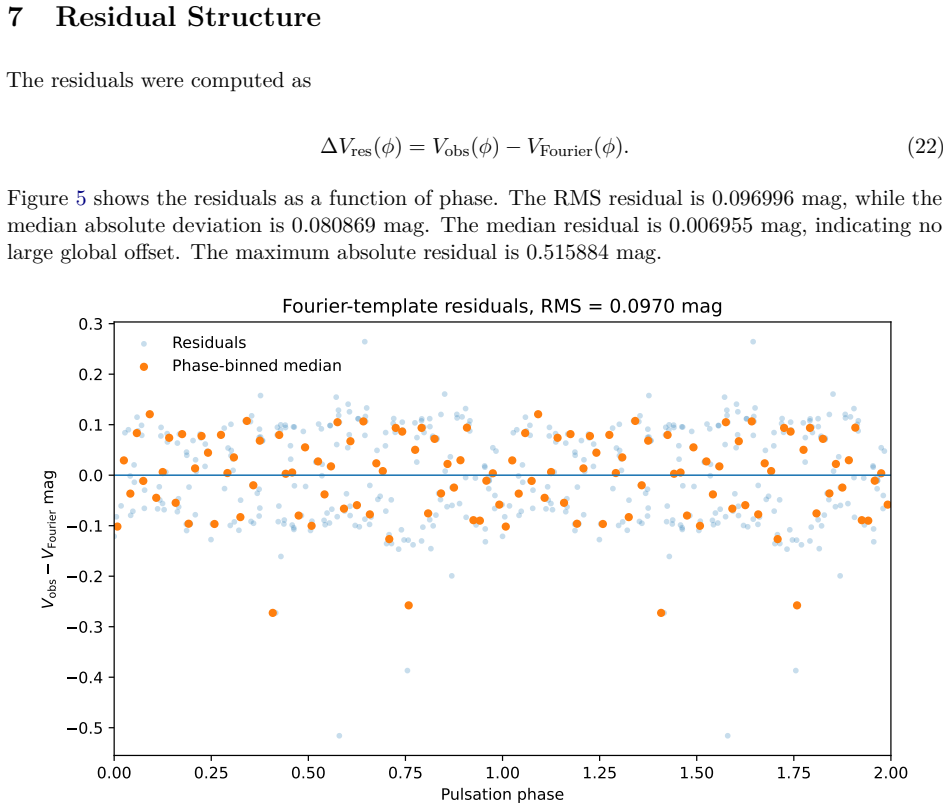
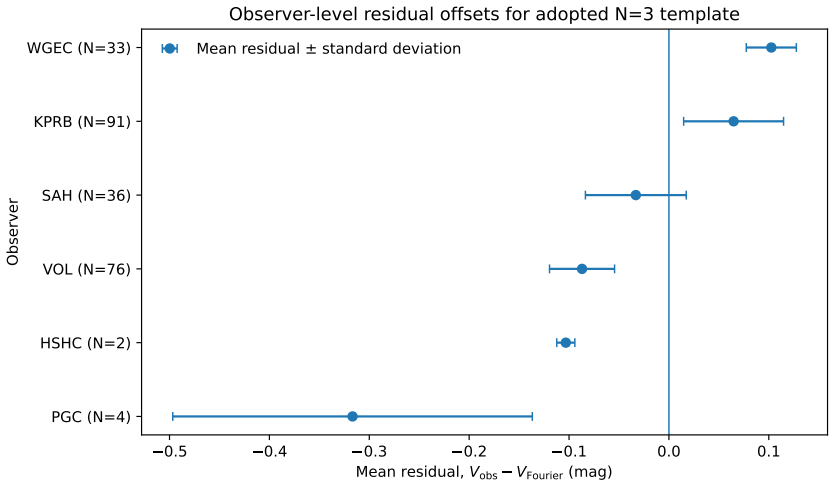
- The remaining non-random scatter in residuals indicates that observer-level effects must be accounted for in future data sets used with this template.
Where Pith is reading between the lines
- The template can serve as a fixed reference shape against which light curves of other Cepheids can be compared to quantify morphological differences across the instability strip.
- If radial-velocity data are later combined with this template, the resulting distance or radius estimates inherit the reported amplitude and asymmetry directly.
Load-bearing premise
The adopted period and bright-maximum epoch are accurate enough that phase folding does not distort the true light-curve shape after outlier removal.
What would settle it
A fresh set of Johnson-V observations of Delta Cephei, phased with the same period and epoch, that produces a significantly different amplitude, rise fraction, or asymmetry from the reported N=3 template.
Figures
read the original abstract
We present an empirical Fourier reconstruction of the observed Johnson-V light curve of the prototype Classical Cepheid Delta Cephei. The goal is not to infer a full physical stellar model but to establish a reproducible observed-light-curve benchmark for later comparison with nonlinear pulsation, synthetic photometry, Baade-Wesselink/SPIPS, GYRE-supported, and independent hydrodynamic calculations. Using an adopted period of Pobs = 5.366531 d, 244 AAVSO Johnson-V measurements were filtered to a cleaned sample of 242 points after rejecting two extreme outliers. The cleaned data span 355.09259 d and were phase folded using an empirical bright-maximum epoch of JD = 2460851.395800. We fit a low-order Fourier model to the phased light curve and adopt a third-order template as the preferred empirical morphology representation. The adopted N = 3 fit gives A0 = 3.9031, A1 = 0.3434 mag, A2 = 0.1428 mag, and A3 = 0.0531 mag, corresponding to R21 = 0.4159 and R31 = 0.1547. The template has a full Johnson-V amplitude of Delta V = 0.8544 mag, a rise fraction of frise = 0.2885, and an asymmetry index of Aasym = 0.4230. Bootstrap uncertainties are reported in the manuscript. Fourier orders N = 4-6 reduce the RMS residual by only about 0.0012 mag relative to the N = 3 model, so the third-order representation is retained as the simplest adequate empirical template. Observer-level residual diagnostics show that the remaining scatter is not purely random. This paper provides an observational morphology target rather than a physical explanation of the pulsation.
Editorial analysis
A structured set of objections, weighed in public.
Referee Report
Summary. The manuscript derives an empirical N=3 Fourier template for the Johnson-V light curve of Delta Cephei from 242 cleaned AAVSO observations spanning 355 d. Using an adopted period Pobs=5.366531 d and bright-maximum epoch JD=2460851.395800, the phased data are fit to yield A0=3.9031, A1=0.3434, A2=0.1428, A3=0.0531 mag (with R21=0.4159, R31=0.1547), Delta V=0.8544 mag, frise=0.2885, and Aasym=0.4230. The N=3 model is retained after comparing RMS residuals to higher orders, with bootstrap uncertainties provided; the template is positioned as a reproducible observational benchmark for theoretical comparisons rather than a physical model.
Significance. If the adopted phasing accurately represents the data without distortion, the work supplies a concrete, quantitative morphology target (with explicit coefficients and derived shape parameters) that can be directly compared against nonlinear pulsation models, synthetic photometry, Baade-Wesselink analyses, and hydrodynamic simulations. The explicit retention of N=3 on the basis of marginal RMS improvement and the reporting of bootstrap uncertainties strengthen its utility as a reproducible reference.
major comments (3)
- [Data preparation and phase-folding procedure] Data preparation section: the period Pobs=5.366531 d and epoch JD=2460851.395800 are adopted without re-derivation (e.g., via Lomb-Scargle or least-squares) from the AAVSO points or a sensitivity test for cumulative phase drift. Over the 355 d baseline (~66 cycles), even a 10^{-5} d error in P produces ~0.06-cycle drift that would systematically alter the folded morphology, the fitted amplitudes, R21, R31, frise, and Aasym.
- [Data preparation and phase-folding procedure] Data preparation section: the rejection of two extreme outliers (reducing 244 to 242 points) is stated without quantitative criteria such as a sigma threshold, magnitude limits, or explicit values of the rejected points. This directly affects whether the retained sample is representative for the central N=3 fit and derived parameters.
- [Fitting procedure and bootstrap uncertainties] Methods section on fitting and uncertainties: while bootstrap uncertainties are mentioned, the procedure (resampling method, number of iterations, handling of phase-folding) is not specified in sufficient detail to allow independent reproduction of the reported coefficient errors.
minor comments (2)
- [Abstract and Methods] The abstract and main text should explicitly state the quantitative outlier rejection threshold and the exact implementation of phase folding to support the reproducibility claim in the title.
- [Results] Notation for the asymmetry index Aasym and rise fraction frise should be defined with an equation or explicit formula in the text rather than only in the results.
Simulated Author's Rebuttal
We thank the referee for the positive evaluation of the manuscript's significance and for the constructive comments aimed at improving reproducibility. We address each major comment point by point below.
read point-by-point responses
-
Referee: Data preparation section: the period Pobs=5.366531 d and epoch JD=2460851.395800 are adopted without re-derivation (e.g., via Lomb-Scargle or least-squares) from the AAVSO points or a sensitivity test for cumulative phase drift. Over the 355 d baseline (~66 cycles), even a 10^{-5} d error in P produces ~0.06-cycle drift that would systematically alter the folded morphology, the fitted amplitudes, R21, R31, frise, and Aasym.
Authors: The period and epoch were adopted as established literature values for Delta Cephei to maintain consistency with prior work. We acknowledge the validity of the phase-drift concern over the 355 d baseline. In the revised manuscript we will add an explicit sensitivity test by perturbing P by amounts up to ±10^{-5} d, re-phasing the data, and re-fitting to quantify any changes in the coefficients and shape parameters. revision: yes
-
Referee: Data preparation section: the rejection of two extreme outliers (reducing 244 to 242 points) is stated without quantitative criteria such as a sigma threshold, magnitude limits, or explicit values of the rejected points. This directly affects whether the retained sample is representative for the central N=3 fit and derived parameters.
Authors: We agree that the outlier rejection must be documented quantitatively for reproducibility. The revised data-preparation section will specify the exact criteria (including any sigma threshold or magnitude limits applied) and will list the observed magnitudes of the two rejected points. revision: yes
-
Referee: Methods section on fitting and uncertainties: while bootstrap uncertainties are mentioned, the procedure (resampling method, number of iterations, handling of phase-folding) is not specified in sufficient detail to allow independent reproduction of the reported coefficient errors.
Authors: We will expand the methods section to provide the missing details: the bootstrap uses sampling with replacement, 1000 iterations are performed, and each resampled dataset is re-phased using the same fixed period and epoch before refitting. revision: yes
Circularity Check
No circularity: empirical Fourier fit to AAVSO data presented explicitly as data reduction, not as a derived prediction.
full rationale
The manuscript states it fits a low-order Fourier series directly to the phase-folded AAVSO Johnson-V points after adopting an external period and epoch, then selects N=3 as the simplest adequate representation. The reported coefficients (A0, A1, A2, A3, R21, R31, etc.) are the explicit least-squares output; the paper makes no claim that these values are predicted from theory, prior models, or external benchmarks. No self-citations, uniqueness theorems, or ansatzes are invoked to justify the result. The procedure is a transparent data-reduction step whose output is definitionally the fit itself, with no reduction of a claimed derivation to its inputs.
Axiom & Free-Parameter Ledger
free parameters (4)
- Fourier order N =
3
- Period Pobs =
5.366531 d
- Epoch JD =
2460851.395800
- Fourier amplitudes A0-A3 =
3.9031, 0.3434, 0.1428, 0.0531
axioms (2)
- domain assumption A low-order Fourier series is sufficient to represent the periodic light variation of a Classical Cepheid.
- domain assumption The AAVSO Johnson-V measurements, after removal of two extreme outliers, faithfully sample the true light curve.
Reference graph
Works this paper leans on
-
[1]
Leavitt and Edward C
Henrietta S. Leavitt and Edward C. Pickering. Periods of 25 variable stars in the small magellanic cloud.Harvard College Observatory Circular, 173:1–3, 1912
1912
-
[2]
Madore and Wendy L
Barry F. Madore and Wendy L. Freedman. The cepheid distance scale.Publications of the Astronomical Society of the Pacific, 103:933–957, 1991
1991
-
[3]
Freedman, Barry F
Wendy L. Freedman, Barry F. Madore, Brad K. Gibson, Laura Ferrarese, Daniel D. Kelson, Shoko Sakai, Jeremy R. Mould, Robert C. Kennicutt, Holland C. Ford, John A. Graham, John P. Huchra, Shaun M. G. Hughes, Garth D. Illingworth, Lucas M. Macri, and Peter B. Stetson. Final results from the hubble space telescope key project to measure the hubble constant.T...
2001
-
[4]
Fritz Benedict, Barbara E
G. Fritz Benedict, Barbara E. McArthur, Michael W. Feast, Thomas G. Barnes, Thomas E. Harrison, Richard J. Patterson, John W. Menzies, Jacob L. Bean, and Wendy L. Freedman. Hubble space telescope fine guidance sensor parallaxes of galactic cepheid variable stars: Period–luminosity relations.The Astronomical Journal, 133:1810–1827, 2007
2007
-
[5]
Riess, Lucas M
Adam G. Riess, Lucas M. Macri, Samantha L. Hoffmann, Dan Scolnic, Stefano Casertano, Alexei V. Filippenko, Brad E. Tucker, Mark J. Reid, David O. Jones, Jeffrey M. Silverman, Ryan Chornock, Peter Challis, Wenlong Yuan, Peter J. Brown, and Ryan J. Foley. A 2.4 percent determination of the local value of the hubble constant.The Astrophysical Journal, 826:56, 2016
2016
-
[6]
Riess, Wenlong Yuan, Lucas M
Adam G. Riess, Wenlong Yuan, Lucas M. Macri, Dan Scolnic, Dillon Brout, Stefano Casertano, David O. Jones, Yukei Murakami, Gagandeep S. Anand, Louise Breuval, Thomas G. Brink, Alexei V. Filippenko, Samantha Hoffmann, Saurabh W. Jha, W. D’Arcy Kenworthy, John Mackenty, Benjamin E. Stahl, and Weikang Zheng. A comprehensive measurement of the local value of ...
2022
-
[7]
Fritz Benedict, Barbara E
G. Fritz Benedict, Barbara E. McArthur, Laurence W. Fredrick, Thomas E. Harrison, Cather- ine L. Slesnick, Joseph Rhee, Richard J. Patterson, Michael F. Skrutskie, Otto G. Franz, Lawrence H. Wasserman, William H. Jefferys, Edmund Nelan, William van Altena, Peter J. Shelus, Paul D. Hemenway, Raynor L. Duncombe, D. Story, A. L. Whipple, and Arthur J. Bradle...
2002
-
[8]
Ridgway, Guy Perrin, Michel Rieutord, Pierre Bordé, Theo ten Brummelaar, and Harold A
Antoine Mérand, Pierre Kervella, Vincent Coudé du Foresto, Stephen T. Ridgway, Guy Perrin, Michel Rieutord, Pierre Bordé, Theo ten Brummelaar, and Harold A. McAlister. The projection factor of delta cephei: A calibration of the baade–wesselink method using the chara array. Astronomy and Astrophysics, 438:L9–L12, 2005
2005
-
[9]
Delta cephei
American Association of Variable Star Observers. Delta cephei. AAVSO Variable Star of the Season, 2026. URLhttps://www.aavso.org/vsots_delcep. Accessed 2026 June 16
2026
-
[10]
Simon and A
Norman R. Simon and A. S. Lee. The structural properties of cepheid light curves.The Astrophysical Journal, 248:291–297, 1981
1981
-
[11]
Simon and Thomas J
Norman R. Simon and Thomas J. Moffett. Classical cepheid light curves revisited.Publications of the Astronomical Society of the Pacific, 97:1078–1085, 1985
1985
-
[12]
Antonello
E. Antonello. Structural properties of the light curves of s-cepheids.Astronomy and Astrophysics, 169:149–154, 1986
1986
-
[13]
G. K. Andreasen. Precise fourier decomposition parameters for classical cepheids.Astronomy and Astrophysics, 196:159–168, 1988
1988
-
[14]
Kanbur and Chow-Choong Ngeow
Shashi M. Kanbur and Chow-Choong Ngeow. On the use of principal component analysis in analysing cepheid light curves.Monthly Notices of the Royal Astronomical Society, 329:126–132, 2002
2002
-
[15]
Kanbur, Sergei Nikolaev, Nial R
Chow-Choong Ngeow, Shashi M. Kanbur, Sergei Nikolaev, Nial R. Tanvir, and Martin A. Hendry. Reconstructing a cepheid light curve with fourier techniques. i. the fourier expansion and interrelations.The Astrophysical Journal, 586:959–982, 2003
2003
-
[16]
Chow-Choong Ngeow and Shashi M. Kanbur. Reconstructing cepheid light curve with fourier techniques. ii. catalogue of the fourier parameters for ogle lmc fundamental mode cepheids, 2004
2004
-
[17]
Tanvir, Martin A
Nial R. Tanvir, Martin A. Hendry, Alan Watkins, Shashi M. Kanbur, Leonid N. Berdnikov, and Chow-Choong Ngeow. Determination of cepheid parameters by light-curve template fitting. Monthly Notices of the Royal Astronomical Society, 363:749–759, 2005
2005
-
[18]
Sukanta Deb and Harinder P. Singh. Light curve analysis of variable stars using fourier decomposition and principal component analysis.Astronomy and Astrophysics, 507:1729–1737, 2009
2009
-
[19]
Kanbur, Harinder P
Anupam Bhardwaj, Shashi M. Kanbur, Harinder P. Singh, Lucas M. Macri, and Chow-Choong Ngeow. On the variation of fourier parameters for galactic and large magellanic cloud cepheids at optical, near-infrared and mid-infrared wavelengths.Monthly Notices of the Royal Astronomical Society, 447:3342–3360, 2015. 18
2015
-
[20]
Kanbur, Marcella Marconi, Marina Rejkuba, Harinder P
Anupam Bhardwaj, Shashi M. Kanbur, Marcella Marconi, Marina Rejkuba, Harinder P. Singh, and Chow-Choong Ngeow. A comparative study of multiwavelength theoretical and observed light curves of cepheid variables.Monthly Notices of the Royal Astronomical Society, 466: 2805–2826, 2017
2017
-
[21]
Szymański, Marcin Kubiak, Grzegorz Pietrzyński, Łukasz Wyrzykowski, Olaf Szewczyk, and Krzysztof Ulaczyk
Igor Soszyński, Radosław Poleski, Andrzej Udalski, Michał K. Szymański, Marcin Kubiak, Grzegorz Pietrzyński, Łukasz Wyrzykowski, Olaf Szewczyk, and Krzysztof Ulaczyk. The optical gravitational lensing experiment. the ogle-iii catalog of variable stars. i. classical cepheids in the large magellanic cloud.Acta Astronomica, 58:163–185, 2008
2008
-
[22]
Aavso international database, 2026
American Association of Variable Star Observers. Aavso international database, 2026. URL https://www.aavso.org/aavso-international-database. AAVSO International Database observations of Delta Cephei, accessed 2026 June 16
2026
-
[23]
Aavso data usage guidelines, 2025
American Association of Variable Star Observers. Aavso data usage guidelines, 2025. URL https://www.aavso.org/data-usage-guidelines. Accessed 2026 June 16
2025
-
[24]
David G. Turner. Visual observations of delta cephei: Time to update the finder chart.Journal of the American Association of Variable Star Observers, 2011. URLhttps://apps.aavso. org/jaavso/article/2711/. 19
2011
discussion (0)
Sign in with ORCID, Apple, or X to comment. Anyone can read and Pith papers without signing in.