Magnetic Reconnection in Galaxy Clusters
Pith reviewed 2026-06-30 05:50 UTC · model grok-4.3
The pith
Magnetic reconnection re-accelerates cosmic rays at cold-front discontinuities in galaxy clusters.
A machine-rendered reading of the paper's core claim, the machinery that carries it, and where it could break.
Core claim
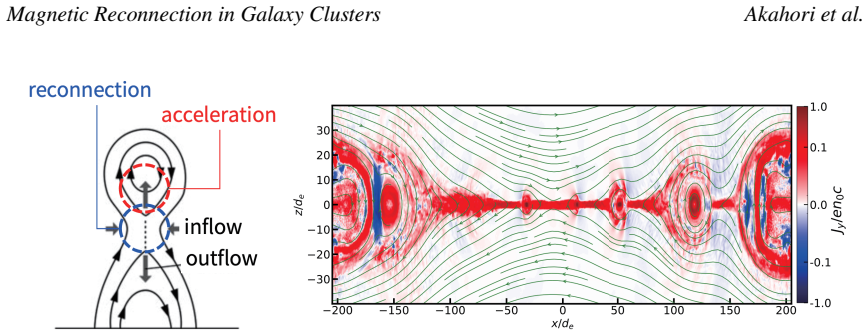
The paper claims that magnetic reconnection, triggered when compression and stretching at the cold-front discontinuity generate current sheets, is the mechanism re-accelerating particles to produce the detected radio emission.
What carries the argument
Magnetic reconnection at current sheets formed by plasma compression and stretching along cold fronts.
If this is right
- Re-acceleration is localized to the discontinuity itself rather than distributed through the surrounding turbulence.
- Polarization data will map the magnetic-field geometry required to sustain the current sheets.
- Broadband spectra at higher resolution can pinpoint whether reconnection operates only where the front is sharpest.
- The same process can operate during any transonic motion of magnetized plasma inside clusters.
Where Pith is reading between the lines
- The mechanism may extend to other contact discontinuities in astrophysical flows where magnetic fields are stretched.
- If confirmed, models of cosmic-ray transport in clusters would need to include reconnection sites at cold fronts as localized accelerators.
- Simulations that track current-sheet formation at moving fronts could be compared directly with the observed radio brightness profiles.
Load-bearing premise
The radio spectra truly require re-acceleration to occur specifically at the cold-front surface rather than by some other process or location.
What would settle it
High-resolution radio maps that show the emission peaking away from the discontinuity or spectra lacking the expected re-acceleration signature would falsify the claim.
Figures
read the original abstract
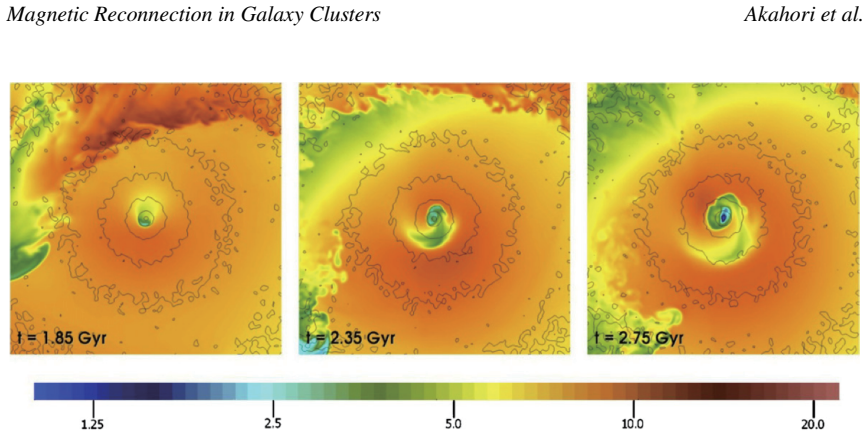
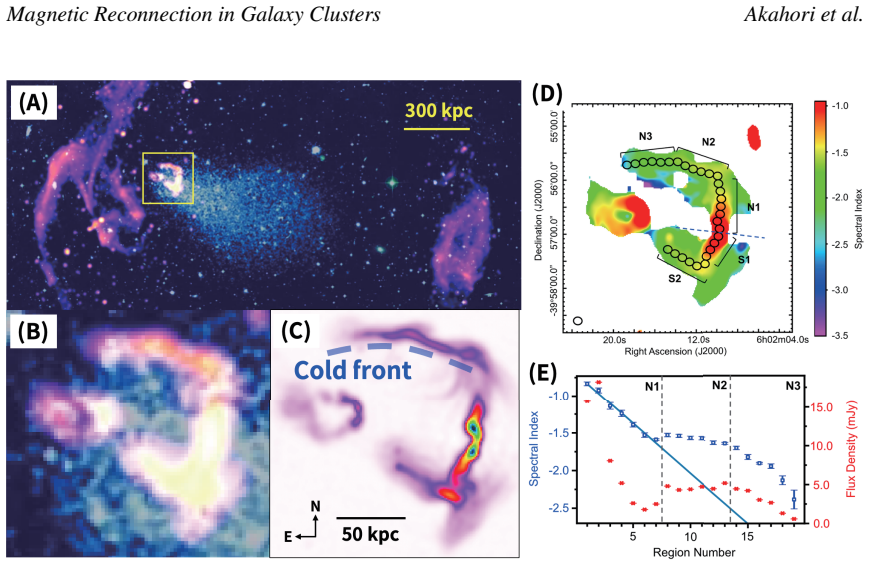
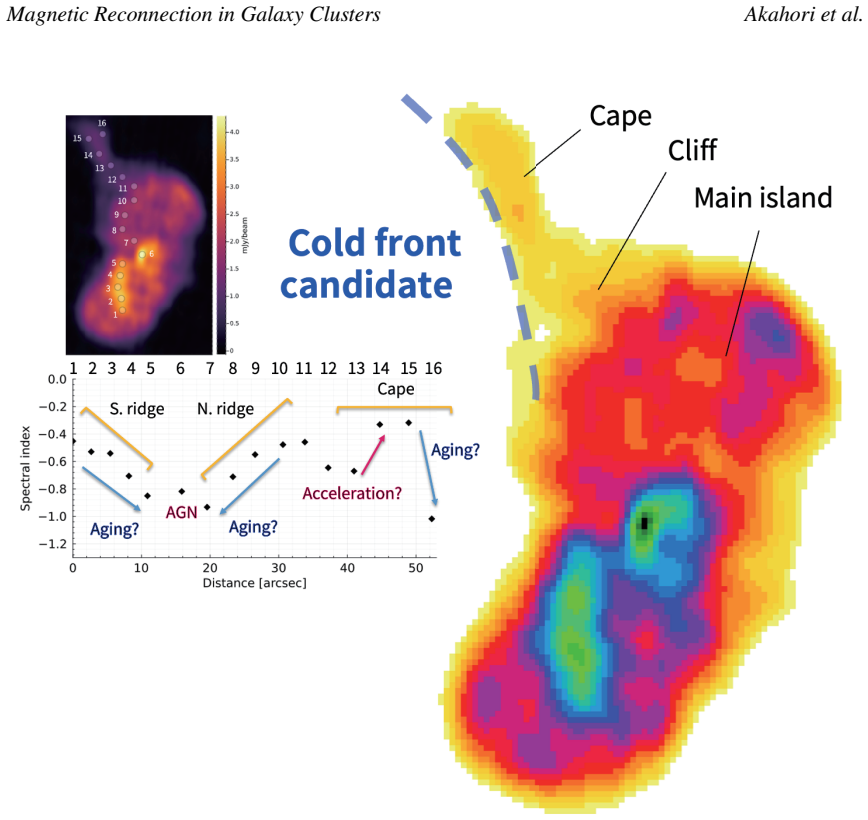
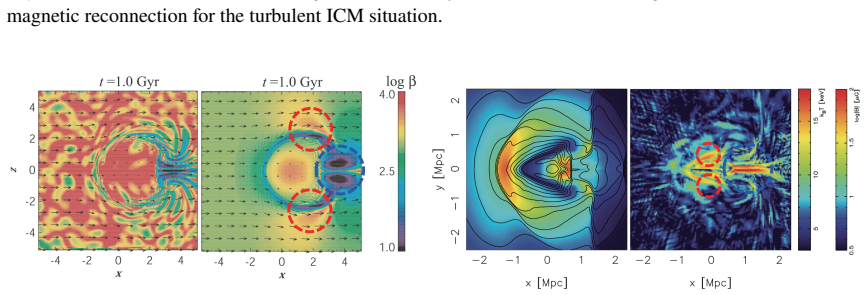
Galaxy clusters contain an intra-cluster medium (ICM) with temperatures of tens of millions of Kelvin. Cosmological structure formation simulations show that this diffuse gas is heated not only by adiabatic gravitational compression but also by shock waves and turbulence generated during mergers of galaxy groups and clusters. These processes are expected to produce magnetic fields and cosmic rays, observed through synchrotron polarization. One structure formed during cluster evolution is the cold front, a contact discontinuity created when colder gas moves transonically through hotter gas. Using MeerKAT, GMRT, and ATCA, we recently discovered radio emission along cold fronts in two galaxy clusters, with spectra indicating re-acceleration at the discontinuity. This presents a new puzzle because the standard mechanism in galaxy clusters, Fermi acceleration, is not naturally expected there. We propose magnetic reconnection as the re-acceleration mechanism. Compression and stretching of magnetized plasma at the discontinuity can generate current sheets that trigger reconnection, as also suggested by simulations. With AA*, we will probe broadband radio spectra at high spatial resolution to constrain where re-acceleration occurs. Polarization measurements will reveal magnetic-field structures and clarify the conditions required for magnetic reconnection.
Editorial analysis
A structured set of objections, weighed in public.
Referee Report
Summary. The manuscript reports the discovery of radio emission along cold fronts in two galaxy clusters from MeerKAT, GMRT, and ATCA data. Spectra are interpreted as showing re-acceleration localized to the discontinuity, which is presented as incompatible with standard Fermi acceleration; magnetic reconnection is proposed as the mechanism, driven by compression and stretching of magnetized plasma at the contact discontinuity (as suggested by simulations). Plans for AA* observations to obtain broadband spectra and polarization are outlined to test the localization and field geometry.
Significance. If the spectral localization to the cold-front discontinuity holds and alternative sites can be excluded, the work would identify a new re-acceleration channel in the ICM with implications for cosmic-ray production and magnetic-field amplification during cluster mergers. The proposal is framed as an interpretive link between existing data and simulations rather than a quantitative model.
major comments (2)
- [Abstract] Abstract: the central claim that the radio spectra demonstrate re-acceleration occurring specifically at the cold-front discontinuity (rather than volume-filling turbulence or projection) is stated without quantitative spectral fitting, error analysis, spectral-index gradient maps aligned to the X-ray surface-brightness edge, or explicit exclusion of alternative acceleration sites.
- [Abstract] Abstract: the assertion that Fermi acceleration is not naturally expected at the discontinuity is presented without supporting discussion, references, or quantitative argument showing why the mechanism would be suppressed there, leaving the motivation for invoking reconnection under-constrained.
minor comments (1)
- The phrase "as also suggested by simulations" should be accompanied by specific citations to the relevant simulation studies.
Simulated Author's Rebuttal
We thank the referee for the constructive comments on our manuscript. We address each major point below and will make targeted revisions to the abstract and supporting text to improve clarity and completeness while preserving the observational results and interpretation.
read point-by-point responses
-
Referee: [Abstract] Abstract: the central claim that the radio spectra demonstrate re-acceleration occurring specifically at the cold-front discontinuity (rather than volume-filling turbulence or projection) is stated without quantitative spectral fitting, error analysis, spectral-index gradient maps aligned to the X-ray surface-brightness edge, or explicit exclusion of alternative acceleration sites.
Authors: The full manuscript presents the spectral fitting, error analysis, and spectral-index maps that demonstrate localization to the discontinuity, with the index gradient aligned to the X-ray edge and spatial coincidence used to exclude volume-filling alternatives. We will revise the abstract to include a concise reference to these quantitative results and the exclusion argument, making the central claim better supported at the abstract level. revision: yes
-
Referee: [Abstract] Abstract: the assertion that Fermi acceleration is not naturally expected at the discontinuity is presented without supporting discussion, references, or quantitative argument showing why the mechanism would be suppressed there, leaving the motivation for invoking reconnection under-constrained.
Authors: We agree that a brief supporting statement with references would strengthen the motivation. The revised abstract (and introduction) will include a short discussion citing literature on the inefficiency of Fermi acceleration at contact discontinuities, where shocks and strong turbulence are absent, thereby better justifying the reconnection proposal. revision: yes
Circularity Check
No significant circularity; interpretive proposal with no derivation chain
full rationale
The manuscript presents an observational interpretation of radio spectra along cold fronts and proposes magnetic reconnection as a mechanism, citing external simulations for the current-sheet generation idea. No equations, fitting procedures, parameter estimations, or self-referential derivations appear in the abstract or described content. The localization claim rests on prior observations rather than reducing to a fitted input or self-citation theorem within this paper. No steps match the enumerated circularity patterns.
Axiom & Free-Parameter Ledger
axioms (2)
- domain assumption Radio spectra indicate re-acceleration at the cold-front discontinuity
- domain assumption Fermi acceleration is not naturally expected at cold fronts
Reference graph
Works this paper leans on
-
[1]
doi: 10.1093/pasj/psx123. N. Asai, N. Fukuda, and R. Matsumoto. ApJ, 663(2):816–823, July
-
[2]
doi: 10.1086/518235. A. Basu et al. In Advancing Astrophysics with the SKA – II (AASKAII)
-
[3]
doi: 10.1038/s41586-021-03434-1. J. O. Chibueze et al. PASJ, 75:S97–S107, Feb
-
[4]
doi: 10.1093/pasj/psac009. L. Feretti, G. Giovannini, F. Govoni, and M. Murgia. A&ARv, 20:54, May
-
[5]
doi: 10.3847/2041-8213/ad9f2d. K. Kurahara et al. PASJ, 75:S138–S153, Feb
-
[6]
doi: 10.1093/pasj/psac098. K. Kurahara et al. PASJ, 76(2):L8–L13, Apr
-
[7]
doi: 10.1093/pasj/psae011. K. Kurahara et al. PASJ, 78(1):137–150, Feb
-
[8]
doi: 10.1093/pasj/psaf128. K. Kurahara et al. In Advancing Astrophysics with the SKA – II (AASKAII)
-
[9]
doi: 10.1016/0003-4916(58) 90024-1. S. Nitta, S. Tanuma, K. Shibata, and K. Maezawa. ApJ, 550(2):1119–1130, Apr
-
[10]
doi: 10.1086/518104. H. Sakemi et al. ApJ, 992(1):14, Oct
-
[11]
doi: 10.3847/1538-4357/adfc64. M. Takizawa. ApJ, 687(2):951–958, Nov
-
[12]
doi: 10.1086/592059. V . Vacca et al. InAdvancing Astrophysics with the SKA – II (AASKAII)
-
[13]
doi: 10.1007/s11214-019-0584-z. T. Vernstrom, J. L. West, and C. Horellou. In Advancing Astrophysics with the SKA – II (AASKAII)
discussion (0)
Sign in with ORCID, Apple, or X to comment. Anyone can read and Pith papers without signing in.