Harnessing Toroidal Neutral Flows to Enhance Divertor Particle Exhaust
Pith reviewed 2026-06-30 04:17 UTC · model grok-4.3
The pith
A toroidally oriented pump inlet reduces back-flow by up to 33 percent for helium by capturing plasma-imprinted neutral flows.
A machine-rendered reading of the paper's core claim, the machinery that carries it, and where it could break.
Core claim
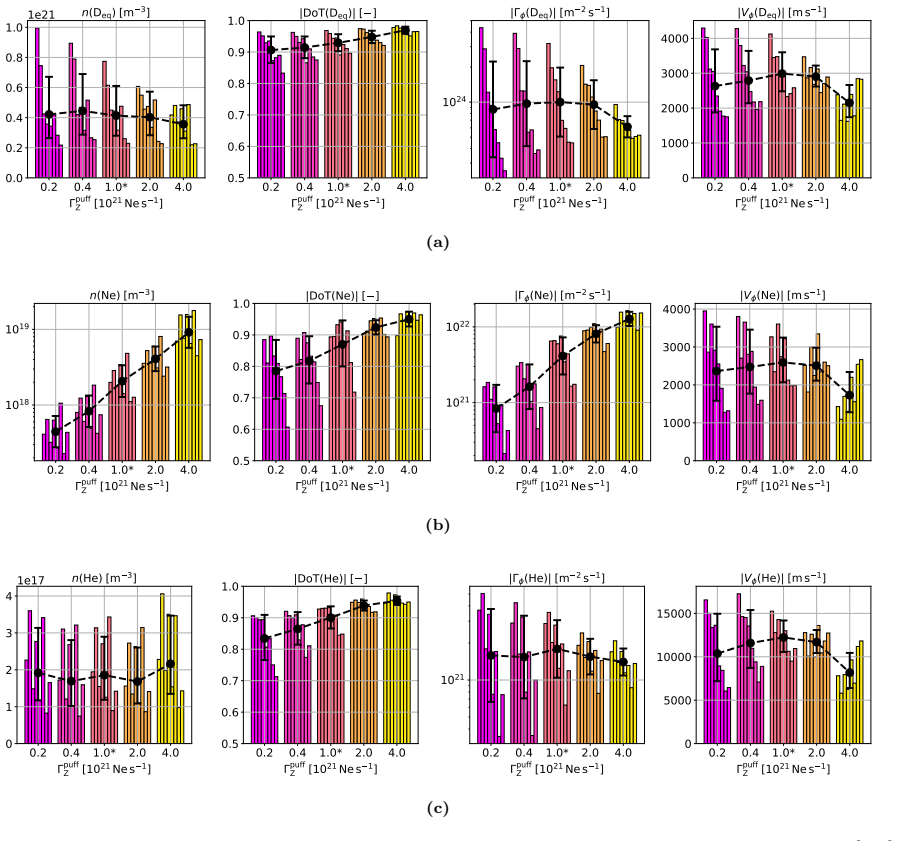
A toroidally oriented pump inlet reduces back-flow by up to 20 percent for deuterium and up to 33 percent for helium at 10 percent concentration relative to a traditional poloidal arrangement. Partial pressures in the toroidal exhaust path increase by factors of 1.78 plus or minus 0.04 for deuterium and 2.00 plus or minus 0.05 for helium across the simulation database, implying a reduction in the required effective pumping speed for fixed throughput.
What carries the argument
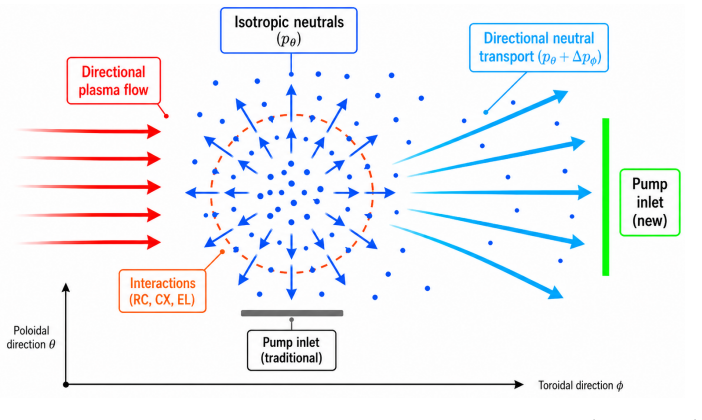
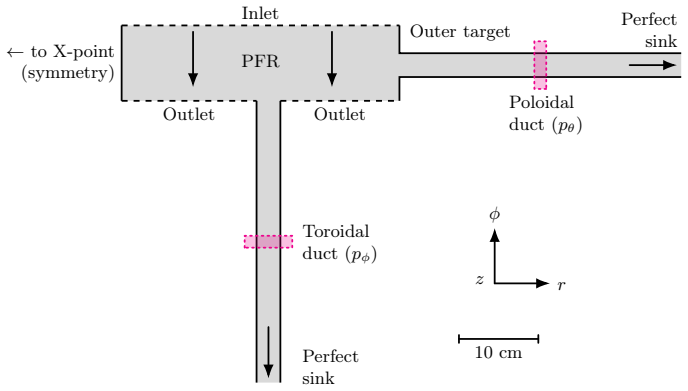
The toroidally oriented pump inlet that captures the ordered toroidal neutral wind imprinted by the plasma in the private-flux region.
If this is right
- For fixed throughput the required effective pumping speed decreases, lowering corresponding hardware demands.
- Partial pressures are enhanced across a range of conditions for both deuterium and helium.
- Explicit retention of toroidal neutral momentum becomes necessary in divertor and sub-divertor modeling.
- Dedicated studies of neutral aerodynamics are motivated, including in stellarators where analogous directional imprinting is expected.
Where Pith is reading between the lines
- If the back-flow reductions persist in full three-dimensional geometries, the approach could be retrofitted to current devices to test exhaust improvements without new power sources.
- The larger relative benefit for helium suggests targeted gains for ash removal in reactor-relevant mixtures.
- Optimization of inlet geometry using the same DSMC framework could further increase the pressure-enhancement factors beyond the reported averages.
Load-bearing premise
The toroidal neutral wind identified in the idealized private-flux simulations will remain sufficiently ordered and capturable once a real pump inlet is introduced into an actual divertor geometry that includes magnetic fields, wall interactions, and three-dimensional effects.
What would settle it
A side-by-side comparison in an existing tokamak of measured back-flow rates and duct pressures for toroidal versus poloidal pump inlets at comparable throughputs would directly test the predicted reductions.
Figures
read the original abstract
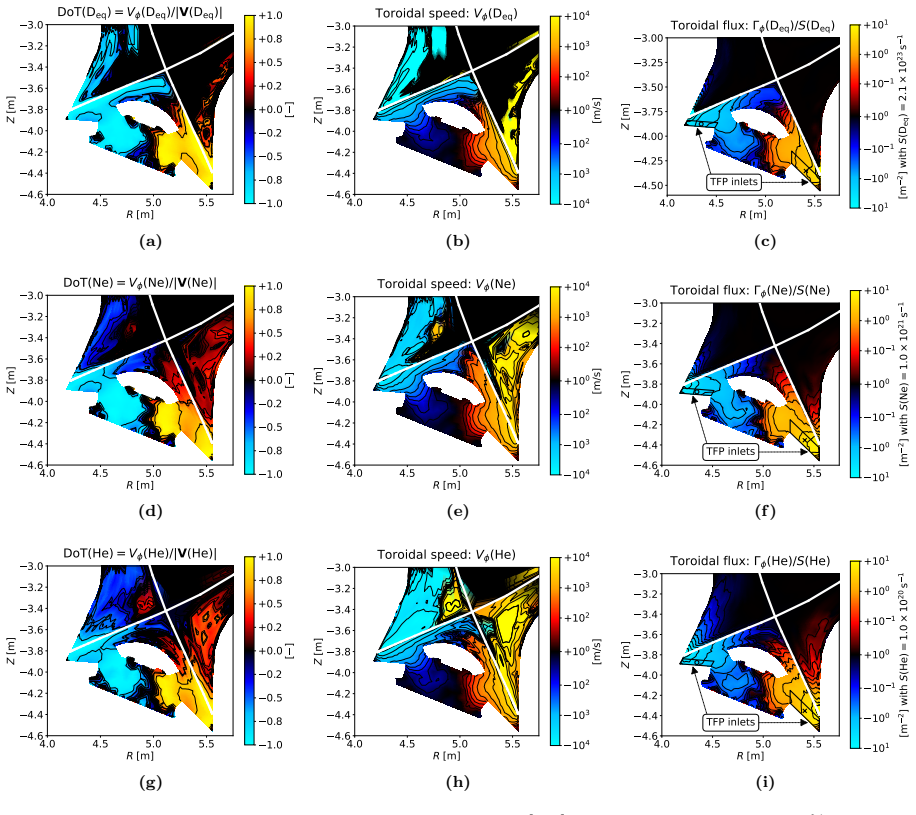
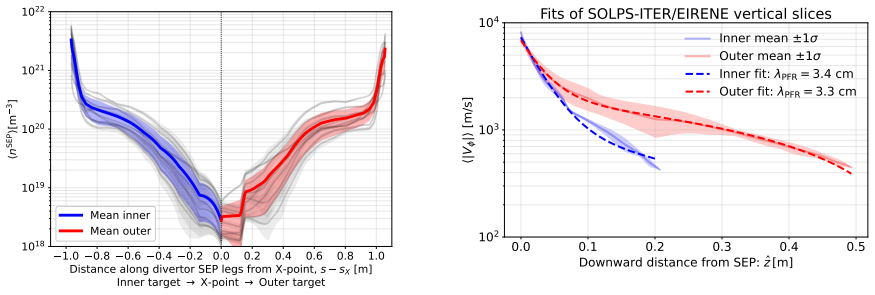
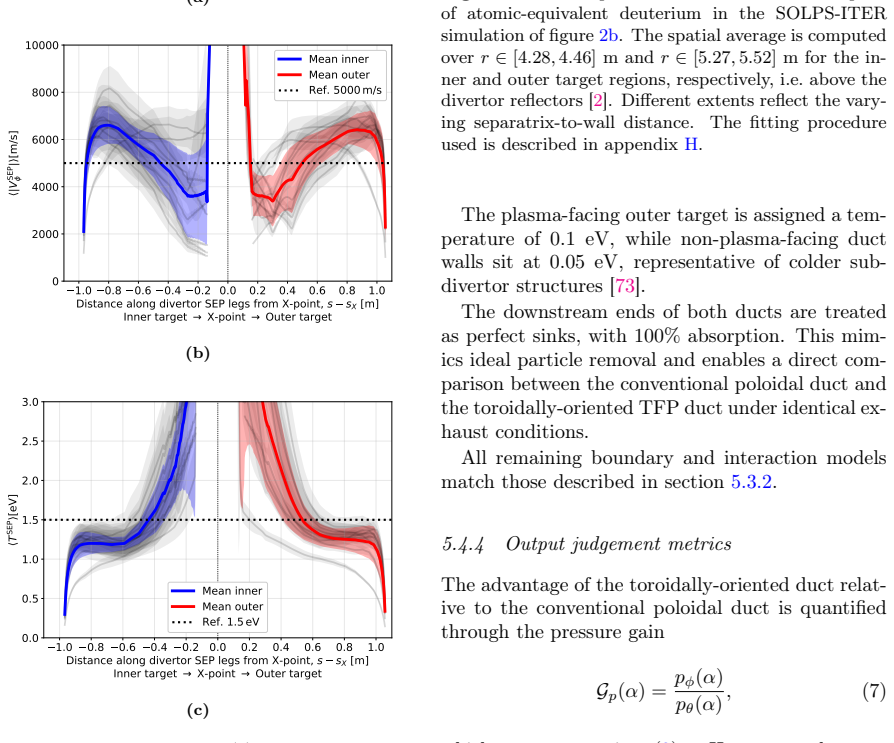
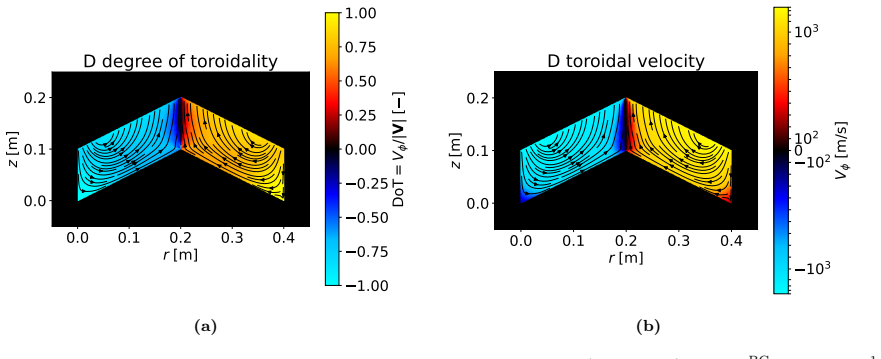
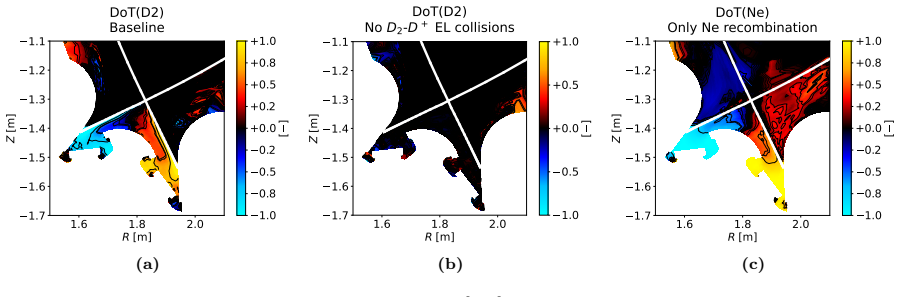
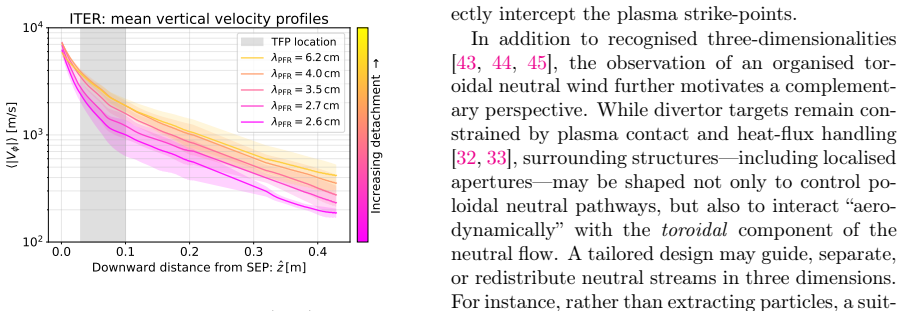
In 1991 Reiter et al. (1991 Plasma Phys. Control. Fusion 33 1579) considered the onerous exhaust requirements of ITER, and wrote: "The vacuum pumping problem of a fusion reactor will probably require some novel solution". Here we show that a toroidally oriented pump inlet can passively exploit intrinsic neutral flows to reduce back-flow, raise duct pressure, and ultimately improve particle-exhaust performance. Drawing on previous experimental observations and SOLPS-ITER edge-plasma simulations, we consolidate the evidence for a plasma-imprinted, multi-species toroidal neutral "wind" in detached tokamak divertors. We isolate the underlying mechanism in a prototypical divertor private-flux region using a database of two-dimensional direct simulation Monte Carlo (DSMC) calculations. The ordered neutral motion is recovered with a strong toroidal alignment, kilometre-per-second velocities, and persistence up to several centimetres across slip-to-transitional rarefied regimes (Kn=0.02$-$2). We then assess the consequences of capturing this ordered motion using a second database of idealised proof-of-principle DSMC simulations. Compared to the traditional poloidal arrangement, a toroidally oriented pump inlet reduces back-flow by up to 20% for deuterium and up to 33% for helium at 10% concentration. Partial pressures in the toroidal exhaust path are enhanced across the database, nominally by a factor of 1.78$\pm$0.04 for deuterium and 2.00$\pm$0.05 for helium. For fixed throughput, this implies a reduction in the required effective pumping speed and corresponding hardware. More broadly, these results motivate explicit retention of toroidal neutral momentum in divertor and sub-divertor modelling, and dedicated studies of neutral aerodynamics, including in stellarators, where an analogous directional imprinting is expected to occur.
Editorial analysis
A structured set of objections, weighed in public.
Referee Report
Summary. The paper argues that a toroidally oriented pump inlet can passively exploit an intrinsic toroidal neutral 'wind' (km/s velocities, strong alignment, persisting several cm at Kn=0.02-2) in the private-flux region of detached divertors. Using two 2D DSMC databases—one isolating the mechanism from SOLPS-ITER and experiment, the other testing idealized toroidal vs. poloidal inlets—it reports up to 20% (D) / 33% (He at 10%) back-flow reduction and partial-pressure enhancements of 1.78±0.04 (D) / 2.00±0.05 (He), implying lower required pumping speed for fixed throughput.
Significance. If the ordered toroidal flow survives realistic 3D perturbations, the result offers a passive, geometry-based route to improved divertor exhaust without added hardware, directly relevant to ITER-class devices. It also supplies a concrete motivation for retaining toroidal neutral momentum in edge modeling and for neutral-aerodynamics studies in stellarators.
major comments (2)
- [proof-of-principle DSMC database and abstract mechanism-isolation paragraph] The central performance claims (back-flow reductions of 20-33% and pressure-enhancement factors 1.78-2.00) rest on idealized 2D proof-of-principle DSMC runs. No 3D test case, sensitivity study to magnetic-field drifts, wall scattering, or inlet-induced disruption of the toroidal wind is reported, leaving the extrapolation from mechanism isolation to actual exhaust performance unverified.
- [DSMC methods and results sections] The quantitative results are presented with error estimates (±0.04, ±0.05) but the manuscript provides no tabulated convergence metrics, Knudsen-number grid, or boundary-condition details for the second DSMC database; without these it is impossible to assess whether the reported gains are robust to numerical or modeling choices.
minor comments (2)
- [abstract and methods] Notation for the two DSMC databases is introduced only in the abstract; a dedicated nomenclature table or explicit section labels would improve traceability.
- [introduction] The citation to Reiter et al. (1991) is appropriate but the manuscript does not discuss how the present toroidal-wind mechanism relates to or extends that earlier vacuum-pumping discussion.
Simulated Author's Rebuttal
We thank the referee for their constructive review and recommendation of major revision. We respond point-by-point to the two major comments, clarifying the proof-of-principle nature of the 2D DSMC study while committing to improvements in documentation and limitations discussion.
read point-by-point responses
-
Referee: [proof-of-principle DSMC database and abstract mechanism-isolation paragraph] The central performance claims (back-flow reductions of 20-33% and pressure-enhancement factors 1.78-2.00) rest on idealized 2D proof-of-principle DSMC runs. No 3D test case, sensitivity study to magnetic-field drifts, wall scattering, or inlet-induced disruption of the toroidal wind is reported, leaving the extrapolation from mechanism isolation to actual exhaust performance unverified.
Authors: We agree that the reported performance metrics derive from idealized 2D DSMC simulations intended to isolate the toroidal neutral wind mechanism in a prototypical private-flux region. No 3D cases or sensitivity studies to drifts, wall scattering, or inlet disruption are included. We will revise the manuscript by adding an explicit limitations paragraph in the discussion that outlines these assumptions and the need for future 3D work to verify extrapolation to realistic exhaust performance. This addresses the concern on scope without changing the core 2D results. revision: partial
-
Referee: [DSMC methods and results sections] The quantitative results are presented with error estimates (±0.04, ±0.05) but the manuscript provides no tabulated convergence metrics, Knudsen-number grid, or boundary-condition details for the second DSMC database; without these it is impossible to assess whether the reported gains are robust to numerical or modeling choices.
Authors: We accept this criticism. The second DSMC database is insufficiently documented. We will revise the Methods and Results sections to add: tabulated convergence metrics, the Knudsen-number grid used across the database, and complete boundary-condition specifications for the toroidal versus poloidal inlet configurations. These additions will allow independent assessment of numerical robustness for the back-flow and partial-pressure results. revision: yes
- Full 3D DSMC test cases with sensitivity to magnetic-field drifts, wall scattering, and inlet-induced disruption of the toroidal wind, which require substantial new computational effort outside the current proof-of-principle scope.
Circularity Check
No circularity; performance metrics are independent DSMC outputs
full rationale
The paper isolates the toroidal neutral flow mechanism in one 2D DSMC database and evaluates toroidal vs. poloidal inlet performance in a second, separate idealized DSMC database. Reported back-flow reductions (up to 20-33%) and pressure-enhancement factors (1.78±0.04 and 2.00±0.05) are direct simulation outputs, not quantities obtained by fitting, redefinition, or self-citation chains. No equations, ansatzes, or uniqueness theorems reduce the central claims to the inputs by construction; external citations (Reiter 1991, SOLPS-ITER) supply supporting context but do not bear the load of the reported gains.
Axiom & Free-Parameter Ledger
axioms (1)
- domain assumption A plasma-imprinted, multi-species toroidal neutral wind exists in detached tokamak divertors and persists across slip-to-transitional regimes
Reference graph
Works this paper leans on
-
[1]
The European roadmap towards fusion electricity,
A. Donné, “The European roadmap towards fusion electricity,”Philosoph- ical Transactions of the Royal Society A, vol. 377, p. 2141, 2019. [Online]. 39 0.4 0.5 0.6 0.7 0.8 [m] 0.00 0.05 0.10 0.15z [m] D pressure 0 5 10 15 20 p [Pa] (a) 0.4 0.5 0.6 0.7 0.8 [m] 0.00 0.05 0.10 0.15z [m] D velocity magnitude 0 1 2 3 4 5 |Vz + V | [km/s] (b) 0.6 0.8 1.0 1.2 1.4...
2019
-
[2]
Physics basis for the first ITER tung- sten divertor,
R. Pitts, X. Bonnin, F. Escourbiac, H. Frerichs, J. Gunn, T. Hirai, A. Kukushkin, E. Kaveeva, M. Miller, D. Moulton, V. Rozhansky, I. Senichenkov, E. Sytova, O. Schmitz, P. Stangeby, G. De Tem- merman, I. Veselova, and S. Wiesen, “Physics basis for the first ITER tung- sten divertor,”Nuclear Materials and En- ergy, vol. 20, p. 100696, 2019. [Online]. Avai...
2019
-
[3]
Stangeby,The Plasma Boundary of Mag- netic Fusion Devices, ser
P. Stangeby,The Plasma Boundary of Mag- netic Fusion Devices, ser. Series in Plasma Physics and Fluid Dynamics. Taylor & Fran- cis, 2000. [Online]. Available: https://books. google.co.uk/books?id=qOliQgAACAAJ
2000
-
[4]
Militello,Boundary Plasma Physics: An Accessible Guide to Transport, Detachment, and Divertor Design, 1st ed., ser
F. Militello,Boundary Plasma Physics: An Accessible Guide to Transport, Detachment, and Divertor Design, 1st ed., ser. Springer Series on Atomic, Optical, and Plasma Physics. Springer Cham, 2022, vol. 123. [Online]. Available: https://doi.org/10.1007/ 978-3-031-17339-4
2022
-
[5]
Physics of ultimate detachment of a tokamak divertor plasma,
S. I. Krasheninnikov and A. S. Kukushkin, “Physics of ultimate detachment of a tokamak divertor plasma,”Journal of Plasma Physics, vol. 83, no. 5, p. 155830501, 2017. [Online]. Available: https://www.cambridge.org/core/ journals/journal-of-plasma-physics/article/ physics-of-ultimate-detachment-of-a-tokamak-divertor-plasma/ B1A927D0F8DD3BB9C19A436C25C6FF31
2017
-
[6]
A review of radiative detachment studies in tokamak advanced magnetic divertor configurations,
V. A. Soukhanovskii, “A review of radiative detachment studies in tokamak advanced magnetic divertor configurations,”Plasma Physics and Controlled Fusion, vol. 59, no. 6, p. 064005, apr 2017. [Online]. Available: https://doi.org/10.1088/1361-6587/aa6959
-
[7]
Impurity seeding for tokamak power exhaust: from present devices via ITER to DEMO,
A. Kallenbach, M. Bernert, R. Dux, L. Cas- ali, T. Eich, L. Giannone, A. Herrmann, R. McDermott, A. Mlynek, H. W. Müller, F. Reimold, J. Schweinzer, M. Sertoli, G. Tardini, W. Treutterer, E. Viezzer, R. Wenninger, M. Wischmeier, and the ASDEX Upgrade Team, “Impurity seeding for tokamak power exhaust: from present devices via ITER to DEMO,”Plasma Physics a...
-
[8]
Divertor of the European DEMO: Engineering and technologies for power exhaust,
J. You, G. Mazzone, E. Visca, H. Greu- ner, M. Fursdon, Y. Addab, C. Bachmann, T. Barrett, U. Bonavolontà, B. Böswirth, F. Castrovinci, C. Carelli, D. Coccorese, R. Coppola, F. Crescenzi, G. Di Gironimo, P. Di Maio, G. Di Mambro, F. Domptail, D. Dongiovanni, G. Dose, D. Flammini, L. Forest, P. Frosi, F. Gallay, B. Ghidersa, C. Harrington, K. Hunger, V. Im...
2022
-
[9]
Summary of the 3rd IAEA technical meeting on divertor concepts,
M. Barbarino, A. Leonard, N. N. Asakura, M. Jakubowski, M. Kobayashi, B. Lipschutz, R. Neu, L. Wang, and M. Wischmeier, “Summary of the 3rd IAEA technical meeting on divertor concepts,”Nuclear Fusion, vol. 60, no. 9, p. 097001, jul 2020. [Online]. Available: https://doi.org/10.1088/1741-4326/ab9a0c
-
[10]
Plasma physics and technology aspects of the deuterium–tritium fuel cycle for fusion energy: Summary of a tech- nical meeting,
International Atomic Energy Agency, “Plasma physics and technology aspects of the deuterium–tritium fuel cycle for fusion energy: Summary of a tech- nical meeting,” International Atomic En- ergy Agency (IAEA), Vienna, Austria, Tech. Rep. IAEA-TECDOC-2049, 2024. [On- line]. Available: https://www-pub.iaea.org/ MTCD/Publications/PDF/TE-2049web.pdf
2049
-
[11]
S. Meschini and M. Moscheni, “On the Relationship Between Plasma and Tritium Fuel Cycle Through Matter Injection and Particle Exhaust,” 2026, submitted to Nuclear Fusion. [Online]. Available: https://arxiv. org/abs/2606.28043
Pith/arXiv arXiv 2026
-
[12]
Multi-machine scaling laws for fuel and impurity puffing rates sufficient for detachment access: a systematic review of magnetic confinement fusion devices,
M. Moscheni, A. Herrmann, R. Kembleton, M. Kryjak, S. Lazerson, F. Levi, M. Siccinio, P. Staniec, T. Giegerich, C. Tantos, and t. G. Fusion Team, “Multi-machine scaling laws for fuel and impurity puffing rates sufficient for detachment access: a systematic review of magnetic confinement fusion devices,” Nuclear Fusion, vol. 66, no. 2, p. 026008, dec
-
[13]
Available: https://doi.org/10
[Online]. Available: https://doi.org/10. 1088/1741-4326/ae287c
-
[14]
Full time-dependent SOLPS-ITER simulation of the SPARC tokamak: actuator design for particle and divertor condition control,
J.-S. Park, J. D. Lore, M. Reinke, A. Q. Kuang, S. De Pascuale, and A. Creely, “Full time-dependent SOLPS-ITER simulation of the SPARC tokamak: actuator design for particle and divertor condition control,” Nuclear Fusion, vol. 64, no. 7, p. 076036, jun
-
[15]
Available: https://doi.org/10
[Online]. Available: https://doi.org/10. 1088/1741-4326/ad4f9d
-
[16]
D.Reiter, H.Kever, G.H.Wolf, M.Baelmans, R. Behrisch, and R. Schneider, “Helium removal from tokamaks,”Plasma Physics and Controlled Fusion, vol. 33, no. 13, p. 1579, nov 1991. [Online]. Available: https: //doi.org/10.1088/0741-3335/33/13/008
-
[17]
Exper- imental divertor physics,
C. S. Pitcher and P. C. Stangeby, “Exper- imental divertor physics,”Plasma Physics and Controlled Fusion, vol. 39, no. 6, p. 779, jun 1997. [Online]. Available: https://doi.org/10.1088/0741-3335/39/6/001
-
[18]
Power and particle exhaust for the ARC fusion power plant,
T. H. Eich, T. A. J. Body, T. P. Looby, S. B. Ballinger, A. J. Creely, J. C. Hillesheim, P. B. Snyder, N. T. Howard, R. Masline, M. R. K. Wigramet al., “Power and particle exhaust for the ARC fusion power plant,”Journal of Plasma Physics, vol. 92, no. 3, p. E66, 2026. [Online]. Available: https://www.cambridge.org/core/ journals/journal-of-plasma-physics/...
2026
-
[19]
Measurement of Natural Plasma Flow along the Field Lines in the Scrape-Off Layer on the JT-60U Divertor Tokamak,
N. Asakura, S. Sakurai, M. Shimada, Y. Koide, N. Hosogane, and K. Itami, “Measurement of Natural Plasma Flow along the Field Lines in the Scrape-Off Layer on the JT-60U Divertor Tokamak,”Phys. Rev. Lett., vol. 84, pp. 3093–3096, Apr 2000. [Online]. Available: https://link.aps.org/doi/10.1103/ PhysRevLett.84.3093
2000
-
[20]
Effects of divertor geometry on tokamak plasmas,
A. Loarte, “Effects of divertor geometry on tokamak plasmas,”Plasma Physics and Controlled Fusion, vol. 43, no. 6, p. R183, jun 2001. [Online]. Available: https: //dx.doi.org/10.1088/0741-3335/43/6/201
-
[21]
Chapter 4: Power and particle control,
A. Loarte, B. Lipschultz, A. Kukushkin, G. Matthews, P. Stangeby, N. Asakura, 41 G. Counsell, G. Federici, A. Kallen- bach, K. Krieger, A. Mahdavi, V. Phil- ipps, D. Reiter, J. Roth, J. Strachan, D. Whyte, R. Doerner, T. Eich, W. Fun- damenski, A. Herrmann, M. Fenstermacher, P. Ghendrih, M. Groth, A. Kirschner, S. Konoshima, B. LaBombard, P. Lang, A. Leon...
-
[22]
The role of divertor pumping in plasma detachment and particle exhaust in a closed divertor,
C. Sang, P. Stangeby, H. Guo, and D. Wang, “The role of divertor pumping in plasma detachment and particle exhaust in a closed divertor,”Nuclear Fusion, vol. 61, no. 1, p. 016022, nov 2020. [Online]. Available: https://doi.org/10.1088/1741-4326/abc356
-
[23]
Simulations of divertor designs that spatially separate power and particle exhaust using mid-leg divertor particle pumping,
J. Yu, R. Wilcox, R. Maurizio, A. Holm, S. Allen, W. Choi, M. Fenstermacher, M. Groth, A. Leonard, A. McLean, F. Scotti, and M. Shafer, “Simulations of divertor designs that spatially separate power and particle exhaust using mid-leg divertor particle pumping,”Nuclear Materials and Energy, vol. 41, p. 101826, 2024. [Online]. Available: https://www.science...
2024
-
[24]
Simula- tion study of effective pumping speed of divertor pumping system for CFETR with COMSOL Multiphysics,
H. Bi, Y. Zhang, X. Wang, Z. Chen, Z. Yu, J. Yuan, and G. Zuo, “Simula- tion study of effective pumping speed of divertor pumping system for CFETR with COMSOL Multiphysics,”Fusion Engineering and Design, vol. 194, p. 113916, 2023. [On- line]. Available: https://www.sciencedirect. com/science/article/pii/S0920379623004982
2023
-
[25]
Mod- eling a divertor with mid-leg pumping for high-power H-mode scenarios in DIII-D con- sidering E x B drift flows,
A. Holm, R. S. Wilcox, J. H. Yu, T. D. Ro- gnlien, M. E. Rensink, F. Scotti, R. Maurizio, S. L. Allen, W. Choi, A. W. Leonard, M. W. Shafer, M. Groth, and A. McLean, “Mod- eling a divertor with mid-leg pumping for high-power H-mode scenarios in DIII-D con- sidering E x B drift flows,”Nuclear Materials and Energy, vol. 41, p. 101782, 2024. [On- line]. Avai...
2024
-
[26]
Divertor closure effects on the TCV boundary plasma,
O. Février, H. Reimerdes, C. Theiler, D. Brida, C. Colandrea, H. De Oliveira, B. Duval, D. Galassi, S. Gorno, S. Henderson, M. Komm, B. Labit, B. Linehan, L. Mar- tinelli, A. Perek, H. Raj, U. Sheikh, C. Tsui, and M. Wensing, “Divertor closure effects on the TCV boundary plasma,”Nuclear Materi- als and Energy, vol. 27, p. 100977, 2021. [On- line]. Availab...
2021
-
[27]
SOLPS analysis of neutral baffling for the design of a new diverter in DIII-D,
C. Sang, H. Guo, P. Stangeby, L. Lao, and T. Taylor, “SOLPS analysis of neutral baffling for the design of a new diverter in DIII-D,”Nuclear Fusion, vol. 57, no. 5, p. 056043, apr 2017. [Online]. Available: https://doi.org/10.1088/1741-4326/aa6548
-
[28]
Overview of the TCV tokamak experimental pro- gramme,
H. Reimerdes, M. Agostini, E. Alessi, S. Al- berti, Y. Andrebe, H. Arnichand, J. Balbin, F. Bagnato, M. Baquero-Ruiz, M. Bern- ert, W. Bin, P. Blanchard, T. Blanken, J. Boedo, D. Brida, S. Brunner, C. Bogar, O. Bogar, T. Bolzonella, F. Bombarda, F. Bouquey, C. Bowman, D. Brunetti, J. Buermans, H. Bufferand, L. Calacci, Y. Camenen, S. Carli, D. Carnevale, ...
-
[29]
Effect of the dome on divertor per- formance in ITER,
A. Kukushkin, H. Pacher, V. Kotov, D. Reiter, D. Coster, and G. Pacher, “Effect of the dome on divertor per- formance in ITER,”Journal of Nuc- lear Materials, vol. 363-365, pp. 308–313, 2007, plasma-Surface Interactions-17. [On- line]. Available: https://www.sciencedirect. com/science/article/pii/S0022311507000633
2007
-
[30]
C. Cowley, D. Moulton, and B. Lipschultz, “Isolating the impacts of divertor closure on fueling and detachment with simpli- fied SOLPS-ITER simulations of MAST- U,”Physics of Plasmas, vol. 33, no. 2, p. 022508, 02 2026. [Online]. Available: https://doi.org/10.1063/5.0271055
-
[31]
Dependence of neutral pressure on detachment in the small angle slot divertor at DIII-D,
M. Shafer, B. Covele, J. Canik, L. Casali, H. Guo, A. Leonard, J. Lore, A. McLean, A. Moser, P. Stangeby, D. Taussig, H. Wang, and J. Watkins, “Dependence of neutral pressure on detachment in the small angle slot divertor at DIII-D,”Nuclear Materials and Energy, vol. 19, pp. 487–492, 2019. [Online]. Available: https://www.sciencedirect.com/ science/articl...
2019
-
[32]
Diver- tor plasma conditions and neutral dynamics in horizontal and vertical divertor config- urations in jet-ilw low confinement mode plasmas,
M. Groth, S. Brezinsek, P. Belo, M. Brix, G. Calabro, A. Chankin, M. Clever, J. Coenen, G. Corrigan, P. Drewelow, C. Guillemaut, D. Harting, A. Huber, S. Jach- mich, A. Järvinen, U. Kruezi, K. Lawson, M. Lehnen, C. Maggi, C. Marchetto, S.Marsen, F.Maviglia, A.Meigs, D.Moulton, C. Silva, M. Stamp, and S. Wiesen, “Diver- tor plasma conditions and neutral dy...
2015
-
[33]
D. Moulton, G. Corrigan, J. Harrison, B. Lipschultz, and J. Contributors, “Neutral pathways and heat flux widths in vertical- and horizontal-target EDGE2D-EIRENE simula- tions of JET,”Nuclear Fusion, vol. 58, no. 9, p. 096029, jul 2018. [Online]. Available: https://dx.doi.org/10.1088/1741-4326/aacf0f
-
[34]
Physics conclusions in support of ITER W divertor monoblock shaping,
R. Pitts, S. Bardin, B. Bazylev, M. van den Berg, P. Bunting, S. Carpentier-Chouchana, J. Coenen, Y. Corre, R. Dejarnac, F. Escour- biac, J. Gaspar, J. Gunn, T. Hirai, S.-H. Hong, J. Horacek, D. Iglesias, M. Komm, K. Krieger, C. Lasnier, G. Matthews, T. Morgan, S. Panayotis, S. Pestchanyi, A. Podolnik, R. Nygren, D. Rudakov, G. De Temmerman, P. Vondracek,...
2017
-
[35]
T. Looby, M. Reinke, A. Wingen, J. Menard, S. Gerhardt, T. Gray, D. Donovan, E. Un- terberg, J. Klabacha, and M. Messineo, “A 43 Software Package for Plasma-Facing Com- ponent Analysis and Design: The Heat Flux Engineering Analysis Toolkit (HEAT),” Fusion Science and Technology, vol. 78, no. 1, pp. 10–27, 2022. [Online]. Available: https: //doi.org/10.108...
-
[36]
First island divertor experiments on the W7-AS stellarator,
P. Grigull, K. McCormick, J. Baldzuhn, R. Burhenn, R. Brakel, H. Ehmler, Y. Feng, F. Gadelmeier, L. Giannone, D. Hartmann, D. Hildebrandt, M. Hirsch, R. Jaenicke, J.Kisslinger, J.Knauer, R.König, G.Kühner, H. Laqua, D. Naujoks, H. Niedermeyer, N. Ramasubramanian, N. Rust, F. Sardei, F.Wagner, A.Weller, U.Wenzel, andtheW7- AS Team, “First island divertor e...
-
[37]
Divertor concept for the W7-X stellarator and mode of operation,
H. Renner, J. Boscary, H. Greuner, H. Grote, F. W. Hoffmann, J. Kiss- linger, E. Strumberger, and B. Mendelevitch, “Divertor concept for the W7-X stellarator and mode of operation,”Plasma Physics and Controlled Fusion, vol. 44, no. 6, p. 1005, may 2002. [Online]. Available: https://doi.org/10.1088/0741-3335/44/6/325
-
[38]
Performance of Wendelstein 7-X stellarator plasmas during the first divertor operation phase,
R. C. Wolf, A. Alonso, S. Äkäslompolo, J. Baldzuhn, M. Beurskens, C. D. Beidler, C. Biedermann, H.-S. Bosch, S. Bozhen- kov, R. Brakel, H. Braune, S. Brezinsek, K.-J. Brunner, H. Damm, A. Dinklage, P. Drewelow, F. Effenberg, Y. Feng, O. Ford, G. Fuchert, Y. Gao, J. Geiger, O. Grulke, N. Harder, D. Hartmann, P. Helander, B. Heinemann, M. Hirsch, U. Höfel, ...
-
[39]
Understanding detachment of the W7-X island divertor,
Y. Feng, M. Jakubowski, R. König, M. Kry- chowiak, M. Otte, F. Reimold, D. Re- iter, O. Schmitz, D. Zhang, C. Beidler, C. Biedermann, S. Bozhenkov, K. Brunner, A. Dinklage, P. Drewelow, F. Effenberg, M. Endler, G. Fuchert, Y. Gao, J. Gei- ger, K. Hammond, P. Helander, C. Killer, J. Knauer, T. Kremeyer, E. Pasch, L. Rudis- chhauser, G. Schlisio, T. Sunn Pe...
-
[40]
The Large Helical Device (LHD) helical di- vertor,
N. Ohyabu, T. Watanabe, H. Ji, H. Akao, T. Ono, T. Kawamura, K. Yamazaki, K. Akaishi, N. Inoue, A. Komori, Y. Kubota, N. Noda, A. Sagara, H. Suzuki, O. Mo- tojima, M. Fujiwara, and A. Iiyoshi, “The Large Helical Device (LHD) helical di- vertor,”Nuclear Fusion, vol. 34, no. 3, p. 387, mar 1994. [Online]. Available: https://doi.org/10.1088/0029-5515/34/3/I07
-
[41]
HSX as an example of a resilient non-resonant divertor,
A. Bader, A. H. Boozer, C. C. Hegna, S. A. Lazerson, and J. C. Schmitt, “HSX as an example of a resilient non-resonant divertor,”Physics of Plasmas, vol. 24, no. 3, p. 032506, 03 2017. [Online]. Available: https://doi.org/10.1063/1.4978494
-
[42]
Minimum magnetic curvature for resilient divertors using compact toroidal hybrid geometry,
A. Bader, C. C. Hegna, M. Cianciosa, and G. J. Hartwell, “Minimum magnetic curvature for resilient divertors using compact toroidal hybrid geometry,”Plasma Physics and Controlled Fusion, vol. 60, no. 5, p. 054003, mar 2018. [Online]. Available: https://doi.org/10.1088/1361-6587/aab1ea
-
[43]
Explorationofnon-resonantdivertorfeatures on the Compact Toroidal Hybrid,
K. Garcia, A. Bader, H. Frerichs, G. Hartwell, J. Schmitt, N. Allen, and O. Schmitz, “Explorationofnon-resonantdivertorfeatures on the Compact Toroidal Hybrid,”Nuclear Fusion, vol. 63, no. 12, p. 126043, oct 2023. [Online]. Available: https://doi.org/10.1088/ 1741-4326/ad0160
2023
-
[44]
Resilient stellarator divertor characteristics in the 44 helically symmetric experiment,
K. A. Garcia, A. Bader, D. Boeyaert, A. H. Boozer, H. Frerichs, M. J. Gerard, A. Punjabi, and O. Schmitz, “Resilient stellarator divertor characteristics in the 44 helically symmetric experiment,”Plasma Physics and Controlled Fusion, vol. 67, no. 3, p. 035011, feb 2025. [Online]. Available: https://doi.org/10.1088/1361-6587/adb179
-
[45]
J. D. Lore, M. L. Reinke, D. Brunner, B. LaBombard, B. Lipschultz, J. Terry, R. A. Pitts, and Y. Feng, “Three-dimensional simulation of H-mode plasmas with localized divertor impurity injection on Alcator C- Mod using the edge transport code EMC3- EIRENE,”Physics of Plasmas, vol. 22, no. 5, p. 056106, 2015. [Online]. Available: https://doi.org/10.1063/1.4919393
-
[46]
EMC3-EIRENE model- ing of toroidally-localized divertor gas injection experiments on Alcator C- Mod,
J. Lore, M. Reinke, B. LaBombard, B. Lipschultz, R. Churchill, R. Pitts, and Y. Feng, “EMC3-EIRENE model- ing of toroidally-localized divertor gas injection experiments on Alcator C- Mod,”Journal of Nuclear Materials, vol. 463, pp. 515–518, 2015, pLASMA- SURFACE INTERACTIONS 21. [Online]. Available: https://www.sciencedirect.com/ science/article/pii/S0022...
2015
-
[47]
EMC3-EIRENE simulations of edge plasma and impurity transportbytoroidallylocalizedargonseeding on CFETR X-divertor,
T. Xie, H. Li, W. Zhang, R. Ding, L. Wang, Y. Luo, and D. Wang, “EMC3-EIRENE simulations of edge plasma and impurity transportbytoroidallylocalizedargonseeding on CFETR X-divertor,”Nuclear Fusion, vol. 65, no. 2, p. 026006, dec 2024. [Online]. Available: https://doi.org/10.1088/ 1741-4326/ad9bc9
2024
-
[48]
Can detached divertor plasmas be explained as self-sustained gas targets?
P. Stangeby, “Can detached divertor plasmas be explained as self-sustained gas targets?” Nuclear Fusion, vol. 33, no. 11, p. 1695, nov
-
[49]
Available: https://doi.org/10
[Online]. Available: https://doi.org/10. 1088/0029-5515/33/11/I10
-
[50]
Data and extended diffusion theories for neutral particle transport in tokamak divertors,
W. M. Stacey, E. W. Thomas, and T. M. Evans, “Data and extended diffusion theories for neutral particle transport in tokamak divertors,”Physics of Plasmas, vol. 2, no. 10, pp. 3740–3756, 10 1995. [Online]. Available: https://doi.org/10.1063/1.871074
-
[51]
Divertor plasma de- tachment: Present status of understanding,
S. I. Krasheninnikov, “Divertor plasma de- tachment: Present status of understanding,” Contributions to Plasma Physics, vol. 36, no. 2-3, pp. 293–303, 1996. [Online]. Available: https://onlinelibrary.wiley.com/ doi/abs/10.1002/ctpp.2150360236
-
[52]
Sim- ulation of dense recombining divertor plas- mas with a navier–stokes neutral transport model,
D. A. Knoll, P. R. McHugh, S. I. Krasheninnikov, and D. J. Sigmar, “Sim- ulation of dense recombining divertor plas- mas with a navier–stokes neutral transport model,”Physics of Plasmas, vol. 3, no. 1, pp. 293–303, 01 1996. [Online]. Available: https://doi.org/10.1063/1.871855
-
[53]
Effect of 3D shear flow and 3D neutral turbulence on the propagation of a heat front towards the divertor plate in the gas blanket regime
G. Vahala, L. Vahala, and J. Morrison, “Effect of 3D shear flow and 3D neutral turbulence on the propagation of a heat front towards the divertor plate in the gas blanket regime.” University of Texas, Austin, TX (United States), 12 1996. [Online]. Available: https://www.osti.gov/biblio/489374
1996
-
[54]
K–ϵ compressible 3D neutral fluid turbulence modelling of the effect of toroidal cavities on flame-front propagation in the gas-blanket regime for tokamak divertors,
G. Vahala, L. Vahala, J. Morrison, S. Krasheninnikov, and D. Sigmar, “K–ϵ compressible 3D neutral fluid turbulence modelling of the effect of toroidal cavities on flame-front propagation in the gas-blanket regime for tokamak divertors,”Journal of Plasma Physics, vol. 57, no. 1, pp. 155–173, 1997. [Online]. Available: https://www.cambridge.org/core/journal...
1997
-
[55]
Computational study of ITER- like dissipative divertor plasmas in the collisional limit,
D. Knoll, “Computational study of ITER- like dissipative divertor plasmas in the collisional limit,”Nuclear Fusion, vol. 38, no. 1, p. 133, 1998. [Online]. Available: https://doi.org/10.1088/0029-5515/38/1/312
-
[56]
The role of friction in SOL pressure balance in Alcator C-Mod,
C. Pitcher, J. Goetz, B. LaBombard, B. Lipschultz, J. Weaver, and B. Welch, “The role of friction in SOL pressure balance in Alcator C-Mod,”Journal of Nuclear Mater- ials, vol. 266-269, pp. 1009–1014, 1999. [On- line]. Available: https://www.sciencedirect. com/science/article/pii/S0022311598008502
1999
-
[57]
High confinement dissip- ative divertor operation on alcator c-mod,
J. A. Goetz, B. LaBombard, B. Lipschultz, C. S. Pitcher, J. L. Terry, C. Boswell, S. Gangadhara, D. Pappas, J. Weaver, B. Welch, R. L. Boivin, P. Bonoli, C. Fiore, R. Granetz, M. Greenwald, A. Hubbard, I. Hutchinson, J. Irby, E. Marmar, D. Mosses- sian, M. Porkolab, J. Rice, W. L. Rowan, G. Schilling, J. Snipes, Y. Takase, S. Wolfe, and S. Wukitch, “High ...
-
[58]
Neutral atom temperature and flow measurements in the edge region of the Alcator C-mod tokamak,
B. L. Welch, J. L. Weaver, H. R. Griem, W. A. Noonan, J. Terry, B. Lipschultz, and 45 C. S. Pitcher, “Neutral atom temperature and flow measurements in the edge region of the Alcator C-mod tokamak,”Physics of Plasmas, vol. 8, no. 4, pp. 1253–1262, 04 2001. [Online]. Available: https://doi.org/10.1063/1.1355025
-
[59]
Transport in the toka- mak - reactor edge plasma with strong collisionality,
V. Rozhansky, E. Kaveeva, I. Baranovsky, and R. Pitts, “Transport in the toka- mak - reactor edge plasma with strong collisionality,”Nuclear Materials and En- ergy, vol. 33, p. 101316, 2022. [Online]. Available: https://www.sciencedirect.com/ science/article/pii/S2352179122001971
2022
-
[60]
The GBS code for the self- consistent simulation of plasma turbulence and kinetic neutral dynamics in the toka- mak boundary,
M. Giacomin, P. Ricci, A. Coroado, G. Fourestey, D. Galassi, E. Lanti, D. Mancini, N. Richart, L. Stenger, and N. Varini, “The GBS code for the self- consistent simulation of plasma turbulence and kinetic neutral dynamics in the toka- mak boundary,”Journal of Computational Physics, vol. 463, p. 111294, 2022. [On- line]. Available: https://www.sciencedirec...
2022
-
[61]
Doppler coherence imaging of divertor and SOL flows in ASDEX upgrade and Wendelstein 7-X,
D. Gradic, O. P. Ford, A. Burckhart, F. Effenberg, H. Frerichs, R. König, T. Lunt, V. Perseo, R. C. Wolf, A. U. Team, W. .-X. Team, and E. M. team, “Doppler coherence imaging of divertor and SOL flows in ASDEX upgrade and Wendelstein 7-X,”Plasma Physics and Controlled Fusion, vol. 60, no. 8, p.084007, jun2018.[Online].Available: https: //dx.doi.org/10.108...
-
[62]
Investigation of conventional and Super-X divertor configurations of MAST Upgrade using scrape-off layer plasma simula- tion,
E. Havlíčková, W. Fundamenski, M. Wischmeier, G. Fishpool, and A. W. Morris, “Investigation of conventional and Super-X divertor configurations of MAST Upgrade using scrape-off layer plasma simula- tion,”Plasma Physics and Controlled Fusion, vol. 56, no. 7, p. 075008, may 2014. [On- line]. Available: https://dx.doi.org/10.1088/ 0741-3335/56/7/075008
2014
-
[63]
Efficacy of passive-limiter pumping of neutral particles,
D. O. Overskei, “Efficacy of passive-limiter pumping of neutral particles,”Phys. Rev. Lett., vol. 46, pp. 177–181, Jan 1981. [Online]. Available: https://link.aps.org/doi/10.1103/ PhysRevLett.46.177
1981
-
[65]
Pump plenum pressure dependence on divertor plasma parameters and magnetic geometry in the DIII-D tokamak,
R. Maingi, J. Watkins, M. Mahdavi, and L. Owen, “Pump plenum pressure dependence on divertor plasma parameters and magnetic geometry in the DIII-D tokamak,”Nuclear Fusion, vol. 39, no. 9, p. 1187, sep 1999. [Online]. Available: https://dx.doi.org/10. 1088/0029-5515/39/9/311
1999
-
[66]
Power and particle exhaust for the Infinity Two fusion pilot plant,
A. Bader, A. Ayilaran, J. Canik, A. De, W. Guttenfelder, C. Hegna, M. Knilans, A. Malkus, T. Pedersen, P. Sinha, and et al., “Power and particle exhaust for the Infinity Two fusion pilot plant,”Journal of Plasma Physics, vol. 91, no. 2, p. E67, 2025. [Online]. Available: https://www.cambridge.org/core/ journals/journal-of-plasma-physics/article/ power-and...
2025
-
[67]
Experimental investigation of transport phenomena in the scrape-off layer and divertor,
B. Labombard, J. Goetz, I. Hutchin- son, D. Jablonski, J. Kesner, C. Kurz, B. Lipschultz, G. McCracken, A. Niem- czewski, J. Terry, A. Allen, R. Boivin, F. Bombarda, P. Bonoli, C. Christensen, C. Fiore, D. Garnier, S. Golovato, R. Granetz, M. Greenwald, S. Horne, A. Hubbard, J. Irby, D. Lo, D. Lumma, E. Marmar, M. May, A. Mazurenko, R. Nachtrieb, H. Ohkaw...
1997
-
[68]
Divertor Physics Research on Alcator C-Mod,
B. Lipschultz, B. LaBombard, J. L. Terry, C. Boswell, and I. H. H. and, “Divertor Physics Research on Alcator C-Mod,”Fusion Science and Technology, vol. 51, no. 3, pp. 369–389, 2007. [Online]. Available: https: //doi.org/10.13182/FST07-A1428
-
[69]
Divertor ‘death-ray’ explained: An artifact of a Langmuir 46 probe operating at negative bias in a high-recycling divertor,
D. Brunner, M. Umansky, B. LaBom- bard, and T. Rognlien, “Divertor ‘death-ray’ explained: An artifact of a Langmuir 46 probe operating at negative bias in a high-recycling divertor,”Journal of Nuc- lear Materials, vol. 438, pp. S1196–S1199, 2013, proceedings of the 20th International Conference on Plasma-Surface Interactions in Controlled Fusion Devices. ...
2013
-
[70]
Flare: field line analysis and reconstruction for 3d boundary plasma modeling,
H. Frerichs, “Flare: field line analysis and reconstruction for 3d boundary plasma modeling,”Nuclear Fusion, vol. 64, no. 10, p. 106034, sep 2024. [Online]. Available: https://doi.org/10.1088/1741-4326/ad7303
-
[71]
The physics of turbulence localised to the tokamak divertor volume,
N. Walkden, F. Riva, J. Harrison, and et al., “The physics of turbulence localised to the tokamak divertor volume,”Commun Phys, vol. 5, no. 139, 2022. [Online]. Available: https://doi.org/10.1038/s42005-022-00906-2
-
[72]
Edge plasma turbulence simulations in detached regimes with the SOLEDGE3X code,
V. Quadri, P. Tamain, Y. Marandet, H. Buf- ferand, N. Rivals, G. Ciraolo, G. Falchetto, R. Düll, S. Sureshkumar, N. Varadara- jan, H. Yang, H. Reimerdes, D. Oliveira, and D. Mancini, “Edge plasma turbulence simulations in detached regimes with the SOLEDGE3X code,”Nuclear Materials and Energy, vol. 41, p. 101756, 2024. [Online]. Available: https://www.scie...
2024
-
[73]
Val- idation of edge turbulence codes against the TCV-X21 diverted L-mode reference case,
D. Oliveira, T. Body, D. Galassi, C. Theiler, E. Laribi, P. Tamain, A. Stegmeir, M. Gi- acomin, W. Zholobenko, P. Ricci, H. Buf- ferand, J. Boedo, G. Ciraolo, C. Colandrea, D. Coster, H. de Oliveira, G. Fourestey, S. Gorno, F. Imbeaux, F. Jenko, V. Naulin, N. Offeddu, H. Reimerdes, E. Serre, C. Tsui, N. Varini, N. Vianello, M. Wiesenberger, C. Wüthrich, a...
-
[74]
Modelling of impurity flow in the tokamak scrape-off layer,
J. Neuhauser, W. Schneider, R. Wunderlich, and K. Lackner, “Modelling of impurity flow in the tokamak scrape-off layer,”Nuclear Fusion, vol. 24, no. 1, p. 39, jan 1984. [Online]. Available: https://dx.doi.org/10. 1088/0029-5515/24/1/004
1984
-
[75]
Kinetic effects and reversal flows in the tokamak edge plasma,
S. Krasheninnikov, T. Soboleva, O. Batischev, G. Zmievskaya, V. Levchenko, P. Ovchenkov, Y. Sigov, and I. Silaev, “Kinetic effects and reversal flows in the tokamak edge plasma,” Journal of Nuclear Materials, vol. 196-198, pp. 899–903, 1992, plasma-Surface Interac- tions in Controlled Fusion Devices. [Online]. Available: https://www.sciencedirect.com/ sci...
1992
-
[76]
SOLPS-ITER modelling of helium transport, recycling and pumping at the ASDEX Upgrade toka- mak,
A. Zito, O. Pan, M. Wischmeier, A. Kapp- atou, A. Kallenbach, S. Makarov, M. Bernert, M. Cavedon, D. Reiter, U. Stroth, and the ASDEX Upgrade Team, “SOLPS-ITER modelling of helium transport, recycling and pumping at the ASDEX Upgrade toka- mak,”Nuclear Fusion, vol. 65, no. 4, p. 046022, mar 2025. [Online]. Available: https: //dx.doi.org/10.1088/1741-4326/adbe90
-
[77]
Minimum Ionic Kinetic Energy for a Stable Sheath,
D. Bohm, “Minimum Ionic Kinetic Energy for a Stable Sheath,” inThe Characteristics of Electrical Discharges in Magnetic Fields, A. Guthrie and R. K. Wakerling, Eds. New York: McGraw-Hill, 1949, pp. 77–86. [Online]. Available: https://cir.nii.ac.jp/crid/ 1372257544375629953
1949
-
[78]
Plasma–wall transition in an oblique magnetic field,
R. Chodura, “Plasma–wall transition in an oblique magnetic field,”The Physics of Fluids, vol. 25, no. 9, pp. 1628– 1633, 09 1982. [Online]. Available: https: //doi.org/10.1063/1.863955
-
[79]
The Bohm criterion and sheath formation,
K. U. Riemann, “The Bohm criterion and sheath formation,”Journal of Physics D, vol. 24, pp. 493–518, 1991. [Online]. Available: https://api.semanticscholar.org/ CorpusID:14086781
1991
-
[80]
The bohm–chodura plasma sheath criterion,
P. C. Stangeby, “The bohm–chodura plasma sheath criterion,”Physics of Plasmas, vol. 2, no. 3, pp. 702–706, 03 1995. [Online]. Available: https://doi.org/10.1063/1.871483
-
[81]
P. Stangeby and A. Chankin, “Simple models for the radial and poloidal E ×B drifts in the scrape-off layer of a divertor tokamak: Effects on in/out asymmetries,”Nuclear Fusion, vol. 36, no. 7, p. 839, jul 1996. [Online]. Available: https: //dx.doi.org/10.1088/0029-5515/36/7/I02
discussion (0)
Sign in with ORCID, Apple, or X to comment. Anyone can read and Pith papers without signing in.