Kinematics of Weak Cool-Core Cluster A3571 Observed with XRISM: Low Cooling Rate Balanced by Low Heating Rate
Pith reviewed 2026-06-30 05:21 UTC · model grok-4.3
The pith
Turbulent heating from sloshing motions balances cooling losses throughout the weak cool-core cluster A3571 despite low observed velocity dispersions.
A machine-rendered reading of the paper's core claim, the machinery that carries it, and where it could break.
Core claim
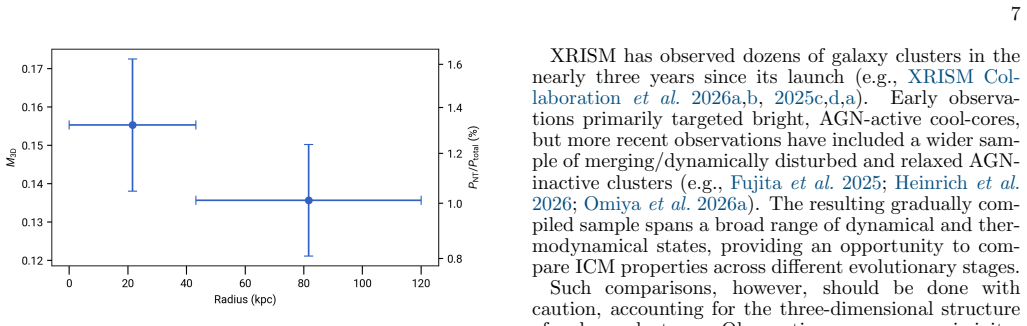
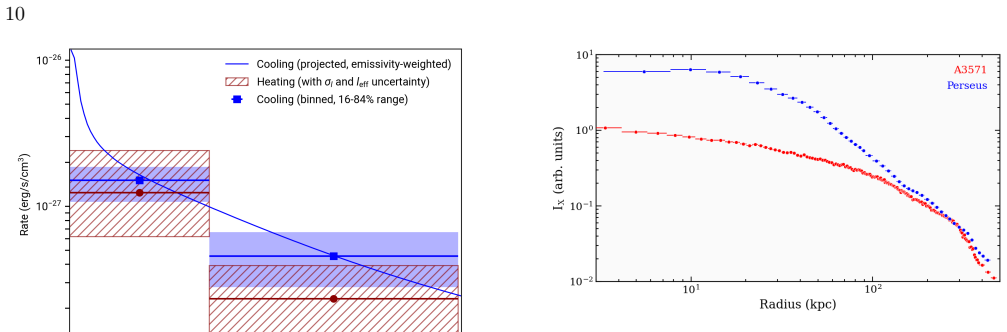
In the weak cool-core cluster A3571, XRISM measurements show velocity dispersions of 100-120 km/s that, when converted to a turbulent heating rate, are sufficient to offset cooling losses in all regions, indicating that sloshing motions contribute significantly to the heating budget.
What carries the argument
Turbulent heating rate calculated from line-of-sight velocity dispersion under the assumption of isotropic turbulence and standard dissipation timescale and volume-filling factor.
If this is right
- Sloshing motions can supply the heating needed to maintain weak cool cores even without dominant AGN feedback.
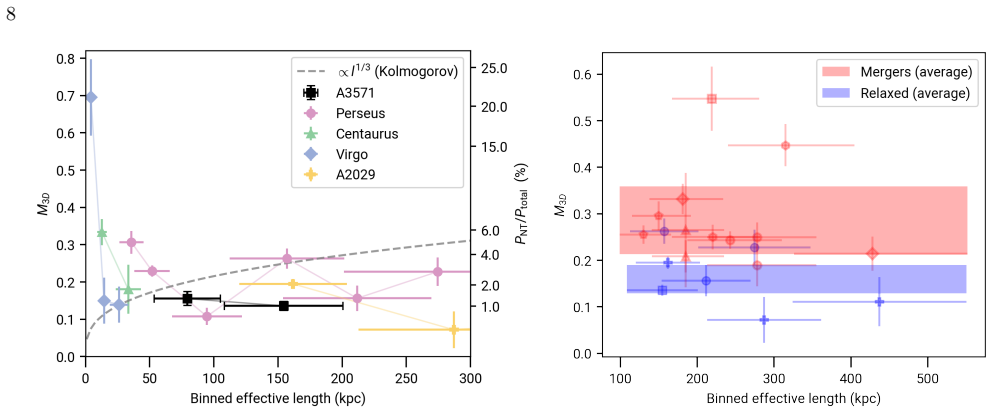
- Merging clusters exhibit roughly twice the average Mach number of relaxed systems such as A3571.
- A3571 remains a viable target for resonant scattering studies of turbulence once deeper data become available.
Where Pith is reading between the lines
- The same sloshing-driven balance may operate in other weak cool cores that lack strong central AGN activity.
- Current cosmological simulations may underpredict the contribution of sloshing to heating in relaxed clusters.
- Refined models of how line-of-sight dispersion maps to volume-filling turbulence would tighten the heating-rate constraint.
Load-bearing premise
The observed line-of-sight velocity dispersion converts to a three-dimensional turbulent heating rate only if the turbulence is isotropic and the dissipation timescale and volume-filling factor are correctly modeled.
What would settle it
A direct measurement or simulation showing that the actual turbulent energy dissipation rate in A3571 falls well below the cooling rate in one or more regions would falsify the claimed balance.
Figures
read the original abstract
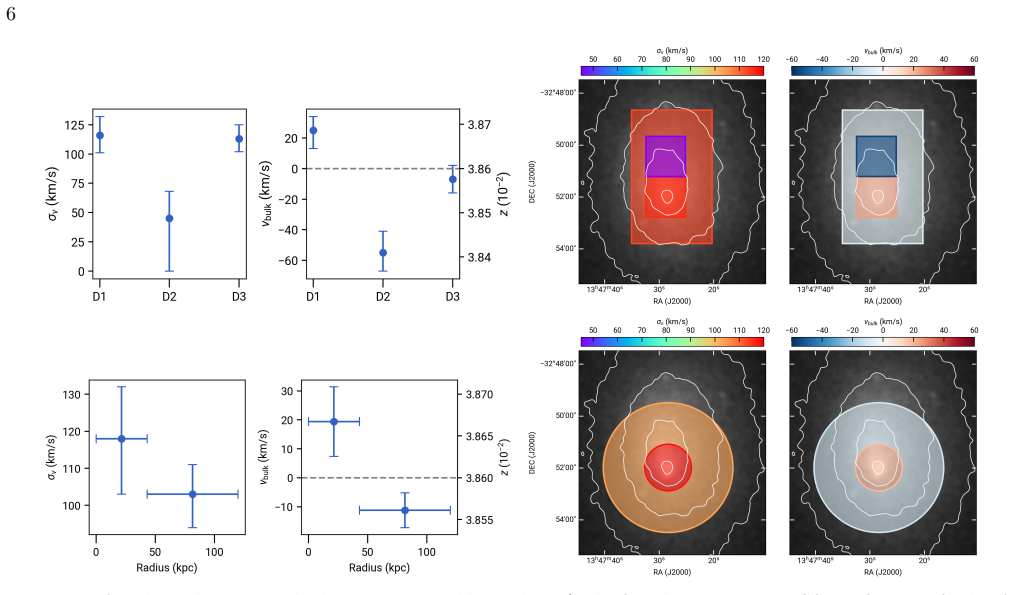
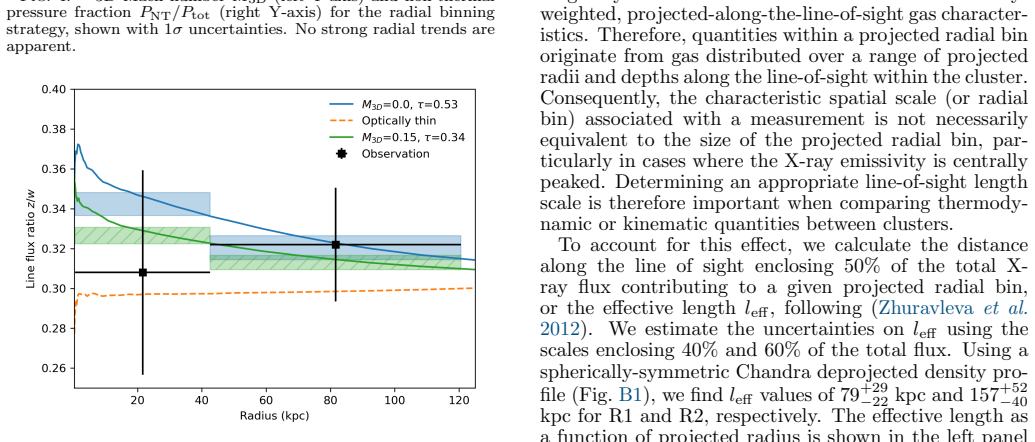
Most XRISM galaxy cluster observations to date have focused on AGN feedback or actively merging systems. The weak cool-core cluster A3571 was observed in four XRISM Cycle 1 pointings, enabling the study of gas kinematics in a relaxed, AGN-feedback-free system. We present measurements of the velocity dispersion and bulk velocity in the core regions of A3571, out to $120$ kpc. The velocity dispersion is relatively uniform across all regions ($\sim100-120 ~\mathrm{km~s^{-1}}$), except in the northern gas sloshing elongation, where a $68\%$ upper limit of $68~\mathrm{km~s^{-1}}$ is obtained. The core Mach number and non-thermal pressure fraction of A3571 are lower than in the extremely relaxed cluster A2029 and below predictions from cosmological simulation suites. Despite relatively low velocity dispersion values, the derived turbulent heating rate is sufficient to offset cooling losses in all studied regions. This suggests that sloshing motions contribute significantly to the heating budget. Comparing XRISM observations of merging and relaxed clusters, we find that mergers exhibit an average Mach number of $0.29\pm0.07$, nearly twice that of the relaxed sample, which is consistent with predictions from non-radiative cosmological simulations. A3571 is a promising target for resonant scattering studies; however, simulations indicate that deeper observations are required to obtain reliable turbulent velocities via the $z/w$ line ratio.
Editorial analysis
A structured set of objections, weighed in public.
Referee Report
Summary. The manuscript reports XRISM Cycle 1 observations of the weak cool-core cluster A3571 across four pointings. It measures line-of-sight velocity dispersions of ~100-120 km s^{-1} (uniform across core regions out to 120 kpc) with a 68% upper limit of 68 km s^{-1} in the northern sloshing elongation, along with bulk velocities. The core Mach number and non-thermal pressure fraction are reported as lower than in A2029 and below non-radiative simulation predictions. The central claim is that the derived turbulent heating rate balances X-ray cooling losses in all regions despite the low dispersions, implying sloshing motions contribute significantly to the heating budget. Comparisons of Mach numbers between merging and relaxed clusters are presented, along with prospects for resonant scattering studies.
Significance. If the heating-cooling balance holds, the result indicates that sloshing-induced turbulence can offset radiative losses in relaxed, AGN-feedback-free clusters, providing an observational anchor for ICM heating models beyond standard AGN feedback. The lower-than-predicted turbulence levels in A3571 and the factor-of-two difference in average Mach number between relaxed and merging systems offer direct tests of cosmological simulations. The identification of A3571 for future resonant scattering work adds a concrete target for deeper XRISM studies.
major comments (2)
- [Abstract and heating-rate derivation section] Abstract (final paragraph before acknowledgments) and the section deriving the turbulent heating rate: the claim that Ė_turb offsets cooling in all regions (including the northern sloshing region reported only as an upper limit) rests on converting the observed line-of-sight velocity dispersion to a 3D heating rate. This conversion invokes isotropy to obtain σ_3D, a dissipation timescale τ_diss = L/σ (L set to region size or sloshing wavelength), and an implicit volume-filling factor of order unity. These modeling choices are not independently constrained by the data; relaxing isotropy or reducing the effective filling factor would drop Ė_turb below the cooling rate.
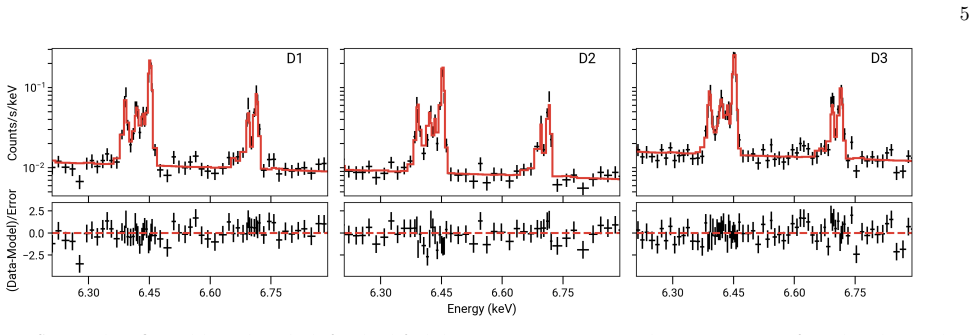
- [Results section on velocity dispersion extraction] Results section on velocity dispersion extraction: the reported uniform values of ~100-120 km s^{-1} and the northern upper limit are presented without accompanying error budgets, explicit definitions of the spatial regions, or the spectral fitting procedure (including any modeling of bulk motions versus turbulence). These details are required to assess whether the dispersions are robust enough to support the balance claim across all regions.
minor comments (2)
- [Abstract] Abstract: the statement that the turbulent heating rate 'is sufficient to offset cooling losses' does not reference the specific equation or subsection where the heating-rate formula and its inputs are defined.
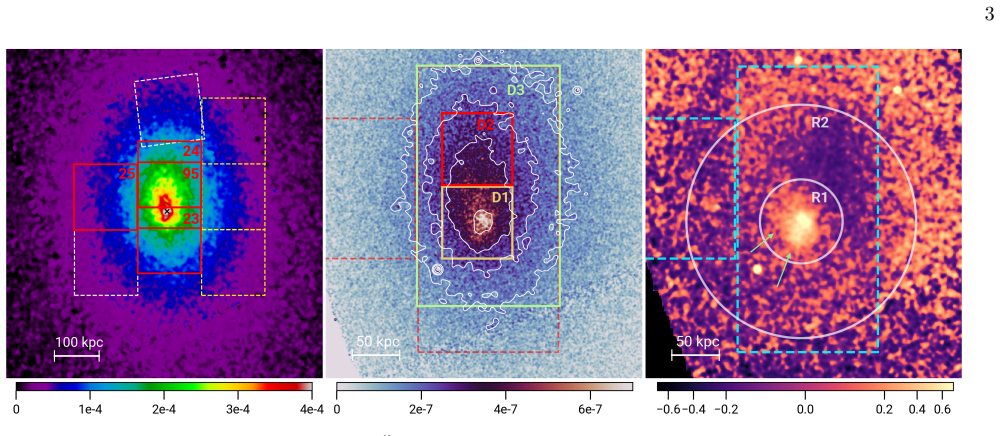
- [Figures and tables] Figure captions and text: ensure all studied regions are clearly labeled on maps or spectra, and that error bars or confidence intervals on the reported dispersions are shown in any summary table or plot.
Simulated Author's Rebuttal
We thank the referee for the constructive and detailed report. We address each major comment below with point-by-point responses and indicate where revisions will be made to improve the manuscript.
read point-by-point responses
-
Referee: [Abstract and heating-rate derivation section] Abstract (final paragraph before acknowledgments) and the section deriving the turbulent heating rate: the claim that Ė_turb offsets cooling in all regions (including the northern sloshing region reported only as an upper limit) rests on converting the observed line-of-sight velocity dispersion to a 3D heating rate. This conversion invokes isotropy to obtain σ_3D, a dissipation timescale τ_diss = L/σ (L set to region size or sloshing wavelength), and an implicit volume-filling factor of order unity. These modeling choices are not independently constrained by the data; relaxing isotropy or reducing the effective filling factor would drop Ė_turb below the cooling rate.
Authors: We agree that the turbulent heating rate derivation relies on standard assumptions (isotropy for σ_3D, τ_diss = L/σ with L set to region or sloshing scale, and volume-filling factor ≈1) that are not independently constrained by the XRISM spectra. These choices follow common practice in the ICM turbulence literature but can affect the result. In revision we will expand the relevant section to (i) explicitly list the assumptions with supporting references, (ii) add a short sensitivity discussion showing how Ė_turb changes if isotropy is relaxed or the filling factor is reduced, and (iii) qualify the northern-region statement as using the 68 % upper limit. The core claim will be presented as holding under the fiducial assumptions while acknowledging the modeling uncertainties. revision: yes
-
Referee: [Results section on velocity dispersion extraction] Results section on velocity dispersion extraction: the reported uniform values of ~100-120 km s^{-1} and the northern upper limit are presented without accompanying error budgets, explicit definitions of the spatial regions, or the spectral fitting procedure (including any modeling of bulk motions versus turbulence). These details are required to assess whether the dispersions are robust enough to support the balance claim across all regions.
Authors: The referee correctly notes that the results section currently omits a full error budget, precise spatial-region definitions, and the spectral-fitting details that separate bulk velocity from dispersion. We will revise the manuscript to add: (1) explicit definitions and sky coordinates of the four extraction regions, (2) tabulated statistical and systematic uncertainties on each velocity-dispersion measurement, and (3) a concise description of the spectral model (including the treatment of bulk motions). These additions will allow readers to evaluate the robustness of the reported values and the heating-balance claim. revision: yes
Circularity Check
No significant circularity; observational derivations use standard external formulas
full rationale
The paper reports direct spectral measurements of line-of-sight velocity dispersion (~100-120 km/s) in A3571 regions and applies standard formulas to compute Mach number, non-thermal pressure, and turbulent heating rate Ė_turb. These steps invoke external assumptions (isotropy, dissipation timescale τ_diss = L/σ, volume-filling factor) that are not defined in terms of the paper's own cooling rates or fitted to the target balance. No self-citation chain, ansatz smuggling, or renaming of results occurs; the heating-cooling comparison is a post-measurement calculation, not a reduction by construction. The derivation chain remains independent of its inputs.
Axiom & Free-Parameter Ledger
Reference graph
Works this paper leans on
-
[1]
Disentangling multiple gas kinematic drivers in the Perseus galaxy cluster. , keywords =. doi:10.1038/s41586-025-10017-x , archivePrefix =. 2509.04421 , primaryClass =
-
[2]
Using X-Ray Absorption Lines to Determine the Distances to Clusters of Galaxies. ApJ , keywords =. doi:10.1086/167876 , adsurl =
-
[3]
Resonant scattering at the center of the galaxy cluster PKS 0745-191 with XRISM. arXiv e-prints , keywords =. doi:10.48550/arXiv.2603.16263 , archivePrefix =. 2603.16263 , primaryClass =
-
[4]
Resonant scattering in the Perseus Cluster: spectral model for constraining gas motions with Astro-H
Resonant scattering in the Perseus Cluster: spectral model for constraining gas motions with Astro-H. , keywords =. doi:10.1093/mnras/stt1506 , archivePrefix =. 1308.1956 , primaryClass =
work page internal anchor Pith review Pith/arXiv arXiv doi:10.1093/mnras/stt1506 1956
-
[5]
Polarization of resonance X-ray lines from clusters of galaxies. , keywords =. doi:10.1046/j.1365-8711.2002.05390.x , archivePrefix =. astro-ph/0112382 , primaryClass =
-
[6]
Resonant scattering in galaxy clusters for anisotropic gas motions on various spatial scales
Resonant scattering in galaxy clusters for anisotropic gas motions on various spatial scales. Astronomy Letters , keywords =. doi:10.1134/S1063773711010087 , archivePrefix =. 1102.4098 , primaryClass =
work page internal anchor Pith review Pith/arXiv arXiv doi:10.1134/s1063773711010087
-
[7]
Improved measurements of turbulence in the hot gaseous atmospheres of nearby giant elliptical galaxies. , keywords =. doi:10.1093/mnras/stx2030 , archivePrefix =. 1702.04364 , primaryClass =
work page internal anchor Pith review Pith/arXiv arXiv doi:10.1093/mnras/stx2030
-
[8]
Measurements of resonant scattering in the Perseus cluster core with Hitomi SXS
Measurements of resonant scattering in the Perseus Cluster core with Hitomi SXS. , keywords =. doi:10.1093/pasj/psx127 , archivePrefix =. 1710.04648 , primaryClass =
work page internal anchor Pith review Pith/arXiv arXiv doi:10.1093/pasj/psx127
-
[9]
Optimal binning of X-ray spectra and response matrix design
Optimal binning of X-ray spectra and response matrix design. , keywords =. doi:10.1051/0004-6361/201527395 , archivePrefix =. 1601.05309 , primaryClass =
work page internal anchor Pith review Pith/arXiv arXiv doi:10.1051/0004-6361/201527395
-
[10]
Astronomical Data Analysis Software and Systems V , year = 1996, editor =
XSPEC: The First Ten Years. Astronomical Data Analysis Software and Systems V , year = 1996, editor =
1996
-
[11]
Abundances of the elements in the solar system
Abundances of the Elements in the Solar System. Landolt B. doi:10.1007/978-3-540-88055-4_34 , archivePrefix =. 0901.1149 , primaryClass =
work page internal anchor Pith review Pith/arXiv arXiv doi:10.1007/978-3-540-88055-4_34
-
[12]
1979, The Astrophysical Journal, 228, 939, doi: 10.1086/156922
Parameter estimation in astronomy through application of the likelihood ratio. , keywords =. doi:10.1086/156922 , adsurl =
-
[13]
Parameter estimation in X-ray astronomy using maximum likelihood. , keywords =. doi:10.1086/157084 , adsurl =
-
[14]
The X-ray properties and structure of A3571 up to R _ 500. , keywords =. doi:10.1051/0004-6361/202557688 , archivePrefix =. 2601.04619 , primaryClass =
-
[15]
, year = 1990, month = jul, volume =
An X-ray flux-limited sample of clusters of galaxies : evidence for evolution of the luminosity function. , year = 1990, month = jul, volume =
1990
-
[16]
Advances in Space Research , year = 2005, month = jan, volume =
Study of the structure of abell 3571: An XMM-Newton view. Advances in Space Research , year = 2005, month = jan, volume =. doi:10.1016/j.asr.2005.04.022 , adsurl =
-
[17]
Radio emission from the A3571 cluster complex: the final stage of a cluster merger?
Radio emission from the A3571 cluster complex: The final stage of a cluster merger?. , keywords =. doi:10.1051/0004-6361:20020117 , archivePrefix =. astro-ph/0201532 , primaryClass =
work page internal anchor Pith review Pith/arXiv arXiv doi:10.1051/0004-6361:20020117
-
[18]
Cool core remnants in galaxy clusters
Cool core remnants in galaxy clusters. , keywords =. doi:10.1051/0004-6361/200913156 , archivePrefix =. 0910.4900 , primaryClass =
work page internal anchor Pith review Pith/arXiv arXiv doi:10.1051/0004-6361/200913156
-
[19]
X-ray and optical observations of the Shapley supercluster in Hydra-Centaurus. , keywords =. doi:10.1093/mnras/248.1.101 , adsurl =
-
[20]
The 0.6 Mpc halo of the cD galaxy (MCG 05–33–002) in the cluster Abell 3571 revealed by the co-addition of eight Schmidt plates. , keywords =. doi:10.1093/mnras/251.1.10P , adsurl =
-
[21]
, year = 1993, month = nov, volume =
Spectroscopic observations of the galaxy cluster A 3571 (SC 1344-325). , year = 1993, month = nov, volume =
1993
-
[22]
X-ray total mass estimate for the nearby relaxed cluster A3571
X-Ray Total Mass Estimate for the Nearby Relaxed Cluster A3571. , keywords =. doi:10.1086/308906 , archivePrefix =. astro-ph/0001162 , primaryClass =
work page internal anchor Pith review Pith/arXiv arXiv doi:10.1086/308906
-
[23]
Temperature and total mass profiles of the A3571 cluster of galaxies
Temperature and total mass profiles of the A3571 cluster of galaxies. , keywords =. doi:10.1051/0004-6361:20010119 , archivePrefix =. astro-ph/0101412 , primaryClass =
work page internal anchor Pith review Pith/arXiv arXiv doi:10.1051/0004-6361:20010119
-
[24]
The Temperature Structure of 30 Nearby Clusters Observed with ASCA: Similarity of Temperature Profiles. , keywords =. doi:10.1086/305976 , archivePrefix =. astro-ph/9711289 , primaryClass =
work page internal anchor Pith review Pith/arXiv arXiv doi:10.1086/305976
-
[25]
A Redshift Survey of Nearby Galaxy Groups: the Shape of the Mass Density Profile
A Redshift Survey of Nearby Galaxy Groups: The Shape of the Mass Density Profile. , keywords =. doi:10.1086/383458 , archivePrefix =. astro-ph/0402161 , primaryClass =
work page internal anchor Pith review Pith/arXiv arXiv doi:10.1086/383458
-
[26]
HI4PI: A full-sky HI survey based on EBHIS and GASS
HI4PI: A full-sky H I survey based on EBHIS and GASS. , keywords =. doi:10.1051/0004-6361/201629178 , archivePrefix =. 1610.06175 , primaryClass =
work page internal anchor Pith review Pith/arXiv arXiv doi:10.1051/0004-6361/201629178
-
[27]
X-Ray Cavity Dynamics and Their Role in the Gas Precipitation in Planck Sunyaev-Zeldovich (SZ) Selected Clusters. , keywords =. doi:10.3847/1538-4357/ace359 , archivePrefix =. 2306.09829 , primaryClass =
-
[28]
Characterization of ICM Temperature Distributions of 62 Galaxy Clusters with XMM-Newton
Characterization of Intracluster Medium Temperature Distributions of 62 Galaxy Clusters with XMM-Newton. , keywords =. doi:10.1088/0004-637X/764/1/46 , archivePrefix =. 1212.2239 , primaryClass =
work page internal anchor Pith review Pith/arXiv arXiv doi:10.1088/0004-637x/764/1/46
-
[29]
The duty cycle of radio-mode feedback in complete samples of clusters. , keywords =. doi:10.1111/j.1365-2966.2012.22083.x , archivePrefix =. 1210.7100 , primaryClass =
-
[30]
Soviet Astronomy Letters , year = 1987, month = jan, volume =
Radial Brightness Profiles of Resonance X-Ray Lines in Galaxy Clusters. Soviet Astronomy Letters , year = 1987, month = jan, volume =
1987
-
[31]
Resonant scattering of X-ray emission lines in the hot intergalactic medium
Resonant Scattering of X-ray Emission Lines in the Hot Intergalactic Medium. , keywords =. doi:10.1007/s11214-010-9685-4 , archivePrefix =. 1007.3263 , primaryClass =
work page internal anchor Pith review Pith/arXiv arXiv doi:10.1007/s11214-010-9685-4
-
[32]
Planck 2018 results. VI. Cosmological parameters. , keywords =. doi:10.1051/0004-6361/201833910 , archivePrefix =. 1807.06209 , primaryClass =
work page internal anchor Pith review Pith/arXiv arXiv doi:10.1051/0004-6361/201833910 2018
-
[33]
A XRISM/Resolve View of the Dynamics in the Hot Gaseous Atmosphere of M87. , keywords =. doi:10.3847/1538-4357/ae2c5c , archivePrefix =. 2512.06596 , primaryClass =
-
[34]
2001, MNRAS, 328, 237, doi: 10.1046/j.1365-8711.2001.04860.x
Streaming motions of galaxy clusters within 12 000 km s ^ -1 - III. A standardized catalogue of Fundamental Plane data. , keywords =. doi:10.1046/j.1365-8711.2001.04786.x , adsurl =
-
[35]
Stirring Up the Pot: Can Cooling Flows In Galaxy Clusters Be Quenched By Gas Sloshing?
Stirring Up the Pot: Can Cooling Flows in Galaxy Clusters be Quenched by Gas Sloshing?. , keywords =. doi:10.1088/0004-637X/717/2/908 , archivePrefix =. 0912.0237 , primaryClass =
work page internal anchor Pith review Pith/arXiv arXiv doi:10.1088/0004-637x/717/2/908
-
[36]
Indirect measurements of gas velocities in galaxy clusters: effects of ellipticity and cluster dynamic state. , keywords =. doi:10.1093/mnras/stad470 , archivePrefix =. 2210.11544 , primaryClass =
-
[37]
XRISM/Resolve view of Abell 2319: Turbulence, sloshing, and ICM dynamics. , keywords =. doi:10.1093/pasj/psaf109 , archivePrefix =. 2508.05067 , primaryClass =
-
[38]
Constraining gas motion and non-thermal pressure beyond the core of the Abell 2029 galaxy cluster with XRISM. , keywords =. doi:10.1093/pasj/psaf055 , archivePrefix =. 2505.06533 , primaryClass =
-
[39]
XRISM Reveals Low Nonthermal Pressure in the Core of the Hot, Relaxed Galaxy Cluster A2029. , keywords =. doi:10.3847/2041-8213/ada7cd , archivePrefix =. 2501.05514 , primaryClass =
-
[40]
The bulk motion of gas in the core of the Centaurus galaxy cluster. , keywords =. doi:10.1038/s41586-024-08561-z , archivePrefix =. 2502.08722 , primaryClass =
-
[41]
The major cluster merger in Abell 2034 as seen by XRISM: Strong turbulence and spectral anomalies?
The major cluster merger in Abell 2034 as seen by XRISM: Strong turbulence and spectral anomalies?. arXiv e-prints , keywords =. doi:10.48550/arXiv.2604.27161 , archivePrefix =. 2604.27161 , primaryClass =
work page internal anchor Pith review Pith/arXiv arXiv doi:10.48550/arxiv.2604.27161 2034
-
[42]
XRISM-Subaru views of Abell 754: Energetic ICM motions revealed by XRISM/Resolve. , keywords =. doi:10.1093/pasj/psag013 , archivePrefix =. 2510.16553 , primaryClass =
-
[43]
Chemical enrichment in the Ophiuchus cluster core studied by high-resolution XRISM spectroscopy. , keywords =. doi:10.1093/pasj/psag001 , archivePrefix =. 2601.01114 , primaryClass =
-
[44]
A Yin-yang Galaxy Cluster Merger in A1914 Revealed by XRISM. , keywords =. doi:10.3847/2041-8213/ae2609 , archivePrefix =. 2509.19449 , primaryClass =
-
[45]
XRISM Observations of the Prototypical Cold Front in A3667. , keywords =. doi:10.3847/2041-8213/ae2a28 , archivePrefix =. 2510.26405 , primaryClass =
-
[46]
Comparing XRISM Cluster Velocity Dispersions with Predictions from Cosmological Simulations: Are Feedback Models Too Ejective?. , keywords =. doi:10.3847/2041-8213/ae100c , archivePrefix =. 2510.06322 , primaryClass =
-
[47]
, year =
Sloshing Motions in Abell 3571 Revealed by XRISM/Resolve Velocity Mapping. , year =
-
[48]
Constraints on the ICM velocity power spectrum from the X-ray lines width and shift. , keywords =. doi:10.1111/j.1365-2966.2012.20844.x , archivePrefix =. 1203.1057 , primaryClass =
-
[49]
Testing X-ray Measurements of Galaxy Clusters with Cosmological Simulations
Testing X-Ray Measurements of Galaxy Clusters with Cosmological Simulations. , keywords =. doi:10.1086/509868 , archivePrefix =. astro-ph/0609247 , primaryClass =
work page internal anchor Pith review Pith/arXiv arXiv doi:10.1086/509868
-
[50]
Effects of Galaxy Formation on Thermodynamics of the Intracluster Medium
Effects of Galaxy Formation on Thermodynamics of the Intracluster Medium. , keywords =. doi:10.1086/521328 , archivePrefix =. astro-ph/0703661 , primaryClass =
work page internal anchor Pith review Pith/arXiv arXiv doi:10.1086/521328
-
[51]
Weighing Galaxy Clusters with Gas. II. On the Origin of Hydrostatic Mass Bias in CDM Galaxy Clusters. , keywords =. doi:10.1088/0004-637X/782/2/107 , archivePrefix =. 1308.6589 , primaryClass =
work page internal anchor Pith review Pith/arXiv arXiv doi:10.1088/0004-637x/782/2/107
-
[52]
Akademiia Nauk SSSR Doklady , year = 1941, month = jan, volume =
The Local Structure of Turbulence in Incompressible Viscous Fluid for Very Large Reynolds' Numbers. Akademiia Nauk SSSR Doklady , year = 1941, month = jan, volume =
1941
-
[53]
X-Ray Imaging and Spectroscopy Mission. , keywords =. doi:10.1093/pasj/psaf023 , adsurl =
-
[54]
XRISM Forecast for the Coma Cluster: Stormy, with a Steep Power Spectrum. , keywords =. doi:10.3847/2041-8213/add2f6 , archivePrefix =. 2504.20928 , primaryClass =
-
[55]
XRISM constraints on the velocity power spectrum in the Coma cluster. , keywords =. doi:10.1051/0004-6361/202556162 , archivePrefix =. 2510.21918 , primaryClass =
-
[56]
A uniform metal distribution in the intergalactic medium of the Perseus cluster of galaxies
A uniform metal distribution in the intergalactic medium of the Perseus cluster of galaxies. , keywords =. doi:10.1038/nature12646 , archivePrefix =. 1310.7948 , primaryClass =
work page internal anchor Pith review Pith/arXiv arXiv doi:10.1038/nature12646
-
[57]
Chandra temperature profiles for a sample of nearby relaxed galaxy clusters
Chandra Temperature Profiles for a Sample of Nearby Relaxed Galaxy Clusters. , keywords =. doi:10.1086/431142 , archivePrefix =. astro-ph/0412306 , primaryClass =
work page internal anchor Pith review Pith/arXiv arXiv doi:10.1086/431142
-
[58]
XMM-Newton Observations of the Perseus Cluster. I. The Temperature and Surface Brightness Structure. , keywords =. doi:10.1086/374923 , archivePrefix =. astro-ph/0301482 , primaryClass =
work page internal anchor Pith review Pith/arXiv arXiv doi:10.1086/374923
-
[59]
Atmospheric gas dynamics in the Perseus cluster observed with Hitomi
Atmospheric gas dynamics in the Perseus cluster observed with Hitomi. , keywords =. doi:10.1093/pasj/psx138 , archivePrefix =. 1711.00240 , primaryClass =
work page internal anchor Pith review Pith/arXiv arXiv doi:10.1093/pasj/psx138
-
[60]
The Quiescent Intracluster Medium in the Core of the Perseus Cluster
The quiescent intracluster medium in the core of the Perseus cluster. , keywords =. doi:10.1038/nature18627 , archivePrefix =. 1607.04487 , primaryClass =
work page internal anchor Pith review Pith/arXiv arXiv doi:10.1038/nature18627
-
[61]
X-ray spectroscopy of galaxy clusters: studying astrophysical processes in the largest celestial laboratories. , keywords =. doi:10.1007/s00159-009-0023-3 , adsurl =
-
[62]
Handbook of X-ray and Gamma-ray Astrophysics , year = 2022, editor =
Thermodynamic Profiles of Galaxy Clusters and Groups. Handbook of X-ray and Gamma-ray Astrophysics , year = 2022, editor =. doi:10.1007/978-981-16-4544-0_119-1 , adsurl =
-
[63]
Residual Gas Motions in the Intracluster Medium and Bias in Hydrostatic Measurements of Mass Profiles of Clusters. , keywords =. doi:10.1088/0004-637X/705/2/1129 , archivePrefix =. 0903.4895 , primaryClass =
work page internal anchor Pith review Pith/arXiv arXiv doi:10.1088/0004-637x/705/2/1129
-
[64]
Turbulent Heating in Galaxy Clusters Brightest in X-rays
Turbulent heating in galaxy clusters brightest in X-rays. , keywords =. doi:10.1038/nature13830 , archivePrefix =. 1410.6485 , primaryClass =
work page internal anchor Pith review Pith/arXiv arXiv doi:10.1038/nature13830
-
[65]
XRISM observation of the Ophiuchus galaxy cluster: Quiescent velocity structure in the dynamically disturbed core. , keywords =. doi:10.1093/pasj/psaf089 , archivePrefix =. 2507.00126 , primaryClass =
-
[66]
Hydrodynamic Simulation of Non-thermal Pressure Profiles of Galaxy Clusters
Hydrodynamic Simulation of Non-thermal Pressure Profiles of Galaxy Clusters. , keywords =. doi:10.1088/0004-637X/792/1/25 , archivePrefix =. 1404.4636 , primaryClass =
work page internal anchor Pith review Pith/arXiv arXiv doi:10.1088/0004-637x/792/1/25
discussion (0)
Sign in with ORCID, Apple, or X to comment. Anyone can read and Pith papers without signing in.