Cyclic Attractor Detection in Boolean Network Dynamics under Local Logical Constraints
Pith reviewed 2026-06-30 03:16 UTC · model grok-4.3
The pith
The problem of detecting a cyclic attractor of exact period k in a Boolean network is NP-complete or polynomial-time solvable depending on which closed class of local rules from Post's lattice is used.
A machine-rendered reading of the paper's core claim, the machinery that carries it, and where it could break.
Core claim
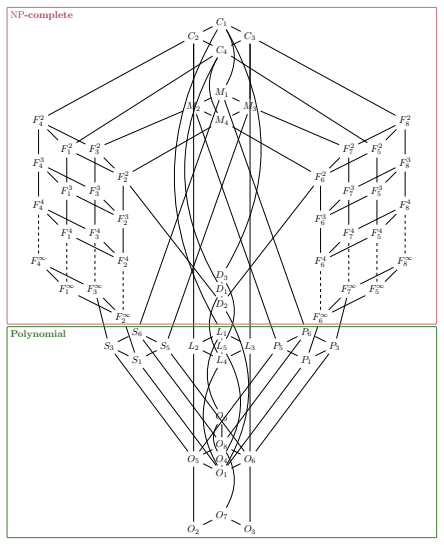
For every fixed k ≥ 2, the exact-k-cyclic-attractor problem over Boolean networks is NP-complete whenever the local rule class contains majority-like self-dual rules or one of the two mixed conjunctive-disjunctive monotone families, and it is polynomial-time solvable in all remaining Post classes, with affine rules and pure conjunctive or pure disjunctive rules with constants providing the boundary tractable cases.
What carries the argument
The classification of closed Boolean function classes given by Post's lattice, which determines whether the local rules preserve enough algebraic or ordering structure to make attractor search tractable.
If this is right
- Networks whose update rules are affine admit polynomial-time detection of period-k cycles because the preserved linear structure allows efficient solving.
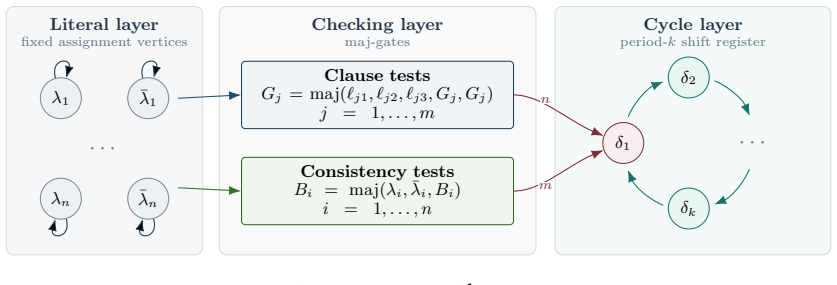
- Rule classes with self-dual majority functions allow reduction of hard consistency problems to the attractor detection task.
- Pure conjunctive rules with constants permit attractor detection by checking consistency in an order structure in polynomial time.
- The dichotomy holds for every fixed period k at least 2.
Where Pith is reading between the lines
- The findings indicate that models of gene networks using majority voting rules may require different analysis techniques than those using linear or one-sided rules.
- Similar complexity boundaries might appear in related problems such as finding fixed points rather than cycles.
- Relaxing the assumption of synchronous updates could produce a different set of tractable rule classes.
- Practical implementations could first check the rule class to decide which algorithm to apply.
Load-bearing premise
The coordinate functions are realized by circuits over a fixed finite basis of a closed Boolean-function class and the network evolves under parallel synchronous update.
What would settle it
An explicit Post class containing mixed conjunctive-disjunctive monotone rules together with a polynomial-time algorithm for the period-k problem in that class, or conversely an affine class in which the problem is NP-complete.
Figures
read the original abstract
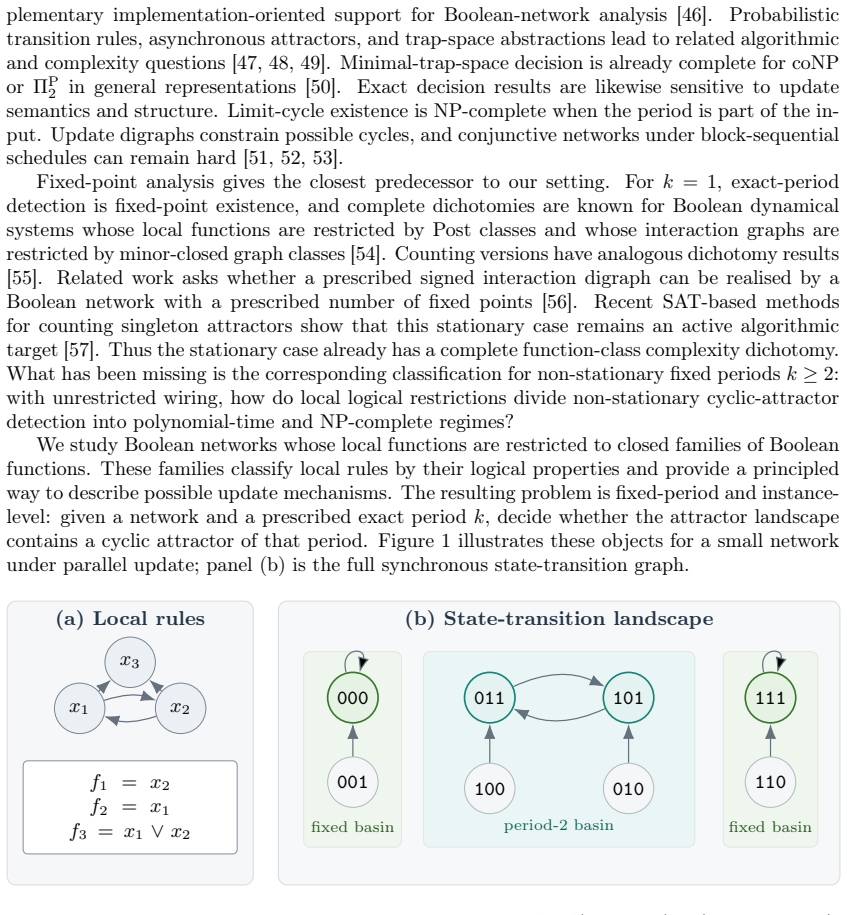
Boolean networks are finite discrete nonlinear systems whose long-term behaviour is organised by fixed-point and cyclic attractors. Detecting such recurrent states is important in applications ranging from gene regulation and neural computation to complex-network models, but the computational boundary between tractable and intractable attractor analysis is still not fully understood. We study that boundary from the perspective of local logical rules. We consider Boolean networks under parallel update whose coordinate functions are given by circuits over a fixed finite basis of a closed Boolean-function class, and ask whether the network has a cyclic attractor of prescribed exact period $k$. For every fixed $k\ge 2$, we obtain a complete complexity dichotomy over Post's lattice. The problem is $\mathrm{NP}$-complete whenever the local rule class contains majority-like self-dual rules or one of the two mixed conjunctive-disjunctive monotone families. In all remaining Post classes it is polynomial-time solvable, with affine rules and pure conjunctive or pure disjunctive rules with constants providing the boundary tractable cases. The results show that exact attractor detection is governed not only by the network architecture but also by the logical mechanism of local update: affine and one-sided rules preserve algebraic or order structure, whereas majority-like and mixed monotone rules can encode global Boolean consistency constraints.
Editorial analysis
A structured set of objections, weighed in public.
Referee Report
Summary. The paper claims a complete complexity dichotomy, for every fixed k≥2, for the problem of deciding whether a Boolean network (with parallel synchronous update) whose coordinate functions are circuits over a fixed finite basis of a closed class in Post's lattice has a cyclic attractor of exact period k. The problem is NP-complete precisely when the class contains majority-like self-dual rules or one of the two mixed conjunctive-disjunctive monotone families; it is polynomial-time solvable in all remaining classes, with affine rules and pure conjunctive or pure disjunctive rules with constants as the boundary tractable cases.
Significance. If the claimed dichotomy holds, the result is significant: it supplies a full classification of exact-period cyclic attractor detection over the standard algebraic structure of Post's lattice, showing that tractability is governed by whether the local rules preserve affine structure or one-sided order properties versus the ability to encode global Boolean consistency constraints via majority-like or mixed monotone rules. This refines the computational boundary for attractor analysis in applications such as gene regulation.
minor comments (1)
- Ensure that the main text explicitly enumerates the Post classes falling on each side of the dichotomy (rather than relying solely on the abstract's high-level description) so that readers can immediately verify the boundary cases without reconstructing the lattice.
Simulated Author's Rebuttal
We thank the referee for the positive recommendation to accept and for the accurate summary of the complexity dichotomy over Post's lattice.
Circularity Check
No significant circularity; classification is external to the paper
full rationale
The paper establishes a complexity dichotomy for cyclic attractor detection by partitioning over the standard, externally defined Post's lattice of Boolean function classes. The tractable and NP-complete cases are identified by algebraic properties of those classes (affine, pure conjunctive/disjunctive with constants vs. majority-like self-dual or mixed monotone families), with no equations, reductions, or predictions that collapse back to fitted parameters or self-defined quantities. No self-citations are invoked as load-bearing uniqueness theorems, and the problem formulation (circuits over a fixed basis, parallel update, exact period k) introduces no internal self-reference that would make the claimed boundaries tautological. The result is therefore a standard complexity classification against an independent mathematical structure.
Axiom & Free-Parameter Ledger
axioms (2)
- standard math Post's lattice enumerates all closed classes of Boolean functions under composition
- domain assumption Network evolution uses parallel (synchronous) update
Reference graph
Works this paper leans on
-
[1]
Steven H. Strogatz. “Exploring Complex Networks”. In:Nature410.6825 (2001), pp. 268– 276.doi:10.1038/35065725
-
[2]
Complex Networks: Structure and Dynamics
S. Boccaletti et al. “Complex Networks: Structure and Dynamics”. In:Physics Reports424 (2006), pp. 175–308.doi:10.1016/j.physrep.2005.10.009
-
[3]
Statistical Mechanics of Complex Networks
Réka Albert and Albert-László Barabási. “Statistical Mechanics of Complex Networks”. In: Reviews of Modern Physics74.1 (2002), pp. 47–97.doi:10.1103/RevModPhys.74.47
-
[4]
The Structure and Function of Complex Networks
M. E. J. Newman. “The Structure and Function of Complex Networks”. In:SIAM Review 45.2 (2003), pp. 167–256.doi:10.1137/S003614450342480
-
[5]
A Logical Calculus of the Ideas Immanent in Nervous Activity
Warren S. McCulloch and Walter Pitts. “A Logical Calculus of the Ideas Immanent in Nervous Activity”. In:The Bulletin of Mathematical Biophysics5.4 (1943), pp. 115–133. doi:10.1007/BF02478259
-
[6]
MetabolicStabilityandEpigenesisinRandomlyConstructedGenetic Nets
StuartA.Kauffman.“MetabolicStabilityandEpigenesisinRandomlyConstructedGenetic Nets”. In:Journal of Theoretical Biology22.3 (1969), pp. 437–467.doi:10.1016/0022- 5193(69)90015-0
-
[7]
Boolean Formalization of Genetic Control Circuits
René Thomas. “Boolean Formalization of Genetic Control Circuits”. In:Journal of Theo- retical Biology42.3 (1973), pp. 563–585.doi:10.1016/0022-5193(73)90247-6
-
[8]
The Logical Analysis of Continuous, Non-linear Biochemical Control Networks
Leon Glass and Stuart A. Kauffman. “The Logical Analysis of Continuous, Non-linear Biochemical Control Networks”. In:Journal of Theoretical Biology39.1 (1973), pp. 103– 129.doi:10.1016/0022-5193(73)90208-7. 16
-
[9]
Neural Networks and Physical Systems with Emergent Collective Com- putational Abilities
John J. Hopfield. “Neural Networks and Physical Systems with Emergent Collective Com- putational Abilities”. In:Proceedings of the National Academy of Sciences79.8 (1982), pp. 2554–2558.doi:10.1073/pnas.79.8.2554
-
[10]
Information Flows, Graphs and Their Guessing Numbers
Søren Riis. “Information Flows, Graphs and Their Guessing Numbers”. In:The Electronic Journal of Combinatorics14.1 (2007), R44.doi:10.37236/962
-
[11]
Graph-Theoretical Constructions for Graph En- tropy and Network Coding Based Communications
Maximilien Gadouleau and Søren Riis. “Graph-Theoretical Constructions for Graph En- tropy and Network Coding Based Communications”. In:IEEE Transactions on Information Theory57.10 (2011), pp. 6703–6717.doi:10.1109/TIT.2011.2155618
-
[12]
Reduction and Fixed Points of Boolean Networks and Linear Network Coding Solvability
Maximilien Gadouleau, Adrien Richard, and Eric Fanchon. “Reduction and Fixed Points of Boolean Networks and Linear Network Coding Solvability”. In:IEEE Transactions on Information Theory62.5 (2016), pp. 2504–2519.doi:10.1109/TIT.2016.2544344
-
[13]
A General Model of Binary Opinions Updating
Alexis Poindron. “A General Model of Binary Opinions Updating”. In:Mathematical Social Sciences109 (2021), pp. 52–76.doi:10.1016/j.mathsocsci.2020.10.004
-
[14]
Dynamics of Neural Networks over Undirected Graphs
Eric Goles and Gonzalo A. Ruz. “Dynamics of Neural Networks over Undirected Graphs”. In:Neural Networks63 (2015), pp. 156–169.doi:10.1016/j.neunet.2014.10.013
-
[15]
Heteroclinic Cycles in Hopfield Networks
Pascal Chossat and Maciej Krupa. “Heteroclinic Cycles in Hopfield Networks”. In:Journal of Nonlinear Science26.2 (2015), pp. 315–344.doi:10.1007/s00332-015-9276-3
-
[16]
Vandana M. Ladwani and V. Ramasubramanian. “Connectionist Temporal Sequence De- coding: M-ary Hopfield Neural-Network with Multi-limit Cycle Formulation”. In:Artificial Neural Networks and Machine Learning – ICANN 2023. Vol. 14258. Lecture Notes in Com- puter Science. Springer Nature Switzerland, 2023, pp. 255–268.doi:10.1007/978-3-031- 44192-9_21
-
[17]
Limit Cycles in Models of Circular Gene Networks Regulated by Negative Feedback Loops
Vitaly A. Likhoshvai, Vladimir P. Golubyatnikov, and Tamara M. Khlebodarova. “Limit Cycles in Models of Circular Gene Networks Regulated by Negative Feedback Loops”. In: BMC Bioinformatics21.S11 (2020), p. 255.doi:10.1186/s12859-020-03598-z
-
[18]
Positive Feedback Loops and Multistationarity
R. Thomas and J. Richelle. “Positive Feedback Loops and Multistationarity”. In:Discrete Applied Mathematics19.1–3 (1988), pp. 381–396.doi:10.1016/0166-218X(88)90026-1
-
[19]
R. Thomas and M. Kaufman. “Multistationarity, the Basis of Cell Differentiation and Memory. II. Logical Analysis of Regulatory Networks in Terms of Feedback Circuits”. In: Chaos: An Interdisciplinary Journal of Nonlinear Science11.1 (2001), pp. 180–195.doi: 10.1063/1.1349893
-
[20]
Negative Circuits and Sustained Oscillations in Asynchronous Automata Networks
Adrien Richard. “Negative Circuits and Sustained Oscillations in Asynchronous Automata Networks”. In:Advances in Applied Mathematics44.4 (2010), pp. 378–392.doi:10.1016/ j.aam.2009.11.011
2010
-
[21]
Positive and Negative Cycles in Boolean Networks
Adrien Richard. “Positive and Negative Cycles in Boolean Networks”. In:Journal of The- oretical Biology463 (2019), pp. 67–76.doi:10.1016/j.jtbi.2018.11.028
-
[22]
Number of Fixed Points and Disjoint Cycles in Monotone Boolean Networks
Julio Aracena, Adrien Richard, and Lilian Salinas. “Number of Fixed Points and Disjoint Cycles in Monotone Boolean Networks”. In:SIAM Journal on Discrete Mathematics31.3 (2017), pp. 1702–1725.doi:10.1137/16M1060868
-
[23]
Local Negative Circuits and Cyclic Attractors in Boolean Networks with at Most Five Components
Elisa Tonello, Etienne Farcot, and Claudine Chaouiya. “Local Negative Circuits and Cyclic Attractors in Boolean Networks with at Most Five Components”. In:SIAM Journal on Applied Dynamical Systems18.1 (2019), pp. 68–79.doi:10.1137/18M1173988
-
[24]
Attractor Separation and Signed Cycles in Asyn- chronous Boolean Networks
Adrien Richard and Elisa Tonello. “Attractor Separation and Signed Cycles in Asyn- chronous Boolean Networks”. In:Theoretical Computer Science947 (2023), p. 113706. doi:10.1016/j.tcs.2023.113706. 17
-
[25]
Random Networks of Automata: A Simple Annealed Ap- proximation
B. Derrida and Y. Pomeau. “Random Networks of Automata: A Simple Annealed Ap- proximation”. In:Europhysics Letters (EPL)1.2 (1986), pp. 45–49.doi:10.1209/0295- 5075/1/2/001
-
[26]
Boolean Dynamics with Random Couplings
Maximino Aldana, Susan Coppersmith, and Leo P. Kadanoff. “Boolean Dynamics with Random Couplings”. In:Perspectives and Problems in Nonlinear Science. Springer New York, 2003, pp. 23–89.doi:10.1007/978-0-387-21789-5_2
-
[27]
Barbara Drossel. “Random Boolean Networks”. In:Reviews of Nonlinear Dynamics and Complexity. Wiley, 2008, pp. 69–110.doi:10.1002/9783527626359.ch3
-
[28]
Superpolynomial Growth in the Number of Attractors in Kauffman Networks
Björn Samuelsson and Carl Troein. “Superpolynomial Growth in the Number of Attractors in Kauffman Networks”. In:Physical Review Letters90.9 (2003), p. 098701.doi:10.1103/ PhysRevLett.90.098701
2003
-
[29]
NumberofAttractorsinRandomBooleanNetworks
BarbaraDrossel.“NumberofAttractorsinRandomBooleanNetworks”.In:Physical Review E72.1 (2005), p. 016110.doi:10.1103/PhysRevE.72.016110
-
[30]
Stable and Unstable Attractors in Boolean Networks
Konstantin Klemm and Stefan Bornholdt. “Stable and Unstable Attractors in Boolean Networks”. In:Physical Review E72.5 (2005), p. 055101.doi:10.1103/PhysRevE.72. 055101
-
[31]
Attractors in Continuous and Boolean Networks
Johannes Norrell, Björn Samuelsson, and Joshua E. S. Socolar. “Attractors in Continuous and Boolean Networks”. In:Physical Review E76.4 (2007), p. 046122.doi:10 . 1103 / PhysRevE.76.046122
2007
-
[32]
Damage Spreading and the Lyapunov Spectrum of Cellular Automata and Boolean Networks
Milan Vispoel, Aisling J. Daly, and Jan M. Baetens. “Damage Spreading and the Lyapunov Spectrum of Cellular Automata and Boolean Networks”. In:Chaos, Solitons & Fractals184 (2024), p. 114989.doi:10.1016/j.chaos.2024.114989
-
[33]
Choices of Regulatory Logic Class Modulate the Dynamical Regime in Random Boolean Networks
Priyotosh Sil et al. “Choices of Regulatory Logic Class Modulate the Dynamical Regime in Random Boolean Networks”. In:Chaos, Solitons & Fractals195 (2025), p. 116231.doi: 10.1016/j.chaos.2025.116231
-
[34]
Chenggui Yao, Wei Zou, and Jürgen Kurths. “Cluster Synchronization in Boolean Neuronal Networks: Roles of Temperature, Time-Delay and Network Topology”. In:Chaos, Solitons & Fractals200 (2025), p. 117136.doi:10.1016/j.chaos.2025.117136
-
[35]
Strategic Node Identification in Complex Network Dynamics
Elaheh Nikougoftar. “Strategic Node Identification in Complex Network Dynamics”. In: Chaos, Solitons & Fractals187 (2024), p. 115348.doi:10.1016/j.chaos.2024.115348
-
[36]
Dynamics Resilience of Complex Networks under Edge-Additions
Xingyue Wen et al. “Dynamics Resilience of Complex Networks under Edge-Additions”. In: Chaos, Solitons & Fractals201 (2025), p. 117389.doi:10.1016/j.chaos.2025.117389
-
[37]
Cyclic Symmetric Dynamics in Chaotic Maps
Jin Liu, Kehui Sun, and Huihai Wang. “Cyclic Symmetric Dynamics in Chaotic Maps”. In: Chaos, Solitons & Fractals189 (2024), p. 115684.doi:10.1016/j.chaos.2024.115684
-
[38]
The Effect of Network Topology on the Stability of Discrete State Models of Genetic Control
Andrew Pomerance et al. “The Effect of Network Topology on the Stability of Discrete State Models of Genetic Control”. In:Proceedings of the National Academy of Sciences 106.20 (2009), pp. 8209–8214.doi:10.1073/pnas.0900142106
-
[39]
Algorithms for Finding Small Attractors in Boolean Networks
Shu-Qin Zhang et al. “Algorithms for Finding Small Attractors in Boolean Networks”. In: EURASIP Journal on Bioinformatics and Systems Biology2007 (2007), pp. 1–13.doi: 10.1155/2007/20180
-
[40]
A SAT-Based Algorithm for Finding Attractors in Synchronous Boolean Networks
Elena Dubrova and Maxim Teslenko. “A SAT-Based Algorithm for Finding Attractors in Synchronous Boolean Networks”. In:IEEE/ACM Transactions on Computational Biology and Bioinformatics8.5 (2011), pp. 1393–1399.doi:10.1109/TCBB.2010.20. 18
-
[41]
An Efficient Algorithm for Computing Attractors of Synchronous and Asynchronous Boolean Networks
Desheng Zheng et al. “An Efficient Algorithm for Computing Attractors of Synchronous and Asynchronous Boolean Networks”. In:PLoS ONE8.4 (2013), e60593.doi:10.1371/ journal.pone.0060593
2013
-
[42]
Tarek Khaled, Belaid Benhamou, and Van-Giang Trinh. “Using Answer Set Programming to Deal with Boolean Networks and Attractor Computation: Application to Gene Regula- tory Networks of Cells”. In:Annals of Mathematics and Artificial Intelligence91.5 (2023), pp. 713–750.doi:10.1007/s10472-023-09886-7
-
[43]
Attractor Detection and Enumeration Algorithms for Boolean Networks
Tomoya Mori and Tatsuya Akutsu. “Attractor Detection and Enumeration Algorithms for Boolean Networks”. In:Computational and Structural Biotechnology Journal20 (2022), pp. 2512–2520.doi:10.1016/j.csbj.2022.05.027
-
[44]
Identification of Periodic Attractors in Boolean Networks Using a Priori Information
Ulrike Münzner et al. “Identification of Periodic Attractors in Boolean Networks Using a Priori Information”. In:PLoS Computational Biology18.1 (2022), e1009702.doi:10.1371/ journal.pcbi.1009702
2022
-
[45]
Exploring Attractor Bifurcations in Boolean Networks
Nikola Beneš et al. “Exploring Attractor Bifurcations in Boolean Networks”. In:BMC Bioinformatics23.1 (2022), p. 173.doi:10.1186/s12859-022-04708-9
-
[46]
BooN: Boolean network analysis software
Franck Delaplace. “BooN: Boolean network analysis software”. In:Bioinformatics Advances 5.1 (2025), vbaf082.doi:10.1093/bioadv/vbaf082
-
[47]
G. Li et al. “Dynamics of Generalized Asynchronous Boolean Networks Based on Proba- bility Transition: Searching for Attractors and Basins”. In:Chaos, Solitons & Fractals197 (2025), p. 116467.doi:10.1016/j.chaos.2025.116467
-
[48]
Finding Attractors in Asynchronous Boolean Dynamics
Thomas Skodawessely and Konstantin Klemm. “Finding Attractors in Asynchronous Boolean Dynamics”. In:Advances in Complex Systems14.3 (2011), pp. 439–449.doi: 10.1142/S0219525911003098
-
[49]
Computing Maximal and Min- imal Trap Spaces of Boolean Networks
Hannes Klarner, Alexander Bockmayr, and Heike Siebert. “Computing Maximal and Min- imal Trap Spaces of Boolean Networks”. In:Natural Computing14.4 (2015), pp. 535–544. doi:10.1007/s11047-015-9520-7
-
[50]
Computational Complexity of Minimal Trap Spaces in Boolean Networks
Kyungduk Moon, Kangbok Lee, and Loïc Paulevé. “Computational Complexity of Minimal Trap Spaces in Boolean Networks”. In:SIAM Journal on Discrete Mathematics38.4 (2024), pp. 2691–2708.doi:10.1137/23M1553248
-
[51]
Complexity of Limit-Cycle Problems in Boolean Networks
Florian Bridoux et al. “Complexity of Limit-Cycle Problems in Boolean Networks”. In: SOFSEM 2021: Theory and Practice of Computer Science. Vol. 12607. Lecture Notes in Computer Science. Springer, 2021, pp. 135–146.doi:10.1007/978-3-030-67731-2_10
-
[52]
Limit Cycles and Update Digraphs in Boolean Networks
Julio Aracena, Luis Gómez, and Lilian Salinas. “Limit Cycles and Update Digraphs in Boolean Networks”. In:Discrete Applied Mathematics161.1–2 (2013), pp. 1–12.doi:10. 1016/j.dam.2012.07.003
2013
-
[53]
Complexity of Limit Cycles with Block-Sequential Update Schedules in Conjunctive Networks
Julio Aracena et al. “Complexity of Limit Cycles with Block-Sequential Update Schedules in Conjunctive Networks”. In:Natural Computing22 (2023), pp. 411–429.doi:10.1007/ s11047-023-09947-0
2023
-
[54]
Dichotomy Results for Fixed-Point Existence Problems for Boolean Dy- namical Systems
Sven Kosub. “Dichotomy Results for Fixed-Point Existence Problems for Boolean Dy- namical Systems”. In:Mathematics in Computer Science1.3 (2008), pp. 487–505.doi: 10.1007/s11786-007-0038-y
-
[55]
Dichotomy Results for Fixed Point Counting in Boolean Dynamical Systems
Christopher M. Homan and Sven Kosub. “Dichotomy Results for Fixed Point Counting in Boolean Dynamical Systems”. In:Theoretical Computer Science573 (2015), pp. 16–25. doi:10.1016/j.tcs.2015.01.040. 19
-
[56]
Complexity of Fixed Point Counting Problems in Boolean Net- works
Florian Bridoux et al. “Complexity of Fixed Point Counting Problems in Boolean Net- works”. In:Journal of Computer and System Sciences126 (2022), pp. 138–164.doi:10. 1016/j.jcss.2022.01.004
2022
-
[57]
A SAT-Based Method for Counting All Singleton Attractors in Boolean Networks
Rei Higuchi et al. “A SAT-Based Method for Counting All Singleton Attractors in Boolean Networks”.In:Proceedings of the Thirty-Fourth International Joint Conference on Artificial Intelligence. International Joint Conferences on Artificial Intelligence Organization, 2025, pp. 2601–2609.doi:10.24963/ijcai.2025/290
-
[58]
Springer Monographs in Mathematics
Dietlinde Lau.Function Algebras on Finite Sets: Basic Course on Many-Valued Logic and Clone Theory. Springer Monographs in Mathematics. Berlin: Springer, 2006.doi:10.1007/ 3-540-36023-9
2006
-
[59]
S. V. Yablonsky, G. P. Gavrilov, and V. B. Kudryavtsev.Functions of the Algebra of Logic and Post Classes. In Russian. Moscow: Nauka, 1966. 120 pp
1966
-
[60]
Garey and David S
Michael R. Garey and David S. Johnson.Computers and Intractability: A Guide to the Theory of NP-Completeness. San Francisco: W. H. Freeman, 1979.isbn: 0-7167-1045-5
1979
-
[61]
Attractor Identification in Asynchronous Boolean Dynam- ics with Network Reduction
Elisa Tonello and Loïc Paulevé. “Attractor Identification in Asynchronous Boolean Dynam- ics with Network Reduction”. In:Computational Methods in Systems Biology. Vol. 14137. Lecture Notes in Computer Science. Springer Nature Switzerland, 2023, pp. 202–219.doi: 10.1007/978-3-031-42697-1_14
-
[62]
Mapping the Attractor Landscape of Boolean Networks with biobalm
Van-Giang Trinh et al. “Mapping the Attractor Landscape of Boolean Networks with biobalm”. In:Bioinformatics41.5 (2025), btaf280.doi:10 . 1093 / bioinformatics / btaf280
2025
-
[63]
The Basis of Easy Controllability in Boolean Networks
Enrico Borriello and Bryan C. Daniels. “The Basis of Easy Controllability in Boolean Networks”. In:Nature Communications12.1 (2021), p. 5227.doi:10.1038/s41467-021- 25533-3
-
[64]
Difficult Control Is Related to Instability in Bi- ologically Inspired Boolean Networks
Bryan C. Daniels and Enrico Borriello. “Difficult Control Is Related to Instability in Bi- ologically Inspired Boolean Networks”. In:PLOS Complex Systems2.1 (2025), e0000025. doi:10.1371/journal.pcsy.0000025
-
[65]
Lattice Structures That Parameterize Regulatory Network Dynamics
Tomáš Gedeon. “Lattice Structures That Parameterize Regulatory Network Dynamics”. In: Mathematical Biosciences374 (2024), p. 109225.doi:10.1016/j.mbs.2024.109225
-
[66]
An Open Problem: Why Are Motif-Avoidant Attractors So Rare in Asynchronous Boolean Networks?
Samuel Pastva et al. “An Open Problem: Why Are Motif-Avoidant Attractors So Rare in Asynchronous Boolean Networks?” In:Journal of Mathematical Biology91.1 (2025), p. 11. doi:10.1007/s00285-025-02235-8. 20
discussion (0)
Sign in with ORCID, Apple, or X to comment. Anyone can read and Pith papers without signing in.