SN 2019vxm: A luminous and long-lived Type IIn supernova with early flash-ionisation features
Pith reviewed 2026-06-30 03:43 UTC · model grok-4.3
The pith
SN 2019vxm reaches a peak of MV = -20.01 mag and its early flash-ionization lines set a lower limit of 0.01 solar masses per year on the progenitor mass-loss rate.
A machine-rendered reading of the paper's core claim, the machinery that carries it, and where it could break.
Core claim
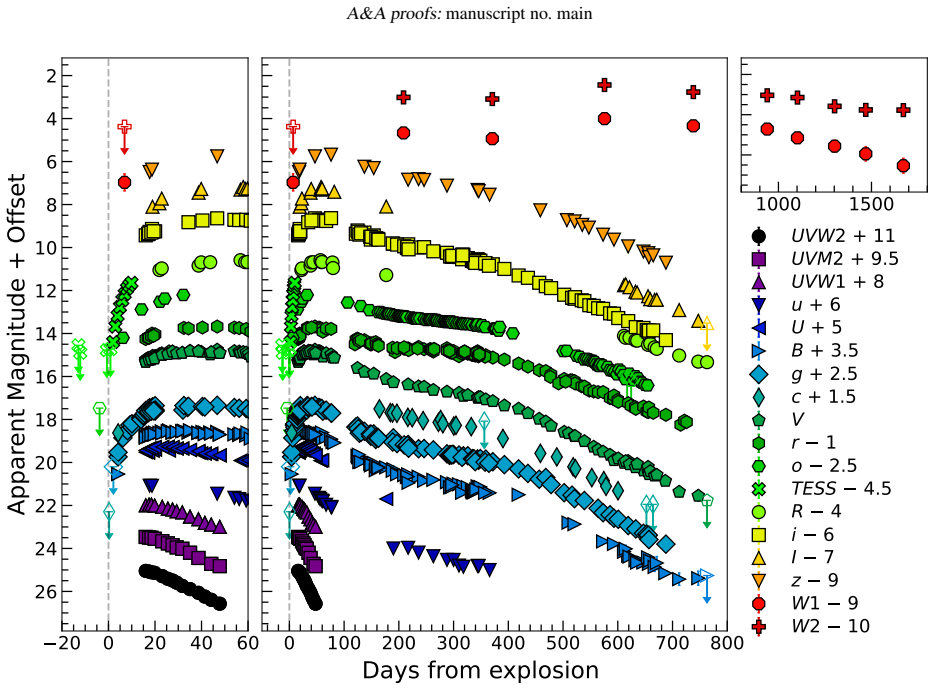
SN 2019vxm is a luminous long-lived Type IIn event whose peak absolute magnitude is MV = -20.01 +/- 0.13 mag at 35 days post-explosion. Its spectra begin with narrow symmetric Balmer lines and flash-ionization features; comparison with interacting-supernova models gives a progenitor mass-loss rate lower limit of at least 0.01 solar masses per year. The light curve and spectral evolution remain slow for months, a mid-infrared excess signals dust formation starting at or after 210 days, and line profiles later become broader and blueshifted, indicating ongoing circumstellar interaction.
What carries the argument
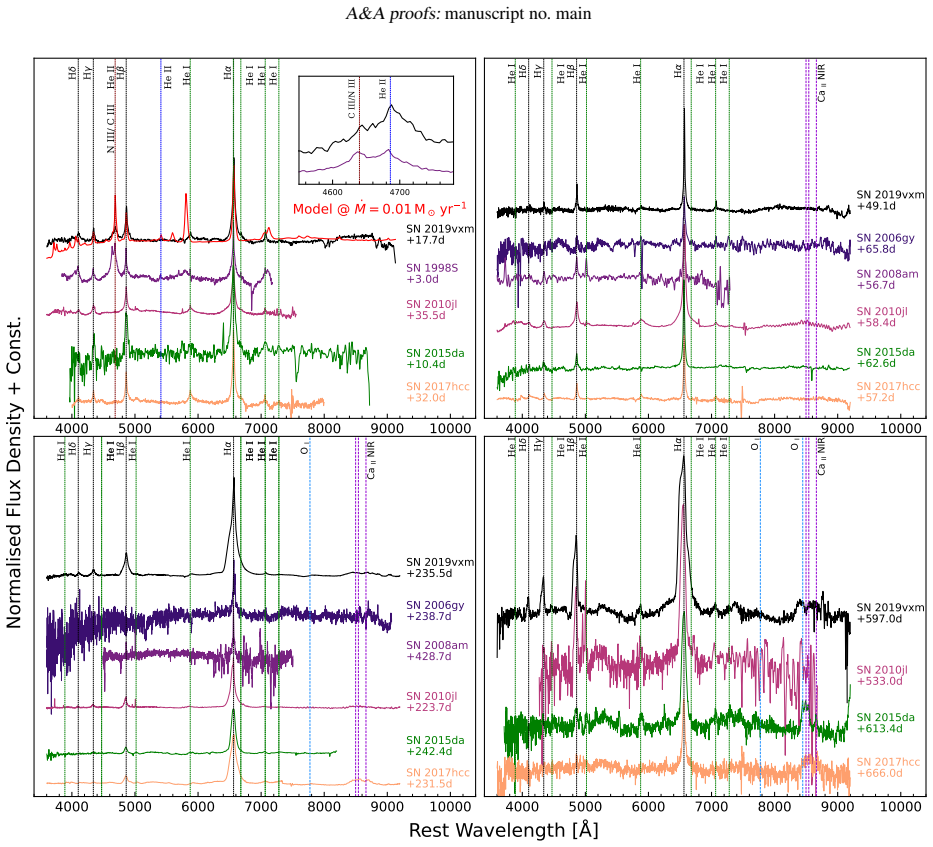
Comparison of the observed early flash-ionized spectrum to existing early-interacting SN spectral models, used to infer the density and thus the mass-loss rate of the progenitor's circumstellar material.
If this is right
- The progenitor expelled material at a rate of at least 0.01 solar masses per year in the years preceding explosion.
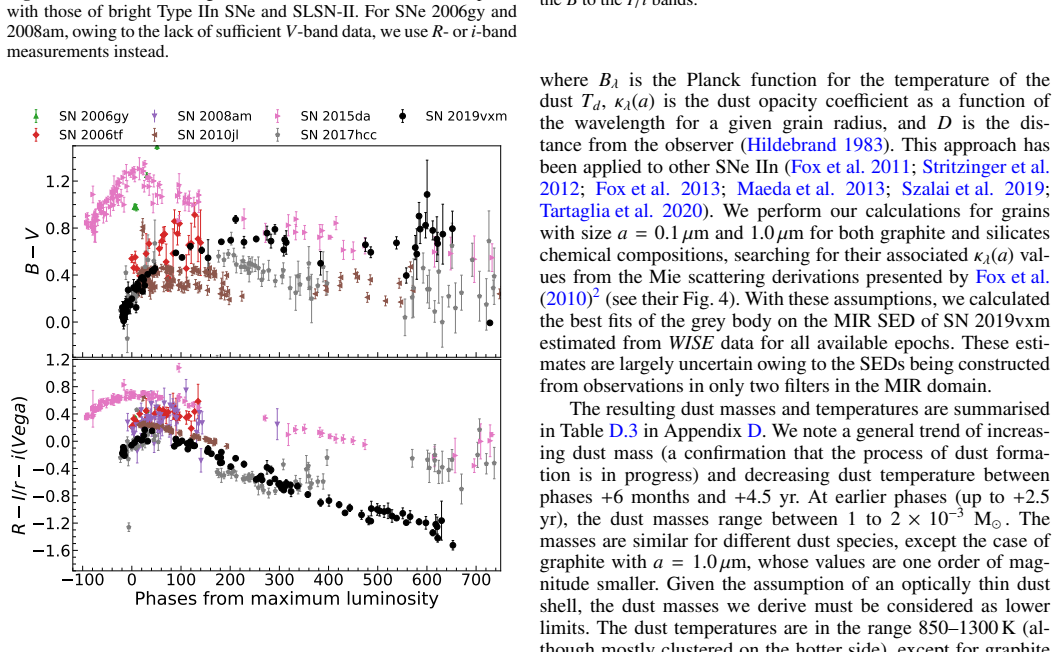
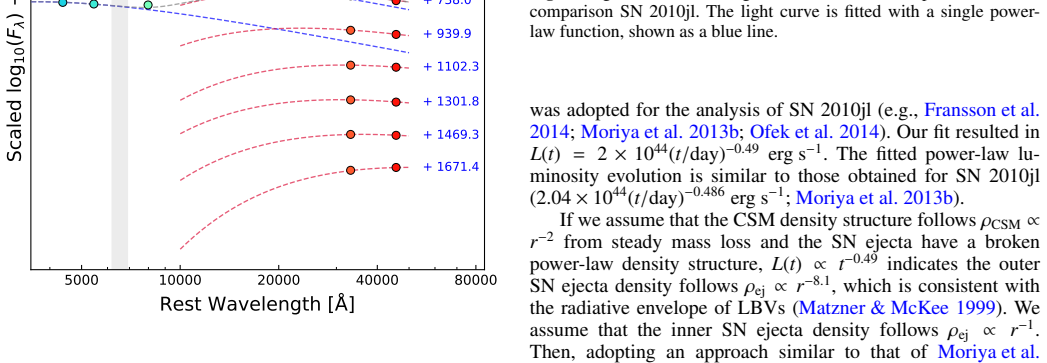
- A few 10^-3 solar masses of dust formed at or after 210 days, possibly reaching 0.01 solar masses by +4.5 years.
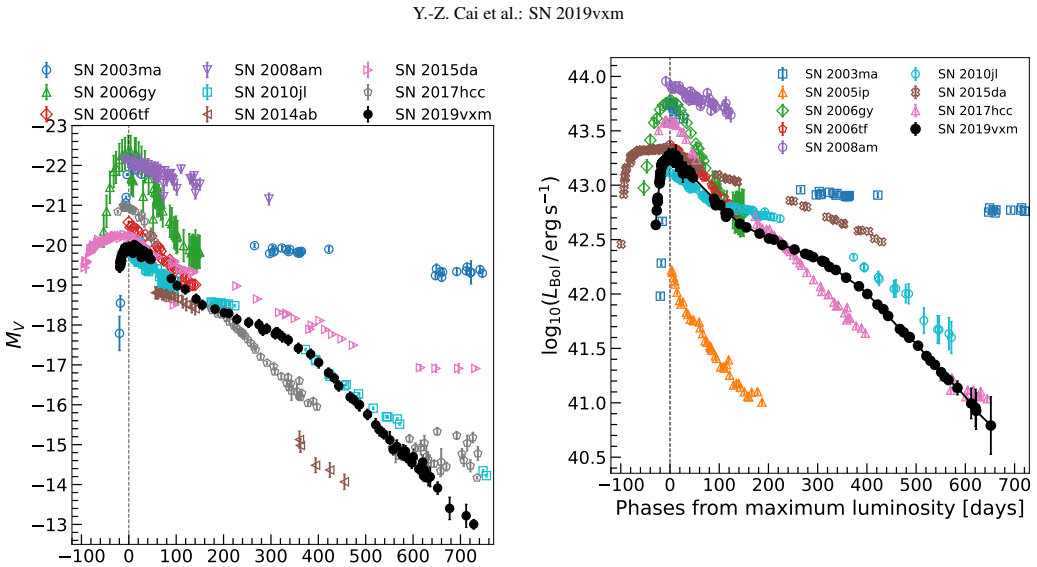
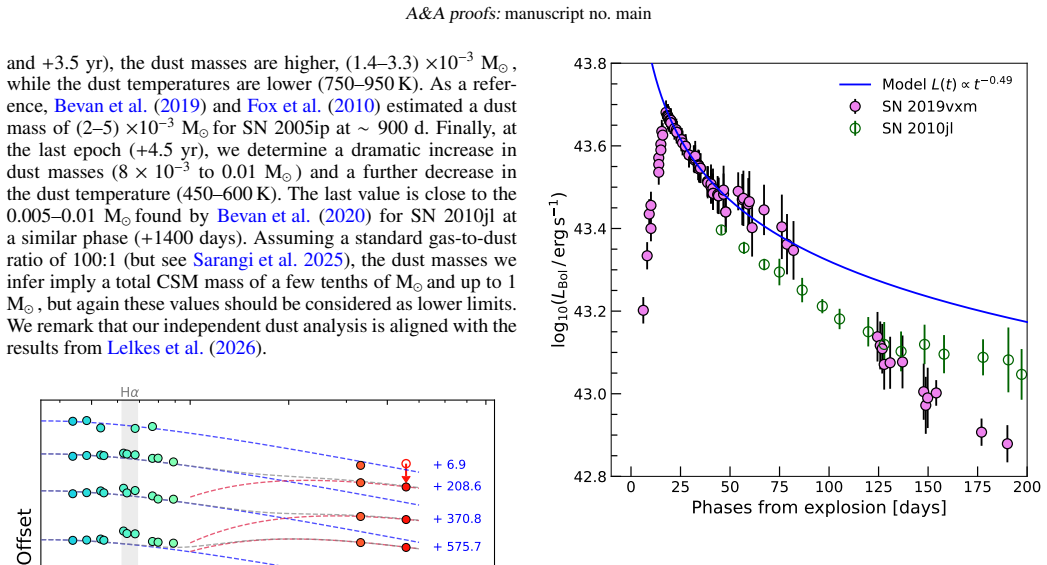
- The bolometric luminosity before 100 days follows L(t) proportional to t to the power -0.49, matching the interaction-powered phase seen in SN 2010jl.
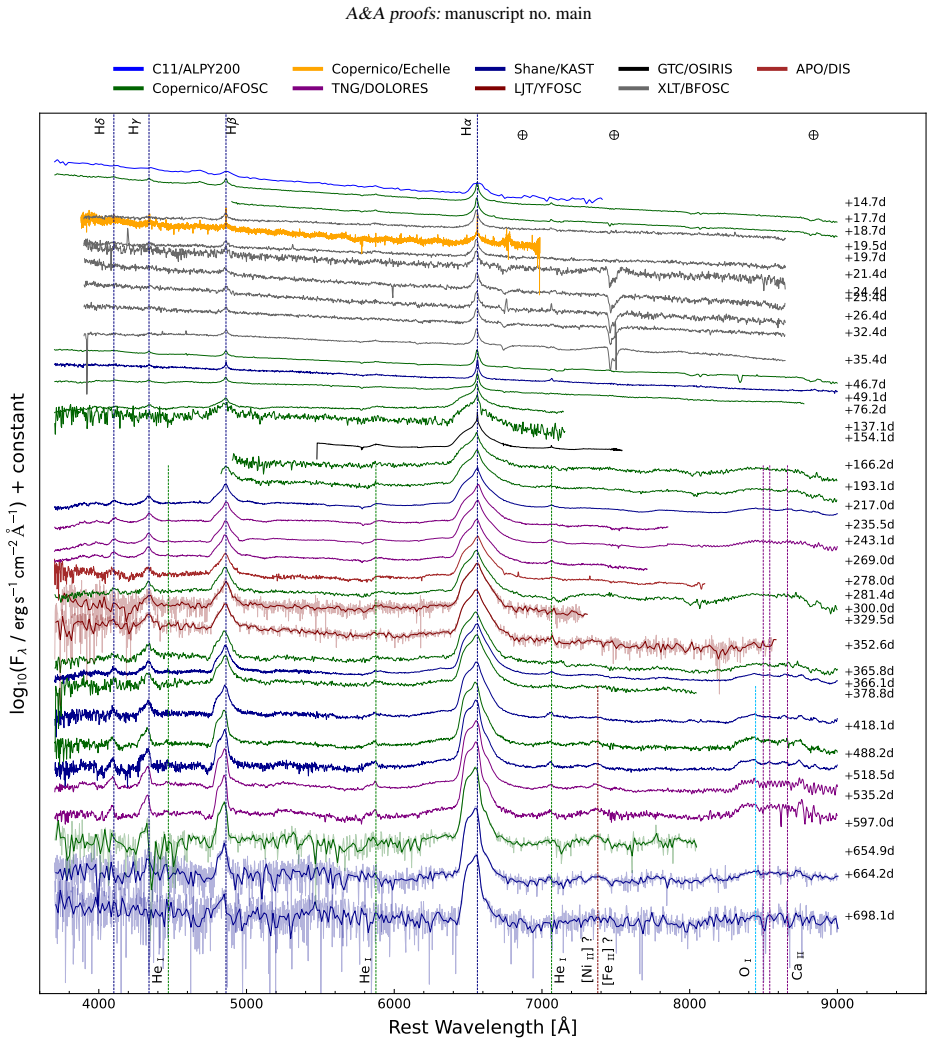
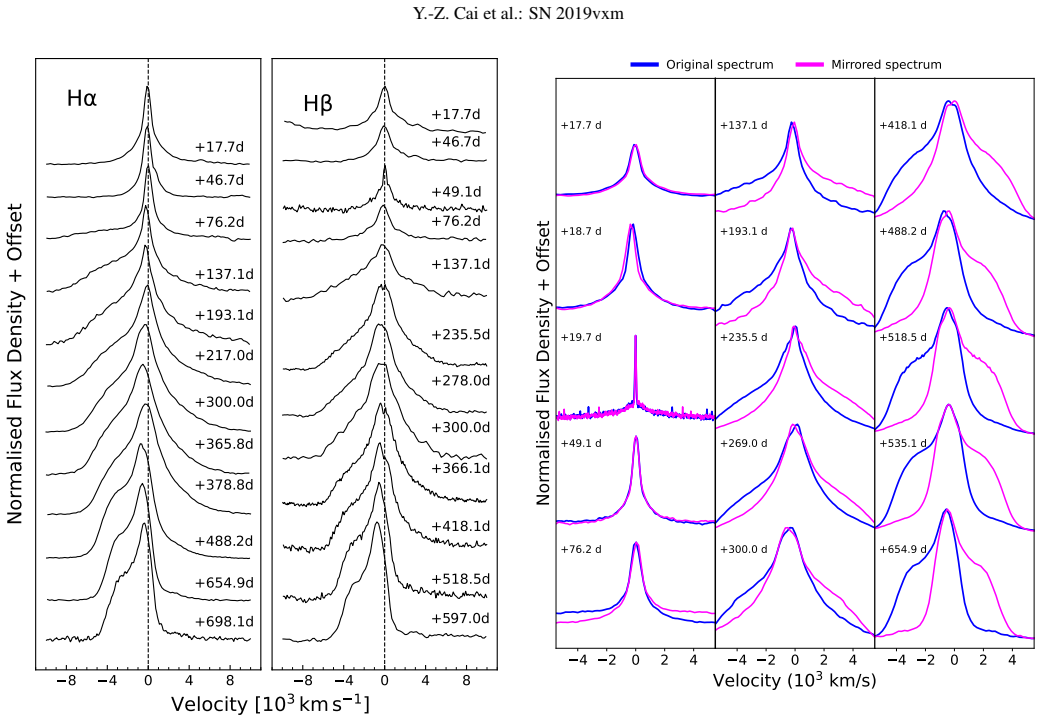
- The gradual broadening and blueshift of H-alpha and H-beta, with growing red-wing deficit after +102 days, record the changing velocity structure of the shocked and unshocked material.
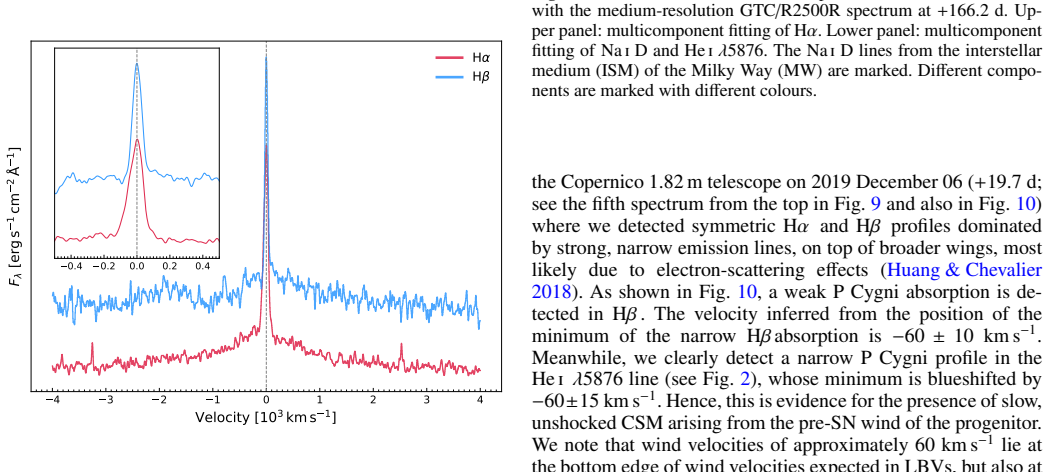
- The weak P Cygni absorption at +19.7 days reveals slow-moving (60 km/s) unshocked circumstellar gas from the pre-supernova wind.
Where Pith is reading between the lines
- Events with comparable early flash-ionization signatures may share a common pattern of dense, recently ejected circumstellar shells.
- Long-term infrared monitoring could test whether dust continues to form or is destroyed by the forward shock at later epochs.
- If similar mass-loss rates recur across the Type IIn population, they would constrain the final evolutionary stages of massive stars that produce these events.
- The power-law index of the early light curve offers a simple diagnostic that future surveys could apply to identify other interaction-dominated supernovae without full spectroscopic coverage.
Load-bearing premise
The mass-loss rate lower limit rests on the assumption that current early-interacting SN spectral models correctly capture the geometry, density profile and composition of the circumstellar material without large systematic offsets.
What would settle it
An independent radio or X-ray measurement showing a mass-loss rate below 0.01 solar masses per year, or pre-explosion imaging that rules out a progenitor capable of such sustained mass loss, would falsify the lower limit derived from the flash-ionization lines.
Figures
read the original abstract
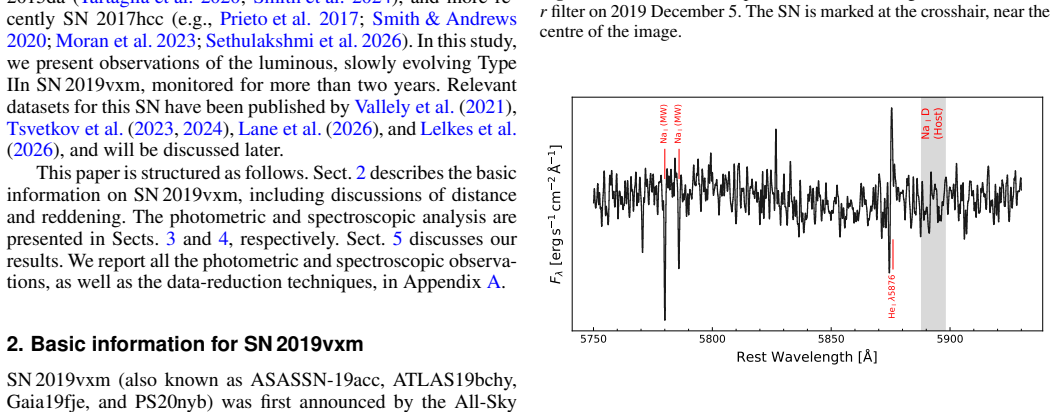
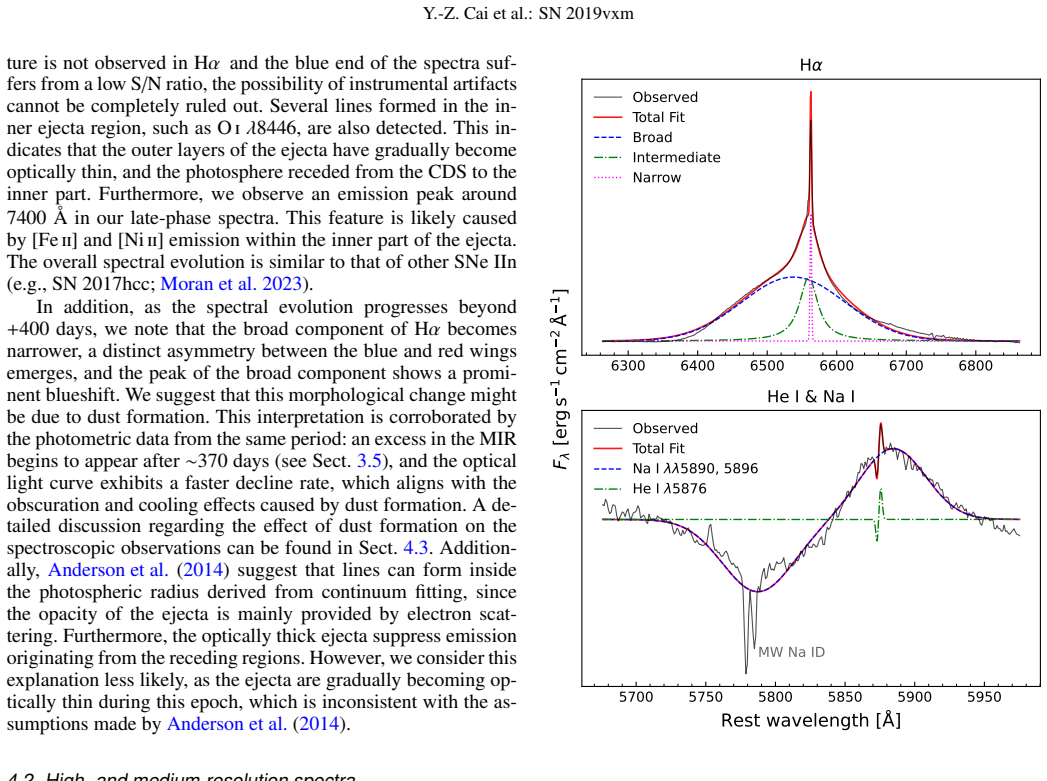
We present the photometric and spectroscopic analysis of the luminous and long-lasting Type IIn supernova (SN) 2019vxm. The SN reaches a peak V-band absolute magnitude of MV = -20.01 +/- 0.13 mag in 35.0 days, and displays slow evolution in both the light curves and spectra, resembling that of long-lived SNe IIn. A mid-infrared (MIR) excess is detected starting from seven months after maximum brightness, suggesting a few 10^-3 solar masses of dust are newly formed at >= 210 days (and up to 0.01 solar masses at +4.5 yr). The spectra are dominated by a blue continuum at early stages, with narrow, symmetric Balmer lines and flash-ionisation emission lines of C III, N III, and He II. Comparing our flash-ionised spectrum with early interacting SN spectral models, we estimate a lower limit for the mass-loss rate of the progenitor of >= 0.01 solar masses per year. A weak P Cygni absorption feature is detected in the H-beta profile of the high-resolution Echelle spectrum at +19.7 d, suggesting the presence of slow-moving (60 +/- 10 km/s), unshocked circumstellar material (CSM) arising from the pre-SN wind of the progenitor. The H-alpha and H-beta profiles gradually evolve and become broader and asymmetric, showing a progressively increasing blueshift, with a clear flux deficit in the red wings of the broad velocity component after +102 days. Our observed bolometric light curve before about 100 days can be well fitted by a power-law function (L(t) = 2 x 10^44 (t/day)^-0.49 erg/s), which is very similar to SN 2010jl.
Editorial analysis
A structured set of objections, weighed in public.
Referee Report
Summary. The manuscript presents photometric and spectroscopic observations of the luminous, long-lived Type IIn supernova SN 2019vxm. It reports a peak V-band absolute magnitude of MV = -20.01 ± 0.13 mag reached at 35 days post-explosion, slow light-curve and spectral evolution resembling other long-lived SNe IIn, a mid-infrared excess starting at +7 months indicating newly formed dust (a few 10^{-3} M_⊙ at ≥210 days), early flash-ionization lines (C III, N III, He II) plus narrow symmetric Balmer lines, a lower limit on progenitor mass-loss rate of ≥0.01 M_⊙ yr^{-1} obtained by comparing the flash-ionized spectrum to published early-interacting SN models, a weak P Cygni absorption in Hβ at +19.7 d indicating slow (60 ± 10 km s^{-1}) unshocked CSM, gradual broadening and blueshift of Hα/Hβ profiles, and a pre-+100 d bolometric light curve well described by the empirical power-law L(t) = 2 × 10^{44} (t/day)^{-0.49} erg s^{-1}, similar to SN 2010jl.
Significance. If the observational results hold, the paper adds a well-observed example of a luminous long-lived SN IIn with early flash features and MIR dust signature, useful for building the sample of events with quantified progenitor mass-loss constraints. Direct measurements (peak magnitude, line profiles, MIR excess) are supported by the described data. The power-law fit is presented as an empirical description. The mass-loss-rate lower limit, however, rests on the applicability of existing spectral models whose assumed wind-like density profile, geometry, and ionization balance may not match the actual CSM around SN 2019vxm.
major comments (1)
- [flash-ionization spectrum comparison / mass-loss rate section] Section on flash-ionization spectrum and mass-loss-rate estimate: the lower limit ≥0.01 M_⊙ yr^{-1} is derived solely by matching the observed C III, N III, He II, and narrow Balmer features to published early-interacting SN spectral models. No quantitative test is provided of how deviations in CSM geometry (e.g., clumpy vs. smooth), density gradient, or covering fraction would shift the inferred rate while still reproducing the line ratios at the observed epoch. Because the abstract and text present this value as a key result without bounding such systematics, the robustness of the lower limit cannot be assessed from the manuscript alone.
minor comments (2)
- [abstract] Abstract: the power-law normalization is written as '2 x 10^44'; confirm whether this is the exact best-fit value or a rounded approximation, and state the fit range explicitly.
- [discussion of progenitor mass loss] The manuscript labels the mass-loss rate a 'lower limit' but does not discuss alternative models or parameter variations that could raise or lower the bound; adding a short paragraph on this would strengthen the claim.
Simulated Author's Rebuttal
We thank the referee for their careful reading and constructive feedback on our manuscript. We address the single major comment point by point below.
read point-by-point responses
-
Referee: Section on flash-ionization spectrum and mass-loss-rate estimate: the lower limit ≥0.01 M_⊙ yr^{-1} is derived solely by matching the observed C III, N III, He II, and narrow Balmer features to published early-interacting SN spectral models. No quantitative test is provided of how deviations in CSM geometry (e.g., clumpy vs. smooth), density gradient, or covering fraction would shift the inferred rate while still reproducing the line ratios at the observed epoch. Because the abstract and text present this value as a key result without bounding such systematics, the robustness of the lower limit cannot be assessed from the manuscript alone.
Authors: We thank the referee for raising this point on the robustness of the mass-loss-rate lower limit. The value is obtained by direct comparison of the observed flash-ionization features (C III, N III, He II, and narrow Balmer lines) to the published early-interacting SN spectral models that best reproduce the line ratios and strengths at the observed epoch. These models assume a wind-like density profile, which is consistent with the narrow, symmetric Balmer lines in our data. We acknowledge that a quantitative exploration of alternative geometries (clumpy vs. smooth), density gradients, or covering fractions would require new dedicated radiative-transfer calculations that lie beyond the scope of this observational paper. The estimate is presented explicitly as a lower limit to reflect such uncertainties. In the revised manuscript we will expand the relevant section and abstract to state the model assumptions more explicitly and to emphasize the conservative nature of the lower limit, allowing readers to better assess its robustness. revision: partial
Circularity Check
No significant circularity; all central quantities are direct observations or comparisons to external models
full rationale
The mass-loss rate lower limit is obtained by direct comparison of the observed flash-ionized spectrum (C III, N III, He II lines) to independently published early-interacting SN spectral models; the paper does not derive or fit those models itself. The bolometric light curve is empirically fitted to a power-law form using the observed photometry, presented as a description rather than a first-principles prediction. Peak magnitude, evolution timescales, and velocity measurements are all direct observational results. No self-citations, self-definitional steps, or fitted inputs renamed as predictions appear in the derivation chain. The analysis remains self-contained against external benchmarks.
Axiom & Free-Parameter Ledger
free parameters (2)
- power-law normalization =
2 x 10^44
- power-law index =
-0.49
axioms (2)
- domain assumption Standard assumptions on distance, Galactic and host extinction, and cosmology are used to derive absolute magnitudes and bolometric luminosities.
- domain assumption Published early-interacting SN spectral models accurately represent the flash-ionization physics and circumstellar geometry for this event.
Reference graph
Works this paper leans on
-
[1]
The Expulsion of Stellar Envelopes in Core-Collapse Supernovae
The Expulsion of Stellar Envelopes in Core-Collapse Supernovae. , keywords =. doi:10.1086/306571 , archivePrefix =. astro-ph/9807046 , primaryClass =
work page internal anchor Pith review Pith/arXiv arXiv doi:10.1086/306571
-
[2]
Lick Obs. Tech. Rep. 66 , year = 1993, volume =
1993
-
[3]
The importance of atmospheric differential refraction in spectrophotometry. , keywords =. doi:10.1086/131052 , adsurl =
-
[4]
, year = 1983, month = sep, volume =
The determination of cloud masses and dust characteristics from submillimetre thermal emission. , year = 1983, month = sep, volume =
1983
-
[5]
, year = 1997, month = jan, volume =
Optical Spectra of Supernovae. , year = 1997, volume = 35, pages =. doi:10.1146/annurev.astro.35.1.309 , adsurl =
-
[6]
Optical Properties of Interstellar Graphite and Silicate Grains. , keywords =. doi:10.1086/162480 , adsurl =
-
[7]
Spectroscopic Constraints on the Properties of Dust in Active Galactic Nuclei. , keywords =. doi:10.1086/172149 , adsurl =
-
[8]
, keywords =
Mass extinction coefficients of various submicron amorphous carbon grains: Tabulated values from 40 NM to 2 mm. , keywords =
-
[9]
, keywords =
A new subclass of Type II supernovae?. , keywords =
-
[10]
Emission from Circumstellar Interaction in Normal Type II Supernovae. , keywords =. doi:10.1086/173557 , adsurl =
-
[11]
Supernovae in dense winds. , keywords =. doi:10.1023/A:1000847125928 , adsurl =
-
[12]
The type IIn supernova 1995G: interaction with the circumstellar medium. , keywords =. doi:10.1046/j.1365-8711.2002.05366.x , archivePrefix =. astro-ph/0201483 , primaryClass =
-
[13]
A luminous stellar outburst during a long-lasting eruptive phase first, and then SN IIn 2018cnf. , keywords =. doi:10.1051/0004-6361/201935420 , archivePrefix =. 1906.00814 , primaryClass =
-
[14]
Berkeley Supernova Ia Program - I. Observations, data reduction and spectroscopic sample of 582 low-redshift Type Ia supernovae. , keywords =. doi:10.1111/j.1365-2966.2012.21270.x , archivePrefix =. 1202.2128 , primaryClass =
-
[15]
Transient Name Server Classification Report , keywords =
Transient Classification Report for 2019-12-02. Transient Name Server Classification Report , keywords =
2019
-
[16]
Transient Name Server Discovery Report , keywords =
ASAS-SN Transient Discovery Report for 2019-12-01. Transient Name Server Discovery Report , keywords =
2019
-
[17]
SN 2019vxm: A Shocking Coincidence between Fermi and TESS
SN 2019vxm: A Shocking Coincidence between Fermi and TESS. , keywords =. doi:10.3847/1538-4357/ae6245 , archivePrefix =. 2511.15975 , primaryClass =
work page internal anchor Pith review Pith/arXiv arXiv doi:10.3847/1538-4357/ae6245
-
[18]
Astronomische Nachrichten , keywords =
SNe 2019vxm and 2020tlf: two luminous type II Supernovae with signatures of circumstellar interaction. Astronomische Nachrichten , keywords =. doi:10.1002/asna.20230166 , adsurl =
-
[19]
Astrophysical Bulletin , keywords =
Progress in Supernovae Studies with the 2.5-m Telescope at the Caucasus Mountain Observatory of SAI MSU. Astrophysical Bulletin , keywords =. doi:10.1134/S1990341323700232 , adsurl =
-
[20]
High-cadence, early-time observations of core-collapse supernovae from the TESS prime mission. , keywords =. doi:10.1093/mnras/staa3675 , archivePrefix =. 2010.06596 , primaryClass =
-
[21]
American Astronomical Society Meeting Abstracts \#223 , year = 2014, series =
All Sky Automated Survey for SuperNovae (ASAS-SN or ``Assassin''). American Astronomical Society Meeting Abstracts \#223 , year = 2014, series =
2014
-
[22]
The All-Sky Automated Survey for Supernovae (ASAS-SN) Light Curve Server v1.0
The All-Sky Automated Survey for Supernovae (ASAS-SN) Light Curve Server v1.0. , keywords =. doi:10.1088/1538-3873/aa80d9 , archivePrefix =. 1706.07060 , primaryClass =
work page internal anchor Pith review Pith/arXiv arXiv doi:10.1088/1538-3873/aa80d9
-
[23]
HEAsoft: Unified Release of FTOOLS and XANADU
-
[24]
, archivePrefix = "arXiv", eprint =
AT 2017be - a new member of the class of intermediate-luminosity red transients. , archivePrefix = "arXiv", eprint =. doi:10.1093/mnras/sty2070 , adsurl =
-
[25]
arXiv e-prints , keywords =
The Pan-STARRS1 Surveys. arXiv e-prints , keywords =
-
[26]
The Pan-STARRS1 Database and Data Products. , keywords =. doi:10.3847/1538-4365/abb82d , archivePrefix =. 1612.05243 , primaryClass =
-
[27]
Pan-STARRS Pixel Processing: Detrending, Warping, Stacking. , keywords =. doi:10.3847/1538-4365/abb82b , archivePrefix =. 1612.05245 , primaryClass =
-
[28]
The Pan-STARRS Data-processing System. , keywords =. doi:10.3847/1538-4365/abb829 , archivePrefix =. 1612.05240 , primaryClass =
-
[29]
Pan-STARRS Photometric and Astrometric Calibration. , keywords =. doi:10.3847/1538-4365/abb82a , archivePrefix =. 1612.05242 , primaryClass =
-
[30]
Pan-STARRS Pixel Analysis: Source Detection and Characterization. , keywords =. doi:10.3847/1538-4365/abb82c , archivePrefix =. 1612.05244 , primaryClass =
-
[31]
ATLAS: A High-Cadence All-Sky Survey System
ATLAS: A High-cadence All-sky Survey System. , keywords =. doi:10.1088/1538-3873/aabadf , archivePrefix =. 1802.00879 , primaryClass =
work page internal anchor Pith review Pith/arXiv arXiv doi:10.1088/1538-3873/aabadf
-
[32]
Design and Operation of the ATLAS Transient Science Server. , keywords =. doi:10.1088/1538-3873/ab936e , archivePrefix =. 2003.09052 , primaryClass =
-
[33]
Transient Name Server AstroNote , keywords =
Release of the ATLAS Forced Photometry server for public use. Transient Name Server AstroNote , keywords =
-
[34]
The ASAS-SN bright supernova catalogue - V. 2018-2020. , keywords =. doi:10.1093/mnras/stad355 , archivePrefix =. 2210.06492 , primaryClass =
-
[35]
Wilkinson Microwave Anisotropy Probe (WMAP) Three Year Results: Implications for Cosmology
Three-Year Wilkinson Microwave Anisotropy Probe (WMAP) Observations: Implications for Cosmology. , keywords =. doi:10.1086/513700 , archivePrefix =. astro-ph/0603449 , primaryClass =
work page internal anchor Pith review Pith/arXiv arXiv doi:10.1086/513700
-
[36]
Measuring Reddening with Sloan Digital Sky Survey Stellar Spectra and Recalibrating SFD. , keywords =. doi:10.1088/0004-637X/737/2/103 , archivePrefix =. 1012.4804 , primaryClass =
work page internal anchor Pith review Pith/arXiv arXiv doi:10.1088/0004-637x/737/2/103
-
[37]
WISeREP - An Interactive Supernova Data Repository
WISeREP An Interactive Supernova Data Repository. , keywords =. doi:10.1086/666656 , archivePrefix =. 1204.1891 , primaryClass =
work page internal anchor Pith review Pith/arXiv arXiv doi:10.1086/666656
-
[38]
Pushing the Boundaries of Conventional Core-collapse Supernovae: The Extremely Energetic Supernova SN 2003ma. , keywords =. doi:10.1088/0004-637X/729/2/88 , archivePrefix =. 0911.2002 , primaryClass =
work page internal anchor Pith review Pith/arXiv arXiv doi:10.1088/0004-637x/729/2/88 2002
-
[39]
Multi-wavelength Observations of the Enduring Type IIn Supernovae 2005ip and 2006jd
Multi-wavelength Observations of the Enduring Type IIn Supernovae 2005ip and 2006jd. , keywords =. doi:10.1088/0004-637X/756/2/173 , archivePrefix =. 1206.5575 , primaryClass =
work page internal anchor Pith review Pith/arXiv arXiv doi:10.1088/0004-637x/756/2/173
-
[40]
Coronal lines and dust formation in SN 2005ip: Not the brightest, but the hottest Type IIn supernova
Coronal Lines and Dust Formation in SN 2005ip: Not the Brightest, but the Hottest Type IIn Supernova. , keywords =. doi:10.1088/0004-637X/695/2/1334 , archivePrefix =. 0809.5079 , primaryClass =
work page internal anchor Pith review Pith/arXiv arXiv doi:10.1088/0004-637x/695/2/1334
-
[41]
SN 2006gy: Discovery of the Most Luminous Supernova Ever Recorded, Powered by the Death of an Extremely Massive Star like Carinae. , keywords =. doi:10.1086/519949 , archivePrefix =. astro-ph/0612617 , primaryClass =
work page internal anchor Pith review Pith/arXiv arXiv doi:10.1086/519949
-
[42]
SN 2006gy: An extremely luminous supernova in the galaxy NGC 1260
SN 2006gy: An Extremely Luminous Supernova in the Galaxy NGC 1260. , keywords =. doi:10.1086/516749 , archivePrefix =. astro-ph/0612408 , primaryClass =
work page internal anchor Pith review Pith/arXiv arXiv doi:10.1086/516749
-
[43]
SN 2006tf: Precursor Eruptions and the Optically Thick Regime of Extremely Luminous Type IIn Supernovae. , keywords =. doi:10.1086/591021 , archivePrefix =. 0804.0042 , primaryClass =
work page internal anchor Pith review Pith/arXiv arXiv doi:10.1086/591021
-
[44]
SN 2010jl: Optical to Hard X-Ray Observations Reveal an Explosion Embedded in a Ten Solar Mass Cocoon. , keywords =. doi:10.1088/0004-637X/781/1/42 , archivePrefix =. 1307.2247 , primaryClass =
work page internal anchor Pith review Pith/arXiv arXiv doi:10.1088/0004-637x/781/1/42
-
[45]
SN2008am: A Super-Luminous Type IIn Supernova
SN 2008am: A Super-luminous Type IIn Supernova. , keywords =. doi:10.1088/0004-637X/729/2/143 , archivePrefix =. 1101.3581 , primaryClass =
work page internal anchor Pith review Pith/arXiv arXiv doi:10.1088/0004-637x/729/2/143
-
[46]
The long-lived Type IIn SN 2015da: Infrared echoes and strong interaction within an extended massive shell. , keywords =. doi:10.1051/0004-6361/201936553 , archivePrefix =. 1908.08580 , primaryClass =
-
[47]
SN 2015da: late-time observations of a persistent superluminous Type IIn supernova with post-shock dust formation. , keywords =. doi:10.1093/mnras/stae726 , archivePrefix =. 2312.00253 , primaryClass =
-
[48]
A long life of excess: The interacting transient SN 2017hcc. , keywords =. doi:10.1051/0004-6361/202244565 , archivePrefix =. 2210.14076 , primaryClass =
-
[49]
Handbook of Supernovae , year = 2017, editor =
Interacting Supernovae: Types IIn and Ibn. Handbook of Supernovae , year = 2017, editor =. doi:10.1007/978-3-319-21846-5_38 , adsurl =
-
[50]
SN 2016iog: A fast-declining Type II-L supernova with an ultra-faint tail persistently interacting with circumstellar material. , keywords =. doi:10.1051/0004-6361/202556330 , archivePrefix =. 2511.12929 , primaryClass =
-
[51]
SN 2018hfm: a low-energy Type II supernova with prominent signatures of circumstellar interaction and dust formation. , keywords =. doi:10.1093/mnras/stab3007 , archivePrefix =. 2110.10440 , primaryClass =
-
[52]
VizieR Online Data Catalog: WISE All-Sky Data Release (Cutri+ 2012)
2012
-
[53]
Evidence for Asphericity in the Type IIn Supernova 1998S
Evidence for Asphericity in the Type IIN Supernova SN 1998S. , keywords =. doi:10.1086/308910 , archivePrefix =. astro-ph/9908040 , primaryClass =
work page internal anchor Pith review Pith/arXiv arXiv doi:10.1086/308910
-
[54]
A Wolf-Rayet-like progenitor of supernova SN 2013cu from spectral observations of a wind
A Wolf-Rayet-like progenitor of SN 2013cu from spectral observations of a stellar wind. , keywords =. doi:10.1038/nature13304 , archivePrefix =. 1406.7640 , primaryClass =
work page internal anchor Pith review Pith/arXiv arXiv doi:10.1038/nature13304
-
[55]
Explosion of red-supergiant stars: Influence of the atmospheric structure on shock breakout and early-time supernova radiation. , keywords =. doi:10.1051/0004-6361/201730942 , archivePrefix =. 1704.01697 , primaryClass =
work page internal anchor Pith review Pith/arXiv arXiv doi:10.1051/0004-6361/201730942
-
[56]
PTF11iqb: Cool supergiant mass loss that bridges the gap between Type IIn and normal supernovae
PTF11iqb: cool supergiant mass-loss that bridges the gap between Type IIn and normal supernovae. , keywords =. doi:10.1093/mnras/stv354 , archivePrefix =. 1501.02820 , primaryClass =
work page internal anchor Pith review Pith/arXiv arXiv doi:10.1093/mnras/stv354
-
[57]
Early Emission from the Type IIn Supernova 1998S at High Resolution
Early Emission from the Type IIn Supernova 1998S at High Resolution. , keywords =. doi:10.1088/0004-637X/806/2/213 , archivePrefix =. 1408.1404 , primaryClass =
work page internal anchor Pith review Pith/arXiv arXiv doi:10.1088/0004-637x/806/2/213
-
[58]
SN 2024cld: unveiling the complex mass-loss histories of evolved supergiant progenitors to core collapse supernovae. , keywords =. doi:10.1093/mnras/staf2261 , archivePrefix =. 2510.27631 , primaryClass =
-
[59]
The Prevalence and Influence of Circumstellar Material around Hydrogen-rich Supernova Progenitors. , keywords =. doi:10.3847/1538-4357/acd8be , archivePrefix =. 2212.03313 , primaryClass =
-
[60]
SN 2024acyl: A fast, linearly declining Type Ibn supernova with early flash-ionisation features
Massive stars exploding in a He-rich circumstellar medium: XII. SN 2024acyl: A fast, linearly declining Type Ibn supernova with early flash-ionisation features. , keywords =. doi:10.1051/0004-6361/202558014 , archivePrefix =. 2511.04337 , primaryClass =
-
[61]
Caltech Core-Collapse Project (CCCP) Observations of Type IIn Supernovae: Typical Properties and Implications for Their Progenitor Stars. , keywords =. doi:10.1088/0004-637X/744/1/10 , archivePrefix =. 1010.2689 , primaryClass =
work page internal anchor Pith review Pith/arXiv arXiv doi:10.1088/0004-637x/744/1/10
-
[62]
Broad emission lines from the opaque electron-scattering environment of SN 1998S. , keywords =. doi:10.1111/j.1365-2966.2001.04717.x , archivePrefix =. astro-ph/0106234 , primaryClass =
-
[63]
High Density Circumstellar Interaction in the Luminous Type IIn SN 2010jl: The first 1100 days
High-density Circumstellar Interaction in the Luminous Type IIn SN 2010jl: The First 1100 Days. , keywords =. doi:10.1088/0004-637X/797/2/118 , archivePrefix =. 1312.6617 , primaryClass =
work page internal anchor Pith review Pith/arXiv arXiv doi:10.1088/0004-637x/797/2/118
-
[64]
Dust Formation and He II 4686 emission in the Dense Shell of the Peculiar Type Ib Supernova 2006jc
Dust Formation and He II 4686 Emission in the Dense Shell of the Peculiar Type Ib Supernova 2006jc. , keywords =. doi:10.1086/587860 , archivePrefix =. 0704.2249 , primaryClass =
work page internal anchor Pith review Pith/arXiv arXiv doi:10.1086/587860
-
[65]
Early Dust Formation and a Massive Progenitor for SN 2011ja?
Early dust formation and a massive progenitor for SN 2011ja?. , keywords =. doi:10.1093/mnras/stw164 , archivePrefix =. 1509.06379 , primaryClass =
work page internal anchor Pith review Pith/arXiv arXiv doi:10.1093/mnras/stw164
-
[66]
Progenitors of early-time interacting supernovae. , keywords =. doi:10.1093/mnras/staa1540 , archivePrefix =. 2001.07651 , primaryClass =
-
[67]
Nearby supernova rates from the Lick Observatory Supernova Search - II. The observed luminosity functions and fractions of supernovae in a complete sample. , keywords =. doi:10.1111/j.1365-2966.2011.18160.x , archivePrefix =. 1006.4612 , primaryClass =
-
[68]
Catalogues and fractions of supernovae in a complete sample
Supernovae at distances <40 Mpc: I. Catalogues and fractions of supernovae in a complete sample. , keywords =. doi:10.1051/0004-6361/202452684 , archivePrefix =. 2504.04393 , primaryClass =
-
[69]
Supernova rate in the local Universe
Supernovae at distances <40 Mpc: II. Supernova rate in the local Universe. , keywords =. doi:10.1051/0004-6361/202452685 , archivePrefix =. 2504.04507 , primaryClass =
-
[70]
Supernova rates from the SUDARE VST-OmegaCAM search. I. Rates per unit volume. , keywords =. doi:10.1051/0004-6361/201526712 , archivePrefix =. 1509.04496 , primaryClass =
work page internal anchor Pith review Pith/arXiv arXiv doi:10.1051/0004-6361/201526712
-
[71]
The death of massive stars - II. Observational constraints on the progenitors of type Ibc supernovae
The death of massive stars - II. Observational constraints on the progenitors of Type Ibc supernovae. , keywords =. doi:10.1093/mnras/stt1612 , archivePrefix =. 1301.1975 , primaryClass =
work page internal anchor Pith review Pith/arXiv arXiv doi:10.1093/mnras/stt1612 1975
-
[72]
Observed fractions of core-collapse supernova types and initial masses of their single and binary progenitor stars. , keywords =. doi:10.1111/j.1365-2966.2011.17229.x , archivePrefix =. 1006.3899 , primaryClass =
-
[73]
Progenitors of core-collapse supernovae
Progenitors of Core-Collapse Supernovae. , keywords =. doi:10.1146/annurev-astro-082708-101737 , archivePrefix =. 0908.0700 , primaryClass =
work page internal anchor Pith review Pith/arXiv arXiv doi:10.1146/annurev-astro-082708-101737
-
[74]
Type IIn supernova light-curve properties measured from an untargeted survey sample. , keywords =. doi:10.1051/0004-6361/201936097 , archivePrefix =. 1906.05812 , primaryClass =
-
[75]
Royal Society Open Science , year = 2020, month = jul, volume =
Supernovae and transients with circumstellar interaction. Royal Society Open Science , year = 2020, month = jul, volume =. doi:10.1098/rsos.200467 , adsurl =
-
[76]
Carnegie Supernova Project: Observations of Type IIn supernovae
Carnegie Supernova Project: Observations of Type IIn supernovae. , keywords =. doi:10.1051/0004-6361/201321180 , archivePrefix =. 1304.3038 , primaryClass =
work page internal anchor Pith review Pith/arXiv arXiv doi:10.1051/0004-6361/201321180
-
[77]
Metallicity at the explosion sites of interacting transients
Metallicity at the explosion sites of interacting transients. , keywords =. doi:10.1051/0004-6361/201525989 , archivePrefix =. 1505.04719 , primaryClass =
work page internal anchor Pith review Pith/arXiv arXiv doi:10.1051/0004-6361/201525989
-
[78]
SN 2009kn - the twin of the Type IIn supernova 1994W. , keywords =. doi:10.1111/j.1365-2966.2012.21224.x , archivePrefix =. 1205.0353 , primaryClass =
-
[79]
SN 2020pvb: A Type IIn-P supernova with a precursor outburst. , keywords =. doi:10.1051/0004-6361/202348790 , archivePrefix =. 2402.02924 , primaryClass =
-
[80]
SN 2011ht: Confirming a Class of Interacting Supernovae with Plateau Light Curves (Type IIn-P)
SN 2011ht: confirming a class of interacting supernovae with plateau light curves (Type IIn-P). , keywords =. doi:10.1093/mnras/stt360 , archivePrefix =. 1209.0821 , primaryClass =
work page internal anchor Pith review Pith/arXiv arXiv doi:10.1093/mnras/stt360
discussion (0)
Sign in with ORCID, Apple, or X to comment. Anyone can read and Pith papers without signing in.