A Simplex-Inspired Architecture for Integrating Quantum Capabilities into Cyber-Physical Systems
Pith reviewed 2026-07-01 04:48 UTC · model grok-4.3
The pith
A simplex-inspired architecture enables hybrid quantum-classical modeling for safe real-time cyber-physical systems.
A machine-rendered reading of the paper's core claim, the machinery that carries it, and where it could break.
Core claim
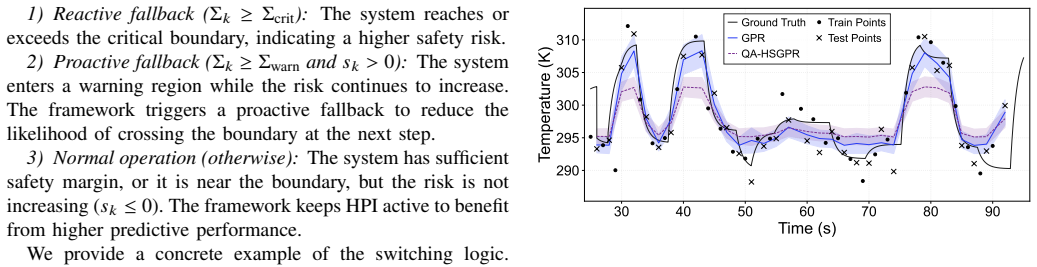
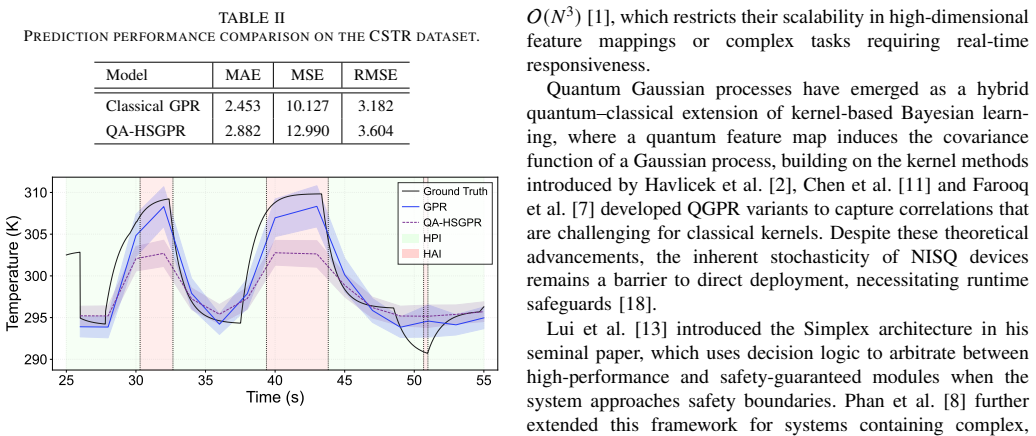
The paper claims that by adopting a Simplex-inspired architecture, cyber-physical systems can integrate Quantum-Assisted Hilbert-Space Gaussian Process Regression as a high-performance module alongside classical GPR as a high-assurance module, with a runtime monitor handling switches to achieve a controllable trade-off between performance and safety, demonstrated through experiments on the Continuous Stirred-Tank Reactor benchmark.
What carries the argument
The Simplex architecture consisting of a quantum-assisted high-performance module, a classical high-assurance module, and a runtime safety monitor that decides switches between them.
If this is right
- Allows quantum-assisted models to be used in safety-critical real-time applications without compromising reliability.
- Provides a mechanism to reduce computational complexity while maintaining safety guarantees.
- Enables dynamic adaptation to system conditions via model switching in cyber-physical systems.
- Validates the approach on the Continuous Stirred-Tank Reactor for practical applicability.
Where Pith is reading between the lines
- Similar hybrid architectures might apply to other domains like robotics or smart grids where real-time predictions are needed.
- The success depends on developing reliable monitors, suggesting future work on monitor validation techniques.
- If effective, this could accelerate adoption of quantum methods in engineering by mitigating their current limitations.
Load-bearing premise
A runtime monitor exists that can accurately evaluate system safety in real time and switch between models without introducing new risks or delays.
What would settle it
Demonstrating a scenario on the Continuous Stirred-Tank Reactor where the monitor fails to switch appropriately, leading to unsafe operation or performance degradation, would challenge the framework's effectiveness.
Figures

read the original abstract
Cyber-physical systems require accurate and reliable system models to ensure safe and efficient operation. Classical Gaussian Process Regression (GPR) provides uncertainty-aware predictions but suffers from high computational complexity, which limits its scalability in real-time applications. Quantum-assisted Gaussian process models reduce complexity in inference, but their practical use is constrained by noise and stability concerns in safety-critical environments. In this paper, we propose a hybrid classical-quantum system identification framework based on a Simplex architecture. The framework combines Quantum-Assisted Hilbert-Space Gaussian Process Regression (QA-HSGPR) as a high-performance module and classical GPR as a high-assurance module. A runtime monitor evaluates system safety and dynamically switches between the two models. Experiments on a Continuous Stirred-Tank Reactor benchmark demonstrate that the proposed framework enables a controllable trade-off between performance and safety for real-time cyber-physical systems.
Editorial analysis
A structured set of objections, weighed in public.
Referee Report
Summary. The paper proposes a Simplex-inspired hybrid architecture for cyber-physical system identification that pairs a Quantum-Assisted Hilbert-Space Gaussian Process Regression (QA-HSGPR) high-performance module with a classical GPR high-assurance module. A runtime monitor is said to evaluate safety and switch between modules dynamically. Experiments on a Continuous Stirred-Tank Reactor (CSTR) benchmark are asserted to demonstrate a controllable performance-safety trade-off for real-time applications.
Significance. If the runtime monitor can be shown to operate correctly without introducing latency or new failure modes, and if the CSTR experiments include quantitative validation, the work would offer a concrete mechanism for safely incorporating quantum-assisted models into safety-critical CPS, addressing both computational complexity and noise concerns.
major comments (2)
- Architecture description (no section/equation cited): the runtime monitor is introduced only as “a runtime monitor evaluates system safety and dynamically switches,” with no equations, state estimator, thresholds, timing bounds, or correctness argument supplied. This component is load-bearing for the safety claim yet cannot be independently verified.
- Abstract / experimental claims: the assertion that “Experiments on a Continuous Stirred-Tank Reactor benchmark demonstrate that the proposed framework enables a controllable trade-off” supplies no data, methods, error bars, baseline comparisons, or stability analysis under quantum noise, preventing assessment of whether the observed trade-off is safe or an artifact of an unvalidated switching policy.
Simulated Author's Rebuttal
We thank the referee for the constructive comments. We address each major point below and commit to a revised manuscript that supplies the requested technical details.
read point-by-point responses
-
Referee: Architecture description (no section/equation cited): the runtime monitor is introduced only as “a runtime monitor evaluates system safety and dynamically switches,” with no equations, state estimator, thresholds, timing bounds, or correctness argument supplied. This component is load-bearing for the safety claim yet cannot be independently verified.
Authors: We agree that the current high-level description of the runtime monitor prevents independent verification. In the revised manuscript we will add a dedicated subsection containing the state estimator equations, explicit safety thresholds, timing bounds, and a correctness argument for the switching logic. revision: yes
-
Referee: Abstract / experimental claims: the assertion that “Experiments on a Continuous Stirred-Tank Reactor benchmark demonstrate that the proposed framework enables a controllable trade-off” supplies no data, methods, error bars, baseline comparisons, or stability analysis under quantum noise, preventing assessment of whether the observed trade-off is safe or an artifact of an unvalidated switching policy.
Authors: We acknowledge that the experimental claims require quantitative support. The revised manuscript will include the full CSTR experimental protocol, numerical results with error bars, baseline comparisons, and stability analysis under quantum noise to substantiate the reported performance-safety trade-off. revision: yes
Circularity Check
No circularity detected; architecture proposal lacks derivation chain or self-referential equations
full rationale
The paper presents an architectural framework combining QA-HSGPR and classical GPR with a runtime monitor for model switching on a CSTR benchmark. No equations, parameter-fitting procedures, predictions derived from fitted inputs, or self-citations of uniqueness theorems appear in the abstract or described content. The central claim is an experimental demonstration of a performance-safety trade-off enabled by the Simplex-inspired switching, which does not reduce to any input by construction. No load-bearing step matches the enumerated circularity patterns. The derivation chain is absent rather than circular, making this a standard non-finding for an applied systems paper.
Axiom & Free-Parameter Ledger
Reference graph
Works this paper leans on
-
[1]
Gaussian Processes in Machine Learning,
C. E. Rasmussen, “Gaussian Processes in Machine Learning,” inSummer school on machine learning, pp. 63–71, Springer, 2003
2003
-
[2]
Supervised Learning with Quantum- enhanced Feature Spaces,
V . Havlí ˇcek, A. D. Córcoles, K. Temme, A. W. Harrow, A. Kandala, J. M. Chow, and J. M. Gambetta, “Supervised Learning with Quantum- enhanced Feature Spaces,”Nature, vol. 567, no. 7747, pp. 209–212, 2019
2019
-
[3]
Quantum Gaussian Process Regression for Bayesian Optimization,
F. Rapp and M. Roth, “Quantum Gaussian Process Regression for Bayesian Optimization,”Quantum Machine Intelligence, vol. 6, no. 1, p. 5, 2024
2024
-
[4]
Noisy Quantum Kernel Machines,
V . Heyraud, Z. Li, Z. Denis, A. Le Boité, and C. Ciuti, “Noisy Quantum Kernel Machines,”Physical Review A, vol. 106, no. 5, p. 052421, 2022
2022
-
[5]
The Simplex Architecture for Safe Online Control System upgrades,
D. Seto, B. Krogh, L. Sha, and A. Chutinan, “The Simplex Architecture for Safe Online Control System upgrades,” inProceedings of the 1998 American Control Conference. ACC (IEEE Cat. No. 98CH36207), vol. 6, pp. 3504–3508, IEEE, 1998
1998
-
[6]
L1Simplex: Fault-tolerant control of cyber-physical systems,
X. Wang, N. Hovakimyan, and L. Sha, “L1Simplex: Fault-tolerant control of cyber-physical systems,” inProceedings of the ACM/IEEE 4th International Conference on Cyber-Physical Systems, pp. 41–50, 2013. 5
2013
-
[7]
Quantum-Assisted Hilbert-space Gaussian Process Regression,
A. Farooq, C. A. Galvis-Florez, and S. Särkkä, “Quantum-Assisted Hilbert-space Gaussian Process Regression,”Physical Review A, vol. 109, no. 5, p. 052410, 2024
2024
-
[8]
A Component-based Simplex Architecture for High-Assurance Cyber-Physical Systems,
D. Phan, J. Yang, M. Clark, R. Grosu, J. Schierman, S. Smolka, and S. Stoller, “A Component-based Simplex Architecture for High-Assurance Cyber-Physical Systems,” in2017 17th International Conference on Application of Concurrency to System Design (ACSD), pp. 49–58, IEEE, 2017
2017
-
[9]
M. A. Nielsen and I. L. Chuang,Quantum Computation and Quantum Information. Cambridge university press, 2010
2010
-
[10]
Coherent Communication of Classical Messages,
A. Harrow, “Coherent Communication of Classical Messages,”Physical review letters, vol. 92, no. 9, p. 097902, 2004
2004
-
[11]
Quantum Algorithm for Gaussian Process Regression,
M.-H. Chen, C.-H. Yu, J.-L. Gao, K. Yu, S. Lin, G.-D. Guo, and J. Li, “Quantum Algorithm for Gaussian Process Regression,”Physical Review A, vol. 106, no. 1, p. 012406, 2022
2022
-
[12]
D. E. Seborg, T. F. Edgar, D. A. Mellichamp, and F. J. Doyle III,Process Dynamics and Control. John Wiley & Sons, 2016
2016
-
[13]
Using Simplicity to Control Complexity,
L. Sha, “Using Simplicity to Control Complexity,”IEEE Software, vol. 18, no. 4, p. 20, 2001
2001
-
[14]
CPSim: Simulation Toolbox for Security Problems in Cyber-Physical Systems,
M. Liu, L. Zhang, W. Xu, S. Jiang, and F. Kong, “CPSim: Simulation Toolbox for Security Problems in Cyber-Physical Systems,”ACM Transactions on Design Automation of Electronic Systems, vol. 29, no. 5, pp. 1–16, 2024
2024
-
[15]
Scikit-learn: Machine Learning in Python,
F. Pedregosa, G. Varoquaux, A. Gramfort, V . Michel, B. Thirion, O. Grisel, M. Blondel, P. Prettenhofer, R. Weiss, V . Dubourg,et al., “Scikit-learn: Machine Learning in Python,”the Journal of machine Learning research, vol. 12, pp. 2825–2830, 2011
2011
-
[16]
Principal Component Analysis,
H. Abdi and L. J. Williams, “Principal Component Analysis,”Wiley interdisciplinary reviews: computational statistics, vol. 2, no. 4, pp. 433– 459, 2010
2010
-
[17]
Dynamic Systems Identification with Gaussian processes,
J. Kocijan, A. Girard, B. Banko, and R. Murray-Smith, “Dynamic Systems Identification with Gaussian processes,”Mathematical and Computer Modelling of Dynamical Systems, vol. 11, no. 4, pp. 411–424, 2005
2005
-
[18]
Safety with Non-Deterministic Control Action Selection using Quantum Devices,
K. Nieman and H. Durand, “Safety with Non-Deterministic Control Action Selection using Quantum Devices,”IFAC-PapersOnLine, vol. 58, no. 14, pp. 664–669, 2024. 6
2024
discussion (0)
Sign in with ORCID, Apple, or X to comment. Anyone can read and Pith papers without signing in.