JWST Medium-Resolution Infrared Spectroscopy of SN 2022acko: Tracing Molecule Formation in the Nebular Phase
Pith reviewed 2026-07-01 04:49 UTC · model grok-4.3
The pith
Low-mass Type II supernovae produce an order of magnitude less carbon monoxide than more massive events.
A machine-rendered reading of the paper's core claim, the machinery that carries it, and where it could break.
Core claim
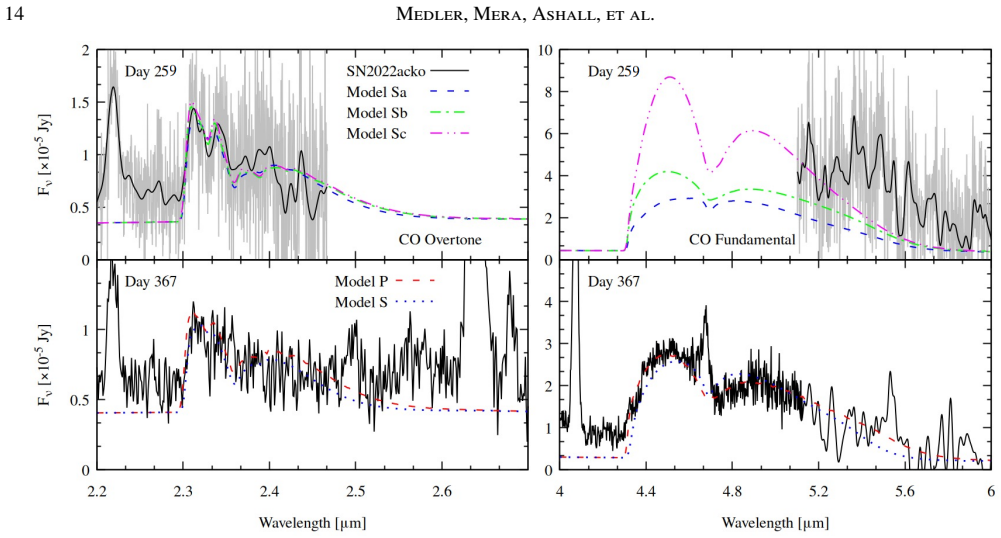
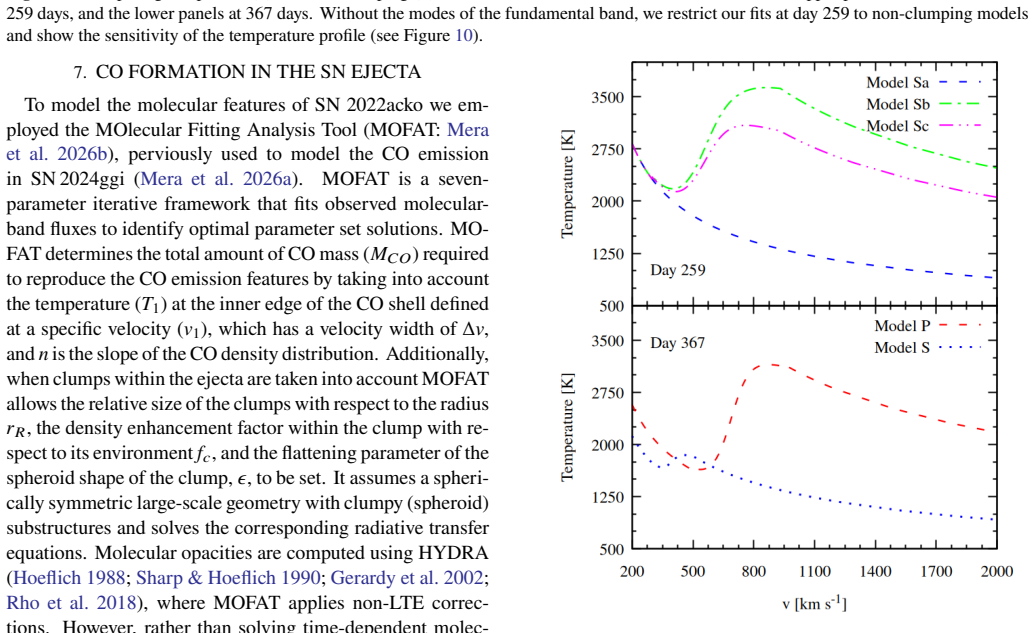
As the first JWST nebular-phase study of a low-mass SN II, the spectra show CO emission without SiO or dust, with a clumped CO distribution whose mass increases over time but remains an order of magnitude lower than in higher-mass counterparts, indicating that low-mass events form substantially less molecules and that dust formation occurs on longer timescales if at all.
What carries the argument
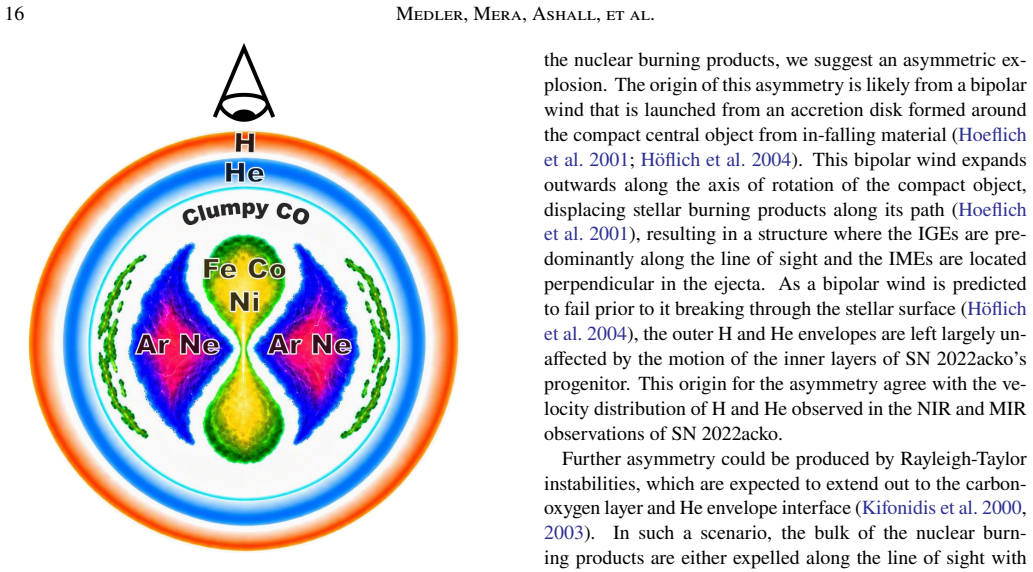
Fitting of the CO first-overtone and fundamental emission bands with the MOFAT code, combined with the measured peak velocity difference between IMEs at 300 km/s and H/He/IGEs at 100 km/s.
If this is right
- CO mass increases between 259 and 368 days post-explosion.
- No SiO emission or dust signatures are detected in the spectra.
- The ejecta shows a bulk velocity offset of about 97 km/s associated with a neutron star natal kick.
- Low-mass SNe II form substantially less molecules than more massive SNe II.
Where Pith is reading between the lines
- Progenitor mass may control the efficiency of molecule formation in core-collapse supernovae.
- Observations of additional low-mass events could test whether dust production is delayed.
- The bipolar outflow geometry might create conditions that limit molecular growth compared to spherical explosions.
Load-bearing premise
The measured velocity difference is best explained by a bipolar outflow rather than Rayleigh-Taylor instabilities or other mixing effects.
What would settle it
Finding similar CO masses or early dust in other low-mass Type II supernovae observed at comparable epochs would undermine the claim of reduced molecule formation.
Figures
read the original abstract
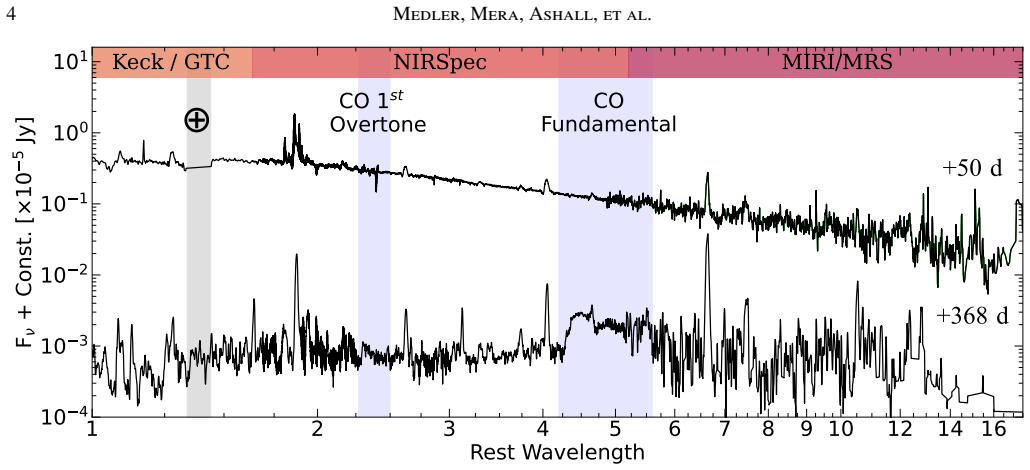
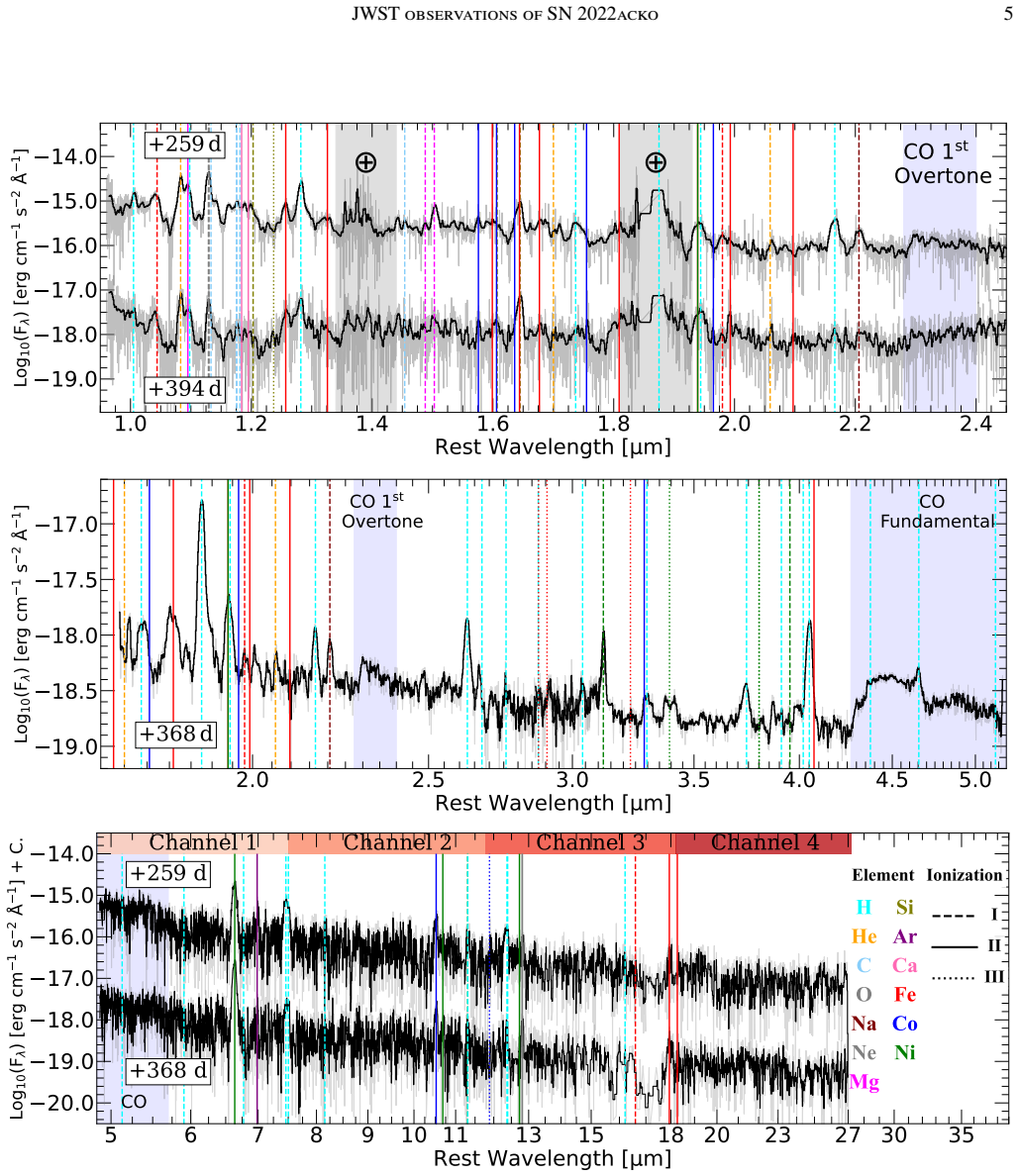
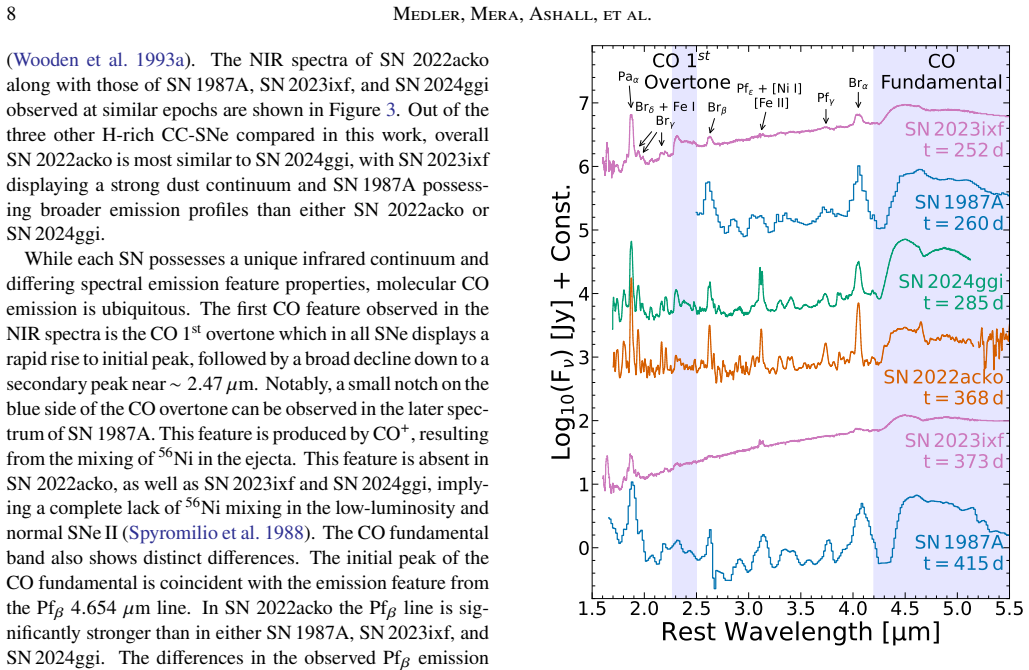
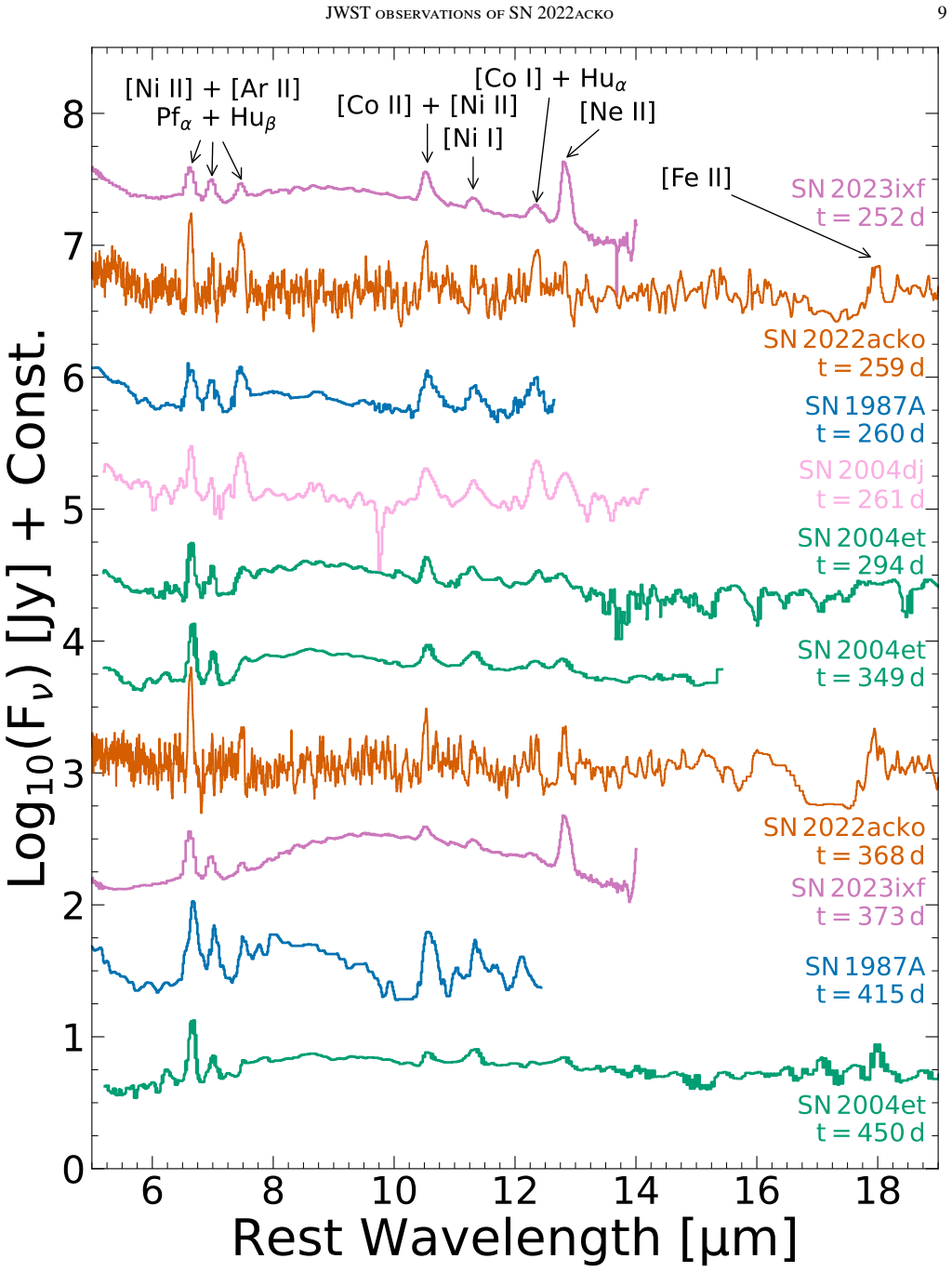
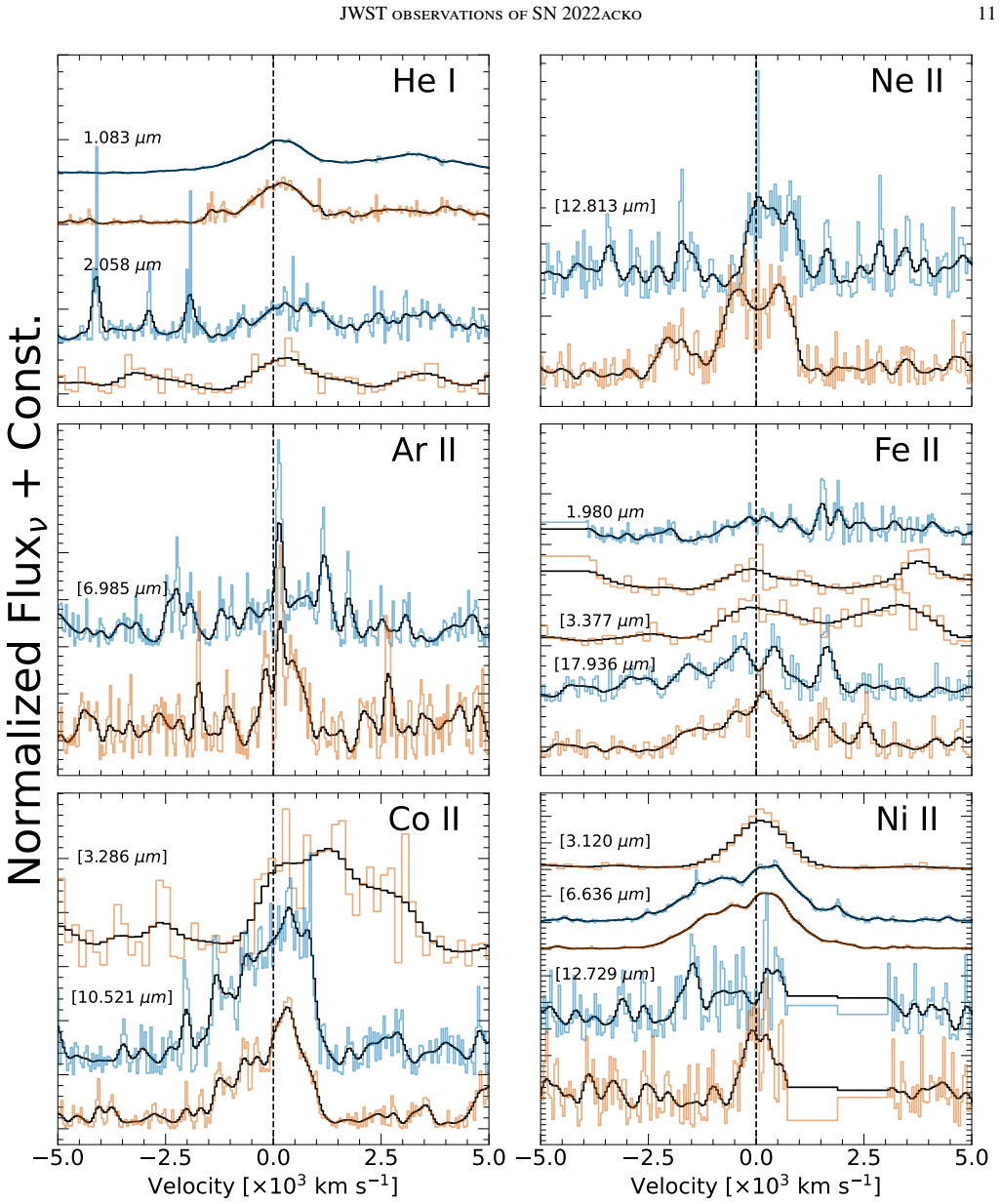
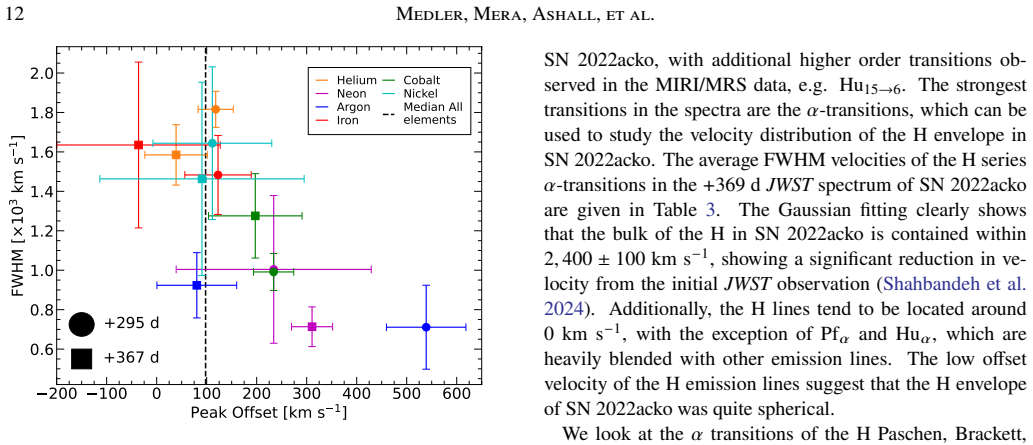
The Type II supernova (SN II) SN 2022acko was the first to be spectroscopically observed by the James Webb Space Telescope ($\textit{JWST}$). Here, we analyze SN 2022acko's second and third $\textit{JWST}$ spectra obtained at $+259$ and $+368$ d. We identify strong features associated with hydrogen along with Intermediate-Mass and Iron-Group Elements (IM/IGEs). The medium-resolution mode of $\textit{JWST}$/MIRI uniquely enables the isolation of emission features, allowing us to determine the structure of SN 2022acko, directly coupling the spectroscopic features and the explosion mechanism. We find that IMEs display peak velocities of $~ 300$ km s$^{-1}$, significantly larger than the $~ 100$ km s$^{-1}$ measured for H, He, and IGEs. We suggest a bipolar outflow best explains this ejecta distribution, although Rayleigh-Taylor instabilities may also contribute. Additionally, we find a bulk velocity offset of $~ 97.4^{+86.3}_{-42.3}$ km s$^{-1}$ in the ejecta which we associate with the natal kick of a neutron star. CO emission is also detected while no SiO or dust signatures are observed. We fit the CO first-overtone and fundamental bands with MOFAT and find a clumped distribution is required with a CO mass increasing from $1.55\times10^{-4}$ M$_{\odot}$ at $+259$ to $2.47\times10^{-4}$ M$_{\odot}$ at $+368$ d. This CO mass is approximately an order of magnitude lower than that of SN 2024ggi. As the first $\textit{JWST}$ nebular-phase study of a low-mass SN II, this work shows that such events form substantially less molecules than more massive SNe II, with dust formation likely occurring on longer timescales, if at all.
Editorial analysis
A structured set of objections, weighed in public.
Referee Report
Summary. The paper analyzes JWST/MIRI medium-resolution spectra of SN 2022acko at +259 d and +368 d, identifying H, IME, IGE, and CO features. It reports IME peak velocities of ~300 km s^{-1} versus ~100 km s^{-1} for H/He/IGEs, suggesting a bipolar outflow (with possible Rayleigh-Taylor contribution), a bulk velocity offset of ~97 km s^{-1} linked to a neutron-star kick, and CO masses of 1.55×10^{-4} M⊙ rising to 2.47×10^{-4} M⊙ derived via MOFAT fits that require clumped CO. No SiO or dust is detected. The central claim is that this first JWST nebular study of a low-mass SN II demonstrates substantially lower molecule formation than in more massive SNe II (e.g., ~10× lower CO than SN 2024ggi), implying dust formation occurs on longer timescales if at all.
Significance. If the CO mass measurements hold, the work supplies the first quantitative nebular-phase JWST constraints on molecule formation in a low-mass SN II, directly testing chemical evolution models and the mass dependence of molecular yields. The new velocity-resolved data on ejecta structure also add to explosion-mechanism diagnostics. The absence of dust signatures at these epochs provides a useful temporal anchor for dust-formation timelines.
major comments (2)
- [MOFAT modeling and CO mass derivation] The central claim that low-mass SNe II form substantially less molecules rests on the MOFAT-derived CO masses being accurate to within a factor of ~10 for comparison to SN 2024ggi. The modeling section states that a clumped distribution is required to reproduce the first-overtone and fundamental bands, but does not quantify how variations in the assumed temperature, density profile, optical depth, or excitation conditions propagate into the mass uncertainty. Without this, it is unclear whether the reported difference is robust against model systematics.
- [Discussion of molecule formation and comparison to SN 2024ggi] The order-of-magnitude comparison to SN 2024ggi is load-bearing for the 'substantially less molecules' conclusion, yet the text does not specify whether identical MOFAT assumptions, temperature ranges, or clumping prescriptions were applied to both objects. Inconsistent modeling choices between the two SNe would undermine the claimed difference.
minor comments (2)
- [Velocity structure analysis] The velocity offset measurement (97.4^{+86.3}_{-42.3} km s^{-1}) is presented without an explicit description of how the uncertainty was derived or which lines contributed to the fit.
- [Observations and data reduction] Figure captions and text should clarify the spectral resolution and wavelength coverage of the MIRI medium-resolution mode to allow readers to assess line isolation.
Simulated Author's Rebuttal
We thank the referee for their constructive comments, which help strengthen the presentation of our modeling and comparisons. We address each major comment below.
read point-by-point responses
-
Referee: [MOFAT modeling and CO mass derivation] The central claim that low-mass SNe II form substantially less molecules rests on the MOFAT-derived CO masses being accurate to within a factor of ~10 for comparison to SN 2024ggi. The modeling section states that a clumped distribution is required to reproduce the first-overtone and fundamental bands, but does not quantify how variations in the assumed temperature, density profile, optical depth, or excitation conditions propagate into the mass uncertainty. Without this, it is unclear whether the reported difference is robust against model systematics.
Authors: We agree that a quantitative assessment of modeling uncertainties would better support the robustness of the CO mass difference. In the revised manuscript we will add a new subsection to the modeling section that explores the sensitivity of the derived CO masses to variations in temperature (2000-3500 K), density power-law index, optical depth, and clumping factor. Preliminary tests indicate the masses remain stable to within a factor of ~2-3, preserving the order-of-magnitude contrast with SN 2024ggi. revision: yes
-
Referee: [Discussion of molecule formation and comparison to SN 2024ggi] The order-of-magnitude comparison to SN 2024ggi is load-bearing for the 'substantially less molecules' conclusion, yet the text does not specify whether identical MOFAT assumptions, temperature ranges, or clumping prescriptions were applied to both objects. Inconsistent modeling choices between the two SNe would undermine the claimed difference.
Authors: We acknowledge the need for explicit clarification. The MOFAT analysis of SN 2022acko adopted the same temperature grid, excitation conditions, and clumping parameterization as the published MOFAT results for SN 2024ggi. In the revised discussion we will add a paragraph that tabulates the key modeling parameters used for both objects and confirms their consistency. revision: yes
Circularity Check
No circularity: all results are direct extractions from new JWST spectra
full rationale
The paper reports observational measurements from new JWST/MIRI spectra at +259 d and +368 d. CO masses are obtained by fitting the first-overtone and fundamental bands directly to the observed data using MOFAT; the reported values (1.55e-4 to 2.47e-4 M⊙) and the order-of-magnitude comparison to SN 2024ggi are therefore empirical outputs, not quantities that reduce by construction to prior fitted parameters. Velocity offsets and IME/H/He/IGE peak velocities are likewise measured from line profiles in the spectra. No equations, self-citations, or uniqueness theorems are invoked to derive the central claims; the bipolar-outflow interpretation is presented as one possible explanation alongside Rayleigh-Taylor instabilities. The derivation chain consists entirely of data reduction and model fitting to fresh observations and remains self-contained.
Axiom & Free-Parameter Ledger
free parameters (2)
- CO mass at +259 d =
1.55×10^{-4} M_⊙
- CO mass at +368 d =
2.47×10^{-4} M_⊙
axioms (2)
- domain assumption SN 2022acko is a low-mass Type II supernova
- ad hoc to paper Clumped CO distribution is required to reproduce the observed bands
Reference graph
Works this paper leans on
-
[1]
Aspherical Core-Collapse Supernovae in Red Supergiants Powered by Nonrelativistic Jets
Aspherical Core-Collapse Supernovae in Red Supergiants Powered by Nonrelativistic Jets. , keywords =. doi:10.1088/0004-637X/696/1/953 , archivePrefix =. 0812.3918 , primaryClass =
work page internal anchor Pith review Pith/arXiv arXiv doi:10.1088/0004-637x/696/1/953
-
[2]
Three-Dimensional Supernova Explosion Simulations of 9-, 10-, 11-, 12-, and 13-M$_{\odot}$ Stars
Three-dimensional supernova explosion simulations of 9-, 10-, 11-, 12-, and 13-M _ ☉ stars. , keywords =. doi:10.1093/mnras/stz543 , archivePrefix =. 1902.00547 , primaryClass =
work page internal anchor Pith review Pith/arXiv arXiv doi:10.1093/mnras/stz543 1902
-
[3]
Chemical Stratification in a Long Gamma-Ray Burst Cocoon and Early-time Spectral Signatures of Supernovae Associated with Gamma-Ray Bursts. , keywords =. doi:10.3847/1538-4357/ac3d8d , archivePrefix =. 2111.12914 , primaryClass =
-
[4]
A 3D Simulation of a Type II-P Supernova: From Core Bounce to beyond Shock Breakout. , keywords =. doi:10.3847/1538-4357/adb1e4 , archivePrefix =. 2411.03434 , primaryClass =
-
[5]
The nebular phase of SN 2024ggi: A low-mass progenitor with no signs of interaction. , keywords =. doi:10.1051/0004-6361/202556652 , archivePrefix =. 2507.22794 , primaryClass =
-
[6]
SN 2024ggi: Another year, another striking Type II supernova. , keywords =. doi:10.1051/0004-6361/202554333 , archivePrefix =. 2503.01577 , primaryClass =
-
[7]
Optical and Near-infrared Nebular-phase Spectroscopy of SN 2024ggi: Constraints on the Structure of the Inner Ejecta, Progenitor Mass, and Dust. , keywords =. doi:10.3847/1538-4357/ae4500 , archivePrefix =. 2508.02656 , primaryClass =
-
[8]
arXiv e-prints , keywords =
Probing the 3D Structures of Supernovae through IR Signatures of CO and SiO. arXiv e-prints , keywords =
-
[9]
Primordial massive supernovae as the first molecular factories in the early universe
Primordial Massive Supernovae as the First Molecular Factories in the Early Universe. , keywords =. doi:10.1086/591906 , archivePrefix =. 0807.2511 , primaryClass =
work page internal anchor Pith review Pith/arXiv arXiv doi:10.1086/591906
-
[11]
Airborne Spectrophotometry of SN 1987A from 1.7 to 12.6 Microns: Time History of the Dust Continuum and Line Emission. , keywords =. doi:10.1086/191830 , adsurl =
-
[12]
Spectroscopic and photometric observations of SN 1987A - III. Days 135 to 260. , keywords =. doi:10.1093/mnras/231.1.75P , adsurl =
-
[13]
PypeIt: The Python Spectroscopic Data Reduction Pipeline. The Journal of Open Source Software , keywords =. doi:10.21105/joss.02308 , archivePrefix =. 2005.06505 , primaryClass =
-
[14]
Spectroscopy of supernova 1987A at 1-5 mu.m -I. The first year. , keywords =. doi:10.1093/mnras/238.1.193 , adsurl =
-
[15]
Herschel Detects a Massive Dust Reservoir in Supernova 1987A
Herschel Detects a Massive Dust Reservoir in Supernova 1987A. Science , keywords =. doi:10.1126/science.1205983 , archivePrefix =. 1107.1477 , primaryClass =
work page internal anchor Pith review Pith/arXiv arXiv doi:10.1126/science.1205983
-
[16]
Composition and quantities of dust produced by AGB-stars and returned to the interstellar medium. , keywords =. doi:10.1051/0004-6361:20041198 , adsurl =
-
[17]
``Thermal'' SiO radio line emission towards M-type AGB stars: A probe of circumstellar dust formation and dynamics. , keywords =. doi:10.1051/0004-6361:20031068 , archivePrefix =. astro-ph/0302179 , primaryClass =
work page internal anchor Pith review Pith/arXiv arXiv doi:10.1051/0004-6361:20031068
-
[18]
The Evolution of the Elemental Abundances in the Gas and Dust Phases of the Galaxy
The Evolution of the Elemental Abundances in the Gas and Dust Phases of the Galaxy. , keywords =. doi:10.1086/305829 , archivePrefix =. astro-ph/9707024 , primaryClass =
work page internal anchor Pith review Pith/arXiv arXiv doi:10.1086/305829
-
[19]
High-excitation CO in a quasar host galaxy at z=6.42
High-excitation CO in a quasar host galaxy at z =6.42. , keywords =. doi:10.1051/0004-6361:20031345 , archivePrefix =. astro-ph/0307408 , primaryClass =
work page internal anchor Pith review Pith/arXiv arXiv doi:10.1051/0004-6361:20031345
-
[20]
SCUBA2 High Redshift Bright Quasar Survey: Far-infrared Properties and Weak-line Features. , keywords =. doi:10.3847/1538-4357/aba52d , archivePrefix =. 2009.00877 , primaryClass =
-
[21]
2003, MNRAS, 341, 1179, doi: 10.1046/j.1365-8711.2003.06473.x
Quasars as probes of the submillimetre cosmos at z > 5 - I. Preliminary SCUBA photometry. , keywords =. doi:10.1046/j.1365-8711.2003.07076.x , archivePrefix =. astro-ph/0308132 , primaryClass =
-
[22]
doi:10.1007/BF00212318 , journal =
-
[23]
European Southern Observatory Conference and Workshop Proceedings , keywords =
-
[24]
doi:10.1093/mnras/229.1.15P , journal =
-
[25]
doi:10.1093/mnras/235.1.19P , journal =
-
[26]
doi:10.1017/S1323358000022608 , journal =
-
[27]
Highlights of Astronomy , month =
-
[28]
Nuclear Astrophysics , keywords =
-
[29]
doi:10.1007/BF00646849 , journal =
-
[30]
doi:10.1086/168981 , journal =
-
[31]
doi:10.1086/169657 , journal =
-
[32]
doi:10.1093/mnras/261.3.535 , journal =
-
[33]
doi:10.1093/mnras/265.2.471 , journal =
-
[34]
doi:10.1086/175317 , journal =
-
[35]
doi:10.1051/aas:1996164 , journal =
-
[36]
, keywords =. doi:10.1086/176894 , eprint =
-
[37]
, keywords =. doi:10.1086/178017 , eprint =
-
[38]
, keywords =. doi:10.1086/305258 , eprint =
-
[39]
, keywords =. doi:10.1086/305327 , eprint =
-
[40]
, keywords =. doi:10.1086/312405 , eprint =
-
[42]
, keywords =. doi:10.1086/308968 , eprint =
-
[43]
, keywords =. doi:10.1086/322239 , eprint =
-
[44]
, keywords =. doi:10.1086/338981 , eprint =
-
[45]
, keywords =. doi:10.1086/376721 , eprint =
-
[46]
2003, MNRAS, 341, 1179, doi: 10.1046/j.1365-8711.2003.06473.x
, keywords =. doi:10.1046/j.1365-8711.2003.06958.x , eprint =
-
[47]
doi:10.1071/AS03041 , eprint =
, keywords =. doi:10.1071/AS03041 , eprint =
-
[48]
arXiv , author =:astro-ph/0405162 , journal =
-
[49]
, keywords =. doi:10.1086/428608 , eprint =
-
[50]
, keywords =. doi:10.1086/432975 , eprint =
-
[51]
, keywords =. doi:10.1111/j.1365-2966.2005.08928.x , eprint =
-
[52]
, keywords =. doi:10.1086/430135 , eprint =
-
[54]
, keywords =. doi:10.1086/512769 , eprint =
-
[55]
, keywords =. doi:10.1086/519733 , eprint =
-
[56]
doi:10.1126/science.1136259 , eprint =
Science , keywords =. doi:10.1126/science.1136259 , eprint =
-
[58]
, keywords =. doi:10.1086/597788 , eprint =
-
[60]
Swift X-Ray Observations of Classical Novae. II. The Super Soft Source sample
doi:10.1088/0067-0049/197/2/31 , eid =. arXiv , author =:1110.6224 , journal =
work page internal anchor Pith review Pith/arXiv arXiv doi:10.1088/0067-0049/197/2/31
-
[61]
Astropy: A Community Python Package for Astronomy
doi:10.1051/0004-6361/201322068 , eid =. arXiv , author =:1307.6212 , journal =
work page internal anchor Pith review Pith/arXiv arXiv doi:10.1051/0004-6361/201322068
-
[62]
Carbon Deflagration in Type Ia Supernova: I. Centrally Ignited Models
doi:10.1088/0004-637X/771/1/58 , eid =. arXiv , author =:1305.2433 , journal =
work page internal anchor Pith review Pith/arXiv arXiv doi:10.1088/0004-637x/771/1/58
-
[63]
Spectroscopy of Type Ia Supernovae by the Carnegie Supernova Project
doi:10.1088/0004-637X/773/1/53 , eid =. arXiv , author =:1305.6997 , journal =
work page internal anchor Pith review Pith/arXiv arXiv doi:10.1088/0004-637x/773/1/53
-
[64]
doi:10.1093/mnras/stt861 , eprint =
, keywords =. doi:10.1093/mnras/stt861 , eprint =
-
[65]
arXiv , author =:1302.4485 , journal =
-
[66]
doi:10.1126/science.1231502 , eprint =
Science , keywords =. doi:10.1126/science.1231502 , eprint =
-
[67]
doi:10.1007/978-3-642-30304-3 , publisher =
-
[68]
Galaxy emission line classification using 3D line ratio diagrams
doi:10.1088/0004-637X/793/2/127 , eid =. arXiv , author =:1406.5186 , journal =
work page internal anchor Pith review Pith/arXiv arXiv doi:10.1088/0004-637x/793/2/127
-
[69]
doi:10.1093/mnras/stu077 , eprint =
, keywords =. doi:10.1093/mnras/stu077 , eprint =
-
[70]
The 2D Distribution of Iron Rich Ejecta in the Remnant of SN 1885 in M31
doi:10.1088/0004-637X/804/2/140 , eid =. arXiv , author =:1412.3815 , journal =
work page internal anchor Pith review Pith/arXiv arXiv doi:10.1088/0004-637x/804/2/140
-
[71]
doi:10.1088/0004-637X/805/1/23 , eid =. arXiv , author =:1503.01475 , journal =
work page internal anchor Pith review Pith/arXiv arXiv doi:10.1088/0004-637x/805/1/23
-
[72]
Reconciling the infrared catastrophe and observations of SN 2011fe
doi:10.1088/2041-8205/814/1/L2 , eid =. arXiv , author =:1511.00245 , journal =
work page internal anchor Pith review Pith/arXiv arXiv doi:10.1088/2041-8205/814/1/l2 2041
-
[73]
doi:10.1093/mnras/stv761 , eprint =
, keywords =. doi:10.1093/mnras/stv761 , eprint =
-
[74]
Nominal values for selected solar and planetary quantities: IAU 2015 Resolution B3
doi:10.3847/0004-6256/152/2/41 , eid =. arXiv , author =:1605.09788 , journal =
work page internal anchor Pith review Pith/arXiv arXiv doi:10.3847/0004-6256/152/2/41
-
[75]
doi:10.1093/mnras/stv2402 , eprint =
, keywords =. doi:10.1093/mnras/stv2402 , eprint =
-
[76]
doi:10.3847/1538-4357/aa81d8 , eid =. arXiv , author =:1704.06275 , journal =
work page internal anchor Pith review Pith/arXiv arXiv doi:10.3847/1538-4357/aa81d8
-
[77]
doi:10.1007/978-3-319-21846-5 , publisher =
Handbook of Supernovae , year =. doi:10.1007/978-3-319-21846-5 , publisher =
-
[78]
Nebular spectroscopy of SN 2014J: Detection of stable nickel in near infrared spectra
doi:10.1051/0004-6361/201833274 , eid =. arXiv , author =:1805.02420 , journal =
work page internal anchor Pith review Pith/arXiv arXiv doi:10.1051/0004-6361/201833274
-
[79]
doi:10.3847/1538-3881/aacea9 , eid =. arXiv , author =:1807.01263 , journal =
work page internal anchor Pith review Pith/arXiv arXiv doi:10.3847/1538-3881/aacea9
-
[80]
The Astropy Project: Building an inclusive, open-science project and status of the v2.0 core package
doi:10.3847/1538-3881/aabc4f , eid =. arXiv , author =:1801.02634 , journal =
work page internal anchor Pith review Pith/arXiv arXiv doi:10.3847/1538-3881/aabc4f
-
[81]
doi:10.3847/2041-8213/aaf167 , eid =. arXiv , author =:1811.08553 , journal =
work page internal anchor Pith review Pith/arXiv arXiv doi:10.3847/2041-8213/aaf167 2041
-
[82]
doi:10.1093/mnras/sty632 , eprint =
, keywords =. doi:10.1093/mnras/sty632 , eprint =
-
[83]
doi:10.1093/mnras/sty820 , eprint =
, keywords =. doi:10.1093/mnras/sty820 , eprint =
-
[85]
doi:10.1007/s11214-018-0494-5 , eid =
, month =. doi:10.1007/s11214-018-0494-5 , eid =
-
[87]
, keywords =. doi:10.1088/1538-3873/aaecbe , eprint =
discussion (0)
Sign in with ORCID, Apple, or X to comment. Anyone can read and Pith papers without signing in.