Probing IMF Variations in High-Redshift Early-Type Galaxies with SHARP
Pith reviewed 2026-07-01 05:01 UTC · model grok-4.3
The pith
The SHARP spectrograph on the E-ELT will enable spatially resolved spectroscopy of IMF-sensitive features in high-redshift early-type galaxies up to z~3.
A machine-rendered reading of the paper's core claim, the machinery that carries it, and where it could break.
Core claim
The SHARP spectrograph on the E-ELT, with unprecedented spatial resolution and sensitivity compared to facilities such as JWST, and broader spectral coverage than other E-ELT instruments, will enable spatially resolved spectroscopy of IMF-sensitive features in high-redshift ETGs up to z~3, providing unique insights into the origin of the non-universal IMF in massive galaxies.
What carries the argument
SHARP spectrograph on the E-ELT for spatially resolved spectroscopy of IMF-sensitive features
Load-bearing premise
The tension between bottom-heavy IMF in local ETGs and the requirement for top-heavy IMF from chemical enrichment is best explained by a time-evolving IMF.
What would settle it
If SHARP observations show no evidence of IMF differences at high redshift compared to local values, the time-evolving IMF hypothesis would be challenged.
Figures
read the original abstract
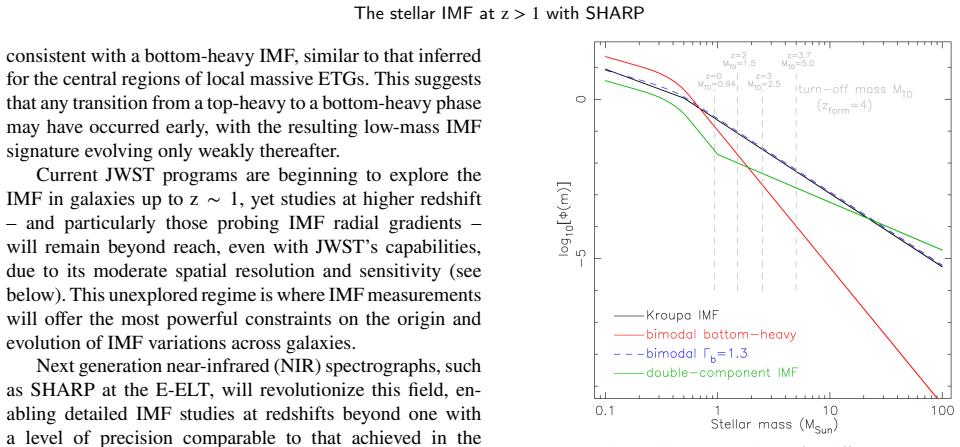
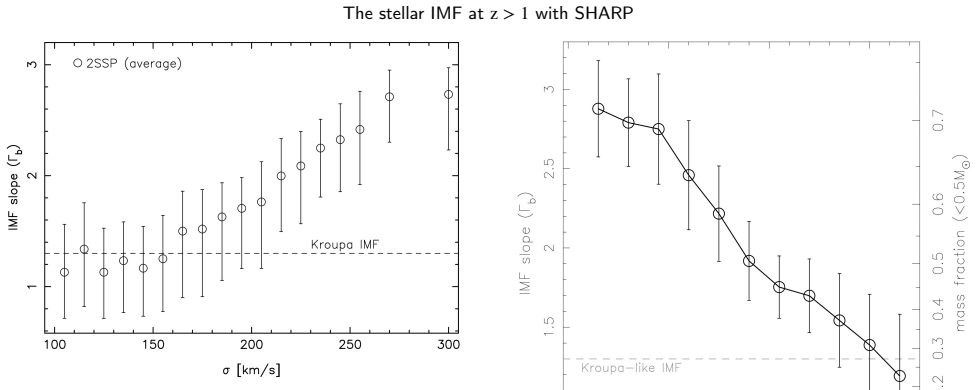
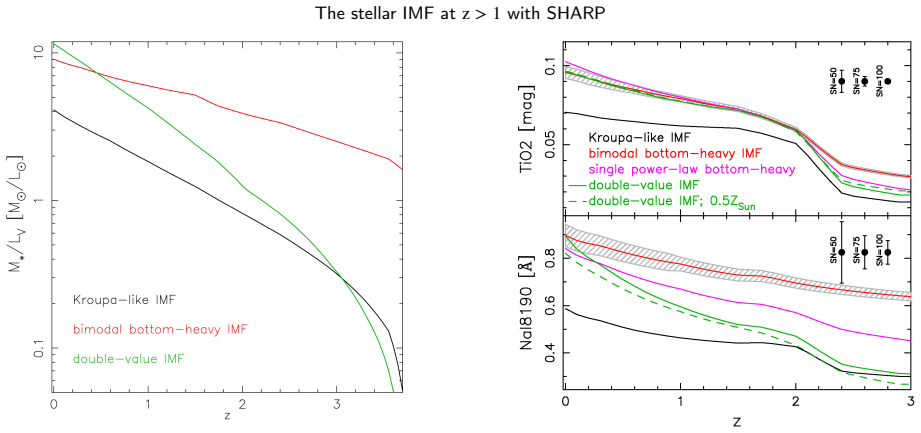
The stellar initial mass function (IMF), which describes the distribution of stellar masses at birth, is a fundamental ingredient in shaping galaxy evolution. Recent observations indicate that the IMF varies between galaxies, depending on their mass, morphology, and stellar content. In local early-type galaxies (ETGs), spectroscopy, dynamics, and lensing reveal bottom-heavy IMFs in dense central regions, with radial gradients toward a Milky Way-like distribution in the outskirts. Yet, the chemical enrichment of massive ETGs implies a dominant role of massive stars during their early formation phases. These findings can be reconciled if the IMF evolves over cosmic time -- initially more top-heavy to enable rapid enrichment, and later dominated by long-lived, low-mass stars. Directly measuring the IMF at z>1 is therefore essential to test such time-dependent IMF scenarios, including variations in the dwarf-to-giant and stellar mass-to-light ratios. To date, no direct observational confirmation of these IMF variations -- or of their physical origin -- has been obtained. The SHARP spectrograph on the E-ELT, with unprecedented spatial resolution and sensitivity compared to facilities such as JWST, and broader spectral coverage than other E-ELT instruments, will enable spatially resolved spectroscopy of IMF-sensitive features in high-redshift ETGs up to z~3, providing unique insights into the origin of the non-universal IMF in massive galaxies.
Editorial analysis
A structured set of objections, weighed in public.
Referee Report
Summary. The manuscript presents a forward-looking science case arguing that the SHARP spectrograph on the E-ELT will enable spatially resolved spectroscopy of IMF-sensitive features in high-redshift early-type galaxies (ETGs) up to z~3. It motivates this by noting the tension between bottom-heavy IMFs observed locally in ETGs and the top-heavy star formation implied by chemical enrichment, suggesting that a time-evolving IMF could reconcile the observations, and positions SHARP's resolution, sensitivity, and spectral coverage as uniquely suited to test this scenario compared to JWST and other E-ELT instruments.
Significance. If the claimed capabilities hold, the work identifies a clear observational path to directly constrain IMF evolution at cosmic epochs when massive ETGs assembled, addressing a key open question in galaxy formation. The emphasis on spatially resolved high-z spectroscopy is a strength, as it targets radial gradients and time dependence that local studies cannot access. No machine-checked proofs or reproducible code are present, as expected for a science case, but the falsifiable prediction of measurable IMF variations at z>1 is explicitly framed.
major comments (2)
- [Abstract] Abstract: The central claim that SHARP 'will enable spatially resolved spectroscopy of IMF-sensitive features in high-redshift ETGs up to z~3' is load-bearing but unsupported by any quantitative estimates of required exposure times, achievable S/N on IMF-sensitive lines (e.g., Na I, Ca II, or TiO features), or resolution requirements at z~3; without such analysis the feasibility assertion cannot be evaluated.
- [Abstract] Abstract (motivation paragraph): The premise that the local bottom-heavy vs. chemical-enrichment tension is best resolved by a time-evolving IMF is presented as the scenario to test, yet no quantitative comparison is made to alternative explanations (e.g., systematics in local dynamical/lensing IMF measurements or variations in star-formation efficiency), which weakens the justification for why SHARP observations would uniquely discriminate among models.
minor comments (1)
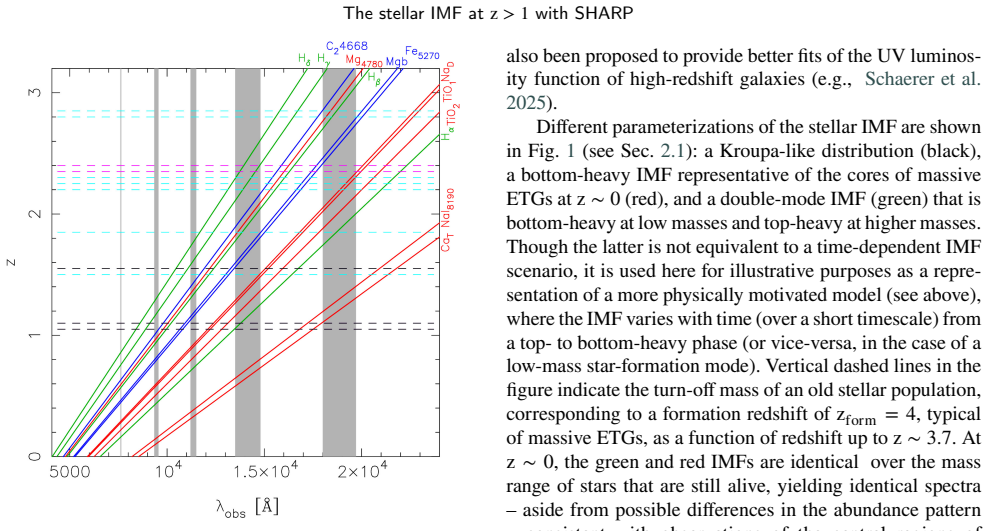
- [Abstract] The manuscript would benefit from explicit references to the specific IMF-sensitive spectral features and wavelength ranges that SHARP's broader coverage would access, to clarify the advantage over other E-ELT instruments.
Simulated Author's Rebuttal
We thank the referee for their constructive and detailed comments, which help clarify the presentation of our science case. We address each major comment below and indicate the planned revisions.
read point-by-point responses
-
Referee: [Abstract] Abstract: The central claim that SHARP 'will enable spatially resolved spectroscopy of IMF-sensitive features in high-redshift ETGs up to z~3' is load-bearing but unsupported by any quantitative estimates of required exposure times, achievable S/N on IMF-sensitive lines (e.g., Na I, Ca II, or TiO features), or resolution requirements at z~3; without such analysis the feasibility assertion cannot be evaluated.
Authors: We agree that the abstract's central claim would be strengthened by quantitative support. The manuscript is a forward-looking science case relying on SHARP's advertised specifications, but it does not include explicit exposure time, S/N, or resolution calculations. In the revised version we will add these estimates (e.g., for Na I, Ca II, and TiO features at z~3) in a dedicated subsection or appendix, and we will update the abstract to reference the new analysis. revision: yes
-
Referee: [Abstract] Abstract (motivation paragraph): The premise that the local bottom-heavy vs. chemical-enrichment tension is best resolved by a time-evolving IMF is presented as the scenario to test, yet no quantitative comparison is made to alternative explanations (e.g., systematics in local dynamical/lensing IMF measurements or variations in star-formation efficiency), which weakens the justification for why SHARP observations would uniquely discriminate among models.
Authors: The manuscript uses the local IMF–enrichment tension to motivate testing time-dependent IMF evolution. We acknowledge that a more explicit discussion of alternatives would provide better context. In revision we will expand the motivation section to include a concise comparison with alternatives such as systematics in local dynamical or lensing measurements and variations in star-formation efficiency, and we will note how spatially resolved high-z spectroscopy can help discriminate among these possibilities. revision: yes
Circularity Check
No significant circularity; forward-looking science case with no derivation chain
full rationale
The document is a prospective science case for the SHARP instrument on E-ELT, outlining expected capabilities for high-redshift IMF measurements. It contains no equations, parameter fits, predictions derived from internal data, or load-bearing self-citations that reduce claims to inputs by construction. The abstract and framing motivate observations by referencing existing literature tensions (local bottom-heavy IMF vs. chemical enrichment) but assert no new derivations or uniqueness theorems; the central claim is instrumental enablement up to z~3, which stands independently of any internal reduction. This matches the default expectation of non-circularity for non-analytical papers.
Axiom & Free-Parameter Ledger
Reference graph
Works this paper leans on
-
[1]
D., Smith, R
Alton, P. D., Smith, R. J., Lucey, J. R., 2017, MNRAS, 468, 1594
2017
-
[2]
D., Smith, R
Alton, P. D., Smith, R. J., Lucey, J. R., 2018, MNRAS, 478, 4464
2018
-
[3]
W., Treu, T., Bolton, A
Auger, M. W., Treu, T., Bolton, A. S., et al., 2010, ApJ, 724, 511 Barnabé, M., Czoske, O., Koopmans, L. V. E., et al., 2011, MNRAS, 415, 2215
2010
-
[4]
Barro, G., et al., 2013, ApJ, 765, 104
2013
-
[5]
Belli, S., et al., 2017, ApJ, 834, 30
2017
-
[6]
Bensby, T., et al., 2017, A&A, 605, A89 Calura F., Menci N., 2009, MNRAS, 400, 1347 Calura F., Gilli R., Vignali C., Pozzi F., Pipino A., Matteucci F., 2014, MNRAS, 438, 2765
2017
-
[7]
Cappellari, M., et al., 2012, Nature, 484, 485
2012
-
[8]
Cappellari, M., et al., 2013, MNRAS, 432, 1862
2013
-
[9]
J., 1986, ApJ, 311, 637
Carter, D., Visvanathan, N., Pickles, A. J., 1986, ApJ, 311, 637
1986
-
[10]
J., Gorgas, J., Vazdekis, A., et al., 2003, MNRAS, 339, L12 Chabriér, G., Hennebelle, P., Charlot, S., 2014, A&A, 577, A123
Cenarro, A. J., Gorgas, J., Vazdekis, A., et al., 2003, MNRAS, 339, L12 Chabriér, G., Hennebelle, P., Charlot, S., 2014, A&A, 577, A123
2003
-
[11]
M., et al., 2023, MNRAS, 526, 4004
Cheng, C. M., et al., 2023, MNRAS, 526, 4004
2023
-
[12]
Chon, S., Hosokawa, T., Omukai, K., Schneider, R., 2024, MNRAS, 530, 2453
2024
-
[13]
G., 1978, ApJ, 221, 788
Cohen, J. G., 1978, ApJ, 221, 788
1978
-
[14]
J., Abraham, R
Damjanov, I., McCarthy, P. J., Abraham, R. G., et al., 2009, ApJ, 695, 101 Davé, R. 2008, MNRAS, 385, 1470
2009
-
[15]
Dekel, A., Burkert, A., 2014, MNRAS, 438, 1870
2014
-
[16]
R., et al., 2019, MNRAS, 489, 5612
Delisle, S., Hardy, E., 1992, AJ, 103, 711 Domínguez Sánchez, H., Bernardi, M., Brownstein, J. R., et al., 2019, MNRAS, 489, 5612
1992
-
[17]
Dong, H., Olsen, K., Lauer, T., et al., 2018, MNRAS, 478, 5379
2018
-
[18]
A., Mendel, J
Dutton, A. A., Mendel, J. T., Simard, L., 2012, MNRAS, 422, 33
2012
-
[19]
Eftekhari, E., Vazdekis, A., La Barbera, F., 2021, MNRAS, 504, 2190 Eftekhari,E.,LaBarbera,F.,Vazdekis,A.,etal.,2022a,MNRAS,512,378
2021
-
[20]
M., French, H
Faber, S. M., French, H. B., 1980, ApJ, 235, 405
1980
-
[21]
A., 2024, MNRAS, 531, 267
Walker, S. A., 2024, MNRAS, 531, 267
2024
-
[22]
Ferreras, I., Saha, P., Williams, L. L. R., 2005, ApJ, 623, 5
2005
-
[23]
Ferreras, I., Saha, P., Burles, S., 2008, MNRAS, 383, 857
2008
-
[24]
Ferreras, I., Saha, P., Leier, D., et al., 2010, MNRAS, 409, L30
2010
-
[25]
Ferreras, I., et al., 2013, MNRAS, 429, L15 Ferreras,I.,Weidner,C.,Vazdekis,A.,LaBarbera,F.,2015,MNRAS,448, 82
2013
-
[26]
Fontanot, F., La Barbera, F., De Lucia, G., Pasquali, A., Vazdekis, A., 2018b, MNRAS, 479, 5678 Fontanot,F.,LaBarbera,F.,DeLucia,G.,Pasquali,A.,Vazdekis,A.,2024, A&A, 686, A302
2024
- [27]
-
[28]
Forrest, B., et al., 2022, ApJ, 927, 123
2022
-
[29]
A., Persson, S
Frogel, J. A., Persson, S. E., Aaronson, M., Matthews, K., 1978, ApJ, 220, 75
1978
-
[30]
A., Persson, S
Frogel, J. A., Persson, S. E., Cohen, J. G., 1980, ApJ, 240, 785 Gall C., Andersen A. C., Hjorth J., 2011, A&A, 528, A13
1980
-
[31]
R., Pasquali, A., Zibetti, S., La Barbera, F., 2021, MNRAS, 502, 4457 Gargiulo,A.,Saracco,P.,Longhetti,M.,LaBarbera,F.,Tamburri,S.,2012, MNRAS, 425, 2698
Gallazzi, A. R., Pasquali, A., Zibetti, S., La Barbera, F., 2021, MNRAS, 502, 4457 Gargiulo,A.,Saracco,P.,Longhetti,M.,LaBarbera,F.,Tamburri,S.,2012, MNRAS, 425, 2698
2021
-
[32]
Gargiulo, A., Saracco, P., Longhetti, M., Tamburri, S., Lonoce, I., Ciocca, F., 2015, A&A, 573, 110
2015
-
[33]
Gibson, B. K. & Matteucci, F. 1997, MNRAS, 291, L8
1997
-
[34]
Gunawardhana, M. L. P., Hopkins, A. M., Sharp, R. G., et al. 2011, MNRAS, 415, 1647
2011
-
[35]
Hardy, E., Couture, J., 1988, ApJ, 325, 29
1988
-
[36]
& Grudić, M
Hennebelle, P. & Grudić, M. Y. 2024, ARAA, 62, 63
2024
-
[37]
Hopkins, P. F. 2013, MNRAS, 433, 170
2013
-
[38]
M., 2018, PASA, 35, 39 Jeřábková, T., et al., 2018, A&A, 620, 39
Hopkins, A. M., 2018, PASA, 35, 39 Jeřábková, T., et al., 2018, A&A, 620, 39
2018
-
[39]
Kroupa, P. 2001, MNRAS, 322, 231 La Barbera, F., Ferreras, I., Vazdekis, A., et al., 2013, MNRAS, 433, 3017 La Barbera, F., Ferreras, I., Vazdekis, A., 2015, MNRAS, 449, L137 La Barbera, F., Vazdekis, A., Ferreras, I., et al., 2016, MNRAS, 457, 1468 La Barbera, F., Vazdekis, A., Ferreras, I., et al., 2017, MNRAS, 464, 3597 La Barbera, F., Vazdekis, A., Fe...
2001
-
[40]
Larson, R. B. 1998, MNRAS, 301, 569
1998
-
[41]
Lecureur, A., Hill, V., Zoccali, M., et al., 2007, A&A, 465, 799
2007
-
[42]
Leier, D., Ferreras, I., Saha, P., et al., 2016, MNRAS, 459, 3677
2016
-
[43]
Maksymowicz-Maciata, M., Spiniello, C., Martín-Navarro, I., et al., 2024, MNRAS, 531, 2864
2024
-
[44]
Maraston, C., 2005, MNRAS, 362, 799 Maraston,C.,Strömbäck,G.,Thomas,D.,etal.,2020,MNRAS,496,2962
2005
-
[45]
Marks, M., Kroupa, P., Dabringhausen, J., & Pawlowski, M. S. 2012, MNRAS, 422, 2246 Mármol-Queraltó,E.,Sánchez-Blázquez,P.,Vazdekis,A.,etal.,2009,ApJ, 706, 212 Martín-Navarro, I., La Barbera, F., Vazdekis, A., et al., 2015a, MNRAS, 447, 1033 Martín-Navarro, I., La Barbera, F., Vazdekis, A., et al., 2015b, ApJ, 806, L31 Martín-Navarro, I., La Barbera, F., ...
2012
-
[46]
1994, A&A, 288, 57
Matteucci, F. 1994, A&A, 288, 57
1994
-
[47]
Muzzin, A., et al., 2013, ApJ, 777, 18
2013
-
[48]
& Davé, R
Narayanan, D. & Davé, R. 2013, MNRAS, 436, 2892 Navarro-González, J., Ricciardelli, E., Quilis, V., Vazdekis, A., 2013, MNRAS, 436, 3507 F. La Barbera et al.:Preprint submitted to ElsevierPage 10 of 12 The stellar IMF atz>1with SHARP
2013
-
[49]
B., Ellis, R
Newman, A. B., Ellis, R. S., Andreon, S., et al., 2014, ApJ, 788, 51
2014
-
[50]
B., Smith, R
Newman, A. B., Smith, R. J., Conroy, C., Villaume, A., van Dokkum, P., 2017, ApJ, 845, 157
2017
-
[51]
P., Naab, T., et al., 2010, ApJ, 725, 2312
Oser, L., Ostriker, J. P., Naab, T., et al., 2010, ApJ, 725, 2312
2010
-
[52]
L., Vincenzo, F., Lacchin, E
Palla, M., Calura, F., Matteucci, F., Fan, X. L., Vincenzo, F., Lacchin, E. 2020, MNRAS, 494, 2355
2020
-
[53]
W., et al., 2018, MNRAS, 477, 3954P
Parikh, T., Treu, T., Auger, M. W., et al., 2018, MNRAS, 477, 3954P
2018
-
[54]
P., Thi, W.-F., Miniati, F., Viti, S., 2011, MNRAS, 414, 1705
Papadopoulos, P. P., Thi, W.-F., Miniati, F., Viti, S., 2011, MNRAS, 414, 1705
2011
-
[55]
W., et al., 2017, MNRAS, 468, 3456
Rock, B., Treu, T., Auger, M. W., et al., 2017, MNRAS, 468, 3456
2017
-
[56]
P., Ivison, R
Romano, D., Matteucci, F., Zhang, Z.-Y., Papadopoulos, P. P., Ivison, R. J. 2017, MNRAS, 470, 401
2017
-
[57]
Rubin, K. H. R., Prochaska, J. X., Chen, H.-W., et al., 2025, ApJ, 981, 31
2025
-
[58]
Saracco, P., Longhetti, M., Gargiulo, A., et al., 2020, ApJ, 905, 40
2020
-
[59]
Sarzi, M., Spiniello, C., La Barbera, F., et al., 2018, MNRAS, 478, 4084S Schaerer,D.,Guibert,J.,Marques-Chaves,R.,Martins,F.,2025,A&A,693, 15
2018
-
[60]
& Krumholz, M
Sharda, P. & Krumholz, M. R. 2022, MNRAS, 509, 1959
2022
-
[61]
Schiavon, R., Barbuy, B., Rossi, S. C. F., et al., 1997, ApJ, 479, 902
1997
-
[62]
Slob, M., et al., 2025, A&A, 702, 110
2025
-
[63]
J., Lucey, J
Smith, R. J., Lucey, J. R., 2013, MNRASL, 434, 1964
2013
-
[64]
Smith, R. J. 2014, MNRAS, 443, L69
2014
-
[65]
J., Lucey, J
Smith, R. J., Lucey, J. R., Conroy, C., 2015, MNRASL, 449, 3441
2015
-
[66]
J., Lucey, J
Smith, R. J., Lucey, J. R., Conroy, C., et al., 2015, MNRAS, 450, 2006
2015
-
[67]
J., 2020, ARA&A, 58, 577
Smith, R. J., 2020, ARA&A, 58, 577
2020
-
[68]
Spiniello, C., Trager, S., Koopmans, L., et al., 2012, ApJ, 753, L32
2012
-
[69]
Spiniello, C., Trager, S., Koopmans, L., et al., 2014, MNRAS, 438, 1483
2014
-
[70]
Spiniello, C., La Barbera, F., Tortora, C., et al., 2021, A&A, 645, A99
2021
-
[71]
Spiniello, C., Saracco, P., La Barbera, F., et al., 2024, MNRAS, 527, 8793
2024
-
[72]
J., 1971, ApJ, 164, 200
Spinrad, H., Taylor, B. J., 1971, ApJ, 164, 200
1971
-
[73]
Thomas, J., et al., 2011, MNRAS, 415, 545
2011
-
[74]
J., Napolitano, N
Tortora, C., Romanowsky, A. J., Napolitano, N. R., et al., 2013, ApJ, 765, 8
2013
-
[75]
W., Koopmans, L., et al., 2010, ApJ, 709, 1195
Treu, T., Auger, M. W., Koopmans, L., et al., 2010, ApJ, 709, 1195
2010
-
[76]
G., et al., 2008, ApJ, 677, L5 van Dokkum, P
Trujillo, I., et al., MNRAS, 373, L36 Trujillo,I.,Cenarro,A.J.,deLorenzo-Cáceres,A.,etal.,2009,ApJL,692, L118 van Dokkum, P. G., et al., 2008, ApJ, 677, L5 van Dokkum, P. G., Conroy, C., 2010, Nature, 468, 940 van Dokkum, P. G., Conroy, C., 2011, ApJ, 735, 13 van Dokkum, P., Conroy, C., Villaume, A., et al., 2015, ApJ, 813, 23 van Dokkum, P., Conroy, C., ...
2009
-
[77]
F., Beckman, J
Vazdekis, A., Casuso, E., Peletier, R. F., Beckman, J. E., 1996, ApJS, 106, 307
1996
-
[78]
F., Beckman, J
Vazdekis, A., Peletier, R. F., Beckman, J. E., Casuso, E., 1997, ApJS, 111, 203
1997
-
[79]
J., Gorgas, J., Cardiel, N., Peletier, R
Vazdekis, A., Cenarro, A. J., Gorgas, J., Cardiel, N., Peletier, R. F., 2003, MNRAS, 340, 1317
2003
-
[80]
Vazdekis, A., Sánchez-Blázquez, P., Falcón-Barroso, J., et al., 2010, MN- RAS, 404, 1639
2010
discussion (0)
Sign in with ORCID, Apple, or X to comment. Anyone can read and Pith papers without signing in.