Dissecting the Obscured Core of GN20: an Active Galactic Nucleus Outshone by Young Stars
Pith reviewed 2026-07-01 05:01 UTC · model grok-4.3
The pith
The nuclear core of GN20 requires a 34 percent AGN fraction to fit its mid-infrared excess while the full galaxy shows only 9 percent.
A machine-rendered reading of the paper's core claim, the machinery that carries it, and where it could break.
Core claim
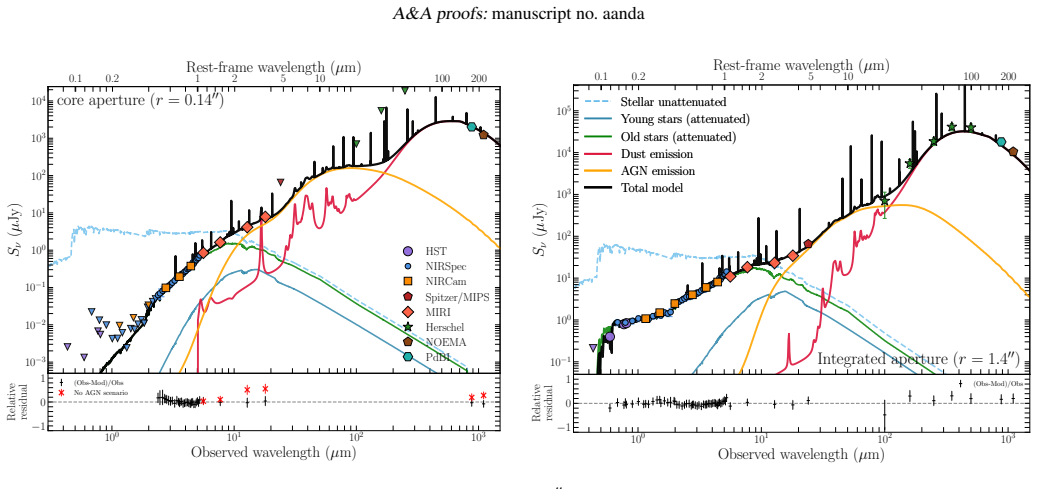
Spatially resolved spectral energy distribution decomposition shows that the nuclear core of GN20 requires an AGN fraction of 0.34 plus or minus 0.05 to account for the mid-infrared excess at rest-frame 2.5 to 3.6 micrometers characteristic of AGN-heated torus dust. The AGN supplies about 34 percent of the nuclear infrared luminosity but only about 9 percent of the total integrated luminosity. The integrated SED is dominated by stellar-heated dust with an AGN fraction of 0.09 plus or minus 0.02.
What carries the argument
Spatially resolved Bayesian SED fitting with CIGALE applied separately to the nuclear aperture (radius 0.14 arcsec) and the full galaxy aperture (radius 1.4 arcsec), using 42 NIRSpec wavelength bins plus MIRI data to isolate the mid-infrared excess.
If this is right
- The AGN contribution remains weak in galaxy-wide diagnostics and matches existing Spitzer spectroscopy upper limits.
- The inferred black hole mass places GN20 on the local black hole to bulge mass relation when accreting at the Eddington limit.
- At sub-Eddington accretion rates the black hole appears overmassive relative to the bulge.
- Black hole assembly occurred early and rapidly alongside the dominant starburst phase.
Where Pith is reading between the lines
- High angular resolution infrared data may be required to detect similar buried AGNs in other high-redshift dusty galaxies where star formation dominates global measurements.
- The same nuclear versus integrated decomposition approach could be applied to additional luminous dusty star-forming systems to measure how common obscured AGN activity is during peak cosmic star formation.
- If the AGN fraction varies with aperture size in other objects, integrated surveys may systematically underestimate the role of black holes at early epochs.
Load-bearing premise
The mid-infrared excess seen in the nuclear aperture comes from dust heated by an AGN torus rather than from hot stellar dust or other dust arrangements.
What would settle it
Mid-infrared spectroscopy of the nuclear region that detects no AGN torus emission features while still showing the excess would indicate the excess arises from non-AGN sources.
Figures
read the original abstract
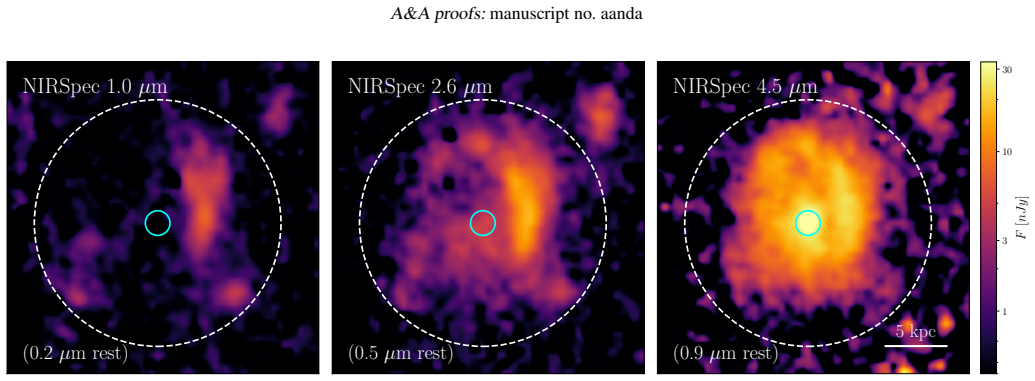
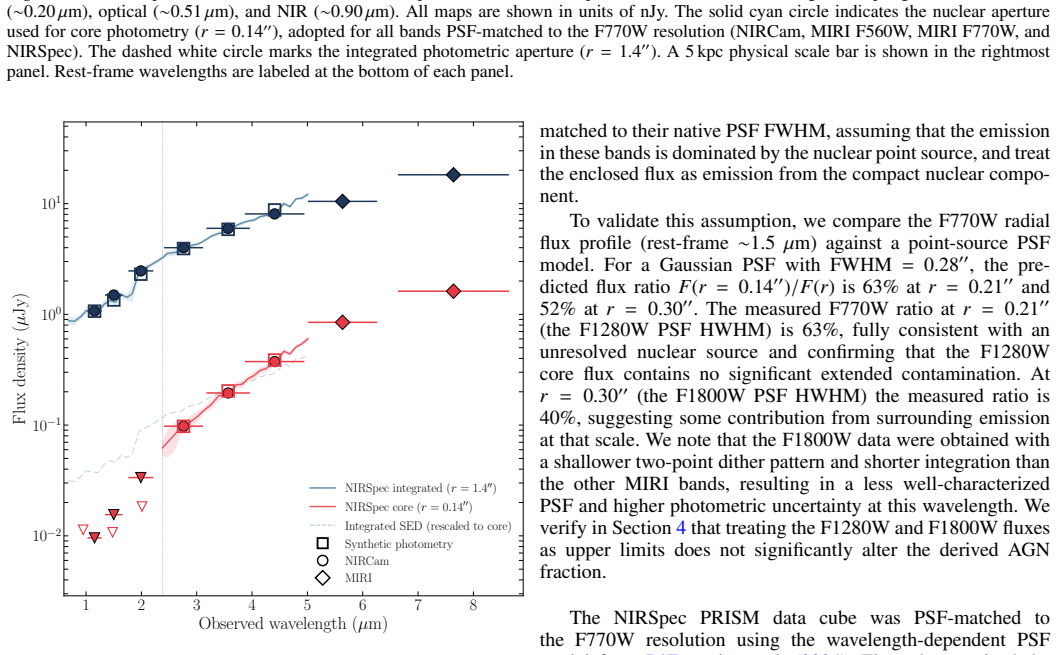
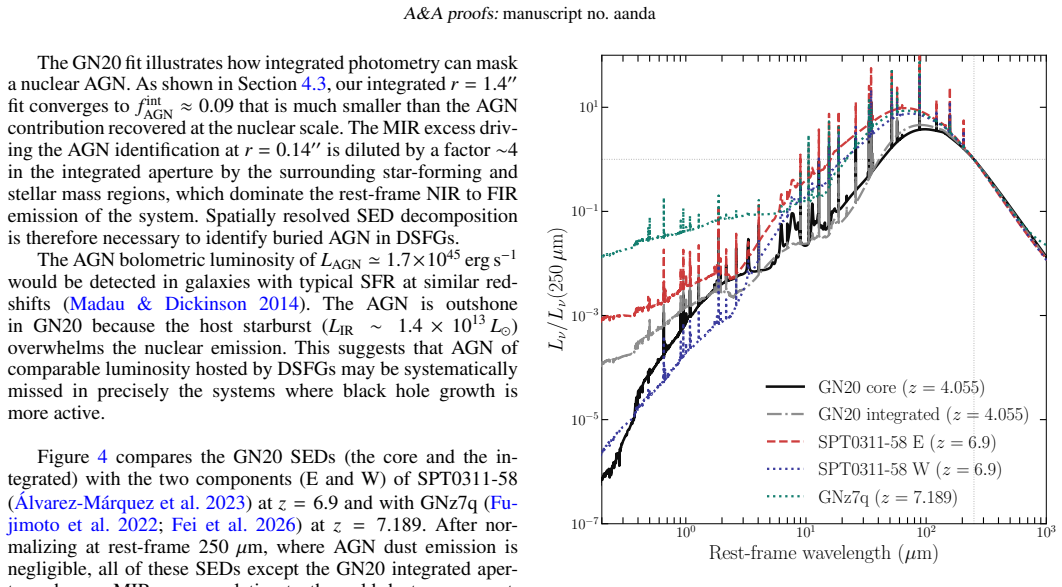
We investigate the relative contributions of star formation and AGN activity to the total energy budget of GN20, one of the most luminous dusty star-forming galaxies known at $z>4$, through spatially resolved spectral energy distribution decomposition. We perform Bayesian SED fitting with CIGALE on two spatially distinct apertures: the nuclear core (r=0.14", $\sim$1kpc physical) and the full galaxy (r=1.4", 9.9 kpc), combining JWST/NIRCam and MIRI broadband imaging, JWST/NIRSpec PRISM IFU pseudo-continuum photometry spanning 42 wavelength bins across rest-frame $0.12$--$1.05\mu$m, and archival HST and millimeter interferometry data from NOEMA and PdBI. The integrated SED is dominated by stellar-heated dust, with only a marginal AGN contribution at galaxy-wide scales ($f_\mathrm{AGN}^\mathrm{int}=0.09\pm0.02$). The nuclear core, however, requires a significant AGN component ($f_\mathrm{AGN}=0.34\pm0.05$) to account for a mid-infrared excess at rest-frame $\sim$2.5--3.6$\mu$m characteristic of AGN-heated torus dust. The AGN accounts for $\sim34\%$ of the nuclear infrared luminosity but only $\sim9\%$ of the total integrated $L_\mathrm{IR}$, explaining its weak signature in integrated diagnostics and its consistency with existing upper limits from Spitzer spectroscopy. The inferred black hole mass places GN20 within the local $M_\mathrm{BH}$--$M_\mathrm{bulge}$ relation at the Eddington limit, and in the overmassive regime at sub-Eddington accretion rates, suggesting early and rapid black hole assembly concurrent with the dominant starburst. GN20 exemplifies a class of systems where nuclear-scale SED decomposition, enabled by the angular resolution and infrared sensitivity of JWST, is the only means to uncover a buried AGN overwhelmed by galaxy-wide star formation.
Editorial analysis
A structured set of objections, weighed in public.
Referee Report
Summary. The manuscript uses JWST/NIRCam, MIRI, NIRSpec PRISM IFU (42 pseudo-continuum bins), HST, and millimeter interferometry data to perform Bayesian CIGALE SED fitting on two apertures of GN20 (z>4): a nuclear core (r=0.14", ~1 kpc) and the full galaxy (r=1.4"). It reports that the integrated SED is star-formation dominated (f_AGN^int=0.09±0.02) while the nuclear aperture requires f_AGN=0.34±0.05 to fit a mid-IR excess at rest-frame 2.5–3.6 μm, attributing ~34% of nuclear L_IR (but only ~9% of total L_IR) to an AGN torus; this places the inferred BH on the local M_BH–M_bulge relation at Eddington or in the overmassive regime at sub-Eddington rates.
Significance. If the nuclear AGN attribution is robust, the result shows that JWST-enabled nuclear-scale decomposition can reveal buried AGNs in high-redshift dusty starbursts that are invisible to integrated diagnostics, with direct implications for concurrent BH and stellar-mass assembly at z>4.
major comments (2)
- [CIGALE modeling of the nuclear (r=0.14") aperture] The central claim that the nuclear core requires f_AGN=0.34±0.05 rests on the assertion that SKIRTOR/Fritz et al. torus templates are needed to reproduce the 2.5–3.6 μm excess. The manuscript does not report fits with alternative dust geometries (e.g., clumpy starburst dust, modified extinction curves, or hot stellar dust continua from the young obscured starburst still present in the r=0.14" aperture) that could absorb the same excess without an AGN component. Because the nuclear aperture is still dominated by a dust-obscured starburst, this test is load-bearing for the reported AGN fraction and its interpretation as torus-heated dust.
- [Abstract and SED-fitting methods] The abstract and methods description provide no information on the priors adopted for f_AGN, the specific dust templates and parameter grids used, or any robustness checks (e.g., fits with AGN module disabled, alternative AGN libraries, or varying aperture definitions). These omissions make it impossible to assess whether the reported 0.34±0.05 value is uniquely required by the data or sensitive to modeling choices.
minor comments (2)
- [Abstract] The abstract states the AGN accounts for ~34% of nuclear infrared luminosity but only ~9% of total integrated L_IR; the text should explicitly define how these percentages are computed from the CIGALE output (e.g., which luminosity integrals and which wavelength range).
- [Introduction or methods] The manuscript should state the physical scale corresponding to the r=0.14" and r=1.4" apertures at the redshift of GN20 for clarity.
Simulated Author's Rebuttal
We thank the referee for their careful and constructive review of our manuscript. Their comments highlight important aspects of the modeling that require clarification and additional tests. We address each major comment below and will revise the manuscript accordingly to strengthen the presentation of our results.
read point-by-point responses
-
Referee: [CIGALE modeling of the nuclear (r=0.14") aperture] The central claim that the nuclear core requires f_AGN=0.34±0.05 rests on the assertion that SKIRTOR/Fritz et al. torus templates are needed to reproduce the 2.5–3.6 μm excess. The manuscript does not report fits with alternative dust geometries (e.g., clumpy starburst dust, modified extinction curves, or hot stellar dust continua from the young obscured starburst still present in the r=0.14" aperture) that could absorb the same excess without an AGN component. Because the nuclear aperture is still dominated by a dust-obscured starburst, this test is load-bearing for the reported AGN fraction and its interpretation as torus-heated dust.
Authors: We agree that explicit tests with alternative dust geometries are necessary to confirm that the mid-IR excess at rest-frame 2.5–3.6 μm cannot be reproduced without an AGN torus component. Although the SKIRTOR and Fritz et al. templates are the standard AGN modules in CIGALE and the wavelength range of the excess aligns with hot torus dust rather than typical starburst emission, the manuscript does not currently include these comparisons. In the revised version we will add fits with the AGN module disabled, clumpy starburst dust models, modified extinction curves, and hot stellar dust continua to demonstrate that none of these alternatives adequately reproduce the nuclear SED. This will directly address the load-bearing nature of the test. revision: yes
-
Referee: [Abstract and SED-fitting methods] The abstract and methods description provide no information on the priors adopted for f_AGN, the specific dust templates and parameter grids used, or any robustness checks (e.g., fits with AGN module disabled, alternative AGN libraries, or varying aperture definitions). These omissions make it impossible to assess whether the reported 0.34±0.05 value is uniquely required by the data or sensitive to modeling choices.
Authors: We acknowledge that the current methods section lacks sufficient detail on the CIGALE configuration. The analysis employs standard SKIRTOR torus templates with a uniform prior on f_AGN between 0 and 1, together with the default dust and stellar parameter grids in CIGALE, but these specifics and any robustness tests are not explicitly documented. In the revised manuscript we will expand the methods section to list the exact priors, templates, and grids, and we will add a dedicated robustness subsection reporting fits with the AGN module disabled, alternative AGN libraries, and varied aperture definitions. These additions will allow readers to evaluate the sensitivity of the reported f_AGN value. revision: yes
Circularity Check
No circularity: standard CIGALE SED fit on external multi-wavelength data
full rationale
The paper's central result (nuclear f_AGN = 0.34) is obtained by running the public CIGALE Bayesian fitter on JWST NIRSpec bins + MIRI photometry plus ancillary data, treating AGN fraction as a free parameter with standard SKIRTOR/Fritz torus templates. No step reduces the reported fraction to a quantity defined by the authors' own prior equations, no self-citation chain is load-bearing for the attribution, and no fitted input is relabeled as a prediction. The derivation chain is therefore self-contained against the observational inputs.
Axiom & Free-Parameter Ledger
free parameters (1)
- f_AGN
axioms (1)
- domain assumption CIGALE SED models with standard AGN torus and stellar-heated dust components accurately separate contributions in high-z dusty galaxies
Reference graph
Works this paper leans on
-
[1]
L., Georgakakis, A., et al
Aird, J., Coil, A. L., Georgakakis, A., et al. 2015, MNRAS, 451, 1892
2015
-
[2]
2024, ApJ, 976, 224
Alberts, S., Lyu, J., Shivaei, I., et al. 2024, ApJ, 976, 224
2024
-
[3]
M., Bauer, F
Alexander, D. M., Bauer, F. E., Chapman, S. C., et al. 2005, ApJ, 632, 736
2005
-
[4]
M., Brandt, W
Alexander, D. M., Brandt, W. N., Smail, I., et al. 2008, AJ, 135, 1968
2008
-
[5]
H., & Rigopoulou, D
Alonso-Herrero, A., Pereira-Santaella, M., Rieke, G. H., & Rigopoulou, D. 2012, ApJ, 744, 2
2012
-
[6]
G., Alexander, D
Alonso-Herrero, A., Pérez-González, P. G., Alexander, D. M., et al. 2006, ApJ, 640, 167 Álvarez-Márquez, J., Crespo Gómez, A., Colina, L., et al. 2023, A&A, 671, A105
2006
-
[7]
2007, ApJ, 656, 148
Armus, L., Charmandaris, V ., Bernard-Salas, J., et al. 2007, ApJ, 656, 148
2007
-
[8]
2024, A&A, 688, A146
Arribas, S., Perna, M., Rodríguez Del Pino, B., et al. 2024, A&A, 688, A146
2024
-
[9]
E., Bridge, J
Backhaus, B. E., Bridge, J. S., Trump, J. R., et al. 2023, ApJ, 943, 37
2023
-
[10]
A., Phillips, M
Baldwin, J. A., Phillips, M. M., & Terlevich, R. 1981, PASP, 93, 5 Barquín-González, L., Mateos, S., Carrera, F. J., et al. 2024, A&A, 687, A159
1981
-
[11]
A., Weibel, A., et al
Barrufet, L., Oesch, P. A., Weibel, A., et al. 2023, MNRAS, 522, 449
2023
-
[12]
2024, A&A, 686, A3
Bik, A., Álvarez-Márquez, J., Colina, L., et al. 2024, A&A, 686, A3
2024
-
[13]
2025, A&A, 694, C1
Bik, A., Álvarez-Márquez, J., Colina, L., et al. 2025, A&A, 694, C1
2025
-
[14]
W., Kneib, J.-P., Ivison, R
Blain, A. W., Kneib, J.-P., Ivison, R. J., & Smail, I. 1999, ApJ, 512, L87
1999
-
[15]
2023, ApJ, 942, L36 Böker, T., Arribas, S., Lützgendorf, N., et al
Bohn, T., Inami, H., Diaz-Santos, T., et al. 2023, ApJ, 942, L36 Böker, T., Arribas, S., Lützgendorf, N., et al. 2022, A&A, 661, A82
2023
-
[16]
A stellar bar hidden in an extreme gas-rich disk galaxy at z=4.055
Boogaard, L. A., Costantin, L., Tepper-García, T., et al. 2026a, arXiv e-prints, arXiv:2605.15273
work page internal anchor Pith review Pith/arXiv arXiv
-
[17]
2019, A&A, 622, A103
Boquien, M., Burgarella, D., Roehlly, Y ., et al. 2019, A&A, 622, A103
2019
-
[18]
& Charlot, S
Bruzual, G. & Charlot, S. 2003, MNRAS, 344, 1000
2003
-
[19]
2005, MNRAS, 360, 1413
Burgarella, D., Buat, V ., & Iglesias-Páramo, J. 2005, MNRAS, 360, 1413
2005
-
[20]
2001, PASP, 113, 1449
Calzetti, D. 2001, PASP, 113, 1449
2001
-
[21]
C., et al
Calzetti, D., Armus, L., Bohlin, R. C., et al. 2000, ApJ, 533, 682
2000
-
[22]
L., Daddi, E., Riechers, D., et al
Carilli, C. L., Daddi, E., Riechers, D., et al. 2010, ApJ, 714, 1407
2010
-
[23]
L., Hodge, J., Walter, F., et al
Carilli, C. L., Hodge, J., Walter, F., et al. 2011, ApJ, 739, L33
2011
-
[24]
M., Scoville, N
Casey, C. M., Scoville, N. Z., Sanders, D. B., et al. 2014, ApJ, 796, 95
2014
-
[25]
2003, PASP, 115, 763
Chabrier, G. 2003, PASP, 115, 763
2003
-
[26]
C., Blain, A
Chapman, S. C., Blain, A. W., Smail, I., & Ivison, R. J. 2005, ApJ, 622, 772
2005
-
[27]
& Fall, S
Charlot, S. & Fall, S. M. 2000, ApJ, 539, 718
2000
-
[28]
2015, A&A, 576, A10
Ciesla, L., Charmandaris, V ., Georgakakis, A., et al. 2015, A&A, 576, A10
2015
-
[29]
2023, A&A, 673, L6
Colina, L., Crespo Gómez, A., Álvarez-Márquez, J., et al. 2023, A&A, 673, L6
2023
-
[30]
2015, A&A, 582, A63 Crespo Gómez, A., Colina, L., Álvarez-Márquez, J., et al
Cresci, G., Marconi, A., Zibetti, S., et al. 2015, A&A, 582, A63 Crespo Gómez, A., Colina, L., Álvarez-Márquez, J., et al. 2024, A&A, 691, A325
2015
-
[31]
2009, ApJ, 694, 1517
Daddi, E., Dannerbauer, H., Stern, D., et al. 2009, ApJ, 694, 1517
2009
-
[32]
2007, ApJ, 670, 156 D’Agostino, J
Daddi, E., Dickinson, M., Morrison, G., et al. 2007, ApJ, 670, 156 D’Agostino, J. J., Kewley, L. J., Groves, B. A., et al. 2019, MNRAS, 485, L38 D’Amato, Q., Gilli, R., Vignali, C., et al. 2020, A&A, 636, A37
2007
-
[33]
2025, A&A, 704, A313 D’Eugenio, F., Pérez-González, P
Delvecchio, I., Daddi, E., Magnelli, B., et al. 2025, A&A, 704, A313 D’Eugenio, F., Pérez-González, P. G., Maiolino, R., et al. 2024, Nature Astron- omy, 8, 1443
2025
-
[34]
L., Koekemoer, A
Donley, J. L., Koekemoer, A. M., Brusa, M., et al. 2012, ApJ, 748, 142
2012
-
[35]
T., Aniano, G., Krause, O., et al
Draine, B. T., Aniano, G., Krause, O., et al. 2014, ApJ, 780, 172 Dudzeviˇci¯ut˙e, U., Smail, I., Swinbank, A. M., et al. 2020, MNRAS, 494, 3828
2014
-
[36]
2026, arXiv e-prints, arXiv:2602.12325
Fei, Q., Fujimoto, S., Brammer, G., et al. 2026, arXiv e-prints, arXiv:2602.12325
-
[37]
J., Chatzikos, M., Guzmán, F., et al
Ferland, G. J., Chatzikos, M., Guzmán, F., et al. 2017, Rev. Mexicana Astron. Astrofis., 53, 385
2017
-
[38]
2018, A&A, 620, A152
Franco, M., Elbaz, D., Béthermin, M., et al. 2018, A&A, 620, A152
2018
-
[39]
2006, MNRAS, 366, 767
Fritz, J., Franceschini, A., & Hatziminaoglou, E. 2006, MNRAS, 366, 767
2006
-
[40]
B., Watson, D., et al
Fujimoto, S., Brammer, G. B., Watson, D., et al. 2022, Nature, 604, 261
2022
-
[41]
C., Koekemoer, A
Giavalisco, M., Ferguson, H. C., Koekemoer, A. M., et al. 2004, ApJ, 600, L93 González-Martín, O., Díaz-González, D. J., Martínez-Paredes, M., et al. 2025, MNRAS, 539, 2158
2004
-
[42]
E., Labbe, I., Goulding, A
Greene, J. E., Labbe, I., Goulding, A. D., et al. 2024, ApJ, 964, 39
2024
-
[43]
2020, A&A, 643, A8
Gruppioni, C., Béthermin, M., Loiacono, F., et al. 2020, A&A, 643, A8
2020
-
[44]
2013, MNRAS, 432, 23
Gruppioni, C., Pozzi, F., Rodighiero, G., et al. 2013, MNRAS, 432, 23
2013
-
[45]
2021, A&A, 646, A127
Hamed, M., Ciesla, L., Béthermin, M., et al. 2021, A&A, 646, A127
2021
-
[46]
Hamed, M., Pérez-González, P. G., Annunziatella, M., et al. 2026, arXiv e-prints, arXiv:2601.15963
-
[47]
2023, ApJS, 265, 5
Harikane, Y ., Ouchi, M., Oguri, M., et al. 2023, ApJS, 265, 5
2023
-
[48]
C., Mullaney, J
Hickox, R. C., Mullaney, J. R., Alexander, D. M., et al. 2014, ApJ, 782, 9
2014
-
[49]
A., Carilli, C
Hodge, J. A., Carilli, C. L., Walter, F., Daddi, E., & Riechers, D. 2013, ApJ, 776, 22
2013
-
[50]
A., Riechers, D., Decarli, R., et al
Hodge, J. A., Riechers, D., Decarli, R., et al. 2015, ApJ, 798, L18
2015
-
[51]
F., Hernquist, L., Cox, T
Hopkins, P. F., Hernquist, L., Cox, T. J., & Kereš, D. 2008, ApJS, 175, 356
2008
-
[52]
H., Serjeant, S., Dunlop, J., et al
Hughes, D. H., Serjeant, S., Dunlop, J., et al. 1998, Nature, 394, 241
1998
-
[53]
2022, A&A, 661, A80
Jakobsen, P., Ferruit, P., Alves de Oliveira, C., et al. 2022, A&A, 661, A80
2022
-
[54]
M., Tremonti, C., et al
Kauffmann, G., Heckman, T. M., Tremonti, C., et al. 2003, MNRAS, 346, 1055
2003
-
[55]
J., Dopita, M
Kewley, L. J., Dopita, M. A., Sutherland, R. S., Heisler, C. A., & Trevena, J. 2001, ApJ, 556, 121
2001
-
[56]
2017, ApJ, 849, 111
Kirkpatrick, A., Alberts, S., Pope, A., et al. 2017, ApJ, 849, 111
2017
-
[57]
2015, ApJ, 814, 9
Kirkpatrick, A., Pope, A., Sajina, A., et al. 2015, ApJ, 814, 9
2015
-
[58]
2025, A&A, 695, A201
Kolupuri, S., Decarli, R., Neri, R., et al. 2025, A&A, 695, A201
2025
-
[59]
Kormendy, J. & Ho, L. C. 2013, ARA&A, 51, 511 Labbé, I., van Dokkum, P., Nelson, E., et al. 2023, Nature, 616, 266
2013
-
[60]
J., Sajina, A., et al
Lacy, M., Storrie-Lombardi, L. J., Sajina, A., et al. 2004, ApJS, 154, 166
2004
-
[61]
S., Nandra, K., Pope, A., & Scott, D
Laird, E. S., Nandra, K., Pope, A., & Scott, D. 2010, MNRAS, 401, 2763
2010
-
[62]
D., Conroy, C., & van Dokkum, P
Leja, J., Johnson, B. D., Conroy, C., & van Dokkum, P. 2018, ApJ, 854, 62
2018
-
[63]
2018, ApJ, 853, 172
Liu, D., Daddi, E., Dickinson, M., et al. 2018, ApJ, 853, 172
2018
-
[64]
N., Xue, Y
Luo, B., Brandt, W. N., Xue, Y . Q., et al. 2017, ApJS, 228, 2
2017
-
[65]
H., et al
Lyu, J., Alberts, S., Rieke, G. H., et al. 2024, ApJ, 966, 229
2024
-
[66]
& Dickinson, M
Madau, P. & Dickinson, M. 2014, ARA&A, 52, 415
2014
-
[67]
E., Daddi, E., Béthermin, M., et al
Magdis, G. E., Daddi, E., Béthermin, M., et al. 2012, ApJ, 760, 6
2012
-
[68]
2013, A&A, 553, A132
Magnelli, B., Popesso, P., Berta, S., et al. 2013, A&A, 553, A132
2013
-
[69]
2024, A&A, 691, A145
Maiolino, R., Scholtz, J., Curtis-Lake, E., et al. 2024, A&A, 691, A145
2024
-
[70]
A., Perna, M., Willott, C
Marshall, M. A., Perna, M., Willott, C. J., et al. 2023, A&A, 678, A191
2023
-
[71]
J., et al
Mateos, S., Alonso-Herrero, A., Carrera, F. J., et al. 2012, MNRAS, 426, 3271
2012
-
[72]
P., Brammer, G., et al
Matthee, J., Naidu, R. P., Brammer, G., et al. 2024, ApJ, 963, 129 Menéndez-Delmestre, K., Blain, A. W., Smail, I., et al. 2009, ApJ, 699, 667
2024
-
[73]
2009, A&A, 507, 1793 Article number, page 11 of 12 A&A proofs:manuscript no
Noll, S., Burgarella, D., Giovannoli, E., et al. 2009, A&A, 507, 1793 Article number, page 11 of 12 A&A proofs:manuscript no. aanda Östlin, G., Pérez-González, P. G., Melinder, J., et al. 2025, A&A, 696, A57
2009
-
[74]
2023, ApJ, 957, L3 Pérez-González, P
Pacucci, F., Nguyen, B., Carniani, S., Maiolino, R., & Fan, X. 2023, ApJ, 957, L3 Pérez-González, P. G., Barro, G., Annunziatella, M., et al. 2023, ApJ, 946, L16 Pérez-González, P. G., Barro, G., Rieke, G. H., et al. 2024, ApJ, 968, 4 Pérez-González, P. G., Rieke, G. H., Egami, E., et al. 2005, ApJ, 630, 82 Planck Collaboration, Aghanim, N., Akrami, Y ., ...
2023
-
[75]
2005, MNRAS, 358, 149
Pope, A., Borys, C., Scott, D., et al. 2005, MNRAS, 358, 149
2005
-
[76]
2006, MNRAS, 370, 1185
Pope, A., Scott, D., Dickinson, M., et al. 2006, MNRAS, 370, 1185
2006
-
[77]
2017, ApJ, 838, L18
Puglisi, A., Daddi, E., Renzini, A., et al. 2017, ApJ, 838, L18
2017
-
[78]
A., Kriek, M., Shapley, A
Reddy, N. A., Kriek, M., Shapley, A. E., et al. 2015, ApJ, 806, 259
2015
-
[79]
T., Lacy, M., Storrie-Lombardi, L
Richards, G. T., Lacy, M., Storrie-Lombardi, L. J., et al. 2006, ApJS, 166, 470
2006
-
[80]
A., Pope, A., Daddi, E., et al
Riechers, D. A., Pope, A., Daddi, E., et al. 2014, ApJ, 786, 31
2014
discussion (0)
Sign in with ORCID, Apple, or X to comment. Anyone can read and Pith papers without signing in.