Fundamentals of Optical Fiber Sensing Schemes Based on Coherent Optical Time Domain Reflectometry: Signal Under Dynamic Temperature Conditions
Pith reviewed 2026-07-01 04:20 UTC · model grok-4.3
The pith
A physics-based model shows that the phase of the Rayleigh backscattered signal in coherent φ-OTDR encodes cumulative temperature change between interrogator and sensing location, while amplitude is only locally sensitive.
A machine-rendered reading of the paper's core claim, the machinery that carries it, and where it could break.
Core claim
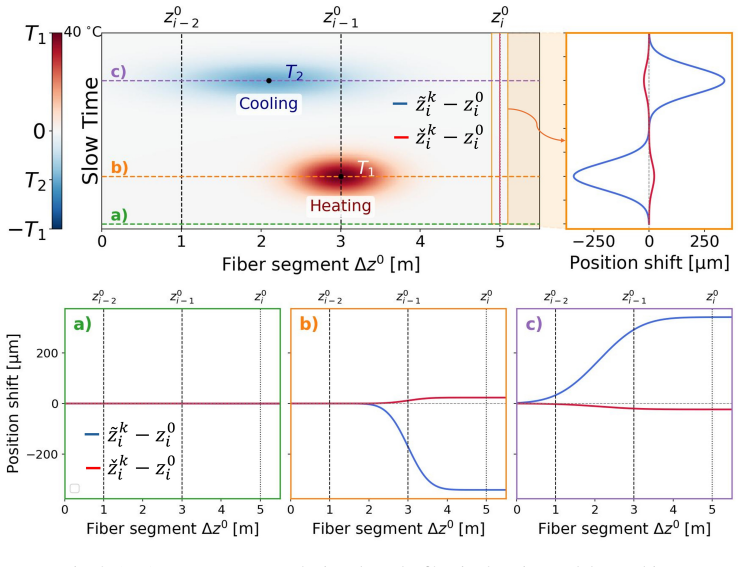
The phase evolution of the coherently detected Rayleigh backscattered signal encodes the cumulative temperature change between the interrogator and the sensing location, while the amplitude exhibits only local sensitivity to temperature variations at each point.
What carries the argument
A physics-based model of the Rayleigh backscattered signal under dynamic temperature conditions that separates cumulative phase encoding from local amplitude sensitivity.
If this is right
- Algorithms that monitor phase evolution can detect temperature events without being misled by local amplitude fluctuations.
- Temperature profiles can be reconstructed by integrating the phase information along the fiber length.
- Standard single-mode fibers support reliable recovery of dynamic temperature perturbations using coherent detection.
Where Pith is reading between the lines
- The same phase-encoding property could be tested for other distributed perturbations such as strain or acoustic waves.
- Existing coherent OTDR hardware might be repurposed for temperature sensing by shifting analysis focus from amplitude to phase.
- Cumulative phase encoding suggests that temperature sensing resolution improves when interrogation points are referenced to the fiber start rather than treated independently.
Load-bearing premise
The model assumes a direct relation between the backscattered signal and temperature variations that remains valid under dynamic conditions without requiring detailed fiber-specific parameters or noise models.
What would settle it
An experiment in which a localized temperature step produces a phase shift at a distant location that deviates from the predicted cumulative sum, or in which amplitude shows nonlocal sensitivity.
Figures
read the original abstract
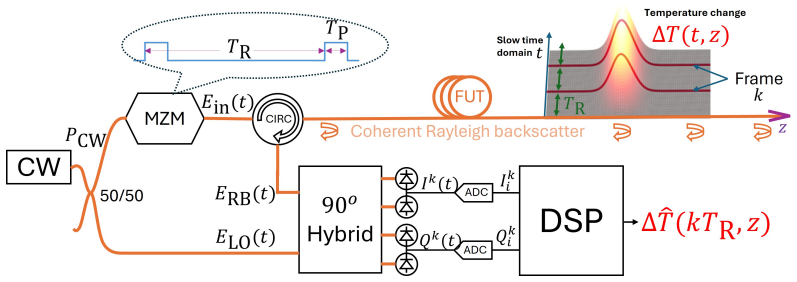
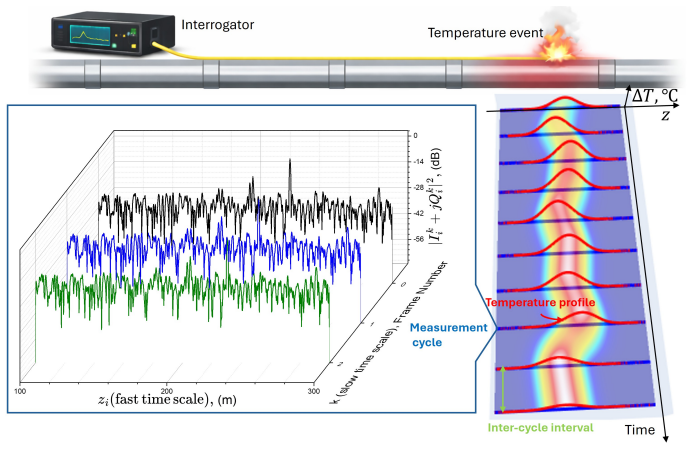
We present a theoretical, algorithmic, and experimental study of temperature sensing using $\phi$-OTDR with coherent detection. A physics-based model is developed to relate the measured Rayleigh backscattered signal to temperature variations along the fiber, showing that the phase evolution encodes the cumulative temperature change between the interrogator and the sensing location, while the amplitude exhibits only local sensitivity. Based on this insight, we propose robust algorithms for temperature-event detection and temperature-profile reconstruction. Experimental results demonstrate reliable recovery of temperature-induced perturbations in standard single-mode fibers using coherently detected $\phi$-OTDR.
Editorial analysis
A structured set of objections, weighed in public.
Referee Report
Summary. The manuscript presents a theoretical, algorithmic, and experimental study of temperature sensing with coherent φ-OTDR. A physics-based model is developed relating the measured Rayleigh backscattered signal to temperature variations along the fiber; the model shows that phase evolution encodes the cumulative temperature change between the interrogator and the sensing location while amplitude exhibits only local sensitivity. Algorithms for temperature-event detection and temperature-profile reconstruction are proposed, and experimental results demonstrate reliable recovery of temperature-induced perturbations in standard single-mode fibers.
Significance. If the derivation and validation hold, the work supplies a clear physical interpretation of the φ-OTDR signal under dynamic temperature conditions that follows directly from standard wave-propagation and scattering models. The parameter-free character of the central phase-cumulative relation (no free parameters listed in the axiom ledger) and the combination of theory with experimental recovery constitute a concrete contribution to distributed optical-fiber sensing.
minor comments (3)
- The abstract states that a model is developed and that experimental recovery is demonstrated, yet supplies neither the governing equations nor quantitative validation metrics (e.g., RMS error, SNR values). Adding these in the abstract or a dedicated results table would improve immediate readability.
- Figure captions and axis labels should explicitly indicate whether the plotted phase is unwrapped, referenced to a baseline temperature, or filtered; this is needed to allow direct comparison with the cumulative-encoding claim.
- The manuscript would benefit from a short paragraph contrasting the proposed cumulative-phase approach with existing intensity-based or frequency-shift OTDR temperature methods, including at least two key references.
Simulated Author's Rebuttal
We thank the referee for the positive assessment of our manuscript on the fundamentals of coherent φ-OTDR temperature sensing. The recommendation for minor revision is noted. No specific major comments appear in the report, so we provide no point-by-point responses.
Circularity Check
No significant circularity in derivation chain
full rationale
The abstract describes a physics-based model derived from standard Rayleigh backscattering wave propagation, where phase accumulates optical path perturbations (cumulative) and amplitude depends on local scatterers. This follows directly from first-principles optics without any indicated self-definition, fitted inputs renamed as predictions, or load-bearing self-citations. No equations are provided that reduce to their own inputs by construction, and the central claim aligns with independent wave-propagation principles. The derivation appears self-contained against external benchmarks.
Axiom & Free-Parameter Ledger
Reference graph
Works this paper leans on
-
[1]
Advances in phase-sensitive optical time-domain reflectometry,
S. Liu, F. Yu, R. Hong,et al., “Advances in phase-sensitive optical time-domain reflectometry,” Opto-Electronic Adv. 5, 200078 (2022)
2022
-
[2]
Integration of botda and𝜙-otdr distributed fiber sensing for multiple parameters monitoring,
Z. Wang, Y.-E. Zou, C.-Y. Guo,et al., “Integration of botda and𝜙-otdr distributed fiber sensing for multiple parameters monitoring,” Phys. Scripta100, 045512 (2025)
2025
-
[3]
250-km ultralong distance single-end𝜙-OTDR assisted by DRA and RPOA technology,
Y. Lei, Y. Zhang, T. Li,et al., “250-km ultralong distance single-end𝜙-OTDR assisted by DRA and RPOA technology,” inFourth International Computational Imaging Conference (CITA 2024),vol. 13542 X. Shao, ed., International Society for Optics and Photonics (SPIE, 2025), p. 135424S
2024
-
[4]
Distributed fiber-optic sensors for vibration detection,
X. Liu, B. Jin, Q. Bai,et al., “Distributed fiber-optic sensors for vibration detection,” Sensors16(2016)
2016
-
[5]
𝜙-otdr based on-line monitoring of overhead power transmission line,
Z.-W. Ding, X.-P. Zhang, N.-M. Zou,et al., “𝜙-otdr based on-line monitoring of overhead power transmission line,” J. Light. Technol.39, 5163–5169 (2021)
2021
-
[6]
First field trial of distributed fiber optical sensing and high-speed communication over an operational telecom network,
M.-F. Huang, M. Salemi, Y. Chen,et al., “First field trial of distributed fiber optical sensing and high-speed communication over an operational telecom network,” J. Light. Technol.38, 75–81 (2020)
2020
-
[7]
Fading in heterodyne otdr,
P. Healey, “Fading in heterodyne otdr,” Electron. Lett.20, 30–32 (1984)
1984
-
[8]
Rayleigh backscattering theory for single-mode optical fibers,
M. Nakazawa, “Rayleigh backscattering theory for single-mode optical fibers,” J. Opt. Soc. Am.73, 1175–1180 (1983)
1983
-
[9]
Statisticsofrayleighbackscatterfromasingle-modefiber,
P.Healey,“Statisticsofrayleighbackscatterfromasingle-modefiber,”IEEETrans.onCommun.35,210–214(1987)
1987
-
[10]
Theoretical and experimental investigations on the temperature dependence of the refractive index of amorphous silica,
Y. Guo, Z.-Y. Wang, Q. Qiu,et al., “Theoretical and experimental investigations on the temperature dependence of the refractive index of amorphous silica,” J. Non-Crystalline Solids429, 198–201 (2015)
2015
-
[11]
Investigationonthethermo-opticcoefficientofsilicafiberwithinawidetemperature range,
H.Gao, Y.Jiang, Y.Cui,et al., “Investigationonthethermo-opticcoefficientofsilicafiberwithinawidetemperature range,” J. Light. Technol.36, 5881–5886 (2018)
2018
-
[12]
Time-expandedphase-sensitiveopticaltime-domainreflectometry,
M.Soriano-Amat,H.F.Martins,V.Duránet al.,“Time-expandedphase-sensitiveopticaltime-domainreflectometry,” Light. Sci. & Appl.10, 51 (2021)
2021
-
[13]
Frequency multiplexed coherent𝜙-otdr,
H. M. Ogden, M. J. Murray, J. B. Murrayet al., “Frequency multiplexed coherent𝜙-otdr,” Sci. Reports11, 17921 (2021)
2021
-
[14]
Phase-sensitive optical time domain reflectometry based on geometric phase measurement,
S. Shaheen, K. Hicke, and K. Krebber, “Phase-sensitive optical time domain reflectometry based on geometric phase measurement,” Sci. Reports13, 2862 (2023)
2023
-
[15]
Recent advances in phase-sensitive optical time domain reflectometry (𝜙-otdr),
Y. Rao, Z. Wang, H. Wuet al., “Recent advances in phase-sensitive optical time domain reflectometry (𝜙-otdr),” Photonic Sensors11, 1–30 (2021)
2021
-
[16]
Coherent𝜙-otdr based on i/q demodulation and homodyne detection,
Z. Wang, L. Zhang, S. Wang,et al., “Coherent𝜙-otdr based on i/q demodulation and homodyne detection,” Opt. Express24, 853–858 (2016)
2016
-
[17]
Random coding method for coherent detection𝜙-otdr without optical amplifier,
P. Li, Y. Wang, K. Yin,et al., “Random coding method for coherent detection𝜙-otdr without optical amplifier,” Opt. Lasers Eng.161, 107318 (2023)
2023
-
[18]
Distributed acoustic sensing based on pulse-coding phase-sensitive otdr,
Z. Wang, B. Zhang, J. Xiong,et al., “Distributed acoustic sensing based on pulse-coding phase-sensitive otdr,” IEEE Internet Things J.6, 6117–6124 (2019)
2019
-
[19]
Phase-sensitive optical time-domain reflectometry with brillouin amplification,
Z. N. Wang, J. Li, M. Q. Fan,et al., “Phase-sensitive optical time-domain reflectometry with brillouin amplification,” Opt. Lett.39, 4313–4316 (2014)
2014
-
[20]
Real-time low noise distributed acoustic sensing in 171 km low loss fiber,
O. H. Waagaard, E. Rønnekleiv, A. Haukanes,et al., “Real-time low noise distributed acoustic sensing in 171 km low loss fiber,” OSA Continuum4, 688–701 (2021)
2021
-
[21]
Application research of optical fiber sensing technology in power optical fiber communication systems,
L. Zhang, Y. Lei, Y. Luo,et al., “Application research of optical fiber sensing technology in power optical fiber communication systems,” J. Physics: Conf. Ser.2503, 012046 (2023)
2023
-
[22]
Simultaneous temperature and acoustic sensing with coherent correlation otdr,
A. Sandmann, F. Azendorf, and M. Eiselt, “Simultaneous temperature and acoustic sensing with coherent correlation otdr,” in2023 Optical Fiber Communications Conference and Exhibition (OFC),(2023), p. W3J.3
2023
-
[23]
Distributed temperature sensor based on a phase-sensitive optical time-domain rayleigh reflectometer,
S. P. Nikitin, A. I. Kuzmenkov, V. V. Gorbulenko,et al., “Distributed temperature sensor based on a phase-sensitive optical time-domain rayleigh reflectometer,” Laser Phys.28, 085107 (2018)
2018
-
[24]
Fiber-optic distributed strain and temperature sensing with very high measurand resolution over long range using coherent otdr,
Y. Koyamada, M. Imahama, K. Kubota, and K. Hogari, “Fiber-optic distributed strain and temperature sensing with very high measurand resolution over long range using coherent otdr,” J. Light. Technol.27, 1142–1146 (2009)
2009
-
[25]
Distributed strain and temperature sensing over 100 km using tunable-wavelength otdr based on mems filters,
M. A. Taranov, B. G. Gorshkov, A. E. Alekseev, and V. T. Potapov, “Distributed strain and temperature sensing over 100 km using tunable-wavelength otdr based on mems filters,” Appl. Opt.60, 3049–3054 (2021)
2021
-
[26]
Single-shot distributed temperature and strain tracking using direct detection phase-sensitive otdr with chirped pulses,
J. Pastor-Graells, H. F. Martins, A. Garcia-Ruiz,et al., “Single-shot distributed temperature and strain tracking using direct detection phase-sensitive otdr with chirped pulses,” Opt. Express24, 13121–13133 (2016)
2016
-
[27]
A hybrid distributed optical fibre sensor for acoustic and temperature fields reconstruction,
Y. Zhang, Y. Cai, F. Xiong,et al., “A hybrid distributed optical fibre sensor for acoustic and temperature fields reconstruction,” Opt. Commun. (2019)
2019
-
[28]
Fundamentals of optical fiber sensing schemes based on coherent optical time domain reflectometry: Signal model under static fiber conditions,
L. B. Liokumovich, N. A. Ushakov, O. I. Kotov,et al., “Fundamentals of optical fiber sensing schemes based on coherent optical time domain reflectometry: Signal model under static fiber conditions,” J. Light. Technol.33, 3660–3671 (2015)
2015
-
[29]
Method for conversion of optical phase to temperature for coherent 𝜙-otdr,
R. Ermakov, F. Azendorf, H. Wang,et al., “Method for conversion of optical phase to temperature for coherent 𝜙-otdr,” inCLEO 2025,(Optica Publishing Group, 2025), p. SS111_4
2025
-
[30]
Recent advancements in rayleigh scattering-based distributed fiber sensors,
X. Bao and Y. Wang, “Recent advancements in rayleigh scattering-based distributed fiber sensors,” Adv. Devices & Instrum.2021, 8696571 (2021)
2021
-
[31]
Transmissioncharacteristicsandreliabilityofpure-silica-coresingle-mode fibers,
H.Kanamori,H.Yokota,G.Tanaka,et al.,“Transmissioncharacteristicsandreliabilityofpure-silica-coresingle-mode fibers,” J. Light. Technol.4, 1144–1150 (1986)
1986
-
[32]
On the theory of backscattering in single-mode optical fibers,
A. Hartog and M. Gold, “On the theory of backscattering in single-mode optical fibers,” J. Light. Technol.2, 76–82 (1984)
1984
-
[33]
A fabry–pérot fiber-optic ultrasonic hydrophone for the simultaneous measurement of temperature and acoustic pressure,
P. Morris, A. Hurrell, A. Shaw,et al., “A fabry–pérot fiber-optic ultrasonic hydrophone for the simultaneous measurement of temperature and acoustic pressure,” The J. Acoust. Soc. Am.125, 3611–3622 (2009)
2009
discussion (0)
Sign in with ORCID, Apple, or X to comment. Anyone can read and Pith papers without signing in.