Mean-Flow Adjoint Sensitivity Analysis of Unsteady Flow Around Porous Cylinders Using a Homogenized Lattice Boltzmann Method
Pith reviewed 2026-07-01 03:10 UTC · model grok-4.3
The pith
A mean-flow adjoint framework computes sensitivities for unsteady and turbulent flows around porous cylinders in lattice Boltzmann simulations.
A machine-rendered reading of the paper's core claim, the machinery that carries it, and where it could break.
Core claim
The mean-flow adjoint sensitivity analysis framework enables computation of gradients for design and control in unsteady and turbulent regimes by using the homogenized lattice Boltzmann method with Brinkman penalization for porous cylinders and automatic differentiation to incorporate subgrid-scale models in the adjoint equations.
What carries the argument
Mean-flow adjoint formulation with automatic differentiation for adjoint kernels containing subgrid-scale turbulence models in the homogenized lattice Boltzmann method.
If this is right
- Adjoint gradients can be obtained for unsteady flows without prohibitive memory requirements from checkpointing.
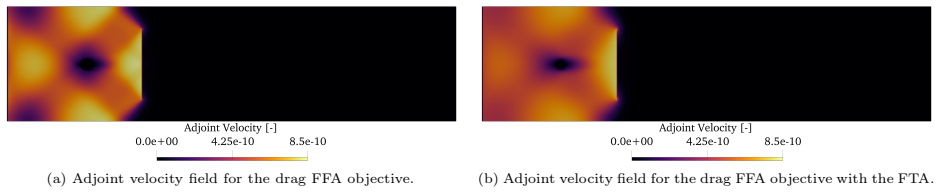
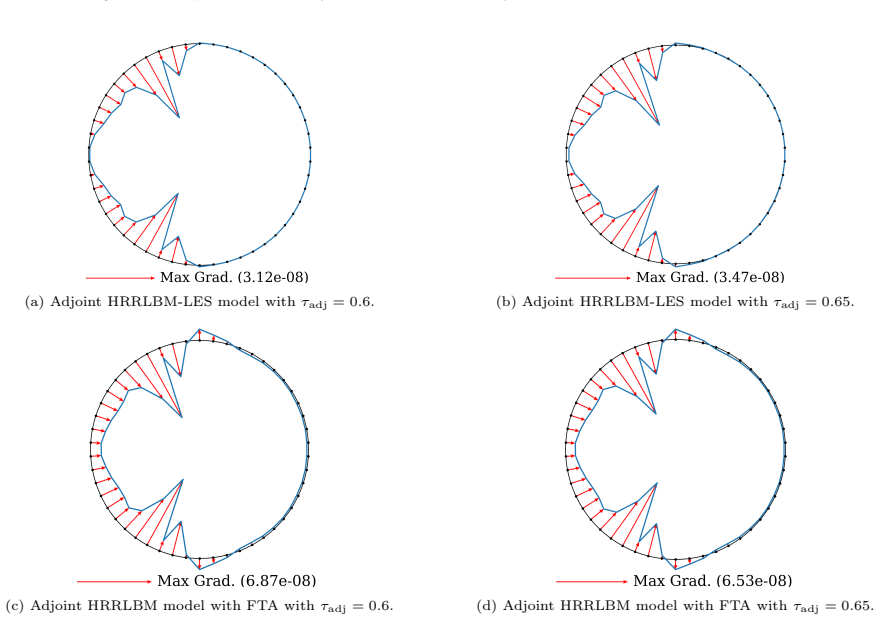
- Direct comparison between automatic differentiation-based adjoints and frozen turbulence assumption is possible in turbulent large eddy simulations.
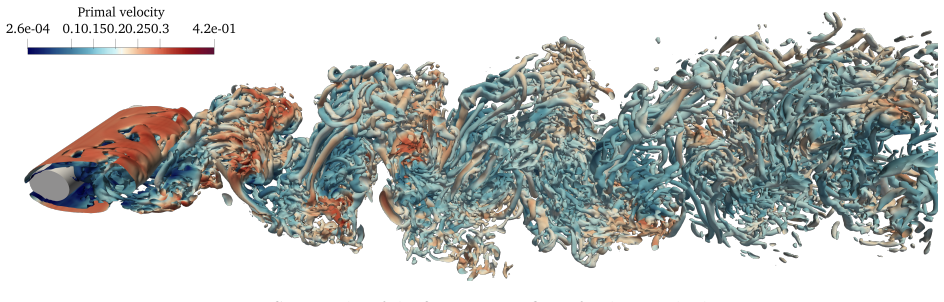
- The approach extends to turbulent flow regimes at Reynolds number 3900 around porous media.
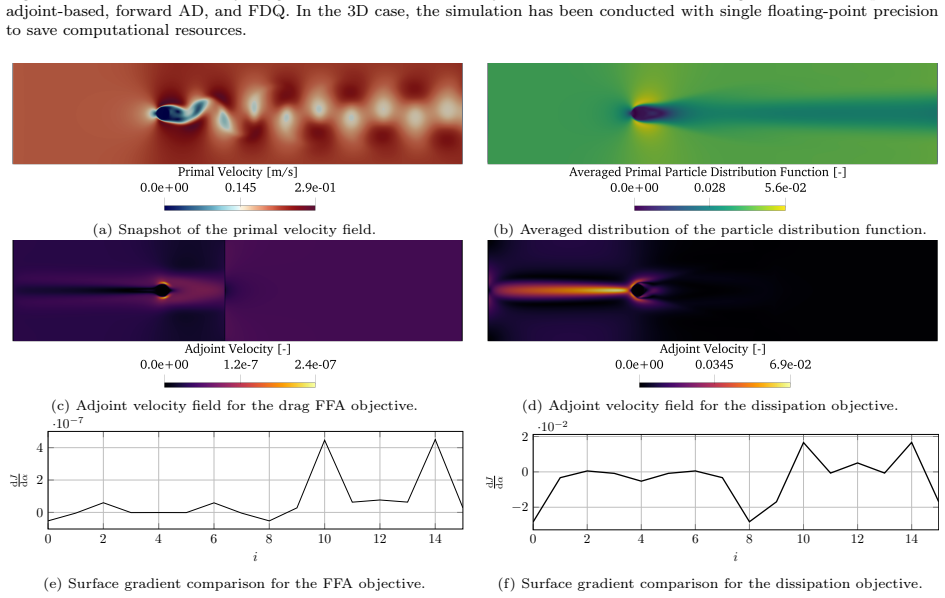
- Objective functionals such as drag and energy dissipation can be analyzed in transitioning flow regimes.
Where Pith is reading between the lines
- Applying this to optimization problems could allow automated design of porous flow control devices.
- Similar automatic differentiation techniques might extend mean-flow adjoints to other turbulence modeling approaches in fluid simulations.
- The method could be tested on different objective functionals or geometries to broaden its applicability.
Load-bearing premise
The mean-flow adjoint formulation remains accurate and stable for the chosen objective functionals when applied to unsteady and turbulent regimes around porous media modeled by Brinkman penalization.
What would settle it
A direct numerical comparison showing that the mean-flow adjoint gradients diverge significantly from those obtained by finite differences or other verification methods in the turbulent case at Re = 3900 would falsify the approach.
Figures

read the original abstract
Adjoint-based sensitivity analysis is an indispensable tool for large-scale fluid-dynamic design and distributed control problems, yet its application to unsteady and turbulent flows is frequently hindered by the prohibitive memory footprint of transient checkpointing and the divergence of gradients in chaotic regimes. To address these computational bottlenecks, this paper presents a mean-flow adjoint sensitivity analysis framework for unsteady flows around porous cylinders using the homogenized lattice Boltzmann method (HLBM). Within this framework, solid structures are efficiently modeled as local porous media utilizing a Brinkman penalization approach. We systematically investigate HLBM-based adjoint gradients for drag and energy dissipation objective functionals, transitioning from steady laminar to unsteady, and finally to turbulent flow regimes. For the turbulent case at Re = 3900, a proof-of-concept is conducted where the framework relies on automatic differentiation to automatically generate adjoint kernels containing subgrid-scale (SGS) turbulence models for large eddy simulations (LES), circumventing manual derivation and allowing for a direct comparison against the frozen turbulence assumption (FTA).
Editorial analysis
A structured set of objections, weighed in public.
Referee Report
Summary. The manuscript presents a mean-flow adjoint sensitivity analysis framework for unsteady flows around porous cylinders using the homogenized lattice Boltzmann method (HLBM) with Brinkman penalization for solid modeling. It systematically examines HLBM-based adjoint gradients for drag and energy-dissipation functionals across steady laminar, unsteady, and turbulent regimes, with a proof-of-concept at Re=3900 that employs automatic differentiation to generate adjoint kernels incorporating subgrid-scale (SGS) turbulence models for LES, enabling comparison to the frozen turbulence assumption (FTA).
Significance. If the mean-flow adjoint formulation proves accurate and stable for the chosen functionals under unsteady/turbulent conditions with Brinkman forcing and SGS closures, the framework would offer a practical route to adjoint-based design and control in porous-media flows without manual derivation of adjoint SGS terms. The automatic differentiation approach for including SGS models is a clear methodological strength that could generalize beyond the specific HLBM implementation.
major comments (1)
- [Abstract (transitioning regimes paragraph)] Abstract (paragraph on transitioning regimes and Re=3900 proof-of-concept): the central claim that the mean-flow adjoint remains accurate and stable when SGS models are included via AD is load-bearing for the extension to turbulent regimes, yet no quantitative consistency checks (e.g., gradient verification against finite differences or discrete adjoint residual norms) or stability metrics are reported for the drag or energy-dissipation functionals; this leaves open whether the mean-flow averaging plus homogenized porous forcing introduces uncontrolled inconsistencies with the SGS closure.
minor comments (1)
- [Abstract] The abstract supplies no equations, error bars, or comparison metrics, making it difficult to assess the numerical implementation details of the HLBM adjoint or the specific objective functionals used.
Simulated Author's Rebuttal
We thank the referee for the detailed and constructive report. The single major comment is addressed below. We agree that additional quantitative validation strengthens the turbulent-regime claims and will revise the manuscript accordingly.
read point-by-point responses
-
Referee: [Abstract (transitioning regimes paragraph)] Abstract (paragraph on transitioning regimes and Re=3900 proof-of-concept): the central claim that the mean-flow adjoint remains accurate and stable when SGS models are included via AD is load-bearing for the extension to turbulent regimes, yet no quantitative consistency checks (e.g., gradient verification against finite differences or discrete adjoint residual norms) or stability metrics are reported for the drag or energy-dissipation functionals; this leaves open whether the mean-flow averaging plus homogenized porous forcing introduces uncontrolled inconsistencies with the SGS closure.
Authors: We agree that quantitative consistency checks are necessary to support the central claim for turbulent regimes. The Re=3900 case is presented as a proof-of-concept demonstrating that AD-generated adjoint kernels containing the SGS model can be obtained without manual derivation and that the resulting mean-flow sensitivities differ from the FTA. However, the manuscript does not report finite-difference gradient verifications or adjoint residual norms for this case. In the revised manuscript we will add (i) finite-difference verification of the drag-functional gradient for a small number of porous parameters at Re=3900 and (ii) discrete adjoint residual norms to quantify stability. These results will be placed in a new validation subsection of the turbulent-flow results and referenced from the abstract. revision: yes
Circularity Check
No circularity detected in derivation chain
full rationale
The paper describes a mean-flow adjoint sensitivity framework for HLBM with Brinkman penalization, using automatic differentiation to generate adjoint kernels that include SGS turbulence models for the Re=3900 LES case. No load-bearing step reduces by construction to its inputs: the AD-generated adjoints are presented as a direct computational extension of the forward operator rather than a fitted or renamed quantity, and no self-citation chain is invoked to justify uniqueness or an ansatz. The transition from laminar to turbulent regimes is handled by standard numerical methods without evidence of self-definitional closure or prediction-by-fit. The framework remains self-contained against external benchmarks such as discrete adjoint consistency checks and frozen-turbulence comparisons.
Axiom & Free-Parameter Ledger
Reference graph
Works this paper leans on
-
[1]
I. Cheylan, G. Fritz, D. Ricot, P. Sagaut, Shape Optimization Using the Adjoint Lattice Boltzmann Method for Aerodynamic Applications, AIAA Journal 57 (7) (2019) 2758–2773, publisher: American Institute of Aeronautics and Astronautics _eprint: https://doi.org/10.2514/1.J057955.doi:10.2514/ 1.J057955. URLhttps://doi.org/10.2514/1.J057955
-
[2]
H. Jalali Khouzani, R. Kamali-Moghadam, Airfoil inverse design based on laminar compressible adjoint lattice Boltzmann method, International Journal for Numerical Methods in Fluids 95 (8) (2023) 1197– 1219, _eprint: https://onlinelibrary.wiley.com/doi/pdf/10.1002/fld.5192.doi:10.1002/fld.5192. URLhttps://onlinelibrary.wiley.com/doi/abs/10.1002/fld.5192
-
[3]
Stück, Adjoint Navier-Stokes methods for hydrodynamic shape optimisation, Technische Universität Hamburg, 2012
A. Stück, Adjoint Navier-Stokes methods for hydrodynamic shape optimisation, Technische Universität Hamburg, 2012
2012
-
[4]
F. Dugast, Y. Favennec, C. Josset, Y. Fan, L. Luo, Topology optimization of thermal fluid flows with an adjoint Lattice Boltzmann Method, Journal of Computational Physics 365 (2018) 376–404. doi:10.1016/j.jcp.2018.03.040. URLhttps://www.sciencedirect.com/science/article/pii/S0021999118302067
-
[5]
M. J. Krause, G. Thäter, V. Heuveline, Adjoint-based fluid flow control and optimisation with lattice Boltzmann methods, Computers & Mathematics with Applications 65 (6) (2013) 945–960.doi:10. 1016/j.camwa.2012.08.007. URLhttps://www.sciencedirect.com/science/article/pii/S0898122112005421
2013
-
[6]
Łaniewski-Wołłk, Ł. and Rokicki, J., Adjoint Lattice Boltzmann for topology optimization on multi- GPU architecture, Computers & Mathematics with Applications 71 (3) (2016) 833–848.doi:10.1016/ j.camwa.2015.12.043. URLhttps://www.sciencedirect.com/science/article/pii/S0898122115006215
2016
-
[7]
S. Ito, J. Jeßberger, S. Simonis, F. Bukreev, A. Kummerländer, A. Zimmermann, G. Thäter, G. R. Pesch, J. Thöming, M. J. Krause, Identification of reaction rate parameters from uncertain spatially distributedconcentrationdatausinggradient-basedPDEconstrainedoptimization, Computers&Math- ematics with Applications 167 (2024) 249–263.doi:10.1016/j.camwa.2024....
-
[8]
C. Chen, K. Yaji, T. Yamada, K. Izui, S. Nishiwaki, Local-in-time adjoint-based topology optimization of unsteady fluid flows using the lattice Boltzmann method, Mechanical Engineering Journal 4 (3) (2017) 17–00120, num Pages: 17-00120.doi:10.1299/mej.17-00120
-
[9]
S. Ito, A. Zimmermann, J. Jeßberger, S. Simonis, A. Kummerländer, F. Bukreev, J. Thöming, G. Pesch, M. J. Krause, Geometry reconstruction from magnetic resonance velocimetry measurements via solving an inverse fluid flow problem, Journal of Computational Physics (2026) 115151doi:10.1016/j.jcp. 2026.115151. URLhttps://www.sciencedirect.com/science/article/...
-
[10]
T. Borrvall, J. Petersson, Topology optimization of fluids in stokes flow, International Journal for Numerical Methods in Fluids 41 (1) (2003) 77–107.arXiv:https://onlinelibrary.wiley.com/doi/ pdf/10.1002/fld.426,doi:https://doi.org/10.1002/fld.426. URLhttps://onlinelibrary.wiley.com/doi/abs/10.1002/fld.426
-
[11]
G. Pingen, A. Evgrafov, K. Maute, Adjoint parameter sensitivity analysis for the hydrodynamic lattice Boltzmann method with applications to design optimization, Computers & Fluids 38 (4) (2009) 910– 923.doi:10.1016/j.compfluid.2008.10.002. URLhttps://www.sciencedirect.com/science/article/pii/S0045793008001989 20
-
[12]
K. Yaji, T. Yamada, M. Yoshino, T. Matsumoto, K. Izui, S. Nishiwaki, Topology optimization in thermal-fluid flow using the lattice Boltzmann method, Journal of Computational Physics 307 (2016) 355–377.doi:10.1016/j.jcp.2015.12.008. URLhttps://www.sciencedirect.com/science/article/pii/S0021999115008244
-
[13]
G. Liu, M. Geier, Z. Liu, M. Krafczyk, T. Chen, Discrete adjoint sensitivity analysis for fluid flow topology optimization based on the generalized lattice Boltzmann method, Computers & Mathematics with Applications 68 (10) (2014) 1374–1392.doi:10.1016/j.camwa.2014.09.002. URLhttps://www.sciencedirect.com/science/article/pii/S0898122114004507
-
[14]
Mohammadi, O
B. Mohammadi, O. Pironneau, Shape optimization in fluid mechanics, Annu. Rev. Fluid Mech. 36 (1) (2004) 255–279
2004
-
[15]
K. Yaji, T. Yamada, M. Yoshino, T. Matsumoto, K. Izui, S. Nishiwaki, Topology optimization using the lattice boltzmann method incorporating level set boundary expressions, Journal of Computational Physics 274 (2014) 158–181.doi:https://doi.org/10.1016/j.jcp.2014.06.004. URLhttps://www.sciencedirect.com/science/article/pii/S0021999114004112
-
[16]
M. J. Krause, A. Kummerländer, S. J. Avis, H. Kusumaatmaja, D. Dapelo, F. Klemens, M. Gaedtke, N. Hafen, A. Mink, R. Trunk, J. E. Marquardt, M.-L. Maier, M. Haussmann, S. Simonis, OpenLB—Open source lattice Boltzmann code, Computers & Mathematics with Applications 81 (2021) 258–288.doi:10.1016/j.camwa.2020.04.033. URLhttps://www.sciencedirect.com/science/...
-
[17]
A. Kummerländer, B. Tur, M. Haase, F. Bukreev, M. Döllinger, M. J. Krause, S. Kniesburges, Efficient fluid structure interaction simulation of vocal fold oscillations using a homogenized Lattice Boltzmann Method, Computer Methods in Applied Mechanics and Engineering 457 (2026) 119009.doi:10.1016/ j.cma.2026.119009. URLhttps://www.sciencedirect.com/science...
-
[18]
A. Kummerländer, S. Ito, M. Schecher, D. Dapelo, S. Simonis, M. J. Krause, F. Bukreev, Ef- ficient wall-modelled large eddy simulation of rotors using homogenized lattice Boltzmann meth- ods, International Journal of Numerical Methods for Heat & Fluid Flow 36 (7) (2026) 2649–2673. doi:10.1108/HFF-09-2025-0724. URLhttps://doi.org/10.1108/HFF-09-2025-0724
-
[19]
S. Ito, A. Kummerländer, J. Jeßberger, J. L. Grafen, E. Öz, N. R. Gauger, M. Sagebaum, M. J. Krause, Generation of efficient adjoint lattice Boltzmann methods with algorithmic differentiation (Apr. 2026). doi:10.2139/ssrn.6505987. URLhttps://papers.ssrn.com/abstract=6505987
-
[20]
F. Klemens, B. Förster, M. Dorn, G. Thäter, M. J. Krause, Solving fluid flow domain identification problems with adjoint lattice Boltzmann methods, Computers & Mathematics with Applications 79 (1) (2020) 17–33.doi:10.1016/j.camwa.2018.07.010. URLhttps://www.sciencedirect.com/science/article/pii/S0898122118303754
-
[21]
M. J. Krause, F. Klemens, T. Henn, R. Trunk, H. Nirschl, Particle flow simulations with homogenised lattice boltzmann methods, Particuology 34 (2017) 1–13.doi:https://doi.org/10.1016/j.partic. 2016.11.001. URLhttps://www.sciencedirect.com/science/article/pii/S167420011730041X
-
[22]
S. Nørgaard, O. Sigmund, B. Lazarov, Topology optimization of unsteady flow problems using the lattice boltzmann method, Journal of Computational Physics 307 (2016) 291–307.doi:https://doi. org/10.1016/j.jcp.2015.12.023. URLhttps://www.sciencedirect.com/science/article/pii/S0021999115008426 21
-
[23]
P. Meliga, E. Boujo, G. Pujals, F. Gallaire, Sensitivity of aerodynamic forces in laminar and turbulent flow past a square cylinder, Physics of Fluids 26 (10) (2014) 104101.arXiv:https://pubs.aip.org/ aip/pof/article-pdf/doi/10.1063/1.4896941/13799256/104101_1_online.pdf,doi:10.1063/1. 4896941. URLhttps://doi.org/10.1063/1.4896941
work page doi:10.1063/1.4896941/13799256/104101_1_online.pdf 2014
-
[24]
N. K. Yamaleev, B. Diskin, E. J. Nielsen, Local-in-time adjoint-based method for design optimization of unsteady flows, Journal of Computational Physics 229 (14) (2010) 5394–5407.doi:https://doi. org/10.1016/j.jcp.2010.03.045. URLhttps://www.sciencedirect.com/science/article/pii/S0021999110001646
-
[25]
K. Yaji, M. Ogino, C. Chen, K. Fujita, Large-scale topology optimization incorporating local-in-time adjoint-based method for unsteady thermal-fluid problem, Structural and Multidisciplinary Optimiza- tion 58 (2) (2018) 817–822
2018
-
[26]
P. J. Blonigan, Q. Wang, E. J. Nielsen, B. Diskin, Least-squares shadowing sensitivity analysis of chaotic flow around a two-dimensional airfoil, AIAA Journal 56 (2) (2018) 658–672.arXiv:https: //doi.org/10.2514/1.J055389,doi:10.2514/1.J055389. URLhttps://doi.org/10.2514/1.J055389
-
[27]
A. C. Marta, S. Shankaran, On the handling of turbulence equations in rans adjoint solvers, Computers & Fluids 74 (2013) 102–113.doi:https://doi.org/10.1016/j.compfluid.2013.01.012. URLhttps://www.sciencedirect.com/science/article/pii/S0045793013000303
-
[28]
E. M. Papoutsis-Kiachagias, K. C. Giannakoglou, Continuous adjoint methods for turbulent flows, ap- plied to shape and topology optimization: industrial applications, Archives of Computational Methods in Engineering 23 (2) (2016) 255–299
2016
-
[29]
M. Schramm, B. Stoevesandt, J. Peinke, Optimization of airfoils using the adjoint approach and the influence of adjoint turbulent viscosity, Computation 6 (1) (2018).doi:10.3390/computation6010005. URLhttps://www.mdpi.com/2079-3197/6/1/5
-
[30]
R. P. Dwight, J. Brezillon, Effect of approximations of the discrete adjoint on gradient-based op- timization, AIAA Journal 44 (12) (2006) 3022–3031.arXiv:https://doi.org/10.2514/1.21744, doi:10.2514/1.21744. URLhttps://doi.org/10.2514/1.21744
-
[31]
Simonis, N
S. Simonis, N. Hafen, J. Jeßberger, D. Dapelo, G. Thäter, M. J. Krause, Homogenized lattice boltzmann methods for fluid flow through porous media–part i: kinetic model derivation, ESAIM: Mathematical Modelling and Numerical Analysis 59 (2) (2025) 789–813
2025
-
[32]
P. L. Bhatnagar, E. P. Gross, M. Krook, A model for collision processes in gases. i. small amplitude processes in charged and neutral one-component systems, Physical Review 94 (3) (1954) 511–525. doi:10.1103/PhysRev.94.511
-
[33]
Y. H. Qian, D. D’Humières, P. Lallemand, Lattice bgk models for navier-stokes equation, Europhysics Letters (EPL) 17 (6) (1992) 479–484.doi:10.1209/0295-5075/17/6/001
-
[34]
M. A. Spaid, F. R. Phelan Jr, Lattice boltzmann methods for modeling microscale flow in fibrous porous media, Physics of fluids 9 (9) (1997) 2468–2474
1997
-
[35]
Krüger, H
T. Krüger, H. Kusumaatmaja, A. Kuzmin, O. Shardt, G. Silva, E. M. Viggen, The Lattice Boltzmann Method: Principles and Practice, Graduate Texts in Physics, Springer International Publishing and Imprint and Springer, Cham, 2017
2017
-
[36]
Smagorinsky, General circulation experiments with the primitive equations: I
J. Smagorinsky, General circulation experiments with the primitive equations: I. the basic experiment, Monthly weather review 91 (3) (1963) 99–164. 22
1963
-
[37]
Recursive regularization step for high-order lattice Boltzmann methods
C. Coreixas, G. Wissocq, G. Puigt, J.-F. Boussuge, P. Sagaut, Recursive regularization step for high- order lattice boltzmann methods, arXiv preprint arXiv:1704.04413 (2017)
work page internal anchor Pith review Pith/arXiv arXiv 2017
-
[38]
Jacob, O
J. Jacob, O. Malaspinas, P. Sagaut, A new hybrid recursive regularised bhatnagar–gross–krook collision model for lattice boltzmann method-based large eddy simulation, Journal of Turbulence 19 (11-12) (2018) 1051–1076
2018
-
[39]
O. Malaspinas, P. Sagaut, Consistent subgrid scale modelling for lattice boltzmann methods, Journal of Fluid Mechanics 700 (2012) 514–542.doi:10.1017/jfm.2012.155
-
[40]
M. D. Gunzburger, Perspectives in Flow Control and Optimization, Society for Industrial and Applied Mathematics, 2002.arXiv:https://epubs.siam.org/doi/pdf/10.1137/1.9780898718720,doi:10. 1137/1.9780898718720. URLhttps://epubs.siam.org/doi/abs/10.1137/1.9780898718720
-
[41]
A. J. C. Ladd, Numerical simulations of particulate suspensions via a discretized Boltzmann equation. Part 1. Theoretical foundation 271 285–309.doi:10.1017/S0022112094001771. URLhttps://www.cambridge.org/core/product/identifier/S0022112094001771/type/ journal_article
-
[42]
A. J. C. Ladd, Numerical simulations of particulate suspensions via a discretized Boltzmann equation. Part 2. Numerical results 271 311–339.doi:10.1017/S0022112094001783. URLhttps://www.cambridge.org/core/product/identifier/S0022112094001783/type/ journal_article
-
[43]
M. Onorato, A. Costelli, A. Garrone, L. Viassone, Experimental analysis of vehicle wakes, Journal of Wind Engineering and Industrial Aerodynamics 22 (2) (1986) 317–330, special Issue 6th Colloquium on Industrial Aerodynamics Vehicle Aerodynamics.doi:https://doi.org/10.1016/0167-6105(86) 90094-2. URLhttps://www.sciencedirect.com/science/article/pii/0167610...
-
[44]
C.-H. Wang, J.-R. Ho, A lattice boltzmann approach for the non-newtonian effect in the blood flow, Computers & Mathematics with Applications 62 (2011) 75–86.doi:10.1016/j.camwa.2011.04.051
-
[45]
Schäfer, S
M. Schäfer, S. Turek, F. Durst, E. Krause, R. Rannacher, Benchmark computations of laminar flow around a cylinder, in: Flow simulation with high-performance computers II: DFG priority research programme results 1993–1995, Springer, 1996, pp. 547–566
1993
-
[46]
Bouzidi, M
M. Bouzidi, M. Firdaouss, P. Lallemand, Momentum transfer of a boltzmann-lattice fluid with bound- aries, Physics of fluids 13 (11) (2001) 3452–3459
2001
-
[47]
S. K. Nadarajah, The discrete adjoint approach to aerodynamic shape optimization, stanford university, 2003
2003
-
[48]
F. H. Abernathy, R. E. Kronauer, The formation of vortex streets, Journal of Fluid Mechanics 13 (1) (1962) 1–20
1962
-
[49]
Q. Wang, J.-H. Gao, The drag-adjoint field of a circular cylinder wake at reynolds numbers 20, 100 and 500, Journal of Fluid Mechanics 730 (2013) 145–161.doi:10.1017/jfm.2013.323
-
[50]
B. N. Rajani, A. Kandasamy, S. Majumdar, Les of flow past circular cylinder at re = 3900, Journal of Applied Fluid Mechanics 9 (3) (2016) 1421–1435.arXiv:https://www.jafmonline.net/article_ 1718_fc6709bfdf0572f183c1a84ce5276e96.pdf,doi:10.18869/acadpub.jafm.68.228.24178. URLhttps://www.jafmonline.net/article_1718.html 23
-
[51]
J. Franke, W. Frank, Large eddy simulation of the flow past a circular cylinder at red=3900, Journal of Wind Engineering and Industrial Aerodynamics 90 (10) (2002) 1191–1206, 3rd European-African Conference on Wind Engineering.doi:https://doi.org/10.1016/S0167-6105(02)00232-5. URLhttps://www.sciencedirect.com/science/article/pii/S0167610502002325
-
[52]
D. Teutscher, F. Bukreev, A. Kummerländer, S. Simonis, P. Bächler, A. Rezaee, M. Hermansdorfer, M. J. Krause, A digital urban twin enabling interactive pollution predictions and enhanced planning, Building and Environment 281 (2025) 113093.doi:10.1016/j.buildenv.2025.113093. URLhttps://www.sciencedirect.com/science/article/pii/S0360132325005748
-
[53]
Blonigan, R
P. Blonigan, R. Chen, Q. Wang, J. Larsson, Towards adjoint sensitivity analysis of statistics in turbulent flow simulation, in: Proceedings of the Summer Program, Vol. 229, Center for Turbulence Research, Stanford Univ., 2012
2012
-
[54]
A. Kummerländer, T. Bingert, S. Bock, F. Bukreev, D. Castroviejo, L. E. Czelusniak, D. Dapelo, C. Gaul, M. Dorn, L. Dorneles, J. Grafen, M. Grinschewski, S. Ito, J. Jeßberger, F. Kaiser, D. Khaza- eipoul, T.Krüger, A.Kumbhat, H.Kusumaatmaja, A.Nettekoven, A.Raeli, T.Riazantsev, M.Rennick, G. Prakash, F. Prinz, L. Sauterleute, M. Schecher, A. Schneider, Y....
discussion (0)
Sign in with ORCID, Apple, or X to comment. Anyone can read and Pith papers without signing in.