Spatially Coupled Sparse Code Multiple Access (SC-SCMA): A Spectral Graph Approach
Pith reviewed 2026-07-01 03:39 UTC · model grok-4.3
The pith
Spatial coupling in SCMA improves the minimum Euclidean distance by projecting codewords into a higher-dimensional space whose dimensionality is bounded below by the spectral gap of the coupled factor graph.
A machine-rendered reading of the paper's core claim, the machinery that carries it, and where it could break.
Core claim
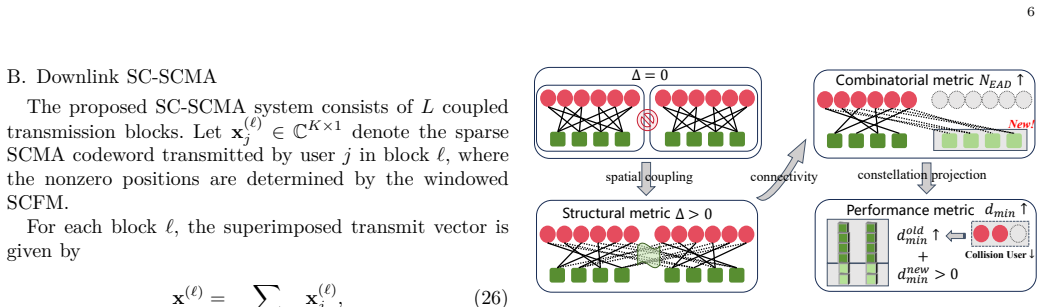
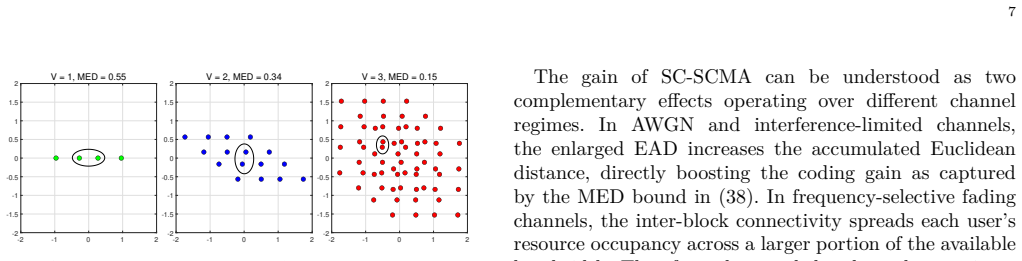
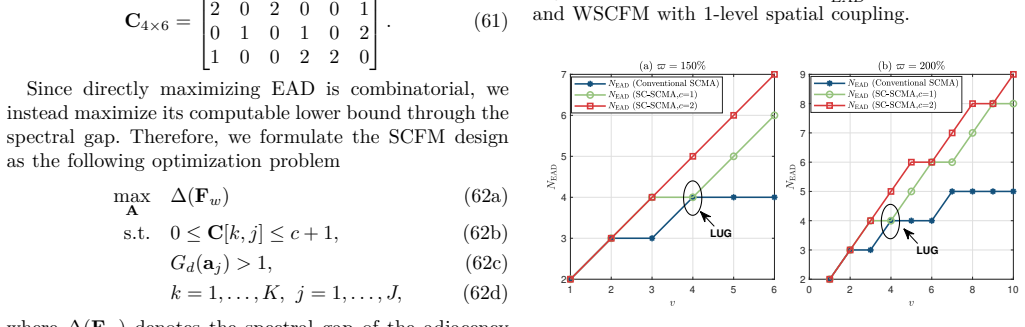
By analyzing pairwise error probabilities for multi-user error patterns, spatial coupling is shown to project the superimposed SCMA codewords into a higher-dimensional effective signal space. This leads to a strictly improved minimum Euclidean distance compared with conventional SCMA. The distance gain is governed by the effective access dimensionality induced by the coupled factor graph. Using spectral graph theory, a direct relationship is established between the spectral gap of the factor graph and a lower bound on the effective access dimensionality, providing a computable metric that guarantees the improvement.
What carries the argument
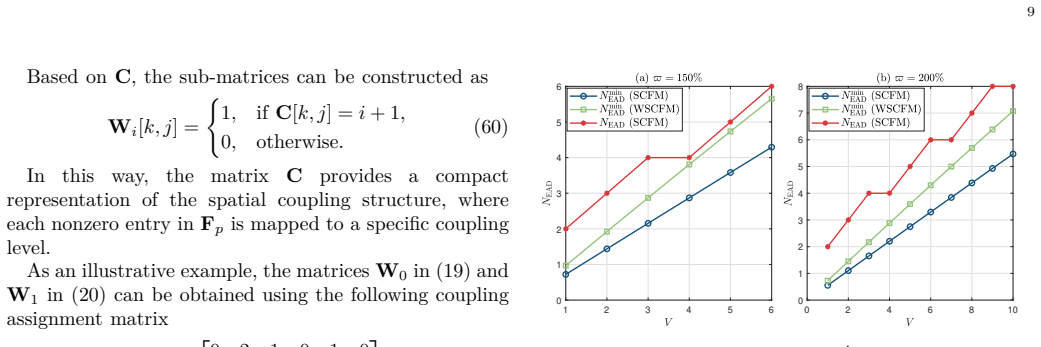
The effective access dimensionality (EAD) of the coupled factor graph, which determines the minimum Euclidean distance gain, with the spectral gap serving as a lower bound on the EAD.
If this is right
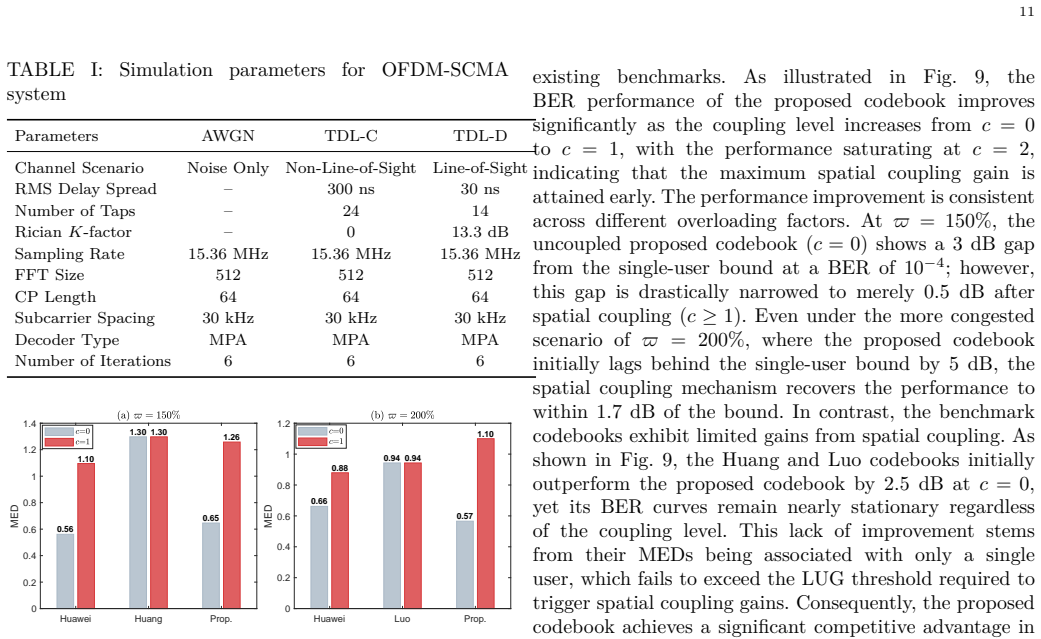
- The improved MED enhances error performance in overloaded massive access channels.
- Global message propagation from coupling improves coding gain.
- Inter-block spreading increases diversity gain.
- A low-complexity codebook design is enabled by focusing on dominant error-inducing local user groups.
- The spectral gap provides a structural metric for guaranteeing performance.
Where Pith is reading between the lines
- The spectral graph method could be used to optimize factor graphs in other non-orthogonal multiple access schemes.
- Performance gains might extend to scenarios with imperfect channel state information if the EAD bound holds.
- This framework suggests that graph design can be separated from codebook optimization for scalable systems.
Load-bearing premise
The pairwise error probability analysis for multi-user error patterns accurately captures the performance improvement from the spectral properties of the factor graph under realistic channel conditions and decoding algorithms.
What would settle it
Compare the actual minimum Euclidean distance achieved in SC-SCMA simulations against the conventional SCMA for factor graphs with different spectral gaps; if the improvement does not scale with the predicted EAD lower bound, the claim would be falsified.
Figures
read the original abstract
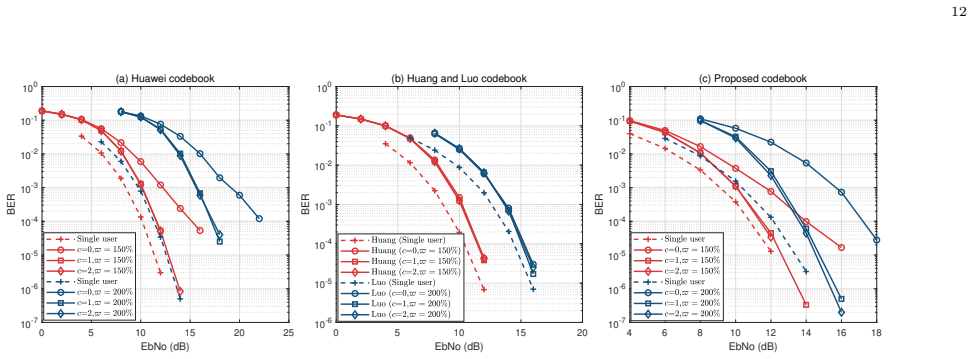
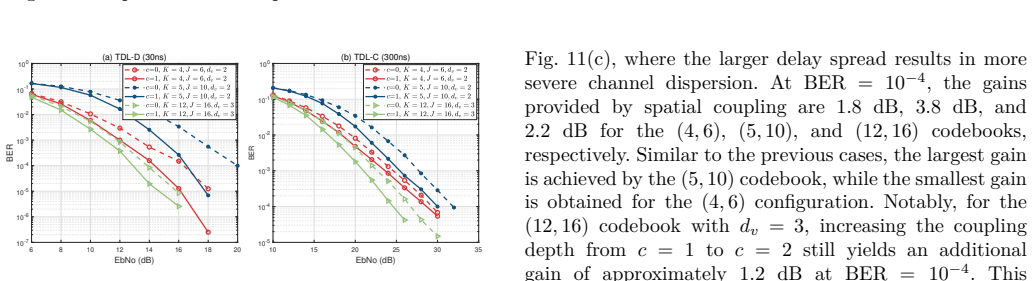
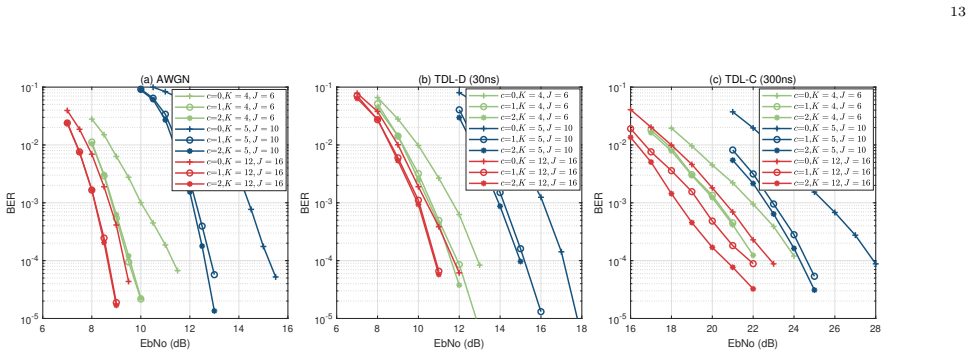
This paper presents a spatially coupled sparse code multiple access (SC-SCMA) framework to overcome the performance and scalability limitations of conventional SCMA systems. By analyzing the pairwise error probability associated to multi-user error patterns, we show that spatial coupling projects the superimposed SCMA codewords into a higher-dimensional effective signal space, leading to a strictly improved minimum Euclidean distance (MED) compared with conventional SCMA, while simultaneously enhancing the coding gain through global message propagation and the diversity gain through inter-block resource spreading. Such a distance gain is shown to be governed by the effective access dimensionality (EAD) induced by the coupled factor graph. With the aid of spectral graph theory, we establish a direct relationship between the spectral gap of the factor graph and a lower bound on the EAD, providing a computable structural metric that guarantees MED improvement under various error patterns. Building upon these theoretical insights, we introduce a low-complexity structure-aware codebook design approach, including a spectral-gap-oriented construction of spatially coupled factor matrices and a localized codebook optimization strategy that exploits the dominant error-inducing local user group. Simulation results validate the analysis and demonstrate that the proposed SC-SCMA consistently outperforms conventional SCMA in overloaded massive access channels.
Editorial analysis
A structured set of objections, weighed in public.
Referee Report
Summary. The manuscript proposes a spatially coupled SCMA (SC-SCMA) framework in which spatial coupling of the factor graph projects superimposed codewords into a higher-dimensional effective signal space. It claims this yields a strictly larger minimum Euclidean distance (MED) than conventional SCMA, with the gain governed by an effective access dimensionality (EAD) induced by the coupled graph; spectral graph theory is used to relate the factor-graph spectral gap to a lower bound on EAD that guarantees the improvement under various multi-user error patterns. A low-complexity codebook design (spectral-gap-oriented factor-matrix construction plus localized optimization over dominant local user groups) is introduced, and simulations are said to confirm consistent gains in overloaded massive-access channels.
Significance. If the claimed direct spectral-gap-to-EAD relationship is rigorously established and the MED gain is shown to be a structural consequence of the coupling (independent of the subsequent localized optimization), the work supplies a computable graph-theoretic metric for designing SCMA systems with guaranteed distance improvements. This could be useful for scalable non-orthogonal multiple access, provided the bound is tight enough to affect actual error rates under realistic decoding.
major comments (3)
- [Abstract / Theoretical Analysis] Abstract and theoretical analysis section: the central claim that spatial coupling produces a strictly improved MED governed by EAD, with the spectral gap supplying a lower bound that guarantees the gain under multi-user error patterns, is asserted via pairwise error probability analysis, but the explicit derivation of the EAD lower bound, its tightness, and verification that it affects error rates (rather than being loose) are load-bearing and require full expansion.
- [Codebook Design] Codebook design section: the construction includes both a spectral-gap-oriented factor-matrix construction and a separate localized codebook optimization that exploits dominant error-inducing local user groups. It must be shown whether the MED improvement is guaranteed by the spectral gap and EAD bound alone, or whether the observed gain requires the optimization step; otherwise the claimed structural guarantee from the graph metric is weaker than stated.
- [Pairwise Error Probability Analysis] Pairwise error probability analysis: the analysis for multi-user error patterns is used to establish the higher-dimensional projection and MED gain, yet no explicit check is described that the EAD lower bound is sufficiently tight to produce measurable distance improvement under the actual decoding algorithm and channel conditions employed in the simulations.
minor comments (2)
- [Simulations] Simulation results: reporting error bars or results over multiple random seeds would strengthen the validation that the observed gains are consistent with the claimed EAD-driven improvement.
- [Notation / Definitions] Notation: the definition of EAD as a function of the coupled factor graph should be stated explicitly before the spectral-gap bound is introduced, to avoid any appearance of circularity in the argument.
Simulated Author's Rebuttal
We thank the referee for the constructive comments. We address each major comment below with clarifications on the theoretical claims and indicate revisions to improve the manuscript.
read point-by-point responses
-
Referee: [Abstract / Theoretical Analysis] Abstract and theoretical analysis section: the central claim that spatial coupling produces a strictly improved MED governed by EAD, with the spectral gap supplying a lower bound that guarantees the gain under multi-user error patterns, is asserted via pairwise error probability analysis, but the explicit derivation of the EAD lower bound, its tightness, and verification that it affects error rates (rather than being loose) are load-bearing and require full expansion.
Authors: The derivation of the EAD lower bound from the spectral gap appears in Section III-B via the Cheeger inequality applied to the factor graph. We agree that additional intermediate steps and a tightness discussion would strengthen the presentation. In revision we will expand the proof with explicit steps and add a numerical verification showing the bound's effect on error rates. revision: yes
-
Referee: [Codebook Design] Codebook design section: the construction includes both a spectral-gap-oriented factor-matrix construction and a separate localized codebook optimization that exploits dominant error-inducing local user groups. It must be shown whether the MED improvement is guaranteed by the spectral gap and EAD bound alone, or whether the observed gain requires the optimization step; otherwise the claimed structural guarantee from the graph metric is weaker than stated.
Authors: Theorem 1 shows the MED gain follows directly from the EAD lower bound induced by the spectral gap, independent of optimization. The localized optimization is an implementation step that further improves performance but is not required for the structural guarantee. We will revise Section IV to explicitly separate these elements and add a clarifying remark. revision: yes
-
Referee: [Pairwise Error Probability Analysis] Pairwise error probability analysis: the analysis for multi-user error patterns is used to establish the higher-dimensional projection and MED gain, yet no explicit check is described that the EAD lower bound is sufficiently tight to produce measurable distance improvement under the actual decoding algorithm and channel conditions employed in the simulations.
Authors: Section V simulations employ the MPA decoder and report gains consistent with the EAD predictions. To make the tightness explicit, we will add a comparison (new figure or table) between the theoretical EAD bound and empirical minimum distances observed under the simulated channel and decoder conditions. revision: yes
Circularity Check
EAD defined via coupled factor graph; spectral-gap bound on EAD then used to guarantee MED gain reduces claim to graph construction properties
specific steps
-
self definitional
[Abstract]
"Such a distance gain is shown to be governed by the effective access dimensionality (EAD) induced by the coupled factor graph. With the aid of spectral graph theory, we establish a direct relationship between the spectral gap of the factor graph and a lower bound on the EAD, providing a computable structural metric that guarantees MED improvement under various error patterns."
EAD is defined as induced by the coupled factor graph; the spectral gap is a property of that identical graph. Establishing a 'direct relationship' between the gap and a lower bound on EAD, then claiming the bound guarantees MED improvement, makes the performance claim reduce to a structural property of the graph definition itself rather than an external derivation.
full rationale
The abstract presents the MED improvement as a consequence of spatial coupling into higher-dimensional space, with the gain governed by EAD induced by the coupled factor graph and a direct spectral-gap-to-EAD-bound relationship that 'guarantees' the improvement. Because EAD is introduced as induced by the same graph whose spectral properties supply the bound, the guarantee step is at least partly definitional rather than an independent first-principles derivation from PEP analysis alone. The separate localized codebook optimization is presented as building on the theory, raising the possibility that the claimed structural guarantee is not fully independent of that optimization step. This produces moderate circularity without a full self-citation chain or explicit equation reduction.
Axiom & Free-Parameter Ledger
axioms (2)
- domain assumption Pairwise error probability analysis accurately models multi-user error patterns in SCMA
- standard math Spectral properties of the factor graph control the effective access dimensionality
invented entities (1)
-
Effective access dimensionality (EAD)
no independent evidence
Reference graph
Works this paper leans on
-
[1]
Nonorthogonal multiple access for 5g and beyond,
Y. Liu, Z. Qin, M. Elkashlan, Z. Ding, A. Nallanathan, and L. Hanzo, “Nonorthogonal multiple access for 5g and beyond,” Proc. IEEE, vol. 105, no. 12, pp. 2347–2381, Dec. 2017
2017
-
[2]
Evolution of NOMA Toward Next Generation Multiple Access (NGMA) for 6G,
Y. Liu, S. Zhang, X. Mu, Z. Ding, R. Schober, N. Al-Dhahir, E. Hossain, and X. Shen, “Evolution of NOMA Toward Next Generation Multiple Access (NGMA) for 6G,” IEEE J. Select. Areas Commun., vol. 40, no. 4, pp. 1037–1071, Apr. 2022
2022
-
[3]
Sparse or Dense: A Comparative Study of Code-Domain NOMA Systems,
Z. Liu and L.-L. Yang, “Sparse or Dense: A Comparative Study of Code-Domain NOMA Systems,” IEEE Trans. Wireless Commun., vol. 20, no. 8, pp. 4768–4780, Aug. 2021
2021
-
[4]
Sparse Code Multiple Access for 6G Wireless Communication Networks: Recent Advances and Future Directions,
L. Yu, Z. Liu, M. Wen, D. Cai, S. Dang, Y. Wang, and P. Xiao, “Sparse Code Multiple Access for 6G Wireless Communication Networks: Recent Advances and Future Directions,” IEEE Comm. Stand. Mag., vol. 5, no. 2, pp. 92–99, Jun. 2021
2021
-
[5]
Sparse code multiple access,
H. Nikopour and H. Baligh, “Sparse code multiple access,” in 2013 IEEE 24th Annual International Symposium on Personal, Indoor, and Mobile Radio Communications (PIMRC). London: IEEE, Sep. 2013, pp. 332–336
2013
-
[6]
SCMA Codebook Design,
M. Taherzadeh, H. Nikopour, A. Bayesteh, and H. Baligh, “SCMA Codebook Design,” in 2014 IEEE 80th Vehicular Technology Conference (VTC2014-Fall). Vancouver, BC, Canada: IEEE, Sep. 2014, pp. 1–5
2014
-
[7]
A Tutorial on Decoding Techniques of Sparse Code Multiple Access,
S. Chaturvedi, Z. Liu, V. A. Bohara, A. Srivastava, and P. Xiao, “A Tutorial on Decoding Techniques of Sparse Code Multiple Access,” IEEE Access, vol. 10, pp. 58 503–58 524, 2022
2022
-
[8]
Novel Low-Density Signature for Synchronous CDMA Systems Over A WGN Channel,
R. Hoshyar, F. P. Wathan, and R. Tafazolli, “Novel Low-Density Signature for Synchronous CDMA Systems Over A WGN Channel,” IEEE Trans. Signal Process., vol. 56, no. 4, pp. 1616–1626, Apr. 2008
2008
-
[9]
Designing Enhanced Multidimensional Constellations for Code-Domain NOMA,
H. Wen, Z. Liu, Q. Luo, C. Shi, and P. Xiao, “Designing Enhanced Multidimensional Constellations for Code-Domain NOMA,” IEEE Wireless Commun. Lett., vol. 11, no. 10, pp. 2130–2134, Oct. 2022
2022
-
[10]
Enhancing Signal Space Diversity for SCMA Over Rayleigh Fading Channels,
Q. Luo, Z. Liu, G. Chen, and P. Xiao, “Enhancing Signal Space Diversity for SCMA Over Rayleigh Fading Channels,” IEEE Trans. Wireless Commun., vol. 23, no. 4, pp. 3676–3690, Apr. 2024
2024
-
[11]
Design and Analysis of SCMA Codebook Based on Star-QAM Signaling Constellations,
L. Yu, P. Fan, D. Cai, and Z. Ma, “Design and Analysis of SCMA Codebook Based on Star-QAM Signaling Constellations,” IEEE Trans. Veh. Technol., vol. 67, no. 11, pp. 10 543–10 553, Nov. 2018
2018
-
[12]
Downlink SCMA Codebook Design With Low Error Rate by Maximizing Minimum Euclidean Distance of Superimposed Codewords,
C. Huang, B. Su, T. Lin, and Y. Huang, “Downlink SCMA Codebook Design With Low Error Rate by Maximizing Minimum Euclidean Distance of Superimposed Codewords,” IEEE Trans. Veh. Technol., vol. 71, no. 5, pp. 5231–5245, May 2022
2022
-
[13]
Multi-Dimensional SCMA Codebook Design Based on Constellation Rotation and Interleaving,
D. Cai, P. Fan, X. Lei, Y. Liu, and D. Chen, “Multi-Dimensional SCMA Codebook Design Based on Constellation Rotation and Interleaving,” in 2016 IEEE 83rd Vehicular Technology Conference (VTC Spring). Nanjing, China: IEEE, May 2016, pp. 1–5
2016
-
[14]
Design of Power-Imbalanced SCMA Codebook,
X. Li, Z. Gao, Y. Gui, Z. Liu, P. Xiao, and L. Yu, “Design of Power-Imbalanced SCMA Codebook,” IEEE Trans. Veh. Technol., vol. 71, no. 2, pp. 2140–2145, Feb. 2022. 14
2022
-
[15]
SCMA Codebook Based on Optimization of Mutual Information and Shaping Gain,
S. Sharma, K. Deka, V. Bhatia, and A. Gupta, “SCMA Codebook Based on Optimization of Mutual Information and Shaping Gain,” in 2018 IEEE Globecom Workshops (GC Wkshps). Abu Dhabi, United Arab Emirates: IEEE, Dec. 2018, pp. 1–6
2018
-
[16]
An Efficient SCMA Codebook Optimization Algorithm Based on Mutual Information Maximization,
C. Dong, G. Gao, K. Niu, and J. Lin, “An Efficient SCMA Codebook Optimization Algorithm Based on Mutual Information Maximization,” Wireless Communications and Mobile Computing, vol. 2018, no. 1, p. 8910907, Jan. 2018
2018
-
[17]
Bit-Interleaved Coded SCMA With Iterative Multiuser Detection: Multidimensional Constellations Design,
B. Jinchen, Z. Ma, M. Xiao, T. A. Tsiftsis, and Z. Zhongliang, “Bit-Interleaved Coded SCMA With Iterative Multiuser Detection: Multidimensional Constellations Design,” vol. 66, no. 11, pp. 5292–5364, Nov. 2018
2018
-
[18]
Low Complexity Techniques for SCMA Detection,
A. Bayesteh, H. Nikopour, M. Taherzadeh, H. Baligh, and J. Ma, “Low Complexity Techniques for SCMA Detection,” in 2015 IEEE Globecom Workshops (GC Wkshps). San Diego, CA, USA: IEEE, Dec. 2015, pp. 1–6
2015
-
[19]
Enabling High Order SCMA Systems in Downlink Scenarios With a Serial Coding Scheme,
Y. Han, W. Zhou, M. Zhao, and S. Zhou, “Enabling High Order SCMA Systems in Downlink Scenarios With a Serial Coding Scheme,” IEEE Access, vol. 6, pp. 33 796–33 809, 2018
2018
-
[20]
A Design of Low-Projection SCMA Codebooks for Ultra-Low Decoding Complexity in Downlink IoT Networks,
Q. Luo, Z. Liu, G. Chen, P. Xiao, Y. Ma, and A. Maaref, “A Design of Low-Projection SCMA Codebooks for Ultra-Low Decoding Complexity in Downlink IoT Networks,” IEEE Trans. Wireless Commun., vol. 22, no. 10, pp. 6608–6623, Oct. 2023
2023
-
[21]
The effect of spatial coupling on compressive sensing,
S. Kudekar and H. D. Pfister, “The effect of spatial coupling on compressive sensing,” in 2010 48th Annual Allerton Conference on Communication, Control, and Computing (Allerton). Monticello, IL, USA: IEEE, Sep. 2010, pp. 347–353
2010
-
[22]
Threshold saturation on BMS channels via spatial coupling,
S. Kudekar, C. Meassony, T. Richardson, and R. Urbankez, “Threshold saturation on BMS channels via spatial coupling,” in 2010 6th International Symposium on Turbo Codes & Iterative Information Processing. Brest: IEEE, Sep. 2010, pp. 309–313
2010
-
[23]
Combining Spatially Coupled LDPC Codes with Modulation and Detection
L. Schmalen, B. Laboratories, and L. Schmalen, “Combining Spatially Coupled LDPC Codes with Modulation and Detection. ”
-
[24]
Spatially Coupled LDPC Codes Constructed From Protographs,
D. G. M. Mitchell, M. Lentmaier, and D. J. Costello, “Spatially Coupled LDPC Codes Constructed From Protographs,” IEEE Trans. Inform. Theory, vol. 61, no. 9, pp. 4866–4889, Sep. 2015
2015
-
[25]
Threshold Saturation via Spatial Coupling: Why Convolutional LDPC Ensembles Perform So Well over the BEC,
S. Kudekar, T. J. Richardson, and R. L. Urbanke, “Threshold Saturation via Spatial Coupling: Why Convolutional LDPC Ensembles Perform So Well over the BEC,” IEEE Trans. Inform. Theory, vol. 57, no. 2, pp. 803–834, Feb. 2011
2011
-
[26]
1st 5g algorithm innovation competition – env1.0-scma,
Altera Innovate Asia, “1st 5g algorithm innovation competition – env1.0-scma,” http://www.innovateasia.com/5G/en/gp2. html, n.d., presentation, Online
discussion (0)
Sign in with ORCID, Apple, or X to comment. Anyone can read and Pith papers without signing in.