Distributed Hierarchical Temporal Memory with Shared Associative Memory for Cross-Entity Preemptive Warning
Pith reviewed 2026-07-01 02:23 UTC · model grok-4.3
The pith
Distributed Hierarchical Temporal Memory reuses precursor signatures via shared memory to issue warnings before anomalies appear locally.
A machine-rendered reading of the paper's core claim, the machinery that carries it, and where it could break.
Core claim
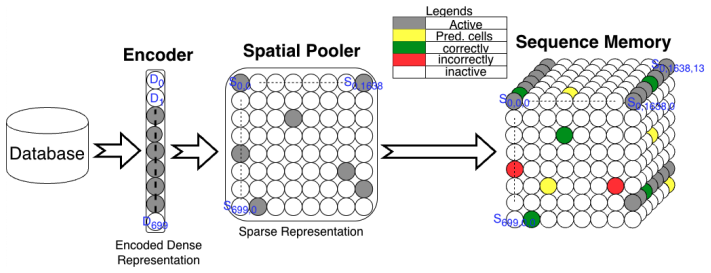
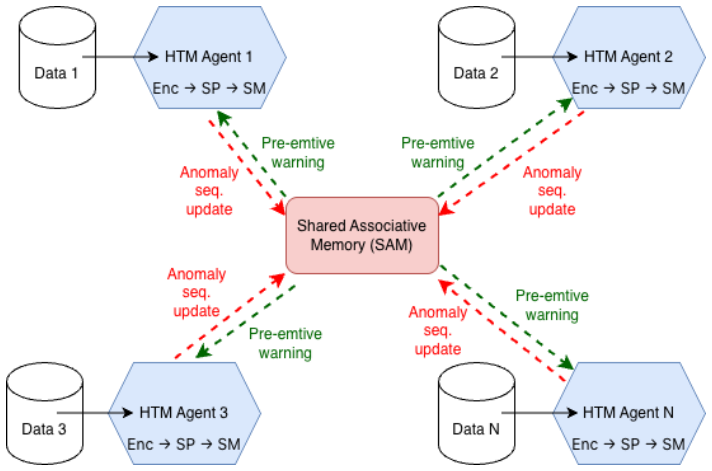
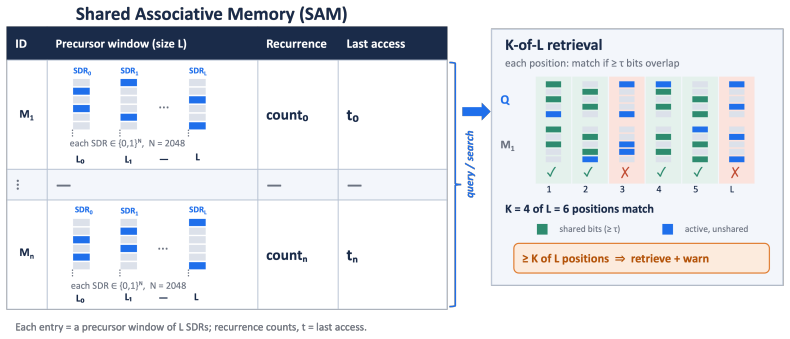
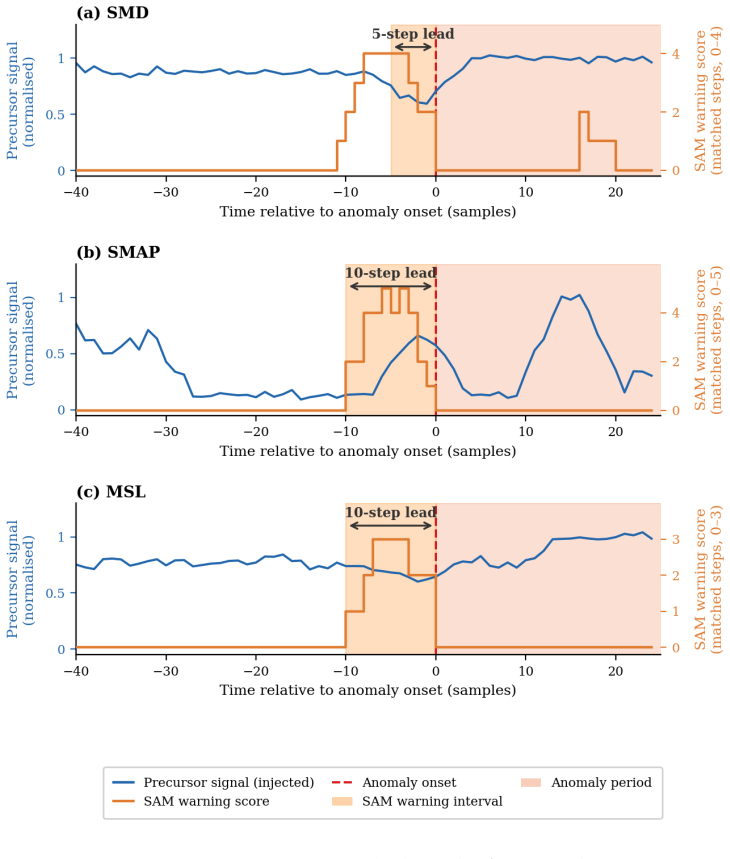
D-HTM projects multivariate observations through a Spatial Pooler into a common SDR space, runs entity-specific Temporal Memory modules that learn dynamics online, and routes recurring pre-anomaly signatures into a Shared Associative Memory that can be consulted by any connected entity. When a matching precursor appears in one entity, the shared memory triggers a warning for related entities before their local anomaly begins, yielding an average 8.1-sample lead time across the evaluated real-world datasets.
What carries the argument
Shared Associative Memory (SAM), which stores and retrieves recurring pre-anomaly signatures projected into the common SDR space so that one entity's precursor can trigger warnings in others.
If this is right
- D-HTM issues warnings an average of 8.1 samples prior to anomaly onset on the tested real-world datasets.
- The system preserves HTM's online learning while adding preemptive capability through SAM reuse.
- Cross-entity warning propagation works on both real telemetry and the synthetic cascade benchmark designed to isolate transfer.
- Transferable precursor structure emerges inside the shared SDR space and supports distributed predictive reasoning beyond isolated detection.
Where Pith is reading between the lines
- If the SDR projection preserves enough structure, the same SAM reuse pattern could shorten response times in other online monitoring domains such as network traffic or sensor networks.
- The synthetic cascade benchmark isolates the transfer effect; similar controlled tests could check whether the lead-time gain scales with the number of related entities.
- Because SAM operates on top of existing HTM components, incremental deployment on existing HTM installations may be feasible without full retraining.
Load-bearing premise
Recurring pre-anomaly signatures exist and remain recognizable when different entities are mapped into the same sparse distributed representation space.
What would settle it
Running D-HTM on the Server Machine Dataset or SMAP streams and finding zero or negative average warning lead time before anomaly onset would falsify the claim of effective cross-entity precursor transfer.
Figures
read the original abstract
Anomaly detection in multivariate time series remains a critical challenge in large-scale distributed systems, where related entities may exhibit transferable precursor behavior prior to anomaly onset. Existing methods typically operate independently on each data stream and therefore remain fundamentally reactive. To address this limitation, we introduce Distributed Hierarchical Temporal Memory (D-HTM), a neuromorphic framework that enables cross-entity preemptive warning through a Shared Associative Memory (SAM). D-HTM combines a Spatial Pooler (SP) that projects observations into a common Sparse Distributed Representation (SDR) space, Temporal Memory (TM) modules that learn entity-specific dynamics online, and a Shared Associative Memory that stores recurring pre-anomaly signatures. By reusing precursor knowledge across related entities, D-HTM can issue warnings prior to local anomaly onset while preserving HTM's online learning capabilities. We evaluate D-HTM on the Server Machine Dataset (SMD), the Soil Moisture Active Passive (SMAP) dataset, the Mars Science Laboratory (MSL) dataset, and a synthetic cascade benchmark designed to isolate precursor transfer. Experimental results demonstrate effective cross-entity warning propagation while maintaining competitive reactive anomaly detection performance. Across the real-world datasets, D-HTM provides an average warning lead time of 8.1 samples prior to anomaly onset. These findings demonstrate that transferable precursor structure can emerge within a shared SDR space and be reused for preemptive warning generation, extending HTM beyond isolated reactive detection toward distributed predictive reasoning.
Editorial analysis
A structured set of objections, weighed in public.
Referee Report
Summary. The manuscript introduces Distributed Hierarchical Temporal Memory (D-HTM), which augments standard HTM with a Shared Associative Memory (SAM) to enable cross-entity preemptive anomaly warnings in multivariate time series. It claims that projecting observations into a common SDR space allows reuse of recurring precursor signatures, yielding an average 8.1-sample warning lead time prior to anomaly onset on the SMD, SMAP, MSL, and synthetic cascade datasets while preserving online learning.
Significance. If the empirical claims hold, the work would demonstrate a concrete extension of HTM to distributed predictive settings, showing that transferable precursor structure can emerge in shared SDR representations and support proactive rather than purely reactive detection.
major comments (2)
- [Abstract] Abstract: the central 8.1-sample lead-time claim is stated without any accompanying methods description, SAM update equations, warning-generation procedure, error bars, or dataset statistics, rendering the result unevaluable from the supplied text.
- [Abstract] Abstract: the load-bearing assumption that recurring pre-anomaly signatures exist and are transferable across entities when projected into shared SDR space is asserted but neither formalized nor supported by any derivation or ablation, leaving the cross-entity propagation mechanism unexamined.
Simulated Author's Rebuttal
We thank the referee for the comments. We address the two major points on the abstract below, indicating planned revisions where appropriate.
read point-by-point responses
-
Referee: [Abstract] Abstract: the central 8.1-sample lead-time claim is stated without any accompanying methods description, SAM update equations, warning-generation procedure, error bars, or dataset statistics, rendering the result unevaluable from the supplied text.
Authors: The abstract is a high-level summary constrained by length. The SAM update equations appear in Equation (3), the warning-generation procedure in Section 3.3, and error bars plus dataset statistics in Table 1 and Figure 4 of the main text. To make the central claim more self-contained within the abstract itself, we will add a single sentence referencing the core D-HTM components and evaluation setting. revision: yes
-
Referee: [Abstract] Abstract: the load-bearing assumption that recurring pre-anomaly signatures exist and are transferable across entities when projected into shared SDR space is asserted but neither formalized nor supported by any derivation or ablation, leaving the cross-entity propagation mechanism unexamined.
Authors: The shared SDR projection and SAM-based transfer mechanism are formalized in Section 3, with the synthetic cascade benchmark (Section 5.4) isolating precursor transfer and ablations (Section 5.5) quantifying SAM contribution. Because the abstract cannot accommodate a full derivation, we will add a brief clause noting that transferability is enabled by the shared associative memory, while retaining the detailed formalization and evidence in the body. revision: partial
Circularity Check
No significant circularity identified
full rationale
The manuscript abstract and framework description contain no equations, parameter-fitting steps, derivations, or self-citations. Claims about cross-entity warning lead time rest on empirical evaluation across external datasets (SMD, SMAP, MSL) rather than any reduction of outputs to inputs by construction. The shared SDR space and SAM reuse are presented as architectural choices whose effectiveness is tested externally, with no load-bearing premise justified solely by prior author work or definitional equivalence.
Axiom & Free-Parameter Ledger
axioms (1)
- domain assumption Precursor behavior is transferable across related entities in a shared SDR space
invented entities (2)
-
Distributed Hierarchical Temporal Memory (D-HTM)
no independent evidence
-
Shared Associative Memory (SAM)
no independent evidence
Reference graph
Works this paper leans on
-
[1]
J. E. Laird, C. Lebiere, P. S. Rosenbloom, A standard model of the mind: Toward a common computational framework across artificial in- telligence, cognitive science, neuroscience, and robotics, AI Magazine 38 (4) (2017) 13–26
2017
-
[2]
J. Hawkins, S. Ahmad, Why neurons have thousands of synapses, a theory of sequence memory in neocortex, Frontiers in Neural Circuits 10 (2016) 23.doi:10.3389/fncir.2016.00023
-
[4]
A. Lavin, S. Ahmad, Evaluating real-time anomaly detection algorithms–the numenta anomaly benchmark, in: IEEE 14th Inter- national Conference on Machine Learning and Applications (ICMLA), 2015, pp. 38–44.doi:10.1109/ICMLA.2015.141
-
[5]
F. Zhou, H. Yang, Y. Zhai, S. Chen, Hierarchical temporal memory for medical image classification, IEEE Access 6 (2018) 30750–30758. doi:10.1109/ACCESS.2018.2844115
-
[6]
T. Adam, M. Haase, H. Bernhard, Wafer defect classification using hi- erarchical temporal memory, Microelectronics Reliability 88–90 (2018) 1027–1031.doi:10.1016/j.microrel.2018.06.053
-
[7]
S. James, S. Bhanja, Htm-based biometric recognition system for real- time identity verification, Pattern Recognition Letters 92 (2017) 102– 108.doi:10.1016/j.patrec.2017.05.018
-
[8]
P. Neubert, P. Protzel, Sequence-based place recognition using hierar- chical temporal memory, IEEE Transactions on Neural Networks and Learning Systems 29 (9) (2018) 4122–4132.doi:10.1109/TNNLS.2017. 2773578
-
[9]
M. Micheletto, L. Garrido, G. Ruiz, Using htm for earthquake prediction from seismic sensor data, IEEE Transactions on Geoscience and Remote Sensing 56 (12) (2018) 7342–7350.doi:10.1109/TGRS.2018.2844083
-
[10]
E.Osegi, A.Usman, M.Ogbimi, Usinghierarchicaltemporalmemoryfor short-term power load forecasting, Neural Computing and Applications 30 (11) (2018) 3451–3463.doi:10.1007/s00521-017-2928-4
-
[11]
Adversarial examples: Attacks and defenses for deep learning
A.Zyarah, D.Kudithipudi, End-to-endneuromemristivearchitecturefor hierarchical temporal memory, IEEE Transactions on Neural Networks and Learning Systems 31 (8) (2020) 2703–2715.doi:10.1109/TNNLS. 2019.2932783
-
[12]
doi:10.1016/j.softx.2020.100491
I.Bautista, S.Sarkar, S.Bhanja, Matlabhtm: Asequencememorymodel of neocortical layers for anomaly detection, SoftwareX 11 (2020) 100491. doi:10.1016/j.softx.2020.100491. 25
-
[13]
K. D. Harris, G. M. G. Shepherd, The neocortical circuit: themes and variations, Nature Neuroscience 18 (2) (2015) 170–181.doi:10.1038/ nn.3917
2015
-
[14]
Audibert, P
J. Audibert, P. Michiardi, F. Guyard, S. Marti, M. A. Zuluaga, USAD: Unsupervised anomaly detection on multivariate time series, in: Pro- ceedings of the 26th ACM SIGKDD International Conference on Knowl- edge Discovery & Data Mining, ACM, 2020, pp. 3395–3404
2020
-
[15]
Y. Su, Y. Zhao, C. Niu, R. Liu, W. Sun, D. Pei, Robust anomaly de- tection for multivariate time series through stochastic recurrent neural network, in: Proceedings of the 25th ACM SIGKDD International Con- ference on Knowledge Discovery & Data Mining, 2019, pp. 2828–2837. doi:10.1145/3292500.3330672
-
[16]
J. N. Foerster, Y. M. Assael, N. de Freitas, S. Whiteson, Learning to communicate with deep multi-agent reinforcement learning, in: Ad- vances in Neural Information Processing Systems, Vol. 29, 2016, pp. 2137–2145. URLhttps://arxiv.org/abs/1605.06676
work page internal anchor Pith review Pith/arXiv arXiv 2016
-
[17]
A. A. Rusu, N. C. Rabinowitz, G. Desjardins, H. Soyer, J. Kirkpatrick, K. Kavukcuoglu, R. Pascanu, R. Hadsell, Progressive neural networks, arXiv preprint arXiv:1606.04671 (2016). URLhttps://arxiv.org/abs/1606.04671
work page internal anchor Pith review Pith/arXiv arXiv 2016
-
[18]
Vashist, C
R. Vashist, C. Mueller, Distributed memory architectures in multi-agent systems, tech Report (2020)
2020
-
[19]
Megatron-LM: Training Multi-Billion Parameter Language Models Using Model Parallelism
M. Shoeybi, M. Patwary, R. Puri, et al., Megatron-lm: Training multi- billion parameter language models using model parallelism, in: arXiv preprint arXiv:1909.08053, 2019
work page internal anchor Pith review Pith/arXiv arXiv 1909
-
[20]
Multiagent Cooperation and Competition with Deep Reinforcement Learning
A. Tampuu, T. Matiisen, I. Kuzovkin, et al., Multi-agent cooperation and competition with deep reinforcement learning, in: arXiv preprint arXiv:1511.08779, 2015
work page internal anchor Pith review Pith/arXiv arXiv 2015
-
[21]
H. B. McMahan, E. Moore, D. Ramage, S. Hampson, B. A. y Arcas, Communication-efficient learning of deep networks from decentralized data, in: Proceedings of the 20th International Conference on Artificial 26 Intelligence and Statistics (AISTATS), Vol. 54, PMLR, 2017, pp. 1273– 1282
2017
-
[22]
J. Hao, P. Chen, J. Chen, X. Li, Multi-task federated learning-based system anomaly detection and multi-classification for microservices ar- chitecture, Future Generation Computer Systems 159 (2024) 77–90. doi:10.1016/j.future.2024.05.001
-
[23]
J. Hao, P. Chen, J. Chen, X. Li, Effectively detecting and diagnos- ing distributed multivariate time series anomalies via unsupervised fed- erated hypernetwork, Information Processing & Management (2025). doi:10.1016/j.ipm.2025.103974
-
[24]
L. Zheng, et al., MAS-LSTM: A multi-agent LSTM-based approach for scalable anomaly detection in IIoT networks, Processes 13 (3) (2025) 753.doi:10.3390/pr13030753
- [25]
-
[26]
Anonymous, LEMAD: LLM-empowered multi-agent system for anomaly detection in power grid services, Electronics 14 (15) (2025) 3008.doi: 10.3390/electronics14153008
-
[27]
Hawkins, S
J. Hawkins, S. Ahmad, Hierarchical temporal memory including htm cortical learning algorithms, Tech. rep., Numenta (2016). URLhttps://numenta.org/resources/white-papers/
2016
-
[28]
S. Ahmad, J. Hawkins, How do neurons operate on sparse distributed representations? A mathematical theory of sparsity, neurons and active dendrites, arXiv preprint arXiv:1601.00720 (2016). URLhttps://arxiv.org/abs/1601.00720
work page internal anchor Pith review Pith/arXiv arXiv 2016
-
[29]
P.Bera, S.H.Moon, J.Adorno, D.A.Reis, S.Bhanja, Enhancingbiolog- ically inspired hierarchical temporal memory with hardware-accelerated reflex memory, arXiv preprintPreprint submitted to Elsevier (2025)
2025
-
[30]
J.Shen, W.Ni, Q.Xu, G.Pan, H.Tang, Contextgatinginspikingneural networks: Achieving lifelong learning through integration of local and global plasticity, Knowledge-Based Systems 311 (2025) 112999. 27
2025
-
[31]
Gatti, J
M. Gatti, J. A. Barbato, C. Zandron, Spiking neural network classifica- tion ofx-ray chestimages, Knowledge-BasedSystems 314 (2025) 113194
2025
-
[32]
M. Davies, N. Srinivasa, T.-H. Lin, G. Chinya, Y. Cao, S. H. Cho- day, G. Dimou, P. Joshi, N. Imam, S. Jain, Y. Liao, C.-K. Lin, A. Lines, R. Liu, D. Mathaikutty, S. McCoy, A. Paul, J. Tse, G. Venkataramanan, Y.-H. Weng, A. Wild, Y. Yang, H. Wang, Loihi: A neuromorphic many- core processor with on-chip learning, IEEE Micro 38 (1) (2018) 82–99. doi:10.1109...
-
[33]
Thottan, C
M. Thottan, C. Ji, Proactive anomaly detection using distributed intel- ligent agents, IEEE Network 12 (5) (1998) 21–27
1998
-
[34]
Per- mutahedra and generalized associahedra
M.-C. Lee, J.-C. Lin, E. G. Gran, RePAD: Real-time proactive anomaly detection for time series, in: Proceedings of the 34th International Conference on Advanced Information Networking and Applications (AINA 2020), Springer, 2020, pp. 1291–1302.doi:10.1007/978-3- 030-44041-1\_110
- [35]
-
[36]
P. Cao, K.-W. Chung, Z. Kalbarczyk, R. Iyer, A. J. Slagell, Preemp- tive intrusion detection, in: Proceedings of the 2015 Symposium and Bootcamp on the Science of Security (HotSoS), ACM, 2015, p. 21. doi:10.1145/2746285.2746306
-
[37]
Anonymous, A novel anomaly detection method for multivariate time series based on spatial-temporal graph learning, Journal of King Saud University – Computer and Information Sciences (2025).doi:10.1007/ s44443-025-00024-3
2025
-
[38]
Z. Li, Y. Zhao, J. Han, Y. Su, R. Jia, Z. Li, D. Pei, Multivariate time se- ries anomaly detection and interpretation using hierarchical inter-metric and temporal embedding, in: Proceedings of the 27th ACM SIGKDD Conference on Knowledge Discovery & Data Mining, 2021, pp. 3220– 3230.doi:10.1145/3447548.3467075
-
[39]
Anonymous, StackVAE: Stacked variational autoencoder for multivari- ate time series anomaly detection, AI Open 3 (2022) 101–110. 28
2022
-
[40]
K. Hundman, V. Constantinou, C. Laporte, I. Colwell, T. Soderstrom, Detecting spacecraft anomalies using LSTMs and nonparametric dy- namic thresholding, in: Proceedings of the 24th ACM SIGKDD Inter- national Conference on Knowledge Discovery & Data Mining, 2018, pp. 387–395.doi:10.1145/3219819.3219845
-
[41]
Akiba, S
T. Akiba, S. Sano, T. Yanase, T. Ohta, M. Koyama, Optuna: A next- generation hyperparameter optimization framework, in: Proceedings of the 25th ACM SIGKDD International Conference on Knowledge Dis- covery & Data Mining, 2019, pp. 2623–2631. 29
2019
discussion (0)
Sign in with ORCID, Apple, or X to comment. Anyone can read and Pith papers without signing in.