On Interpretations of Normal Modal Logics
Pith reviewed 2026-07-01 02:11 UTC · model grok-4.3
The pith
All additive and normal formulas are completely described in the modal logics K, GL, Grz, S4, and S5.
A machine-rendered reading of the paper's core claim, the machinery that carries it, and where it could break.
Core claim
We study interpretations of modal logics in one another where the Boolean connectives are interpreted identically and the modal operator diamond is interpreted by an arbitrary formula A(p). Clearly, such a formula A(p) defines an interpretation of a normal modal logic whenever A(p) is additive (that is, preserves disjunction) and normal (that is, preserves bottom) in the target logic. In the present paper, we provide a complete description of all additive and normal formulas in five prominent modal logics: K, GL, Grz, S4, and S5. For K, GL, and S5, we also describe all additive and normal formulas with parameters.
What carries the argument
An additive and normal formula A(p) that preserves disjunction and bottom, thereby serving as a direct substitution for the diamond operator in an interpretation between normal modal logics.
If this is right
- Every possible interpretation of these five logics into one another via substitution for diamond can now be enumerated explicitly.
- The listed formulas give the exact syntactic forms that preserve the normality and additivity conditions inside each logic.
- For K, GL, and S5 the classification extends to formulas containing additional parameters, yielding a still larger but finite set of admissible substitutions.
- The results apply directly to checking whether a given substitution yields an interpretation that remains normal.
Where Pith is reading between the lines
- The classification supplies a decision procedure for the existence of interpretations between any pair of the listed logics under this substitution scheme.
- Because GL appears among the logics, the results bear on the question of which formulas can serve as provability predicates that preserve the properties of provability logic.
- The same syntactic conditions may be used to test candidate interpretations in other normal modal logics not covered here.
Load-bearing premise
A formula A(p) defines a valid interpretation of a normal modal logic precisely when it is additive and normal in the target logic.
What would settle it
Discovery of an additive and normal formula in K, GL, Grz, S4, or S5 that falls outside the complete list supplied by the paper, or proof that one of the listed formulas fails to preserve disjunction or bottom.
Figures
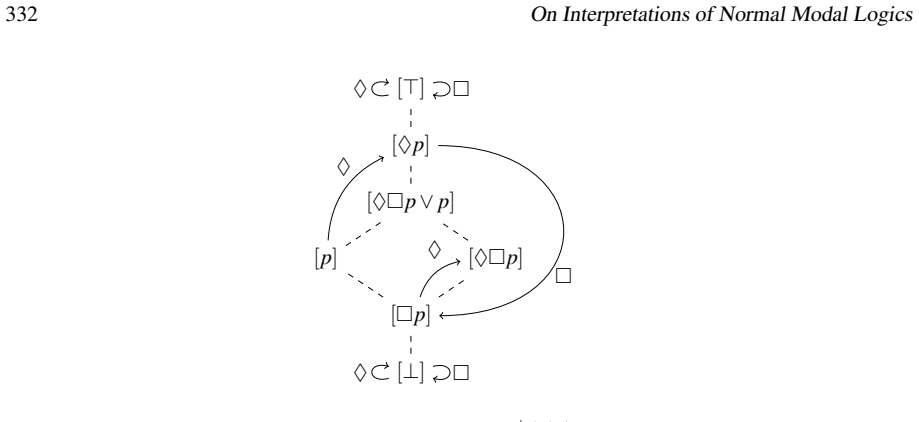
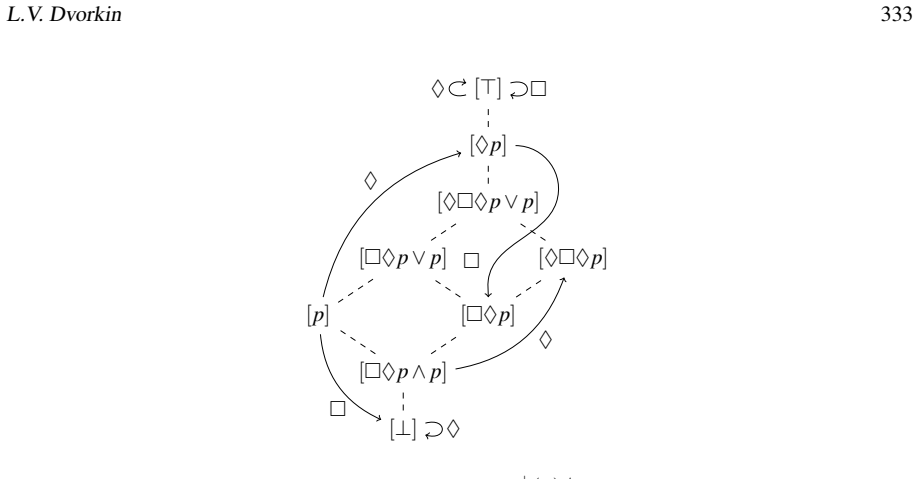
read the original abstract
We study interpretations of modal logics in one another where the Boolean connectives are interpreted identically and the modal operator diamond is interpreted by an arbitrary formula A(p). Clearly, such a formula A(p) defines an interpretation of a normal modal logic whenever A(p) is additive (that is, preserves disjunction) and normal (that is, preserves bottom) in the target logic. In the present paper, we provide a complete description of all additive and normal formulas in five prominent modal logics: K, GL, Grz, S4, and S5. For K, GL, and S5, we also describe all additive and normal formulas with parameters.
Editorial analysis
A structured set of objections, weighed in public.
Referee Report
Summary. The paper studies interpretations of normal modal logics in which Boolean connectives are preserved and the diamond operator is replaced by an arbitrary formula A(p). It claims to give a complete classification of all formulas A(p) that are additive (A(p ∨ q) ↔ A(p) ∨ A(q)) and normal (A(⊥) ↔ ⊥) in K, GL, Grz, S4 and S5; for K, GL and S5 the classification is also given for formulas with parameters. The motivating observation that additivity plus normality suffice for the formula to define a normal modal logic is the standard K axiom plus necessitation condition.
Significance. If the classification is exhaustive and correct, the result supplies a precise inventory of all possible diamond-interpretations that preserve normality in these five logics. This is a useful reference for work on embeddings, translations and definability in modal logic. The paper rests on the standard definitions of additivity and normality with no parameter-fitting or circular reductions.
major comments (1)
- [Abstract] The abstract asserts a 'complete description' for each of the five logics, yet the manuscript provides no explicit enumeration of the cases or proof that every possible formula has been considered; without the detailed case analysis it is impossible to confirm exhaustiveness of the classification.
Simulated Author's Rebuttal
We thank the referee for the report. We address the major comment below.
read point-by-point responses
-
Referee: [Abstract] The abstract asserts a 'complete description' for each of the five logics, yet the manuscript provides no explicit enumeration of the cases or proof that every possible formula has been considered; without the detailed case analysis it is impossible to confirm exhaustiveness of the classification.
Authors: The body of the manuscript supplies the explicit classifications and exhaustiveness proofs. Theorems 3.1 (K), 4.2 (GL), 5.3 (Grz), 6.1 (S4) and 7.4 (S5) each list all additive normal formulas (and the parameter versions for K, GL, S5) together with proofs that proceed by exhaustive syntactic case analysis on formulas satisfying additivity and normality. These cases are derived directly from the semantic or axiomatic properties of the target logic. The abstract is only a summary statement. If a consolidated table of all cases would make the enumeration more immediately visible, we can add one. revision: partial
Circularity Check
No significant circularity; classification rests on standard definitions
full rationale
The paper's central result is a complete description of all additive (A(p ∨ q) ↔ A(p) ∨ A(q)) and normal (A(⊥) ↔ ⊥) formulas in K, GL, Grz, S4, and S5 (with parameters for some). This is presented as a direct classification resting on the standard definitions of additivity and normality, which the abstract states are the precise conditions for A(p) to interpret diamond in a normal modal logic. No load-bearing step reduces by construction to fitted parameters, self-citations, or prior results by the same author; the motivating claim is the standard K axiom + necessitation equivalence. The derivation chain is therefore self-contained against external modal logic benchmarks and receives the default non-circularity finding.
Axiom & Free-Parameter Ledger
axioms (1)
- domain assumption A formula A(p) interprets diamond validly in a normal modal logic exactly when A is additive and normal in the target logic.
Reference graph
Works this paper leans on
-
[1]
Abashidze (1986): The Iterativity Property in Provability Logics
Merab A. Abashidze (1986): The Iterativity Property in Provability Logics. In: Abstracts of the 8th All-Union Conference on Mathematical Logic, Moscow, p. 4. In Russian. L.V . Dvorkin 339
1986
-
[2]
Johan van Benthem (1998): Program constructions that are safe for bisimulation. Studia Logica 60(2), pp. 311–330, doi:10.1023/A:1005072201319
-
[3]
Johan van Benthem, Balder ten Cate & Xi Yang (2026): When do modal definability and preservation theo- rems transfer to the finite?, doi:10.48550/arXiv.2603.12171. arXiv:2603.12171
-
[4]
Nick Bezhanishvili, Balder ten Cate & Rosalie Iemhoff (2025): Six proofs of interpolation for the modal logic K, doi:10.48550/arXiv.2510.16398. arXiv:2510.16398
-
[5]
Oxford Uni- versity Press, United States, 2017.doi:10.1093/oso/9780198701347.001.0001
Alexander Chagrov & Michael Zakharyaschev (1997): Modal Logic. Oxford Logic Guides 35, Clarendon Press, Oxford, doi:10.1093/oso/9780198537793.001.0001
-
[6]
Dvorkin (2024): On provability logics of Niebergall arithmetic
Lev V . Dvorkin (2024): On provability logics of Niebergall arithmetic. Izvestiya Rossiiskoi Akademii Nauk. Seriya Matematicheskaya 88(3), pp. 468–505, doi:10.4213/im9524e
-
[7]
Dvorkin (2026): Monotonicity versus positivity in modal logics , doi:10.48550/arXiv.2602.02837
Lev V . Dvorkin (2026): Monotonicity versus positivity in modal logics , doi:10.48550/arXiv.2602.02837. arXiv:2602.02837
-
[8]
Rohan French (2010): Translational embeddings in modal logic . Ph.D. thesis, Monash University, doi:10.26180/4546354
-
[9]
Oxford Uni- versity Press, United States, 2017.doi:10.1093/oso/9780198701347.001.0001
Dov M. Gabbay & Larisa L. Maksimova (2005): Interpolation and definability. Modal and intuitionistic log- ics. Oxford Logic Guides 46, Clarendon Press, Oxford, doi:10.1093/acprof:oso/9780198511748.001.0001
work page doi:10.1093/acprof:oso/9780198511748.001.0001 2005
-
[10]
Valery Glivenko (1929): Sur quelques points de la logique de M. Brouwer. Bulletins de la classe des sciences de l’Académie royale de Belgique15(5), pp. 183–188
1929
-
[11]
Ergebnisse eines Mathematis- chen Kolloquiums 4, pp
Kurt Gödel (1933): Eine Interpretation des intuitionistischen Aussagenkalküls. Ergebnisse eines Mathematis- chen Kolloquiums 4, pp. 39–40. English translation in Gödel, Kurt. Collected works. Volume I: Publications 1929–1936. Ed. by Solomon Feferman et al. New York: Oxford University Press, 1986., pp. 301–303
1933
-
[12]
Rob Goldblatt (1978): Arithmetical necessity, provability and intuitionistic logic. Theoria 44(1), pp. 38–46, doi:10.1111/j.1755-2567.1978.tb00831.x
-
[13]
Notre Dame Journal of Formal Logic 36(2), pp
Lloyd Humberstone (1995): The logic of non-contingency. Notre Dame Journal of Formal Logic 36(2), pp. 214–229, doi:10.1305/ndjfl/1040248455
-
[14]
In Guido Gov- ernatori, Ian Hodkinson & Yde Venema, editors:Advances in Modal Logic, 6, College Publications, London, pp
Lloyd Humberstone (2006): Weaker-to-Stronger Translational Embeddings in Modal Logic. In Guido Gov- ernatori, Ian Hodkinson & Yde Venema, editors:Advances in Modal Logic, 6, College Publications, London, pp. 279–297. Available at http://www.aiml.net/volumes/volume6/
2006
-
[15]
Bjarni Jónsson & Alfred Tarski (1951): Boolean algebras with operators. I. American Journal of Mathemat- ics 73, pp. 891–939, doi:10.2307/2372123
-
[16]
The Journal of Symbolic Logic 64(1), pp
Marcus Kracht & Frank Wolter (1999): Normal monomodal logics can simulate all others . The Journal of Symbolic Logic 64(1), pp. 99–138, doi:10.2307/2586754
-
[17]
Journal of Logic and Compu- tation7(4), pp
Natasha Kurtonina & Maarten de Rijke (1997): Simulating without negation. Journal of Logic and Compu- tation 7(4), pp. 501–522, doi:10.1093/logcom/7.4.501
-
[18]
Kuznetsov & Alexei Yu
Aleksandr V . Kuznetsov & Alexei Yu. Muravitsky (1980):Provability as Modality. In: Current Problems of Logic and Methodology of Science, Naukova Dumka, Kiev, pp. 193–230. In Russian
1980
-
[19]
Lyndon (1959): Properties preserved under homomorphism
Roger C. Lyndon (1959): Properties preserved under homomorphism. Pacific Journal of Mathematics 9, pp. 143–154, doi:10.2140/pjm.1959.9.143
-
[20]
Maksimova (1980): Interpolation theorems in modal logics
Larisa L. Maksimova (1980): Interpolation theorems in modal logics. Sufficient conditions . Algebra and Logic 19(2), pp. 120–132, doi:10.1007/BF01669837
-
[21]
Maksimova (1982): The Lyndon interpolation theorem in modal logics
Larisa L. Maksimova (1982): The Lyndon interpolation theorem in modal logics. Trudy Inst. Mat. Sib. Otd. AN SSSR 2, pp. 45–55. In Russian
1982
-
[22]
Mathematica Japonicae 3, pp
Kazuo Matsumoto (1955): Reduction theorem in Lewis’ sentential calculi . Mathematica Japonicae 3, pp. 133–135
1955
-
[23]
Meskhi (1978): Algebraic analysis of modal fragments of temporal logics
Vyacheslav Yu. Meskhi (1978): Algebraic analysis of modal fragments of temporal logics . In: Logic, Se- mantics, Methodology, Metsniereba, Tbilisi, pp. 113–124. In Russian. 340 On Interpretations of Normal Modal Logics
1978
-
[24]
Hugh Montgomery & Richard Routley (1966): Contingency and non-contingency bases for normal modal logics. Logique et Analyse. Nouvelle Série 9(35/36), pp. 318–328. Available at http://www.jstor.org/ stable/44083397
-
[25]
The Review of Symbolic Logic 12(3), pp
Tommaso Moraschini (2019): Varieties of positive modal algebras and structural completeness. The Review of Symbolic Logic 12(3), pp. 557–588, doi:10.1017/S1755020319000236
-
[26]
Francis J. Pelletier (1984): Six Problems in “Translational Equivalence” . Logique et Analyse 27(108), pp. 423–434. Available at http://www.jstor.org/stable/44084104
-
[27]
In: Studies in Logic and the Foundations of Mathematics , 50, Elsevier, pp
Dag Prawitz & Per-Erik Malmnäs (1968): A survey of some connections between classical, intuitionistic and minimal logic . In: Studies in Logic and the Foundations of Mathematics , 50, Elsevier, pp. 215–229, doi:10.1016/S0049-237X(08)70527-5
-
[28]
Maarten de Rijke (1993): Extending Modal Logic . Ph.D. thesis, University of Amsterdam. Available at https://eprints.illc.uva.nl/id/eprint/1961/
1993
-
[29]
Solovay (1976): Provability interpretations of modal logic
Robert M. Solovay (1976): Provability interpretations of modal logic. Israel Journal of Mathematics 25, pp. 287–304, doi:10.1007/BF02757006
-
[30]
Thomason (1975): Reduction of Tense Logic to Modal Logic II
Steven K. Thomason (1975): Reduction of Tense Logic to Modal Logic II . Theoria 41(3), pp. 154–169, doi:10.1111/j.1755-2567.1975.tb00555.x
-
[31]
Zolin (2000): Embeddings of propositional monomodal logics
Evgeni E. Zolin (2000): Embeddings of propositional monomodal logics . Logic Journal of the IGPL 8(6), pp. 861–882, doi:10.1093/jigpal/8.6.861
-
[32]
Zolin (2002): Sequential Reflexive Logics with Noncontingency Operator
Evgeni E. Zolin (2002): Sequential Reflexive Logics with Noncontingency Operator . Mathematical Notes 72(6), pp. 784–798, doi:10.1023/A:1021485712270
discussion (0)
Sign in with ORCID, Apple, or X to comment. Anyone can read and Pith papers without signing in.