On Modal Logics of Connectedness in Metric Spaces
Pith reviewed 2026-07-01 02:40 UTC · model grok-4.3
The pith
Complete axiomatizations exist for modal logics of a-connected and connected metric spaces.
A machine-rendered reading of the paper's core claim, the machinery that carries it, and where it could break.
Core claim
The authors give a complete axiomatization of a-connected metric spaces in the language with a family of distance modalities and the universal modality. They then give a complete axiomatization of the logic of connected metric spaces in the language with the topological modality, universal modality, and a single distance modality. They also show that these logics have the finite model property.
What carries the argument
The distance relation D_a of pairs less than a apart, interpreted via corresponding modal operators, together with the universal modality and (in the second case) the topological modality.
If this is right
- Validity of formulas in these languages can be decided by checking finite models.
- a-connectedness is fully captured by axioms involving the family of distance modalities and the universal modality.
- Topological connectedness is fully captured by axioms involving the topological modality, universal modality, and one distance modality.
- Reasoning about path-connectedness in metric spaces reduces to derivability in the given axiom systems.
Where Pith is reading between the lines
- The finite model property opens the door to algorithmic checks of connectivity statements expressed in these languages.
- The same style of axiomatization might apply to other metric properties such as bounded diameter or total disconnectedness.
- These logics could serve as a foundation for spatial query languages that treat metric data directly.
Load-bearing premise
The listed axioms are both sound and complete for the classes of a-connected and topologically connected metric spaces.
What would settle it
A metric space that satisfies every axiom in one of the systems yet fails to be a-connected (or fails to be topologically connected) would refute the claimed completeness.
Figures
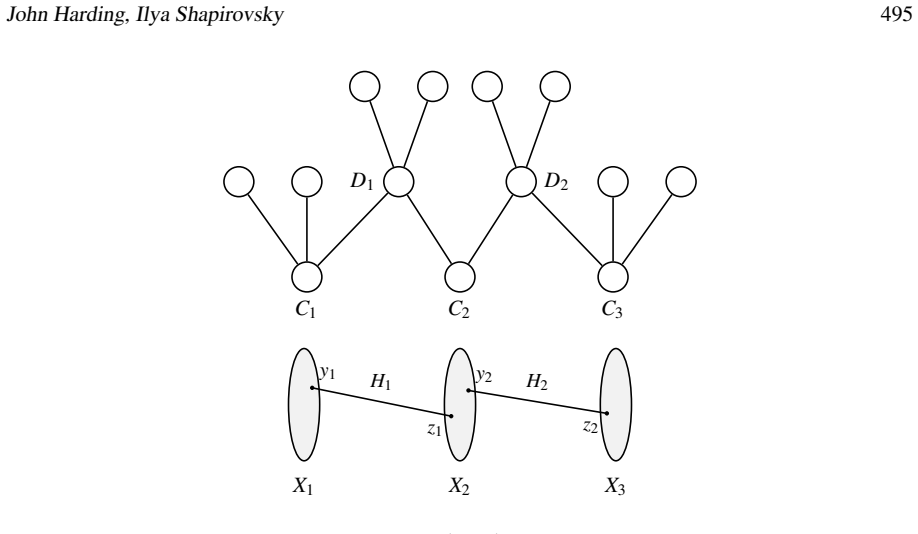
read the original abstract
For a positive number a, each metric space carries the relation D_a consisting of those pairs that are of distance less than a apart. A space X is said to be a-connected, if the graph (X,D_a) is connected (that is, there is a D_a-path between every pair of points in X). We give a complete axiomatization of a-connected metric spaces in the language with a family of distance modalities and the universal modality. Then we give a complete axiomatization of the logic of connected (in the classical topological sense) metric spaces in the language with the topological modality, universal modality, and a single distance modality. We also show that these logics have the finite model property.
Editorial analysis
A structured set of objections, weighed in public.
Referee Report
Summary. The paper claims to provide a complete axiomatization of a-connected metric spaces using a family of distance modalities together with the universal modality, and a separate complete axiomatization of classically connected metric spaces using the topological modality, the universal modality, and a single distance modality; both logics are also claimed to enjoy the finite model property.
Significance. If the claimed axiomatizations are sound and complete, the work would supply the first explicit modal characterizations of a-connectedness and topological connectedness over metric spaces, extending the literature on spatial modal logics with distance and topological operators.
major comments (1)
- [Abstract] Abstract: the central claims of completeness and finite model property are asserted, but the explicit axiom sets, the canonical-model or filtration constructions, and the verification that these constructions preserve a-connectedness (or classical connectedness) are not visible in the provided text, so it is impossible to check whether the interaction between the distance modalities and the connectedness condition is handled without gaps.
Simulated Author's Rebuttal
We thank the referee for their report. The major comment notes that certain technical details are not visible in the provided text. We address this point directly below, drawing on the content of the full manuscript.
read point-by-point responses
-
Referee: [Abstract] Abstract: the central claims of completeness and finite model property are asserted, but the explicit axiom sets, the canonical-model or filtration constructions, and the verification that these constructions preserve a-connectedness (or classical connectedness) are not visible in the provided text, so it is impossible to check whether the interaction between the distance modalities and the connectedness condition is handled without gaps.
Authors: The referee comment refers to the abstract alone. The full manuscript supplies the explicit axiom sets for both the logic of a-connected metric spaces (in the language with the family of distance modalities and the universal modality) and the logic of topologically connected metric spaces (in the language with the topological modality, universal modality, and a single distance modality). It also contains the canonical-model constructions for completeness and the filtration arguments for the finite model property. These constructions are verified in detail to preserve a-connectedness and classical topological connectedness, respectively, with explicit attention to the interaction between the distance modalities and the connectedness conditions. The abstract summarizes the results; the proofs appear in the body of the paper. revision: no
Circularity Check
No circularity: axiomatization claims rest on standard model-theoretic arguments without reduction to inputs.
full rationale
The provided abstract and context assert complete axiomatizations and FMP for two classes of metric-space models using distance, topological, and universal modalities. No equations, definitions, or self-citations are quoted that reduce a claimed derivation to its own inputs by construction (e.g., no fitted parameters renamed as predictions, no self-definitional relations, no load-bearing self-citation chains). The completeness claim is presented as a model-theoretic result (soundness from semantics plus completeness via canonical models or filtration), which is independent of the target logics themselves. This is the normal case for a logic paper stating an axiomatization theorem; the derivation chain is self-contained against external semantic benchmarks.
Axiom & Free-Parameter Ledger
Reference graph
Works this paper leans on
-
[1]
Gabriel Agnew, Uzias Gutierrez-Hougardy, John Harding, Ilya Shapirovsky & Jackson West (2025): On Distance Logics of Euclidean Spaces. arXiv:2501.04884. Accepted to Studia Logica
-
[2]
Cambridge University Press, 2001
Patrick Blackburn, Maarten de Rijke & Yde Venema (2001): Modal Logic. Cambridge University Press, doi:10.1017/CBO9781107050884
-
[3]
Journal of Logic and Computation 2(1), pp
Valentin Goranko & Solomon Passy (1992): Using the Universal Modality: Gains and Questions. Journal of Logic and Computation 2(1), pp. 5–30, doi:10.1093/logcom/2.1.5
-
[4]
In Carlos Areces & Robert Goldblatt, editors: Advances in Modal Logic , 7, College Publications, pp
Roman Kontchakov, Ian Pratt-Hartmann, Frank Wolter & Michael Zakharyaschev (2008): Topology, Con- nectedness, and Modal Logic . In Carlos Areces & Robert Goldblatt, editors: Advances in Modal Logic , 7, College Publications, pp. 151–176
2008
-
[5]
Logical Methods in Computer Science V olume 6, Issue 3:7, doi:10.2168/LMCS-6(3:7)2010
Roman Kontchakov, Ian Pratt-Hartmann, Frank Wolter & Michael Zakharyaschev (2010): Spatial Log- ics with Connectedness Predicates . Logical Methods in Computer Science V olume 6, Issue 3:7, doi:10.2168/LMCS-6(3:7)2010
-
[6]
In Sergei N
Agi Kurucz, Frank Wolter & Michael Zakharyaschev (2005): Modal Logics for Metric Spaces: Open Prob- lems. In Sergei N. Artëmov, Howard Barringer, Artur S. d’Avila Garcez, Luís C. Lamb & John Woods, editors: We Will Show Them! Essays in Honour of Dov Gabbay, V olume Two , College Publications, pp. 193–108
2005
-
[7]
Oliver Kutz (2007): Notes on Logics of Metric Spaces. Studia Logica 85(1), pp. 75–104, doi:10.1007/s11225- 007-9023-3
-
[8]
Journal of Applied Non-Classical Logics 12(3-4), pp
Oliver Kutz, Holger Sturm, Nobu-Yuki Suzuki, Frank Wolter & Michael Zakharyaschev (2002): Axiomatizing Distance Logics . Journal of Applied Non-Classical Logics 12(3-4), pp. 425–439, doi:10.3166/jancl.12.425-439
-
[9]
Oliver Kutz, Frank Wolter, Holger Sturm, Nobu-Yuki Suzuki & Michael Zakharyaschev (2003): Logics of Metric Spaces. ACM Trans. Comput. Logic 4(2), p. 260–294, doi:10.1145/635499.635504
-
[10]
J. C. C. McKinsey & Alfred Tarski (1944): The Algebra of Topology . Annals of Mathematics 45(1), pp. 141–191, doi:10.2307/1969080
-
[11]
Krister Segerberg (1968): Decidability of S4.1 . Theoria 34(1), pp. 7–20, doi:10.1111/j.1755- 2567.1968.tb00335.x
-
[12]
In Helle Hvid Hansen, Andre Scedrov & Ruy J.G.B
Ilya Shapirovsky (2023): Decidability of Modal Logics of Non-k-Colorable graphs . In Helle Hvid Hansen, Andre Scedrov & Ruy J.G.B. de Queiroz, editors:Logic, Language, Information, and Computation, Springer Nature Switzerland, Cham, pp. 351–361, doi:10.1007/978-3-031-39784-4_22
-
[13]
Valentin Shehtman (1999): “Everywhere” and “Here”. Journal of Applied Non-Classical Logics 9(2-3), pp. 369–379, doi:10.1080/11663081.1999.10510972
-
[14]
Princeton Legacy Library, Princeton University Press
Gordon Thomas Whyburn (1964): Topological Analysis. Princeton Legacy Library, Princeton University Press
1964
-
[15]
The Journal of Symbolic Logic 70(3), pp
Frank Wolter & Michael Zakharyaschev (2005): A Logic for Metric and Topology. The Journal of Symbolic Logic 70(3), pp. 795–828, doi:10.2178/jsl/1122038915
discussion (0)
Sign in with ORCID, Apple, or X to comment. Anyone can read and Pith papers without signing in.