Constraining dark energy with complementary probes of large-scale structure
Pith reviewed 2026-07-01 03:33 UTC · model grok-4.3
The pith
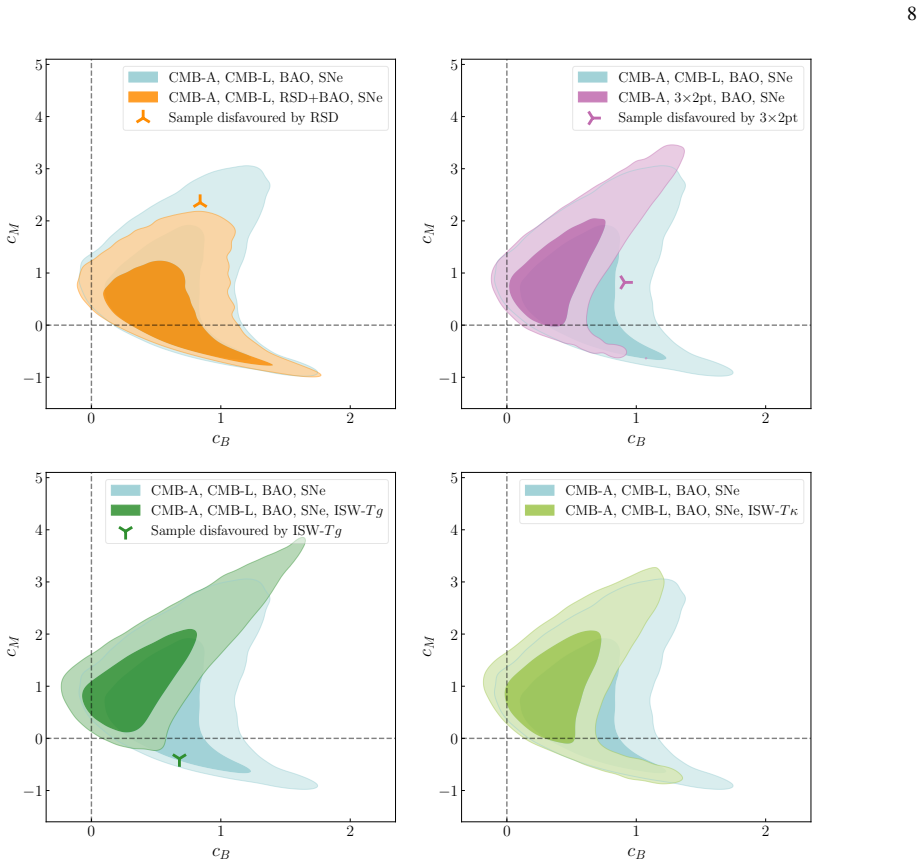
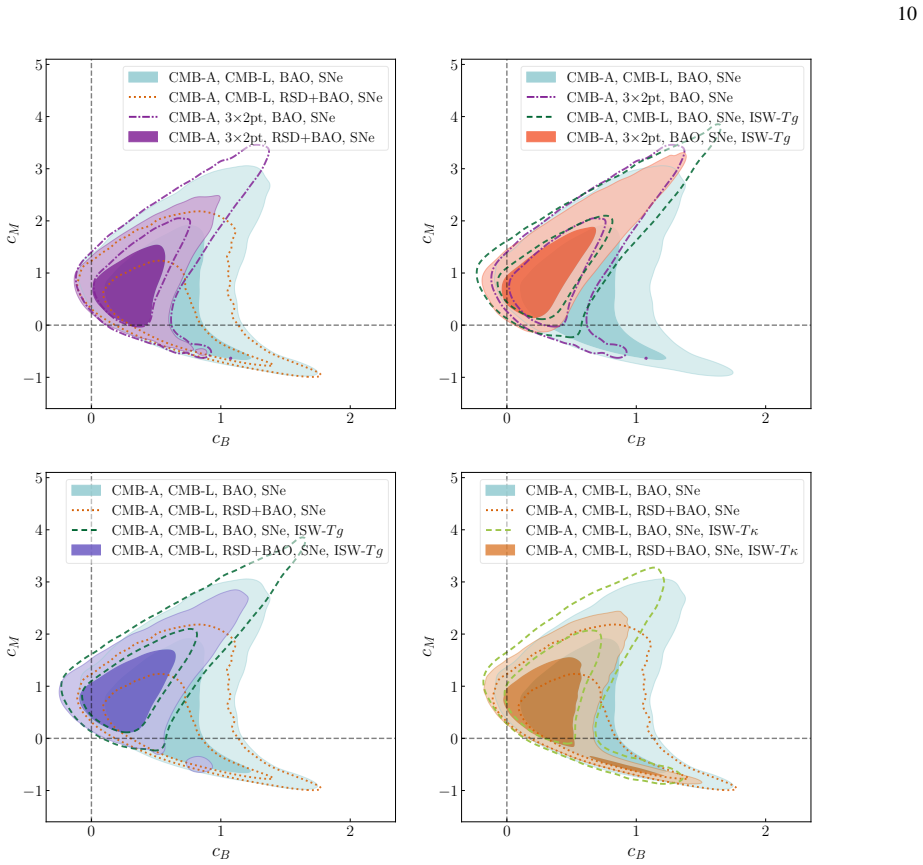
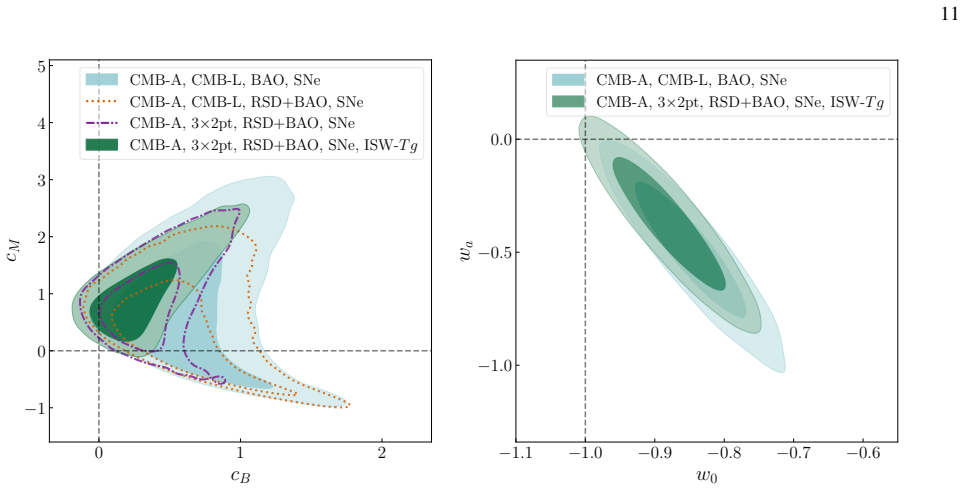
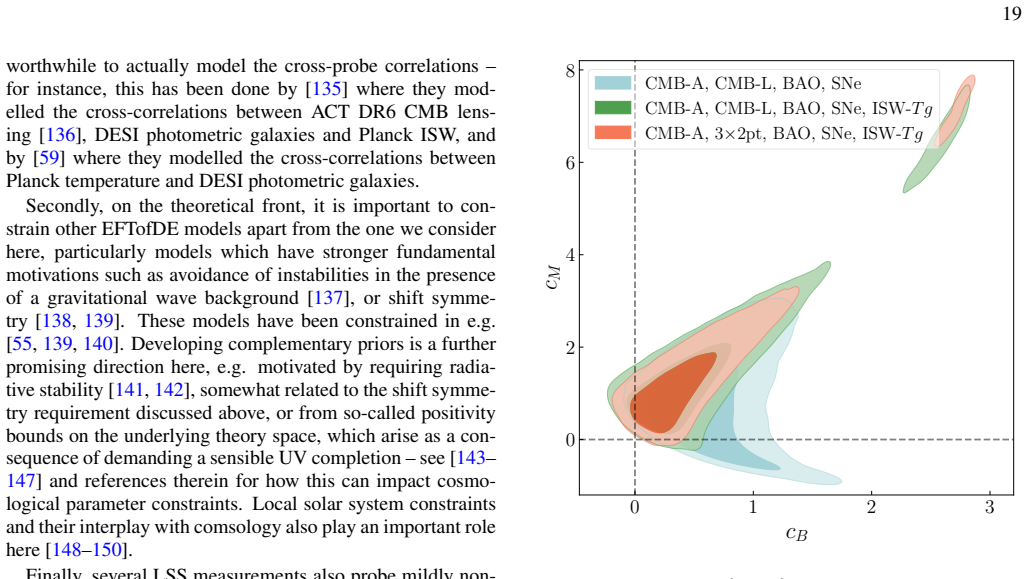
Supplementing CMB+BAO+SNe data with DESI RSD, DES 3x2pt and ISW cross-correlations improves the figure of merit for EFTofDE perturbation parameters {c_B, c_M} by a factor of 2.69.
A machine-rendered reading of the paper's core claim, the machinery that carries it, and where it could break.
Core claim
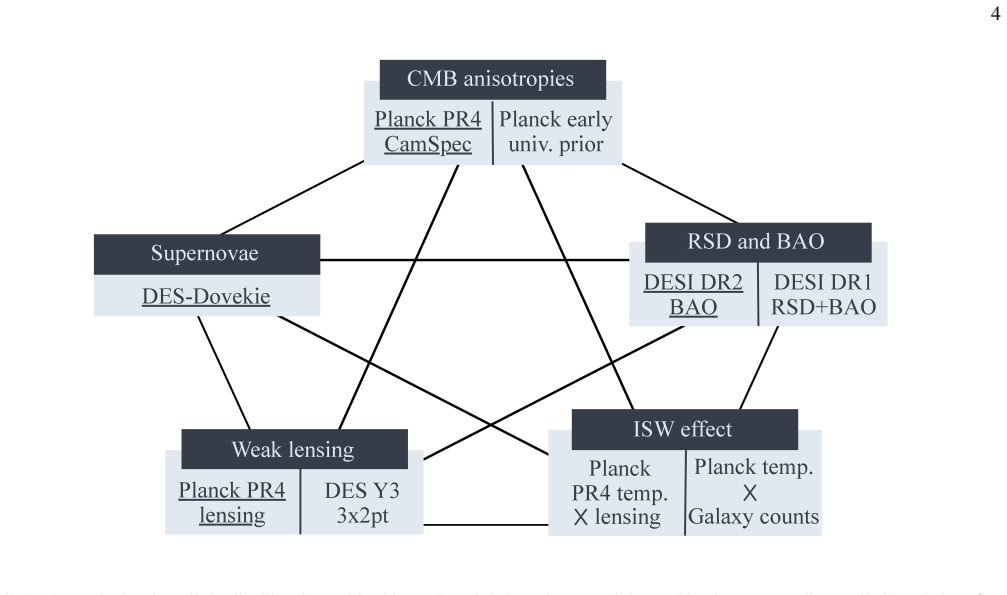
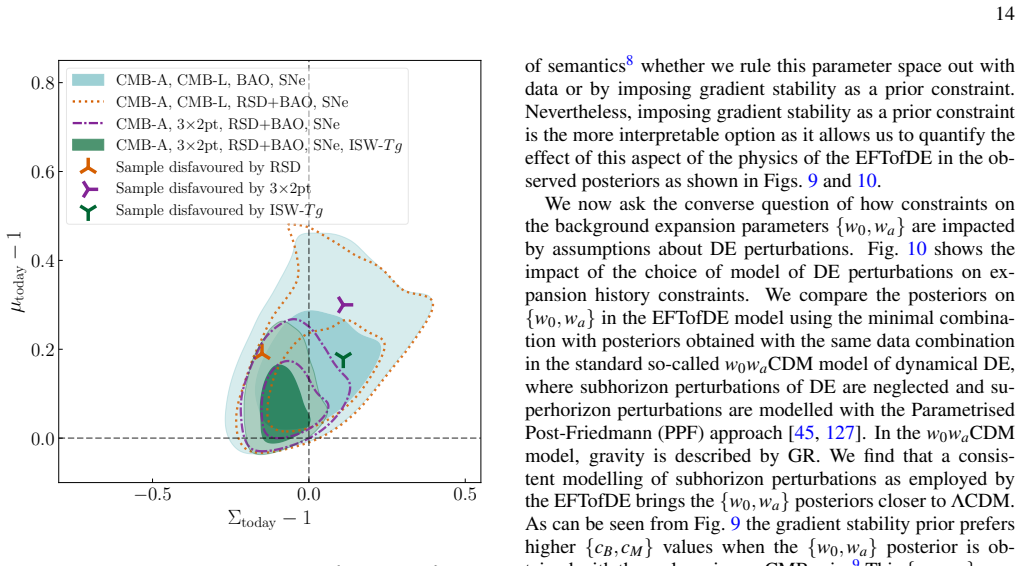
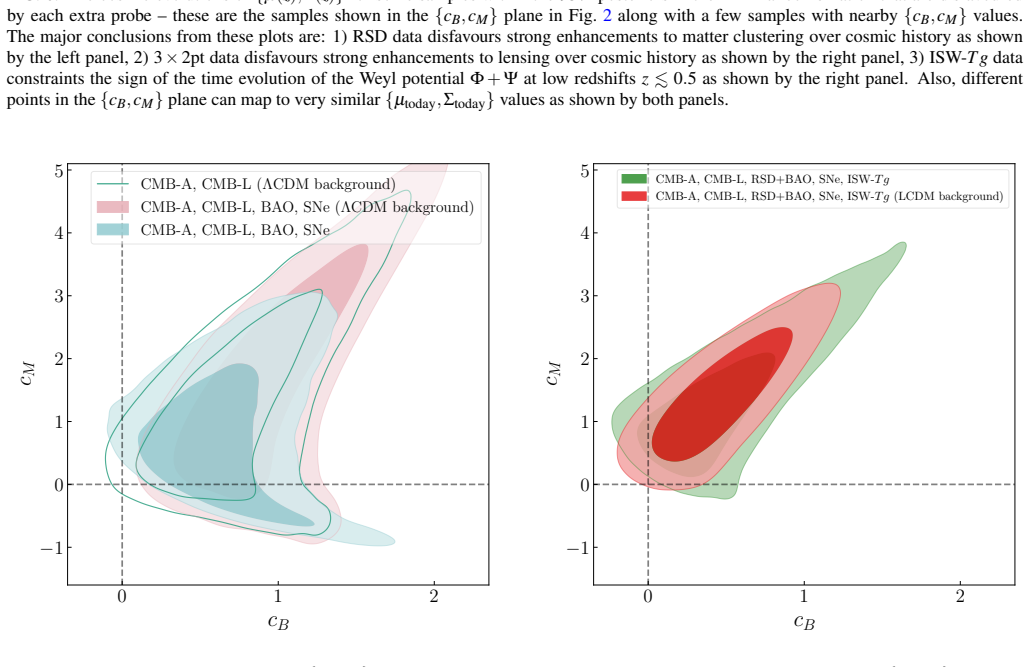
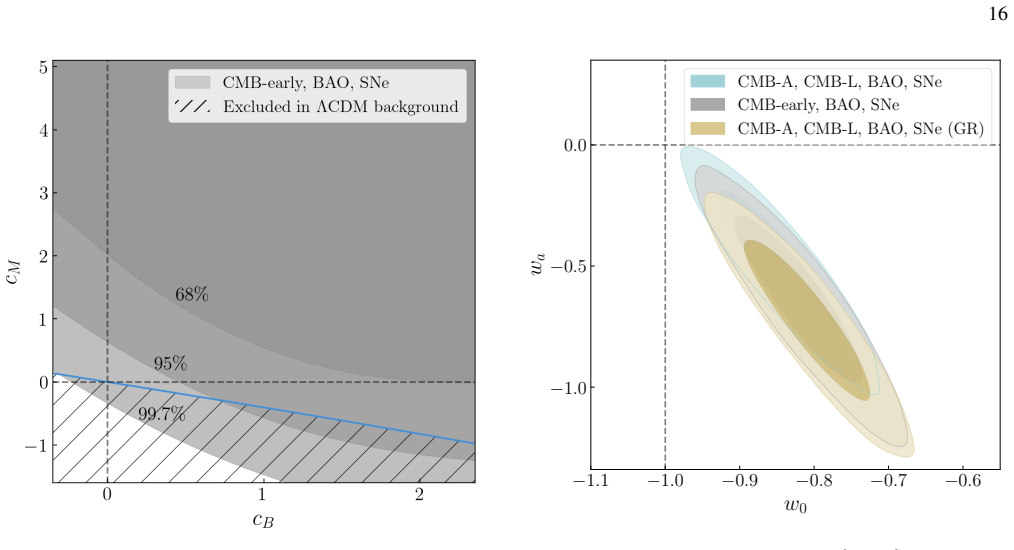
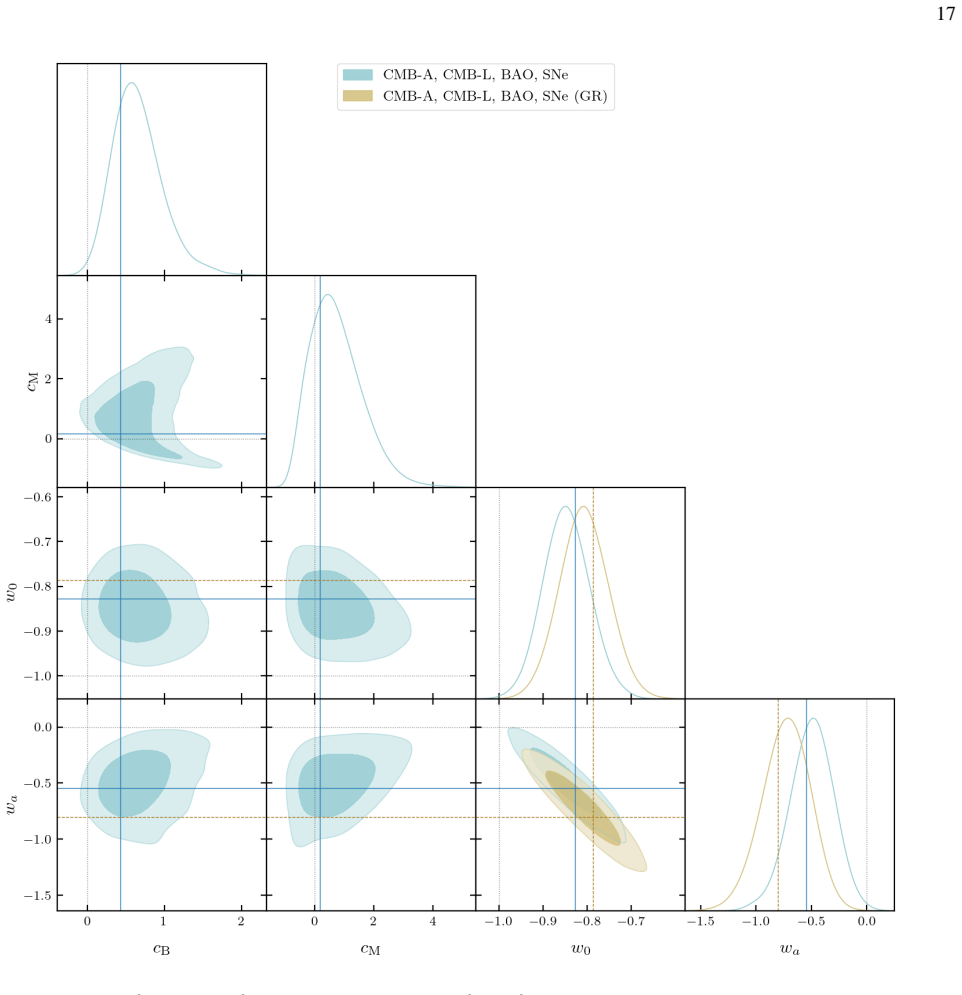
By supplementing CMB+BAO+SNe probes with DESI DR1 RSD, DES Y3 3×2pt and ISW cross-correlations between CMB temperature and galaxy counts, the constraints on the dark energy perturbation parameters {c_B, c_M} in the EFTofDE framework achieve a 2.69 times higher figure of merit. The same data combination improves the figure of merit for the phenomenological functions {μ(z), Σ(z)} by a factor of 3.37. The posteriors of {w0, wa} and {c_B, c_M} exhibit significant interdependence due to the gradient stability condition imposed as a theoretical prior. With CMB+BAO+SNe data alone the EFTofDE model deviates from ΛCDM at 2.9σ, comparable to the 3.1σ deviation found for the w0waCDM model.
What carries the argument
The Effective Field Theory of Dark Energy (EFTofDE) parameters {c_B, c_M} that encode dark energy perturbations, constrained jointly with background parameters under the gradient stability condition prior.
If this is right
- The figure of merit for the phenomenological functions {μ(z), Σ(z)} improves by a factor of 3.37 with the full dataset combination.
- Significant interdependence appears between the posteriors of {w0, wa} and {c_B, c_M} because of the gradient stability prior.
- The EFTofDE model deviates from ΛCDM at 2.9σ when constrained with CMB+BAO+SNe data alone.
- The deviation significance for EFTofDE is nontrivially close to the 3.1σ deviation found for the w0waCDM model on the same baseline datasets.
Where Pith is reading between the lines
- The demonstrated complementarity implies that adding further large-scale structure observables from upcoming surveys could continue to shrink the allowed region for perturbation parameters.
- The mapping from {c_B, c_M} to {μ(z), Σ(z)} permits direct comparison of these constraints with independent tests of modified gravity from galaxy clustering or weak lensing.
- Relaxing the gradient stability prior would likely reduce the observed interdependence and allow more independent constraints on background versus perturbation sectors.
Load-bearing premise
The gradient stability condition must be imposed as a theoretical prior in the EFTofDE framework, which creates interdependence between the posteriors of background and perturbation parameters.
What would settle it
An independent measurement of the present-day values or redshift evolution of μ(z) or Σ(z) lying outside the joint posterior ranges obtained from the full dataset combination would falsify the constrained EFTofDE parameter space.
Figures
read the original abstract
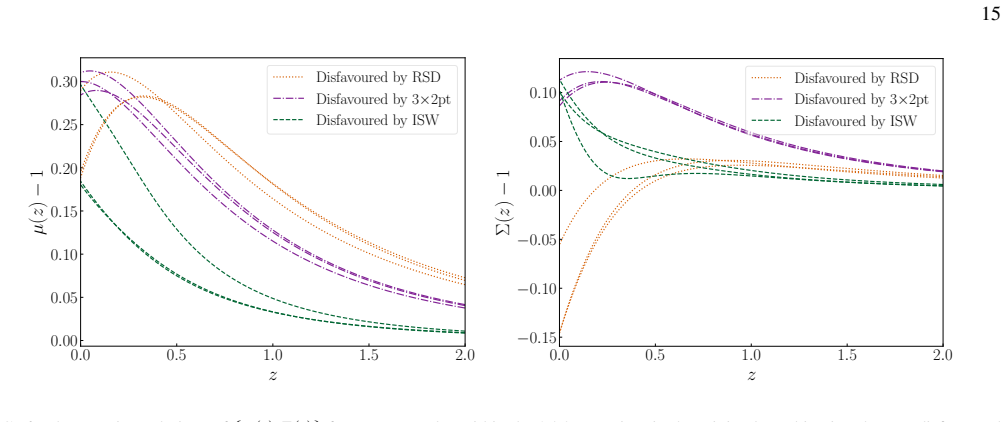
To observationally pin down the nature of dark energy, it is essential to consistently model cosmological perturbations in the presence of dark energy alongside the background expansion and constrain this joint theory space with a large array of complementary probes. Here, we achieve this by constraining a model in the Effective Field Theory of Dark Energy (EFTofDE) framework by supplementing probes of the expansion history with several probes of large-scale structure: redshift space distortions (RSD) from DESI DR1, $3\times2$pt measurements from DES Y3, and the Integrated Sachs-Wolfe effect from cross-correlating CMB temperature anisotropies with galaxy number counts or CMB lensing. We demonstrate the complementarity of different probes which leads to strong improvements on constraints on DE perturbations. For our most constraining dataset combination that supplements CMB+BAO+SNe probes with DESI DR1 RSD, DES Y3 $3\times2$pt and ISW cross-correlations between CMB temperature and galaxy counts, we find an improvement in the Figure of Merit (FoM) for the DE perturbation parameters $\{c_B, c_M\}$ by a factor of 2.69. We show the phenomenological implications of these constraints by mapping them to the present-day values of the phenomenological functions $\{\mu(z), \Sigma(z)\}$, where we see an FoM improvement by a factor of 3.37. We find a significant interdependence between the posteriors of $\{w_0, w_a\}$ and $\{c_B, c_M\}$, caused by the theoretical prior imposed by the gradient stability condition within the EFTofDE framework. Finally, we compute the significance of deviation from $\Lambda$CM for the EFTofDE model when constrained with CMB+BAO+SNe datasets, finding it to be at 2.9$\sigma$. This significance is nontrivially similar to the significance for the $w_0w_a$CDM model for the same dataset combination which we find to be 3.1$\sigma$.
Editorial analysis
A structured set of objections, weighed in public.
Referee Report
Summary. The paper constrains an EFTofDE model by combining CMB+BAO+SNe with DESI DR1 RSD, DES Y3 3×2pt, and ISW cross-correlations, reporting a 2.69× FoM gain for {c_B, c_M} and 3.37× for {μ(z), Σ(z)} in the most constraining combination; it notes interdependence between {w0, wa} and {c_B, c_M} posteriors induced by the gradient stability prior and finds ~2.9σ deviation from ΛCDM (comparable to 3.1σ in w0waCDM) for CMB+BAO+SNe.
Significance. Demonstrating that added LSS probes tighten DE perturbation constraints beyond background expansion would be valuable for multi-probe cosmology, provided the reported FoM gains are shown to be driven by the data rather than the stability prior.
major comments (2)
- [Abstract] Abstract: the headline FoM improvement of 2.69 for {c_B, c_M} (and 3.37 for {μ, Σ}) is measured inside the space restricted by the gradient stability condition, which the abstract states induces the observed interdependence between {w0, wa} and {c_B, c_M}. Without an explicit comparison (e.g., chains run with the stability condition removed) it is unclear whether the complementarity claim holds independently of this theoretical prior.
- [Abstract] Abstract: the reported deviation significances (2.9σ for EFTofDE vs. 3.1σ for w0waCDM with CMB+BAO+SNe) are nearly identical; this similarity, combined with the shared use of the same background datasets, requires explicit discussion of whether the EFTofDE extension meaningfully alters the tension or whether covariance modeling and error propagation are driving the result.
minor comments (2)
- All dataset combinations and their FoM values should be collected in a single table for direct comparison.
- Notation for the phenomenological functions μ(z) and Σ(z) and their mapping from EFTofDE parameters should be defined at first use.
Simulated Author's Rebuttal
We thank the referee for their careful reading of the manuscript and for highlighting important points regarding the gradient stability prior and the interpretation of the deviation significance. We address each major comment below and will make revisions to improve clarity on these issues.
read point-by-point responses
-
Referee: [Abstract] Abstract: the headline FoM improvement of 2.69 for {c_B, c_M} (and 3.37 for {μ, Σ}) is measured inside the space restricted by the gradient stability condition, which the abstract states induces the observed interdependence between {w0, wa} and {c_B, c_M}. Without an explicit comparison (e.g., chains run with the stability condition removed) it is unclear whether the complementarity claim holds independently of this theoretical prior.
Authors: We agree that all reported FoM values are computed within the parameter space allowed by the gradient stability condition, which is an intrinsic theoretical requirement of the EFTofDE framework to exclude ghost instabilities. The manuscript already notes that this prior induces the observed interdependence between {w0, wa} and {c_B, c_M}. The complementarity claim refers to the ability of the LSS probes to further tighten constraints on the perturbation parameters inside this physically viable region, as demonstrated by the progressive FoM gains when successively adding DESI RSD, DES Y3 3×2pt, and ISW data. Running additional chains without the stability prior is not straightforward, as it would require the Boltzmann solver to explore regions where the theory is mathematically ill-defined, leading to numerical instabilities. In the revised manuscript we will add explicit text in the abstract and results section clarifying that the FoM improvements quantify data-driven tightening within the model’s valid domain, and we will include a brief discussion of why a direct comparison outside this domain is not physically meaningful. revision: partial
-
Referee: [Abstract] Abstract: the reported deviation significances (2.9σ for EFTofDE vs. 3.1σ for w0waCDM with CMB+BAO+SNe) are nearly identical; this similarity, combined with the shared use of the same background datasets, requires explicit discussion of whether the EFTofDE extension meaningfully alters the tension or whether covariance modeling and error propagation are driving the result.
Authors: The near-identical significances (2.9σ versus 3.1σ) indicate that the tension with ΛCDM is driven primarily by the background parameters w0 and wa, which are constrained by the same CMB+BAO+SNe data in both models. The additional EFTofDE perturbation parameters do not substantially shift the overall deviation because the data combination does not strongly favor values of {c_B, c_M} that would move the posterior away from the ΛCDM limit. We will revise the manuscript to expand the discussion of this result, explicitly stating that the EFTofDE extension does not meaningfully alter the tension level relative to w0waCDM for this dataset and addressing the possible role of covariance modeling between probes. This addition will make clear that the reported significance is a direct consequence of the data constraints rather than an artifact of error propagation. revision: yes
Circularity Check
No significant circularity in constraint chain or FoM claims
full rationale
The paper performs Bayesian constraints on EFTofDE parameters using independent datasets (CMB+BAO+SNe supplemented by DESI RSD, DES 3x2pt, ISW). The reported FoM gains (2.69 for {c_B, c_M}, 3.37 for {μ, Σ}) are measured from the addition of these external probes. The noted interdependence between {w0, wa} and {c_B, c_M} is explicitly attributed to the gradient stability prior, which is a standard theoretical requirement in the EFTofDE framework rather than a self-referential fit or self-citation. No derivation reduces to its inputs by construction, no fitted parameter is relabeled as a prediction, and no load-bearing step relies on self-citation or ansatz smuggling. The analysis remains self-contained against external data benchmarks.
Axiom & Free-Parameter Ledger
free parameters (4)
- w0
- wa
- cB
- cM
axioms (1)
- domain assumption Gradient stability condition within EFTofDE
Reference graph
Works this paper leans on
-
[1]
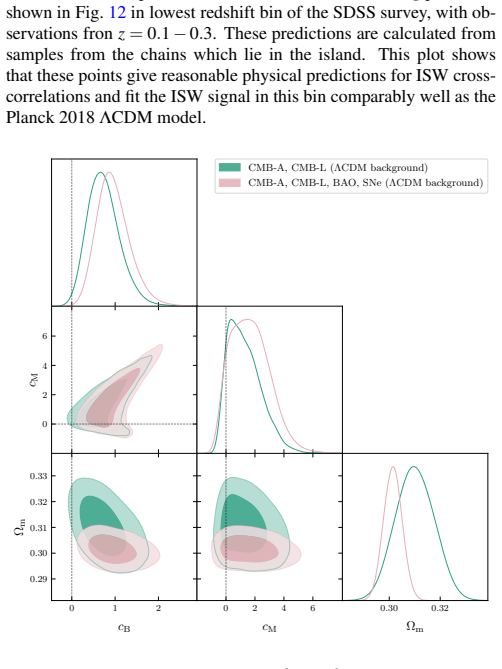
the posterior of{c B,c M}being away from theirΛCDM limit at more than 95%, 3) the different extra degrees of free- dom overΛCDM in the two models (4 in EFTofDE and 2 in w0waCDM), and 4) the difference in the maximum a posteri- ori values∆χ 2 MAP in the two models (-15.80 in EFTofDE and -12.57 inw 0waCDM). 17 FIG. 11. Joint posterior of{c B,c M,w 0,w a}for...
-
[2]
Observational Evidence from Supernovae for an Accelerating Universe and a Cosmological Constant
which were combined in [59, 133]; and measurements of the decay rate of the Weyl potential [134], the lensing- inferred growth amplitude, and the growth rate from both DESI clustering and peculiar velocities, which were combined in [60]. Given this vast array of LSS probes now available, it is worthwhile to look for the optimal combination of these probes...
work page internal anchor Pith review Pith/arXiv arXiv 1998
-
[3]
Union Through UNITY: Cosmology with 2,000 SNe Using a Unified Bayesian Framework
D. Rubinet al., “Union Through UNITY: Cosmology with 2,000 SNe Using a Unified Bayesian Framework,”Astrophys. J.986(2025) no. 2, 231,arXiv:2311.12098 [astro-ph.CO]. [4]DESCollaboration, T. M. C. Abbottet al., “The Dark Energy Survey: Cosmology Results with∼1500 New High-redshift Type Ia Supernovae Using the Full 5 yr Data Set,”Astrophys. J. Lett.973(2024)...
work page internal anchor Pith review Pith/arXiv arXiv 2025
-
[4]
Union3.1: Self-consistent Measurements of Host Galaxy Properties for 2000 Type Ia Supernovae,
T. J. Hoyt, D. Rubin, G. Aldering, S. Perlmutter, A. Cuceu, and R. Gupta, “Union3.1: Self-consistent Measurements of Host Galaxy Properties for 2000 Type Ia Supernovae,” arXiv:2601.19424 [astro-ph.CO]. [12]PlanckCollaboration, N. Aghanimet al., “Planck 2018 results. VI. Cosmological parameters,”Astron. Astrophys. 641(2020) A6,arXiv:1807.06209 [astro-ph.CO...
-
[5]
The Pantheon+ Analysis: Cosmological Constraints
D. Broutet al., “The Pantheon+ Analysis: Cosmological Constraints,”Astrophys. J.938(2022) no. 2, 110, arXiv:2202.04077 [astro-ph.CO]. [16]PlanckCollaboration, N. Aghanimet al., “Planck 2018 results. VIII. Gravitational lensing,”Astron. Astrophys.641 (2020) A8,arXiv:1807.06210 [astro-ph.CO]. [17]ACTCollaboration, M. S. Madhavacherilet al., “The Atacama Cos...
work page internal anchor Pith review Pith/arXiv arXiv 2022
-
[6]
KiDS-Legacy: Cosmological constraints from cosmic shear with the complete Kilo-Degree Survey
A. H. Wrightet al., “KiDS-Legacy: Cosmological constraints from cosmic shear with the complete Kilo-Degree Survey,” Astron. Astrophys.703(2025) A158,arXiv:2503.19441 [astro-ph.CO]. [21]DESCollaboration, T. M. C. Abbottet al., “Dark Energy Survey Year 6 Results: Cosmological Constraints from Galaxy Clustering and Weak Lensing,” arXiv:2601.14559 [astro-ph.CO]
work page internal anchor Pith review Pith/arXiv arXiv 2025
-
[7]
Planck integrated Sachs-Wolfe-lensing likelihood and the CMB temperature,
J. Carron, A. Lewis, and G. Fabbian, “Planck integrated Sachs-Wolfe-lensing likelihood and the CMB temperature,” Phys. Rev. D106(2022) no. 10, 103507, arXiv:2209.07395 [astro-ph.CO]
-
[8]
The DESI DR1 peculiar velocity survey: Growth rate measurements from the galaxy power spectrum,
F. Qinet al., “The DESI DR1 peculiar velocity survey: Growth rate measurements from the galaxy power spectrum,” Astron. Astrophys.708(2026) A219,arXiv:2512.03230 [astro-ph.CO]
-
[9]
Y . Laiet al., “The DESI DR1 peculiar velocity survey: growth rate measurements from the maximum likelihood fields method,”JCAP04(2026) 026,arXiv:2512.03229 [astro-ph.CO]
work page internal anchor Pith review Pith/arXiv arXiv 2026
-
[10]
The DESI DR1 Peculiar Velocity Survey: Growth Rate Measurements from the Galaxy Power Spectrum,
F. Qinet al., “The DESI DR1 Peculiar Velocity Survey: Growth Rate Measurements from the Galaxy Power Spectrum,”arXiv:2512.03231 [astro-ph.CO]
-
[11]
The Effective Field Theory of Dark Energy
G. Gubitosi, F. Piazza, and F. Vernizzi, “The Effective Field Theory of Dark Energy,”JCAP1302(2013) 032, arXiv:1210.0201 [hep-th]. [JCAP1302,032(2013)]
work page internal anchor Pith review Pith/arXiv arXiv 2013
-
[12]
Dark Energy or Modified Gravity? An Effective Field Theory Approach
J. K. Bloomfield, E. E. Flanagan, M. Park, and S. Watson, “Dark energy or modified gravity? An effective field theory approach,”JCAP1308(2013) 010,arXiv:1211.7054 [astro-ph.CO]
work page internal anchor Pith review Pith/arXiv arXiv 2013
-
[13]
Essential Building Blocks of Dark Energy
J. Gleyzes, D. Langlois, F. Piazza, and F. Vernizzi, “Essential Building Blocks of Dark Energy,”JCAP08(2013) 025, arXiv:1304.4840 [hep-th]
work page internal anchor Pith review Pith/arXiv arXiv 2013
-
[14]
Maximal freedom at minimum cost: linear large-scale structure in general modifications of gravity
E. Bellini and I. Sawicki, “Maximal freedom at minimum cost: linear large-scale structure in general modifications of gravity,”JCAP1407(2014) 050,arXiv:1404.3713 [astro-ph.CO]
work page internal anchor Pith review Pith/arXiv arXiv 2014
-
[15]
A unifying description of dark energy
J. Gleyzes, D. Langlois, and F. Vernizzi, “A unifying description of dark energy,”Int. J. Mod. Phys.D23(2015) no. 13, 1443010,arXiv:1411.3712 [hep-th]
work page internal anchor Pith review Pith/arXiv arXiv 2015
-
[16]
Second-order scalar-tensor field equations in a four-dimensional space,
G. W. Horndeski, “Second-order scalar-tensor field equations in a four-dimensional space,”Int. J. Theor . Phys.10(1974) 363–384
1974
-
[17]
General second order scalar-tensor theory, self tuning, and the Fab Four
C. Charmousis, E. J. Copeland, A. Padilla, and P. M. Saffin, “General second order scalar-tensor theory, self tuning, and the Fab Four,”Phys. Rev. Lett.108(2012) 051101, arXiv:1106.2000 [hep-th]
work page internal anchor Pith review Pith/arXiv arXiv 2012
-
[18]
From k-essence to generalised Galileons
C. Deffayet, X. Gao, D. A. Steer, and G. Zahariade, “From k-essence to generalised Galileons,”Phys. Rev.D84(2011) 064039,arXiv:1103.3260 [hep-th]
work page internal anchor Pith review Pith/arXiv arXiv 2011
-
[19]
Generalized G-inflation: Inflation with the most general second-order field equations
T. Kobayashi, M. Yamaguchi, and J. Yokoyama, “Generalized G-inflation: Inflation with the most general second-order field equations,”Prog. Theor . Phys.126(2011) 511–529,arXiv:1105.5723 [hep-th]. 22
work page internal anchor Pith review Pith/arXiv arXiv 2011
-
[20]
A general theory of linear cosmological perturbations: bimetric theories
M. Lagos and P. G. Ferreira, “A general theory of linear cosmological perturbations: bimetric theories,” arXiv:1610.00553 [gr-qc]
work page internal anchor Pith review Pith/arXiv arXiv
-
[21]
M. Lagos, E. Bellini, J. Noller, P. G. Ferreira, and T. Baker, “A general theory of linear cosmological perturbations: stability conditions, the quasistatic limit and dynamics,” JCAP1803(2018) no. 03, 021,arXiv:1711.09893 [gr-qc]
work page internal anchor Pith review Pith/arXiv arXiv 2018
-
[22]
R. Kimura, T. Kobayashi, and K. Yamamoto, “Vainshtein screening in a cosmological background in the most general second-order scalar-tensor theory,”Phys. Rev. D85(2012) 024023,arXiv:1111.6749 [astro-ph.CO]
work page internal anchor Pith review Pith/arXiv arXiv 2012
-
[23]
Y . Takushima, A. Terukina, and K. Yamamoto, “Third order solutions of cosmological density perturbations in Horndeski’s most general scalar-tensor theory with the Vainshtein mechanism,”Phys. Rev. D92(2015) no. 10, 104033,arXiv:1502.03935 [gr-qc]
work page internal anchor Pith review Pith/arXiv arXiv 2015
-
[24]
Nonlinear Effective Theory of Dark Energy,
G. Cusin, M. Lewandowski, and F. Vernizzi, “Nonlinear Effective Theory of Dark Energy,”JCAP04(2018) 061, arXiv:1712.02782 [astro-ph.CO]
-
[25]
Revisiting Vainshtein screening for fast N-body simulations,
G. Brando, K. Koyama, and H. A. Winther, “Revisiting Vainshtein screening for fast N-body simulations,”JCAP06 (2023) 045,arXiv:2303.09549 [astro-ph.CO]
-
[26]
L. Amendola, C. Bernal, and R. Gannouji, “Nonlinear dynamics in Horndeski gravity: A renormalized approach to effective gravitational coupling,”Phys. Rev. D112(2025) no. 6, 063533,arXiv:2505.03999 [gr-qc]
-
[27]
A Master Equation for Screening in Luminal Horndeski Gravity
S. Sirera, T. Baker, J. Hallam, and K. Naidoo, “A Master Equation for Screening in Luminal Horndeski Gravity,” arXiv:2605.04154 [gr-qc]
work page internal anchor Pith review Pith/arXiv arXiv
-
[28]
Constraints on a New Post-General Relativity Cosmological Parameter
R. Caldwell, A. Cooray, and A. Melchiorri, “Constraints on a New Post-General Relativity Cosmological Parameter,”Phys. Rev.D76(2007) 023507,arXiv:astro-ph/0703375 [ASTRO-PH]
work page internal anchor Pith review Pith/arXiv arXiv 2007
-
[29]
Measuring the dark side (with weak lensing)
L. Amendola, M. Kunz, and D. Sapone, “Measuring the dark side (with weak lensing),”JCAP04(2008) 013, arXiv:0704.2421 [astro-ph]
work page internal anchor Pith review Pith/arXiv arXiv 2008
-
[30]
A Parameterized Post-Friedmann Framework for Modified Gravity
W. Hu and I. Sawicki, “A Parameterized Post-Friedmann Framework for Modified Gravity,”Phys. Rev. D76(2007) 104043,arXiv:0708.1190 [astro-ph]
work page internal anchor Pith review Pith/arXiv arXiv 2007
-
[31]
Observational Tests of Modified Gravity
B. Jain and P. Zhang, “Observational Tests of Modified Gravity,”Phys. Rev. D78(2008) 063503, arXiv:0709.2375 [astro-ph]
work page internal anchor Pith review Pith/arXiv arXiv 2008
-
[32]
Distinguishing Modified Gravity from Dark Energy
E. Bertschinger and P. Zukin, “Distinguishing Modified Gravity from Dark Energy,”Phys. Rev.D78(2008) 024015, arXiv:0801.2431 [astro-ph]
work page internal anchor Pith review Pith/arXiv arXiv 2008
-
[33]
Searching for modified growth patterns with tomographic surveys
G.-B. Zhao, L. Pogosian, A. Silvestri, and J. Zylberberg, “Searching for modified growth patterns with tomographic surveys,”Phys. Rev.D79(2009) 083513, arXiv:0809.3791 [astro-ph]
work page internal anchor Pith review Pith/arXiv arXiv 2009
-
[34]
L. Pogosian, A. Silvestri, K. Koyama, and G.-B. Zhao, “How to optimally parametrize deviations from General Relativity in the evolution of cosmological perturbations?,”Phys. Rev. D81(2010) 104023,arXiv:1002.2382 [astro-ph.CO]
work page internal anchor Pith review Pith/arXiv arXiv 2010
-
[35]
Probing modifications of General Relativity using current cosmological observations
G.-B. Zhao, T. Giannantonio, L. Pogosian, A. Silvestri, D. J. Bacon, K. Koyama, R. C. Nichol, and Y .-S. Song, “Probing modifications of General Relativity using current cosmological observations,”Phys. Rev. D81(2010) 103510, arXiv:1003.0001 [astro-ph.CO]
work page internal anchor Pith review Pith/arXiv arXiv 2010
-
[36]
A practical approach to cosmological perturbations in modified gravity
A. Silvestri, L. Pogosian, and R. V . Buniy, “Practical approach to cosmological perturbations in modified gravity,” Phys. Rev.D87(2013) no. 10, 104015,arXiv:1302.1193 [astro-ph.CO]
work page internal anchor Pith review Pith/arXiv arXiv 2013
-
[37]
Diagnostic of Horndeski Theories
L. Perenon, C. Marinoni, and F. Piazza, “Diagnostic of Horndeski Theories,”JCAP01(2017) 035, arXiv:1609.09197 [astro-ph.CO]
work page internal anchor Pith review Pith/arXiv arXiv 2017
-
[38]
Large-scale structure phenomenology of viable Horndeski theories
S. Peirone, K. Koyama, L. Pogosian, M. Raveri, and A. Silvestri, “Large-scale structure phenomenology of viable Horndeski theories,”Phys. Rev. D97(2018) no. 4, 043519, arXiv:1712.00444 [astro-ph.CO]
work page internal anchor Pith review Pith/arXiv arXiv 2018
-
[39]
J. Espejo, S. Peirone, M. Raveri, K. Koyama, L. Pogosian, and A. Silvestri, “Phenomenology of Large Scale Structure in scalar-tensor theories: joint prior covariance ofw DE,Σandµ in Horndeski,”Phys. Rev. D99(2019) no. 2, 023512, arXiv:1809.01121 [astro-ph.CO]
work page internal anchor Pith review Pith/arXiv arXiv 2019
-
[40]
Dark energy constraints in light of theoretical priors,
N. Shah, K. Koyama, and J. Noller, “Dark energy constraints in light of theoretical priors,”JCAP01(2026) 054, arXiv:2507.19450 [astro-ph.CO]
-
[41]
Constraining dark energy with the integrated Sachs-Wolfe effect,
E. Seraille, J. Noller, and B. D. Sherwin, “Constraining dark energy with the integrated Sachs-Wolfe effect,” arXiv:2401.06221 [astro-ph.CO]
-
[42]
Modified Gravity Constraints from the Full Shape Modeling of Clustering Measurements from DESI 2024,
M. Ishaket al., “Modified Gravity Constraints from the Full Shape Modeling of Clustering Measurements from DESI 2024,”arXiv:2411.12026 [astro-ph.CO]
-
[43]
B. Stölzneret al., “KiDS-Legacy: Constraints on Horndeski gravity from weak lensing combined with galaxy clustering and cosmic microwave background anisotropies,”Astron. Astrophys.707(2026) A323,arXiv:2512.11039 [astro-ph.CO]
-
[44]
New multiprobe analysis of modified gravity and evolving dark energy,
Z. Lu and T. Simon, “New multiprobe analysis of modified gravity and evolving dark energy,”Phys. Rev. D113(2026) no. 6, 063555,arXiv:2511.10616 [astro-ph.CO]
-
[45]
S. Li, P. Zhang, and F. Dong, “Synergy between the gravitational potential decay rate and other structure growth probes in testing gravity,”arXiv:2606.10597 [astro-ph.CO]. [61]DESCollaboration, T. M. C. Abbottet al., “Dark Energy Survey Year 3 results: Constraints on extensions toΛCDM with weak lensing and galaxy clustering,”Phys. Rev. D107 (2023) no. 8, ...
work page internal anchor Pith review Pith/arXiv arXiv 2023
-
[46]
B. Stölzner, A. Cuoco, J. Lesgourgues, and M. Bilicki, “Updated tomographic analysis of the integrated Sachs-Wolfe effect and implications for dark energy,”Phys. Rev. D97 (2018) no. 6, 063506,arXiv:1710.03238 [astro-ph.CO]
work page internal anchor Pith review Pith/arXiv arXiv 2018
-
[47]
CMB lensing from Planck PR4 maps
J. Carron, M. Mirmelstein, and A. Lewis, “CMB lensing from Planck PR4 maps,”JCAP09(2022) 039, arXiv:2206.07773 [astro-ph.CO]
work page internal anchor Pith review Pith/arXiv arXiv 2022
-
[48]
Inherently stable effective field theory for dark energy and modified gravity
L. Lombriser, C. Dalang, J. Kennedy, and A. Taylor, “Inherently stable effective field theory for dark energy and modified gravity,”JCAP1901(2019) no. 01, 041, arXiv:1810.05225 [astro-ph.CO]. [65]LIGO Scientific, VirgoCollaboration, B. Abbottet al., “GW170817: Observation of Gravitational Waves from a Binary Neutron Star Inspiral,”Phys. Rev. Lett.119(2017...
work page internal anchor Pith review Pith/arXiv arXiv 2019
-
[49]
A. Goldsteinet al., “An Ordinary Short Gamma-Ray Burst with Extraordinary Implications: Fermi-GBM Detection of GRB 170817A,”Astrophys. J. Lett.848(2017) no. 2, L14, arXiv:1710.05446 [astro-ph.HE]
work page internal anchor Pith review Pith/arXiv arXiv 2017
-
[50]
V . Savchenkoet al., “INTEGRAL Detection of the First Prompt Gamma-Ray Signal Coincident with the Gravitational-wave Event GW170817,”Astrophys. J. Lett. 848(2017) no. 2, L15,arXiv:1710.05449 [astro-ph.HE]. 23 [68]LIGO Scientific, Virgo, Fermi-GBM, INTEGRAL Collaboration, B. P. Abbottet al., “Gravitational Waves and Gamma-rays from a Binary Neutron Star Me...
work page internal anchor Pith review Pith/arXiv arXiv 2017
-
[51]
Multi-messenger Observations of a Binary Neutron Star Merger
B. P. Abbottet al., “Multi-messenger Observations of a Binary Neutron Star Merger,”Astrophys. J. Lett.848(2017) no. 2, L12,arXiv:1710.05833 [astro-ph.HE]
work page internal anchor Pith review Pith/arXiv arXiv 2017
-
[52]
Dark Energy after GW170817 and GRB170817A
P. Creminelli and F. Vernizzi, “Dark Energy after GW170817 and GRB170817A,”Phys. Rev. Lett.119(2017) no. 25, 251302,arXiv:1710.05877 [astro-ph.CO]
work page internal anchor Pith review Pith/arXiv arXiv 2017
-
[53]
Dark Energy after GW170817: dead ends and the road ahead
J. M. Ezquiaga and M. Zumalacárregui, “Dark Energy After GW170817: Dead Ends and the Road Ahead,”Phys. Rev. Lett.119(2017) no. 25, 251304,arXiv:1710.05901 [astro-ph.CO]
work page internal anchor Pith review Pith/arXiv arXiv 2017
-
[54]
Strong constraints on cosmological gravity from GW170817 and GRB 170817A
T. Baker, E. Bellini, P. G. Ferreira, M. Lagos, J. Noller, and I. Sawicki, “Strong constraints on cosmological gravity from GW170817 and GRB 170817A,”Phys. Rev. Lett.119(2017) no. 25, 251301,arXiv:1710.06394 [astro-ph.CO]
work page internal anchor Pith review Pith/arXiv arXiv 2017
-
[55]
Gravitational Rainbows: LIGO and Dark Energy at its Cutoff
C. de Rham and S. Melville, “Gravitational Rainbows: LIGO and Dark Energy at its Cutoff,”Phys. Rev. Lett.121(2018) no. 22, 221101,arXiv:1806.09417 [hep-th]
work page internal anchor Pith review Pith/arXiv arXiv 2018
-
[56]
Probing the speed of gravity with LVK, LISA, and joint observations,
I. Harry and J. Noller, “Probing the speed of gravity with LVK, LISA, and joint observations,”Gen. Rel. Grav.54 (2022) no. 10, 133,arXiv:2207.10096 [gr-qc]. [75]LISA Cosmology Working GroupCollaboration, T. Baker et al., “Measuring the propagation speed of gravitational waves with LISA,”JCAP08(2022) no. 08, 031, arXiv:2203.00566 [gr-qc]
-
[57]
Testing gravitational wave propagation with multiband detections,
T. Baker, E. Barausse, A. Chen, C. de Rham, M. Pieroni, and G. Tasinato, “Testing gravitational wave propagation with multiband detections,”JCAP03(2023) 044, arXiv:2209.14398 [gr-qc]
-
[58]
Testing the speed of gravity with black hole ringdowns,
S. Sirera and J. Noller, “Testing the speed of gravity with black hole ringdowns,”Phys. Rev. D107(2023) no. 12, 124054,arXiv:2301.10272 [gr-qc]
-
[59]
Novel probe of graviton dispersion relations at nanohertz frequencies,
B. Atkins, A. Malhotra, and G. Tasinato, “Novel probe of graviton dispersion relations at nanohertz frequencies,”Phys. Rev. D110(2024) no. 12, 124018,arXiv:2408.10122 [gr-qc]
-
[60]
Relativistic scalar fields and the quasi-static approximation in theories of modified gravity
J. Noller, F. von Braun-Bates, and P. G. Ferreira, “Relativistic scalar fields and the quasistatic approximation in theories of modified gravity,”Phys. Rev. D89(2014) no. 2, 023521, arXiv:1310.3266 [astro-ph.CO]
work page internal anchor Pith review Pith/arXiv arXiv 2014
-
[61]
Limits of Quasi-Static Approximation in Modified-Gravity Cosmologies
I. Sawicki and E. Bellini, “Limits of quasistatic approximation in modified-gravity cosmologies,”Phys. Rev. D92(2015) no. 8, 084061,arXiv:1503.06831 [astro-ph.CO]
work page internal anchor Pith review Pith/arXiv arXiv 2015
-
[62]
hi_class: Background Evolution, Initial Conditions and Approximation Schemes,
E. Bellini, I. Sawicki, and M. Zumalacárregui, “hi_class: Background Evolution, Initial Conditions and Approximation Schemes,”JCAP02(2020) 008,arXiv:1909.01828 [astro-ph.CO]
-
[63]
Comparison of different approaches to the quasi-static approximation in Horndeski models,
F. Pace, R. Battye, E. Bellini, L. Lombriser, F. Vernizzi, and B. Bolliet, “Comparison of different approaches to the quasi-static approximation in Horndeski models,”JCAP06 (2021) 017,arXiv:2011.05713 [astro-ph.CO]
-
[64]
Accelerating Universes with Scaling Dark Matter
M. Chevallier and D. Polarski, “Accelerating universes with scaling dark matter,”Int. J. Mod. Phys. D10(2001) 213–224, arXiv:gr-qc/0009008
work page internal anchor Pith review Pith/arXiv arXiv 2001
-
[65]
Exploring the Expansion History of the Universe
E. V . Linder, “Exploring the expansion history of the universe,”Phys. Rev. Lett.90(2003) 091301, arXiv:astro-ph/0208512
work page internal anchor Pith review Pith/arXiv arXiv 2003
-
[66]
CMB power spectra and cosmological parameters from Planck PR4 with CamSpec
E. Rosenberg, S. Gratton, and G. Efstathiou, “CMB power spectra and cosmological parameters from Planck PR4 with CamSpec,”Mon. Not. Roy. Astron. Soc.517(2022) no. 3, 4620–4636,arXiv:2205.10869 [astro-ph.CO]. [86]PlanckCollaboration, N. Aghanimet al., “Planck 2018 results. V . CMB power spectra and likelihoods,”Astron. Astrophys.641(2020) A5,arXiv:1907.128...
work page internal anchor Pith review Pith/arXiv arXiv 2022
-
[67]
CMB constraints on the early Universe independent of late-time cosmology,
P. Lemos and A. Lewis, “CMB constraints on the early Universe independent of late-time cosmology,”Phys. Rev. D 107(2023) no. 10, 103505,arXiv:2302.12911 [astro-ph.CO]. [88]DES, NOAO Data LabCollaboration, T. M. C. Abbottet al., “The Dark Energy Survey Data Release 1,”Astrophys. J. Suppl.239(2018) no. 2, 18,arXiv:1801.03181 [astro-ph.IM]. [89]DESCollaborat...
-
[68]
Imprints of cosmological tensions in reconstructed gravity,
L. Pogosian, M. Raveri, K. Koyama, M. Martinelli, A. Silvestri, G.-B. Zhao, J. Li, S. Peirone, and A. Zucca, “Imprints of cosmological tensions in reconstructed gravity,” Nature Astron.6(2022) no. 12, 1484–1490, arXiv:2107.12992 [astro-ph.CO]
-
[69]
Planck-PR4 anisotropy spectra show better consistency with general relativity,
E. Specogna, W. Giarè, and E. Di Valentino, “Planck-PR4 anisotropy spectra show better consistency with general relativity,”Phys. Rev. D111(2025) no. 10, 103510, arXiv:2411.03896 [astro-ph.CO]
-
[70]
ShapeFit: extracting the power spectrum shape information in galaxy surveys beyond BAO and RSD,
S. Brieden, H. Gil-Marín, and L. Verde, “ShapeFit: extracting the power spectrum shape information in galaxy surveys beyond BAO and RSD,”JCAP12(2021) no. 12, 054, arXiv:2106.07641 [astro-ph.CO]
-
[71]
Y . Laiet al., “A comparison between ShapeFit compression and Full-Modelling method with PyBird for DESI 2024 and beyond,”JCAP01(2025) 139,arXiv:2404.07283 [astro-ph.CO]
-
[72]
Cosmology with massive neutrinos II: on the universality of the halo mass function and bias
E. Castorina, E. Sefusatti, R. K. Sheth, F. Villaescusa-Navarro, and M. Viel, “Cosmology with massive neutrinos II: on the universality of the halo mass function and bias,”JCAP02(2014) 049, arXiv:1311.1212 [astro-ph.CO]
work page internal anchor Pith review Pith/arXiv arXiv 2014
-
[73]
Observational Constraints on Kinetic Gravity Braiding from the Integrated Sachs-Wolfe Effect
R. Kimura, T. Kobayashi, and K. Yamamoto, “Observational Constraints on Kinetic Gravity Braiding from the Integrated Sachs-Wolfe Effect,”Phys. Rev. D85(2012) 123503, arXiv:1110.3598 [astro-ph.CO]
work page internal anchor Pith review Pith/arXiv arXiv 2012
-
[74]
CosmoSIS: modular cosmological parameter estimation
J. Zuntz, M. Paterno, E. Jennings, D. Rudd, A. Manzotti, S. Dodelson, S. Bridle, S. Sehrish, and J. Kowalkowski, “CosmoSIS: modular cosmological parameter estimation,” Astron. Comput.12(2015) 45–59,arXiv:1409.3409 [astro-ph.CO]
work page internal anchor Pith review Pith/arXiv arXiv 2015
-
[75]
Extending MGCAMB tests of gravity to nonlinear scales,
Z. Wang, D. Saadeh, K. Koyama, L. Pogosian, B. Bose, L. Yi, and G.-B. Zhao, “Extending MGCAMB tests of gravity to nonlinear scales,”JCAP11(2024) 003, arXiv:2406.09204 [astro-ph.CO]
-
[76]
2MASS Photometric Redshift catalog: a comprehensive three-dimensional census of the whole sky
M. Bilicki, T. H. Jarrett, J. A. Peacock, M. E. Cluver, and L. Steward, “2MASS Photometric Redshift catalog: a comprehensive three-dimensional census of the whole sky,” Astrophys. J. Suppl.210(2014) 9,arXiv:1311.5246 [astro-ph.CO]
work page internal anchor Pith review Pith/arXiv arXiv 2014
-
[77]
WISE x SuperCOSMOS photometric redshift catalog: 20 million galaxies over 3pi steradians
M. Bilickiet al., “WISE x SuperCOSMOS photometric redshift catalog: 20 million galaxies over 3pi steradians,” Astrophys. J. Suppl.225(2016) 5,arXiv:1607.01182 24 [astro-ph.CO]
work page internal anchor Pith review Pith/arXiv arXiv 2016
-
[78]
Photometric redshifts for the sdss data release 12,
R. Beck, L. Dobos, T. Budavari, A. S. Szalay, and I. Csabai, “Photometric redshifts for the sdss data release 12,”Monthly Notices of the Royal Astronomical Society460(2016) no. 2, 1371–1381.https: //doi.org/10.1093%2Fmnras%2Fstw1009
2016
-
[79]
G. T. Richards, A. D. Myers, A. G. Gray, R. N. Riegel, R. C. Nichol, R. J. Brunner, A. S. Szalay, D. P. Schneider, and S. F. Anderson, “Efficient Photometric Selection of Quasars from the Sloan Digital Sky Survey: II. ~1,000,000 Quasars from Data Release Six,”Astrophys. J. Suppl.180(2009) 67–83, arXiv:0809.3952 [astro-ph]
work page internal anchor Pith review Pith/arXiv arXiv 2009
-
[80]
The NRAO VLA Sky survey,
J. J. Condon, W. D. Cotton, E. W. Greisen, Q. F. Yin, R. A. Perley, G. B. Taylor, and J. J. Broderick, “The NRAO VLA Sky survey,”Astron. J.115(1998) 1693–1716
1998
discussion (0)
Sign in with ORCID, Apple, or X to comment. Anyone can read and Pith papers without signing in.