Cesium Based Laser-Atomic Oscillator
Pith reviewed 2026-07-01 02:33 UTC · model grok-4.3
The pith
Cesium atoms form the first laser-atomic oscillator that runs as both an atomic clock and a magnetometer.
A machine-rendered reading of the paper's core claim, the machinery that carries it, and where it could break.
Core claim
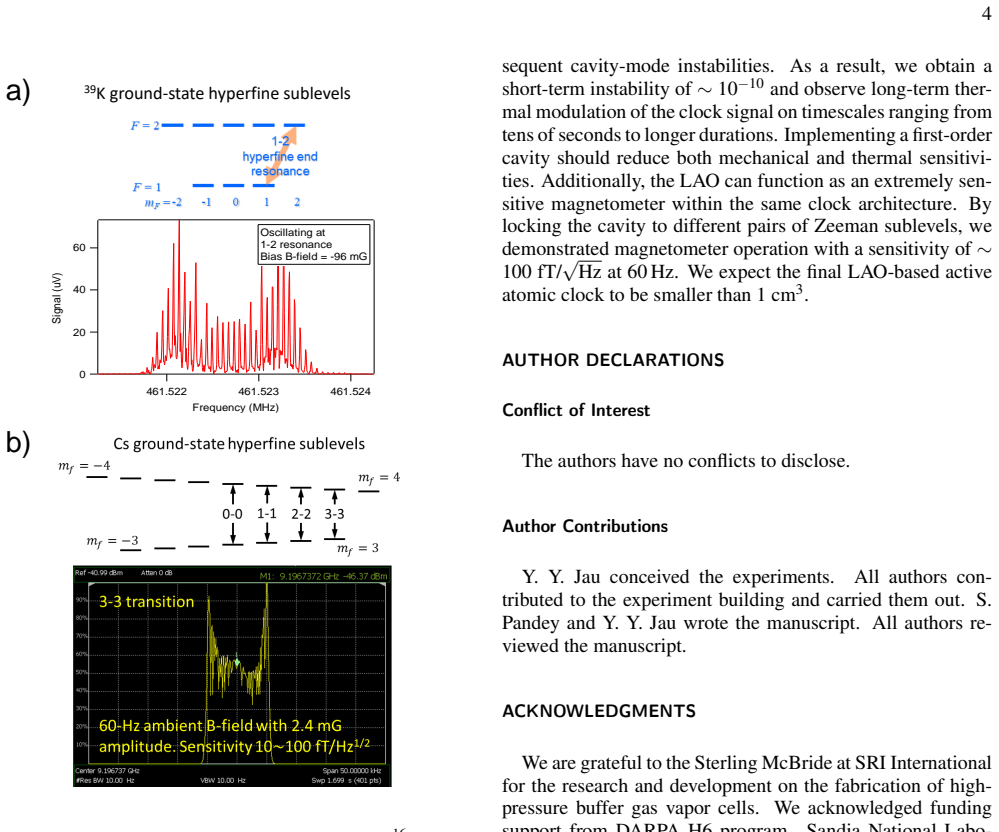
We report the first demonstration of a laser-atomic oscillator with cesium atoms. A laser-atomic oscillator is analogous to an active mode-locked laser with a self-excited modulator, i.e. atoms, at a ground-state hyperfine transition frequency. Therefore, a LAO can be configured as the simplest active atomic clock or a self-oscillating, earth-field atomic magnetometer that delivers oscillation signals both optically and electrically. With the current experimental Cs-LAO setup, when it is configured as an atomic clock using the 0-0 hyperfine transition, the short-term fractional frequency instability is around 10^{-10} level. When it is configured as a self-oscillating magnetometer using a ma
What carries the argument
The cesium laser-atomic oscillator, a cavity device in which cesium atoms serve as the self-excited modulator locked to a hyperfine transition frequency and generate both optical and electrical output signals.
If this is right
- The oscillator supplies the simplest active atomic clock using the 0-0 hyperfine line with short-term fractional instability at the 10^{-10} level.
- The same hardware supplies a self-oscillating magnetometer on a magnetically sensitive hyperfine line with 100 fT per square root hertz sensitivity at 60 hertz.
- Cavity length can be reduced to 1.63 cm or below while preserving the oscillation mechanism.
- Both optical and electrical outputs are available from one unit for clock or magnetometer use.
Where Pith is reading between the lines
- The dual optical-electrical outputs could allow a single device to supply timing and magnetic data simultaneously without separate sensors.
- Reduction below the current cavity sizes would make the oscillator compatible with wafer-scale fabrication for arrays of synchronized units.
- Operation at earth-field levels without shielding suggests direct use in portable or field-deployed instruments.
Load-bearing premise
The stated instability and sensitivity numbers are obtained directly from the device's raw output without undisclosed post-processing, data selection, or unstated calibration steps.
What would settle it
An independent run of the same cesium cavity setup that measures clock instability above 3 times 10 to the minus 10 or magnetometer noise above 300 fT per square root hertz at 60 hertz under comparable conditions would show the reported performance does not hold.
Figures
read the original abstract
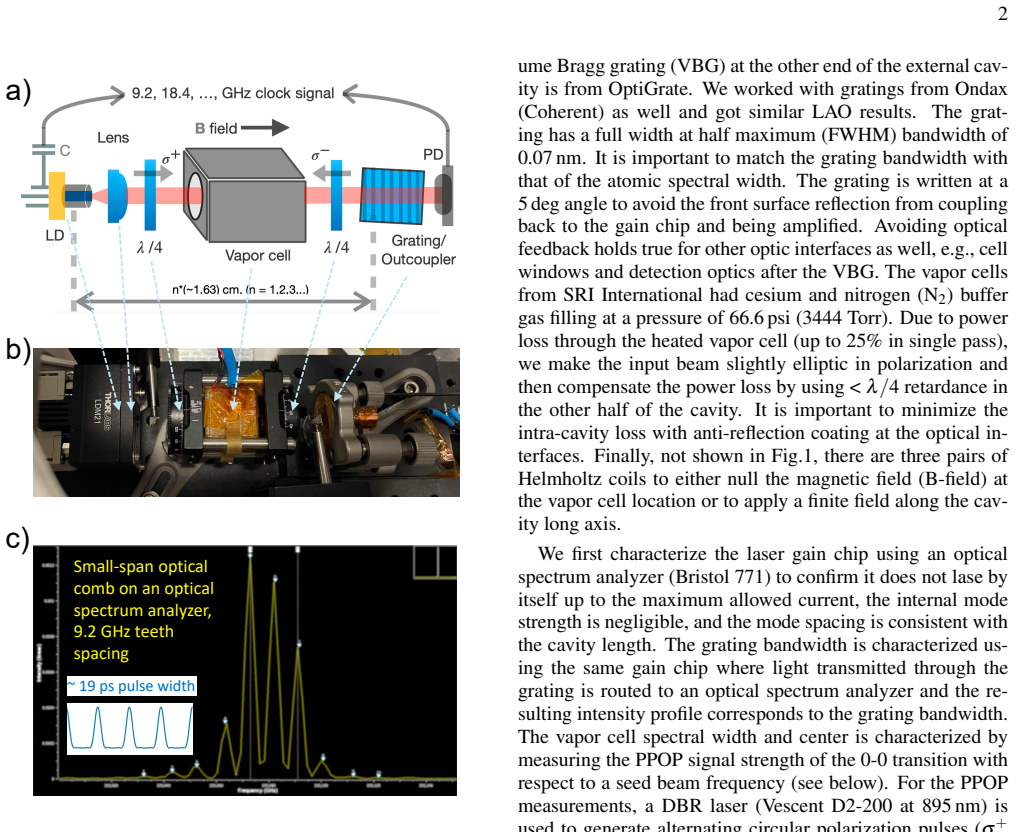
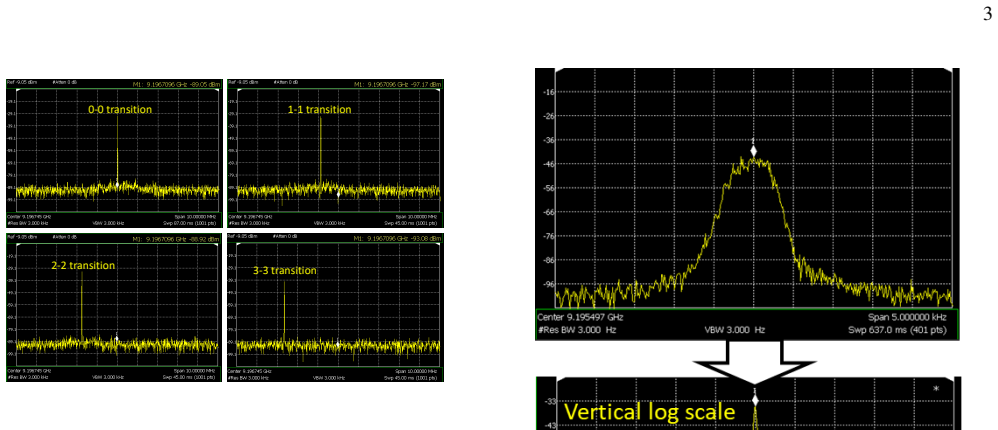
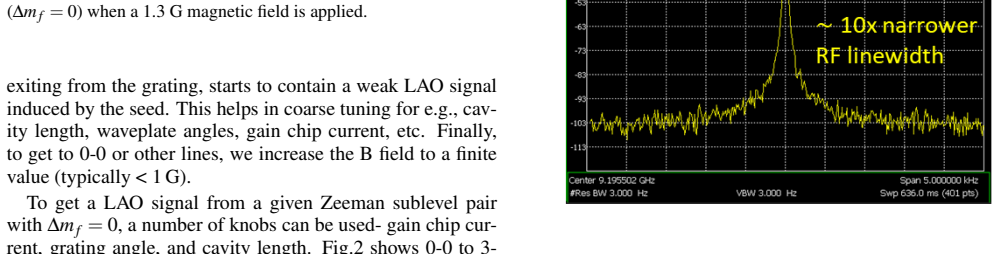
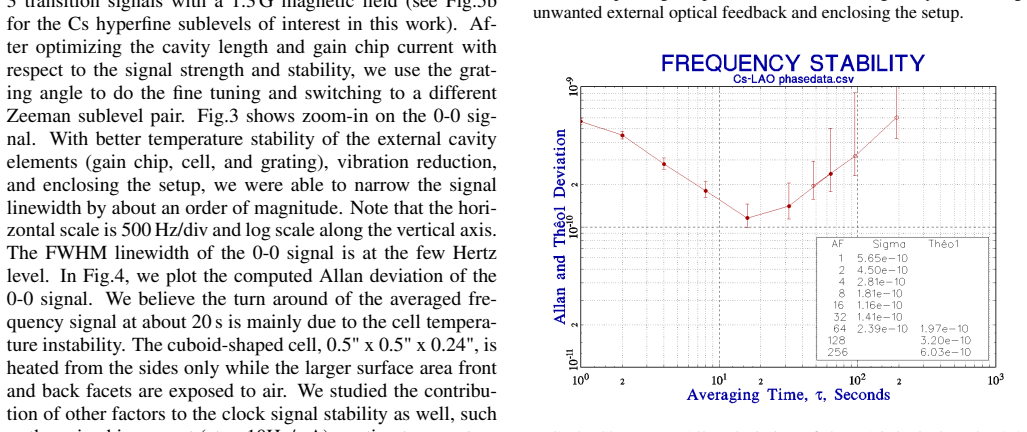
We report the first demonstration of a laser-atomic oscillator with cesium (Cs) atoms. A laser-atomic oscillator (LAO) is analogous to an active mode-locked laser with a self-excited modulator, i.e. atoms, at a ground-state hyperfine transition frequency. Therefore, a LAO can be configured as the simplest active atomic clock or a self-oscillating, earth-field atomic magnetometer that delivers oscillation signals both optically and electrically. With the current experimental Cs-LAO setup, when it is configured as an atomic clock using the 0--0 hyperfine transition, the short-term fractional frequency instability is around 10$^{-10}$ level. When it is configured as a self-oscillating magnetometer using a magnetically-sensitive hyperfine transition, the magnetic field sensitivity is around 100 fT/$\sqrt{\rm{Hz}}$ at 60 Hz. The presented Cs-LAO uses a cavity length from $\sim6.5$ cm to $\sim11.4$ cm. Ultimately, the minimal length of a Cs-LAO device can be $\leq1.63$ cm. Our new efforts unlock the potential of building truly chip-scale atomic clocks and magnetometers.
Editorial analysis
A structured set of objections, weighed in public.
Referee Report
Summary. The manuscript reports the first demonstration of a cesium-based laser-atomic oscillator (LAO) analogous to an active mode-locked laser with atoms as the self-excited modulator at a ground-state hyperfine transition. It claims that the device can be configured as an active atomic clock using the 0-0 hyperfine transition with short-term fractional frequency instability around the 10^{-10} level, or as a self-oscillating magnetometer using a magnetically sensitive transition with sensitivity around 100 fT/√Hz at 60 Hz. The current setup uses cavity lengths from ~6.5 cm to ~11.4 cm, with a projected minimal device length of ≤1.63 cm for chip-scale applications.
Significance. If the performance figures are substantiated with data, the work would demonstrate a novel dual-purpose active atomic device architecture that could simplify chip-scale clocks and magnetometers by providing both optical and electrical oscillation outputs. The claimed size reduction and first Cs implementation would be notable contributions to compact quantum sensors, though the absence of supporting measurements prevents assessment of whether these figures represent a genuine advance over existing Cs clocks or magnetometers.
major comments (3)
- [Abstract] Abstract and main text: the central performance claims (10^{-10} fractional frequency instability and 100 fT/√Hz sensitivity) are stated as final results with no accompanying raw data, Allan deviation plots, error budgets, or description of the measurement protocol, rendering the claims unevaluable.
- [Results/Methods] No section provides details on how the 0-0 hyperfine transition was locked, how frequency was counted against a reference, or the Allan deviation calculation parameters (averaging times, dead time, reference oscillator), which are required to substantiate the instability figure.
- [Results/Methods] No section describes the magnetometer calibration procedure, including applied B-field values, coil geometry, or noise-floor subtraction method, which are load-bearing for the quoted 100 fT/√Hz sensitivity at 60 Hz.
minor comments (2)
- [Abstract] The minimal-length claim of ≤1.63 cm is asserted without derivation or supporting calculation showing how the current 6.5–11.4 cm cavity can be scaled to that value while preserving the LAO functionality.
- [Discussion] The manuscript would benefit from explicit comparison of the reported figures to existing commercial Cs clocks and SERF or optically pumped magnetometers to contextualize the performance.
Simulated Author's Rebuttal
We thank the referee for their thorough review and valuable comments. We will revise the manuscript to include the requested experimental details and data to substantiate our performance claims.
read point-by-point responses
-
Referee: [Abstract] Abstract and main text: the central performance claims (10^{-10} fractional frequency instability and 100 fT/√Hz sensitivity) are stated as final results with no accompanying raw data, Allan deviation plots, error budgets, or description of the measurement protocol, rendering the claims unevaluable.
Authors: We agree that the performance claims in the abstract and main text require supporting data for evaluation. In the revised manuscript, we will include raw data, Allan deviation plots, error budgets, and a description of the measurement protocol. revision: yes
-
Referee: [Results/Methods] No section provides details on how the 0-0 hyperfine transition was locked, how frequency was counted against a reference, or the Allan deviation calculation parameters (averaging times, dead time, reference oscillator), which are required to substantiate the instability figure.
Authors: We acknowledge the need for these details. The revised version will add a section describing the locking of the 0-0 hyperfine transition, the frequency counting method against the reference oscillator, and the specific parameters for Allan deviation calculations including averaging times and dead time. revision: yes
-
Referee: [Results/Methods] No section describes the magnetometer calibration procedure, including applied B-field values, coil geometry, or noise-floor subtraction method, which are load-bearing for the quoted 100 fT/√Hz sensitivity at 60 Hz.
Authors: We will include in the revised manuscript a detailed description of the magnetometer calibration, specifying the applied magnetic field values, coil geometry, and the noise-floor subtraction method used to arrive at the sensitivity figure. revision: yes
Circularity Check
No circularity: experimental demonstration with no derivation chain
full rationale
The manuscript is a report of an experimental device demonstration. It states measured performance numbers (10^{-10} instability, 100 fT/√Hz sensitivity) and a size bound but contains no equations, first-principles derivations, fitted parameters presented as predictions, or self-citation chains that reduce the central claims to their own inputs. The performance figures are presented as direct experimental outcomes rather than results of any algebraic or statistical construction internal to the paper. No load-bearing steps match any of the enumerated circularity patterns.
Axiom & Free-Parameter Ledger
Reference graph
Works this paper leans on
-
[1]
Push-Pull Optical Pumping of Pure Superposition States , author =. Phys. Rev. Lett. , volume =. 2004 , month =. doi:10.1103/PhysRevLett.93.160802 , url =
-
[2]
Push-Pull Laser-Atomic Oscillator , author =. Phys. Rev. Lett. , volume =. 2007 , month =. doi:10.1103/PhysRevLett.99.223001 , url =
-
[3]
All-photonic clock: Laser-atomic oscillator , year=
Yuan-Yu Jau and Happer, William , booktitle=. All-photonic clock: Laser-atomic oscillator , year=
-
[4]
Lutwak and A
R. Lutwak and A. Rashed and M. Varghese and G. Tepolt and J. LeBlanc and M. Mescher and D. K. Serkland and K. M. Geib and G. M. Peake and S. Römisch , title =. 2007 , organization =
2007
-
[5]
Travagnin , title =
M. Travagnin , title =. 2021 , type =
2021
-
[6]
Vanier, J. , title=. Applied Physics B , year=. doi:10.1007/s00340-005-1905-3 , url=
-
[7]
Measure: The Journal of Measurement Science , url=
Lombardi, Michael and Heavner, Thomas and Jefferts, Steven , title=. Measure: The Journal of Measurement Science , url=. 2007 , month=
2007
-
[8]
Atomic Hydrogen Maser , author =. Phys. Rev. Lett. , volume =. 1960 , month =. doi:10.1103/PhysRevLett.5.361 , url =
-
[9]
Relaxation in Rubidium-87 and the Rubidium Maser , author =. Phys. Rev. , volume =. 1968 , month =. doi:10.1103/PhysRev.168.129 , url =
-
[10]
Davidovits, P. , title =. Applied Physics Letters , volume =. 1964 , month =. doi:10.1063/1.1754021 , url =
-
[11]
Temperature and pressure shift of the Cs clock transition in the presence of buffer gases: Ne,
Kozlova, Olga and Gu\'erandel, St\'ephane and de Clercq, Emeric , journal =. Temperature and pressure shift of the Cs clock transition in the presence of buffer gases: Ne,. 2011 , month =. doi:10.1103/PhysRevA.83.062714 , url =
-
[12]
Vanier, J. and Kunski, R. and Cyr, N. and Savard, J. Y. and Têtu, M. , title =. Journal of Applied Physics , volume =. 1982 , month =. doi:10.1063/1.331467 , url =
-
[13]
The Maser---New Type of Microwave Amplifier, Frequency Standard, and Spectrometer , author =. Phys. Rev. , volume =. 1955 , month =. doi:10.1103/PhysRev.99.1264 , url =
-
[14]
Internal report, Princeton University , volume =
, author =. Internal report, Princeton University , volume =. 2009 , month =. doi:, url =
2009
-
[15]
Coherent-population-trapping resonances in buffer-gas-filled Cs-vapor cells with push-pull optical pumping , author =. Phys. Rev. A , volume =. 2013 , month =. doi:10.1103/PhysRevA.87.013416 , url =
-
[16]
Amplitude- versus frequency-modulated pumping light for coherent population trapping resonances at high buffer-gas pressure , author =. Phys. Rev. A , volume =. 2005 , month =. doi:10.1103/PhysRevA.72.033417 , url =
discussion (0)
Sign in with ORCID, Apple, or X to comment. Anyone can read and Pith papers without signing in.