Constant mean curvature hypersurfaces in mathbb{H}²timesmathbb{H}² with double horocyclic symmetry
Pith reviewed 2026-07-02 17:44 UTC · model grok-4.3
The pith
Double horocyclic invariance reduces the CMC equation in H²×H² to a single autonomous ODE
A machine-rendered reading of the paper's core claim, the machinery that carries it, and where it could break.
Core claim
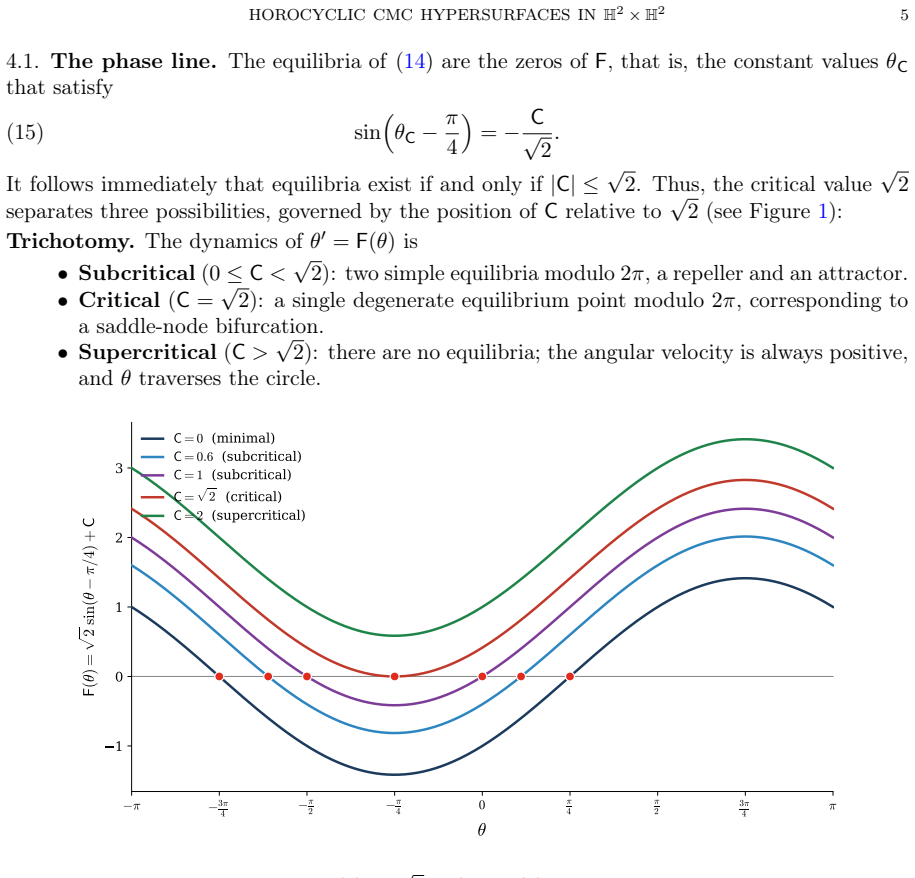
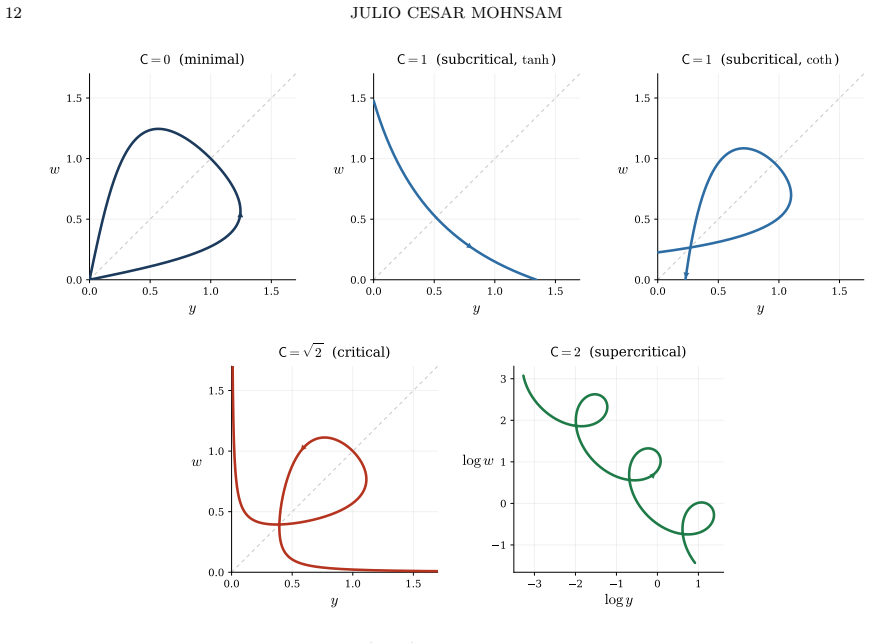
By assuming double horocyclic invariance, the mean curvature condition for hypersurfaces in H² × H² simplifies to an autonomous ODE for an angular function, which is solved explicitly in three regimes determined by the mean curvature value, yielding families of such hypersurfaces and classifying their limiting homogeneous models as H³, H² × R, Sol₃, and left-invariant metrics on semidirect products.
What carries the argument
The double horocyclic action, which reduces the mean curvature equation to an autonomous ODE in one angular variable
If this is right
- Explicit solutions for the hypersurfaces exist in each of the three regimes.
- Existence and uniqueness hold once mean curvature and initial angular data are fixed.
- Equilibrium solutions of the ODE correspond to the listed homogeneous three-manifolds.
Where Pith is reading between the lines
- The explicit solutions obtained could serve as comparison surfaces for stability questions under small symmetry-breaking perturbations.
- Analogous symmetry reductions might produce solvable ODEs for CMC hypersurfaces in other four-dimensional product spaces.
- The appearance of Sol₃ among the equilibria points to possible links with left-invariant geometries in other symmetric spaces.
Load-bearing premise
The hypersurface is assumed to be invariant under the double horocyclic action.
What would settle it
A direct substitution of one of the explicit ODE solutions back into the original mean curvature operator on H²×H² that yields a non-constant value would falsify the claimed reduction.
Figures
read the original abstract
We study constant mean curvature hypersurfaces in $\mathbb{H}^2\times\mathbb{H}^2$ invariant under a double horocyclic action. We show that the CMC condition reduces to a single autonomous ordinary differential equation for an angular function. From this reduction, we obtain three distinct regimes and solve the ODE explicitly in each case, obtaining an existence and uniqueness result for double horocyclic CMC hypersurfaces in $\mathbb{H}^2\times\mathbb{H}^2$. Finally, we classify the equilibrium solutions and identify the corresponding homogeneous models: $\mathbb{H}^3$, $\mathbb{H}^2\times\mathbb{R}$, $\mathrm{Sol}_3$, and left-invariant metrics on semidirect product Lie groups.
Editorial analysis
A structured set of objections, weighed in public.
Referee Report
Summary. The manuscript studies constant mean curvature hypersurfaces in H²×H² invariant under a double horocyclic action. It claims that the CMC condition reduces to a single autonomous ODE for an angular function, which is solved explicitly in three regimes to obtain existence and uniqueness results. Equilibrium solutions are classified and matched to the homogeneous models H³, H²×R, Sol₃, and left-invariant metrics on semidirect product Lie groups.
Significance. If the reduction and explicit solutions hold, the work supplies new explicit CMC examples in a 4-dimensional product geometry under symmetry, together with a classification that recovers known 3-dimensional homogeneous spaces. The explicit solvability across regimes and the independent corroboration via matching to standard models constitute a clear strength.
minor comments (3)
- Abstract: the three regimes are referenced but not characterized (e.g., by the range of the mean-curvature constant or the behavior of the angular function); a one-sentence description of each would aid the reader.
- The explicit solutions should be accompanied by a clear statement of the admissible parameter intervals (mean curvature, integration constants) that guarantee the hypersurface is well-defined and embedded.
- Notation for the angular function and the double horocyclic coordinates should be introduced once in a dedicated preliminary section and used consistently thereafter.
Simulated Author's Rebuttal
We are grateful to the referee for their positive summary and recommendation of minor revision. The referee's description accurately reflects the reduction to an autonomous ODE, the explicit solutions in three regimes, the existence/uniqueness results, and the classification of equilibria matching known homogeneous spaces. No specific major comments were raised in the report.
Circularity Check
No significant circularity
full rationale
The derivation begins from the explicit assumption of double horocyclic invariance, which by standard symmetry reduction in Riemannian geometry converts the CMC PDE into an autonomous scalar ODE in one angular variable. The paper then solves this ODE explicitly in three regimes and classifies equilibria by matching to known homogeneous spaces (H^3, H^2×R, Sol_3, semidirect products). No step equates a derived quantity to a fitted parameter, renames a known result as new, or relies on a load-bearing self-citation whose content is itself unverified; the reduction is a direct algebraic consequence of the imposed symmetry and is independently corroborated by the explicit solvability and geometric identifications.
Axiom & Free-Parameter Ledger
Reference graph
Works this paper leans on
-
[1]
D. Gao, H. Ma and Z. Yao,On hypersurfaces ofH 2 ×H 2, Sci. China Math.67(2024), no. 2, 339–366, doi:10.1007/s11425-022-2103-2
-
[2]
D. Gao, J. Van der Veken, A. Wijffels and B. Xu,Lagrangian surfaces inH2 ×H 2, Comm. Anal. Geom.33 (2025), no. 4, 957–980, doi:10.4310/CAG.250815015202
-
[3]
Hu and X
Z. Hu and X. Lu,On real hypersurfaces inS2 ×S2 andH 2 ×H2 with parallel normal Jacobi operator, Mediterr. J. Math.21(2024), no. 4, Article 123
2024
-
[4]
Z. Hu, X. Lu, Z. Yao and X. Zhang,On Hopf hypersurfaces ofS2 ×S 2 andH 2 ×H 2, J. Geom. Phys.194 (2023), Article 104996
2023
-
[5]
Z. Hu, X. Lu, Z. Yao and X. Zhang,On curvature-adapted hypersurfaces ofS2 ×S 2 andH 2 ×H 2, Int. J. Math.35(2024), no. 2, Article 2450010, doi:10.1142/S0129167X24500721
-
[6]
E. L. Ince,Ordinary Differential Equations, Dover Publications, New York, 1956. Reprint of the 1926 edition
1956
-
[7]
H. Li, L. Vrancken, X. Wang and Z. Yao,Hypersurfaces ofH2 ×H2 with constant sectional curvature, preprint (2026), arXiv:2606.24686 [math.DG]
work page internal anchor Pith review Pith/arXiv arXiv 2026
-
[8]
G. Stas and J. Van der Veken,Spheres with parallel mean curvature inS 2 ×H 2, preprint (2025), arXiv:2509.08581 [math.DG]
-
[9]
Torralbo and F
F. Torralbo and F. Urbano,Surfaces with parallel mean curvature vector inS2 ×S 2 andH 2 ×H 2, Trans. Amer. Math. Soc.364(2012), 785–813. Department of Mathematics, UFRGS, Porto Alegre, Brazil Email address:julio.mohnsam@ufrgs.br
2012
discussion (0)
Sign in with ORCID, Apple, or X to comment. Anyone can read and Pith papers without signing in.