Strong Majority Edge-Coloring
Pith reviewed 2026-07-02 18:28 UTC · model grok-4.3
The pith
Every admissible graph admits a strong majority edge-coloring with at most five colors.
A machine-rendered reading of the paper's core claim, the machinery that carries it, and where it could break.
Core claim
The central claim is that five colors suffice to produce a strong majority edge-coloring of any admissible graph, where a strong majority edge-coloring requires that for any edge and any color at most half the adjacent edges receive that color, and admissible graphs are those without a pendant path of length two.
What carries the argument
The strong majority condition, which limits each color to at most half the edges adjacent to any given edge.
Load-bearing premise
Strong majority edge-colorings exist precisely when the graph has no pendant path of length two.
What would settle it
An admissible graph that requires six or more colors for any strong majority edge-coloring.
Figures
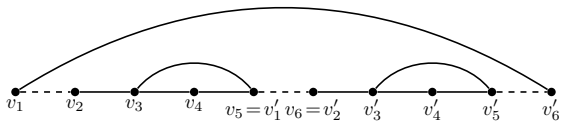
read the original abstract
A strong majority edge-coloring of a graph is an edge-coloring in which, for every edge $e$ and every color $i$, at most half of the edges adjacent to $e$ have color $i$. Such a coloring exists only for graphs with no pendant path of length two, which, following Kalinowski, Kamyczura, Pil\'sniak, and Wo\'zniak, we call admissible. They proved that every admissible graph admits such a coloring with at most eight colors and conjectured that four colors always suffice. We improve the upper bound from eight to five.
Editorial analysis
A structured set of objections, weighed in public.
Referee Report
Summary. The manuscript proves that every admissible graph (i.e., a graph with no pendant path of length two) admits a strong majority edge-coloring with at most five colors. This improves the previous upper bound of eight colors established by Kalinowski, Kamyczura, Pilśniak, and Woźniak, while leaving open their conjecture that four colors always suffice.
Significance. If the central construction holds, the result narrows the gap between the known upper bound and the conjectured minimum of four colors for this variant of edge-coloring. The improvement is obtained via an explicit coloring procedure that builds directly on the prior characterization of admissible graphs; this constructive approach is a positive feature that may facilitate further tightening of the bound.
minor comments (2)
- [§2] §2, definition of strong majority edge-coloring: the phrasing 'at most half of the edges adjacent to e have color i' should explicitly address whether the degree is even or odd to avoid ambiguity in the half-boundary case.
- [§4] The proof of the five-color bound (likely in §4) would benefit from a short high-level outline of the coloring algorithm before the case analysis, to improve readability for readers familiar with the eight-color result.
Simulated Author's Rebuttal
We thank the referee for their supportive summary and recommendation of minor revision. No major comments were listed in the report, so we have no specific points requiring rebuttal or revision at this stage.
Circularity Check
No significant circularity identified
full rationale
The paper cites an external characterization of admissible graphs (no pendant path of length 2) and the prior 8-color bound from Kalinowski et al. (distinct authors with no overlap). The new result improves the bound to 5 via an independent proof construction on admissible graphs. No self-definitional steps, fitted inputs renamed as predictions, or load-bearing self-citations appear in the derivation chain. The central claim remains externally grounded and does not reduce to its own inputs by construction.
Axiom & Free-Parameter Ledger
axioms (2)
- standard math Graphs are finite undirected simple graphs.
- domain assumption Strong majority edge-colorings exist if and only if the graph is admissible (contains no pendant path of length two).
Reference graph
Works this paper leans on
-
[1]
Matematicheskii sbornik , volume=
On some properties of linear complexes , author=. Matematicheskii sbornik , volume=. 1949 , publisher=
1949
-
[2]
Magyar Tud
On the number of complete subgraphs contained in certain graphs , author=. Magyar Tud. Akad. Mat. Kutat
-
[3]
Survey of generalized Tur 'an problems--counting subgraphs , author=. arXiv preprint arXiv:2506.03418 , year=
-
[4]
Electronic Journal of Combinatorics , volume=
The maximum number of triangles in a graph of given maximum degree , author=. Electronic Journal of Combinatorics , volume=
-
[5]
Electronic Journal of Combinatorics , volume=
The maximum number of cliques in graphs with a given maximum degree , author=. Electronic Journal of Combinatorics , volume=
-
[6]
Discrete Mathematics , volume=
A sufficient condition for equitable edge-colourings of simple graphs , author=. Discrete Mathematics , volume=. 1994 , publisher=
1994
-
[7]
Strong majority colorings of graphs
Strong majority colorings of graphs , author=. arXiv preprint arXiv:2605.23828 , year=
work page internal anchor Pith review Pith/arXiv arXiv
-
[8]
Journal of Combinatorial Theory, Series B , volume =
Aharoni, Ron and Milner, Eric and Prikry, Karel , title =. Journal of Combinatorial Theory, Series B , volume =
-
[9]
Anholcer, Marcin and Bosek, Bart. Mrs. correct and majority colorings , journal =
-
[10]
Combinatorica , volume =
Berger, Eli , title =. Combinatorica , volume =
-
[11]
Majority Edge-Colorings of Graphs , journal =
Bock, Florian and Kalinowski, Rafa. Majority Edge-Colorings of Graphs , journal =
-
[12]
Every rayless graph has an unfriendly partition , journal =
Bruhn, Henning and Diestel, Reinhard and Georgakopoulos, Agelos and Spr. Every rayless graph has an unfriendly partition , journal =
-
[13]
Hilton, Anthony J. W. and Stirling, D. and Slivnik, T. , title =. Journal of Combinatorial Theory, Series B , volume =
-
[14]
Majority colourings of digraphs , journal =
Kreutzer, Stephan and Oum,. Majority colourings of digraphs , journal =
-
[15]
On decomposition of graphs , journal =
Lov. On decomposition of graphs , journal =
-
[16]
Combinatorica , volume=
Unfriendly Partition Conjecture Holds for Line Graphs , author=. Combinatorica , volume=. 2025 , publisher=
2025
discussion (0)
Sign in with ORCID, Apple, or X to comment. Anyone can read and Pith papers without signing in.