Evolving Intelligent Complex Systems via Intellicise Networks: Architecture, Technologies, and Pathways
Pith reviewed 2026-07-02 00:54 UTC · model grok-4.3
The pith
Intellicise networks provide a cross-domain architecture with intent-driven operation, semantic-native capability, and distributed intelligence to manage large-scale heterogeneous complex systems.
A machine-rendered reading of the paper's core claim, the machinery that carries it, and where it could break.
Core claim
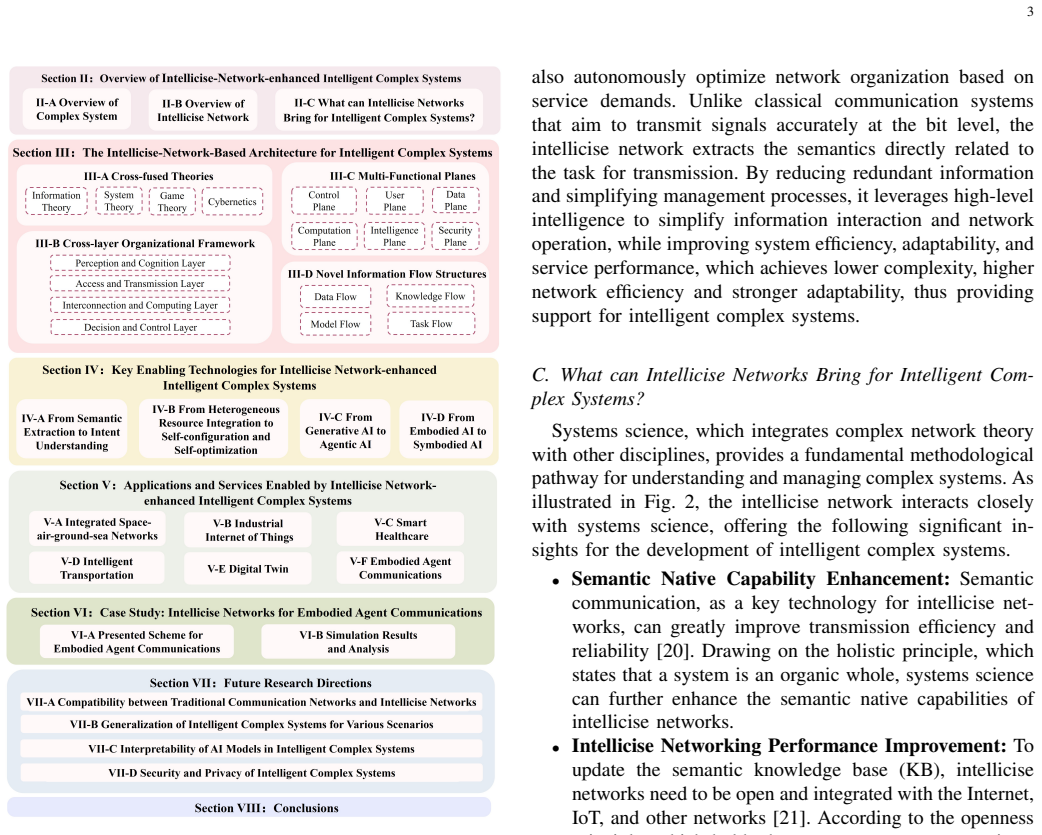
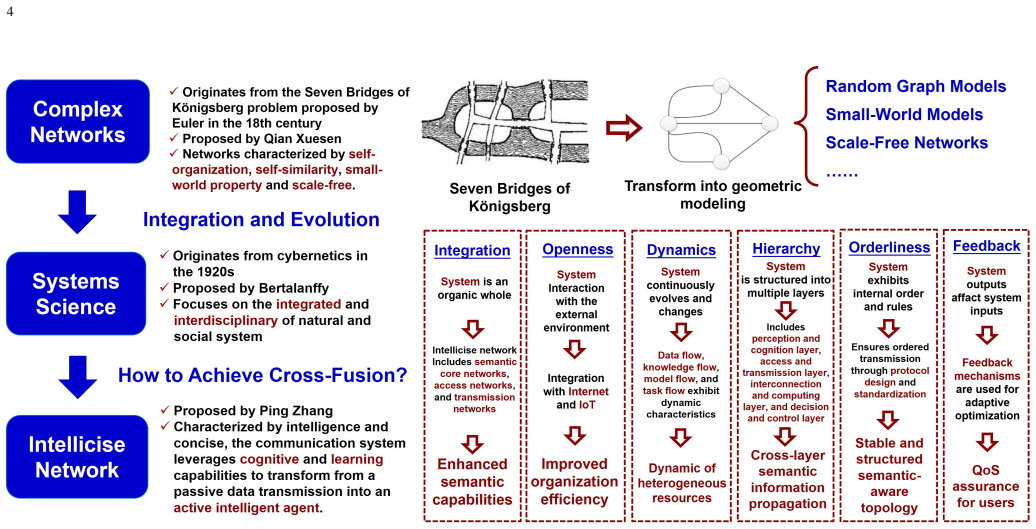
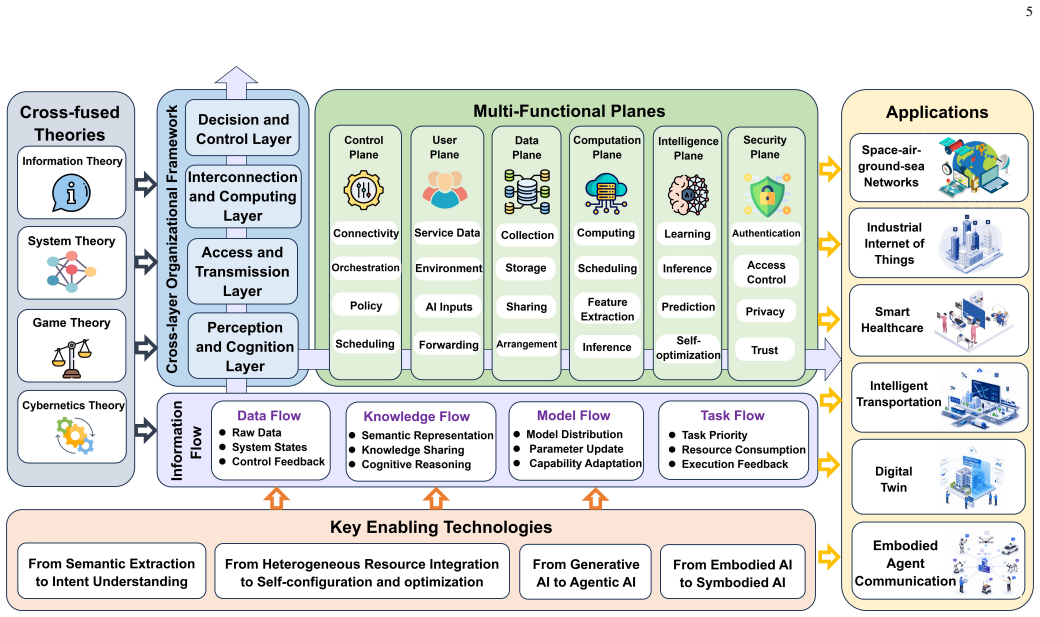
Intellicise networks offer a promising paradigm for enabling intelligent complex systems. The architecture comprises a cross-layer organizational framework that defines the vertical evolution from perception and cognition to decision, multi-functional planes (control, user, data, computation, intelligence, and security) that deliver horizontal intellicise capabilities, and novel information flows (data, knowledge, model, and task) that interconnect layers and planes to form a closed-loop process deriving simplicity from high-level intelligence while pursuing enhanced performance.
What carries the argument
The cross-layer organizational framework together with the six multi-functional planes and four information flows that interconnect them to create a closed-loop derivation of simplicity from high-level intelligence.
If this is right
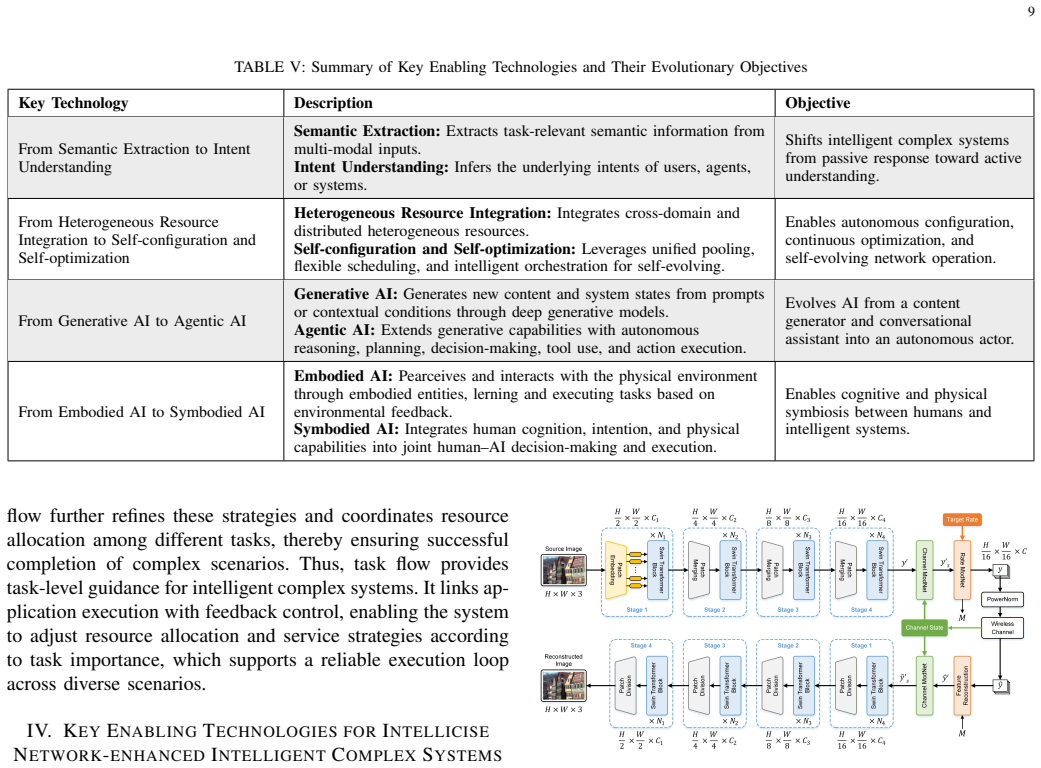
- The architecture supports evolution of technologies from semantic extraction to intent understanding and from generative AI to agentic AI and symbodied AI.
- Heterogeneous resource integration leads to self-configuration and self-optimization capabilities.
- A case study demonstrates the framework applied to embodied agent communications.
- Representative applications and services become feasible for intelligent complex systems.
Where Pith is reading between the lines
- The closed-loop flows could be tested for stability when scaling to open systems with rapidly changing business requirements.
- The grounding in cybernetics suggests the planes might support adaptive feedback loops in real-time control applications.
- Integration with existing wireless standards may require mapping the vertical layers onto current protocol stacks.
- Symbodied AI extensions could link physical embodiment directly to semantic-native communication flows.
Load-bearing premise
The proposed cross-layer organizational framework and multi-functional planes can be grounded in information theory, systems theory, game theory, and cybernetics to form a closed-loop process that derives simplicity from high-level intelligence.
What would settle it
A deployment or simulation of the proposed architecture in a large-scale heterogeneous wireless system that fails to show measurable gains in resource optimization or information-space management compared with conventional network designs.
Figures

read the original abstract
Future engineering infrastructures are evolving into large-scale, open, heterogeneous, and wirelessly interconnected complex systems. These systems present significant challenges in optimizing network resource utilization, managing high-dimensional information spaces, and accommodating diverse business requirements. Intellicise networks, characterized by Intent-driven operation, semantic-native capability, and distributed intelligence, offer a promising paradigm for enabling such intelligent complex systems. We provide a systematic exploration of future intelligent complex systems from the perspective of intellicise networks. Specifically, we propose a cross-domain intelligent communication network architecture based on intellicise networks, grounded in information theory, systems theory, game theory, and cybernetics. The architecture comprises a cross-layer organizational framework, multi-functional planes, and novel information flows. The cross-layer framework defines the vertical evolution from perception and cognition to decision, while the control, user, data, computation, intelligence, and security planes deliver horizontal intellicise capabilities. Moreover, data, knowledge, model, and task flows interconnect the various layers and planes, forming a closed-loop process that derives simplicity from high-level intelligene while concurrently pursuing enhanced. Building on this architecture, we review key enabling technologies, tracing their evolution from semantic extraction to intent understanding, from heterogeneous resource integration to self-configuration and self-optimization, from generative artificial intelligence (AI) to agentic AI, and from embodied AI to symbodied AI. Additionally, we present a case study on intellicise networks for embodied agent communications and discuss representative applications and services for intelligent complex systems.
Editorial analysis
A structured set of objections, weighed in public.
Referee Report
Summary. The paper proposes 'Intellicise networks' as a new paradigm for future intelligent complex systems, defined by intent-driven operation, semantic-native capability, and distributed intelligence. It outlines a cross-domain architecture comprising a cross-layer organizational framework (perception to decision), six horizontal planes (control, user, data, computation, intelligence, security), and interconnecting data/knowledge/model/task flows that form a closed loop. The architecture is stated to be grounded in information theory, systems theory, game theory, and cybernetics. The manuscript reviews enabling technologies (semantic extraction to symbodied AI) and presents a case study on embodied agent communications along with applications.
Significance. If the proposed architecture can be shown to derive concrete properties (such as closed-loop stability or semantic efficiency) from the cited theories, the framework could provide a unifying conceptual structure for integrating intent, semantics, and distributed intelligence in large-scale wireless systems. The review of technology evolution and the embodied-agent case study offer a useful synthesis for researchers working on 6G and intelligent infrastructure.
major comments (2)
- [Architecture section (Abstract and main proposal)] The central claim that the cross-layer framework and multi-functional planes are 'grounded in information theory, systems theory, game theory, and cybernetics' (Abstract and architecture description) is asserted without any explicit mappings, theorems, bounds, or derivations. No rate-distortion results, Nash equilibria, feedback equations, or other concrete results from these fields are supplied to justify the semantic-native flows, intelligence plane, or the closed-loop property.
- [Architecture section (Abstract and main proposal)] The statement that the data/knowledge/model/task flows 'form a closed-loop process that derives simplicity from high-level intelligence' (Abstract) remains a qualitative assertion. No analysis is provided showing how this property follows from the listed theories or how the flows achieve the claimed simplification.
minor comments (2)
- [Abstract] Typo in Abstract: 'intelligene' should be 'intelligence'.
- [Architecture description] The manuscript would benefit from a dedicated section that explicitly lists the specific results or mappings from each cited theory to the proposed planes and flows.
Simulated Author's Rebuttal
We thank the referee for the constructive and detailed comments. The observations correctly identify that the architecture section asserts grounding in the listed theories and the closed-loop property without explicit mappings or derivations. We address each point below and will revise the manuscript to strengthen these aspects.
read point-by-point responses
-
Referee: [Architecture section (Abstract and main proposal)] The central claim that the cross-layer framework and multi-functional planes are 'grounded in information theory, systems theory, game theory, and cybernetics' (Abstract and architecture description) is asserted without any explicit mappings, theorems, bounds, or derivations. No rate-distortion results, Nash equilibria, feedback equations, or other concrete results from these fields are supplied to justify the semantic-native flows, intelligence plane, or the closed-loop property.
Authors: We acknowledge that the current manuscript presents the grounding at a conceptual level without explicit mappings, theorems, or derivations. In the revised version, we will add a new subsection 'Theoretical Underpinnings of the Architecture' that supplies explicit connections: information theory to semantic-native flows via semantic information measures; systems theory to the cross-layer framework via hierarchical decomposition; game theory to the intelligence plane via multi-agent equilibrium concepts; and cybernetics to the closed-loop property via feedback and control principles. Illustrative references to relevant results will be included to justify the design elements. revision: yes
-
Referee: [Architecture section (Abstract and main proposal)] The statement that the data/knowledge/model/task flows 'form a closed-loop process that derives simplicity from high-level intelligence' (Abstract) remains a qualitative assertion. No analysis is provided showing how this property follows from the listed theories or how the flows achieve the claimed simplification.
Authors: We agree that the closed-loop simplification is described qualitatively without supporting analysis. The revision will expand the architecture description to include a high-level analytical discussion: systems theory will be used to explain abstraction-based complexity reduction, and cybernetics will be invoked for self-regulating feedback that yields emergent simplicity. A schematic model of the flows will be added, together with references to relevant theoretical results, to demonstrate how the property is achieved. revision: yes
Circularity Check
No circularity; conceptual architecture proposal without load-bearing derivations or self-referential reductions
full rationale
The manuscript is a high-level vision paper proposing an architecture for 'intellicise networks' and asserting it is grounded in information theory, systems theory, game theory, and cybernetics. No equations, theorems, or explicit mappings are supplied that would allow any claimed derivation (e.g., the closed-loop process deriving simplicity) to be inspected for reduction to its own inputs by construction. The description defines the framework in terms of the new terminology but does not present a mathematical chain that collapses. Self-citations are not invoked as load-bearing uniqueness theorems. This is a standard non-circular conceptual proposal.
Axiom & Free-Parameter Ledger
invented entities (1)
-
Intellicise networks
no independent evidence
Reference graph
Works this paper leans on
-
[1]
Advancing llm-based security automation with customized group relative policy optimization for zero-touch networks,
X. Cao, Y . Lin, G. Nan, Q. Zhou, Y . Luo, Y . Gao, Z. Zhang, H. Lu, Q. Cui, Y . Houet al., “Advancing llm-based security automation with customized group relative policy optimization for zero-touch networks,”IEEE Journal on Selected Areas in Communications, 2025
2025
-
[2]
Towards green and sustainable ai-native ran: From prediction to live testbed deployment,
C. Feng, S. Guo, M. Van Ngo, Z. Chen, H. H. Yang, and T. Q. Quek, “Towards green and sustainable ai-native ran: From prediction to live testbed deployment,”Journal of Communications and Information Networks, vol. 10, no. 4, pp. 326–339, 2025
2025
-
[3]
Semantic radio access networks: Architecture, state-of-the-art, and future directions,
R. Meng, Z. Huang, J. Yan, M. Sun, Y . Liu, C. Feng, X. Xu, Z. Zhang, S. Gao, P. Zhanget al., “Semantic radio access networks: Architecture, state-of-the-art, and future directions,”IEEE Transactions on Cognitive Communications and Networking, vol. 12, pp. 7076–7097, 2026
2026
-
[4]
Enhanced ground–satellite direct access via onboard rydberg atomic quantum receivers,
Q. Peng, T. Gong, Z. Song, Q. Luo, Z. Lin, P. Xiao, and C. Yuen, “Enhanced ground–satellite direct access via onboard rydberg atomic quantum receivers,”IEEE Wireless Communications, vol. 33, no. 3, pp. 23–30, 2026
2026
-
[5]
Complex systems and network science: a survey,
K. Yang, J. Li, M. Liu, T. Lei, X. Xu, H. Wu, J. Cao, and G. Qi, “Complex systems and network science: a survey,”Journal of systems engineering and electronics, vol. 34, no. 3, pp. 543–573, 2023
2023
-
[6]
Secure intellicise wireless network: Agentic ai for coverless semantic steganography communication,
R. Meng, S. Gao, B. Xu, X. Xu, J. Chen, N. Ma, P. Xiao, P. Zhang, and R. Tafazolli, “Secure intellicise wireless network: Agentic ai for coverless semantic steganography communication,”IEEE Transactions on Cognitive Communications and Networking, vol. 12, pp. 8106–8122, 2026
2026
-
[7]
Disentangled dynamic intrusion detection,
C. Qiu, G. Nan, H. Xia, Z. Weng, X. Wang, M. Shen, X. Tao, and J. Liu, “Disentangled dynamic intrusion detection,”IEEE Transactions on Pattern Analysis and Machine Intelligence, 2025
2025
-
[8]
Towards 6g wireless communica- tion networks: Vision, enabling technologies, and new paradigm shifts,
X. You, C.-X. Wang, J. Huang, X. Gao, Z. Zhang, M. Wang, Y . Huang, C. Zhang, Y . Jiang, J. Wanget al., “Towards 6g wireless communica- tion networks: Vision, enabling technologies, and new paradigm shifts,” Science China information sciences, vol. 64, no. 1, p. 110301, 2021
2021
-
[9]
Intellicise wireless networks from semantic communications: A survey, research issues, and challenges,
P. Zhang, W. Xu, Y . Liu, X. Qin, K. Niu, S. Cui, G. Shi, Z. Qin, X. Xu, F. Wanget al., “Intellicise wireless networks from semantic communications: A survey, research issues, and challenges,”IEEE Communications Surveys & Tutorials, vol. 27, no. 3, pp. 2051–2084, 2025
2051
-
[10]
Modern semantic communications and theoretical and technical system of 6g intellicise networks,
P. Zhang, X. Xu, K. Niu, W. Xu, S. Han, M. Sun, C. Dong, N. Ma, and Z. Zhang, “Modern semantic communications and theoretical and technical system of 6g intellicise networks,”Journal of Beijing University of Posts and Telecommunications, vol. 48, no. 5, p. 1, 2025
2025
-
[11]
Physical-layer adversarial robustness for deep learning-based semantic communications,
G. Nan, Z. Li, J. Zhai, Q. Cui, G. Chen, X. Du, X. Zhang, X. Tao, Z. Han, and T. Q. Quek, “Physical-layer adversarial robustness for deep learning-based semantic communications,”IEEE Journal on Selected Areas in Communications, vol. 41, no. 8, pp. 2592–2608, 2023
2023
-
[12]
From active to battery-free: Rydberg atomic quantum receivers for self-sustained swipt-mimo networks,
Q. Peng, Q. Luo, Z. Chu, N. Ye, H. Ren, C. Pan, L. Xiao, and P. Xiao, “From active to battery-free: Rydberg atomic quantum receivers for self-sustained swipt-mimo networks,”IEEE Journal on Selected Areas in Communications, In Press. 2026
2026
-
[13]
Large language models and emergence: A complex systems perspective,
D. C. Krakauer, M. Mitchell, and J. W. Krakauer, “Large language models and emergence: A complex systems perspective,”Philosophical Transactions of the Royal Society A: Mathematical, Physical and Engineering Sciences, vol. 384, no. 2320, p. 20250014, 2026
2026
-
[14]
A survey of the analysis of complex systems based on complex network theory and deep learning,
D. Lu and S. Yang, “A survey of the analysis of complex systems based on complex network theory and deep learning,”International Journal of Performability Engineering, vol. 18, no. 4, p. 241, 2022
2022
-
[15]
State-of-the-art development of complex systems and their simulation methods,
Y . Tang, L. Li, and X. Liu, “State-of-the-art development of complex systems and their simulation methods,”Complex system modeling and simulation, vol. 1, no. 4, pp. 271–290, 2021
2021
-
[16]
M. E. Newman, “Complex systems: A survey,”arXiv preprint arXiv:1112.1440, 2011
work page internal anchor Pith review Pith/arXiv arXiv 2011
-
[17]
Turing instability analysis of a rumor propaga- tion model with time delay on non-network and complex networks,
Y . Ding and L. Zhu, “Turing instability analysis of a rumor propaga- tion model with time delay on non-network and complex networks,” Information Sciences, vol. 667, p. 120402, 2024
2024
-
[18]
Semantic-driven dimension reduction for wireless internet of things,
Y . Han, Y . Zhang, and J. Wang, “Semantic-driven dimension reduction for wireless internet of things,”Internet of Things, vol. 25, p. 101138, 2024
2024
-
[19]
On exploiting network topology for hierarchical coded multi-task learning,
H. Hu, S. Li, M. Cheng, S. Ma, Y . Shi, and Y . Wu, “On exploiting network topology for hierarchical coded multi-task learning,”IEEE Transactions on Communications, vol. 72, no. 8, pp. 4930–4944, 2024
2024
-
[20]
Toward wisdom-evolutionary and primitive- concise 6g: A new paradigm of semantic communication networks,
P. Zhang, W. Xu, H. Gao, K. Niu, X. Xu, X. Qin, C. Yuan, Z. Qin, H. Zhao, J. Weiet al., “Toward wisdom-evolutionary and primitive- concise 6g: A new paradigm of semantic communication networks,” Engineering, vol. 8, pp. 60–73, 2022
2022
-
[21]
A survey of semantic knowledge bases for semantic communications,
Y . Sun, S. Cui, and P. Zhang, “A survey of semantic knowledge bases for semantic communications,”ZTE Communications Technol- ogy, vol. 29, no. 2, pp. 19–23, 2023
2023
-
[22]
Toward native ai in 6g standardization: The roadmap of semantic communication,
P. Zhang, X. Xu, M. Sun, H. Gao, N. Ma, X. Wang, R. Zhang, J. Wang, and D. Niyato, “Toward native ai in 6g standardization: The roadmap of semantic communication,”IEEE Communications Standards Magazine, 2026
2026
-
[23]
A mathematical theory of communication,
C. E. Shannon, “A mathematical theory of communication,”The Bell System Technical Journal, vol. 27, no. 3, pp. 379–423, 1948
1948
-
[24]
Beyond shannon: Semantic information theory and methodology,
P. Zhang, K. Niu, Z. Liang, C. Wang, J. Wu, Y . Liu, W. Xu, N. Ma, X. Xu, and R. Zhang, “Beyond shannon: Semantic information theory and methodology,”IEEE Transactions on Network Science and Engineering, vol. 13, pp. 8062–8079, 2026
2026
-
[25]
von Bertalanffy,General System Theory: Foundations, Development, Applications
L. von Bertalanffy,General System Theory: Foundations, Development, Applications. George Braziller, 1968
1968
-
[26]
R. F. Malina,Hidden order: How adaptation builds complexity by John H. Holland. The MIT Press, 1996, vol. 29, no. 3
1996
-
[27]
Haken,Synergetics: An Introduction
H. Haken,Synergetics: An Introduction. Springer, 1983
1983
-
[28]
Jamshidi,System of Systems Engineering: Innovations for the 21st Century
M. Jamshidi,System of Systems Engineering: Innovations for the 21st Century. John Wiley & Sons, 2008
2008
-
[29]
Agentic ai needs a systems theory,
E. Miehling, K. N. Ramamurthy, K. R. Varshney, M. Riemer, D. Boun- effouf, J. T. Richards, A. Dhurandhar, E. M. Daly, M. Hind, P. Sattigeri, D. Wei, A. Rawat, J. Gajcin, and W. Geyer, “Agentic ai needs a systems theory,”arXiv preprint arXiv:2503.00237, 2025
-
[30]
A comprehensive review of recent developments in smart grid through renewable energy resources integration,
C. P. Ohanu, S. A. Rufai, and U. C. Oluchi, “A comprehensive review of recent developments in smart grid through renewable energy resources integration,”Heliyon, vol. 10, p. e25705, 2024
2024
-
[31]
V on Neumann and O
J. V on Neumann and O. Morgenstern,Theory of games and economic behavior, 2nd rev. Princeton university press, 1947
1947
-
[32]
Markov games as a framework for multi-agent rein- forcement learning,
M. L. Littman, “Markov games as a framework for multi-agent rein- forcement learning,”Machine Learning Proceedings 1994, pp. 157– 163, 1994
1994
-
[33]
Generative adversarial nets,
I. J. Goodfellow, J. Pouget-Abadie, M. Mirza, B. Xu, D. Warde-Farley, S. Ozair, A. Courville, and Y . Bengio, “Generative adversarial nets,” Advances in Neural Information Processing Systems, vol. 27, 2014. 21
2014
-
[34]
Competitive pricing for spectrum sharing in cognitive radio networks: Dynamic game, inefficiency of nash equilibrium, and collusion,
D. Niyato and E. Hossain, “Competitive pricing for spectrum sharing in cognitive radio networks: Dynamic game, inefficiency of nash equilibrium, and collusion,”IEEE Journal on Selected Areas in Com- munications, vol. 26, pp. 192–202, 2008
2008
-
[35]
Incentive mech- anism for reliable federated learning: A joint optimization approach to combining reputation and contract theory,
J. Kang, Z. Xiong, D. Niyato, S. Xie, and J. Zhang, “Incentive mech- anism for reliable federated learning: A joint optimization approach to combining reputation and contract theory,”IEEE Internet of Things Journal, vol. 6, pp. 10 700–10 714, 2019
2019
-
[36]
Physical layer security: Coalitional games for distributed cooperation,
W. Saad, Z. Han, T. Basar, M. Debbah, and A. Hjorungnes, “Physical layer security: Coalitional games for distributed cooperation,”2009 7th International Symposium on Modeling and Optimization in Mobile, Ad Hoc, and Wireless Networks, pp. 1–8, 2009
2009
-
[37]
Wiener,Cybernetics: Or Control and Communication in the Animal and the Machine
N. Wiener,Cybernetics: Or Control and Communication in the Animal and the Machine. MIT Press, 1948
1948
-
[38]
H. S. Tsien (X. Qian),Engineering cybernetics. McGraw-Hill, 1954
1954
-
[39]
W. R. Ashby,An Introduction to Cybernetics. Chapman & Hall, 1956
1956
-
[40]
A. M. Lyapunov,The General Problem of the Stability of Motion. Kharkov Mathematical Society, 1892
-
[41]
Isidori,Nonlinear Control Systems: An Introduction
A. Isidori,Nonlinear Control Systems: An Introduction. Springer- Verlag, 1985
1985
-
[42]
A survey of imitation learning: Algorithms, recent developments, and challenges,
M. Zare, P. M. Kebria, A. Khosravi, and S. Nahavandi, “A survey of imitation learning: Algorithms, recent developments, and challenges,” IEEE Transactions on Cybernetics, vol. 54, pp. 7173–7186, 2024
2024
-
[43]
A survey of embodied ai: From simulators to research tasks,
J. Duan, S. Yu, H. L. Tan, H. Zhu, and C. Tan, “A survey of embodied ai: From simulators to research tasks,”IEEE Transactions on Emerging Topics in Computational Intelligence, vol. 6, no. 2, pp. 230–244, 2022
2022
-
[44]
Brain-inspired energy effi- cient technologies for next-generation artificial intelligence,
H. J. Chiel, J. S. Coggan, G. Dattaet al., “Brain-inspired energy effi- cient technologies for next-generation artificial intelligence,”Biological Cybernetics, vol. 120, 2026
2026
-
[45]
Towards semantic-based agent communication networks: Vision, technologies, and challenges,
P. Zhang, R. Meng, X. Xu, Y . Wang, Z. Huang, Y . Liu, R. Zhang, Y . Liu, H. Tong, H. Songet al., “Towards semantic-based agent communication networks: Vision, technologies, and challenges,”arXiv preprint arXiv:2603.24328, 2026
-
[46]
The roadmap to 6g: Ai empowered wireless networks,
K. B. Letaief, W. Chen, Y . Shi, J. Zhang, and Y .-J. A. Zhang, “The roadmap to 6g: Ai empowered wireless networks,”IEEE communica- tions magazine, vol. 57, no. 8, pp. 84–90, 2019
2019
-
[47]
Kgrag-sc: Knowledge graph rag-assisted semantic communication,
D. Fan, R. Meng, S. Gao, and X. Xu, “Kgrag-sc: Knowledge graph rag-assisted semantic communication,” in2025 lEEE International Conference on Cloud Computing Technology and Science (CloudCom). IEEE, 2025, pp. 1–7
2025
-
[48]
Csgo: Generalized optimization for cold start in wireless collaborative edge llm systems,
X. Liu, N. Xue, R. Bao, Y . Sun, Z. Chen, M. Tao, X. Xu, and S. Cui, “Csgo: Generalized optimization for cold start in wireless collaborative edge llm systems,”Journal of Communications and Information Networks, vol. 10, no. 4, pp. 340–351, 2025
2025
-
[49]
Beyond transmitting bits: Context, se- mantics, and task-oriented communications,
D. G ¨und¨uz, Z. Qin, I. E. Aguerri, H. S. Dhillon, Z. Yang, A. Yener, K. K. Wong, and C.-B. Chae, “Beyond transmitting bits: Context, se- mantics, and task-oriented communications,”IEEE Journal on Selected Areas in Communications, vol. 41, no. 1, pp. 5–41, 2023
2023
-
[50]
S-mdma: Sensitivity-aware model division multiple access for satellite-ground semantic communication,
H. Cao, R. Meng, S. Han, S. Gao, X. Xu, and P. Zhang, “S-mdma: Sensitivity-aware model division multiple access for satellite-ground semantic communication,”IEEE Transactions on Network Science and Engineering, vol. 13, pp. 8295–8312, 2026
2026
-
[51]
6g network architecture: Qos paradigms and data lifecycle management for next-generation networks,
Y . Yuan, B. Sun, J. Zeng, Q. Wu, J. Liu, D. Jiang, and F. Qin, “6g network architecture: Qos paradigms and data lifecycle management for next-generation networks,”IEEE Communications Magazine, vol. 63, no. 8, pp. 16–22, 2025
2025
-
[52]
Sanet: A semantic-aware agentic ai networking framework for cross- layer optimization in 6g,
Y . Xiao, X. Li, H. Zhou, Y . Li, Y . Gao, G. Shi, P. Zhang, and M. Krunz, “Sanet: A semantic-aware agentic ai networking framework for cross- layer optimization in 6g,”IEEE Transactions on Mobile Computing, 2026
2026
-
[53]
End-to-end intent-based networking,
L. Velasco, M. Signorelli, O. G. De Dios, C. Papagianni, R. Bifulco, J. J. V . Olmos, S. Pryor, G. Carrozzo, J. Schulz-Zander, M. Bennis et al., “End-to-end intent-based networking,”IEEE communications Magazine, vol. 59, no. 10, pp. 106–112, 2021
2021
-
[54]
Task-oriented 6g native-ai network architecture,
Y . Yang, J. Wu, T. Chen, C. Peng, J. Wang, J. Deng, X. Tao, G. Liu, W. Li, L. Yanget al., “Task-oriented 6g native-ai network architecture,” IEEE Network, vol. 38, no. 1, pp. 219–227, 2023
2023
-
[55]
Integrated ai and communications: A two-way catalysis toward 6g and beyond,
X. Cheng, J. Zhang, N. Ding, N. Li, Y . Li, T. Wu, W. Xu, J. Zhang, and Q. Sun, “Integrated ai and communications: A two-way catalysis toward 6g and beyond,”Journal of Communications and Information Networks, vol. 10, no. 3, pp. 191–200, 2025
2025
-
[56]
Intellicise wireless networks meet agentic ai: A security and privacy perspective,
R. Meng, Z. Zhang, S. Gao, Y . Wang, X. Xu, Y . Lin, Y . Liu, C. Feng, L. Xu, Y . Maet al., “Intellicise wireless networks meet agentic ai: A security and privacy perspective,”arXiv preprint arXiv:2602.15290, 2026
-
[57]
Apeg: Adaptive physical layer authentication with channel extrapolation and generative ai,
X. Chenget al., “Apeg: Adaptive physical layer authentication with channel extrapolation and generative ai,”IEEE Transactions on Infor- mation Forensics and Security, vol. 21, pp. 1257–1272, 2026
2026
-
[58]
A survey of machine learning-based physical-layer authentication in wireless communications,
R. Meng, B. Xu, X. Xu, M. Sun, B. Wang, S. Han, S. Lv, and P. Zhang, “A survey of machine learning-based physical-layer authentication in wireless communications,”Journal of Network and Computer Appli- cations, vol. 235, p. 104085, 2025
2025
-
[59]
Optimization of secrecy rate aided by ris in underlay cognitive networks,
S. Liu, J. Ji, Y . Shang, C. Cui, S. Xiao, L. Zhang, J. Tian, and Z. Sun, “Optimization of secrecy rate aided by ris in underlay cognitive networks,”Journal of Communications and Information Networks, vol. 11, no. 1, pp. 110–119, 2026
2026
-
[60]
Secure semantic communication with homomorphic encryption,
R. Menget al., “Secure semantic communication with homomorphic encryption,”arXiv preprint arXiv:2501.10182, 2025
-
[61]
Security and privacy for 6g: A survey on prospective technologies and challenges,
V .-L. Nguyen, P.-C. Lin, B.-C. Cheng, R.-H. Hwang, and Y .-D. Lin, “Security and privacy for 6g: A survey on prospective technologies and challenges,”IEEE Communications Surveys & Tutorials, vol. 23, no. 4, pp. 2384–2428, 2021
2021
-
[62]
Semantic communications for future internet: Fundamentals, applications, and challenges,
W. Yang, H. Du, Z. Q. Liew, W. Y . B. Lim, Z. Xiong, D. Niyato, X. Chi, X. Shen, and C. Miao, “Semantic communications for future internet: Fundamentals, applications, and challenges,”IEEE Communications Surveys & Tutorials, vol. 25, no. 1, pp. 213–250, 2022
2022
-
[63]
From large ai models to agentic ai: A tutorial on future intelligent communications,
F. Jiang, C. Pan, K. Wang, P. Michiardi, O. A. Dobre, and M. Debbah, “From large ai models to agentic ai: A tutorial on future intelligent communications,”IEEE Journal on Selected Areas in Communications, 2026
2026
-
[64]
A survey of secure semantic communica- tions,
R. Meng, S. Gao, D. Fan, H. Gao, Y . Wang, X. Xu, B. Wang, S. Lv, Z. Zhang, M. Sunet al., “A survey of secure semantic communica- tions,”Journal of Network and Computer Applications, vol. 239, p. 104181, 2025
2025
-
[65]
Resource allocation in wireless semantic communications: A comprehensive survey,
C. Zhang, L. Huang, and Q. Ning, “Resource allocation in wireless semantic communications: A comprehensive survey,”IEEE Communi- cations Surveys & Tutorials, vol. 28, pp. 2965–3001, 2026
2026
-
[66]
Impor- tant bits prefix m-ary quadrature amplitude modulation for semantic communications,
H. Lu, R. Meng, X. Xu, Y . Liu, P. Zhang, and D. Niyato, “Impor- tant bits prefix m-ary quadrature amplitude modulation for semantic communications,”IEEE Wireless Communications Letters, vol. 15, pp. 3209–3213, 2026
2026
-
[67]
Deep joint source- channel coding for wireless image transmission,
E. Bourtsoulatze, D. B. Kurka, and D. G ¨und¨uz, “Deep joint source- channel coding for wireless image transmission,”IEEE Transactions on Cognitive Communications and Networking, vol. 5, no. 3, pp. 567– 579, 2019
2019
-
[68]
Nonlinear transform source-channel coding for semantic communications,
J. Dai, S. Wang, K. Tan, Z. Si, X. Qin, K. Niu, and P. Zhang, “Nonlinear transform source-channel coding for semantic communications,”IEEE Journal on Selected Areas in Communications, vol. 40, no. 8, pp. 2300– 2316, 2022
2022
-
[69]
Swinjscc: Taming swin transformer for deep joint source-channel coding,
K. Yang, S. Wang, J. Dai, X. Qin, K. Niu, and P. Zhang, “Swinjscc: Taming swin transformer for deep joint source-channel coding,”IEEE Transactions on Cognitive Communications and Networking, vol. 11, no. 1, pp. 90–104, 2024
2024
-
[70]
Wireless end-to-end image transmis- sion system using semantic communications,
M. U. Lokumarambage, V . S. S. Gowrisetty, H. Rezaei, T. Sivalingam, N. Rajatheva, and A. Fernando, “Wireless end-to-end image transmis- sion system using semantic communications,”IEEE Access, vol. 11, pp. 37 149–37 163, 2023
2023
-
[71]
Generative semantic communication: Diffusion models beyond bit recovery,
E. Grassucci, S. Barbarossa, and D. Comminiello, “Generative semantic communication: Diffusion models beyond bit recovery,”IEEE Trans- actions on Cognitive Communications and Networking, 2026
2026
-
[72]
Generative semantic communication via textual prompts: Latency performance tradeoffs,
M. Ren, L. Qiao, L. Yang, Z. Gao, J. Chen, M. B. Mashhadi, P. Xiao, R. Tafazolli, and M. Bennis, “Generative semantic communication via textual prompts: Latency performance tradeoffs,”IEEE Transactions on Vehicular Technology, 2025
2025
-
[73]
Plan recognition as planning revisited
S. Sohrabi, A. V . Riabov, and O. Udrea, “Plan recognition as planning revisited.” inIJCAI. New York, NY , 2016, pp. 3258–3264
2016
-
[74]
Neuro-symbolic artificial intelligence (ai) for intent based semantic communication,
C. K. Thomas and W. Saad, “Neuro-symbolic artificial intelligence (ai) for intent based semantic communication,” inGLOBECOM 2022-2022 IEEE Global Communications Conference. IEEE, 2022, pp. 2698– 2703
2022
-
[75]
User-intent-driven seman- tic communication via adaptive deep understanding,
P. Ye, J. Duan, H. Du, and Y . Guo, “User-intent-driven seman- tic communication via adaptive deep understanding,”arXiv preprint arXiv:2508.05884, 2025
-
[76]
Generalized user-oriented image semantic coding empowered by large vision-language model,
S.-Y . Huang and V . W. Wong, “Generalized user-oriented image semantic coding empowered by large vision-language model,”arXiv preprint arXiv:2509.08913, 2025
-
[77]
J. Men, M. B. Mashhadi, N. Wang, Y . Ma, M. Nilsson, and R. Tafazolli, “Video tokencom: Textual intent-guided multi-rate video token com- munications with uep-based adaptive source-channel coding,”arXiv preprint arXiv:2603.02470, 2026
-
[78]
Semantic communication using intent-guided coarse-and fine-grained codec with pre-trained diffusion 22 models,
R. Tang, D. Gao, and M. Yang, “Semantic communication using intent-guided coarse-and fine-grained codec with pre-trained diffusion 22 models,” in2025 IEEE International Conference on Multimedia and Expo (ICME). IEEE, 2025, pp. 1–6
2025
-
[79]
Receiver-centric generative semantic communications,
X. Liu, Y . Sun, Z. Wang, L. You, H. Pan, F. Wang, and S. Cui, “Receiver-centric generative semantic communications,” in2025 IEEE International Conference on Communications Workshops (ICC Work- shops). IEEE, 2025, pp. 1122–1127
2025
-
[80]
Intention-Aware Semantic Agent Communications for AI Glasses
P. Jiang, F. Liu, J. Guo, C.-K. Wen, S. Jin, and J. Zhang, “Intention- aware semantic agent communications for ai glasses,”arXiv preprint arXiv:2604.23691, 2026
work page internal anchor Pith review Pith/arXiv arXiv 2026
discussion (0)
Sign in with ORCID, Apple, or X to comment. Anyone can read and Pith papers without signing in.