Frame-Based AFDM-ISAC Waveform Design With Chirp-Enabled Pulse Compression
Pith reviewed 2026-07-02 07:42 UTC · model grok-4.3
The pith
AFDM-ISAC frame structure places one chirp subcarrier per ISAC symbol to handle sensing, pulse compression, and channel estimation while using analog down-mixing to avoid full-duplex hardware.
A machine-rendered reading of the paper's core claim, the machinery that carries it, and where it could break.
Core claim
The central claim is that an AFDM-ISAC frame consisting of ISAC symbols (one chirp subcarrier each) and pure data symbols, together with an analog-domain down-mixing receiver and a parameter-guided digital sensing fusion algorithm, enables chirp pulse compression for sensing while supplying a low-complexity GCE-BEM channel estimator and a GCE-BEM Kalman filter for robust intra-frame tracking in high-mobility channels, all without full-duplex hardware.
What carries the argument
The AFDM-ISAC frame structure that allocates a single chirp subcarrier per ISAC symbol for joint sensing and channel estimation, combined with analog-domain chirp down-mixing for pulse compression.
If this is right
- The analog receiver achieves pulse compression without full-duplex hardware.
- A low-complexity GCE-BEM scheme performs channel estimation for high-mobility links.
- An optimal power split between pilot and data symbols is obtained from the frame structure.
- The GCE-BEM Kalman filter maintains intra-frame channel estimates for frame-based AFDM communications.
Where Pith is reading between the lines
- The single-chirp ISAC symbol approach could be tested in other multicarrier waveforms to reduce sensing overhead.
- Improved range resolution from the analog compression step may benefit vehicular radar applications that already use AFDM.
- The frame design suggests a way to trade sensing update rate against data rate by varying the fraction of ISAC symbols.
Load-bearing premise
Down-mixing the received echo with a local chirp in the analog domain fully exploits chirp compression gains while avoiding the need for full-duplex hardware, and the GCE-BEM model plus Kalman filter will provide robust estimation for high-mobility channels.
What would settle it
A hardware test measuring whether the post-down-mixing sensing SNR matches the theoretical chirp compression gain or whether the GCE-BEM Kalman filter's channel tracking error exceeds the predicted bound in a high-Doppler scenario.
Figures
read the original abstract
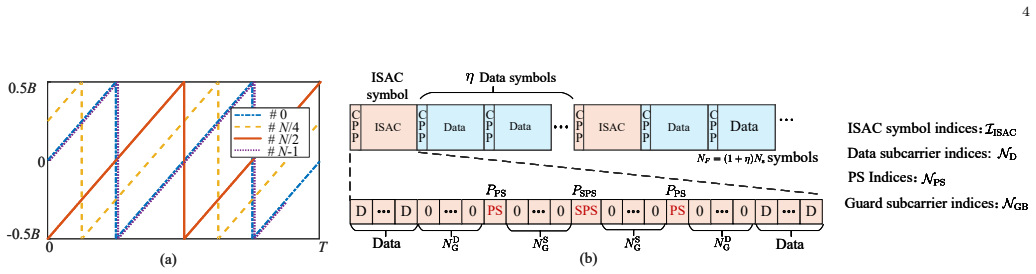
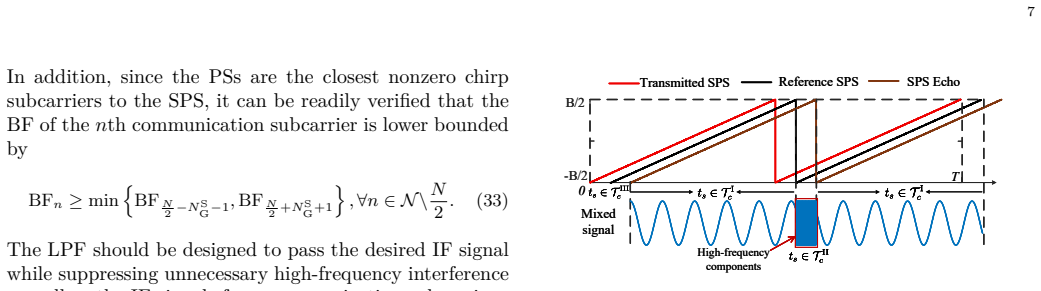
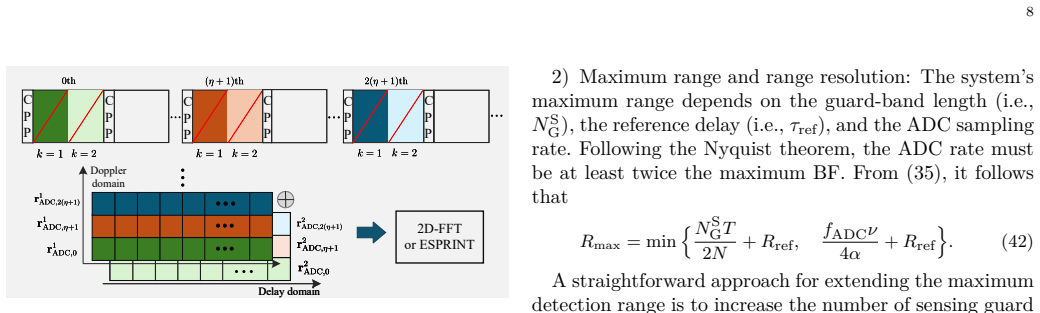
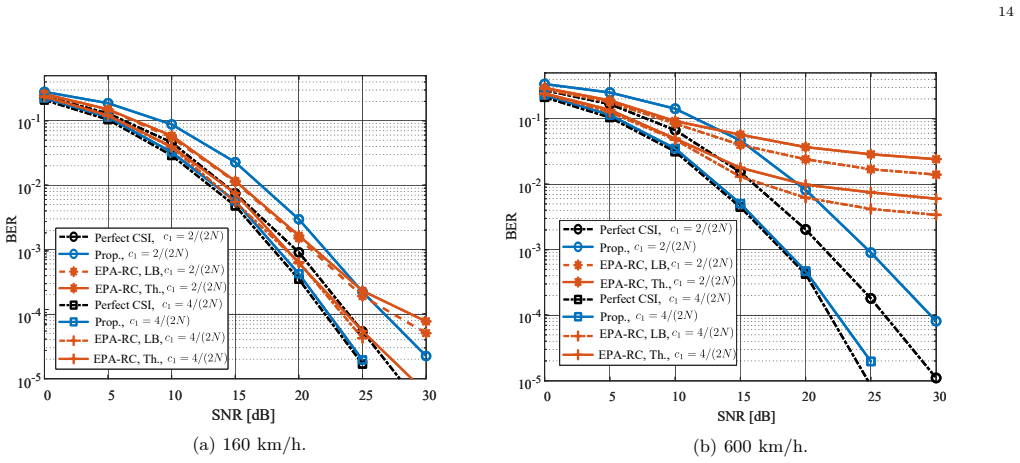
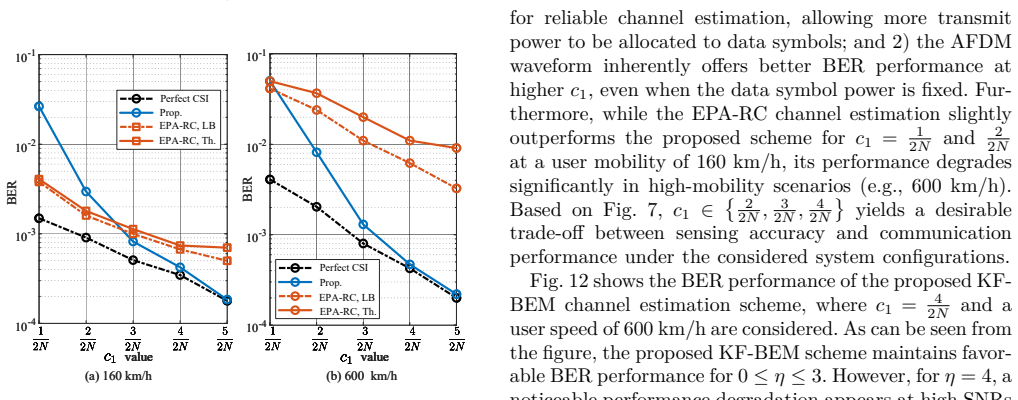
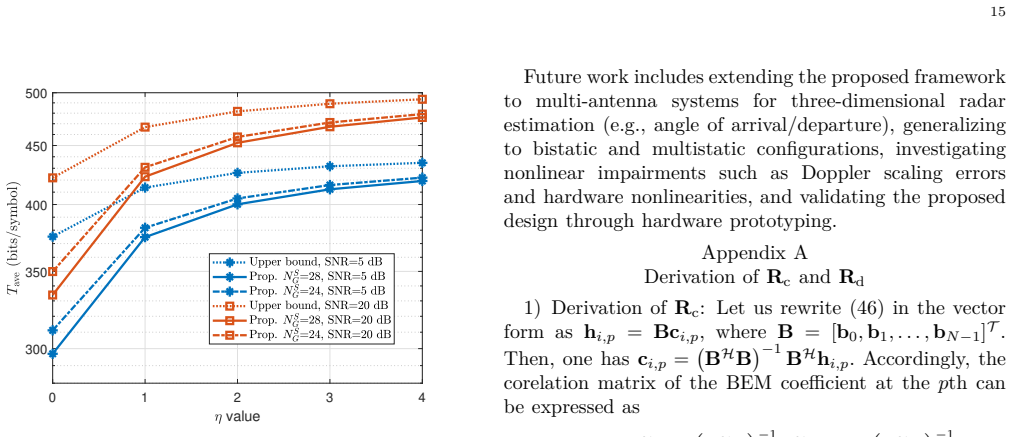
This paper proposes an Affine frequency division multiplexing (AFDM)-empowered integrated sensing and communications (ISAC) design, referred to as AFDM-ISAC. We first design a novel AFDM-ISAC frame structure that consists of both ISAC and pure data symbols. Each ISAC symbol consists of a single chirp subcarrier for both sensing and channel estimation, while the remaining subcarriers are allocated for communication. Building upon this structure, we present an analog-domain sensing receiver that down-mixes the received echo with a local chirp to fully exploit \textit{chirp compression} gains avoiding the need for full-duplex hardware. In addition, a sensing fusion algorithm, guided by AFDM modulation parameters, is further proposed in the digital domain. Leveraging the distinct features of the proposed AFDM-ISAC frame, we present a low-complexity channel estimation scheme for high mobility channels based on a generalized complex exponential basis expansion model (GCE-BEM), along with an optimal power allocation strategy between pilot and data symbols. Moreover, to support frame-based AFDM communications, a GCE-BEM-based Kalman filter is also employed for robust intra-frame channel estimation.
Editorial analysis
A structured set of objections, weighed in public.
Referee Report
Summary. The paper proposes an AFDM-empowered ISAC design (AFDM-ISAC) featuring a novel frame structure that interleaves ISAC symbols (each containing one chirp subcarrier for joint sensing and channel estimation, with remaining subcarriers for data) and pure data symbols. It introduces an analog-domain sensing receiver that down-mixes the echo with a local chirp to exploit chirp compression gains without full-duplex hardware, a parameter-guided digital sensing fusion algorithm, a low-complexity GCE-BEM-based channel estimator with optimal pilot-data power allocation for high-mobility channels, and a GCE-BEM Kalman filter for intra-frame tracking.
Significance. If validated, the design offers a hardware-efficient approach to ISAC in high-mobility scenarios by leveraging AFDM chirp properties for compression and model-based estimation. Strengths include the explicit frame structure separating sensing/comms roles and the avoidance of full-duplex via analog processing; these could support reproducible implementations if the fusion algorithm and BEM parameters are fully specified.
major comments (2)
- [analog-domain sensing receiver description] The central claim that analog down-mixing with a local chirp fully exploits chirp compression gains while avoiding full-duplex hardware (abstract and sensing receiver description) requires explicit analysis of residual self-interference or quantization effects; without this, the hardware-avoidance benefit remains unverified and load-bearing for the overall ISAC feasibility.
- [GCE-BEM channel estimation and Kalman filter sections] The GCE-BEM channel estimation scheme and associated Kalman filter (channel estimation and intra-frame sections) rely on the model providing robust estimation for targeted high-mobility channels, but the manuscript must specify the exact basis order, Doppler spread assumptions, and state-transition matrix to allow independent verification of the low-complexity claim and Kalman robustness.
minor comments (2)
- Define all acronyms (e.g., AFDM, ISAC, GCE-BEM) at first use and ensure consistent notation for subcarrier allocation across the frame structure description.
- [sensing fusion algorithm] Clarify the exact AFDM modulation parameters used to guide the sensing fusion algorithm and provide pseudocode or a block diagram for reproducibility.
Simulated Author's Rebuttal
We thank the referee for the constructive feedback on the AFDM-ISAC design. We address the two major comments point by point below, indicating where revisions will be made to improve clarity and verifiability.
read point-by-point responses
-
Referee: [analog-domain sensing receiver description] The central claim that analog down-mixing with a local chirp fully exploits chirp compression gains while avoiding full-duplex hardware (abstract and sensing receiver description) requires explicit analysis of residual self-interference or quantization effects; without this, the hardware-avoidance benefit remains unverified and load-bearing for the overall ISAC feasibility.
Authors: We agree that the manuscript would benefit from an explicit analysis of residual self-interference and quantization effects to fully substantiate the hardware-avoidance claim. The analog down-mixing approach is designed to achieve chirp compression prior to digitization, thereby sidestepping full-duplex digital processing. However, the current text does not quantify the residual impairments. We will add a dedicated paragraph in the sensing receiver section providing this analysis under representative hardware parameters. revision: yes
-
Referee: [GCE-BEM channel estimation and Kalman filter sections] The GCE-BEM channel estimation scheme and associated Kalman filter (channel estimation and intra-frame sections) rely on the model providing robust estimation for targeted high-mobility channels, but the manuscript must specify the exact basis order, Doppler spread assumptions, and state-transition matrix to allow independent verification of the low-complexity claim and Kalman robustness.
Authors: The GCE-BEM parameters and Kalman filter formulation are presented in the channel estimation and intra-frame tracking sections, but we acknowledge that the exact numerical values and assumptions are not stated with sufficient explicitness for independent verification. We will revise these sections to clearly list the chosen basis order, the maximum Doppler spread assumption, and the explicit form of the state-transition matrix. revision: yes
Axiom & Free-Parameter Ledger
Reference graph
Works this paper leans on
-
[1]
W. Yuan et al., “From ground to sky: Architectures, applications, and challenges shaping low-altitude wireless networks,” 2025. [Online]. A vailable: https://arxiv.org/abs/ 2506.12308
work page internal anchor Pith review Pith/arXiv arXiv 2025
-
[2]
Toward AFDM-based scalable and secure Internet of things for low-altitude economy networks,
Q. Luo et al., “Toward AFDM-based scalable and secure Internet of things for low-altitude economy networks,” IEEE Internet Things Magaz., pp. 1–8, 2026
2026
-
[3]
Ubiquitous UA V communi- cation enabled low-altitude economy: Applications, techniques, and 3GPP’s efforts,
D. He, W. Yuan, J. Wu, and R. Liu, “Ubiquitous UA V communi- cation enabled low-altitude economy: Applications, techniques, and 3GPP’s efforts,” IEEE Network, pp. 1–1, 2025
2025
-
[4]
Z. Sui et al., “Multi-functional chirp signalling for next- generation multi-carrier wireless networks: Communications, sensing and ISAC perspectives,” 2025. [Online]. A vailable: https://arxiv.org/abs/2508.06022
-
[5]
Q. Luo et al., “Chirp-based OCDM and AFDM waveforms for 6G and beyond: Principles, recent advances, and future opportunities,” Authorea Preprints, 2026. [Online]. A vailable: https://www.authorea.com/doi/full/10. 22541/au.177145233.37871971
-
[6]
Integrated sensing and communications: Toward dual-functional wireless networks for 6G and beyond,
F. Liu, Y. Cui, C. Masouros, J. Xu, T. X. Han, Y. C. Eldar, and S. Buzzi, “Integrated sensing and communications: Toward dual-functional wireless networks for 6G and beyond,” IEEE J. Sel. Areas Commun., vol. 40, no. 6, pp. 1728–1767, 2022. 16
2022
-
[7]
Affine frequency division multiplexing: Extending OFDM for scenario-flexibility and resilience,
H. Yin, et al., “Affine frequency division multiplexing: Extending OFDM for scenario-flexibility and resilience,” May
-
[8]
A vailable: https://arxiv.org/abs/2502.04735
[Online]. A vailable: https://arxiv.org/abs/2502.04735
-
[9]
Orthogonal time frequency space modulation,
R. Hadani, S. Rakib, M. Tsatsanis, A. Monk, A. J. Goldsmith, A. F. Molisch, and R. Calderbank, “Orthogonal time frequency space modulation,” in 2017 WCNC, 2017, pp. 1–6
2017
-
[10]
Near-optimal BEM OTFS receiver with low pilot overhead for high-mobility com- munications,
Y. Liu, Y. L. Guan, and D. González, “Near-optimal BEM OTFS receiver with low pilot overhead for high-mobility com- munications,” IEEE Trans. Commun., vol. 70, no. 5, pp. 3392– 3406, 2022
2022
-
[11]
Orthogonal chirp division multiplex- ing,
X. Ouyang and J. Zhao, “Orthogonal chirp division multiplex- ing,” IEEE Trans. Commun., vol. 64, no. 9, pp. 3946–3957, 2016
2016
-
[12]
Affine frequency division multiplexing for next generation wireless communica- tions,
A. Bemani, N. Ksairi, and M. Kountouris, “Affine frequency division multiplexing for next generation wireless communica- tions,” IEEE Trans. Wireless Commun., vol. 22, no. 11, pp. 8214–8229, 2023
2023
-
[13]
H. S. Rou et al., “From orthogonal time–frequency space to affine frequency-division multiplexing: A comparative study of next-generation waveforms for integrated sensing and commu- nications in doubly dispersive channels,” IEEE Signal Proce. Mag., vol. 41, no. 5, 2024
2024
-
[14]
Redefining orthogonal co-existence: A mother waveform framework for DFT-based waveforms,
A. A. Boudjelal, R. Y. Bir, and H. Arslan, “Redefining orthogonal co-existence: A mother waveform framework for DFT-based waveforms,” 2025. [Online]. A vailable: https: //arxiv.org/abs/2503.12676
-
[15]
Channel estimation for AFDM with superimposed pilots,
K. Zheng, M. Wen, T. Mao, L. Xiao, and Z. Wang, “Channel estimation for AFDM with superimposed pilots,” IEEE Transl Veh. Techno., 2024
2024
-
[16]
AFDM based preamble sequence transmission for 6G mobile satellite communication systems,
Y. Wang, Y. He, L. Zhao, and Y. Jiang, “AFDM based preamble sequence transmission for 6G mobile satellite communication systems,” IEEE Trans. Wireless Commun., 2025
2025
-
[17]
Joint channel, data and radar parameter estimation for AFDM systems in doubly-dispersive channels,
K. R. R. Ranasinghe, H. Seok Rou, G. Thadeu Freitas de Abreu, T. Takahashi, and K. Ito, “Joint channel, data and radar parameter estimation for AFDM systems in doubly-dispersive channels,” IEEE Trans. Wireless Commun., vol. 24, no. 2, pp. 1602–1619
-
[18]
AFDM-SCMA: A promising waveform for massive connectivity over high mobility channels,
Q. Luo et al., “AFDM-SCMA: A promising waveform for massive connectivity over high mobility channels,” IEEE Trans. Wireless Commun., vol. 23, no. 10, pp. 14 421–14 436, 2024
2024
-
[19]
Affine frequency division multiplexing with index modula- tion: Full diversity condition, performance analysis, and low- complexity detection,
Y. Tao, M. Wen, Y. Ge, J. Li, E. Basar, and N. Al-Dhahir, “Affine frequency division multiplexing with index modula- tion: Full diversity condition, performance analysis, and low- complexity detection,” IEEE Journal Sel. Areas Commun., 2025
2025
-
[20]
Affine frequency division multiplexing for 6G networks: Funda- mentals, opportunities, and challenges,
Q. Li, J. Li, M. Wen, X. Dang, H. Arslan, and N. Al-Dhahir, “Affine frequency division multiplexing for 6G networks: Funda- mentals, opportunities, and challenges,” IEEE Network, 2025
2025
-
[21]
Low- complexity vector-by-vector detector for AFDM-IM systems by reconstructing sparse channel matrix,
X. Wang, L. Xiao, Q. Luo, J. Zhou, M. Wen, and T. Jiang, “Low- complexity vector-by-vector detector for AFDM-IM systems by reconstructing sparse channel matrix,” IEEE Commun. Lett., 2025
2025
-
[22]
Power allocation for cell-free MIMO integrated sensing and communication,
G. Xia, P. Xiao, Q. Luo, B. Ji, Y. Zhang, and H. Zhou, “Power allocation for cell-free MIMO integrated sensing and communication,” 2025. [Online]. A vailable: https://arxiv.org/ abs/2505.19845
-
[23]
AFDM-based bistatic integrated sensing and communication in static scatterer environments,
J. Zhu et al., “AFDM-based bistatic integrated sensing and communication in static scatterer environments,” IEEE Wire- less Commun. Lett., vol. 13, no. 8, pp. 2245–2249, 2024
2024
-
[24]
Blind bistatic radar parameter estimation for AFDM systems in doubly-dispersive channels,
K. R. R. Ranasinghe et al., “Blind bistatic radar parameter estimation for AFDM systems in doubly-dispersive channels,”
-
[25]
A vailable: https://arxiv.org/abs/2407.05328
[Online]. A vailable: https://arxiv.org/abs/2407.05328
-
[26]
An AFDM-based integrated sensing and communications,
Y. Ni, Z. Wang, P. Yuan, and Q. Huang, “An AFDM-based integrated sensing and communications,” in IEEE ISWCS, 2022, pp. 1–6
2022
-
[27]
Integrated sensing and communications with affine frequency division multiplex- ing,
A. Bemani, N. Ksairi, and M. Kountouris, “Integrated sensing and communications with affine frequency division multiplex- ing,” IEEE Wireless Commun. Lett., vol. 13, no. 5, pp. 1255– 1259, 2024
2024
-
[28]
Normalized ambiguity function characteristics of OFDM, OTFS, AFDM, and CP- AFDM for ISAC,
H. S. Rou and G. T. F. de Abreu, “Normalized ambiguity function characteristics of OFDM, OTFS, AFDM, and CP- AFDM for ISAC,” arXiv preprint arXiv:2510.11216, 2025
-
[29]
Ambiguity function analysis of AFDM signals for integrated sensing and communications,
H. Yin et al., “Ambiguity function analysis of AFDM signals for integrated sensing and communications,” IEEE J. Sel. Areas Commun., vol. 44, pp. 196–211, 2026
2026
-
[30]
Ambiguity function analysis of AFDM under pulse-shaped random ISAC signaling,
Y. Ni, F. Liu, H. Yin, Y. Tang, Y. Ma, and Z. Wang, “Ambiguity function analysis of AFDM under pulse-shaped random ISAC signaling,” IEEE Trans. Wireless Commun., vol. 25, pp. 13 619– 13 635, 2026
2026
-
[31]
An integrated sensing and communications system based on affine frequency division multiplexing,
Y. Ni, P. Yuan, Q. Huang, F. Liu, and Z. Wang, “An integrated sensing and communications system based on affine frequency division multiplexing,” IEEE Trans. Wireless Commu., vol. 24, no. 5, 2025
2025
-
[32]
Ambiguity function analysis of affine frequency di- vision multiplexing for integrated sensing and communication,
E. Bedeer, “Ambiguity function analysis of affine frequency di- vision multiplexing for integrated sensing and communication,”
-
[33]
A vailable: https://arxiv.org/abs/2504.02582
[Online]. A vailable: https://arxiv.org/abs/2504.02582
-
[34]
AFDM-enabled integrated sensing and communication: Theoretical framework and pilot design,
F. Zhang, Z. Wang, T. Mao, T. Jiao, Y. Zhuo, M. Wen, W. Xiang, S. Chen, and G. K. Karagiannidis, “AFDM- enabled integrated sensing and communication: Theoretical framework and pilot design,” 2025. [Online]. A vailable: https://arxiv.org/abs/2502.14203
-
[35]
F. Xiao, Z. Li, and D. Slock, “Multipath component power delay profile based joint range and doppler estimation for AFDM-ISAC systems,” 2025. [Online]. A vailable: https: //arxiv.org/abs/2503.10833
-
[36]
Target sensing with off-grid sparse bayesian learning for AFDM-ISAC system,
Y. Luo, Y. L. Guan, Y. Ge, and C. Yuen, “Target sensing with off-grid sparse bayesian learning for AFDM-ISAC system,”
-
[37]
A vailable: https://arxiv.org/abs/2503.10011
[Online]. A vailable: https://arxiv.org/abs/2503.10011
-
[38]
A novel angle-delay-doppler estimation scheme for AFDM-ISAC system in mixed near-field and far-field scenarios,
Y. Luo, Y. L. Guan, Y. Ge, D. González, and C. Yuen, “A novel angle-delay-doppler estimation scheme for AFDM-ISAC system in mixed near-field and far-field scenarios,” IEEE Internet Things J., 2025
2025
-
[40]
OTFS-ISAC system with sub-nyquist ADC sampling rate,
H. Pu, X. Wang, A. Kumar, L. Su, and H. Li, “OTFS-ISAC system with sub-nyquist ADC sampling rate,” IEEE J. Sel. Areas Commun., vol. 44, pp. 212–228, 2026
2026
-
[41]
Diagonally re- constructed channel estimation for MIMO-AFDM with inter- doppler interference in doubly selective channels,
H. Yin, X. Wei, Y. Tang, and K. Yang, “Diagonally re- constructed channel estimation for MIMO-AFDM with inter- doppler interference in doubly selective channels,” IEEE Trans. Wireless Commun., vol. 23, no. 10, pp. 14 066–14 079, 2024
2024
-
[42]
Design and performance analysis of index modulation empowered AFDM system,
J. Zhu, Q. Luo, G. Chen, P. Xiao, and L. Xiao, “Design and performance analysis of index modulation empowered AFDM system,” IEEE Wireless Commun. Lett., 2023
2023
-
[43]
Multi-input multi-output fading channel tracking and equal- ization using kalman estimation,
C. Komninakis, C. Fragouli, A. H. Sayed, and R. D. Wesel, “Multi-input multi-output fading channel tracking and equal- ization using kalman estimation,” IEEE Trans. Signal Proce., vol. 50, no. 5, 2002
2002
-
[44]
An EM-based forward-backward kalman filter for the estimation of time-variant channels in OFDM,
T. Y. Al-Naffouri, “An EM-based forward-backward kalman filter for the estimation of time-variant channels in OFDM,” IEEE Trans. Signal Processing, vol. 55, no. 7, pp. 3924–3930, 2007
2007
-
[45]
ESPRIT-estimation of signal param- eters via rotational invariance techniques,
R. Roy and T. Kailath, “ESPRIT-estimation of signal param- eters via rotational invariance techniques,” IEEE Trans. Signal Process., vol. 37, no. 7, pp. 984–995, 1989
1989
-
[46]
Multi-target location and doppler estimation in multistatic automotive radar applications,
A. Moussa, W. Liu, Y. D. Zhang, and M. S. Greco, “Multi-target location and doppler estimation in multistatic automotive radar applications,” IEEE Trans. Radar Systems, vol. 2, pp. 215–225, 2024
2024
-
[47]
MUSIC, maximum likelihood, and Cramér-Rao bound,
P. Stoica and A. Nehorai, “MUSIC, maximum likelihood, and Cramér-Rao bound,” IEEE Trans. Acoust., Speech, Signal Process., vol. 37, no. 5, pp. 720–741, May 1989
1989
-
[48]
Chirp parameter selection for affine frequency division multiplexing with MMSE equalization,
Z. Li et al., “Chirp parameter selection for affine frequency division multiplexing with MMSE equalization,” IEEE Trans. Commun., 2024
2024
-
[49]
OTFS-based ISAC for super-resolution range-velocity profile,
S. E. Zegrar, H. Haif, and H. Arslan, “OTFS-based ISAC for super-resolution range-velocity profile,” IEEE Trans. Commun., vol. 72, no. 7, pp. 3934–3946, 2024
2024
discussion (0)
Sign in with ORCID, Apple, or X to comment. Anyone can read and Pith papers without signing in.