How does academic performance affect self-efficacy? Interpretable modelling through latent academic achievement
Pith reviewed 2026-07-02 07:50 UTC · model grok-4.3
The pith
A conditional formulation of the Gaussian copula model lets latent academic achievement serve as an interpretable predictor of self-efficacy while supporting a tailored Gibbs sampler.
A machine-rendered reading of the paper's core claim, the machinery that carries it, and where it could break.
Core claim
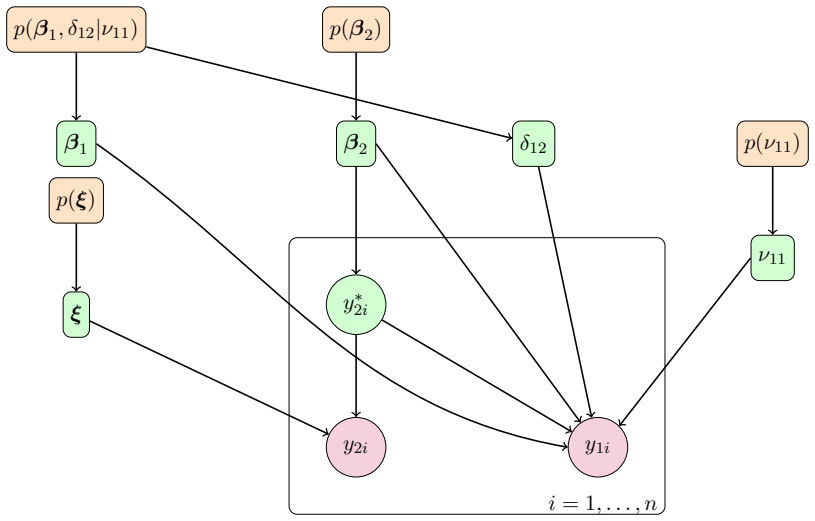
The resulting conditional formulation yields an interpretable regression characterisation of how latent academic achievement relates to self-efficacy. Furthermore, it enables a tailored partially collapsed Gibbs sampler that analytically integrates out the regression coefficients when updating the variable inclusion indicators. Simulation studies demonstrate that the proposed conditional formulation and tailored sampler improve sampling efficiency and variable-selection performance relative to a recent, more general joint Gaussian copula regression formulation.
What carries the argument
Conditional formulation of the joint Gaussian copula regression that places the latent continuous achievement variable directly into the self-efficacy regression equation
If this is right
- Latent academic achievement enters the self-efficacy equation as a direct, interpretable predictor.
- Bayesian variable selection identifies separate covariate sets for academic performance versus self-efficacy.
- The tailored sampler improves mixing and selection accuracy compared with the general joint copula model.
- Application to the Australian children cohort shows the two outcomes differ markedly in their associated covariates.
Where Pith is reading between the lines
- The conditional approach could be applied to other mixed ordinal-continuous outcomes in social or health data without arbitrary recoding of scales.
- If the single-latent assumption holds, interventions on observable academic performance would have predictable downstream effects on self-efficacy.
- The framework supplies a route to treat ordinal predictors in regression while preserving uncertainty about the underlying continuous trait.
Load-bearing premise
A single latent continuous achievement variable together with the Gaussian copula structure adequately describes the joint distribution of ordinal performance and continuous self-efficacy.
What would settle it
Simulated data generated from a process requiring two or more latent factors or non-Gaussian dependence would produce lower sampling efficiency or incorrect variable selections under the proposed conditional model relative to the joint formulation.
Figures
read the original abstract
There is increasing evidence of a directional relationship from academic performance to self-efficacy. We develop a Bayesian model for investigating this relationship when academic performance is measured on an ordinal scale and self-efficacy on a continuous scale. The model allows latent academic achievement to enter the self-efficacy regression as a predictor, while Bayesian variable selection identifies factors associated with either response. The resulting conditional formulation yields an interpretable regression characterisation of how latent academic achievement relates to self-efficacy. Furthermore, it enables a tailored partially collapsed Gibbs sampler that analytically integrates out the regression coefficients when updating the variable inclusion indicators. Simulation studies demonstrate that the proposed conditional formulation and tailored sampler improve sampling efficiency and variable-selection performance relative to a recent, more general joint Gaussian copula regression formulation. We apply the methodology to data from the longitudinal study of Australian children, a landmark national cohort study covering children's education, social and emotional wellbeing, health and family circumstances. The model and analysis shed light on how latent academic achievement relates to self-efficacy in Australian children, and reveal that the two outcomes differ markedly in the range of covariates associated with each outcome.
Editorial analysis
A structured set of objections, weighed in public.
Referee Report
Summary. The paper develops a Bayesian conditional formulation derived from a joint Gaussian copula model for mixed ordinal (academic performance) and continuous (self-efficacy) outcomes. Latent academic achievement enters the self-efficacy regression as a predictor, with spike-and-slab priors for variable selection on covariates associated with either outcome. A tailored partially collapsed Gibbs sampler analytically integrates out regression coefficients when updating inclusion indicators. Simulations are reported to show gains in sampling efficiency and variable-selection performance relative to a more general joint formulation; the model is then applied to LSAC data to characterize how latent achievement relates to self-efficacy and to identify differing covariate sets for the two responses.
Significance. If the simulation results and model assumptions hold, the conditional formulation supplies an interpretable regression characterization of the latent-predictor relationship while delivering a computationally convenient sampler. The approach could extend to other mixed-outcome settings that require variable selection and latent continuous predictors. The LSAC application provides concrete substantive findings on covariate differences between the outcomes.
major comments (1)
- [Simulation studies] Simulation studies (referenced in the abstract and presumably detailed in §4 or §5): the claim of improved efficiency and selection performance is central to the contribution, yet the abstract supplies no quantitative effect sizes, effective sample size ratios, or sensitivity checks; without these numbers it is impossible to judge whether the gains are practically meaningful or sensitive to the data-generating processes used.
minor comments (2)
- Ensure the 'recent, more general joint Gaussian copula regression formulation' used as comparator is explicitly cited in the introduction and simulation sections so readers can locate the baseline method.
- [Model development] Clarify in the model section whether the single latent continuous achievement variable is treated as a modeling choice or as an assumption whose violation would materially alter the conditional regression interpretation.
Simulated Author's Rebuttal
We thank the referee for the positive assessment, the recommendation of minor revision, and the helpful comment on the simulation studies. We address the point below.
read point-by-point responses
-
Referee: [Simulation studies] Simulation studies (referenced in the abstract and presumably detailed in §4 or §5): the claim of improved efficiency and selection performance is central to the contribution, yet the abstract supplies no quantitative effect sizes, effective sample size ratios, or sensitivity checks; without these numbers it is impossible to judge whether the gains are practically meaningful or sensitive to the data-generating processes used.
Authors: We agree that the abstract would benefit from quantitative summaries to allow readers to assess the practical magnitude of the reported gains. The simulation section already contains the detailed results (including effective sample size ratios, selection accuracy metrics, and checks across multiple data-generating processes), but we will revise the abstract to include specific numerical effect sizes and key performance ratios drawn from those studies. revision: yes
Circularity Check
No significant circularity identified
full rationale
The derivation begins from a joint Gaussian copula model for mixed ordinal/continuous outcomes and derives a conditional formulation that places latent academic achievement as a predictor in the self-efficacy regression; this is a modeling choice, not a self-definition. The partially collapsed Gibbs sampler analytically integrates regression coefficients under spike-and-slab priors when updating inclusion indicators, which follows directly from the conditional structure without reducing to fitted inputs renamed as predictions. Simulation comparisons are made to an external recent joint formulation, and the single-latent-variable assumption is invoked as a modeling decision rather than justified by self-citation chains or uniqueness theorems. No load-bearing step reduces by construction to its own inputs, and the claimed efficiency and selection gains are presented as empirical simulation results.
Axiom & Free-Parameter Ledger
axioms (2)
- domain assumption A latent continuous variable underlies the observed ordinal academic performance scale
- domain assumption Gaussian copula structure adequately represents dependence between the ordinal and continuous responses
Reference graph
Works this paper leans on
-
[1]
2013 , publisher=
Monte Carlo statistical methods , author=. 2013 , publisher=
2013
-
[2]
2011 , publisher=
Handbook of Markov Chain Monte Carlo , author=. 2011 , publisher=
2011
-
[3]
Austerity in
Korattikara, Anoop and Chen, Yutian and Welling, Max , journal=. Austerity in
-
[4]
Towards scaling up
Bardenet, R. Towards scaling up. Proceedings of the 31st International Conference on Machine Learning , pages=
-
[5]
Natural Gradient Works Efficiently in Learning , year=
Amari, Shun-ichi , journal=. Natural Gradient Works Efficiently in Learning , year=
-
[6]
Journal of Machine Learning Research , year =
James Martens , title =. Journal of Machine Learning Research , year =
-
[7]
The Block-
Quiroz, Matias and Dang, Khue-Dung and Tran, Minh-Ngoc and Kohn, Robert and Villani, Mattias , journal=. The Block-
-
[8]
Efficient
Talhouk, Aline and Doucet, Arnaud and Murphy, Kevin , journal=. Efficient. 2012 , publisher=
2012
-
[9]
Bayesian Analysis , year =
Bayesian auxiliary variable models for binary and multinomial regression , author=. Bayesian Analysis , year =
-
[10]
Variational inference:
Blei, David M and Kucukelbir, Alp and McAuliffe, Jon D , journal=. Variational inference:
-
[11]
SMC ^2 :
Chopin, Nicolas and Jacob, Pierre E and Papaspiliopoulos, Omiros , journal=. SMC ^2 :
-
[12]
P. H. Garthwaite and Y. Fan and S. A. Sisson , title =. Communications in Statistics - Theory and Methods , volume =. 2016 , publisher =
2016
-
[13]
Journal of the Royal Statistical Society: Series B (Statistical Methodology) , volume=
Particle Markov chain Monte Carlo methods , author=. Journal of the Royal Statistical Society: Series B (Statistical Methodology) , volume=
-
[14]
Bernoulli , number =
Heikki Haario and Eero Saksman and Johanna Tamminen , title =. Bernoulli , number =
-
[15]
Bootstrap methods:
Efron, Bradley , journal=. Bootstrap methods:
-
[16]
1994 , publisher=
An introduction to the bootstrap , author=. 1994 , publisher=
1994
-
[17]
Journal of Econometrics , volume=
Generalized autoregressive conditional heteroskedasticity , author=. Journal of Econometrics , volume=. 1986 , publisher=
1986
-
[18]
Autoregressive conditional heteroscedasticity with estimates of the variance of
Engle, Robert F , journal=. Autoregressive conditional heteroscedasticity with estimates of the variance of. 1982 , publisher=
1982
-
[19]
The Journal of Finance , volume=
On the relation between the expected value and the volatility of the nominal excess return on stocks , author=. The Journal of Finance , volume=. 1993 , publisher=
1993
-
[20]
Speeding up
Quiroz, Matias and Kohn, Robert and Villani, Mattias and Tran, Minh-Ngoc , journal=. Speeding up. 2019 , publisher=
2019
-
[21]
Perturbations of
Rudolf, Daniel and Smith, Aaron and Quiroz, Matias , booktitle =. Perturbations of
-
[22]
Subsampling
Quiroz, Matias and Villani, Mattias and Kohn, Robert and Tran, Minh-Ngoc and Dang, Khue-Dung , journal=. Subsampling. 2018 , publisher=
2018
-
[23]
Proceedings of the 28th international conference on machine learning (ICML-11) , pages=
Bayesian learning via stochastic gradient Langevin dynamics , author=. Proceedings of the 28th international conference on machine learning (ICML-11) , pages=. 2011 , organization=
2011
-
[24]
Stochastic gradient
Chen, Tianqi and Fox, Emily and Guestrin, Carlos , booktitle=. Stochastic gradient. 2014 , organization=
2014
-
[25]
SIAM Journal on Control and Optimization , volume=
Acceleration of stochastic approximation by averaging , author=. SIAM Journal on Control and Optimization , volume=. 1992 , publisher=
1992
-
[26]
Hamiltonian
Dang, Khue-Dung and Quiroz, Matias and Kohn, Robert and Tran, Minh-Ngoc and Villani, Mattias , journal=. Hamiltonian
-
[27]
Bardenet, R. On. Journal of Machine Learning Research , volume=
-
[28]
Journal of the Royal Statistical Society Series B: Statistical Methodology , volume=
The correlated pseudomarginal method , author=. Journal of the Royal Statistical Society Series B: Statistical Methodology , volume=. 2018 , publisher=
2018
-
[29]
The Block Pseudo-Marginal Sampler
The block pseudo-marginal sampler , author=. arXiv preprint arXiv:1603.02485 , year=
work page internal anchor Pith review Pith/arXiv arXiv
-
[30]
Journal of Economic Dynamics and Control , volume=
Threshold heteroskedastic models , author=. Journal of Economic Dynamics and Control , volume=. 1994 , publisher=
1994
-
[31]
No free lunch for approximate
Johndrow, James E and Pillai, Natesh S and Smith, Aaron , journal=. No free lunch for approximate
-
[32]
Global optimization by basin-hopping and the lowest energy structures of
Wales, David J and Doye, Jonathan PK , journal=. Global optimization by basin-hopping and the lowest energy structures of. 1997 , publisher=
1997
-
[33]
On some properties of
Pitt, Michael K and dos Santos Silva, Ralph and Giordani, Paolo and Kohn, Robert , journal=. On some properties of. 2012 , publisher=
2012
-
[34]
2003 , publisher=
Model Assisted Survey Sampling , author=. 2003 , publisher=
2003
-
[35]
and Pitt, M
Doucet, A. and Pitt, M. K. and Deligiannidis, G. and Kohn, R. , title =. Biometrika , volume =
-
[36]
Conditional heteroskedasticity in asset returns:
Nelson, Daniel B , journal=. Conditional heteroskedasticity in asset returns:. 1991 , publisher=
1991
-
[37]
The Econometrics Journal , volume =
Bauwens, Luc and Lubrano, Michel , title =. The Econometrics Journal , volume =
-
[38]
Facilitating the
Ritter, Christian and Tanner, Martin A , journal=. Facilitating the. 1992 , publisher=
1992
-
[39]
Stochastic variational inference for
Xuan, Hanwen and Maestrini, Luca and Chen, Feng and Grazian, Clara , journal=. Stochastic variational inference for. 2024 , publisher=
2024
-
[40]
Concepción and Galeano, Pedro , title =
Virbickaite, Audrone and Ausín, M. Concepción and Galeano, Pedro , title =. Journal of Economic Surveys , volume =
-
[41]
and Kroner, Kenneth F
Bollerslev, Tim and Chou, Ray Y. and Kroner, Kenneth F. , title =. Journal of Econometrics , pages =
-
[42]
Proceedings of the Fourth ACM International Conference on AI in Finance , pages =
Magris, Martin and Iosifidis, Alexandros , title =. Proceedings of the Fourth ACM International Conference on AI in Finance , pages =. 2023 , publisher =
2023
-
[43]
Econometrics and Statistics , volume =
Efficient. Econometrics and Statistics , volume =. 2021 , author =
2021
-
[44]
Estimating
Huang, Da and Wang, Hansheng and Yao, Qiwei , journal=. Estimating. 2008 , publisher=
2008
-
[45]
The convergence of optimization based GARCH estimators: T heory and application
Winker, Peter and Maringer, Dietmar. The convergence of optimization based GARCH estimators: T heory and application. Compstat 2006 - Proceedings in Computational Statistics. 2006
2006
-
[46]
Variational inference for
Magris, Martin and Iosifidis, Alexandros , booktitle=. Variational inference for
-
[47]
Journal of the American Statistical Association , volume =
HaiYing Wang and Rong Zhu and Ping Ma , title =. Journal of the American Statistical Association , volume =
-
[48]
Journal of Data Science , volume=
A review on optimal subsampling methods for massive datasets , author=. Journal of Data Science , volume=
-
[49]
Statistica Sinica , volume=
Optimal subsampling algorithms for big data regressions , author=. Statistica Sinica , volume=. 2021 , publisher=
2021
-
[50]
Spectral subsampling
Salomone, Robert and Quiroz, Matias and Kohn, Robert and Villani, Mattias and Tran, Minh-Ngoc , booktitle=. Spectral subsampling. 2020 , organization=
2020
-
[51]
Econometrics and Statistics , volume =
Spectral Subsampling. Econometrics and Statistics , volume =. 2024 , issn =
2024
-
[52]
Whittle estimation in a heavy-tailed
Mikosch, Thomas and Straumann, Daniel , journal=. Whittle estimation in a heavy-tailed. 2002 , publisher=
2002
-
[53]
Estimation and information in stationary time series , author=. Arkiv f. 1953 , publisher=
1953
-
[54]
Stochastic gradient
Ma, Yi-An and Foti, Nicholas J and Fox, Emily B , booktitle=. Stochastic gradient. 2017 , organization=
2017
-
[55]
Bayesian Analysis , number =
Christopher Aicher and Srshti Putcha and Christopher Nemeth and Paul Fearnhead and Emily Fox , title =. Bayesian Analysis , number =
-
[56]
Stochastic gradient
Nemeth, Christopher and Fearnhead, Paul , journal=. Stochastic gradient. 2021 , publisher=
2021
-
[57]
The Annals of Mathematical Statistics , pages=
A stochastic approximation method , author=. The Annals of Mathematical Statistics , pages=. 1951 , publisher=
1951
-
[58]
Analytic Derivatives and the Computation of
Gabriele Fiorentini and Giorgio Calzolari and Lorenzo Panattoni , journal =. Analytic Derivatives and the Computation of
-
[59]
Automatic differentiation in machine learning:
Baydin, Atilim Gunes and Pearlmutter, Barak A and Radul, Alexey Andreyevich and Siskind, Jeffrey Mark , journal=. Automatic differentiation in machine learning:
-
[60]
2019 , publisher=
Matrix Differential Calculus with Applications in Statistics and Econometrics , author=. 2019 , publisher=
2019
-
[61]
Stochastic gradient descent as approximate
Mandt, Stephan and Hoffman, Matthew D and Blei, David M , journal=. Stochastic gradient descent as approximate
-
[62]
On asymptotic normality of limiting density functions with
Chen, Chan-Fu , journal=. On asymptotic normality of limiting density functions with. 1985 , publisher=
1985
-
[63]
Knuth, Donald E , journal=. Johann
-
[64]
2009 , publisher=
Andrieu, Christophe and Roberts, Gareth O , journal=. 2009 , publisher=
2009
-
[65]
Subsampling sequential
Gunawan, David and Dang, Khue-Dung and Quiroz, Matias and Kohn, Robert and Tran, Minh-Ngoc , journal=. Subsampling sequential. 2020 , publisher=
2020
-
[66]
Biometrika , volume=
A sequential particle filter method for static models , author=. Biometrika , volume=. 2002 , publisher=
2002
-
[67]
Doubly Stochastic Variational
Titsias, Michalis and Lázaro-Gredilla, Miguel , booktitle =. Doubly Stochastic Variational. 2014 , volume =
2014
-
[68]
and Lunde, Asger , title =
Hansen, Peter R. and Lunde, Asger , title =. Journal of Applied Econometrics , volume =
-
[69]
Fast inference for intractable likelihood problems using variational
Gunawan, David and Tran, Minh-Ngoc and Kohn, Robert , journal=. Fast inference for intractable likelihood problems using variational
-
[70]
Auto-Encoding Variational
Kingma, Diederik P and Welling, Max , booktitle=. Auto-Encoding Variational
-
[71]
Proceedings of the Twenty-Second International Conference on Artificial Intelligence and Statistics , pages =
Variance reduction properties of the reparameterization trick , author =. Proceedings of the Twenty-Second International Conference on Artificial Intelligence and Statistics , pages =. 2019 , volume =
2019
-
[72]
Journal of Computational and Graphical Statistics , volume=
Gaussian variational approximation with a factor covariance structure , author=. Journal of Computational and Graphical Statistics , volume=. 2018 , publisher=
2018
-
[73]
Nott and Robert Kohn , title =
Matias Quiroz and David J. Nott and Robert Kohn , title =. Bayesian Analysis , number =
-
[74]
and Ba, Jimmy , title =
Kingma, Diederik P. and Ba, Jimmy , title =. Proceedings of the 3rd International Conference on Learning Representations , year =
-
[75]
Speeding up
Quiroz, Matias and Tran, Minh-Ngoc and Villani, Mattias and Kohn, Robert , journal=. Speeding up. 2018 , publisher=
2018
-
[76]
The Journal of Chemical Physics , volume=
The penalty method for random walks with uncertain energies , author=. The Journal of Chemical Physics , volume=. 1999 , publisher=
1999
-
[77]
Bayesian Analysis of Big Data via Subsampling
Quiroz, Matias and Tran, Minh-Ngoc , publisher =. Bayesian Analysis of Big Data via Subsampling. Wiley StatsRef: Statistics Reference Online , pages =
- [78]
-
[79]
Bayesian variable selection for
Alexopoulos, Angelos and Bottolo, Leonardo , journal=. Bayesian variable selection for. 2021 , publisher=
2021
-
[80]
Partially collapsed
Van Dyk, David A and Park, Taeyoung , journal=. Partially collapsed. 2008 , publisher=
2008
discussion (0)
Sign in with ORCID, Apple, or X to comment. Anyone can read and Pith papers without signing in.