From Consistency to Collaborative Discovery: MFEA-CoD for Multitask Novelty Search
Pith reviewed 2026-07-02 03:23 UTC · model grok-4.3
The pith
MFEA-CoD coordinates multiple novelty search tasks to collaboratively discover diverse novel solutions via repulsion and adaptive transfer.
A machine-rendered reading of the paper's core claim, the machinery that carries it, and where it could break.
Core claim
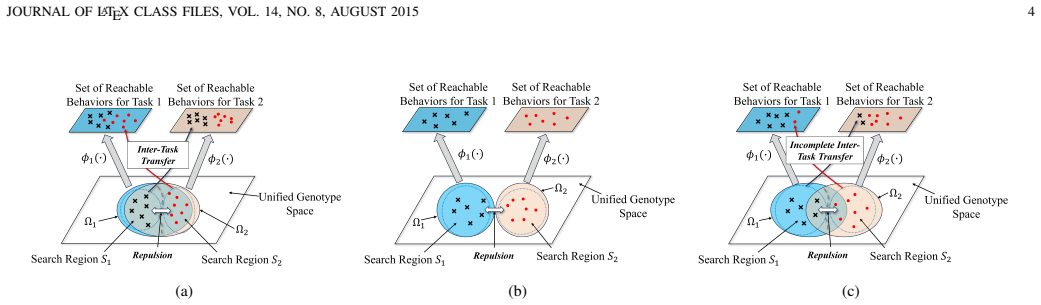
MFEA-CoD coordinates multiple novelty search tasks to collaboratively discover behaviorally novel solutions rather than merely transferring consistent search information for faster convergence. A multitask repulsion operator encourages different tasks to explore distinct regions of the unified search space, thereby reducing redundant behavioral discoveries. An adaptive inter-task transfer mechanism exploits shared discovery opportunities in overlapping novelty-improving regions by adjusting the transfer probability according to the online contribution of transferred information. MFEA-CoD is further extended to multitask novelty-augmented optimization to alleviate premature convergence caused
What carries the argument
The multitask repulsion operator paired with an adaptive inter-task transfer mechanism that together separate exploration while selectively sharing overlapping novelty gains.
If this is right
- Reduces redundant behavioral discoveries across tasks.
- Exploits shared opportunities in overlapping novelty regions through adjusted transfer rates.
- Improves discovery efficiency on basin, maze, policy, and generative problems.
- Alleviates premature convergence when novelty is added to deceptive objective functions.
Where Pith is reading between the lines
- The same repulsion-plus-adaptive-transfer pattern could be tested on other population-based methods that currently waste evaluations on duplicate behaviors.
- If repulsion strength is made task-dependent rather than uniform, the approach might scale to larger numbers of tasks without forcing artificial separation.
- Applying the framework to standard objective optimization without novelty would test whether collaborative discovery ideas transfer when the goal is convergence rather than diversity.
Load-bearing premise
Overlapping novelty-improving regions exist across tasks and the repulsion operator can separate them without destroying useful shared information that the adaptive transfer would otherwise use.
What would settle it
Run the algorithm on a set of tasks whose novelty-improving regions have zero overlap and check whether performance drops below that of independent single-task novelty searches.
Figures
read the original abstract
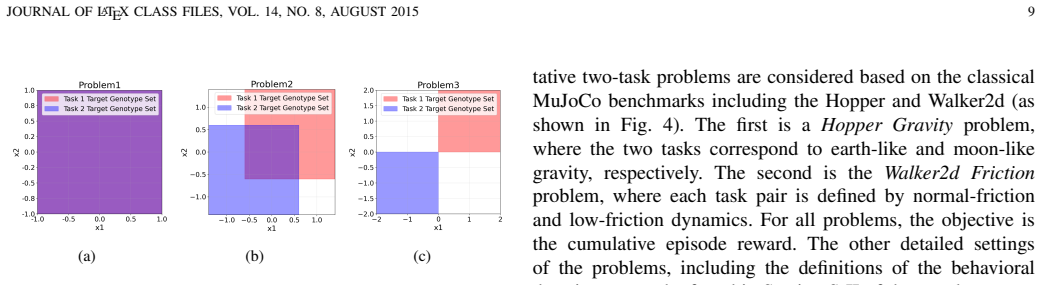
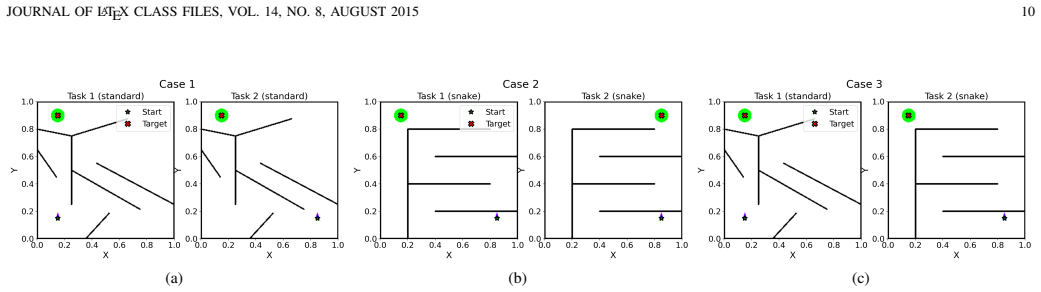
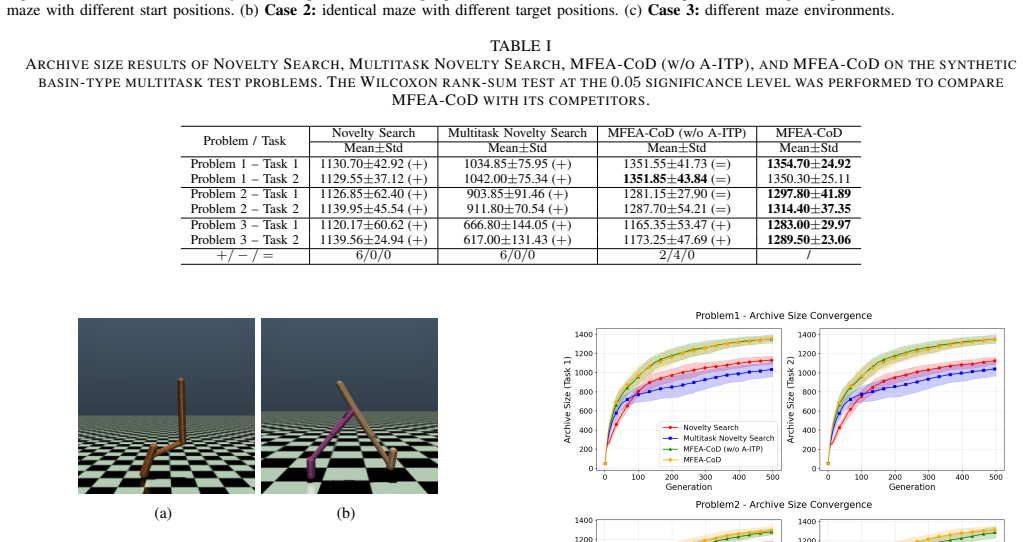
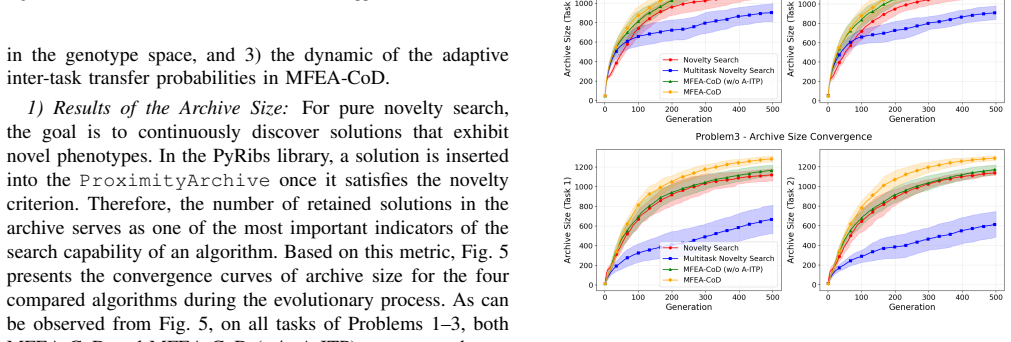
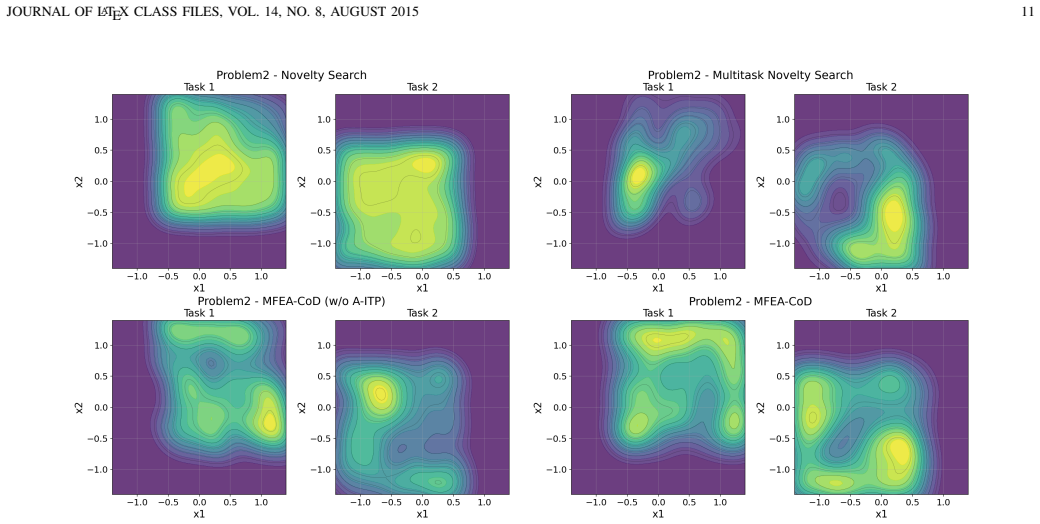
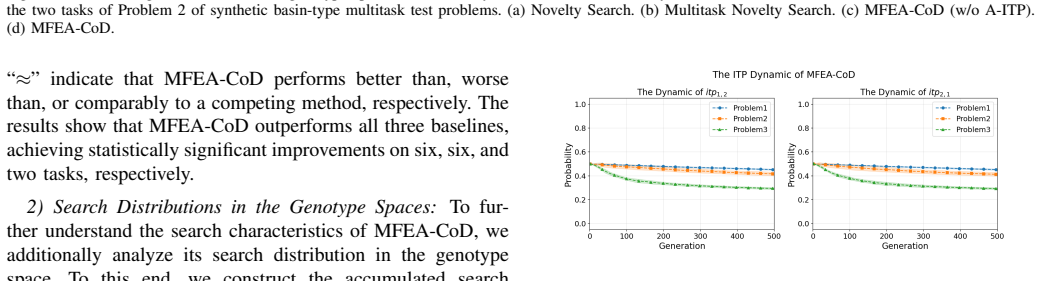
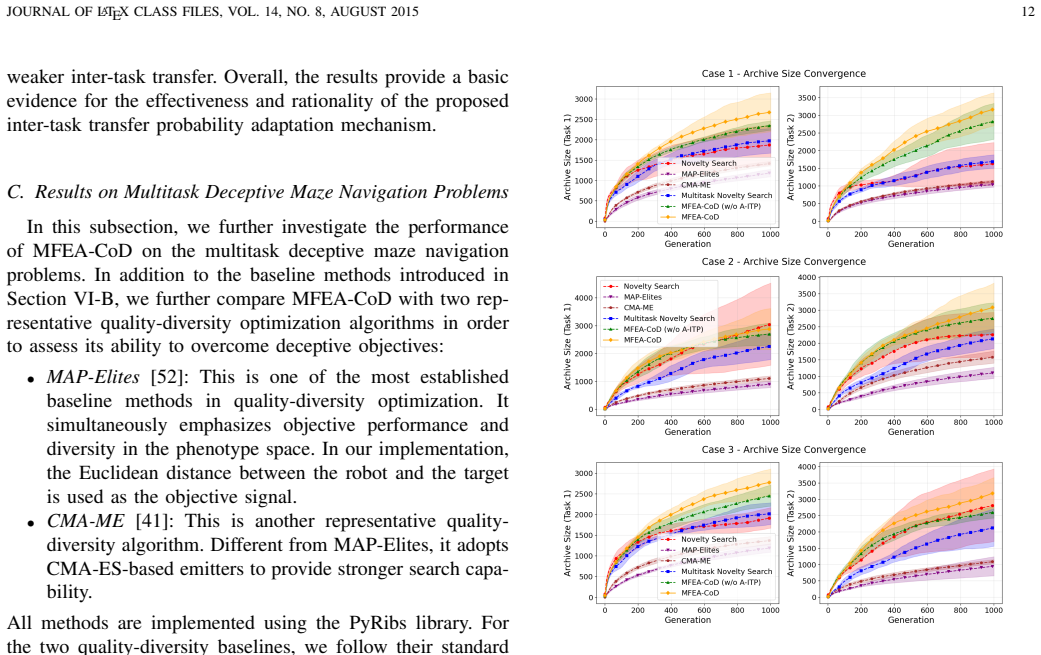
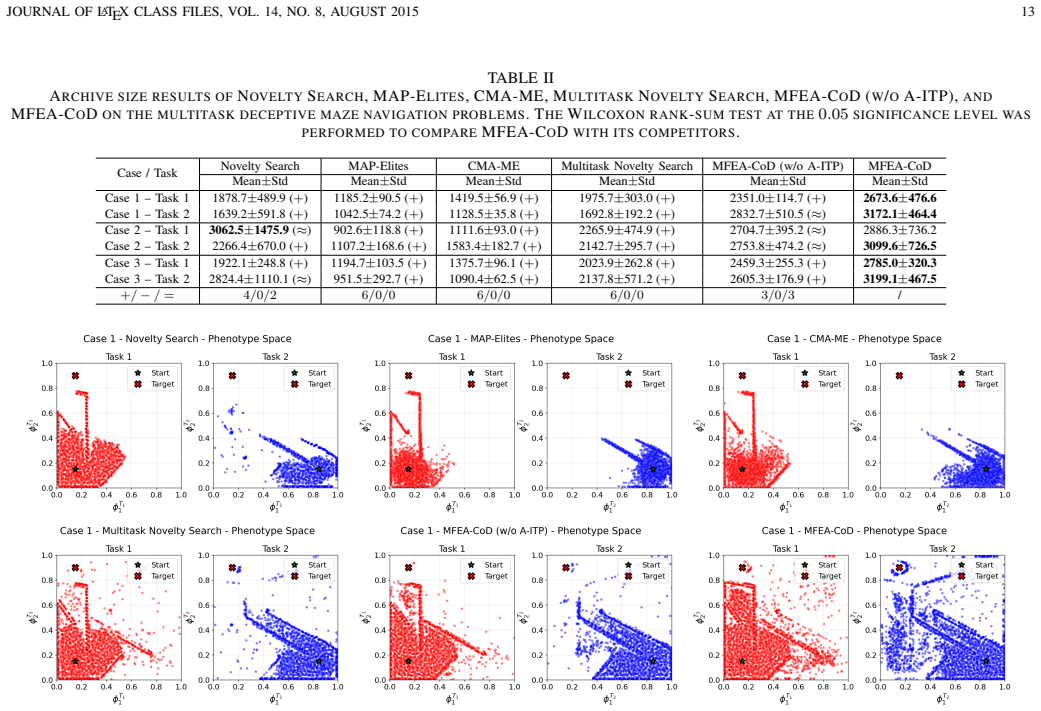
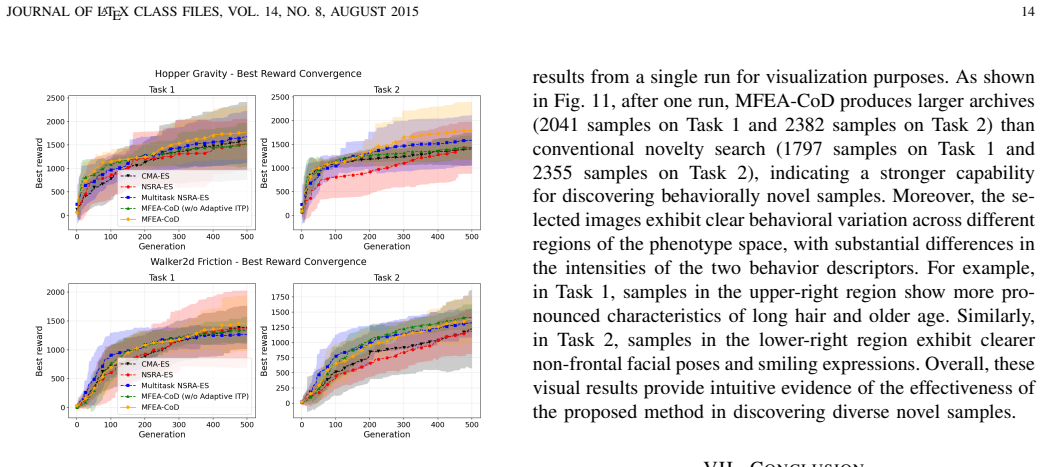
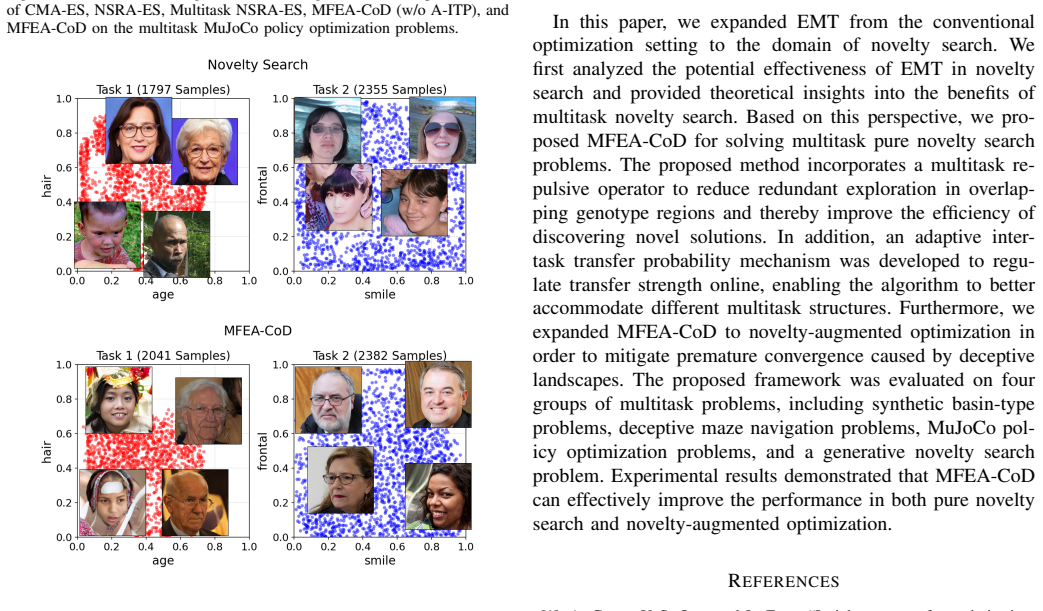
Evolutionary multitasking (EMT) has shown strong capability in solving multiple optimization problems simultaneously by exploiting latent inter-task consistency, such as similarities in promising solutions or search directions. However, most existing EMT studies remain focused on objective-driven optimization, where such consistency is mainly used to accelerate convergence toward predefined optima. In this paper, we move EMT from consistency to collaborative discovery and propose a multifactorial evolutionary algorithm with collaborative discovery (MFEA-CoD) for multitask novelty search. Unlike conventional EMT, MFEA-CoD coordinates multiple novelty search tasks to collaboratively discover behaviorally novel solutions rather than merely transferring consistent search information for faster convergence. Specifically, a multitask repulsion operator encourages different tasks to explore distinct regions of the unified search space, thereby reducing redundant behavioral discoveries. Meanwhile, an adaptive inter-task transfer mechanism exploits shared discovery opportunities in overlapping novelty-improving regions by adjusting the transfer probability according to the online contribution of transferred information. Furthermore, MFEA-CoD is extended to multitask novelty-augmented optimization, where behavioral novelty is jointly considered with objective information to alleviate premature convergence caused by deceptive objectives. Experiments on synthetic basin-type problems, deceptive maze navigation problems, MuJoCo policy optimization problems, and generative novelty search problems demonstrate that MFEA-CoD improves the efficiency of discovering diverse novel solutions and shows clear advantages in deceptive objective landscapes.
Editorial analysis
A structured set of objections, weighed in public.
Referee Report
Summary. The paper proposes MFEA-CoD, a multifactorial evolutionary algorithm for multitask novelty search. It shifts EMT from objective-driven convergence to collaborative discovery by introducing a multitask repulsion operator that encourages tasks to explore distinct regions of the unified search space and an adaptive inter-task transfer mechanism that adjusts transfer probability based on the online contribution of transferred information. The method is extended to novelty-augmented optimization to mitigate premature convergence in deceptive objective landscapes. Experiments on synthetic basin-type problems, deceptive maze navigation, MuJoCo policy optimization, and generative novelty search problems are used to claim improved efficiency in discovering diverse novel solutions and advantages over standard approaches in deceptive settings.
Significance. If the empirical claims hold, the work provides a useful extension of EMT techniques into novelty search, addressing the need for diversity maintenance across tasks rather than pure convergence. The combination of repulsion for reduced redundancy and adaptive transfer for exploiting shared opportunities is a natural fit for collaborative exploration. The application to deceptive problems and the range of test domains (synthetic, maze, MuJoCo, generative) add practical relevance for evolutionary robotics and design tasks where local optima are prevalent.
minor comments (3)
- [Abstract] The abstract states that the adaptive mechanism 'adjusts the transfer probability according to the online contribution of transferred information,' but without the precise definition or pseudocode for this contribution metric it is difficult to assess whether the adaptation is parameter-free or introduces new hyperparameters.
- [Abstract] The description of the repulsion operator as encouraging 'distinct regions' would benefit from an explicit formulation (e.g., how repulsion is computed between tasks and whether it interacts with the standard EMT skill-factor assignment).
- The claim of 'clear advantages in deceptive objective landscapes' is presented without reference to the specific baseline algorithms or statistical tests used; adding these details would strengthen the experimental section.
Simulated Author's Rebuttal
We thank the referee for the constructive summary, positive significance assessment, and recommendation of minor revision. No specific major comments were enumerated in the provided report, so we have no points requiring point-by-point rebuttal or clarification at this stage.
Circularity Check
No significant circularity detected
full rationale
The paper presents MFEA-CoD as an extension of standard multifactorial evolutionary algorithms by adding a multitask repulsion operator and an adaptive inter-task transfer probability. No equations or claims in the provided abstract reduce a reported performance metric or discovery result to a fitted parameter or self-citation by construction. The central method is described through explicit algorithmic components whose behavior is independent of the experimental outcomes, and the derivation chain remains self-contained against external benchmarks.
discussion (0)
Sign in with ORCID, Apple, or X to comment. Anyone can read and Pith papers without signing in.