Overlapping Domain Decomposition for Meshless Finite Difference Methods
Pith reviewed 2026-07-02 07:43 UTC · model grok-4.3
The pith
Small overlaps between subdomains reduce iteration counts for algebraic Schwarz methods applied to RBF-FD discretizations of Poisson and Stokes equations.
A machine-rendered reading of the paper's core claim, the machinery that carries it, and where it could break.
Core claim
In the meshless finite difference setting using RBF-FD, the algebraic Schwarz method performs better with small overlaps in the subdomains than with disjoint partitions, as shown by reduced iteration counts in numerical tests on the Poisson and Stokes problems; the continuity of the partition of unity benefits from these overlaps.
What carries the argument
The partition of unity that combines local subdomain solutions in the algebraic Schwarz method, whose continuity is controlled by the amount of subdomain overlap in the RBF-FD discretization.
If this is right
- Small overlaps produce smaller iteration counts than disjoint partitions.
- The improvement appears for both the Poisson and Stokes equations.
- No disjoint partitioning technique is required to obtain good algebraic performance.
- The continuity of the partition of unity is strengthened by modest overlap in the meshless discretization.
Where Pith is reading between the lines
- The same overlap benefit may appear in other linear elliptic problems discretized by RBF-FD.
- Overlap size could be tuned against the RBF-FD stencil radius to further reduce iterations.
- Meshless implementations may avoid the extra coding cost of enforcing exact disjointness.
Load-bearing premise
The iteration reductions seen in the numerical tests on Poisson and Stokes equations are caused by the overlap itself and hold more generally for RBF-FD based problems.
What would settle it
A numerical experiment on a Poisson or Stokes problem (or similar) in which a disjoint partition produces strictly fewer iterations than any small-overlap configuration would falsify the central claim.
Figures



read the original abstract
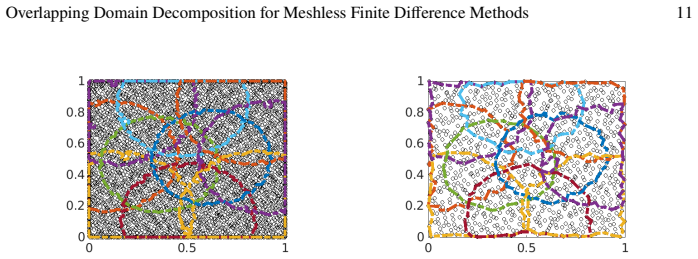
Schwarz type domain decomposition methods generally require a partition of unity to combine solutions on subdomains. However, in mesh-based methods it is common to organize subdomains with minimal overlap, if any, which is facilitated by the availability of a mesh. This study analyzes how the continuity of the partition of unity affects the algebraic Schwarz method for Poisson and Stokes equations from a meshless point of view, whereby the underlying differential operators are discretized using the radial basis function finite difference (RBF-FD) method. We demonstrate numerically that, in this setting, small overlaps improve the performance of the domain decomposition, leading to smaller iteration counts, and therefore no disjoint partitioning technique is required.
Editorial analysis
A structured set of objections, weighed in public.
Referee Report
Summary. The manuscript analyzes the effect of partition-of-unity continuity (via subdomain overlap) on the performance of algebraic Schwarz domain decomposition methods when the underlying operators are discretized by RBF-FD on Poisson and Stokes problems. The central claim, supported by numerical experiments, is that small overlaps reduce iteration counts relative to disjoint partitions and that no special disjoint partitioning technique is therefore required.
Significance. If the numerical findings hold under the reported conditions, the result supplies practical guidance for subdomain construction in meshless RBF-FD settings and indicates that the continuity properties of the partition of unity can be leveraged to improve algebraic convergence without additional machinery. The work is a targeted numerical study rather than a theoretical derivation.
minor comments (3)
- The abstract and introduction state that the tests cover Poisson and Stokes equations, but the precise overlap sizes, number of subdomains, and RBF-FD stencil parameters used in each experiment should be tabulated for reproducibility.
- Clarify whether the reported iteration counts are for the outer Schwarz iteration only or include the inner solver; this affects the interpretation of the performance gain attributed to overlap.
- A brief statement on how the partition of unity is constructed numerically (e.g., the cutoff function and its smoothness) would help readers replicate the continuity effect being studied.
Simulated Author's Rebuttal
We thank the referee for the positive summary of our work and the recommendation of minor revision. No specific major comments appear in the report, so we have no individual points requiring rebuttal or clarification at this stage. We will make any minor editorial or presentational adjustments requested by the editor in the revised version.
Circularity Check
No circularity: numerical study with no derivation chain
full rationale
The paper is framed entirely as a numerical investigation of algebraic Schwarz methods with RBF-FD discretizations on Poisson and Stokes problems. It reports iteration counts for varying overlaps and concludes that small overlaps suffice, without presenting any mathematical derivation, fitted parameters renamed as predictions, or load-bearing self-citations that reduce the central claim to its own inputs. The strongest claim is an empirical observation from experiments; no self-definitional, uniqueness-imported, or ansatz-smuggled steps exist. This is the normal case of a self-contained numerical study.
Axiom & Free-Parameter Ledger
Reference graph
Works this paper leans on
-
[1]
Siam Journal on Scientific Computing21(2), 792–797 (1999)
Cai, X.C., Sarkis, M.: A restricted additive Schwarz preconditioner for general sparse linear systems. Siam Journal on Scientific Computing21(2), 792–797 (1999)
work page 1999
-
[2]
Davydov, O.: mFDlab: A laboratory for meshless finite difference (mFD) methods, https://bitbucket.org/meshlessFD/mfdlab (2020)
work page 2020
-
[3]
BIT Numerical Mathematics43(5), 945–959 (2003)
Efstathiou, E., Gander, M.J.: Why restricted additive Schwarz converges faster than additive Schwarz. BIT Numerical Mathematics43(5), 945–959 (2003)
work page 2003
-
[4]
Fornberg, B., Flyer, N.: A primer on radial basis functions with applications to the geosciences. SIAM (2015)
work page 2015
-
[5]
Gander, M.J.: Does the partition of unity influence the convergence of Schwarz methods? In: International Conference on Domain Decomposition Methods, pp. 3–15. Springer (2018)
work page 2018
-
[6]
Electron.Trans.Numer.Anal31(5), 228–255 (2008)
Gander,M.J.,etal.:Schwarzmethodsoverthecourseoftime. Electron.Trans.Numer.Anal31(5), 228–255 (2008)
work page 2008
-
[7]
International Journal for Numerical Methods in Fluids37(8), 885–903 (2001)
John, V., Matthies, G.: Higher-order finite element discretizations in a benchmark problem for incompressible flows. International Journal for Numerical Methods in Fluids37(8), 885–903 (2001)
work page 2001
-
[8]
Vierteljahrsschrift der Naturforschenden Gesellschaft in Zurich (1870)
Schwarz, H.: Ueber einen Grenzübergang durch alternirendes Verfahren. Vierteljahrsschrift der Naturforschenden Gesellschaft in Zurich (1870)
-
[9]
In: Domain decomposition methods in science and engineering XVI, pp
St-Cyr, A., Gander, M.J., Thomas, S.J.: Optimized restricted additive Schwarz methods. In: Domain decomposition methods in science and engineering XVI, pp. 213–220. Springer (2007)
work page 2007
-
[10]
Toselli, A., Widlund, O.: Domain Decomposition Methods - Algorithms and Theory, vol. 34. Springer Science & Business Media (2004)
work page 2004
-
[11]
Journal of Computational Physics65(1), 138–158 (1986)
Vanka, S.P.: Block-implicit multigrid solution of Navier-Stokes equations in primitive variables. Journal of Computational Physics65(1), 138–158 (1986)
work page 1986
-
[12]
International Journal for Numerical Methods in Engineering126(3) (2025)
Westermann, A., Davydov, O., Sokolov, A., Turek, S.: Stability and accuracy of a meshless finite difference method for the Stokes equations. International Journal for Numerical Methods in Engineering126(3) (2025)
work page 2025
-
[13]
Advances in Applied Mathematics and Mechanics1(1), 29–55 (2009)
Wobker, H., Turek, S.: Numerical studies of Vanka-type smoothers in computational solid me- chanics. Advances in Applied Mathematics and Mechanics1(1), 29–55 (2009)
work page 2009
discussion (0)
Sign in with ORCID, Apple, or X to comment. Anyone can read and Pith papers without signing in.