Kolmogorov turbulence across multi-fractal gas in Polaris Flare
Pith reviewed 2026-07-02 08:57 UTC · model grok-4.3
The pith
A scale-invariant 3D Kolmogorov velocity cascade spans 0.05 to 20 parsecs in the Polaris Flare.
A machine-rendered reading of the paper's core claim, the machinery that carries it, and where it could break.
Core claim
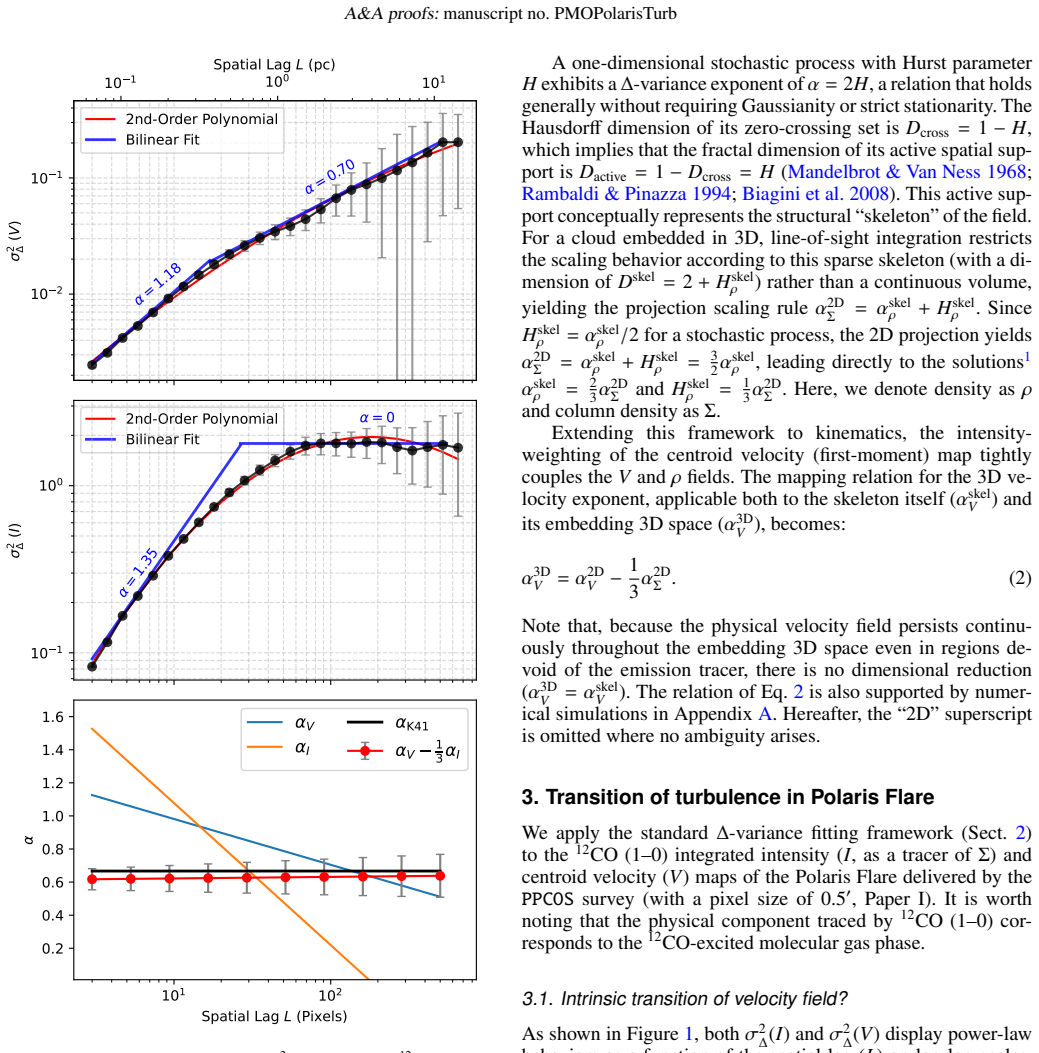
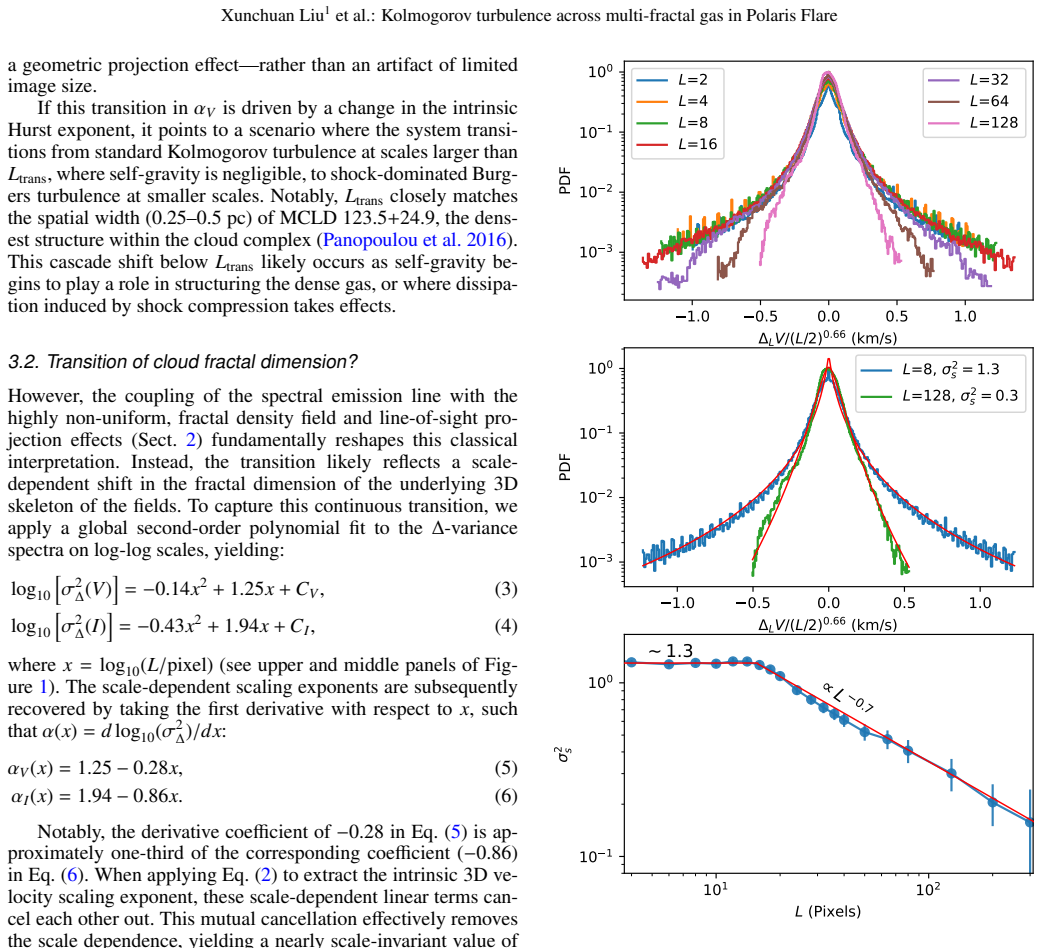
The paper claims a pristine, scale-invariant 3D Kolmogorov velocity cascade with exponent approximately 2/3 exists from 0.05 to 20 pc. Structure-function exponents show a transition near 0.5 pc, below which intermittency saturates, yet the analytical mapping alpha_V^3D equals alpha_V minus one-third alpha_I converts the observed values into a constant 2/3 across all scales. This demonstrates that the transition is produced by geometric projection and a changing density fractal dimension rather than any shift in turbulent regime. The cascade is inherited directly from the large-scale cold neutral medium and remains uninterrupted by compression or gravity below 0.1 pc.
What carries the argument
The analytical mapping relation alpha_V^{3D} = alpha_V - (1/3) alpha_I that converts measured two-dimensional velocity and intensity structure-function exponents into the intrinsic three-dimensional velocity scaling while correcting for projection and density-fractal effects.
If this is right
- The observed transition in structure-function exponents does not indicate a change in turbulent driving mechanism.
- Intermittency reaches a saturated level below the 0.5 pc transition scale.
- Kolmogorov scaling continues without break from the large-scale cold neutral medium into the molecular gas.
- Local compression or gravity does not reset the velocity cascade below 0.1 pc.
Where Pith is reading between the lines
- The same mapping could be tested on other molecular clouds to check whether Kolmogorov scaling is common once projection effects are removed.
- Numerical simulations that supply known three-dimensional velocity fields could directly verify whether the derived mapping recovers the input exponent.
- If the mapping holds, small-scale processes such as core formation would be shaped by turbulence injected at much larger scales.
Load-bearing premise
The mapping relation completely accounts for geometric projection effects and changes in density fractal dimension with no additional assumptions needed about the underlying three-dimensional fields.
What would settle it
A direct three-dimensional velocity measurement, obtained for example from matched simulations or proper-motion data, that yields a velocity structure-function exponent clearly different from 2/3 across the 0.05--20 pc range would falsify the claim.
Figures
read the original abstract
We reveal a pristine, scale-invariant 3D Kolmogorov velocity cascade ($\alpha_V^{\mathrm{3D}} \sim 2/3$) spanning $0.05$--$20$~pc in the Polaris Flare using \texttt{PPCOS} $^{12}\text{CO}$ data. A transition scale at $\sim 0.5$~pc marks a bifurcation in the structure functions' exponents, below which the degree of intermittency is also saturated. By deriving an analytical mapping relation ($\alpha_V^{\mathrm{3D}}=\alpha_V-\frac{1}{3}\alpha_I$), we obtain the scale-invariant value of $\alpha_V^{\mathrm{3D}}$, proving that the apparent transition stems from geometric projection and a changing density fractal dimension rather than a turbulent mode shift. Kolmogorov turbulence is smoothly inherited from the large-scale cold neutral medium, remaining uninterrupted by compression or gravity below 0.1 pc.
Editorial analysis
A structured set of objections, weighed in public.
Referee Report
Summary. The manuscript analyzes PPCOS 12CO observations of the Polaris Flare and reports a scale-invariant 3D Kolmogorov velocity cascade (α_V^{3D} ∼ 2/3) from 0.05–20 pc. A break in the observed 2D structure-function exponents at ∼0.5 pc is interpreted as a geometric transition arising from projection and a change in density fractal dimension. This interpretation rests on an analytically derived mapping α_V^{3D} = α_V − (1/3)α_I that converts the measured 2D exponents into the claimed 3D Kolmogorov value, leading to the conclusion that turbulence is inherited uninterrupted from the CNM.
Significance. If the mapping relation is shown to be complete and assumption-free, the result would be significant: it would demonstrate that a pristine Kolmogorov cascade persists across more than two orders of magnitude in scale in a molecular cloud, with apparent breaks being purely geometric rather than dynamical. The work would also supply a concrete, parameter-free tool for de-projecting velocity structure functions in other multi-fractal regions.
major comments (2)
- [Abstract and §3 (mapping derivation)] The central claim that the observed transition at ∼0.5 pc is purely geometric (rather than a change in turbulent regime) rests entirely on the mapping α_V^{3D}=α_V−(1/3)α_I. The manuscript states that the relation is analytically derived, yet provides neither the derivation steps nor an explicit list of assumptions concerning line-of-sight integration of the velocity field, possible density–velocity correlations, or the precise manner in which α_I encodes the fractal-dimension change. Without these steps it is impossible to verify that the mapping exhausts all projection and multi-fractal effects.
- [Methods / data analysis section] No information is given on the data-reduction pipeline, the precise definition of the structure functions (lags, weighting, error estimation), or any validation tests (e.g., synthetic observations or comparison with known 3D fields) that would confirm the mapping recovers the input 3D exponent when applied to projected data. These omissions directly affect the reliability of the reported α_V^{3D} ∼ 2/3 value.
minor comments (2)
- [Abstract] The abstract states the range 0.05–20 pc but does not specify how the lower and upper limits were determined from the data or beam.
- [Throughout] Notation for the structure-function exponents (α_V, α_I, α_V^{3D}) should be defined at first use and kept consistent throughout.
Simulated Author's Rebuttal
We thank the referee for their careful and constructive review. The comments highlight areas where additional detail will strengthen the manuscript, and we have prepared revisions to address them directly.
read point-by-point responses
-
Referee: [Abstract and §3 (mapping derivation)] The central claim that the observed transition at ∼0.5 pc is purely geometric (rather than a change in turbulent regime) rests entirely on the mapping α_V^{3D}=α_V−(1/3)α_I. The manuscript states that the relation is analytically derived, yet provides neither the derivation steps nor an explicit list of assumptions concerning line-of-sight integration of the velocity field, possible density–velocity correlations, or the precise manner in which α_I encodes the fractal-dimension change. Without these steps it is impossible to verify that the mapping exhausts all projection and multi-fractal effects.
Authors: We agree that the derivation steps and explicit assumptions for the mapping α_V^{3D}=α_V−(1/3)α_I were not presented in sufficient detail in §3. The revised manuscript will expand this section with a complete step-by-step derivation beginning from the 3D velocity structure function, incorporating the line-of-sight projection, and arriving at the correction term involving α_I. The assumptions will be listed explicitly: statistical isotropy and homogeneity of the 3D velocity field; density-velocity correlations limited to those arising from the fractal density field itself; and α_I serving as the direct tracer of the density fractal dimension change under projection. Under these assumptions the mapping accounts for the geometric and multi-fractal projection effects. revision: yes
-
Referee: [Methods / data analysis section] No information is given on the data-reduction pipeline, the precise definition of the structure functions (lags, weighting, error estimation), or any validation tests (e.g., synthetic observations or comparison with known 3D fields) that would confirm the mapping recovers the input 3D exponent when applied to projected data. These omissions directly affect the reliability of the reported α_V^{3D} ∼ 2/3 value.
Authors: We acknowledge that the Methods section lacked sufficient detail on the data pipeline and validation. The revised manuscript will add a dedicated subsection describing the PPCOS 12CO data-reduction steps, the precise definition of the structure functions (including lag ranges, weighting, and error estimation via bootstrapping), and results from validation tests on synthetic observations of 3D Kolmogorov fields with known fractal dimensions, confirming that the mapping recovers the input 3D exponent after projection. revision: yes
Circularity Check
No significant circularity; mapping claimed as independent analytical derivation
full rationale
The paper states it derives the mapping α_V^{3D}=α_V−(1/3)α_I analytically and applies it to recover a scale-invariant 3D Kolmogorov exponent from observed 2D quantities. No equations or self-citations are provided that reduce this mapping to a fit, a self-definition, or a prior result by the same authors. The central claim therefore rests on an asserted derivation whose internal steps are not shown to be tautological with the inputs. This is the most common honest outcome when no explicit reduction can be exhibited from the text.
Axiom & Free-Parameter Ledger
axioms (1)
- domain assumption Velocity and intensity structure functions can be reliably extracted from the 12CO maps across 0.05-20 pc without significant observational bias.
Reference graph
Works this paper leans on
-
[1]
The Global Schmidt Law in Star Forming Galaxies
The Global Schmidt Law in Star-forming Galaxies. , keywords =. doi:10.1086/305588 , archivePrefix =. astro-ph/9712213 , primaryClass =
work page internal anchor Pith review Pith/arXiv arXiv doi:10.1086/305588
-
[2]
1978 , doi =
Spitzer, Lyman , title =. 1978 , doi =
1978
-
[3]
The Atomic to Molecular Transition in Galaxies. II: HI and H_2 Column Densities
The Atomic-to-Molecular Transition in Galaxies. II: H I and H _ 2 Column Densities. , keywords =. doi:10.1088/0004-637X/693/1/216 , archivePrefix =. 0811.0004 , primaryClass =
work page internal anchor Pith review Pith/arXiv arXiv doi:10.1088/0004-637x/693/1/216
-
[4]
Anisotropies in the HI gas distribution toward 3C196
Anisotropies in the HI gas distribution toward 3C 196. , keywords =. doi:10.1051/0004-6361/201629113 , archivePrefix =. 1608.05369 , primaryClass =
work page internal anchor Pith review Pith/arXiv arXiv doi:10.1051/0004-6361/201629113
-
[5]
Akademiia Nauk SSSR Doklady , year = 1941, month = jan, volume =
The Local Structure of Turbulence in Incompressible Viscous Fluid for Very Large Reynolds' Numbers. Akademiia Nauk SSSR Doklady , year = 1941, month = jan, volume =
1941
-
[6]
J. M. Burgers , title =. Advances in Applied Mechanics , volume =. 1948 , doi =
1948
-
[7]
Structure analysis of interstellar clouds. I. Improving the -variance method. , keywords =. doi:10.1051/0004-6361:20079106 , archivePrefix =. 0804.4649 , primaryClass =
work page internal anchor Pith review Pith/arXiv arXiv doi:10.1051/0004-6361:20079106
-
[8]
The link between molecular cloud structure and turbulence
The link between molecular cloud structure and turbulence. , keywords =. doi:10.1051/0004-6361/200913884 , archivePrefix =. 1001.2453 , primaryClass =
work page internal anchor Pith review Pith/arXiv arXiv doi:10.1051/0004-6361/200913884
-
[9]
A network of velocity-coherent filaments formed by supersonic turbulence in a very-high-velocity H I cloud. Nature Astronomy , keywords =. doi:10.1038/s41550-025-02605-8 , archivePrefix =. 2502.10897 , primaryClass =
-
[10]
Turbulence in cascading: Origin of the variance and skewness of density function
Turbulence in cascading: Origin of the variance and skewness of density function. arXiv e-prints , keywords =. doi:10.48550/arXiv.2502.20458 , archivePrefix =. 2502.20458 , primaryClass =
work page internal anchor Pith review Pith/arXiv arXiv doi:10.48550/arxiv.2502.20458
-
[11]
Larson, Richard B. , title =. Monthly Notices of the Royal Astronomical Society , volume =. 1981 , month =. doi:10.1093/mnras/194.4.809 , url =
-
[12]
Comparing the statistics of interstellar turbulence in simulations and observations. Solenoidal versus compressive turbulence forcing. , keywords =. doi:10.1051/0004-6361/200912437 , archivePrefix =. 0905.1060 , primaryClass =
work page internal anchor Pith review Pith/arXiv arXiv doi:10.1051/0004-6361/200912437
-
[13]
The Universality of Turbulence in Galactic Molecular Clouds
The Universality of Turbulence in Galactic Molecular Clouds. , keywords =. doi:10.1086/425978 , archivePrefix =. astro-ph/0409420 , primaryClass =
work page internal anchor Pith review Pith/arXiv arXiv doi:10.1086/425978
-
[14]
PMO Polaris CO survey. I. A 100 deg ^2 view of the Polaris Flare. arXiv e-prints , keywords =
-
[15]
PMO Polaris CO survey. II. Where is the dust?. arXiv e-prints , keywords =
-
[16]
The IRAM key-project: small-scale structure of pre-star-forming regions. I. Observational results. , keywords =
-
[17]
Herschel-SPIRE observations of the Polaris flare: Structure of the diffuse interstellar medium at the sub-parsec scale. , keywords =. doi:10.1051/0004-6361/201014678 , archivePrefix =. 1005.2746 , primaryClass =
work page internal anchor Pith review Pith/arXiv arXiv doi:10.1051/0004-6361/201014678
-
[18]
From filamentary clouds to prestellar cores to the stellar IMF: Initial highlights from the Herschel Gould Belt Survey. , keywords =. doi:10.1051/0004-6361/201014666 , archivePrefix =. 1005.2618 , primaryClass =
work page internal anchor Pith review Pith/arXiv arXiv doi:10.1051/0004-6361/201014666
-
[19]
The interstellar cold dust observed by COBE
The interstellar cold dust observed by COBE. , keywords =. doi:10.48550/arXiv.astro-ph/9812474 , archivePrefix =. astro-ph/9812474 , primaryClass =
work page internal anchor Pith review Pith/arXiv arXiv doi:10.48550/arxiv.astro-ph/9812474
-
[20]
, keywords =
PRONAOS observations of MCLD 123.5 + 24.9: cold dust in the Polaris cirrus cloud. , keywords =
-
[21]
The Polaris Flare: Extensive Molecular Gas near the North Celestial Pole. , keywords =. doi:10.1086/185705 , adsurl =
-
[22]
M., Hartmann, D., & Thaddeus, P
The Milky Way in Molecular Clouds: A New Complete CO Survey. , keywords =. doi:10.1086/318388 , archivePrefix =. astro-ph/0009217 , primaryClass =
work page internal anchor Pith review Pith/arXiv arXiv doi:10.1086/318388
-
[23]
, keywords =
On the fractal structure of molecular clouds. , keywords =
-
[24]
Turbulent velocity structure in molecular clouds. , keywords =. doi:10.1051/0004-6361:20020629 , adsurl =
-
[25]
TURBUSTAT: Turbulence Statistics in Python. , keywords =. 2019. doi:10.3847/1538-3881/ab1cc0 , eprint =
-
[26]
The Geometry of Random Fields
-
[27]
SIAM Review , volume=
Fractional Brownian motions, fractional noises and applications , author=. SIAM Review , volume=. 1968 , publisher=
1968
-
[28]
An accurate fractional Brownian motion generator , journal =
Sandro Rambaldi and Ombretta Pinazza , abstract =. An accurate fractional Brownian motion generator , journal =. 1994 , issn =. doi:https://doi.org/10.1016/0378-4371(94)90531-2 , url =
-
[29]
2008 , publisher=
Stochastic Calculus for Fractional Brownian Motion and Applications , author=. 2008 , publisher=
2008
-
[30]
The magnetic field and dust filaments in the Polaris Flare
The magnetic field and dust filaments in the Polaris Flare. , keywords =. doi:10.1093/mnras/stw1678 , archivePrefix =. 1607.00005 , primaryClass =
work page internal anchor Pith review Pith/arXiv arXiv doi:10.1093/mnras/stw1678
-
[31]
Journal of Fluid Mechanics , year = 1962, month = jan, volume =
A refinement of previous hypotheses concerning the local structure of turbulence in a viscous incompressible fluid at high Reynolds number. Journal of Fluid Mechanics , year = 1962, month = jan, volume =. doi:10.1017/S0022112062000518 , adsurl =
-
[32]
Physica D Nonlinear Phenomena , year = 1990, month = nov, volume =
Velocity probability density functions of high Reynolds number turbulence. Physica D Nonlinear Phenomena , year = 1990, month = nov, volume =. doi:10.1016/0167-2789(90)90035-N , adsurl =
-
[33]
Thermodynamics and dynamics of two-dimensional systems with dipole-like repulsive interactions
Interstellar Turbulence I: Observations and Processes. , keywords =. doi:10.1146/annurev.astro.41.011802.094859 , archivePrefix =. astro-ph/0404451 , primaryClass =
work page internal anchor Pith review Pith/arXiv arXiv doi:10.1146/annurev.astro.41.011802.094859
-
[34]
Hierarchical Structure in Nearly Pressureless Flows as a Consequence of Self-similar Statistics. , keywords =. doi:10.1086/173847 , adsurl =
-
[35]
The Universality of the Stellar IMF
The universality of the stellar initial mass function. , keywords =. doi:10.1093/mnras/288.1.145 , archivePrefix =. astro-ph/9703110 , primaryClass =
work page internal anchor Pith review Pith/arXiv arXiv doi:10.1093/mnras/288.1.145
-
[36]
Magnetized interstellar molecular clouds - II. The large-scale structure and dynamics of filamentary molecular clouds. , keywords =. doi:10.1093/mnras/stz653 , archivePrefix =. 1901.04593 , primaryClass =
work page internal anchor Pith review Pith/arXiv arXiv doi:10.1093/mnras/stz653 1901
-
[37]
A Stable, Accurate Methodology for High Mach Number, Strong Magnetic Field MHD Turbulence with Adaptive Mesh Refinement: Resolution and Refinement Studies. , keywords =. doi:10.1088/0004-637X/745/2/139 , archivePrefix =. 1111.2784 , primaryClass =
work page internal anchor Pith review Pith/arXiv arXiv doi:10.1088/0004-637x/745/2/139
discussion (0)
Sign in with ORCID, Apple, or X to comment. Anyone can read and Pith papers without signing in.