Improved Approximation Algorithms for Parallel Task Scheduling and Multiple Cluster Scheduling
Pith reviewed 2026-07-02 04:20 UTC · model grok-4.3
The pith
A new O(n log n) algorithm achieves (4/3)OPT + p_max for parallel task scheduling.
A machine-rendered reading of the paper's core claim, the machinery that carries it, and where it could break.
Core claim
We present an algorithm for Parallel Task Scheduling that achieves an approximation ratio of (4/3)OPT + p_max with running time O(n log n). For Multiple Cluster Scheduling we improve the running time of the 2-approximation and generalize the 9/4 approximation to arbitrary numbers of clusters. The 2-approximation for MCS is tight since one cannot hope for an approximation ratio better than 2 unless P=NP.
What carries the argument
A near-linear-time approximation algorithm that schedules jobs with given processing times and machine requirements by efficient partitioning and assignment to minimize makespan.
If this is right
- The (4/3)OPT + p_max guarantee for PTS is now available in near-linear time.
- The 9/4 approximation for MCS holds for every number of clusters rather than only when N is divisible by 3.
- The 2-approximation for MCS cannot be improved by any polynomial-time algorithm unless P=NP.
- The implemented algorithms can be used directly on practical scheduling instances.
Where Pith is reading between the lines
- The same partitioning technique may adapt to related resource-constrained scheduling problems such as moldable tasks or heterogeneous clusters.
- Tighter analysis of the additive p_max term could remove or reduce the additive term in future work.
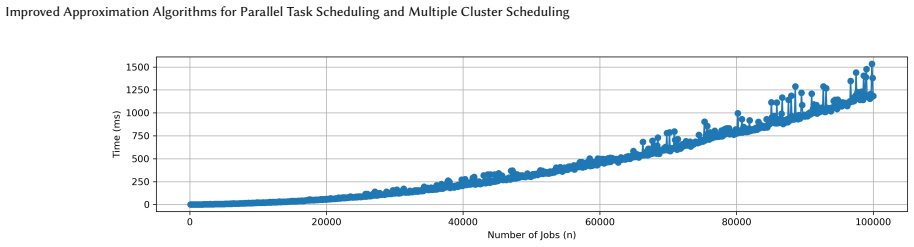
- Empirical testing on very large instances would show whether the observed running time stays close to the O(n log n) bound in practice.
Load-bearing premise
The standard parallel-task model admits an algorithm whose analysis yields exactly the stated (4/3)OPT + p_max bound without hidden restrictions on job sizes or machine counts.
What would settle it
An explicit list of jobs with processing times and machine requirements where every feasible schedule has makespan strictly larger than (4/3)OPT + p_max.
Figures
read the original abstract
In the problem of Parallel Task Scheduling (PTS), we are asked to schedule $n$ jobs, each with a fixed processing time and machine requirement, such that the completion time of the last job is minimized. Jansen and Rau (2019) presented an algorithm for PTS that achieves an approximation ratio of $(3/2)\text{OPT} + p_{\max}$. They additionally posed the open question whether an approximation ratio of $(4/3)\text{OPT} + p_{\max}$ is possible. In this work, we present such an algorithm with a running time of $O(n\log n)$. The problem of Multiple Cluster Scheduling (MCS) is a natural extension of PTS where we are given $N$ clusters each of $m$ machines to schedule jobs. Jansen and Rau (2019) adapted their PTS algorithm to MCS with the following results: (1) a 2 approximation, and (2) a near-linear 9/4 approximation if $N$ is divisible by 3. We improve the running time of their 2-approximation and generalize the 9/4 approximation to the general case. The 2-approximation for MCS is tight, since one cannot hope for an approximation ratio better than 2, unless P=NP [Zhuk, 2006]. In addition to our theoretical results, we implement our algorithm and show its practical applicability.
Editorial analysis
A structured set of objections, weighed in public.
Referee Report
Summary. The paper claims an O(n log n)-time algorithm for Parallel Task Scheduling (PTS) achieving approximation ratio (4/3)OPT + p_max, resolving an open question of Jansen and Rau (2019). It also improves the running time of the 2-approximation for Multiple Cluster Scheduling (MCS), generalizes the 9/4-approximation to arbitrary N, notes that 2 is tight for MCS unless P=NP, and reports an implementation demonstrating practical applicability.
Significance. If the claims hold, the work would resolve a stated open question with a near-linear-time algorithm and a strictly improved guarantee for the standard PTS model (fixed p_j, m_j, makespan objective). The explicit credit to the prior (3/2)OPT + p_max result and the acknowledgment that the MCS 2-approximation is tight are appropriate. The inclusion of an implementation is a positive feature for a theory paper in this area.
major comments (1)
- [Abstract] Abstract: the central claims—an O(n log n) algorithm with exactly (4/3)OPT + p_max for PTS and the stated MCS improvements—are asserted without any algorithm description, pseudocode, proof sketch, reduction, or experimental data. This prevents verification of the claimed guarantee or running time and is load-bearing for the paper's main contribution.
Simulated Author's Rebuttal
We thank the referee for their review. Below we respond point-by-point to the single major comment.
read point-by-point responses
-
Referee: [Abstract] Abstract: the central claims—an O(n log n) algorithm with exactly (4/3)OPT + p_max for PTS and the stated MCS improvements—are asserted without any algorithm description, pseudocode, proof sketch, reduction, or experimental data. This prevents verification of the claimed guarantee or running time and is load-bearing for the paper's main contribution.
Authors: Abstracts are concise summaries by design and are not intended to contain algorithm descriptions, pseudocode, proof sketches, reductions, or experimental data; those elements appear in the body of the manuscript (algorithm, analysis, implementation, and experimental results). The abstract accurately summarizes the results established in the full paper without overclaiming. revision: no
Circularity Check
No significant circularity in algorithmic construction
full rationale
The paper presents an independent algorithmic construction achieving the (4/3)OPT + p_max guarantee in O(n log n) time for the standard PTS model, improving on the prior (3/2)OPT + p_max result from Jansen and Rau (2019). The central claim does not reduce to any fitted parameter, self-definition, or load-bearing self-citation; the 2-approximation tightness for MCS is supported by external citation (Zhuk 2006). No equations or reductions loop back to the paper's own inputs, and the result is presented as a new construction without ansatz smuggling or renaming of known patterns. The derivation chain is self-contained against external benchmarks.
Axiom & Free-Parameter Ledger
Reference graph
Works this paper leans on
-
[1]
József Békési, Gábor Galambos, and Hans Kellerer. 2000. A 5/4 Linear Time Bin Packing Algorithm.J. Comput. Syst. Sci.60, 1 (2000), 145–160. doi:10.1006/jcss. 1999.1667 Improved Approximation Algorithms for Parallel Task Scheduling and Multiple Cluster Scheduling Figure 7: Testing the Parallel Task Scheduling algorithm
-
[2]
Rudolf Berghammer and Florian Reuter. 2003. A linear approximation algorithm for bin packing with absolute approximation factor 3/2.Sci. Comput. Program. 48, 1 (2003), 67–80. doi:10.1016/S0167-6423(03)00011-X
-
[3]
Marin Bougeret, Pierre-François Dutot, Klaus Jansen, Christina Otte, and Denis Trystram. 2010. Approximating the Non-contiguous Multiple Organization Packing Problem. InIFIP TCS (IFIP Advances in Information and Communication Technology, Vol. 323). Springer, 316–327. doi:10.1007/978-3-642-15240-5_23
-
[4]
Marin Bougeret, Pierre-François Dutot, Denis Trystram, Klaus Jansen, and Christina Robenek. 2015. Improved approximation algorithms for schedul- ing parallel jobs on identical clusters.Theor. Comput. Sci.600 (2015), 70–85. doi:10.1016/j.tcs.2015.07.003
-
[5]
Edward G Coffman Jr, János Csirik, Gábor Galambos, Silvano Martello, and Daniele Vigo. 2013. Bin packing approximation algorithms: survey and clas- sification. InHandbook of combinatorial optimization. Springer, 455–531. doi:10.1007/978-1-4419-7997-1_35
-
[6]
Wenceslas Fernandez de la Vega and George S. Lueker. 1981. Bin packing can be solved within 1+epsilon in linear time.Comb.1, 4 (1981), 349–355. doi:10.1007/ BF02579456
1981
-
[7]
Maciej Drozdowski. 1995. On the complexity of multiprocessor task scheduling. Bulletin of The Polish Academy of Sciences-technical Sciences43 (1995), 381–392
1995
-
[8]
Jianzhong Du and Joseph Y.-T. Leung. 1989. Complexity of Scheduling Parallel Task Systems.SIAM J. Discret. Math.2, 4 (1989), 473–487. doi:10.1137/0402042
-
[9]
M. R. Garey and Ronald L. Graham. 1975. Bounds for Multiprocessor Scheduling with Resource Constraints.SIAM J. Comput.4, 2 (1975), 187–200. doi:10.1137/ 0204015
1975
-
[10]
Sören Henning, Klaus Jansen, Malin Rau, and Lars Schmarje. 2017. Complexity and Inapproximability Results for Parallel Task Scheduling and Strip Packing. CoRRabs/1705.04587 (2017). doi:10.48550/arXiv.1705.04587
work page internal anchor Pith review Pith/arXiv arXiv doi:10.48550/arxiv.1705.04587 2017
-
[11]
Klaus Jansen. 2012. A(3/2+𝜖) approximation algorithm for scheduling moldable and non-moldable parallel tasks. InSPAA. ACM, 224–235. doi:10.1145/2312005. 2312048
- [12]
-
[13]
Klaus Jansen and Malin Rau. 2019. Closing the Gap for Pseudo-Polynomial Strip Packing. InESA (LIPIcs, Vol. 144). Schloss Dagstuhl - Leibniz-Zentrum für Informatik, 62:1–62:14. doi:10.4230/LIPIcs.ESA.2019.62
-
[14]
Klaus Jansen and Malin Rau. 2019. Linear Time Algorithms for Multiple Cluster Scheduling and Multiple Strip Packing. InEuro-Par (Lecture Notes in Computer Science, Vol. 11725). Springer, 103–116. doi:10.1007/978-3-030-29400-7_8
-
[15]
Klaus Jansen and Ralf Thöle. 2008. Approximation Algorithms for Scheduling Parallel Jobs: Breaking the Approximation Ratio of 2. InICALP (1) (Lecture Notes in Computer Science, Vol. 5125). Springer, 234–245. doi:10.1007/978-3-540-70575- 8_20
-
[16]
Klaus Jansen and Denis Trystram. 2016. Scheduling parallel jobs on heteroge- neous platforms.Electron. Notes Discret. Math.55 (2016), 9–12. doi:10.1016/j. endm.2016.10.003
work page doi:10.1016/j 2016
-
[17]
Berit Johannes. 2006. Scheduling parallel jobs to minimize the makespan.J. Sched.9, 5 (2006), 433–452. doi:10.1007/s10951-006-8497-6
-
[18]
Narendra Karmarkar and Richard M. Karp. 1982. An Efficient Approximation Scheme for the One-Dimensional Bin-Packing Problem. InFOCS. IEEE Computer Society, 312–320. doi:10.1109/SFCS.1982.61
- [19]
-
[20]
Charles U Martel. 1985. A linear time bin-packing algorithm.Operations Research Letters4, 4 (1985), 189–192. doi:10.1016/0167-6377(85)90028-8
-
[21]
John Turek, Joel L. Wolf, and Philip S. Yu. 1992. Approximate Algorithms Scheduling Parallelizable Tasks. InSPAA. ACM, 323–332. doi:10.1145/140901. 141909
-
[22]
Deshi Ye, Xin Han, and Guochuan Zhang. 2011. Online multiple-strip packing. Theor. Comput. Sci.412, 3 (2011), 233–239. doi:10.1016/j.tcs.2009.09.029
-
[23]
Sergey Nikolaevich Zhuk. 2006. Approximate algorithms to pack rectangles into several strips.Discrete Mathematics & Applications16, 1 (2006). doi:10.1515/ 156939206776241264
2006
discussion (0)
Sign in with ORCID, Apple, or X to comment. Anyone can read and Pith papers without signing in.