REVIEW 4 major objections 3 minor 42 references
No evidence of vorticity production from irrotational turbulent gravitational collapse yet
T0 review · 4 major / 3 minor · reviewed 2026-08-04 · deepseek-v4-flash
Pith's one-line read Gravitational collapse itself produces no vorticity in the numerically reliable window; the vorticity observed is inherited from initial turbulence and the late surge is an artifact.
desk verdict Useful DNS negative result, but the reliability cutoff that carries the main conclusion is internally inconsistent and the SGS attribution in the abstract is not tested. read the letter →
The pith
A machine-rendered reading of the paper's core claim, the machinery that carries it, and where it could break.
The reading
What carries the argument
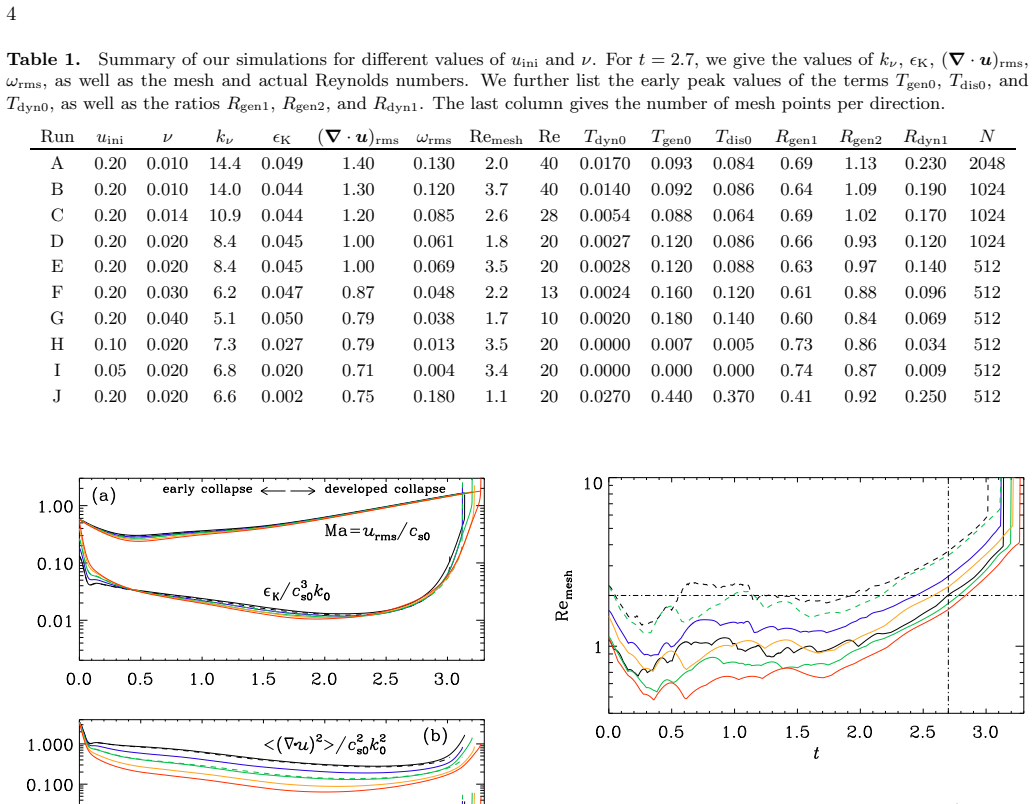
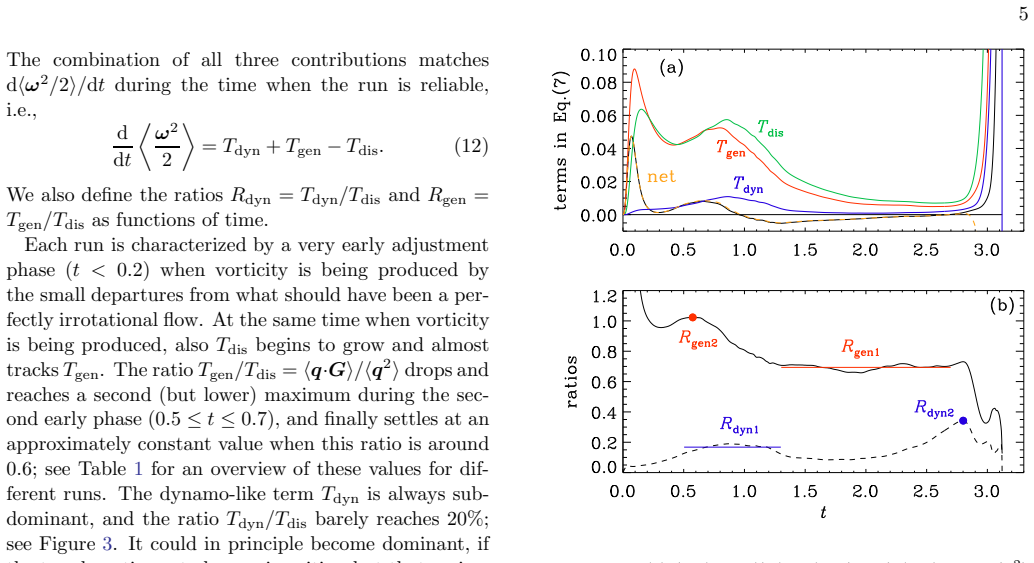
The central diagnostic is the volume-averaged enstrophy budget, d/dt⟨ω²/2⟩ = ⟨q·(u×ω)⟩ + ν(⟨q·G⟩ − ⟨q²⟩), with q=∇×ω and the 'crucial vector' G=2S·∇lnρ. This separates vorticity evolution into a dynamo-like stretching term, a viscous generation term, and a viscous dissipation term. The analysis uses the mesh Reynolds number Rem = umax δx/ν as the trust criterion; for compressive flows, Rem must stay below roughly 2–4 for results to be reliable. The budget shows that in the reliable window the generation term never exceeds dissipation, and the late-time vorticity surge occurs only after Rem exceeds this threshold.
What would settle it
Run the same collapse at a resolution (or with a collapsing-coordinate transformation) that keeps the mesh Reynolds number below 2 through the collapse, and measure the enstrophy budget in the previously reliable window; if the dynamo-like term pushes ωrms above the level of the non-gravity reference run, the paper's central claim is falsified.
Extended reading notes
Core claim
On its own terms, the paper claims that, for its resolution-accessible parameter space, the vorticity observed is not a consequence of the collapse but a viscous conversion of the initial irrotational turbulence. In reliable runs (mesh Reynolds number below about 2–4), the enstrophy budget shows generation balanced by dissipation and a subdominant dynamo-like term. With a barotropic equation of state and no magnetic field, baroclinic vorticity is impossible; viscosity is the only source. The result is negative for collapse-generated vorticity in the tested regime, leaving open the possibility at larger Reynolds numbers.
Load-bearing premise
The central claim collapses if the adopted mesh-Reynolds-number reliability cutoff (about 2–4) is too conservative: if collapse-generated vorticity appears just after the reliable window (t≈2.7), or only at higher Reynolds numbers than currently accessible, the 'no vorticity from collapse' conclusion does not follow.
Editorial extensions
If this is right
- If correct, collapse-driven small-scale dynamo action is not demonstrated; magnetic-field growth seen in earlier collapse simulations may need to be reinterpreted as a subgrid-scale artifact.
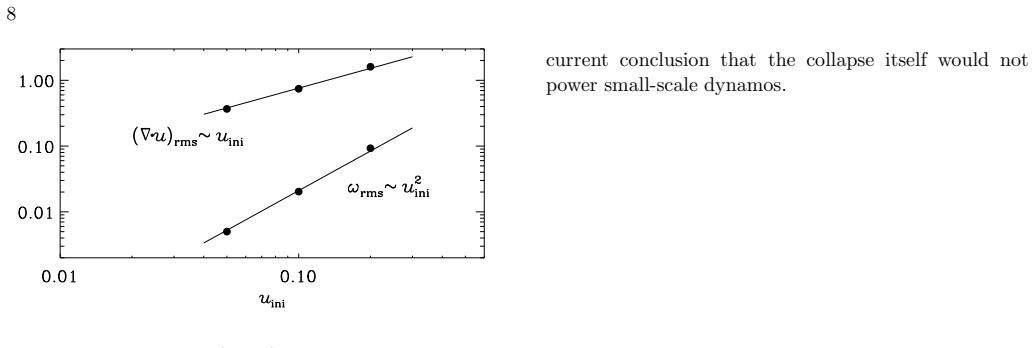
- The scaling relationships (ωrms ∝ uini², drms ∝ uini) give a testable signature that distinguishes initial-turbulence inheritance from collapse-generated vorticity.
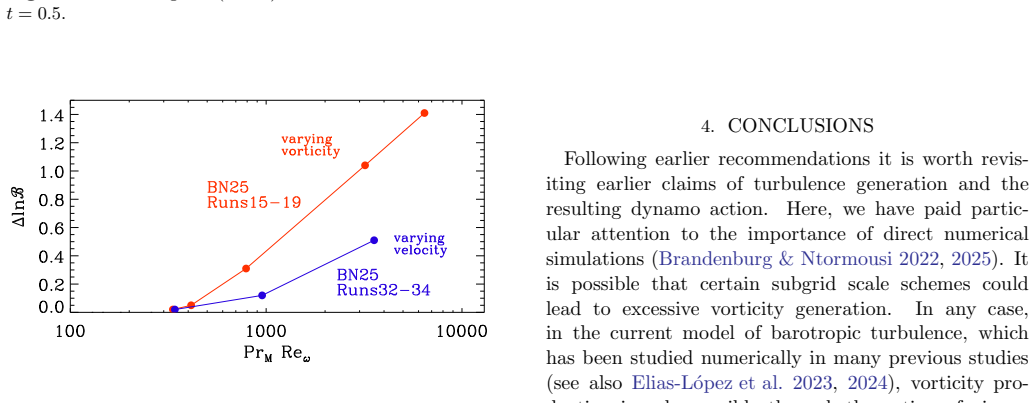
- The finding that purely irrotational flows stay below a vorticity-based Reynolds number of around 300 reinforces the view that dynamo action requires pre-existing vorticity.
- Compression alone can amplify a magnetic field, but that is not dynamo action; future claims of dynamo action must be made only within the numerically reliable window where Rem stays below a few.
- Vorticity production is still expected at sufficiently large Reynolds numbers, so the result is a limit on currently accessible resolution rather than a universal statement.
Reading between the lines
- If this negative result persists at higher resolution, the seed vorticity for star-forming clouds must come from other processes—rotation shear, baroclinic effects, or external turbulence—rather than from the collapse itself.
- A clean test of the subgrid-scale artifact hypothesis would be to run the same collapse setup once with and once without an explicit subgrid model; the paper did not perform that comparison, so the attribution to earlier SGS schemes remains an inference.
- The spectral analogy between vorticity and magnetic fields suggests that transforming to a collapsing coordinate system is the most direct way to isolate collapse-specific vorticity; such runs are a natural next step.
- The mesh-Reynolds-number criterion deserves wider adoption: compressive-flow simulations may need Rem below about 2 to be trusted, far stricter than the common limit for incompressible flows.
Editorial analysis
A structured set of objections, weighed in public.
Referee Report
Summary. The paper investigates whether gravitational collapse of a barotropic Bonnor–Ebert sphere produces vorticity from an initially irrotational turbulent velocity field. Using direct numerical simulations with explicit constant viscosity and no magnetic fields, the authors measure enstrophy production terms and compare runs with different initial amplitudes, wavenumbers, and with/without self-gravity. They report that, within a time window they deem numerically reliable (t ≲ 2.7), vorticity tracks the initial irrotational turbulence and is not enhanced by collapse, and they interpret the late-time vorticity increase as a resolution artifact. They further conclude that some earlier numerical evidence of collapse-driven dynamo action may be a subgrid-scale artifact, although no SGS scheme is run.
Significance. If correct, the negative result is an important caution for star-formation and dynamo theory: it implies that collapse-generated vorticity, and hence collapse-driven small-scale dynamo action, has not yet been demonstrated in this barotropic setup, and that earlier positive claims may be numerical artifacts. The paper is careful in several respects: it uses explicit viscosity only, provides data and code availability (Pencil Code, DOI 10.5281/zenodo.21109846), documents resolution dependence in Table 1, and explicitly defines a reliability window. The main limitation is that the reliability window is defined by a hand-set mesh Reynolds number criterion that is stated inconsistently, and the SGS attribution is inferred rather than tested. These weaknesses prevent the central 'no collapse effect' claim from being as strong as stated.
major comments (4)
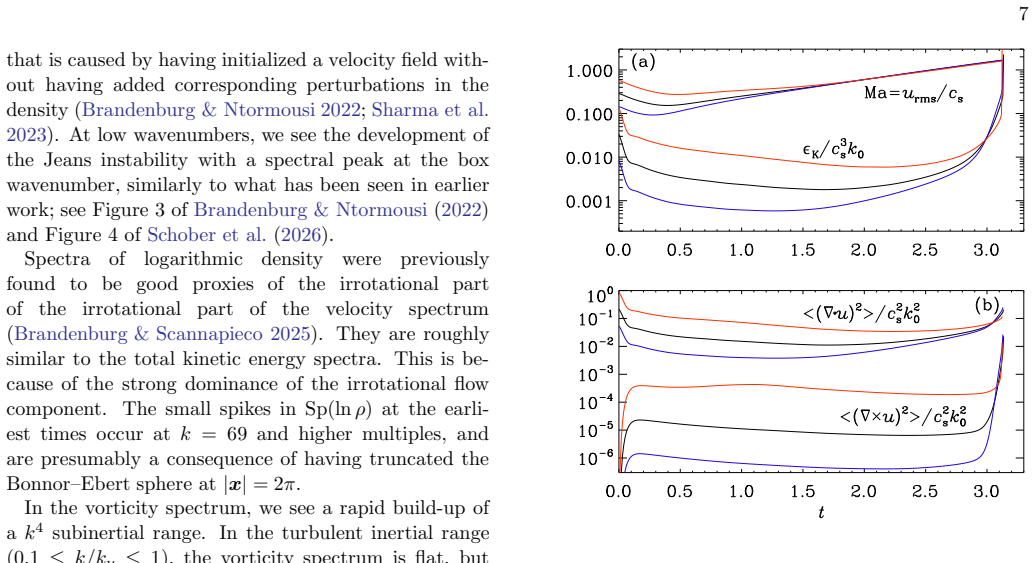
- [§2.2, §3.1, Fig. 2] The reliability criterion for the mesh Reynolds number is internally inconsistent. Section 2.2 states that for compressive/shocked flows Rem may need to be 'well below 0.5'; the caption of Fig. 2 marks Rem=0.7 as the reliability limit; yet Section 3.1 declares t≈2.7 as the trustworthy end point for runs with Rem=2–4. The central negative result—that the collapse produces no additional vorticity—rests entirely on this boundary. If the stricter criterion is correct, the reliable interval ends before t=2.7 and the GN=0 comparison in §3.7 covers only the early pre-collapse phase; if Rem=2–4 is acceptable, the sharp increase in ωrms at t≈3 in Fig. 10 could be physical collapse-generated vorticity discarded by fiat. Provide a resolution-convergence-based justification for the cutoff or restrict the 'no collapse effect' claim to the unambiguously reliable range.
- [Abstract and §4] The abstract states that earlier numerical evidence 'is now found to be the result of subgrid scale modeling and not reproduced in direct numerical simulations.' This is not demonstrated: the paper runs only DNS with constant viscosity and no SGS scheme. The inference that earlier positive results are SGS artifacts is speculative. To support this claim, the authors would need to run their setup with a specific SGS prescription (e.g., shock viscosity or hyperviscosity) and show it produces the excess vorticity. Otherwise the sentence should be weakened to 'may be affected by subgrid modeling' or 'is not reproduced in our DNS.' As written, this is a load-bearing overclaim.
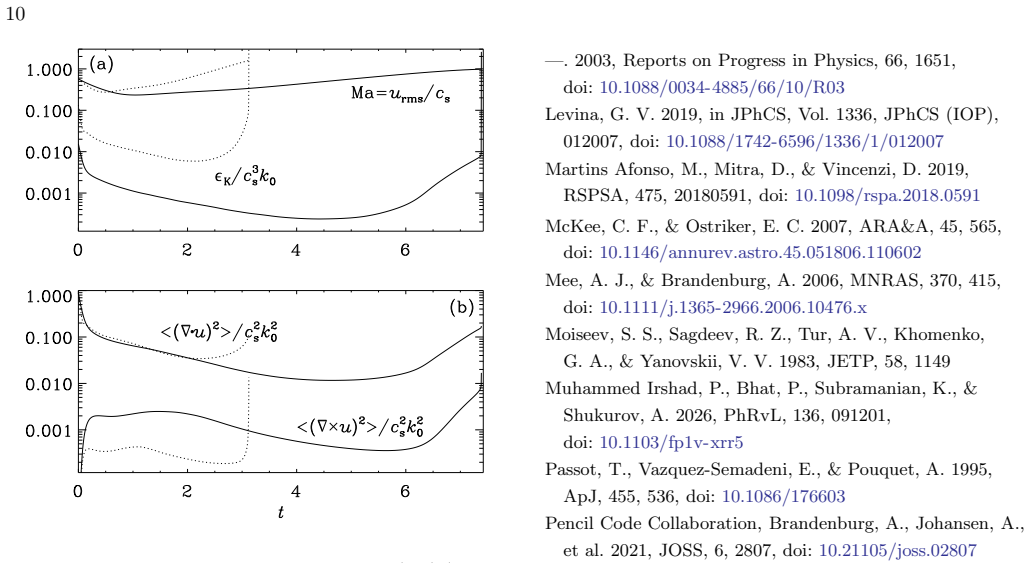
- [§3.7, Fig. 10] The comparison with GN=0 runs is used to argue that vorticity 'remains at the original level that is also obtained without collapse.' However, the reliable window ends at t≈2.7, and the sharp increase at t≈3 is attributed to underresolution without a convergence test at that time. The figure suggests that the GN=0 and GN≠0 curves begin to separate before t=3 for some k0, but this is not quantified. Please provide a quantitative comparison (e.g., the ratio of ωrms with and without gravity) restricted to the reliable window, and demonstrate that the underresolved region is not approached before the time where the comparison is made. Without this, the statement that collapse does not affect vorticity is not established.
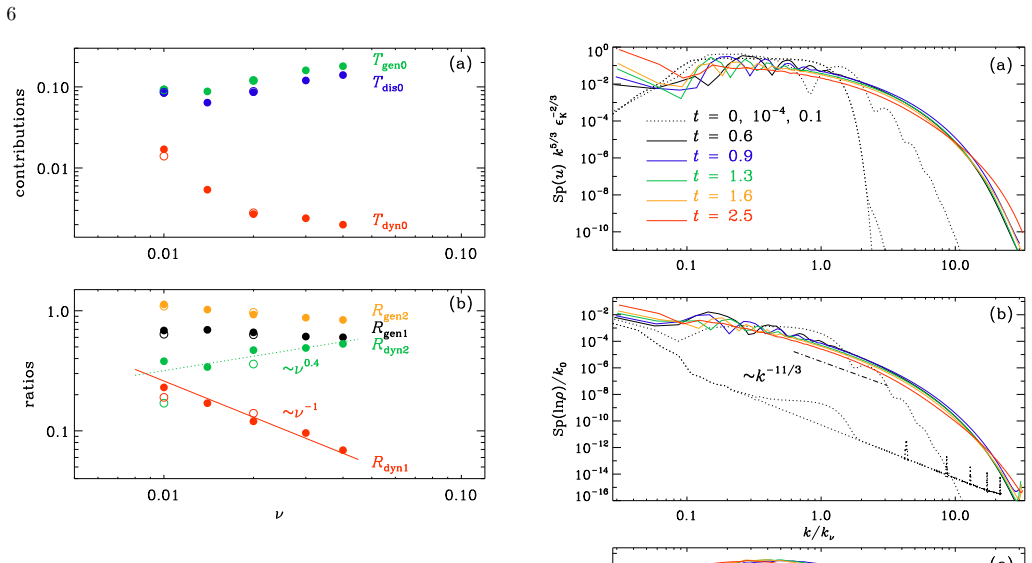
- [§3.1, Table 1] Table 1 shows that the resolution dependence of ωrms, drms, and ǫK is opposite for ν=0.01 and ν=0.02: for ν=0.01, increasing resolution from 1024³ to 2048³ increases ωrms (C to B), while for ν=0.02, increasing resolution from 512³ to 1024³ decreases ωrms (F to E, I to H). This non-convergence at times used for the central diagnostics undermines the definition of the 'reliable' window. The authors should either demonstrate that these differences are within the intended error bars or restrict conclusions to quantities that are demonstrably converged.
minor comments (3)
- [§3.6] 'Initial flow altitude' should be 'initial flow amplitude'.
- [Fig. 5 caption] 'Run H is a lower resolution result of Runs I' should read 'Run H is a lower resolution result of Run I'.
- [§3.5] The phrase 'additional hump in the extension of the line ω ∝ ρ^(2/3)' is ambiguous; clarify whether this is a separate branch of the PDF or a continuous extension.
Circularity Check
The central negative claim is an empirical DNS result with independent controls; self-citations are contextual, and the reliability-window concern is an evidential limitation, not a circular reduction.
full rationale
No load-bearing step equates the output with an input. The paper's central claim—vorticity in the trustworthy part of the run follows the initial irrotational turbulence rather than collapse—is supported by new Pencil Code runs, by the u_ini scaling result in §3.6 ('the separation between the three curves for ωrms remains unchanged until t=2.7'), and by the GN=0 control in §3.7 ('the vorticity remains at the original level that is also obtained without collapse'). These are independent measurements, not identities. The §3.1 reliability boundary is a stated numerical judgment ('we deem the runs no longer trustworthy'), and the inconsistency between Rem≈2 and Figure 2's Rem=0.7 line, like the absence of a convergence test at t=3, is a correctness/evidence weakness, not a construction in which the conclusion is its own premise. The paper also flags its own limits ('would be interesting in its own right, but is not the purpose of the present study'; 'If correct ... would not affect our current conclusion'). Citations to Brandenburg & Ntormousi (2022, 2025) and Schober et al. (2026) supply the setup and a conditional dynamo threshold; the main result does not reduce to those citations, and the paper partly challenges the coauthored Schober et al. setup by removing shock viscosity. Thus no pattern of self-definition, fitted-input-as-prediction, author-imported uniqueness, or ansatz-smuggling is present.
Assumptions & free parameters
free parameters (7)
- uini (initial velocity amplitude) =
0.20, 0.10, 0.05
- k0 (peak wavenumber of initial spectrum) =
2.5, 5, 10
- kcut (spectral cutoff) =
25
- α (subinertial spectral slope) =
4
- ν (kinematic viscosity) =
0.005–0.04
- Reliability criterion Rem ≈ 2 =
2
- Critical magnetic vorticity Reynolds number PrM Reω =
≈300
assumptions (5)
- domain assumption Barotropic/isentropic equation of state makes pressure and density gradients parallel, so baroclinic vorticity production is absent; viscosity is the only vorticity source.
- domain assumption A periodic domain with a modified Bonnor-Ebert sphere repeated to infinity is a faithful model of isolated collapse.
- ad hoc to paper Mesh Reynolds number Rem ≤ 2 is a valid criterion for trusting DNS results; runs at t≈2.7 with Rem 2–4 are still reliable.
- ad hoc to paper The initial velocity spectrum (Equations 7–8) with α=4, k0=2.5, kcut=25 and random phases represents 'initial irrotational turbulence'.
- standard math The enstrophy budget (Equation 12) and the split into Tdyn/Tgen/Tdis correctly captures vorticity dynamics for smooth DNS flows.
Cite this review
Pith. "Pith review of No evidence of vorticity production from irrotational turbulent gravitational collapse yet." pith.science (2026). https://pith.science/paper/VYVA6RX2
@misc{pith2026260701207,
  author       = {Pith},
  title        = {Pith review of: No evidence of vorticity production from irrotational turbulent gravitational collapse yet},
  year         = {2026},
  howpublished = {\url{https://pith.science/paper/VYVA6RX2}},
  note         = {Machine review of arXiv:2607.01207}
}
read the original abstract
Gravitational collapse creates large amounts of kinetic energy that could potentially seed turbulence. If such turbulence were also suitable to initiate dynamo action, the resulting magnetic field would further modify the dynamics, especially on small length scales. However, a small-scale dynamo is believed to require vortical turbulence, whereas the collapse produces mainly irrotational motions, which may not be efficient for dynamo action. Here, we study the efficiency of vorticity production during a turbulent collapse. We use a barotropic equation of state, where pressure and density gradients are parallel, and no magnetic field, so that vorticity can only be produced by viscosity. Using direct numerical simulations of gravitational collapse, we show that, for the parameter space accessible to our numerical resolution, this effect is related to the initial irrotational turbulence and is not a consequence of the collapse. Vorticity production along with the associated small-scale dynamo action are still expected to occur for sufficiently large Reynolds numbers, but some of the earlier numerical evidence in the literature is now found to be the result of subgrid scale modeling and not reproduced in direct numerical simulations.
Figures


Figures from the paper (17 more)








Reference graph
Works this paper leans on
-
[1]
Bonnor, W. B. 1956, MNRAS, 116, 351, doi: 10.1093/mnras/116.3.351
-
[2]
2003, in Advances in Nonlinear Dynamics, ed
Brandenburg, A. 2003, in Advances in Nonlinear Dynamics, ed. A. Ferriz-Mas & M. N´ u˜ nez, 269, doi: 10.1201/9780203493137.ch9
-
[3]
2022, MNRAS, 513, 2136, doi: 10.1093/mnras/stac982 —
Brandenburg, A., & Ntormousi, E. 2022, MNRAS, 513, 2136, doi: 10.1093/mnras/stac982 —. 2023, ARA&A, 61, 561, doi: 10.1146/annurev-astro-071221-052807 —. 2025, ApJ, 990, 223, doi: 10.3847/1538-4357/adf725
-
[4]
2023, MNRAS, 518, 6367, doi: 10.1093/mnras/stac3555
Brandenburg, A., Rogachevskii, I., & Schober, J. 2023, MNRAS, 518, 6367, doi: 10.1093/mnras/stac3555
-
[5]
2025, ApJ, 983, 105, doi: 10.3847/1538-4357/adbe38
Brandenburg, A., & Scannapieco, E. 2025, ApJ, 983, 105, doi: 10.3847/1538-4357/adbe38
-
[6]
2001, A&A, 379, 1153, doi: 10.1051/0004-6361:20011400
Brandenburg, A., & von Rekowski, B. 2001, A&A, 379, 1153, doi: 10.1051/0004-6361:20011400
-
[7]
Crutcher, R. M. 2012, ARA&A, 50, 29, doi: 10.1146/annurev-astro-081811-125514 Del Sordo, F., & Brandenburg, A. 2011, A&A, 528, A145, doi: 10.1051/0004-6361/201015661
-
[8]
2006, ApJ, 638, 336, doi: 10.1086/498634
Dobler, W., Stix, M., & Brandenburg, A. 2006, ApJ, 638, 336, doi: 10.1086/498634
doi:10.1086/498634 2006
Show all 42 references
-
[9]
1955, ZA, 37, 217 Elias-L´ opez, A., Del Sordo, F., & Vigan` o, D
Ebert, R. 1955, ZA, 37, 217 Elias-L´ opez, A., Del Sordo, F., & Vigan` o, D. 2023, A&A, 677, A46, doi: 10.1051/0004-6361/202346696 —. 2024, A&A, 690, A77, doi: 10.1051/0004-6361/202450398
1955 doi
-
[10]
2003, PhRvE, 68, 016311, doi: 10.1103/PhysRevE.68.016311
Elperin, T., Kleeorin, N., & Rogachevskii, I. 2003, PhRvE, 68, 016311, doi: 10.1103/PhysRevE.68.016311
2003 doi
-
[11]
1994, PhFl, 6, 1411, doi: 10.1063/1.868255
Falkovich, G. 1994, PhFl, 6, 1411, doi: 10.1063/1.868255
1994 doi
-
[12]
2011a, PhRvL, 107, 114504, doi: 10.1103/PhysRevLett.107.114504
Federrath, C., Chabrier, G., Schober, J., et al. 2011a, PhRvL, 107, 114504, doi: 10.1103/PhysRevLett.107.114504
-
[13]
Klessen, R. S. 2011b, ApJ, 731, 62, doi: 10.1088/0004-637X/731/1/62
-
[14]
B., Blackman, E
Field, G. B., Blackman, E. G., & Keto, E. R. 2008, MNRAS, 385, 181, doi: 10.1111/j.1365-2966.2007.12609.x
2008
-
[15]
S., & Sulem, P
Frisch, U., She, Z. S., & Sulem, P. L. 1987, PhyD, 28, 382, doi: 10.1016/0167-2789(87)90026-1
1987 doi
-
[16]
Haugen, N. E. L., Brandenburg, A., & Mee, A. J. 2004, MNRAS, 353, 947, doi: 10.1111/j.1365-2966.2004.08127.x
2004
-
[17]
Hayes, W. D. 1957, JFM, 2, 595, doi: 10.1017/S0022112057000403
1957 doi
-
[18]
2021, A&A, 655, A3, doi: 10.1051/0004-6361/202141650
Hennebelle, P. 2021, A&A, 655, A3, doi: 10.1051/0004-6361/202141650
2021 doi
-
[19]
B., & Petviashvili, V
Kadomtsev, B. B., & Petviashvili, V. I. 1973, SPhD, 18, 115 K¨ apyl¨ a, M. J., Gent, F. A., V¨ ais¨ al¨ a, M. S., & Sarson, G. R. 2018, A&A, 611, A15, doi: 10.1051/0004-6361/201731228 K¨ apyl¨ a, P. J., Mitra, D., & Brandenburg, A. 2009, PhRvE, 79, 016302, doi: 10.1103/PhysRev...
1973 doi
-
[20]
P., Ruzmaikin, A
Kazantsev, A. P., Ruzmaikin, A. A., & Sokolov, D. D. 1985, ZhETF, 61, 285
1985
-
[21]
S., & Hennebelle, P
Klessen, R. S., & Hennebelle, P. 2010, A&A, 520, A17, doi: 10.1051/0004-6361/200913780
2010 doi
-
[22]
1974, AN, 295, 93, doi: 10.1002/asna.19742950205
Krause, F., & R¨ udiger, G. 1974, AN, 295, 93, doi: 10.1002/asna.19742950205
1974 doi
-
[23]
Larson, R. B. 1969, MNRAS, 145, 271, doi: 10.1093/mnras/145.3.271 —. 2003, Reports on Progress in Physics, 66, 1651, doi: 10.1088/0034-4885/66/10/R03
1969 doi
-
[24]
Levina, G. V. 2019, in JPhCS, Vol. 1336, JPhCS (IOP), 012007, doi: 10.1088/1742-6596/1336/1/012007
2019 doi
-
[25]
Lighthill, M. J. 1957, JFM, 2, 1, doi: 10.1017/S0022112057000713 Martins Afonso, M., Mitra, D., & Vincenzi, D. 2019, RSPSA, 475, 20180591, doi: 10.1098/rspa.2018.0591
1957
-
[26]
F., & Ostriker, E
McKee, C. F., & Ostriker, E. C. 2007, ARA&A, 45, 565, doi: 10.1146/annurev.astro.45.051806.110602
2007 arXiv
-
[27]
J., & Brandenburg, A
Mee, A. J., & Brandenburg, A. 2006, MNRAS, 370, 415, doi: 10.1111/j.1365-2966.2006.10476.x
2006
-
[28]
S., Sagdeev, R
Moiseev, S. S., Sagdeev, R. Z., Tur, A. V., Khomenko, G. A., & Yanovskii, V. V. 1983, JETP, 58, 1149 Muhammed Irshad, P., Bhat, P., Subramanian, K., &
1983
-
[29]
2026, PhRvL, 136, 091201, doi: 10.1103/fp1v-xrr5
Shukurov, A. 2026, PhRvL, 136, 091201, doi: 10.1103/fp1v-xrr5
2026 doi
-
[30]
W., Chang, P., Murray, N
Murray, D. W., Chang, P., Murray, N. W., & Pittman, J. 2017, MNRAS, 465, 1316, doi: 10.1093/mnras/stw2796
2017 doi
-
[31]
1995, ApJ, 455, 536, doi: 10.1086/176603 Pencil Code Collaboration, Brandenburg, A., Johansen, A., et al
Passot, T., Vazquez-Semadeni, E., & Pouquet, A. 1995, ApJ, 455, 536, doi: 10.1086/176603 Pencil Code Collaboration, Brandenburg, A., Johansen, A., et al. 2021, JOSS, 6, 2807, doi: 10.21105/joss.02807
1995 doi
-
[32]
Penston, M. V. 1969, MNRAS, 144, 425, doi: 10.1093/mnras/144.4.425
1969 doi
-
[33]
H., Jones, T
Porter, D. H., Jones, T. W., & Ryu, D. 2015, ApJ, 810, 93, doi: 10.1088/0004-637X/810/2/93
2015 doi
-
[34]
2012, ApJL, 750, L31, doi: 10.1088/2041-8205/750/2/L31
Robertson, B., & Goldreich, P. 2012, ApJL, 750, L31, doi: 10.1088/2041-8205/750/2/L31
2012 doi
-
[35]
2026, A&A, 711, A147, doi: 10.1051/0004-6361/202659624
Kahniashvili, T. 2026, A&A, 711, A147, doi: 10.1051/0004-6361/202659624
2026 doi
-
[36]
2023, JCAP, 2023, 042, doi: 10.1088/1475-7516/2023/12/042
Sharma, R., Dahl, J., Brandenburg, A., & Hindmarsh, M. 2023, JCAP, 2023, 042, doi: 10.1088/1475-7516/2023/12/042
2023 doi
-
[37]
Shu, F. H. 1977, ApJ, 214, 488, doi: 10.1086/155274
1977 doi
-
[38]
L., She, Z
Sulem, P. L., She, Z. S., Scholl, H., & Frisch, U. 1989, JFM, 205, 341, doi: 10.1017/S0022112089002065 15
1989 doi
-
[39]
Klessen, R. S. 2012, MNRAS, 423, 3148, doi: 10.1111/j.1365-2966.2012.21100.x
2012
-
[40]
Klessen, R. S. 2010, ApJL, 721, L134, doi: 10.1088/2041-8205/721/2/L134
2010 doi
-
[41]
Truesdell, C. 1952, J. Aeron. Sci., 19, 826, doi: 10.2514/8.2495
1952 doi
-
[42]
2020a, ApJ, 890, 157, doi: 10.3847/1538-4357/ab6e63 —
Xu, S., & Lazarian, A. 2020a, ApJ, 890, 157, doi: 10.3847/1538-4357/ab6e63 —. 2020b, ApJ, 899, 115, doi: 10.3847/1538-4357/aba7ba
Reviewed August 4, 2026 · model on record in the stance chip above.
Discussion (0). Continue with ORCID to comment.