Development of a thin-target hard X-ray bremsstrahlung detection system to study confined runaway electrons in Aditya-U Tokamak
Pith reviewed 2026-07-03 00:52 UTC · model grok-4.3
The pith
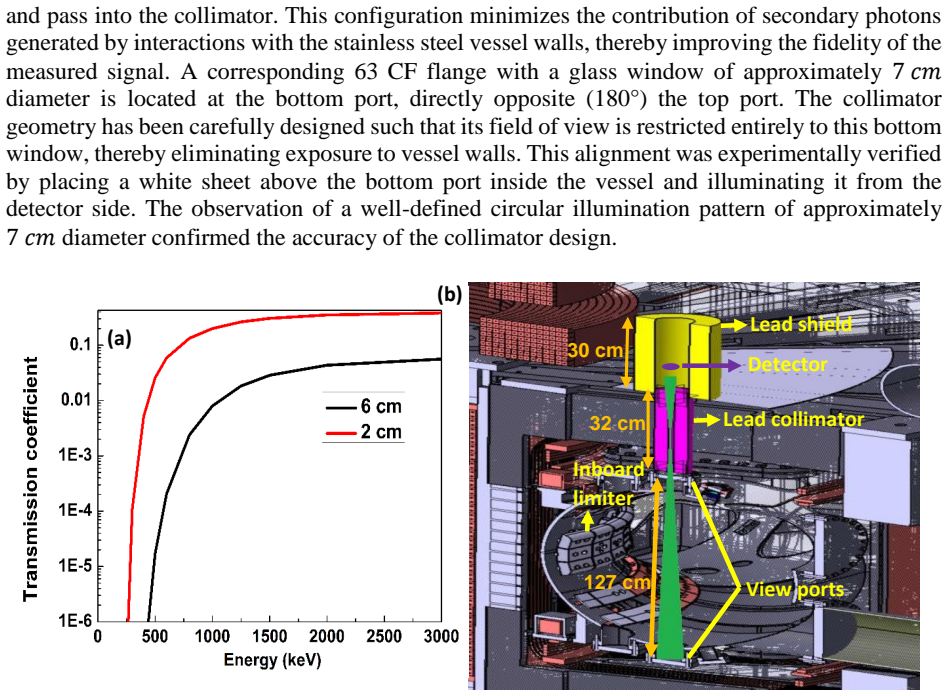
A shielded CdTe detector with lead collimator measures chord-averaged thin-target hard X-ray bremsstrahlung from the core plasma region in Aditya-U.
A machine-rendered reading of the paper's core claim, the machinery that carries it, and where it could break.
Core claim
The newly developed diagnostic has successfully measured the chord-averaged thin-target HXR bremsstrahlung emission encompassing the core plasma region, particularly within and around the sawtooth inversion radius. The measured HXR spectra are validated through forward modelling code that incorporates plasma parameters, confined RE characteristics, and the geometric configuration of the diagnostic system. The results confirm the capability of the developed HXR monitor to probe the fast-electron dynamics during internal plasma instabilities.
What carries the argument
The lead-collimated and specially shielded CdTe detector that restricts the line of sight to a chord through the core plasma volume.
If this is right
- The diagnostic separates signals from confined runaway electrons inside the sawtooth inversion radius from those produced at the edge or on limiters.
- It supplies chord-averaged spectra that can be compared directly with models of fast-electron transport during internal instabilities.
- Repeated measurements on the same chord allow tracking of changes in confined runaway electron populations as sawteeth evolve.
- The validated geometry and response function provide a quantitative basis for estimating local runaway electron density and energy in the core.
Where Pith is reading between the lines
- Similar collimated detectors could be installed on other tokamaks to obtain core-specific runaway electron data for cross-machine comparisons.
- Time-resolved operation of the same system might reveal whether runaway electron redistribution precedes or follows each sawtooth crash.
- If the forward model is extended to include measured electron temperature and density profiles from other diagnostics, the inferred runaway electron parameters could be cross-checked for consistency.
Load-bearing premise
The lead collimator and shielding isolate thin-target bremsstrahlung emission from the core plasma volume without significant contamination from peripheral limiters or structural components.
What would settle it
If the recorded spectra continue to show features attributable to limiter or wall interactions when the viewing chord is deliberately shifted away from the core, or if they fail to match the forward model even after all plasma and geometric inputs are fixed, the isolation claim would be falsified.
Figures


read the original abstract
A specially shielded CdTe detector based hard X-ray (HXR) monitoring system equipped with a lead collimator has been developed and installed on the Aditya-U tokamak to investigate the dynamics of fast electrons (~20-200 keV) generated during sawtooth activity. The pre-existing HXR monitor in Aditya-U is exposed to the entire HXR bremsstrahlung emission from the plasma volume, peripheral limiters, and other structural components, which limits its ability to separately study the dynamics of lost and confined runaway electrons (REs). In contrast, the newly developed diagnostic has successfully measured the chord-averaged thin-target HXR bremsstrahlung emission encompassing the core plasma region, particularly within and around the sawtooth inversion radius. The measured HXR spectra are validated through forward modelling code that incorporates plasma parameters, confined RE characteristics, and the geometric configuration of the diagnostic system. The results confirm the capability of the developed HXR monitor to probe the fast-electron dynamics during internal plasma instabilities.
Editorial analysis
A structured set of objections, weighed in public.
Referee Report
Summary. The manuscript reports the development and installation of a shielded CdTe detector equipped with a lead collimator for measuring chord-averaged thin-target hard X-ray bremsstrahlung emission from the core plasma region (within and around the sawtooth inversion radius) in the Aditya-U tokamak. This new diagnostic is intended to isolate confined runaway electron dynamics during sawtooth activity, in contrast to the existing uncollimated HXR monitor that integrates emission from the full plasma volume plus peripheral structures. Measurements are stated to be validated by a forward-modeling code that incorporates plasma parameters, confined RE characteristics, and diagnostic geometry.
Significance. If the collimator isolation and forward-model validation can be shown quantitatively, the diagnostic would provide a useful capability for separating confined versus lost runaway electron contributions in tokamak plasmas, which is relevant to understanding sawtooth-driven RE dynamics and related stability issues. The forward-modeling approach is a constructive element for an instrument paper.
major comments (2)
- [Abstract] Abstract: The central claim that the lead collimator and shielding 'successfully' isolate chord-averaged thin-target HXR bremsstrahlung from the core plasma (within/around the sawtooth inversion radius) without significant peripheral contamination is load-bearing, yet the abstract provides no rejection ratios, point-spread-function data, off-axis source simulations, or signal-to-background metrics to substantiate the isolation. This directly affects attribution of the measured spectra to confined REs.
- [Abstract] Abstract: The statement that 'the measured HXR spectra are validated through forward modelling code' is presented without any quantitative match metrics, χ^{2} values, residual plots, or error-bar comparisons between data and model; this leaves the validation assertion unverified and weakens the overall result.
Simulated Author's Rebuttal
We thank the referee for the constructive comments, which help clarify how the abstract can better support the key claims of the manuscript. We address each point below.
read point-by-point responses
-
Referee: [Abstract] Abstract: The central claim that the lead collimator and shielding 'successfully' isolate chord-averaged thin-target HXR bremsstrahlung from the core plasma (within/around the sawtooth inversion radius) without significant peripheral contamination is load-bearing, yet the abstract provides no rejection ratios, point-spread-function data, off-axis source simulations, or signal-to-background metrics to substantiate the isolation. This directly affects attribution of the measured spectra to confined REs.
Authors: The abstract provides a concise overview; the supporting quantitative details (collimator rejection ratios, point-spread function from ray-tracing and Monte Carlo modeling, off-axis source simulations, and signal-to-background estimates) appear in the main text sections describing the diagnostic design, shielding, and geometric modeling. We agree the abstract would be strengthened by referencing these metrics. We will revise the abstract to include brief quantitative statements on the achieved isolation performance. revision: yes
-
Referee: [Abstract] Abstract: The statement that 'the measured HXR spectra are validated through forward modelling code' is presented without any quantitative match metrics, χ^{2} values, residual plots, or error-bar comparisons between data and model; this leaves the validation assertion unverified and weakens the overall result.
Authors: The forward-model validation, including direct spectral comparisons, residuals, and agreement within experimental uncertainties, is shown in the results section with accompanying figures. The abstract summarizes this without the numerical details. We will revise the abstract to note the level of quantitative agreement demonstrated in the manuscript. revision: yes
Circularity Check
No circularity: experimental diagnostic paper with external validation
full rationale
The paper reports development of a collimated CdTe HXR detector on Aditya-U, asserts successful chord-averaged core measurements during sawteeth, and states that spectra are validated by a forward-modelling code incorporating plasma parameters, RE characteristics, and diagnostic geometry. No derivation chain, fitted parameters renamed as predictions, or self-citation load-bearing steps appear; the modelling is presented as independent validation rather than a closed loop, and the collimator isolation claim rests on hardware design rather than any self-referential equation. The work is therefore self-contained against external benchmarks with no reduction of outputs to inputs by construction.
Axiom & Free-Parameter Ledger
axioms (1)
- domain assumption Plasma parameters and confined RE characteristics can be combined with the diagnostic geometry to produce a forward model that validates measured spectra.
Reference graph
Works this paper leans on
-
[1]
Sawtooth reconnection,
Here, L denotes the total chord length along the detector’s line of sight (LoS). The plasma density and runaway electron (RE) density are assumed to be spatially uniform across the entire plasma volume. The principal design parameters of the thin -target bremsstrahlung diagnostic system are summarized in Table 1. Table 1. Key design parameters of the thin...
1990
-
[2]
Generation and transport of runaway electrons during sawteeth crash in the ADITYA tokamak,
Purohit, P.K. Atrey, Y.C. Saxena, and R. Pal, “Generation and transport of runaway electrons during sawteeth crash in the ADITYA tokamak,” Nuclear Fusion 58(7), (2018). 6 P. V. Savrukhin, “Nonthermal electrons during sawteeth and disruption instability in tokamaks,” Plasma Phys. Control. Fusion 48(12 B), (2006). 7 A. Burckhart, A. Bock, R. Fischer, T. Püt...
2018
-
[3]
Magnetohydrodynamic instability modulated runaway electron losses in the ADITYA-U tokamak,
Tahiliani, L. Pradhan, and K.B.K. Mayya, “Magnetohydrodynamic instability modulated runaway electron losses in the ADITYA-U tokamak,” Nuclear Fusion 66(1), 016041 (2026). 14 M. Lamoureux, and P. Charles, “General deconvolution of thin-target and thick-target Bremsstrahlung spectra to determine electron energy distributions,” Radiation Physics and Chemistr...
2026
-
[4]
Overview of recent experimental results from the ADITYA-U tokamak,
Sen, R. Pal, and S. Chaturvedi, “Overview of recent experimental results from the ADITYA-U tokamak,” Nuclear Fusion 62(4), (2022). 13 19 S. Gnesin, S. Coda, J. Decker, and Y. Peysson, “Suprathermal electron studies in the TCV tokamak: Design of a tomographic hard-x-ray spectrometer,” in Review of Scientific Instruments, (2008). 20 J. Liptac, R. Parker, V....
2022
-
[5]
A Hard X-Ray Pinhole Camera System for Fast Electron Bremsstrahlung Measurements in the HL-2A Tokamak,
Zou, J.W. Yang, G.L. Yuan, M. Isobe, X.Y. Song, X. Li, Y. Liu, Z.B. Shi, M. Xu, and X.R. Duan, “A Hard X-Ray Pinhole Camera System for Fast Electron Bremsstrahlung Measurements in the HL-2A Tokamak,” Fusion Science and Technology 77(1), 1–8 (2021). 24 H.Y. Yang, Z.Y. Chen, D.W. Huang, R.H. Tong, W. Yan, Y.N. Wei, Z.F. Lin, A.J. Dai, H.L
2021
-
[6]
Vertical fast electron bremsstrahlung diagnostic on J-TEXT tokamak,
Gao, X.L. Wang, Y. Li, W. Li, Y. Huang, J. Hu, D.Q. Wang, Z.J. Yang, and Z.H. Jiang, “Vertical fast electron bremsstrahlung diagnostic on J-TEXT tokamak,” Review of Scientific Instruments 89(10), (2018). 25 Y. Hong, L. Zeng, T. Tang, D.L. Chen, S.Y. Lin, H.L. Zhao, T.F. Zhou, A. Ti, C.X. Lou, W
2018
-
[7]
Study of runaway electrons during EAST plasma start- up,
Xia, H.Q. Liu, J.P. Qian, and X. Gao, “Study of runaway electrons during EAST plasma start- up,” Fusion Engineering and Design 219, (2025). 26 E.A. Shestakov, P. V. Savrukhin, M.I. Ershova, and A. V. Khramenkov, “Generation of runaway electrons during the initial stage of the T-10 tokamak plasma discharge,” in J. Phys. Conf. Ser., (Institute of Physics Pu...
2025
-
[8]
A diagnostic for measuring radial profile of visible continuum radiation from ADITYA-U Tokamak Plasmas,
Jadeja, R.L. Tanna, and A.U. team, “A diagnostic for measuring radial profile of visible continuum radiation from ADITYA-U Tokamak Plasmas,” Fusion Engineering and Design 173, (2021). 29 P. Nowak Vel Nowakowski, D. Makowski, B. Jabłoński, P. Szajerski, S.P. Pandya, R. O’Connor, R. Tieulent, and R. Barnsley, “Evaluation of optical transmission across the I...
2021
discussion (0)
Sign in with ORCID, Apple, or X to comment. Anyone can read and Pith papers without signing in.