pykci: A Compact Urban Knowledge Graph for Semantic and Spatial Queries using LLMs
Pith reviewed 2026-07-03 03:37 UTC · model grok-4.3
The pith
pykci converts CityGML semantic 3D city models into a Neo4j knowledge graph that LLMs can query in natural language.
A machine-rendered reading of the paper's core claim, the machinery that carries it, and where it could break.
Core claim
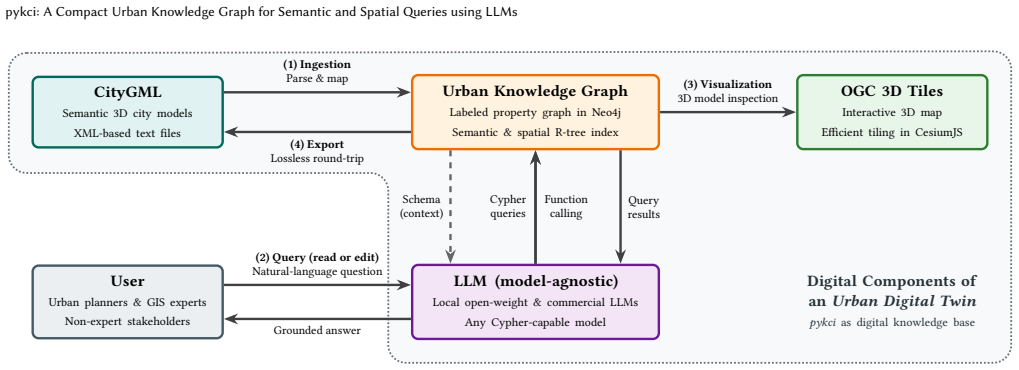
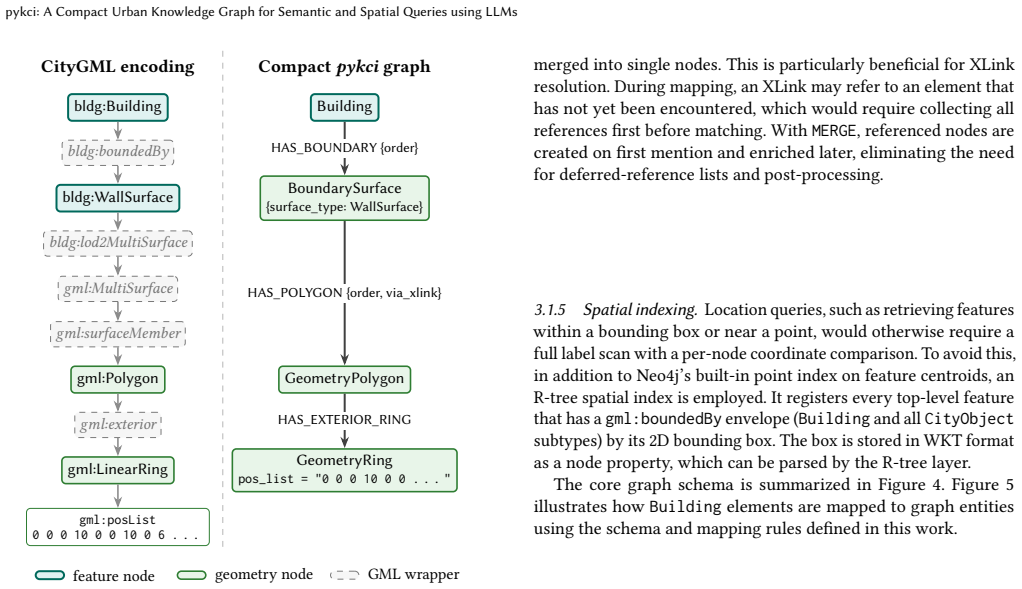
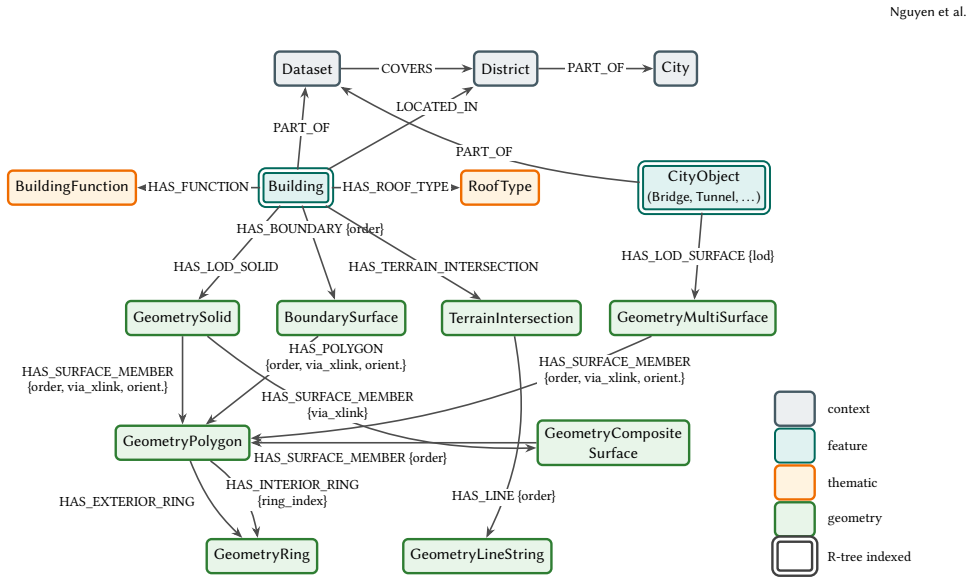
pykci transforms CityGML 2.0 datasets into a compact urban knowledge graph in Neo4j whose schema covers every thematic feature module across all levels of detail and carries an R-tree spatial index. An end-to-end Python pipeline performs ingestion, 3D Tiles export, and lossless round-trip to CityGML. Querying occurs through a model-agnostic text-to-Cypher layer that supplies only the graph schema as context so that an LLM translates natural-language questions into executable Cypher statements whose results remain grounded in the city graph.
What carries the argument
The text-to-Cypher mechanism that supplies the graph schema as context to an LLM so the model can emit executable Cypher queries against the urban knowledge graph.
If this is right
- Urban planners can locate roof surfaces for greening by asking questions in plain English.
- Citizens and GIS users can retrieve semantic and spatial city information without learning database schemas or Cypher.
- Responses carry direct provenance from the stored graph rather than model memory, reducing hallucination risk.
- Sensitive city data can stay on-premise when a local open-weight model is used.
- Existing CityGML workflows remain compatible because of the lossless round-trip export.
Where Pith is reading between the lines
- The same schema-driven translation approach could be tested on other 3D city or building information standards.
- Adding incremental update paths from live sensor feeds would allow queries over changing city conditions.
- Combining the graph with web-based 3D viewers could let non-experts explore results visually in the same session.
Load-bearing premise
An LLM given only the graph schema as context can generate correct and complete Cypher queries for complex semantic and spatial questions without errors or hallucinations.
What would settle it
A benchmark set of complex urban queries run through the text-to-Cypher layer whose generated Cypher statements are executed and checked against manually verified results from the original CityGML files.
Figures
read the original abstract
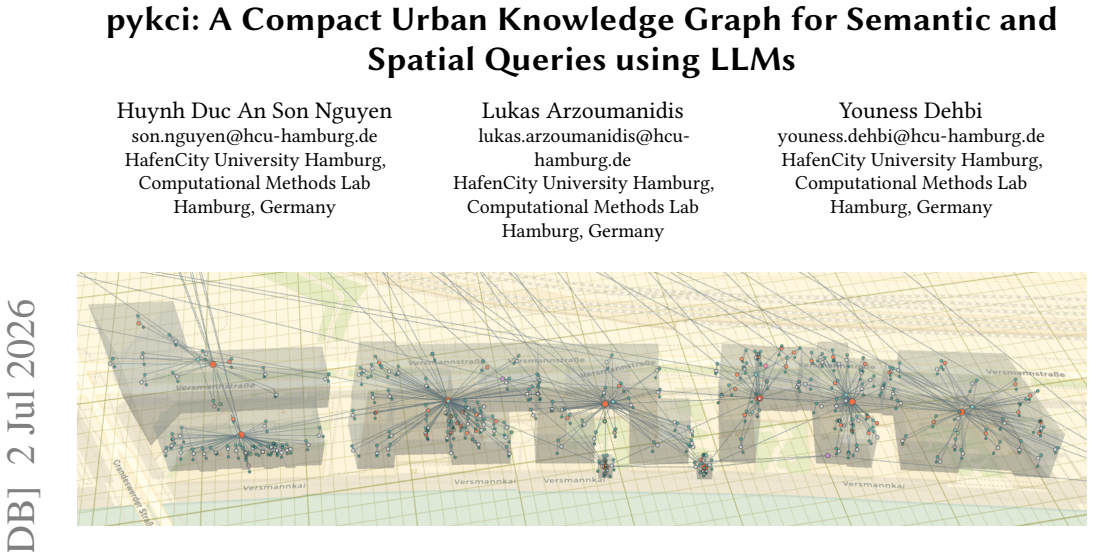
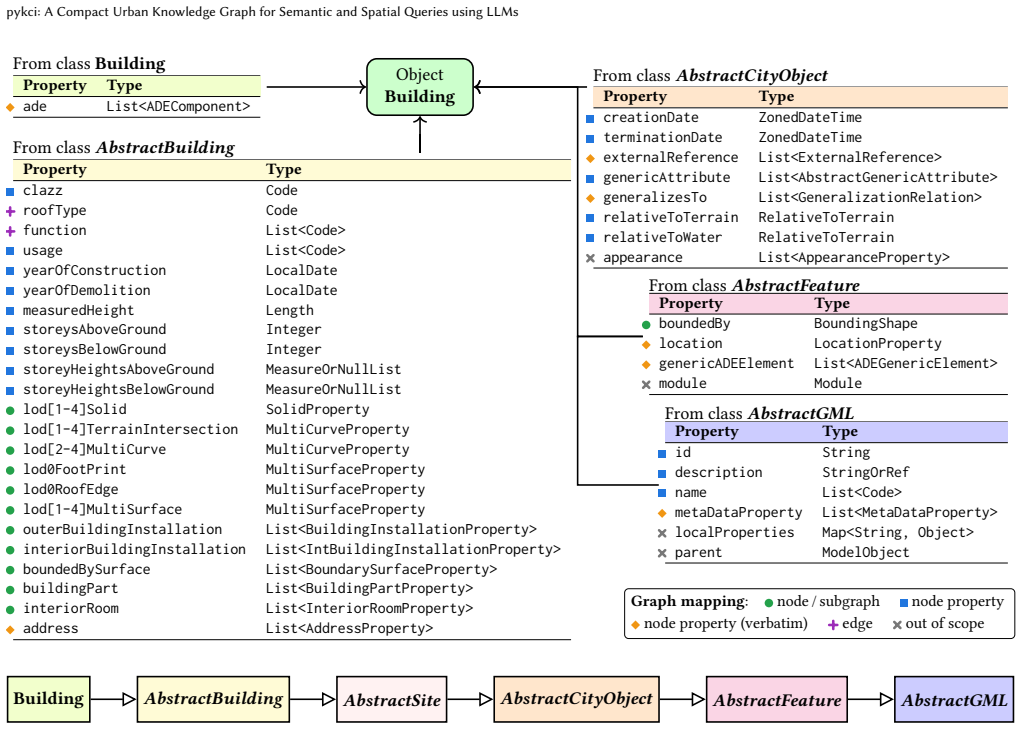
CityGML, the OGC standard for modeling, storage, and exchange of semantic 3D city models, describes urban objects with detailed semantics, geometry, and topology. Yet this richness is difficult to query directly: CityGML's XML encoding is designed for exchange rather than analysis, and relational mappings expose it through schemas requiring expert knowledge. We present pykci (Python Knowledge Graph for Cities), an open-source system that transforms CityGML 2.0 datasets into a compact urban knowledge graph in Neo4j and makes it queryable in natural language. The graph schema covers all thematic feature modules of CityGML 2.0 across all levels of detail and is spatially indexed with an R-tree for efficient geometric retrieval. A complete end-to-end Python pipeline ingests CityGML datasets into the knowledge graph, exports them to OGC 3D Tiles for interactive visualization, and supports lossless round-trip export of all content back to CityGML. For querying, the graph is paired with a large language model through a model-agnostic text-to-Cypher mechanism: the graph schema is supplied as context, and the model translates natural-language questions into Cypher queries executed against the graph. We evaluate both a locally running open-weight model, which keeps sensitive city data on-premise, and a state-of-the-art commercial model for the most demanding spatial and semantic queries. Answers are grounded in exact city data rather than the model's parametric memory, reducing hallucination and providing auditable provenance for every response. We demonstrate the system on open-government CityGML LoD2 datasets from Hamburg, Germany, including complex semantic and spatial queries such as identifying roof surfaces suitable for greening. pykci enables urban planners, GIS practitioners, and citizens to interact with semantic 3D city models without expertise in query languages and database schemas.
Editorial analysis
A structured set of objections, weighed in public.
Referee Report
Summary. The paper presents pykci, an open-source Python system that ingests CityGML 2.0 datasets into a compact Neo4j knowledge graph covering all thematic modules and LoDs with R-tree spatial indexing, provides a model-agnostic LLM text-to-Cypher interface that supplies only the graph schema as context for natural-language queries, includes pipelines for 3D Tiles visualization export and lossless round-trip to CityGML, and demonstrates the system on Hamburg LoD2 open-government data for complex semantic-spatial queries such as roof-greening suitability. The central claim is that this enables urban planners, GIS practitioners, and citizens to interact with semantic 3D city models without expertise in query languages or schemas, with answers grounded in the graph rather than model memory.
Significance. If the text-to-Cypher translation is shown to be reliable, the system would offer a practical, open-source bridge between detailed CityGML models and non-expert users while preserving data provenance and supporting on-premise deployment. The reproducible pipeline, full schema coverage, spatial indexing, and round-trip fidelity are concrete strengths that could be adopted by the urban data community.
major comments (1)
- [Abstract] Abstract (evaluation paragraph): the manuscript states that both open-weight and commercial models 'were evaluated on demanding queries' and that 'answers are grounded in exact city data rather than the model's parametric memory, reducing hallucination,' yet reports no quantitative metrics (accuracy, recall, success rate on complex semantic+spatial queries, hallucination rate, or baseline comparisons). This directly undermines the load-bearing claim that the no-expertise guarantee holds.
Simulated Author's Rebuttal
We thank the referee for the constructive feedback and for recognizing the strengths of the reproducible pipeline, schema coverage, spatial indexing, and round-trip fidelity. We address the single major comment below.
read point-by-point responses
-
Referee: [Abstract] Abstract (evaluation paragraph): the manuscript states that both open-weight and commercial models 'were evaluated on demanding queries' and that 'answers are grounded in exact city data rather than the model's parametric memory, reducing hallucination,' yet reports no quantitative metrics (accuracy, recall, success rate on complex semantic+spatial queries, hallucination rate, or baseline comparisons). This directly undermines the load-bearing claim that the no-expertise guarantee holds.
Authors: We agree that the abstract's phrasing implies a quantitative evaluation that is not present in the manuscript. The current version demonstrates the system on Hamburg LoD2 data through qualitative examples of complex semantic-spatial queries but does not report numerical metrics such as translation success rate, accuracy, or hallucination rate. We will revise the manuscript by (1) updating the abstract to accurately describe the evaluation as a demonstration rather than a quantified benchmark, and (2) adding a new evaluation section that reports quantitative metrics on a curated set of demanding queries (success rate, exact-match Cypher correctness, and provenance verification). This revision will be included in the next version. revision: yes
Circularity Check
No circularity: system description with no derivations or self-referential predictions
full rationale
The paper presents a software pipeline that ingests CityGML into a Neo4j graph schema, adds spatial indexing, pairs it with an LLM for text-to-Cypher translation using the schema as context, and demonstrates queries on Hamburg data. No equations, fitted parameters, predictions derived from inputs, or load-bearing self-citations appear. The text-to-Cypher mechanism is described as a practical interface rather than a derived result; its correctness is an empirical claim (unquantified in the provided text) but does not reduce to a definitional or self-referential loop. The contribution is therefore self-contained as an engineering artifact.
Axiom & Free-Parameter Ledger
axioms (3)
- domain assumption CityGML 2.0 standard provides accurate and complete semantic, geometric, and topological descriptions of urban objects across all LoDs
- domain assumption LLMs can reliably translate natural-language questions into correct Cypher queries when the graph schema is provided as context
- standard math Neo4j with R-tree indexing supports efficient retrieval for the described urban graph sizes
Reference graph
Works this paper leans on
-
[1]
Jethro Akroyd, Sebastian Mosbach, Amit Bhave, and Markus Kraft. 2021. Uni- versal Digital Twin - A Dynamic Knowledge Graph.Data-Centric Engineering2 (2021), e14. doi:10.1017/dce.2021.10
-
[2]
Renzo Angles, Marcelo Arenas, Pablo Barceló, Aidan Hogan, Juan Reutter, and Domagoj Vrgoč. 2017. Foundations of Modern Query Languages for Graph Databases.ACM Comput. Surv.50, 5, Article 68 (Sept. 2017), 40 pages. doi:10. 1145/3104031
2017
-
[3]
2025.Amtliches 3D-Gebäudemodell in der Ausprägung Level of Detail 2 (LoD2-DE)
Arbeitsgemeinschaft der Vermessungsverwaltungen der Länder der Bundesre- publik Deutschland (AdV). 2025.Amtliches 3D-Gebäudemodell in der Ausprägung Level of Detail 2 (LoD2-DE). https://www.adv-online.de/AdV-Produkte/Weitere- Produkte/3D-Gebaeudemodelle-LoD/
2025
-
[4]
Nguyen, Lara Johannsen, Filip Rothaut, Weilian Li, and Youness Dehbi
Lukas Arzoumanidis, Son H. Nguyen, Lara Johannsen, Filip Rothaut, Weilian Li, and Youness Dehbi. 2025. Object Detection for the Enrichment of Semantic 3D City Models with Roofing Materials.ISPRS Annals of the Photogrammetry, Remote Sensing and Spatial Information SciencesX-4/W6-2025 (2025), 9–16. doi:10.5194/ isprs-annals-X-4-W6-2025-9-2025
2025
-
[5]
Michael K. Bergman. 2019. A Common Sense View of Knowledge Graphs. Adaptive Information, Adaptive Innovation, Adaptive Infrastructure Blog. http: //www.mkbergman.com/2244/a-common-sense-view-of-knowledge-graphs/
2019
-
[6]
Piero Andrea Bonatti, Stefan Decker, Axel Polleres, and Valentina Presutti. 2018. Knowledge Graphs: New Directions for Knowledge Representation on the Se- mantic Web (Dagstuhl Seminar 18371).Dagstuhl Reports8, 9 (2018), 29–111. https://doi.org/10.4230/DagRep.8.9.29
-
[7]
Car, Timo Homburg, Matthew Perry, Frans Knibbe, Simon J
Nicholas J. Car, Timo Homburg, Matthew Perry, Frans Knibbe, Simon J. D. Cox, Joseph Abhayaratna, Mathias Bonduel, Paul J. Cripps, and Krzysztof Janowicz. 2024.OGC GeoSPARQL - A Geographic Query Language for RDF Data. Open Geospatial Consortium (OGC). http://www.opengis.net/doc/IS/geosparql/1.1 OGC 22-047r1, Version 1.1, International Standard
2024
-
[8]
Arkadiusz Chadzynski, Nenad Krdzavac, Feroz Farazi, Mei Qi Lim, Shiying Li, Ayda Grisiute, Pieter Herthogs, Aurel von Richthofen, Stephen Cairns, and Markus Kraft. 2021. Semantic 3D City Database - An Enabler for a Dynamic Geospatial Knowledge Graph.Energy and AI6 (2021), 100106. doi:10.1016/j. egyai.2021.100106
work page doi:10.1016/j 2021
-
[9]
Shengyuan Chen, Chuang Zhou, Zheng Yuan, Qinggang Zhang, Zeyang Cui, Hao Chen, Yilin Xiao, Jiannong Cao, and Xiao Huang. 2026. You Don’t Need Pre-Built Graphs for RAG: Retrieval Augmented Generation with Adaptive Reasoning Structures.Proceedings of the AAAI Conference on Artificial Intelligence40, 36 (March 2026), 30270–30278. doi:10.1609/aaai.v40i36.40278
-
[10]
Simon Cox, Paul Daisey, Ron Lake, Clemens Portele, and Arliss Whiteside. 2004. OpenGIS(R) Geography Markup Language (GML) Implementation Specification. Open Geospatial Consortium (OGC). doi:10.13140/2.1.2846.2401 OGC 03-105r1, Version 3.1.1, Recommendation Paper
-
[11]
2023.OGC 3D Tiles Specification
Patrick Cozzi and Sean Lilley. 2023.OGC 3D Tiles Specification. Open Geospatial Consortium (OGC). https://www.opengis.net/doc/cs/3D-Tiles/1.1 22-025r4, Version 1.1, Community Standard
2023
-
[12]
Linfang Ding, Guohui Xiao, Albulen Pano, Mattia Fumagalli, Dongsheng Chen, Yu Feng, Diego Calvanese, Hongchao Fan, and Liqiu Meng. 2025. Integrating 3D City Data through Knowledge Graphs.Geo-spatial Information Science28, 2 (2025), 780–799. arXiv:https://doi.org/10.1080/10095020.2024.2337360 doi:10. 1080/10095020.2024.2337360
-
[13]
Darren Edge, Ha Trinh, Newman Cheng, Joshua Bradley, Alex Chao, Apurva Mody, Steven Truitt, Dasha Metropolitansky, Robert Osazuwa Ness, and Jonathan Larson. 2025. From Local to Global: A Graph RAG Approach to Query-Focused Summarization. arXiv:2404.16130 [cs.CL] https://arxiv.org/abs/2404.16130
work page internal anchor Pith review Pith/arXiv arXiv 2025
-
[14]
Lisa Ehrlinger and Wolfram Wöß. 2016. Towards a Definition of Knowledge Graphs. InJoint Proceedings of the Posters and Demos Track of the 12th Interna- tional Conference on Semantic Systems - SEMANTiCS2016 and the 1st International Workshop on Semantic Change & Evolving Semantics (SuCCESS’16) co-located with the 12th International Conference on Semantic S...
2016
-
[15]
http://ceur-ws.org/Vol-1695/paper4.pdf
-
[16]
Jie Feng, Tianhui Liu, Yuwei Du, Siqi Guo, Yuming Lin, and Yong Li. 2025. CityGPT: Empowering Urban Spatial Cognition of Large Language Models. InProceedings of the 31st ACM SIGKDD Conference on Knowledge Discovery and Data Mining V.2(Toronto ON, Canada)(KDD ’25). Association for Computing Machinery, New York, NY, USA, 591–602. doi:10.1145/3711896.3736878
-
[17]
Kolbe, Claus Nagel, and Karl-Heinz Häfele
Gerhard Gröger, Thomas H. Kolbe, Claus Nagel, and Karl-Heinz Häfele. 2012. OGC City Geography Markup Language (CityGML) Encoding Standard. Open Geospatial Consortium (OGC). https://portal.ogc.org/files/?artifact_id=47842 OGC 12-019, Version 2.0.0, International Standard
2012
-
[18]
Olaf Hartig. 2017. Foundations of RDF* and SPARQL* : (An Alternative Approach to Statement-Level Metadata in RDF). InProceedings of the 11th Alberto Mendelzon International Workshop on Foundations of Data Management and the Web 2017 : (CEUR Workshop Proceedings, Vol. 1912). Juan Reutter, Divesh Srivastava, Article
2017
-
[19]
http://ceur-ws.org/Vol-1912/paper12.pdf
1912
-
[20]
Suchanek, Klaus Berberich, Edwin Lewis-Kelham, Gerard de Melo, and Gerhard Weikum
Johannes Hoffart, Fabian M. Suchanek, Klaus Berberich, Edwin Lewis-Kelham, Gerard de Melo, and Gerhard Weikum. 2011. Yago2: Exploring And Querying World Knowledge In Time, Space, Context, And Many Languages. InProceedings Of The 20th International Conference On World Wide Web, WWW 2011, Hyderabad, India, March 28 - April 1, 2011 (Companion Volume), Sadago...
-
[21]
Rashid, Anisa Rula, Lukas Schmelzeisen, Juan F
Aidan Hogan, Eva Blomqvist, Michael Cochez, Claudia d’Amato, Gerard de Melo, Claudio Gutiérrez, Sabrina Kirrane, José Emilio Labra Gayo, Roberto Navigli, Se- bastian Neumaier, Axel-Cyrille Ngonga Ngomo, Axel Polleres, Sabbir M. Rashid, Anisa Rula, Lukas Schmelzeisen, Juan F. Sequeda, Steffen Staab, and Antoine Zim- mermann. 2021.Knowledge Graphs. Number 2...
-
[22]
2015.CityGML Example Railway Scene
Karl-Heinz Häfele and Claus Nagel. 2015.CityGML Example Railway Scene. Institute for Automation and Applied Computer Science (IAI), Karlsruhe Institute of Technology (KIT) and virtualcitysystems GmbH. https://github.com/3dcitydb/ importer-exporter/tree/master/resources/samples
2015
-
[23]
2021.CityGML Example FZK-Haus
Institute for Automation and Applied Computer Science (IAI), Karlsruhe In- stitute of Technology (KIT). 2021.CityGML Example FZK-Haus. https: //www.citygmlwiki.org/index.php?title=FZK_Haus
2021
-
[24]
Elmehdi Kanna, Jannik Matijevic, Lukas Arzoumanidis, Huynh Duc An Son Nguyen, and Youness Dehbi. 2026. Semantic Enrichment of 3D City Models via Roof Material Classification for Urban Greening and Heat Island Mitigation. SSRN Electronic Journal(2026). doi:10.2139/ssrn.6127041
-
[25]
Kanna and T
K. Kanna and T. H. Kolbe. 2025. Advanced User Interaction with Urban Digital Twins using Large Language Models.ISPRS Annals of the Photogrammetry, Remote Sensing and Spatial Information SciencesX-G-2025 (2025), 469–476. doi:10.5194/ isprs-annals-X-G-2025-469-2025
2025
-
[26]
K. Kanna and T. H. Kolbe. 2025. Automatic Enrichment of Semantic 3D City Models using Large Language Models.ISPRS Annals of the Photogrammetry, Remote Sensing and Spatial Information SciencesX-4/W6-2025 (2025), 105–112. doi:10.5194/isprs-annals-X-4-W6-2025-105-2025
work page doi:10.5194/isprs-annals-x-4-w6-2025-105-2025 2025
- [27]
-
[28]
Kolbe, Tatjana Kutzner, Carl Steven Smyth, Claus Nagel, Carsten Roensdorf, and Charles Heazel
Thomas H. Kolbe, Tatjana Kutzner, Carl Steven Smyth, Claus Nagel, Carsten Roensdorf, and Charles Heazel. 2021.OGC City Geography Markup Language (CityGML) Part 1: Conceptual Model Standard. Open Geospatial Consortium (OGC). https://www.opengis.net/doc/IS/CityGML-1/3.0 20-010, Version 3.0.0, International Standard
2021
-
[29]
2019.CityJSON: A Compact and Easy-to-use Encoding of the CityGML Data Model
Hugo Ledoux, Ken Arroyo Ohori, Kavisha Kumar, Balázs Dukai, Anna Labetski, and Stelios Vitalis. 2019.CityJSON: A Compact and Easy-to-use Encoding of the CityGML Data Model. Vol. 4. Springer Science and Business Media LLC. doi:10.1186/s40965-019-0064-0
-
[30]
Mendes, Sebastian Hellmann, Mohamed Morsey, Patrick van Kleef, Sören Auer, and Christian Bizer
Jens Lehmann, Robert Isele, Max Jakob, Anja Jentzsch, Dimitris Kontokostas, Pablo N. Mendes, Sebastian Hellmann, Mohamed Morsey, Patrick van Kleef, Sören Auer, and Christian Bizer. 2015. DBpedia – A Large-scale, Multilingual Knowledge Base Extracted From Wikipedia.Semantic Web Journal6, 2 (2015), 167–195. doi:10.3233/SW-140134
-
[31]
2023.Challenges of Urban Digital Twins: A Systematic Review and a Delphi Expert Survey
Binyu Lei, Patrick Janssen, Jantien Stoter, and Filip Biljecki. 2023.Challenges of Urban Digital Twins: A Systematic Review and a Delphi Expert Survey. Vol. 147. Elsevier BV, 104716. doi:10.1016/j.autcon.2022.104716
-
[32]
Patrick Lewis, Ethan Perez, Aleksandra Piktus, Fabio Petroni, Vladimir Karpukhin, Naman Goyal, Heinrich Küttler, Mike Lewis, Wen-tau Yih, Tim Rocktäschel, Sebastian Riedel, and Douwe Kiela. 2020. Retrieval-Augmented Gen- eration for Knowledge-Intensive NLP Tasks. InAdvances in Neural Information Processing Systems, H. Larochelle, M. Ranzato, R. Hadsell, M...
2020
-
[33]
S. Liu and C. Wang. 2025. KCitychatBot: A Knowledge Graph Based Chatbot System for Large-scale CityGML Dataset.The International Archives of the Photogrammetry, Remote Sensing and Spatial Information SciencesXLVIII-4/W15- 2025 (2025), 99–105. doi:10.5194/isprs-archives-XLVIII-4-W15-2025-99-2025
work page doi:10.5194/isprs-archives-xlviii-4-w15-2025-99-2025 2025
-
[34]
Yu Liu, Jingtao Ding, Yanjie Fu, and Yong Li. 2023. UrbanKG: An Urban Knowl- edge Graph System.ACM Trans. Intell. Syst. Technol.14, 4, Article 60 (May 2023), 25 pages. doi:10.1145/3588577
-
[35]
2025.3D-Gebäudemodell LoD2-DE Hamburg
Metaver Metadatenverbund, Landesbetrieb Geoinformation und Vermes- sung (LGV) Hamburg. 2025.3D-Gebäudemodell LoD2-DE Hamburg. https: //metaver.de/trefferanzeige?cmd=doShowDocument&docuuid=2C1F2EEC- CF9F-4D8B-ACAC-79D8C1334D5E
2025
-
[36]
2024.Automatic Detection and Interpretation of Changes in Massive Semantic 3D City Models
Huynh Duc An Son Nguyen. 2024.Automatic Detection and Interpretation of Changes in Massive Semantic 3D City Models. Ph. D. Dissertation. Technical University of Munich. https://mediatum.ub.tum.de/1748695
-
[37]
Son H. Nguyen and Thomas H. Kolbe. 2024. Identification and Interpretation of Change Patterns in Semantic 3D City Models. InRecent Advances in 3D Geoinformation Science, Thomas H. Kolbe, Andreas Donaubauer, and Christof Beil (Eds.). Springer Nature Switzerland, 479–496. doi:10.1007/978-3-031-43699- Nguyen et al. 4_30 18th 3D GeoInfo Conference 2023, Techn...
-
[38]
S. H. Nguyen, Z. Yao, and T. H. Kolbe. 2017.Spatio-Semantic Comparison of Large 3D City Models in CityGML Using a Graph Database. Vol. IV-4/W5. Copernicus GmbH, 99–106. doi:10.5194/isprs-annals-iv-4-w5-99-2017 12th International 3D GeoInfo Conference 2017, University of Melbourne, Melbourne, Australia
-
[39]
Yansong Ning and Hao Liu. 2024. UrbanKGent: A Unified Large Language Model Agent Framework for Urban Knowledge Graph Construction. InAdvances in Neural Information Processing Systems, A. Globerson, L. Mackey, D. Belgrave, A. Fan, U. Paquet, J. Tomczak, and C. Zhang (Eds.), Vol. 37. Curran Associates, Inc., 123127–123154. doi:10.52202/079017-3913
-
[40]
Shirui Pan, Linhao Luo, Yufei Wang, Chen Chen, Jiapu Wang, and Xindong Wu
-
[41]
IEEE Transactions on Knowledge and Data Engineering36, 7 (2024), 3580–3599
Unifying Large Language Models and Knowledge Graphs: A Roadmap. IEEE Transactions on Knowledge and Data Engineering36, 7 (2024), 3580–3599. doi:10.1109/TKDE.2024.3352100
-
[42]
Carlos Ramonell, Rolando Chacón, and Héctor Posada. 2023. Knowledge Graph- based Data Integration System for Digital Twins of Built Assets.Automation in Construction156 (2023), 105109. doi:10.1016/j.autcon.2023.105109
-
[43]
O’Reilly Media, Inc
Ian Robinson, Jim Webber, and Emil Eifrem. 2015.Graph Databases: New Oppor- tunities for Connected Data. " O’Reilly Media, Inc. "
2015
-
[44]
Nicole Schneider, Nandini Ramachandran, Kent O’Sullivan, and Hanan Samet
-
[45]
DistRAG: Towards Distance-Based Spatial Reasoning in LLMs. InProceed- ings of the 4th ACM SIGSPATIAL International Workshop on Searching and Mining Large Collections of Geospatial Data (GeoSearch ’25). Association for Computing Machinery, New York, NY, USA, 31–34. doi:10.1145/3764920.3771694
-
[46]
Craig Taverner and Andreas Berger. 2025. Neo4j Spatial. https://github.com/ neo4j-contrib/spatial Accessed: June 10, 2026
2025
- [47]
-
[48]
Denny Vrandečić and Markus Krötzsch. 2014. Wikidata: A Free Collaborative Knowledgebase.Commun. ACM57, 10 (2014), 78–85. https://doi.org/10.1145/ 2629489
2014
-
[49]
Mohammad Saif Wajid, Hugo Terashima-Marin, Peyman Najafirad, Santiago Enrique Conant Pablos, and Mohd Anas Wajid. 2024. DTwin-TEC: An AI-based TEC District Digital Twin and Emulating Security Events by Leveraging Knowl- edge Graph.Journal of Open Innovation: Technology, Market, and Complexity10, 2 (2024), 100297. doi:10.1016/j.joitmc.2024.100297
-
[50]
Zhu Wang, Fengxia Han, and Shengjie Zhao. 2024. A Survey on Knowledge Graph Related Research in Smart City Domain.ACM Trans. Knowl. Discov. Data 18, 9, Article 223 (Nov. 2024), 31 pages. doi:10.1145/3672615
-
[51]
Olaf Wysocki, Benedikt Schwab, and Bruno Willenborg. 2022. Awesome CityGML: The Ultimate List of Open Data Semantic 3D City Models. Zenodo. doi:10.5281/zenodo.5899096 Version 1.0
-
[52]
Z. Yao, C. Nagel, M. Kendir, B. Willenborg, and T. H. Kolbe. 2025. The New 3D City Database 5.0 - Advancing 3D City Data Management based on CityGML 3.0.ISPRS Annals of the Photogrammetry, Remote Sensing and Spatial Information Sciences X-4/W6-2025 (2025), 241–248. doi:10.5194/isprs-annals-X-4-W6-2025-241-2025
work page doi:10.5194/isprs-annals-x-4-w6-2025-241-2025 2025
-
[53]
Zhihang Yao, Claus Nagel, Felix Kunde, György Hudra, Philipp Willkomm, An- dreas Donaubauer, Thomas Adolphi, and Thomas H. Kolbe. 2018.3DCityDB - A 3D Geodatabase Solution for the Management, Analysis, and Visualization of Semantic 3D City Models based on CityGML. Vol. 3. Springer Science and Business Media LLC, 1–26. doi:10.1186/s40965-018-0046-7 A Query...
discussion (0)
Sign in with ORCID, Apple, or X to comment. Anyone can read and Pith papers without signing in.