GlycoMAC: A Multiscale Metabolic-Glycosylation Framework for Predicting Glycosylation Across Conditions in Mammalian Cell Cultures
Pith reviewed 2026-07-03 02:18 UTC · model grok-4.3
The pith
A multiscale framework predicts glycosylation trajectories in CHO cultures by linking single-cell metabolism to population behavior.
A machine-rendered reading of the paper's core claim, the machinery that carries it, and where it could break.
Core claim
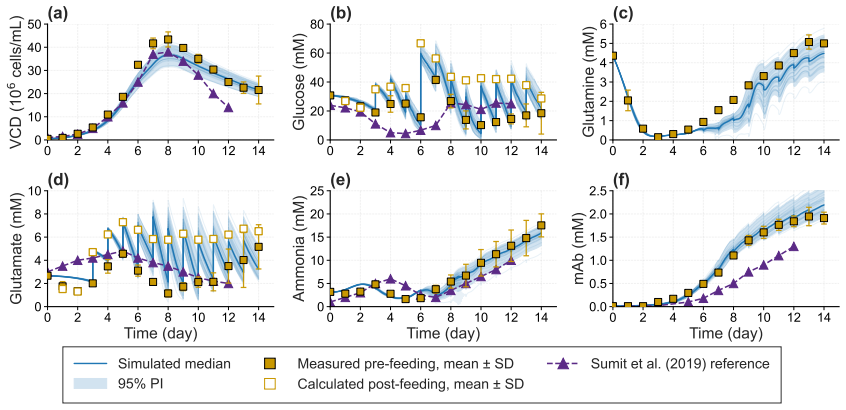
The framework accurately predicts trajectories of cell density, metabolites, productivity, and glycosylation, including increased G0F and reduced galactosylation under ammonia stress, by propagating cell-resolved metabolic states including ammonia-regulated Golgi pH, nucleotide sugar availability, manganese cofactors, and synthesis rates from the single-cell kinetic model through the stochastic population model.
What carries the argument
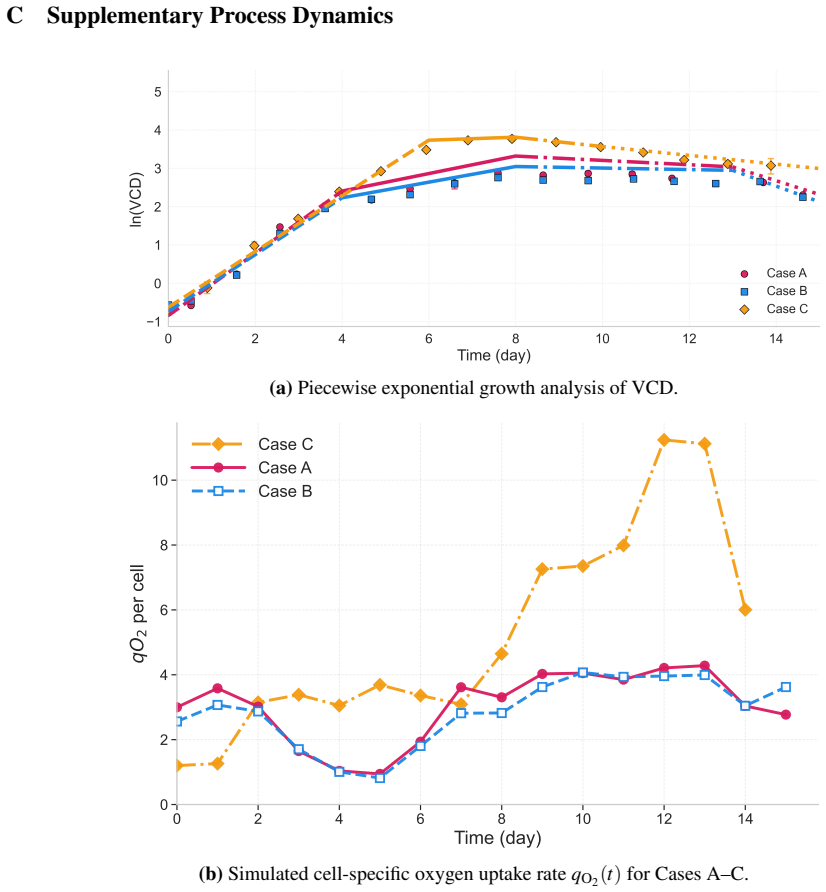
The single-cell kinetic model coupling metabolic and glycosylation networks, combined with the stochastic single-cell model for environment-dependent transitions and the cumulative oxygen uptake rate biomarker.
If this is right
- Trajectories of cell density, metabolites, productivity, and glycosylation are accurately predicted across fed-batch conditions.
- Increased G0F and reduced galactosylation occur under ammonia stress relative to matched controls.
- Metabolic heterogeneity drives variability in productivity and critical quality attributes.
- The pyramid-feeding strategy allows tighter control and can be assessed for its effects on these metrics.
Where Pith is reading between the lines
- If the model holds, it could support development of advanced process control strategies in biomanufacturing.
- Applying the framework to additional stress conditions or different cell lines would test its generality.
- The biomarker approach may simplify integration with existing process monitoring systems.
Load-bearing premise
That cell-resolved metabolic states can be propagated from the single-cell kinetic model through the stochastic population model and cumulative oxygen uptake rate biomarker to yield accurate population-level predictions across fed-batch conditions without extensive post-hoc parameter adjustments.
What would settle it
A significant mismatch between the model's predicted glycosylation profiles and experimental measurements in an independent set of fed-batch cultures under ammonia stress or alternative feeding would falsify the framework's accuracy.
Figures




read the original abstract
Antibody productivity and glycosylation quality in CHO cultures arise from a dynamically evolving metabolic environment, yet models often work in isolation or at a single scale. Here, we present a multiscale mechanistic framework linking molecular, cellular, and process levels to predict how inputs shape bioprocess trajectories. The framework is grounded on a single-cell kinetic model that couples metabolic and glycosylation networks governing yield and critical quality attributes (CQAs). A stochastic single-cell model describes environment-dependent transitions among growth, production, and decline, capturing population heterogeneity. We further introduce cumulative variation in the oxygen uptake rate, integrating total metabolic adjustment over time, as a compact biomarker for predicting metabolic shifts. Unlike population-averaged approaches, the model propagates cell-resolved metabolic states (including ammonia-regulated Golgi pH, nucleotide sugar availability, manganese cofactors, and synthesis rates) into glycan processing. The framework was evaluated using CHO-K1 fed-batch cultures producing VRC01 IgG1 under targeted ammonia stress, matched control conditions, and a pyramid-feeding strategy with tighter control. It accurately predicts trajectories of cell density, metabolites, productivity, and glycosylation, including increased G0F and reduced galactosylation under ammonia stress, and quantifies how metabolic heterogeneity drives variability in productivity and CQAs. This work provides a unified foundation for predictive biomanufacturing and advanced process control.
Editorial analysis
A structured set of objections, weighed in public.
Referee Report
Summary. The paper presents GlycoMAC, a multiscale mechanistic framework linking molecular, cellular, and process levels to predict antibody productivity and glycosylation in CHO cultures. It combines a single-cell kinetic model coupling metabolic and glycosylation networks, a stochastic single-cell model for environment-dependent population transitions, and a cumulative oxygen uptake rate biomarker. The framework is evaluated on CHO-K1 fed-batch cultures under ammonia stress, control conditions, and pyramid feeding, claiming accurate predictions of cell density, metabolite, productivity, and glycosylation trajectories (including increased G0F and reduced galactosylation under ammonia stress) while quantifying how metabolic heterogeneity drives variability in productivity and CQAs.
Significance. If the central claims hold with independent validation, the work offers a unified mechanistic approach to multiscale modeling of glycosylation and productivity that accounts for cell-resolved states (Golgi pH, nucleotide sugars, Mn cofactors) and heterogeneity, which could support predictive biomanufacturing and advanced process control beyond population-averaged methods.
major comments (1)
- [Abstract] Abstract: the claim that the framework 'accurately predicts' trajectories of cell density, metabolites, productivity, and glycosylation (including specific shifts under ammonia stress) is not accompanied by any equations, validation metrics, error analysis, held-out test results, or parameter counts. Without these details it is impossible to determine whether the reported predictions are independent of parameters fitted to the same data used for evaluation or whether they rely on post-hoc adjustments.
Simulated Author's Rebuttal
We thank the referee for their review and for highlighting the need for clearer linkage between abstract claims and supporting evidence. We address the concern point-by-point below and propose targeted revisions to strengthen the presentation.
read point-by-point responses
-
Referee: [Abstract] Abstract: the claim that the framework 'accurately predicts' trajectories of cell density, metabolites, productivity, and glycosylation (including specific shifts under ammonia stress) is not accompanied by any equations, validation metrics, error analysis, held-out test results, or parameter counts. Without these details it is impossible to determine whether the reported predictions are independent of parameters fitted to the same data used for evaluation or whether they rely on post-hoc adjustments.
Authors: We agree that the abstract, as a concise summary, does not contain equations, quantitative metrics, or parameter counts; these elements are provided in the main text. The single-cell kinetic model equations appear in Section 2.1, the stochastic population model in Section 2.2, and the oxygen-uptake biomarker derivation in Section 2.3. Parameter estimation from control cultures and forward prediction on ammonia-stress and pyramid-feeding conditions (with explicit held-out evaluation) are described in Sections 3.2–3.4, accompanied by RMSE values, correlation coefficients, and glycan profile error bars. The model was not refit to the stress or feeding datasets; parameters were fixed after control-condition calibration. To make this distinction immediately visible to readers, we will revise the abstract to replace the unqualified phrase “accurately predicts” with “predicts with quantitative agreement to experimental trajectories (RMSE < 15 % for cell density and key metabolites; glycan shifts reproduced within experimental variability)” and will add a parenthetical reference to the validation sections. revision: yes
Circularity Check
No significant circularity identified
full rationale
The abstract and framework description present a multiscale model propagating cell-resolved states through kinetic and stochastic components to predict trajectories, but no equations, fitting procedures, or self-citations are supplied that would allow exhibition of any reduction of a claimed prediction to its inputs by construction. All load-bearing steps remain externally falsifiable against the described fed-batch experiments, with no self-definitional, fitted-input, or uniqueness-imported patterns detectable from the given material.
Axiom & Free-Parameter Ledger
Reference graph
Works this paper leans on
-
[1]
Effects of nutrient levels and average culture ph on the glyco- sylation pattern of camelid-humanized monoclonal antibody.Journal of biotechnology, 186:98–109, 2014
Hengameh Aghamohseni, Kaveh Ohadi, Maureen Spearman, Natalie Krahn, Murray Moo-Young, Jeno M Scharer, Mike Butler, and Hector M Budman. Effects of nutrient levels and average culture ph on the glyco- sylation pattern of camelid-humanized monoclonal antibody.Journal of biotechnology, 186:98–109, 2014
2014
-
[2]
Metabolic flux analysis of cho cells at growth and non-growth phases using isotopic tracers and mass spectrometry.Metabolic engineering, 13(5):598–609, 2011
Woo Suk Ahn and Maciek R Antoniewicz. Metabolic flux analysis of cho cells at growth and non-growth phases using isotopic tracers and mass spectrometry.Metabolic engineering, 13(5):598–609, 2011
2011
-
[3]
Towards dynamic metabolic flux analysis in cho cell cultures.Biotech- nology journal, 7(1):61–74, 2012
Woo Suk Ahn and Maciek R Antoniewicz. Towards dynamic metabolic flux analysis in cho cell cultures.Biotech- nology journal, 7(1):61–74, 2012
2012
-
[4]
Neutralization of ph in the golgi apparatus causes redistribution of glycosyltransferases and changes in the o-glycosylation of mucins.Glycobiology, 11(8):633–644, 2001
Magnus AB Axelsson, Niclas G Karlsson, Daniella M Steel, Joke Ouwendijk, Tommy Nilsson, and Gunnar C Hansson. Neutralization of ph in the golgi apparatus causes redistribution of glycosyltransferases and changes in the o-glycosylation of mucins.Glycobiology, 11(8):633–644, 2001
2001
-
[5]
The choice of mammalian cell host and possibilities for glycosylation engineering.Current opinion in biotechnology, 30:107–112, 2014
Michael Butler and Maureen Spearman. The choice of mammalian cell host and possibilities for glycosylation engineering.Current opinion in biotechnology, 30:107–112, 2014
2014
-
[6]
Microevolutionary dynamics of eccdna in chinese hamster ovary cells grown in fed-batch cultures under control and lactate-stressed conditions.Scientific Reports, 13(1):1200, 2023
Dylan G Chitwood, Qinghua Wang, Stephanie R Klaubert, Kiana Green, Cathy H Wu, Sarah W Harcum, and Christopher A Saski. Microevolutionary dynamics of eccdna in chinese hamster ovary cells grown in fed-batch cultures under control and lactate-stressed conditions.Scientific Reports, 13(1):1200, 2023
2023
-
[7]
Cell-and tissue-specific glycosylation pathways informed by single-cell transcriptomics.NAR Genomics and Bioinformatics, 6(4):lqae169, 2024
Panagiotis Chrysinas, Shriramprasad Venkatesan, Isaac Ang, Vishnu Ghosh, Changyou Chen, Sriram Nee- lamegham, and Rudiyanto Gunawan. Cell-and tissue-specific glycosylation pathways informed by single-cell transcriptomics.NAR Genomics and Bioinformatics, 6(4):lqae169, 2024
2024
-
[8]
Metabolic profiling of cho cells during the production of biotherapeutics.Cells, 11(12):1929, 2022
Mathilde Coulet, Oliver Kepp, Guido Kroemer, and Stephane Basmaciogullari. Metabolic profiling of cho cells during the production of biotherapeutics.Cells, 11(12):1929, 2022
1929
-
[9]
Amino acid and manganese supplementation modulates the glycosylation state of erythropoietin in a cho culture system
Christopher K Crowell, Gustavo E Grampp, Gary N Rogers, Janis Miller, and Robert I Scheinman. Amino acid and manganese supplementation modulates the glycosylation state of erythropoietin in a cho culture system. Biotechnology and bioengineering, 96(3):538–549, 2007
2007
-
[10]
Expression systems for therapeutic glycoprotein production.Current opinion in biotechnology, 20(6):700–707, 2009
Yves Durocher and Michael Butler. Expression systems for therapeutic glycoprotein production.Current opinion in biotechnology, 20(6):700–707, 2009. 16
2009
-
[11]
Spent media analysis with an integrated ce-ms analyzer of chinese hamster ovary cells grown in an ammonia-stressed parallel microbioreactor platform.BioProcessing Journal, 19, 2020
Kathryn Elliott, Glenn Harris, Sarah Harcum, Kenion Blakeman, Colin Gavin, and Ji Young Anderson. Spent media analysis with an integrated ce-ms analyzer of chinese hamster ovary cells grown in an ammonia-stressed parallel microbioreactor platform.BioProcessing Journal, 19, 2020
2020
-
[12]
Vivian Erklavec Zajec, Uro ˇs Novak, Miha Kastelic, Boˇstjan Japelj, Ljerka Lah, Andrej Pohar, and Blaˇz Likozar. Dynamic multiscale metabolic network modeling of chinese hamster ovary cell metabolism integrating n-linked glycosylation in industrial biopharmaceutical manufacturing.Biotechnology and Bioengineering, 118(1):397– 411, 2021
2021
-
[13]
The n-glycosylation processing potential of the mammalian golgi apparatus.Frontiers in cell and developmental biology, 7:157, 2019
Peter Fisher, Jane Thomas-Oates, A Jamie Wood, and Daniel Ungar. The n-glycosylation processing potential of the mammalian golgi apparatus.Frontiers in cell and developmental biology, 7:157, 2019
2019
-
[14]
High- end ph-controlled delivery of glucose effectively suppresses lactate accumulation in cho fed-batch cultures
Matthew Gagnon, Gregory Hiller, Yen-Tung Luan, Amy Kittredge, Jordy DeFelice, and Denis Drapeau. High- end ph-controlled delivery of glucose effectively suppresses lactate accumulation in cho fed-batch cultures. Biotechnology and bioengineering, 108(6):1328–1337, 2011
2011
-
[15]
Ammonium alters n-glycan struc- tures of recombinant tnfr-igg: degradative versus biosynthetic mechanisms.Biotechnology and Bioengineering, 68(6):637–646, 2000
Martin Gawlitzek, Thomas Ryll, Jim Lofgren, and Mary B Sliwkowski. Ammonium alters n-glycan struc- tures of recombinant tnfr-igg: degradative versus biosynthetic mechanisms.Biotechnology and Bioengineering, 68(6):637–646, 2000
2000
-
[16]
The chemical langevin equation.The Journal of Chemical Physics, 113(1):297–306, 2000
Daniel T Gillespie. The chemical langevin equation.The Journal of Chemical Physics, 113(1):297–306, 2000
2000
-
[17]
Modulation of antibody galac- tosylation through feeding of uridine, manganese chloride, and galactose.Biotechnology and bioengineering, 108(7):1591–1602, 2011
Michael J Gramer, Jackie J Eckblad, Ruth Donahue, Joseph Brown, Carrie Shultz, Kent Vickerman, Patrick Priem, Ewald TJ van den Bremer, Jolanda Gerritsen, and Patrick HC van Berkel. Modulation of antibody galac- tosylation through feeding of uridine, manganese chloride, and galactose.Biotechnology and bioengineering, 108(7):1591–1602, 2011
2011
-
[18]
Pid controls: The forgotten bioprocess parameters.Discover Chemical Engineering, 2(1):1, 2022
Sarah W Harcum, Kathryn S Elliott, Bradley A Skelton, Stephanie R Klaubert, Hussain Dahodwala, and Kelvin H Lee. Pid controls: The forgotten bioprocess parameters.Discover Chemical Engineering, 2(1):1, 2022
2022
-
[19]
Optimal and consistent protein glycosylation in mam- malian cell culture.Glycobiology, 19(9):936–949, 2009
Patrick Hossler, Sarwat F Khattak, and Zheng Jian Li. Optimal and consistent protein glycosylation in mam- malian cell culture.Glycobiology, 19(9):936–949, 2009
2009
-
[20]
Systems analysis of n-glycan processing in mammalian cells.PloS one, 2(8):e713, 2007
Patrick Hossler, Bhanu Chandra Mulukutla, and Wei-Shou Hu. Systems analysis of n-glycan processing in mammalian cells.PloS one, 2(8):e713, 2007
2007
-
[21]
Zhuangrong Huang, Dong-Yup Lee, and Seongkyu Yoon. Quantitative intracellular flux modeling and applica- tions in biotherapeutic development and production using cho cell cultures.Biotechnology and Bioengineering, 114(12):2717–2728, 2017
2017
-
[22]
Evaluating the impact of cell culture process parameters on monoclonal antibody n-glycosylation.Journal of biotechnology, 188:88–96, 2014
Marija Ivarsson, Thomas K Villiger, Massimo Morbidelli, and Miroslav Soos. Evaluating the impact of cell culture process parameters on monoclonal antibody n-glycosylation.Journal of biotechnology, 188:88–96, 2014
2014
-
[23]
ph excursions impact cho cell culture performance and antibody n-linked glycosylation.Bioprocess and Biosystems Engineering, 41(12):1731–1741, 2018
Rubin Jiang, Hao Chen, and Sen Xu. ph excursions impact cho cell culture performance and antibody n-linked glycosylation.Bioprocess and Biosystems Engineering, 41(12):1731–1741, 2018
2018
-
[24]
Polizzi, and Cleo Kon- toravdi
Ioscani Jim ´enez del Val, Antony Constantinou, Anne Dell, Stuart Haslam, Karen M. Polizzi, and Cleo Kon- toravdi. A quantitative and mechanistic model for monoclonal antibody glycosylation as a function of nutrient availability during cell culture.BMC Proceedings, 7(Suppl 6):O10, 2013
2013
-
[25]
Ioscani Jimenez del Val, Judit M Nagy, and Cleo Kontoravdi. A dynamic mathematical model for monoclonal antibody n-linked glycosylation and nucleotide sugar donor transport within a maturing golgi apparatus.Biotech- nology progress, 27(6):1730–1743, 2011
2011
-
[26]
Modulation and modeling of monoclonal antibody n-linked glycosylation in mammalian cell perfusion reactors.Biotechnology and Bioengineering, 114(9):1978–1990, 2017
Daniel J Karst, Ernesto Scibona, Elisa Serra, Jean-Marc Bielser, Jonathan Souquet, Matthieu Stettler, Herv ´e Broly, Miroslav Soos, Massimo Morbidelli, and Thomas K Villiger. Modulation and modeling of monoclonal antibody n-linked glycosylation in mammalian cell perfusion reactors.Biotechnology and Bioengineering, 114(9):1978–1990, 2017
1978
-
[27]
Dynamic ph profiles drive higher cell-specific and volumetric productivity.Biotech- nology Progress, 42(1):e70080, 2026
Stephanie R Klaubert, Dylan G Chitwood, Danqia Peng, Erin Redman, Ji Young L Anderson, Nicholas R San- doval, and Sarah W Harcum. Dynamic ph profiles drive higher cell-specific and volumetric productivity.Biotech- nology Progress, 42(1):e70080, 2026
2026
-
[28]
N Kochanowski, Fabian Blanchard, R Cacan, F Chirat, E Guedon, A Marc, and J-L Goergen. Influence of intracellular nucleotide and nucleotide sugar contents on recombinant interferon-γglycosylation during batch and fed-batch cultures of cho cells.Biotechnology and bioengineering, 100(4):721–733, 2008
2008
-
[29]
Johannes Kopp, Denise Jahn, Guido V ogt, Anthi Psoma, Edoardo Ratto, Willy Morelle, Nina Stelzer, Ingrid Hausser, Anne Hoffmann, Miguel Rodriguez de Los Santos, et al. Golgi ph elevation due to loss of v-atpase subunit v0a2 function correlates with tissue-specific glycosylation changes and globozoospermia.Cellular and molecular life sciences, 82(1):4, 2024. 17
2024
-
[30]
Choglyconet: Comprehensive glycosylation reaction network for cho cells.Metabolic engineering, 76:87–96, 2023
Pavlos Kotidis, Roberto Donini, Johnny Arnsdorf, Anders Holmgaard Hansen, Bjørn Gunnar Rude V oldborg, Austin WT Chiang, Stuart M Haslam, Michael Betenbaugh, Ioscani Jimenez Del Val, Nathan E Lewis, et al. Choglyconet: Comprehensive glycosylation reaction network for cho cells.Metabolic engineering, 76:87–96, 2023
2023
-
[31]
Model-based optimization of antibody galactosylation in cho cell culture.Biotechnology and bioengineering, 116(7):1612–1626, 2019
Pavlos Kotidis, Philip Jedrzejewski, Si Nga Sou, Christopher Sellick, Karen Polizzi, Ioscani Jimenez Del Val, and Cleo Kontoravdi. Model-based optimization of antibody galactosylation in cho cell culture.Biotechnology and bioengineering, 116(7):1612–1626, 2019
2019
-
[32]
Model-based analysis of n-glycosylation in chinese hamster ovary cells.PLoS One, 12(5):e0175376, 2017
Frederick J Krambeck, Sandra V Bennun, Mikael R Andersen, and Michael J Betenbaugh. Model-based analysis of n-glycosylation in chinese hamster ovary cells.PLoS One, 12(5):e0175376, 2017
2017
-
[33]
A mathematical model of n-linked glycosylation.Biotechnol- ogy and Bioengineering, 92(6):711–728, 2005
Frederick J Krambeck and Michael J Betenbaugh. A mathematical model of n-linked glycosylation.Biotechnol- ogy and Bioengineering, 92(6):711–728, 2005
2005
-
[34]
Tamara Kurdyaeva and Andreas Milias-Argeitis. Uncertainty propagation for deterministic models of biochem- ical networks using moment equations and the extended kalman filter.Journal of the Royal Society Interface, 18(181), 2021
2021
-
[35]
Kinetic modeling of mammalian cell culture bioprocessing: The quest to advance biomanufacturing.Biotechnology Journal, 13(3):1700229, 2018
Sarantos Kyriakopoulos, Kok Siong Ang, Meiyappan Lakshmanan, Zhuangrong Huang, Seongkyu Yoon, Rudiyanto Gunawan, and Dong-Yup Lee. Kinetic modeling of mammalian cell culture bioprocessing: The quest to advance biomanufacturing.Biotechnology Journal, 13(3):1700229, 2018
2018
-
[36]
Therapeutic glycoprotein production in mammalian cells.Journal of biotechnology, 251:128–140, 2017
Marie-Eve Lalonde and Yves Durocher. Therapeutic glycoprotein production in mammalian cells.Journal of biotechnology, 251:128–140, 2017
2017
-
[37]
Benchmark glycan profile of therapeutic monoclonal antibodies produced by mammalian cell expression systems.Pharmaceutical Research, 41(1):29–37, 2024
Shen Luo and Baolin Zhang. Benchmark glycan profile of therapeutic monoclonal antibodies produced by mammalian cell expression systems.Pharmaceutical Research, 41(1):29–37, 2024
2024
-
[38]
Adaptive nonlinear model predictive control of monoclonal antibody glycosylation in cho cell culture.Control Engineering Practice, 169:106731, 2026
Yingjie Ma, Jing Guo, Alexis B Dubs, Krystian Ganko, and Richard D Braatz. Adaptive nonlinear model predictive control of monoclonal antibody glycosylation in cho cell culture.Control Engineering Practice, 169:106731, 2026
2026
-
[39]
Quasi-steady-state approach for efficient multiscale simulation and optimization of mab glycosylation in cho cell culture.Chemical Engineering Science, 318:122162, 2025
Yingjie Ma, Jing Guo, Andrew J Maloney, and Richard D Braatz. Quasi-steady-state approach for efficient multiscale simulation and optimization of mab glycosylation in cho cell culture.Chemical Engineering Science, 318:122162, 2025
2025
-
[40]
New developments in online our monitoring and its application to animal cell cultures.Applied microbiology and biotechnology, 103:6903–6917, 2019
I Mart ´ınez-Monge, R Roman, P Comas, A Fontova, M Lecina, A Casablancas, and JJ Cair´o. New developments in online our monitoring and its application to animal cell cultures.Applied microbiology and biotechnology, 103:6903–6917, 2019
2019
-
[41]
Quantifi- cation of the dynamics of population heterogeneities in cho cultures with stably integrated fluorescent markers
Johannes M ¨oller, Marcel Rosenberg, Kristoffer Riecken, Ralf P¨ortner, An-Ping Zeng, and Uwe Jandt. Quantifi- cation of the dynamics of population heterogeneities in cho cultures with stably integrated fluorescent markers. Analytical and bioanalytical chemistry, 412(9):2065–2080, 2020
2065
-
[42]
On metabolic shift to lactate consumption in fed-batch culture of mammalian cells.Metabolic engineering, 14(2):138–149, 2012
Bhanu Chandra Mulukutla, Michael Gramer, and Wei-Shou Hu. On metabolic shift to lactate consumption in fed-batch culture of mammalian cells.Metabolic engineering, 14(2):138–149, 2012
2012
-
[43]
Johannes M ¨uthing, Sven E Kemminer, Harald S Conradt, Dijana ˇSagi, Manfred Nimtz, Uwe K ¨arst, and Jasna Peter-Katalini´c. Effects of buffering conditions and culture ph on production rates and glycosylation of clinical phase i anti-melanoma mouse igg3 monoclonal antibody r24.Biotechnology and bioengineering, 83(3):321–334, 2003
2003
-
[44]
Effects of cell culture conditions on antibody n-linked glycosylation—what affects high mannose 5 glycoform.Biotechnology and bioengineering, 108(10):2348–2358, 2011
Efren Pacis, Marcella Yu, Jennifer Autsen, Robert Bayer, and Feng Li. Effects of cell culture conditions on antibody n-linked glycosylation—what affects high mannose 5 glycoform.Biotechnology and bioengineering, 108(10):2348–2358, 2011
2011
-
[45]
Magdalena Pappenreiter, Bernhard Sissolak, Wolfgang Sommeregger, and Gerald Striedner. Oxygen uptake rate soft-sensing via dynamic k l a computation: Cell volume and metabolic transition prediction in mammalian bioprocesses.Frontiers in Bioengineering and Biotechnology, 7:195, 2019
2019
-
[46]
Intraclonal protein expression heterogeneity in recombinant cho cells.PloS one, 4(12):e8432, 2009
Warren Pilbrough, Trent P Munro, and Peter Gray. Intraclonal protein expression heterogeneity in recombinant cho cells.PloS one, 4(12):e8432, 2009
2009
-
[47]
Hybrid deep modeling of a cho-k1 fed-batch process: combining first-principles with deep neural networks.Frontiers in Bioengineering and Biotechnology, 11:1237963, 2023
Jos ´e Pinto, Jo ˜ao RC Ramos, Rafael S Costa, Sergio Rossell, Patrick Dumas, and Rui Oliveira. Hybrid deep modeling of a cho-k1 fed-batch process: combining first-principles with deep neural networks.Frontiers in Bioengineering and Biotechnology, 11:1237963, 2023
2023
-
[48]
Metabolic and process engineering to control glycan structures for biopharmaceuticals produced in cultured mammalian cells
Ranya Pranomphon, Vijay Tejwani, Hussain Dahodwala, Montarop Yamabhai, and Susan T Sharfstein. Metabolic and process engineering to control glycan structures for biopharmaceuticals produced in cultured mammalian cells. InBioprocessing, Bioengineering and Process Chemistry in the Biopharmaceutical Industry: Using Chemistry and Bioengineering to Improve the...
2024
-
[49]
Controlling the glycosylation profile in mabs using time-dependent media supplementation.Antibodies, 7(1):1, 2017
Devesh Radhakrishnan, Anne S Robinson, and Babatunde A Ogunnaike. Controlling the glycosylation profile in mabs using time-dependent media supplementation.Antibodies, 7(1):1, 2017
2017
-
[50]
Fc glycans of therapeutic antibodies as critical quality attributes.Glycobiol- ogy, 25(12):1325–1334, 2015
Dietmar Reusch and Max L Tejada. Fc glycans of therapeutic antibodies as critical quality attributes.Glycobiol- ogy, 25(12):1325–1334, 2015
2015
-
[51]
Elevated golgi ph impairs terminal n-glycosylation by inducing mislocalization of golgi glycosyltransferases.Journal of cellular physiology, 220(1):144–154, 2009
Antti Rivinoja, Antti Hassinen, Nina Kokkonen, Annika Kauppila, and Sakari Kellokumpu. Elevated golgi ph impairs terminal n-glycosylation by inducing mislocalization of golgi glycosyltransferases.Journal of cellular physiology, 220(1):144–154, 2009
2009
-
[52]
Elevated golgi ph in breast and colorectal cancer cells correlates with the expression of oncofetal carbohydrate t-antigen.Journal of cellular physiology, 208(1):167–174, 2006
Antti Rivinoja, Nina Kokkonen, Ilmo Kellokumpu, and Sakari Kellokumpu. Elevated golgi ph in breast and colorectal cancer cells correlates with the expression of oncofetal carbohydrate t-antigen.Journal of cellular physiology, 208(1):167–174, 2006
2006
-
[53]
A single dynamic metabolic model can describe mab producing cho cell batch and fed-batch cultures on different culture media.PloS one, 10(9):e0136815, 2015
Julien Robitaille, Jingkui Chen, and Mario Jolicoeur. A single dynamic metabolic model can describe mab producing cho cell batch and fed-batch cultures on different culture media.PloS one, 10(9):e0136815, 2015
2015
-
[54]
Approximation and inference methods for stochastic biochemical kinetics—a tutorial review.Journal of Physics A: Mathematical and Theoretical, 50(9):093001, 2017
David Schnoerr, Guido Sanguinetti, and Ramon Grima. Approximation and inference methods for stochastic biochemical kinetics—a tutorial review.Journal of Physics A: Mathematical and Theoretical, 50(9):093001, 2017
2017
-
[55]
Combined in silico modeling and metabolomics analysis to characterize fed-batch cho cell culture.Biotechnology and bioengineering, 109(6):1415–1429, 2012
Suresh Selvarasu, Ying Swan Ho, William PK Chong, Niki SC Wong, Faraaz NK Yusufi, Yih Yean Lee, Mi- randa GS Yap, and Dong-Yup Lee. Combined in silico modeling and metabolomics analysis to characterize fed-batch cho cell culture.Biotechnology and bioengineering, 109(6):1415–1429, 2012
2012
-
[56]
N-glycosylation design and control of therapeutic monoclonal antibodies.Trends in Biotechnology, 34(10):835 – 846, 2016
Sha Sha, Cyrus Agarabi, Kurt Brorson, Dong-Yup Lee, and Seongkyu Yoon. N-glycosylation design and control of therapeutic monoclonal antibodies.Trends in Biotechnology, 34(10):835 – 846, 2016
2016
-
[57]
Mechanistic modeling and applications for cho cell culture development and production.Current Opinion in Chemical Engineering, 22:54 – 61, 2018
Sha Sha, Zhuangrong Huang, Zhao Wang, and Seongkyu Yoon. Mechanistic modeling and applications for cho cell culture development and production.Current Opinion in Chemical Engineering, 22:54 – 61, 2018
2018
-
[58]
Dissecting n-glycosylation dynamics in chinese hamster ovary cells fed-batch cultures using time course omics analyses
Madhuresh Sumit, Sepideh Dolatshahi, An-Hsiang Adam Chu, Kaffa Cote, John J Scarcelli, Jeffrey K Mar- shall, Richard J Cornell, Ron Weiss, Douglas A Lauffenburger, Bhanu Chandra Mulukutla, et al. Dissecting n-glycosylation dynamics in chinese hamster ovary cells fed-batch cultures using time course omics analyses. IScience, 12:102–120, 2019
2019
-
[59]
Transient ammonia stress on chinese hamster ovary (cho) cells yield alterations to alanine metabolism and igg glycosylation profiles.Biotechnology Journal, 16(7):2100098, 2021
Benjamin F Synoground, Claire E McGraw, Kathryn S Elliott, Christina Leuze, Jada R Roth, Sarah W Harcum, and Nicholas R Sandoval. Transient ammonia stress on chinese hamster ovary (cho) cells yield alterations to alanine metabolism and igg glycosylation profiles.Biotechnology Journal, 16(7):2100098, 2021
2021
-
[60]
What cho is made of: Variations in the biomass composition of chinese hamster ovary cell lines.Metabolic engineering, 61:288–300, 2020
Diana Sz ´eliov´a, David E Ruckerbauer, Sarah N Galleguillos, Lars B Petersen, Klaus Natter, Michael Hanscho, Christina Troyer, Tim Causon, Harald Schoeny, Hanne B Christensen, et al. What cho is made of: Variations in the biomass composition of chinese hamster ovary cell lines.Metabolic engineering, 61:288–300, 2020
2020
-
[61]
A mathematical model of n-linked glycoform biosynthesis.Biotechnology and bioengineering, 55(6):890–908, 1997
Pablo Uma ˜na and James E Bailey. A mathematical model of n-linked glycoform biosynthesis.Biotechnology and bioengineering, 55(6):890–908, 1997
1997
-
[62]
Controlling the time evolution of mab n-linked glycosylation-part ii: Model-based predictions.Biotechnology progress, 32(5):1135–1148, 2016
Thomas K Villiger, Ernesto Scibona, Matthieu Stettler, Herv ´e Broly, Massimo Morbidelli, and Miroslav Soos. Controlling the time evolution of mab n-linked glycosylation-part ii: Model-based predictions.Biotechnology progress, 32(5):1135–1148, 2016
2016
-
[63]
Multi-scale hybrid modeling to predict cell culture process with metabolic phase transitions.Biotechnology and Bioengineering, 2026
Keqi Wang, Sarah W Harcum, and Wei Xie. Multi-scale hybrid modeling to predict cell culture process with metabolic phase transitions.Biotechnology and Bioengineering, 2026
2026
-
[64]
Simulation and inference algorithms for stochastic biochemical reaction networks: from basic concepts to state-of-the-art.Journal of the Royal Society Interface, 16(151), 2019
David J Warne, Ruth E Baker, and Matthew J Simpson. Simulation and inference algorithms for stochastic biochemical reaction networks: from basic concepts to state-of-the-art.Journal of the Royal Society Interface, 16(151), 2019
2019
-
[65]
Production of recombinant protein therapeutics in cultivated mammalian cells.Nature biotech- nology, 22(11):1393–1398, 2004
Florian M Wurm. Production of recombinant protein therapeutics in cultivated mammalian cells.Nature biotech- nology, 22(11):1393–1398, 2004
2004
-
[66]
Progress in fed-batch culture for recombinant protein production in cho cells.Applied microbiology and biotechnology, 107(4):1063–1075, 2023
Wen-Jing Xu, Yan Lin, Chun-Liu Mi, Jing-Ying Pang, and Tian-Yun Wang. Progress in fed-batch culture for recombinant protein production in cho cells.Applied microbiology and biotechnology, 107(4):1063–1075, 2023
2023
-
[67]
Effects of ammonia on cho cell growth, erythropoietin production, and glycosylation
M Yang and M Butler. Effects of ammonia on cho cell growth, erythropoietin production, and glycosylation. Biotechnology and bioengineering, 68(4):370–380, 2000. 19 A Metabolic Network and Kinetic Equations Table 1: Reactions for the metabolic network No. Pathway 1 EGLC→G6P 2 G6P→2 PYR 3 PYR↔LAC 4 LAC↔ELAC 5 GLU + PYR↔AKG + ALA 6 ALA→EALA 7 SER→PYR + NH 3 ...
2000
discussion (0)
Sign in with ORCID, Apple, or X to comment. Anyone can read and Pith papers without signing in.