A Stable Boundary Element Method for Reliable Long-Time Industrial Sound Emission
Pith reviewed 2026-07-03 07:41 UTC · model grok-4.3
The pith
A space-time Galerkin boundary element method for the acoustic wave equation remains stable over long times in industrial geometries.
A machine-rendered reading of the paper's core claim, the machinery that carries it, and where it could break.
Core claim
The authors present a well-posed space-time Galerkin formulation of the hypersingular boundary integral operator for the acoustic wave equation in three dimensions. Their numerical tests confirm that the associated time-stepping scheme is stable and accurate for complex acoustic problems in industrial geometries, in contrast to alternative schemes, and yields very good agreement with physical acoustic measurements.
What carries the argument
The space-time Galerkin formulation of the hypersingular boundary integral operator, which enables a stable time-stepping scheme for the acoustic wave equation.
If this is right
- The time stepping scheme is stable and accurate for long-time simulations.
- It performs well on complex acoustic problems in industrial geometries.
- The method is efficient for real-world problems.
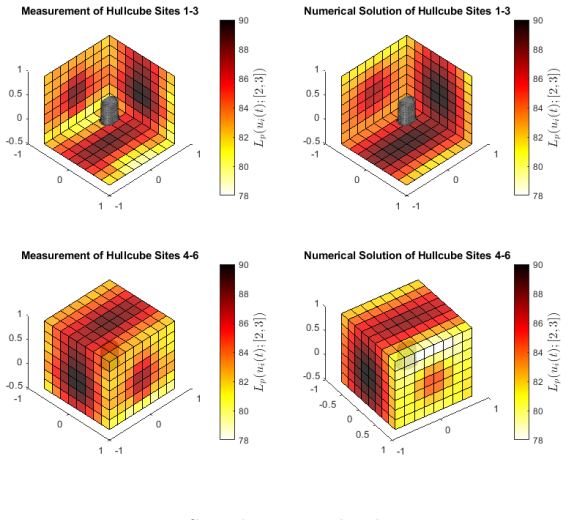
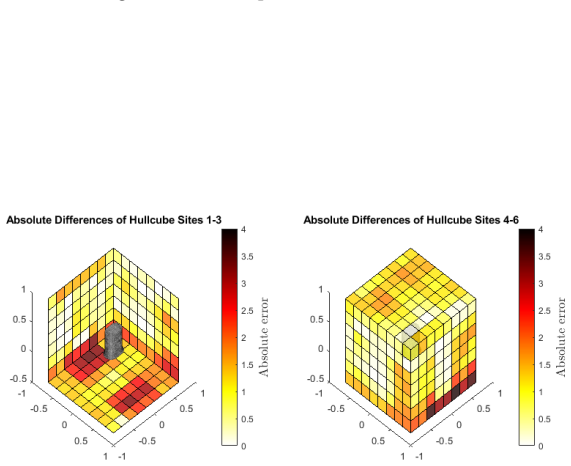
- It obtains very good agreement with physical acoustic measurements.
Where Pith is reading between the lines
- This stability could allow simulations over longer time periods than previously feasible in industrial acoustics.
- Similar formulations might apply to other boundary integral equations for wave problems.
- Integration with adaptive meshing could further improve efficiency for very large geometries.
Load-bearing premise
The space-time Galerkin formulation of the hypersingular boundary integral operator is well-posed for the acoustic wave equation in three dimensions.
What would settle it
Running the time-stepping scheme on one of the industrial test cases and observing instability or large errors accumulating over long simulation times would disprove the stability claim.
Figures
read the original abstract
In this paper we investigate a stable space-time formulation for long-time industrial sound emission problems. To this end, we use a well-posed Galerkin formulation in space and time of the acoustic wave equation in $\mathbb{R}^3$, involving a hypersingular boundary integral operator. Our numerical experiments confirm that the resulting time stepping scheme is stable and accurate for complex acoustic problems in industrial geometries, in contrast to alternative well-known schemes. The proposed method is shown to be efficient for real-world problems, and we obtain very good agreement with physical acoustic measurements.
Editorial analysis
A structured set of objections, weighed in public.
Referee Report
Summary. The manuscript presents a space-time Galerkin boundary element method for the acoustic wave equation in R^3 based on the hypersingular boundary integral operator. It asserts that this formulation is well-posed and produces a stable, accurate time-stepping scheme for long-time industrial sound emission problems in complex geometries. Numerical experiments are claimed to confirm stability and accuracy (outperforming alternative schemes) along with good agreement to physical acoustic measurements.
Significance. If the well-posedness holds and the experiments include rigorous quantitative verification, the work could meaningfully advance reliable long-time time-domain BEM for acoustics, addressing a known practical difficulty. The industrial focus and reported measurement agreement would add applied value.
major comments (2)
- [Introduction] Introduction and formulation sections: the central claim that the space-time Galerkin hypersingular formulation is well-posed (and therefore yields an inheriting stable scheme) is asserted without the Bochner-space setting, inf-sup or coercivity argument, or reference to a complete analysis; this underpins all subsequent stability statements.
- [Numerical Experiments] Numerical experiments section: the abstract and reported results supply no quantitative error measures, mesh details, time-step sizes, comparison baselines, or data-exclusion rules, so the claims of confirmed stability, accuracy, and measurement agreement lack verifiable support.
Simulated Author's Rebuttal
We thank the referee for the careful review and constructive comments. We address each major point below and will revise the manuscript to strengthen the presentation of the well-posedness argument and the quantitative support for the numerical results.
read point-by-point responses
-
Referee: [Introduction] Introduction and formulation sections: the central claim that the space-time Galerkin hypersingular formulation is well-posed (and therefore yields an inheriting stable scheme) is asserted without the Bochner-space setting, inf-sup or coercivity argument, or reference to a complete analysis; this underpins all subsequent stability statements.
Authors: We agree that the well-posedness claim would be strengthened by an explicit outline of the underlying functional-analytic setting. In the revised manuscript we will add a concise paragraph in the formulation section that recalls the Bochner-space framework, states the inf-sup condition for the space-time hypersingular operator, and sketches the coercivity argument that guarantees well-posedness; we will also cite the complete analysis from the relevant prior work on which the present formulation rests. This addition directly supports the subsequent stability statements without altering the manuscript’s core contribution. revision: yes
-
Referee: [Numerical Experiments] Numerical experiments section: the abstract and reported results supply no quantitative error measures, mesh details, time-step sizes, comparison baselines, or data-exclusion rules, so the claims of confirmed stability, accuracy, and measurement agreement lack verifiable support.
Authors: We accept that the numerical section requires additional quantitative detail to make the claims verifiable. In the revision we will insert tables and text that report relative L2-error norms over the full time interval, the number of spatial elements and degrees of freedom for each mesh, the chosen time-step sizes, direct comparisons against the alternative schemes mentioned in the abstract, and an explicit statement of any data-exclusion criteria used when comparing with physical measurements. These additions will provide the rigorous quantitative verification requested. revision: yes
Circularity Check
No circularity: formulation asserted well-posed from wave equation; experiments independent of inputs
full rationale
The provided abstract and context present the space-time Galerkin hypersingular formulation as derived from the acoustic wave equation in R^3 and asserted well-posed, with numerical experiments then used to confirm stability for industrial cases. No equations, fitted parameters, or self-citations are exhibited that reduce any claimed prediction or stability result to the inputs by construction. The derivation chain remains self-contained against external benchmarks (wave equation properties and operator theory), with no load-bearing step that renames a fit or imports uniqueness solely via overlapping authors. This is the normal non-finding for papers whose central claim rests on independent numerical verification rather than tautological redefinition.
Axiom & Free-Parameter Ledger
axioms (1)
- domain assumption The space-time Galerkin formulation of the hypersingular boundary integral operator for the acoustic wave equation is well-posed
Reference graph
Works this paper leans on
-
[1]
A. Aimi, L. Desiderio, and G. Di Credico. Partially pivoted ACA based accelerationoftheenergeticbemfortime-domainacousticandelasticwaves exterior problems.Comput. Math. Appl., 119:351–370, 2022
2022
-
[2]
A. Aimi, G. Di Credico, H. Gimperlein, and C. Guardasoni. Adaptive time-domain boundary element methods for the wave equation with Neu- mann boundary conditions.Computers & Mathematics with Applications, 198:196–213, 2025
2025
-
[3]
A. Aimi, M. Diligenti, A. Frangi, and C. Guardasoni. Neumann exte- rior wave propagation problems: computational aspects of 3D energetic Galerkin BEM.Computational Mechanics, 51(4):475–493, 2013
2013
-
[4]
Anenergy approach to space–time Galerkin BEM for wave propagation problems
A.Aimi, M.Diligenti, C.Guardasoni, I.Mazzieri, andS.Panizzi. Anenergy approach to space–time Galerkin BEM for wave propagation problems. International Journal for Numerical Methods in Engineering, 80(9):1196– 1240, 2009
2009
-
[5]
Bamberger and T
A. Bamberger and T. Ha-Duong. Formulation variationnelle espace-temps pour le calcul par potentiel retarde de la diffraction d’une onde acoustique. Math. Meth. Appl. Sci., 8:405–435, 1986
1986
-
[6]
Banjai and F.-J
L. Banjai and F.-J. Sayas.Integral Equation Methods for Evolutionary PDE. Springer, 2022. 23
2022
-
[7]
L. Banz, H. Gimperlein, Z. Nezhi, and E. P. Stephan. Time domain BEM for sound radiation of tires.Comp. Mech., 58:45–57, 2016
2016
-
[8]
Carbonelli, E
A. Carbonelli, E. Rigaud, and J. Perret-Liaudet. Vibro-acoustic analysis of geared systems-predicting and controlling the whining noise. InAutomotive NVH Technology, volume 5, pages 63–79. Springer, 2015
2015
-
[9]
Costabel and F.-J
M. Costabel and F.-J. Sayas. Time-dependent problems with the boundary integral equation method. InEncyclopedia of Computational Mechanics, Second Edition, pages 1–24. John Wiley & Sons, 2017
2017
-
[10]
P. J. Davies and D. B. Duncan. Stability and convergence of collocation schemes for retarded potential integral equations.SIAM J. Numer. Anal., 42(3):1167–1188, 2004
2004
-
[11]
Gimperlein, M
H. Gimperlein, M. Maischak, and E. P. Stephan. Adaptive time-domain boundary element methods and engineering applications.J. Integral Equa- tions Appl., 29(1):75–105, 2017
2017
-
[12]
Gimperlein, F
H. Gimperlein, F. Meyer, and C. Özdemir. Space-time stochastic Galerkin boundary elements for acoustic scattering problems.International Journal for Numerical Methods in Engineering, 125(15):e7497, 2024
2024
-
[13]
Gimperlein, F
H. Gimperlein, F. Meyer, C. Özdemir, D. Stark, and E. P. Stephan. Bound- ary elements with mesh refinements for the wave equation.Numerische Mathematik, 139:867–912, 2018
2018
-
[14]
Gimperlein, Z
H. Gimperlein, Z. Nezhi, and E. P. Stephan. A priori error estimates for a time-dependent boundary element method for the acoustic wave equation in a half-space.Math. Methods Appl. Sci., 40(2):448–462, 2017
2017
-
[15]
Gimperlein, C
H. Gimperlein, C. Özdemir, D. Stark, and E. P. Stephan. hp-version time domain boundary elements for the wave equation on quasi-uniform meshes. Computer Methods in Applied Mechanics and Engineering, 356:145–174, 2019
2019
-
[16]
Gimperlein, C
H. Gimperlein, C. Özdemir, D. Stark, and E. P. Stephan. A residual a posteriori error estimate for the time–domain boundary element method. Numerische Mathematik, 146(2):239–280, 2020
2020
-
[17]
Gimperlein, C
H. Gimperlein, C. Özdemir, and E. P. Stephan. Time domain boundary element methods for the Neumann problem: Error estimates and acoustic problems.J. Comp. Math., 36:70–89, 2018
2018
-
[18]
Graf.Validierung von Methoden zur Berechnung und Reduzierung der Schallabstrahlung von Getriebegehäusen
B. Graf.Validierung von Methoden zur Berechnung und Reduzierung der Schallabstrahlung von Getriebegehäusen. PhD thesis, Technical University of Ilmenau, 2007
2007
-
[19]
Ha-Duong
T. Ha-Duong. On retarded potential boundary integral equations and their discretisation. InTopics in Computational Wave Propagation, volume 31 of Lecture Notes in Computational Science and Engineering, pages 301–336. Springer, 2003. 24
2003
-
[20]
Joly and J
P. Joly and J. Rodriguez. Mathematical aspects of variational boundary integral equations for time dependent wave propagation.J. Integral Equa- tions Appl., 29(1):pp. 137–187, 2017
2017
-
[21]
Maischak, E
M. Maischak, E. Ostermann, and E. P. Stephan. TD-BEM for Sound Ra- diation in Three Dimensions and the Numerical Evaluation of Retarded Potentials. InProceedings of the 2009 International Conference on Acous- tics (NAG/DAGA 2009), pages 629–632, Rotterdam, Netherlands, 2009. DEGA Akustik
2009
-
[22]
M. Ochmann. Boundary element acoustics fundamentals and computer- codes.J. Acoust. Soc. Am., 111(4):1507–1508, 2002
2002
-
[23]
Ostermann.Numerical Methods for Space-Time Variational Formu- lations of Retarded Potential Boundary Integral Equations
E. Ostermann.Numerical Methods for Space-Time Variational Formu- lations of Retarded Potential Boundary Integral Equations. PhD thesis, Leibniz University Hannover, 2010
2010
-
[24]
Özdemir.Finite Elements and Boundary Elements—Coupling in Time Domain
C. Özdemir.Finite Elements and Boundary Elements—Coupling in Time Domain. PhD thesis, Leibniz University Hannover, 2019
2019
-
[25]
Pang.Noise and Vibration Control in Automotive Bodies
J. Pang.Noise and Vibration Control in Automotive Bodies. Automotive Series. John Wiley & Sons, 2018
2018
-
[26]
Pölz and M
D. Pölz and M. Schanz. On the space-time discretization of variational retarded potential boundary integral equations.Comput. Math. Appl., 99:195–210, 2021
2021
-
[27]
Preuss, C
S. Preuss, C. Gurbuz, Ch. Jelich, S. Koji Baydoun, and S. Marburg. Re- cent advances in acoustic boundary element methods.J. Theor. Comput. Acoust., 30(03):2240002, 2022
2022
-
[28]
H. A. Schenck. Improved integral formulation for acoustic radiation prob- lems.J. Acoust. Soc. Am., 44(1):41–58, 1968
1968
-
[29]
Schneider, B
S. Schneider, B. Graf, M. Heinrich, T. Giese, and I. Haralampiev. Practical application and validation of the time-domain boundary element method in acoustics. InProceedings of ISMA / ISAAC 2022, pages 4472–4433, Leuven, Belgium, 2022
2022
-
[30]
Schneider, C
S. Schneider, C. Özdemir, H. Gimperlein, K. Urban, and B. Graf. Stability and instability of time-domain boundary element methods for the acoustic Neumann problem.Proceedings in Applied Mathematics and Mechanics, 2026
2026
-
[31]
Steinbach and C
O. Steinbach and C. Urzúa-Torres. A new approach to space-time boundary integral equations for the wave equation.SIAM J. Math. Anal., 54(2):1370– 1392, 2022
2022
-
[32]
Stephan, Matthias Maischak, and Elke Ostermann
Ernst P. Stephan, Matthias Maischak, and Elke Ostermann. Transient boundary element method and numerical evaluation of retarded potentials. In Marian Bubak, Geert Dick van Albada, Jack Dongarra, and Peter M. A. 25 Sloot, editors,Computational Science – ICCS 2008, pages 321–330, Berlin, Heidelberg, 2008. Springer Berlin Heidelberg
2008
-
[33]
Stütz and M
M. Stütz and M. Ochmann. Stability behaviour and results of a transient boundary element method for exterior radiation problems.J. Acoust. Soc. Am., 123(5):3530–3540, 2008
2008
-
[34]
Terrasse.Résolution mathématique et numérique des équations de Maxwell instationnaires par une méthode de potentiels retardés
I. Terrasse.Résolution mathématique et numérique des équations de Maxwell instationnaires par une méthode de potentiels retardés. PhD thesis, École Polytechnique, Palaiseau, 1993
1993
-
[35]
A. Veit, M. Merta, J. Zapletal, and D. Lukáš. Efficient solution of time- domain boundary integral equations arising in sound-hard scattering.Int. J. Numer. Methods Eng., 107(5):430–449, 2016. 26
2016
discussion (0)
Sign in with ORCID, Apple, or X to comment. Anyone can read and Pith papers without signing in.