REVIEW 3 major objections 5 minor 1 cited by
A NICER view of the millisecond pulsar PSR J2124$-$3358: evidence for a helium atmosphere
T0 review · 3 major / 5 minor · reviewed 2026-07-12 · grok-4.5
Pith's one-line read Pulse-profile modeling of PSR J2124−3358 favors a helium atmosphere and yields M ≈ 1.8 M⊙, R_eq ≈ 11.7 km.
desk verdict Solid first X-PSI analysis of a faint isolated MSP that modestly prefers helium; useful new data point with honest caveats and wide posteriors. read the letter →
The pith
A machine-rendered reading of the paper's core claim, the machinery that carries it, and where it could break.
The reading
What carries the argument
X-PSI relativistic ray-tracing plus nested-sampling Bayesian inference of phase- and energy-resolved pulse profiles, jointly fitting NICER and Chandra data while marginalizing over instrument backgrounds and comparing fully ionized hydrogen versus helium atmosphere tables under ST-U, ST+CDT and ST-U+EL hot-spot geometries.
What would settle it
A decisive multiwavelength geometric prior (radio and gamma-ray pulse-profile modeling of the same source) that forces the hot-spot configuration into a geometry whose likelihood under helium is strongly lower than under hydrogen would reverse the atmospheric-composition preference.
Extended reading notes
Core claim
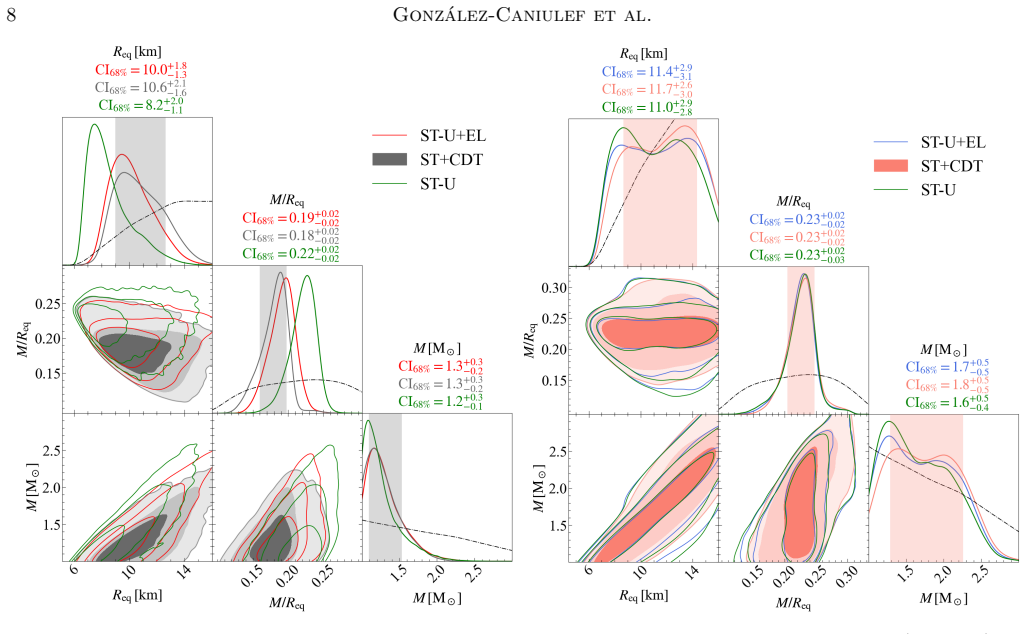
Bayesian evidence from X-PSI modeling of joint NICER and Chandra data substantially favors a helium atmospheric composition for PSR J2124−3358 over hydrogen. Under the preferred ST+CDT hot-spot model the helium atmosphere yields M = 1.8 ± 0.5 M⊙ and R_eq = 11.7^{+2.6}_{-3.0} km, with two slightly non-antipodal polar caps; a hydrogen atmosphere lowers both quantities by ~0.5 M⊙ and ~1 km.
Load-bearing premise
The analysis assumes that low-resolution ray-tracing grids and fully ionized atmosphere tables remain adequate even for the cold surface components whose temperatures sit near 10^{5.4} K, where partial ionization would normally matter.
Editorial extensions
If this is right
- Helium atmospheres must be considered as a viable default when modeling other recycled millisecond pulsars, not only hydrogen.
- The new (M, R) point, even with large uncertainties, can be folded into statistical equation-of-state inferences once mass priors improve.
- Slightly non-antipodal hot spots under helium favor a near-centered dipole magnetic field for this isolated MSP.
- Future lower-energy X-ray observations can test whether a cold bulk surface component is truly absent or merely hidden by the NICER bandpass.
Reading between the lines
- If helium surfaces prove common among MSPs, the short timescale of diffuse nuclear burning may require continuous light-element replenishment or suppressed burning rates that current models do not predict.
- The same data-reduction and joint-background strategy used here can be applied immediately to other faint, isolated MSPs already in the NICER archive, expanding the sample without waiting for new observations.
- A decisive geometric prior from radio/γ-ray modeling would convert the present broad posteriors into a competitive EOS constraint even without higher X-ray counts.
Editorial analysis
A structured set of objections, weighed in public.
Referee Report
Summary. The paper presents a Bayesian pulse-profile modeling analysis of the isolated MSP PSR J2124−3358 with X-PSI, combining NICER (1.72 Ms after filtering) and three Chandra ACIS-S spectra. Three hot-spot families (ST-U, ST+CDT, ST-U+EL) are explored with fully ionized NSX H and He atmospheres. Bayesian evidence favors helium for every surface pattern; for the preferred ST+CDT model the difference is Δlog10 Z ≈ 0.85 (“substantial” on the Kass–Raftery scale). The headline helium ST+CDT posteriors are M = 1.8 ± 0.5 M⊙ and Req = 11.7^{+2.6}_{-3.0} km (68 % CI), with two slightly non-antipodal spots; hydrogen yields systematically lower mass and radius. Background is marginalized using Chandra, residuals show no large phase–energy structure, and all samples/scripts are deposited on Zenodo.
Significance. If the helium preference holds, the work supplies the second NICER MSP (after J1231−1411) for which a helium atmosphere is preferred, with a concrete evolutionary interpretation (accretion and evaporation of a former He white-dwarf companion). The M–R posteriors, though broad, enlarge the set of NICER constraints used for EOS inference and illustrate that isolated, faint MSPs can still be useful once multi-instrument background control is applied. Strengths include public X-PSI runs, full posterior samples, explicit evidence tables, and transparent discussion of computational and modeling limits.
major comments (3)
- §4.3 and Table 2: the headline claim of “evidence for a helium atmosphere” rests on Δlog10 Z = 0.847 for ST+CDT. On the Kass–Raftery scale this is only “substantial,” not “strong” or “decisive.” The abstract and title should state the strength of the preference more precisely (e.g., “substantial Bayesian preference”) so that the result is not over-read as decisive.
- §3.5 and §5: only low-resolution ray-tracing was used; high-resolution runs are stated to be prohibitive. While Vinciguerra et al. (2023, 2024) found limited LR/HR differences for J0030+0451, that source is brighter and less background-dominated. A short quantitative check (e.g., likelihood re-evaluation of a subset of posterior samples at higher resolution, or a synthetic-data recovery test at the S/N of J2124−3358) would strengthen that the LR settings do not bias the H/He ranking or the M–R medians.
- §4.1 and Fig. 3 (left): for all hydrogen models the mass posterior piles up against the prior lower bound M = 1 M⊙ (near the validity edge of the AlGendy–Morsink oblateness approximation). Because radius is correlated with mass, the reported hydrogen M–R values and the H-versus-He comparison are partly prior-truncated. The paper should either re-run with a lower mass floor (or a compactness prior that respects the approximation) or quantify how much of the Δlog10 Z and the ~0.5 M⊙ / ~1 km shift is driven by this truncation.
minor comments (5)
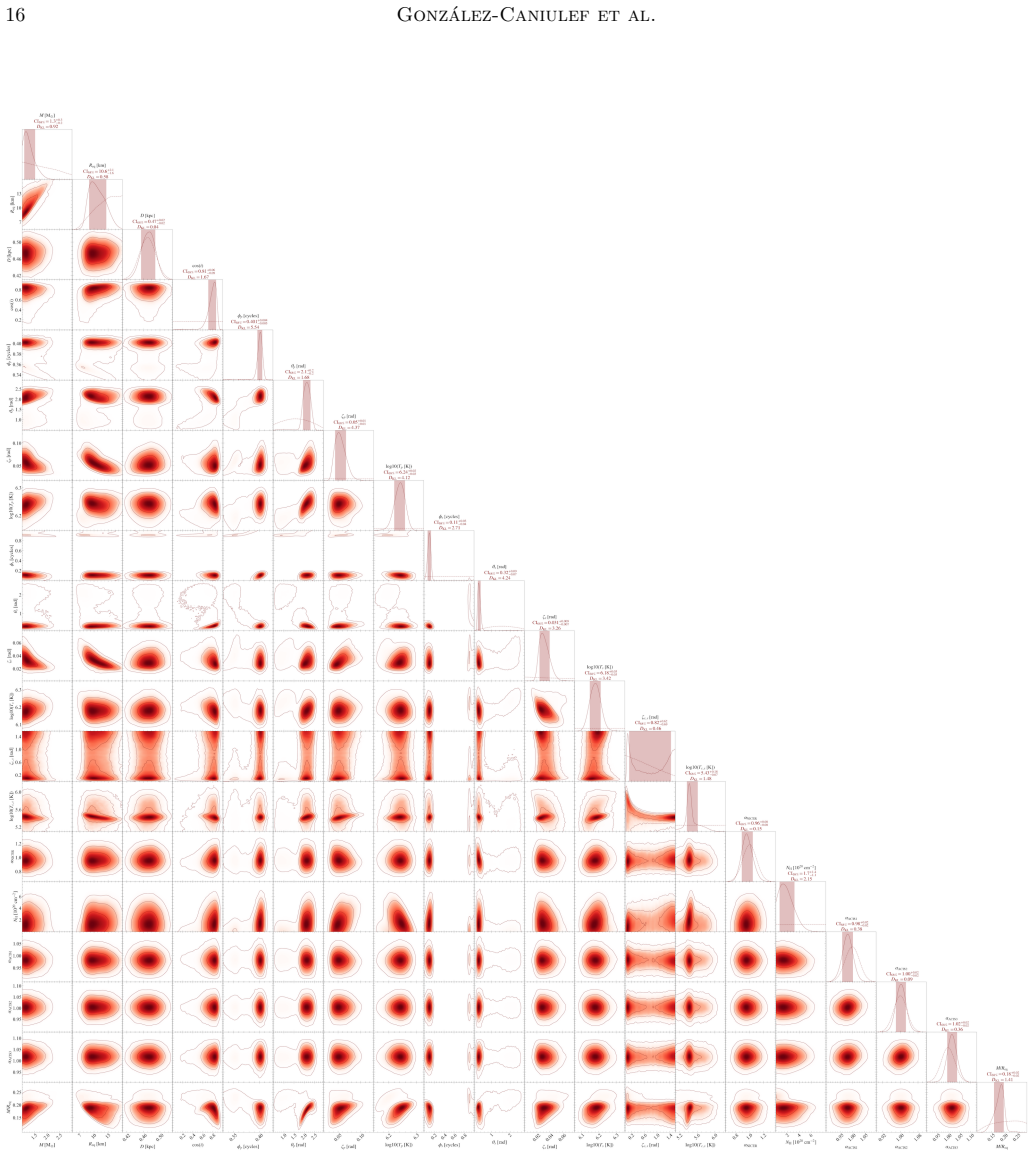
- §4.4 and Figs. 8–9: several geometric parameters (ϕp, ϕs, θs, ζc,s) show clear bimodality. The maximum-likelihood geometries plotted in Fig. 4 are therefore not representative; a short note or an additional panel showing the two modes would help readers.
- §5: the discussion of diffuse nuclear burning versus accretion for helium atmospheres is useful; a brief quantitative comparison of the expected burning timescale with the characteristic age of J2124−3358 would make the evolutionary argument sharper.
- Table 3: the Kullback–Leibler divergences are reported but never interpreted in the text; either drop them or add one sentence on what they imply for information gain relative to the priors.
- Fig. 1 caption and §2.1: the oxygen VII feature at 50–60 PI is correctly identified; a one-line statement that it is treated as part of the background (and not modeled as source emission) would remove any ambiguity.
- Throughout: a few minor typos (“favor of a helium,” “the ST+CDT is the preferred”) and inconsistent use of “elsewhere” (italicized vs. plain) should be cleaned up.
Circularity Check
No significant circularity: Bayesian evidence ranking and M–R posteriors are obtained by sampling external NICER/Chandra counts against public X-PSI ray-tracing and independent NSX atmosphere tables.
full rationale
The derivation chain is ordinary Bayesian model comparison. NICER phase-energy data and Chandra spectra are reduced with standard pipelines; distance is an external EPTA parallax prior; atmospheres are pre-tabulated NSX H/He models (Ho & Lai 2001; Ho & Heinke 2009) that do not encode the target M–R or composition ranking; ray-tracing uses the publicly released X-PSI package under the oblate-Schwarzschild approximation of AlGendy & Morsink. Nested sampling (PyMultiNest) produces posterior samples and ln Z values for three surface-pattern families; the helium preference (Δlog10 Z ≈ 0.85 for ST+CDT) and the quoted medians M = 1.8 ± 0.5 M⊙, Req = 11.7+2.6−3.0 km are simply the numerical outputs of that sampling. Self-citations to earlier X-PSI papers supply only methodological settings (LR resolution, background marginalization) that have been validated on other sources or synthetic data; none of those citations redefine the likelihood or force the helium ranking. No quantity is fitted and then re-derived, no uniqueness theorem is imported, and no ansatz is smuggled that collapses the result to its inputs. The paper’s own caveats (LR settings, fully-ionized tables for T ∼ 10^5.4 K) are modeling limitations, not circularities. Score 0 is therefore the correct assessment.
Assumptions & free parameters
free parameters (4)
- hot-spot temperatures, colatitudes, angular radii, phases (Tp, θp, ζp, ϕp and secondary/ceding counterparts)
- energy-independent effective-area scalings αNICER, αACIS1–3
- neutral hydrogen column NH
- background counts per Chandra channel (marginalized)
assumptions (4)
- domain assumption Oblate Schwarzschild + Doppler ray-tracing (AlGendy & Morsink 2014) is an adequate spacetime approximation for a 203 Hz rotator.
- domain assumption Fully-ionized non-magnetic H and He NSX atmosphere tables correctly describe the emergent spectrum even for the cold (~10^5.4 K) ceding/elsewhere components.
- ad hoc to paper Two non-overlapping hot spots (ST-U, ST+CDT or ST-U+EL) exhaust the relevant surface-pattern complexity for this data set.
- domain assumption Chandra imaging spectra provide an unbiased external constraint on the NICER background after simple circular extraction.
Cite this review
Pith. "Pith review of A NICER view of the millisecond pulsar PSR J2124$-$3358: evidence for a helium atmosphere." pith.science (2026). https://pith.science/paper/OPNVQNJ4
@misc{pith2026260703721,
  author       = {Pith},
  title        = {Pith review of: A NICER view of the millisecond pulsar PSR J2124$-$3358: evidence for a helium atmosphere},
  year         = {2026},
  howpublished = {\url{https://pith.science/paper/OPNVQNJ4}},
  note         = {Machine review of arXiv:2607.03721}
}
abstract
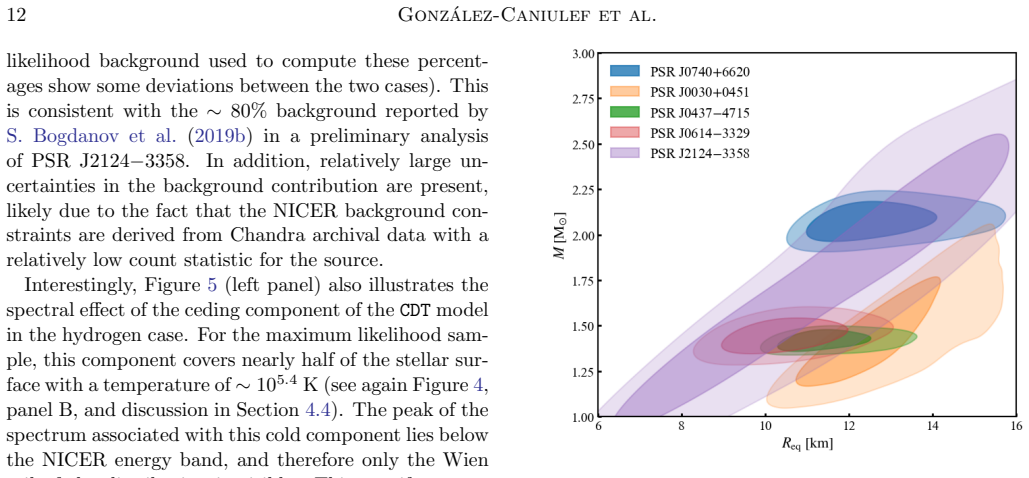
Pulse profile modeling has proven to be a powerful technique for determining the mass and radius of neutron stars. To date, this method has been applied to a handful of millisecond pulsars observed by the Neutron Star Interior Composition Explorer (NICER). However, analyses of more millisecond pulsars are necessary to determine tight constraints on the equation of state of superdense matter. In this study, we present an analysis of the isolated, rotation-powered millisecond pulsar PSR J2124$-$3358 using the X-ray Pulse Simulation and Inference (X-PSI) package, a publicly available state-of-the-art code for neutron-star relativistic ray tracing and Bayesian parameter inference. We use NICER and Chandra observations of this pulsar, exploring different neutron star atmospheric compositions and different configurations of the hot polar caps responsible for the pulsed X-ray emission. Our analyses favor a helium atmospheric composition, plausibly originating from accretion and subsequent evaporation of a former hydrogen-depleted binary companion. For this composition, and given the faint nature of the source and the low signal-to-noise of the data sets, we obtain broad posterior distributions yielding a mass $M = 1.8\pm0.5\,M_\odot$ and an equatorial radius $R_{\mathrm{eq}} = 11.7^{+2.6}_{-3.0}$ km (medians and $68\%$ credible intervals), and infer a configuration consisting of two slightly non-antipodal hot spots. By contrast, when using a hydrogen atmosphere model, the mass and radius decrease by $\sim 0.5\,M_\odot$ and $\sim 1$ km, respectively. Future multiwavelength studies, particularly those incorporating radio and gamma-ray pulse-emission, may provide tighter constraints on the geometry and physical properties of this source.
Figures


Figures from the paper (6 more)




Forward citations
Cited by 1 Pith paper
-
Determination of neutron star radius from pulse profile modeling using profile likelihood
Profile-likelihood maximization over nuisance parameters in X-PSI recovers injected neutron-star radius to <1σ on synthetic data, with precision comparable to MultiNest Bayesian inference but ~400× lower CPU cost.
Reference graph
Works this paper leans on
-
[1]
Universality of the Acceleration due to Gravity on the Surface of a Rapidly Rotating Neutron Star. , keywords =. doi:10.1088/0004-637X/791/2/78 , archivePrefix =. 1404.0609 , primaryClass =
-
[2]
The NANOGrav 11-year Data Set: High-precision Timing of 45 Millisecond Pulsars. , keywords =. doi:10.3847/1538-4365/aab5b0 , archivePrefix =. 1801.01837 , primaryClass =
-
[3]
The Astropy Project: Sustaining and Growing a Community-oriented Open-source Project and the Latest Major Release (v5.0) of the Core Package. , keywords =. doi:10.3847/1538-4357/ac7c74 , archivePrefix =. 2206.14220 , primaryClass =
-
[4]
The Astropy Project: Building an Open-science Project and Status of the v2.0 Core Package. , keywords =. doi:10.3847/1538-3881/aabc4f , archivePrefix =. 1801.02634 , primaryClass =
-
[5]
Astropy: A community Python package for astronomy. , keywords =. 2013. doi:10.1051/0004-6361/201322068 , archivePrefix =. 1307.6212 , primaryClass =
-
[6]
GW170817: Observation of Gravitational Waves from a Binary Neutron Star Inspiral. , keywords =. doi:10.1103/PhysRevLett.119.161101 , archivePrefix =. 1710.05832 , primaryClass =
-
[7]
GW190425: Observation of a Compact Binary Coalescence with Total Mass 3.4 M _. , keywords =. doi:10.3847/2041-8213/ab75f5 , archivePrefix =. 2001.01761 , primaryClass =
-
[8]
A new class of radio pulsars. , keywords =. doi:10.1038/300728a0 , adsurl =
Show all 126 references
-
[9]
I - General theory
Vortex creep and the internal temperature of neutron stars. I - General theory. , keywords =. doi:10.1086/161616 , adsurl =
-
[10]
, keywords =
Discovery of Four Isolated Millisecond Pulsars. , keywords =. doi:10.1086/304041 , adsurl =
- [11]
- [12]
- [13]
- [14]
-
[15]
Computing in Science and Engineering , keywords =
Cython: The Best of Both Worlds. Computing in Science and Engineering , keywords =. doi:10.1109/MCSE.2010.118 , adsurl =
2010 doi
- [16]
- [17]
- [18]
- [19]
- [20]
- [21]
-
[22]
Progress in Particle and Nuclear Physics , keywords =
Neutron stars and the nuclear equation of state. Progress in Particle and Nuclear Physics , keywords =. doi:10.1016/j.ppnp.2021.103879 , archivePrefix =. 2105.03747 , primaryClass =
2021 doi
-
[23]
, keywords =
The Combined X-Ray and -Ray Modeling of Millisecond Pulsar PSR J0030+0451 in the Dissipative Magnetospheres. , keywords =. doi:10.3847/1538-4357/ae3467 , archivePrefix =. 2601.07491 , primaryClass =
- [24]
- [25]
- [26]
-
[27]
Reviews of Modern Physics , keywords =
Neutron stars and the dense matter equation of state. Reviews of Modern Physics , keywords =. doi:10.1103/ymsq-cfcw , archivePrefix =. 2407.11153 , primaryClass =
-
[28]
American Astronomical Society Meeting Abstracts , year = 2005, series =
PSR J2124-3358: A Bow Shock Nebula with an X-ray Tail. American Astronomical Society Meeting Abstracts , year = 2005, series =
2005
- [29]
- [30]
- [31]
-
[32]
MPI for Python: Performance improvements and MPI-2 extensions , journal =
Lisandro Dalcín and Rodrigo Paz and Mario Storti and Jorge D’Elía , keywords =. MPI for Python: Performance improvements and MPI-2 extensions , journal =. 2008 , issn =. doi:https://doi.org/10.1016/j.jpdc.2007.09.005 , url =
2008 doi
-
[33]
, keywords =
A powerful test for weak periodic signals with unknown light curve shape in sparse data. , keywords =
- [34]
- [35]
- [36]
- [37]
-
[38]
, keywords =
MULTINEST: an efficient and robust Bayesian inference tool for cosmology and particle physics. , keywords =. doi:10.1111/j.1365-2966.2009.14548.x , archivePrefix =. 0809.3437 , primaryClass =
2009 doi
- [39]
-
[40]
Observatory Operations: Strategies, Processes, and Systems , year = 2006, editor =
CIAO: Chandra's data analysis system. Observatory Operations: Strategies, Processes, and Systems , year = 2006, editor =. doi:10.1117/12.671760 , adsurl =
2006 doi
- [41]
- [42]
-
[43]
GNU Scientific Library Reference Manual
-
[44]
Space Telescopes and Instrumentation 2016: Ultraviolet to Gamma Ray , year = 2016, editor =
The Neutron star Interior Composition Explorer (NICER): design and development. Space Telescopes and Instrumentation 2016: Ultraviolet to Gamma Ray , year = 2016, editor =. doi:10.1117/12.2231304 , adsurl =
2016 doi
-
[45]
, keywords =
Interplay of astrophysics and nuclear physics in determining the properties of neutron stars. , keywords =. doi:10.1103/PhysRevD.111.023029 , archivePrefix =. 2410.14597 , primaryClass =
- [46]
- [47]
- [48]
- [49]
- [50]
- [51]
- [52]
- [53]
-
[54]
HEAsoft: Unified Release of FTOOLS and XANADU
-
[55]
The Journal of Open Source Software , year = 2018, month = sep, volume =
nestcheck: error analysis, diagnostic tests and plots for nested sampling calculations. The Journal of Open Source Software , year = 2018, month = sep, volume =. doi:10.21105/joss.00916 , adsurl =
2018 doi
-
[56]
, keywords =
Atmospheres and spectra of strongly magnetized neutron stars. , keywords =. doi:10.1046/j.1365-8711.2001.04801.x , archivePrefix =. astro-ph/0104199 , primaryClass =
2001 doi
- [57]
-
[58]
, keywords =
Cross-comparison of sampling algorithms for pulse profile modeling of PSR J0740+6620. , keywords =. doi:10.1103/cp8c-2nbk , archivePrefix =. 2502.13682 , primaryClass =
- [59]
-
[60]
, keywords =
Physics-motivated Models of Pulsar X-Ray Hotspots: Off-center Dipole Configurations. , keywords =. doi:10.3847/1538-4357/adf747 , archivePrefix =. 2502.15881 , primaryClass =
- [61]
-
[62]
, journal=
Hunter, John D. , journal=. Matplotlib: A 2D Graphics Environment , year=
-
[63]
and Oliphant, T
Jones, E. and Oliphant, T. and Peterson, P. and et al. , title =
- [64]
- [65]
- [66]
-
[67]
Kass and Adrian E
Robert E. Kass and Adrian E. Raftery , title =. Journal of the American Statistical Association , volume =. 1995 , publisher =. doi:10.1080/01621459.1995.10476572 , URL =
1995 doi
-
[68]
and Guillot, S
Kazantsev, C. and Guillot, S. and Mauviard, L. and Salmi, T. and Webb, N. A. , year=. Mass and radius measurements of the neutron star 47 Tuc X7. A new bias-free method , ISSN=. doi:10.1051/0004-6361/202659948 , journal=
-
[69]
arXiv e-prints , keywords =
A NICER View of PSR J0030+0451: Updated Constraints from Six Years of NICER Observations. arXiv e-prints , keywords =. doi:10.48550/arXiv.2602.23743 , archivePrefix =. 2602.23743 , primaryClass =
-
[70]
IOS Press , year = 2016, pages =
Jupyter Notebooks a publishing format for reproducible computational workflows. IOS Press , year = 2016, pages =. doi:10.3233/978-1-61499-649-1-87 , adsurl =
2016 doi
-
[71]
Classification of compact objects and model comparison using EOS knowledge , author =. Phys. Rev. D , volume =. 2024 , month =. doi:10.1103/PhysRevD.110.103015 , url =
2024 doi
- [72]
- [73]
- [74]
- [75]
-
[76]
Physics Letters B , keywords =
Bayesian constraints on covariant density functional equations of state of compact stars with new NICER mass-radius measurements. Physics Letters B , keywords =. doi:10.1016/j.physletb.2025.139501 , archivePrefix =. 2412.16513 , primaryClass =
2025 doi
- [77]
- [78]
-
[79]
, keywords =
A NICER View of the 1.4 M _ Edge-on Pulsar PSR J0614-3329. , keywords =. doi:10.3847/1538-4357/ae145d , archivePrefix =. 2506.14883 , primaryClass =
- [80]
- [81]
- [82]
- [83]
- [84]
- [85]
-
[86]
Computing in Science and Engineering , year = 2007, month = jan, volume =
Python for Scientific Computing. Computing in Science and Engineering , year = 2007, month = jan, volume =. doi:10.1109/MCSE.2007.58 , adsurl =
2007 doi
- [87]
-
[88]
, keywords =
Hot spots on neutron stars - The near-field gravitational lens. , keywords =. doi:10.1086/161498 , adsurl =
-
[89]
Computing in Science and Engineering , year = 2007, month = jan, volume =
IPython: A System for Interactive Scientific Computing. Computing in Science and Engineering , year = 2007, month = jan, volume =. doi:10.1109/MCSE.2007.53 , adsurl =
2007 doi
- [90]
- [91]
- [92]
-
[93]
Physics Uspekhi , keywords =
Atmospheres and radiating surfaces of neutron stars. Physics Uspekhi , keywords =. doi:10.3367/UFNe.0184.201408a.0793 , archivePrefix =. 1403.0074 , primaryClass =
- [94]
- [95]
-
[96]
Current Science , year = 1982, month = dec, volume =
On the origin of the recently discovered ultra-rapid pulsar. Current Science , year = 1982, month = dec, volume =
1982
- [97]
- [98]
- [99]
- [100]
-
[101]
Neutron star parameter estimation from a NICER perspective
- [102]
- [103]
-
[104]
, keywords =
The Asymmetric Bow Shock/Pulsar Wind Nebula of PSR J2124-3358. , keywords =. doi:10.3847/1538-4357/aa9890 , adsurl =
- [105]
-
[106]
The Journal of Open Source Software , keywords =
X-PSI: A Python package for neutron star X-ray pulse simulation and inference. The Journal of Open Source Software , keywords =. doi:10.21105/joss.04977 , adsurl =
-
[107]
, keywords =
Model Atmospheres for Cooling Neutron Stars. , keywords =. doi:10.1086/165010 , adsurl =
-
[108]
, keywords =
Accretion Turnoff and Rapid Evaporation of Very Light Secondaries in Low-Mass X-Ray Binaries. , keywords =. doi:10.1086/167029 , adsurl =
- [109]
- [110]
- [111]
- [112]
- [113]
- [114]
-
[115]
Nested Sampling. Bayesian Inference and Maximum Entropy Methods in Science and Engineering: 24th International Workshop on Bayesian Inference and Maximum Entropy Methods in Science and Engineering , year = 2004, editor =. doi:10.1063/1.1835238 , adsurl =
2004 doi
- [116]
- [117]
-
[118]
, keywords =
Fate of the companion stars of ultra-rapid pulsars. , keywords =. doi:10.1038/334227a0 , adsurl =
- [119]
- [120]
- [121]
- [122]
- [123]
- [124]
-
[125]
Science China Physics, Mechanics, and Astronomy , keywords =
The enhanced X-ray Timing and Polarimetry mission eXTP for launch in 2030. Science China Physics, Mechanics, and Astronomy , keywords =. doi:10.1007/s11433-025-2786-6 , archivePrefix =. 2506.08101 , primaryClass =
- [126]
Reviewed July 12, 2026 · model on record in the stance chip above.
Discussion (0). Sign in to comment.