REVIEW 4 minor 13 references
Rigidity of maps between configuration spaces
T0 review · 0 major / 4 minor · reviewed 2026-07-11 · grok-4.5
Pith's one-line read Irreducible non-cyclic braid-group maps from n≥5 strands force m=n and agree with an automorphism modulo the center; holomorphic maps of unordered configuration spaces are therefore affine-equivalent only to constants or the identity.
desk verdict Clean resolution of the Chen–Kordek–Margalit conjecture on irreducible braid homomorphisms (and Farb’s holomorphic consequence for n eq4), via a long but standard MCG argument that holds up under scrutiny. read the letter →
The pith
A machine-rendered reading of the paper's core claim, the machinery that carries it, and where it could break.
The reading
What carries the argument
The reduction of an arbitrary irreducible non-cyclic homomorphism to an externally central one (Lemma 10.5), which rests on the filling property of the set of Φ-maximal curves and the existence of a single centralizer element that simultaneously corrects the exterior parts of all standard generators; once the map is externally central the puncture-type analysis forces m=n and recovers the identity.
What would settle it
An explicit irreducible non-cyclic homomorphism B_n o B_m with n≥5, m eq n, or with m=n but not centrally equivalent to the identity, would falsify Theorem B; equivalently, a non-constant holomorphic map UConf_n(C) o UConf_m(C) that is not affine-equivalent to the identity would falsify the holomorphic consequence.
Extended reading notes
Core claim
If n≥5, m≥3 and Φ:B_n o B_m is an irreducible homomorphism with non-cyclic image, then m=n and Φ is centrally equivalent to the identity (i.e., agrees with an automorphism of B_n modulo the infinite cyclic center). The same numerical and uniqueness statement holds for holomorphic maps UConf_n(C) o UConf_m(C) up to affine equivalence.
Load-bearing premise
The claim that every irreducible non-cyclic homomorphism can be adjusted by a single central element so that all exterior parts become powers of the boundary twist; if that common correction fails for some exotic configuration of maximal curves the reduction to the classified case collapses.
Editorial extensions
If this is right
- Every holomorphic map UConf_n(C) o UConf_m(C) for n≥5, m≥3 is affine-equivalent to a constant or the identity.
- Holomorphic maps between hyperelliptic loci H_g,1 o H_h,1 with g≥2 that are non-constant on coarse spaces must satisfy g=h and agree with the identity.
- The classification of all braid-group homomorphisms (the remaining open part of the K3 problem) is reduced to the reducible case.
- Any continuous map of configuration spaces whose induced braid homomorphism is irreducible must be homotopic to a holomorphic (hence rigid) map.
Reading between the lines
- The same puncture-type and maximal-curve machinery may classify reducible homomorphisms once a canonical reducing multicurve is fixed, giving a complete answer to the K3 problem for n≥5.
- The argument supplies a model for analogous rigidity statements for mapping-class-group homomorphisms between surfaces of higher genus with marked points.
- Because the bound n=4 is forced by Ferrari’s map, any future classification for four strands must treat that map as an exceptional building block rather than an anomaly.
Signed reviews
Editorial analysis
A structured set of objections, weighed in public.
Referee Report
Summary. The paper proves Theorem B: for n≥5 and m≥3, any irreducible homomorphism Φ:B_n o B_m with non-cyclic image satisfies m=n and is centrally equivalent to the identity (i.e., agrees with an automorphism of B_m modulo the center). The argument proceeds by showing that such Φ is externally periodic (Lemma 4.8), then minimally typed (Lemma 6.1), that the set Δ(Φ) of curves interior to two distinct Φ-maximal curves is empty (Proposition 7.14), and finally that Φ is centrally equivalent to an externally central homomorphism (Lemma 10.5) which is then classified (Theorem 9.11). As a consequence (via Chen–Salter), every non-constant holomorphic map UConf_n(C) o UConf_m(C) is affine-equivalent to the identity (Theorem A), resolving Farb’s conjecture for n eq4; further consequences include rigidity of maps between hyperelliptic loci (Theorem C).
Significance. The result settles a conjecture of Chen–Kordek–Margalit and a problem on the K3 list for irreducible homomorphisms, and yields the corresponding holomorphic rigidity statement for configuration spaces. The proof is a self-contained, carefully layered application of classical mapping-class-group tools (Nielsen–Thurston, Dyer–Grossman, González-Meneses–Wiest centralizers, Birman–Hilden) together with new combinatorial invariants (Φ-maximal curves, puncture types, exterior parts). The reduction to the externally-central case via a common centralizer element is technically substantial and appears complete; the paper therefore constitutes a genuine advance in the classification of braid-group homomorphisms and of holomorphic maps between configuration spaces.
minor comments (4)
- [Section 2] The indexing convention for the extended generating set SG_n (s_k = s_i for i ≡ k mod n) is introduced early and used heavily; a brief reminder when it first appears in later sections (e.g., Section 5) would help the reader.
- [Section 5] Lemma 5.4 notes that the reverse relation Φ(s_{i+1}s_i)(E^{s_{i+1}}_Φ)=E^{s_i}_Φ does not a priori hold; a short remark on why the asymmetry does not affect later arguments would improve clarity.
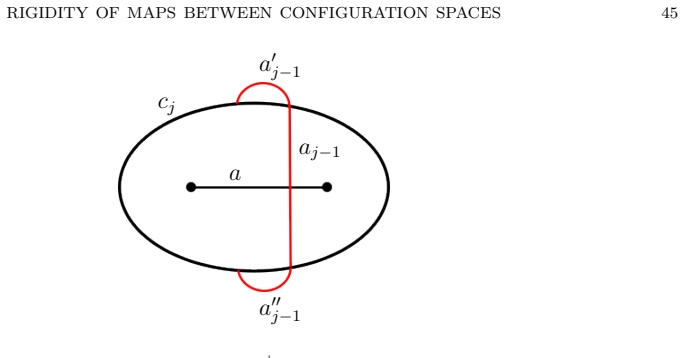
- [Sections 6–7] Figures 10–18 illustrating types and Δ(Φ) are helpful; ensuring that the captions explicitly name the generators whose maximal curves appear would make them self-contained.
- [Section 11] In the proof of Theorem 11.7 the appeal to the triviality of the abelianization of Mod_{g,1} for g≥3 is standard but could be given a precise reference for the reader’s convenience.
Circularity Check
Self-contained group-theoretic derivation of braid homomorphism rigidity; only non-load-bearing self-citations for ancillary lemmas and holomorphic consequences
full rationale
The core claim (Theorem B) is proved from first principles in Sections 2–10 via Nielsen–Thurston classification, commuting graphs of the extended generating set, Φ-maximal curves, puncture types, exterior parts, and a reduction (Lemma 10.5) to the externally-central case, followed by classification (Theorem 9.11). All steps quote classical facts (Dyer–Grossman, González-Meneses–Wiest, Birman–Hilden, Formanek) or prior non-overlapping partial classifications (Lin, Bell–Margalit, Castel, Chen–Kordek–Margalit) used as black boxes. No equation reduces to a definition of the target, no parameters are fitted, and no uniqueness is imported solely from the authors’ prior work. Minor self-citations ([HS25] for exact sequences of stabilizers and small-n maps; [DS24]/[DeP25] for holomorphic monodromy irreducibility) appear only in ancillary lemmas or Section 11 consequences and are not required for the load-bearing chain of Theorem B. The derivation is therefore independent and non-circular.
Assumptions & free parameters
assumptions (5)
- standard math Nielsen–Thurston classification for braid groups (periodic / aperiodic reducible / pseudo-Anosov)
- standard math Dyer–Grossman description of Aut(B_n) ≅ Inn(B_n)
times Z/2Z
- standard math González-Meneses–Wiest structure of centralizers of braids
- domain assumption Chen–Salter theorem that Theorem B implies the holomorphic rigidity statement
- domain assumption Irreducibility of the monodromy of a non-isotrivial holomorphic map (De Pool–Souto / Daskalopoulos–Wentworth)
invented entities (3)
-
Φ-maximal curves E_Φ and E^{s_i}_Φ
-
Type T_Φ(p) of a puncture
-
Exterior part Ext_M(f) and canonical exterior part Ext(f)
Cite this review
Pith. "Pith review of Rigidity of maps between configuration spaces." pith.science (2026). https://pith.science/paper/IIW3KXCK
@misc{pith2026260705826,
  author       = {Pith},
  title        = {Pith review of: Rigidity of maps between configuration spaces},
  year         = {2026},
  howpublished = {\url{https://pith.science/paper/IIW3KXCK}},
  note         = {Machine review of arXiv:2607.05826}
}
abstract
Let $n\geq5$ and $m\geq3$. Let $\Phi\colon\mathrm{B}_n\to\mathrm{B}_m$ be a homomorphism of braid groups. We prove that if the image of $\Phi$ is irreducible and not cyclic, then $m=n$ and $\Phi$ agrees with an automorphism modulo the center $Z(\mathrm{B}_m)$. This resolves in the affirmative a conjecture of Chen, Kordek, and Margalit. It also provides a partial resolution to a problem on the K3 problem list. As a consequence, we prove that every holomorphic map $\mathrm{UConf}_n(\mathbb{C})\to\mathrm{UConf}_m(\mathbb{C})$ for $n\geq5$ and $m\geq3$ is affine equivalent to either a constant map or the identity map. This resolves a conjecture of Farb for $n\neq4$.
Figures


Figures from the paper (14 more)




Reference graph
Works this paper leans on
-
[1]
Holomorphic maps be- tween moduli spaces
[AAS18] Stergios Antonakoudis, Javier Aramayona, and Juan Souto. “Holomorphic maps be- tween moduli spaces”.Ann. Inst. Fourier (Grenoble)68.1 (2018), pp. 217–228.url: http://aif.cedram.org/item?id=AIF_2018__68_1_217_0. [AS12] Javier Aramayona and Juan Souto. “Homomorphisms between mapping class groups”. Geom. Topol.16.4 (2012), pp. 2285–2341.doi:10.2140/g...
-
[2]
Braid groups and the co-Hopfian property
Mathematical Surveys and Monographs. American Mathematical Society, Providence, RI, 2026, pp. xi+430.doi:10.1090/surv/295. [BM06] Robert W. Bell and Dan Margalit. “Braid groups and the co-Hopfian property”.J. Algebra303.1 (2006), pp. 275–294.doi:10.1016/j.jalgebra.2005.10.038. [BS24] Frederik Benirschke and Carlos A. Serv´ an. “Isometric embeddings of Tei...
-
[3]
On isotopies of homeomorphisms of Riemann surfaces
Princeton Univ. Press, Princeton, NJ, 1971, pp. 81–115. [BH73] Joan S. Birman and Hugh M. Hilden. “On isotopies of homeomorphisms of Riemann surfaces”.Ann. of Math. (2)97 (1973), pp. 424–439.doi:10.2307/1970830. [BLM83] Joan S. Birman, Alex Lubotzky, and John McCarthy. “Abelian and solvable subgroups of the mapping class groups”.Duke Math. J.50.4 (1983), ...
-
[4]
IRMA Lect. Math. Theor. Phys. Eur. Math. Soc., Z¨ urich, 2007, pp. 33–109.doi:10.4171/029-1/2. 62 REFERENCES [DS24] Rodrigo De Pool and Juan Souto.Holomorphic maps between moduli spaces II
-
[5]
Holomorphic maps between moduli spaces II
arXiv:2412.01257v1 [math.GT]. [DeP25] Rodrigo De Pool. “Homomorphisms between pure mapping class groups”.Adv. Math. 480.part C (2025), Paper No. 110509, 42.doi:10.1016/j.aim.2025.110509. [DG81] Joan L. Dyer and Edna K. Grossman. “The automorphism groups of the braid groups”. Amer. J. Math.103.6 (1981), pp. 1151–1169.doi:10.2307/2374228. [FN62] Edward Fade...
work page Pith review arXiv doi:10.1016/j.aim.2025.110509 2025
-
[6]
Ed. by Authors of the volume. Surveys in Differential Geometry. In memory of S.S. Chern. International Press, 2024, pp. 31–49. [FM12] Benson Farb and Dan Margalit.A primer on mapping class groups. Vol
work page 2024
-
[7]
Braid group representations of low degree
Princeton Mathematical Series. Princeton University Press, Princeton, NJ, 2012, pp. xiv+472. [For96] Edward Formanek. “Braid group representations of low degree”.Proc. London Math. Soc. (3)73.2 (1996), pp. 279–322.doi:10.1112/plms/s3-73.2.279. [GW04] Juan Gonz´ alez-Meneses and Bert Wiest. “On the structure of the centralizer of a braid”. Ann. Sci. ´Ecole...
-
[8]
Generators for the mapping class group
Troisi` eme ´ edition, corrig´ ee, S´ eminaire de G´ eom´ etrie Alg´ ebrique, 1960/61. Institut des Hautes ´Etudes Scientifiques, Paris, 1963, i+163 pp. (not consecutively paged) (loose errata). [Hum79] Stephen P. Humphries. “Generators for the mapping class group”.Topology of low- dimensional manifolds (Proc. Second Sussex Conf., Chelwood Gate, 1977). Vol
work page 1960
Show all 13 references
-
[9]
Braid groups, elliptic curves, and resolving the quartic
Lecture Notes in Math. Springer, Berlin, 1979, pp. 44–47. [HS25] Peter Huxford and Jeroen Schillewaert. “Braid groups, elliptic curves, and resolving the quartic”.Mathematische Annalen391.3 (2025), pp. 4409–4440.doi:10.1007/s00208- 024-03029-x. [IS88] Yˆ oichi Imayoshi and Hir...
1979 doi
-
[10]
A cofinite universal space for proper actions for mapping class groups
Math. Sci. Res. Inst. Publ. Springer, New York, 1988, pp. 207–219.doi:10. 1007/978-1-4613-9611-6_15. [JW10] Lizhen Ji and Scott A. Wolpert. “A cofinite universal space for proper actions for mapping class groups”.In the tradition of Ahlfors-Bers. V. Vol
1988
-
[11]
Homomorphisms of commutator subgroups of braid groups
Contemp. Math. Amer. Math. Soc., Providence, RI, 2010, pp. 151–163.doi:10.1090/conm/510/10023. [KM22] Kevin Kordek and Dan Margalit. “Homomorphisms of commutator subgroups of braid groups”.Bull. Lond. Math. Soc.54.1 (2022), pp. 95–111.doi:10.1112/blms.12560. [Lin04a] Vladimir ...
2010 doi
-
[12]
[Lin04b] Vladimir Ya
arXiv: math/0403120v3 [math.AG]. [Lin04b] Vladimir Ya. Lin.Braids and Permutations
-
[13]
On mapping-class groups and Teichm¨ uller spaces
arXiv:math/0404528 [math.GR]. [MH75] C. Maclachlan and W. J. Harvey. “On mapping-class groups and Teichm¨ uller spaces”. Proc. London Math. Soc. (3)30.part, part 4 (1975), pp. 496–512.doi:10.1112/plms/ s3-30.4.496. [Mar22] Dan Margalit.Maps of braid groups. Braids in Symplecti...
Reviewed July 11, 2026 · model on record in the stance chip above.
Discussion (0). Continue with ORCID to comment.