REVIEW 4 major objections 6 minor 71 references
UniLM-Nav: A Unified Framework for Zero-Shot Last-Mile Navigation
T0 review · 4 major / 6 minor · reviewed 2026-07-14 · grok-4.5
Pith's one-line read A single multimodal language model can choose views, ground affordances, and reason about robot base pose for zero-shot last-mile navigation.
desk verdict Clean three-stage MLLM last-mile recipe with a real but modest OVMM gain; useful systems work, not a statistical slam dunk. read the letter →
The pith
A machine-rendered reading of the paper's core claim, the machinery that carries it, and where it could break.
The reading
What carries the argument
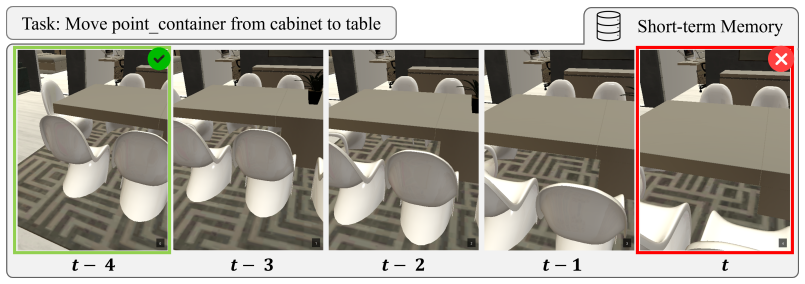
UniLM-Nav’s three-stage shared-MLLM pipeline: view selection from a short-term RGB-D memory, task-conditioned 2D affordance grounding lifted to robot-centric 3D, and geometry-aware base-pose reasoning that predicts (x, y) while orienting the robot toward the affordance.
What would settle it
On the same OVMM validation protocol, replace the full three-stage UniLM-Nav pipeline with a strong object-navigation endpoint plus simple turn-to-face or floor-point heuristics and check whether overall success still exceeds the prior zero-shot leader MoTo by a clear margin; if the gap disappears, the claimed benefit of the unified MLLM decomposition is falsified.
Extended reading notes
Core claim
UniLM-Nav shows that last-mile navigation for open-vocabulary mobile manipulation can be performed zero-shot by a single multimodal large language model that first selects a reference view from short-term memory, then grounds a task-relevant affordance and lifts it to 3D, and finally reasons over that geometry plus robot configuration to output a manipulation-ready base pose, outperforming prior zero-shot and several trained baselines on OVMM.
Load-bearing premise
The pipeline assumes object navigation already leaves the robot roughly one to two meters from the target with that target visible in a handful of recent camera frames; if the target never appears in that memory, last-mile navigation has no usable input.
Signed reviews
Editorial analysis
A structured set of objections, weighed in public.
Referee Report
Summary. UniLM-Nav proposes a zero-shot, open-vocabulary last-mile navigation framework that bridges object-goal navigation and manipulation-ready base positioning. The method decomposes the problem into three MLLM-driven stages—view selection from a short-term RGB-D memory (K=5), task-conditioned 2D affordance grounding with depth lifting to a robot-centric 3D point, and geometry-aware base-pose reasoning that predicts (x,y) while computing heading geometrically toward the affordance. On the HomeRobot OVMM validation set, UniLM-Nav with Gemini-3-Flash-Preview reports 23.77% Overall SR, exceeding MoTo (20.64%) by 3.13 points and training-based MoManipVLA (15.80%); a 4B embodied backend (RoboBrain-2.5-4B) remains competitive at 19.19%. Component ablations on a 20% stratified subset, multi-backend comparisons, failure taxonomy, and four real-world tasks (10 trials each) on a Unitree B2+Z1 platform are provided to support the design.
Significance. Last-mile navigation is a genuine bottleneck in modular open-vocabulary mobile manipulation: proximity after object nav often fails to yield a reachable, collision-free, task-aligned base pose. A training-free pipeline that uses a shared MLLM for view selection, fine-grained spatial affordance (beyond object-level cues), and explicit geometry-conditioned base reasoning is a useful systems contribution. Strengths include (i) a clean three-stage formulation with released-style prompts in the appendix, (ii) multi-backend analysis showing that embodied fine-tuning (RoboBrain-2.5-4B) can rival much larger general models, (iii) qualitative error breakdown of view/affordance/base failures, and (iv) real-robot deployment with spatial-relation tasks. If the SOTA margin and component attributions hold under stronger experimental controls, the work would be a solid reference for MLLM-based navigation–manipulation handoff.
major comments (4)
- Table 1 reports the headline 23.77% Overall SR (Gemini) vs MoTo 20.64% as a single point estimate with no multi-seed variance, confidence intervals, or sensitivity to sampling temperature/prompt wording. Given that OVMM episodes are stochastic (navigation, perception, contact), a 3.13-point absolute gain cannot be assessed for robustness from one run. Please report at least repeated evaluation variance or bootstrap-style uncertainty on Overall SR for UniLM-Nav and the primary baseline under matched seeds/policies.
- §5.2 and Fig. 3 / Tables 2,4–6: all component ablations (w/o last-mile, w/o view selection, w/o base-pose reasoning, merging stages, heading strategy, thinking models) and the detailed MLLM backend comparison are run only on a scene-stratified 20% subset, where Gemini already reaches 25.42% Overall SR—higher than the full-set 23.77%. Component importance and backend rankings may therefore be inflated or reordered by subset selection. Either re-run the key ablations (at least w/o view selection and w/o geometry-aware base-pose reasoning) on the full validation set, or show that the 20% subset is distributionally matched and that full-set deltas are consistent.
- §5.1 Setup and Table 1: navigation and grasping use default HomeRobot policies, while placement uses a simple MLLM-predicted arm-extension/lift policy integrated with base-pose reasoning. MoTo and other baselines may differ in placement execution. The Overall SR gain therefore conflates last-mile base positioning with a custom placement controller and a stronger proprietary MLLM. Please isolate the contribution of the predicted base pose alone (e.g., fixed placement policy across methods, or an ablation that keeps UniLM-Nav’s placement but replaces base pose with MoTo/HomeRobot heuristics) so the 3.13-point claim can be attributed to the proposed decomposition.
- §3–4 and Limitations: the pipeline assumes object navigation leaves the target visible in the last K=5 frames within ~1–2 m. Error analysis (Appendix B.4) attributes 61% of failures to pre–last-mile navigation, so headline OVMM gains partly reflect interaction with an upstream policy that often fails before UniLM-Nav runs. The paper should quantify conditional success given successful FindObj/FindRec near-target states (last-mile-only metrics), and more clearly bound the claim to the near-target regime rather than end-to-end OVMM superiority without that conditioning.
minor comments (6)
- Abstract/§5.1: “Gemini-3-Flash-Previw” / “Gemini3-Flash-Preview” spelling is inconsistent; standardize the model name throughout.
- Fig. 3(a) uses hard-to-read Unicode-style labels in the manuscript text dump; ensure the published figure has clear axis labels and method names.
- Eq. (3) predicts (x,y) but the surrounding text and prompts also discuss theta and arm parameters; clarify in the main text which quantities are MLLM outputs vs. geometric post-processing (heading is geometric; arm reach/lift are MLLM-predicted for placement).
- Table 1 “Average SR” definition (average of partial rates and Overall SR) is unconventional; state explicitly whether this is an official OVMM metric or an author-defined aggregate.
- Related work could more sharply contrast UniLM-Nav with Lin et al. (AAAI 2026) affordance-guided base placement and MoMa-Kitchen, beyond a one-line mention.
- Real-world §5.4: report failure modes for the two harder spatial-relation tasks (4/10) in the main text, not only success counts, to match the sim error analysis.
Circularity Check
No circularity: UniLM-Nav is an empirical modular pipeline whose SOTA claim is an external OVMM success-rate comparison, not a quantity defined from its own fitted inputs.
full rationale
The paper presents a zero-shot engineering pipeline (view selection from short-term memory Mt, 2D affordance grounding, depth lift to pa, then MLLM base-pose prediction with geometrically computed heading) and evaluates it against the external HomeRobot OVMM benchmark and real-robot trials. Table 1 reports Overall SR numbers (23.77% with Gemini-3-Flash-Preview vs MoTo 20.64%) that are measured outcomes of running the pipeline with fixed HomeRobot navigation/grasp policies; they are not algebraic rearrangements of parameters fitted to the same metric. Ablations (Fig. 3, Tables 2/4/5/6) remove modules or swap MLLM backends and re-measure success rates; none redefine a fitted coefficient as a 'prediction.' Self-citations (e.g., MoTo [18], HomeRobot [23], RoboBrain [24]) appear only as related-work baselines or optional backends, not as uniqueness theorems that force the method. The near-target K=5 assumption is an explicit scope limitation, not a circular definition of the reported SR. Therefore the derivation chain contains no self-definitional, fitted-as-prediction, or load-bearing self-citation circularity; score 0 is appropriate.
Assumptions & free parameters
free parameters (3)
- short-term memory buffer size K =
5
- optimal manipulation distance heuristic =
70–80% of max arm reach
- arm-lift offset formula =
+0.2 m
assumptions (4)
- domain assumption Object-goal navigation terminates with the target visible inside a 1–2 m near-target radius and recent observations.
- domain assumption An off-the-shelf MLLM can select views, ground 2D affordances, and reason about metric base poses when given explicit 3D coordinates and robot configuration.
- domain assumption Default HomeRobot navigation and grasping policies plus a simple MLLM-predicted arm extension/lift suffice for the remaining stages.
- domain assumption Depth maps and camera extrinsics are accurate enough to lift a 2D pixel to a usable robot-centric 3D affordance.
invented entities (1)
-
UniLM-Nav three-stage pipeline
independent evidence
Cite this review
Pith. "Pith review of UniLM-Nav: A Unified Framework for Zero-Shot Last-Mile Navigation." pith.science (2026). https://pith.science/paper/N4VP26JF
@misc{pith2026260706537,
  author       = {Pith},
  title        = {Pith review of: UniLM-Nav: A Unified Framework for Zero-Shot Last-Mile Navigation},
  year         = {2026},
  howpublished = {\url{https://pith.science/paper/N4VP26JF}},
  note         = {Machine review of arXiv:2607.06537}
}
read the original abstract
Mobile manipulation requires a robot to navigate to a target object or receptacle and then perform intended manipulation. However, reaching the vicinity of the target does not guarantee a manipulation-ready base pose, a problem known as last-mile navigation. Prior methods for last-mile navigation either rely on manual pose annotation or task-specific training, limiting their scalability to open-vocabulary settings with fine-grained spatial constraints. We propose UniLM-Nav, a unified framework for zero-shot open-vocabulary last-mile navigation. UniLM-Nav decomposes last-mile navigation into view selection, task-conditioned affordance grounding, and geometry-aware base-pose reasoning, all resolved with a shared multimodal large language model (MLLM) backend. Specifically, UniLM-Nav first selects a reference view that best captures the target object or receptacle from recently collected observations. It then grounds task-relevant affordance point in the selected view and lifts the result into the robot-centric coordinate frame. Finally, conditioned on the grounded affordance, task context, and robot geometry, it infers a manipulation-ready base pose for the robot. We evaluate UniLM-Nav on the OVMM benchmark, where it outperforms the previous state-of-the-art method, MoTo, by 3.13 percentage points. Analyses show that the components of our method are crucial to final performance, and that the choice of MLLM also has a substantial effect. We further deploy UniLM-Nav on a Unitree B2 quadruped robot with a 6-DoF Unitree Z1 manipulator, validating its applicability to real-world mobile manipulation tasks.
Figures


Figures from the paper (10 more)




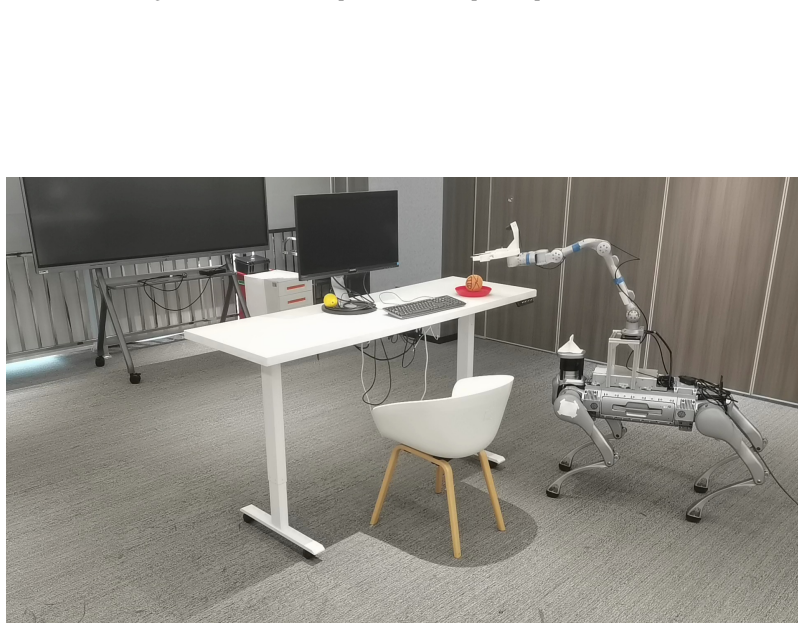


Reference graph
Works this paper leans on
-
[1]
R. Yang, Y . Kim, R. Hendrix, A. Kembhavi, X. Wang, and K. Ehsani. Harmonic mobile manipulation. In2024 IEEE/RSJ International Conference on Intelligent Robots and Systems (IROS), pages 3658–3665. IEEE, 2024
2024
-
[2]
Z. Wu, Y . Zhou, X. Xu, Z. Wang, and H. Yan. Momanipvla: Transferring vision-language- action models for general mobile manipulation. InThe IEEE/CVF Conference on Computer Vision and Pattern Recognition (CVPR), pages 1714–1723, 2025
2025
-
[3]
A. Xiao, N. Janaka, T. Hu, A. Gupta, K. Li, C. Yu, and D. Hsu. Robi butler: Multimodal remote interaction with a household robot assistant.arXiv preprint arXiv:2409.20548, 2024
arXiv 2024
-
[4]
Abbatematteo, E
B. Abbatematteo, E. Rosen, S. Thompson, T. Akbulut, S. Rammohan, and G. Konidaris. Com- posable interaction primitives: A structured policy class for efficiently learning sustained- contact manipulation skills. In2024 IEEE international conference on robotics and automation (ICRA), pages 7522–7529. IEEE, 2024
2024
-
[5]
Y . Peng, Z. Wang, Y . Zhang, S. Zhang, N. Cai, F. Wu, and M. Chen. Revolutionizing battery disassembly: The design and implementation of a battery disassembly autonomous mobile manipulator robot (beam-1). In2024 IEEE/RSJ International Conference on Intelligent Robots and Systems (IROS), pages 6367–6374. IEEE, 2024
2024
-
[6]
ˇStibinger, G
P. ˇStibinger, G. Broughton, F. Majer, Z. Rozsyp´alek, A. Wang, K. Jindal, A. Zhou, D. Thakur, G. Loianno, T. Krajn´ık, et al. Mobile manipulator for autonomous localization, grasping and precise placement of construction material in a semi-structured environment.IEEE Robotics and Automation Letters (RA-L), 6(2):2595–2602, 2021
2021
-
[7]
Chang, T
M. Chang, T. Gervet, M. Khanna, S. Yenamandra, D. Shah, S. Y . Min, K. Shah, C. Paxton, S. Gupta, D. Batra, et al. Goat: Go to any thing. InRobotics: Science and Systems (RSS),
-
[8]
doi:10.15607/RSS.2024.XX.073
Show all 71 references
-
[9]
Zhang, X
P. Zhang, X. Gao, Y . Wu, K. Liu, D. Wang, Z. Wang, B. Zhao, Y . Ding, and X. Li. Moma- kitchen: A 100k+ benchmark for affordance-grounded last-mile navigation in mobile manipu- lation. InInternational Conference on Computer Vision (ICCV), pages 6315–6326, 2025
2025
-
[10]
R.-Z. Qiu, Y . Song, X. Peng, S. A. Suryadevara, G. Yang, M. Liu, M. Ji, C. Jia, R. Yang, X. Zou, et al. Wildlma: Long horizon loco-manipulation in the wild. In2025 IEEE International Conference on Robotics and Automation (ICRA), pages 10011–10019. IEEE, 2025
2025
-
[11]
Huang, D
X. Huang, D. Batra, A. Rai, and A. Szot. Skill transformer: A monolithic policy for mobile manipulation. InInternational Conference on Computer Vision (ICCV), pages 10852–10862, 2023
2023
-
[12]
Yokoyama, A
N. Yokoyama, A. Clegg, J. Truong, E. Undersander, T.-Y . Yang, S. Arnaud, S. Ha, D. Batra, and A. Rai. Asc: Adaptive skill coordination for robotic mobile manipulation.IEEE Robotics and Automation Letters (RA-L), 9(1):779–786, 2023
2023
-
[13]
J. Yang, I. Huang, B. Vu, M. Bajracharya, R. Antonova, and J. Bohg. Mobi-π: Mobilizing your robot learning policy. InConference on Robot Learning (CoRL), volume 305 ofProceedings of Machine Learning Research, pages 3516–3536. PMLR, 2025. 9
2025
-
[14]
Kirillov, E
A. Kirillov, E. Mintun, N. Ravi, H. Mao, C. Rolland, L. Gustafson, T. Xiao, S. Whitehead, A. C. Berg, W.-Y . Lo, et al. Segment anything. InInternational Conference on Computer Vision (ICCV), pages 4015–4026, 2023
2023
-
[15]
Oquab, T
M. Oquab, T. Darcet, T. Moutakanni, H. V o, M. Szafraniec, V . Khalidov, P. Fernandez, D. Haz- iza, F. Massa, A. El-Nouby, et al. DINOv2: Learning robust visual features without supervi- sion.Transactions on Machine Learning Research, 2024
2024
-
[16]
Radford, J
A. Radford, J. W. Kim, C. Hallacy, A. Ramesh, G. Goh, S. Agarwal, G. Sastry, A. Askell, P. Mishkin, J. Clark, et al. Learning transferable visual models from natural language supervi- sion. InInternational Conference on Machine Learning (ICML), volume 139 ofProceedings of Mach...
2021
-
[17]
Hurst, A
A. Hurst, A. Lerer, A. P. Goucher, A. Perelman, A. Ramesh, A. Clark, A. Ostrow, A. Welihinda, A. Hayes, A. Radford, et al. Gpt-4o system card.arXiv preprint arXiv:2410.21276, 2024
2024 arXiv
-
[18]
Openai o3 and o4-mini system card.https://openai.com/index/ o3-o4-mini-system-card/, 2025
OpenAI. Openai o3 and o4-mini system card.https://openai.com/index/ o3-o4-mini-system-card/, 2025
2025
-
[19]
Z. Wu, A. Ma, X. Xu, H. Yin, Y . Liang, Z. Wang, J. Lu, and H. Yan. Moto: A zero-shot plug-in interaction-aware navigation for general mobile manipulation. InConference on Robot Learning (CoRL), volume 305 ofProceedings of Machine Learning Research, pages 2933–
-
[20]
Lin, J.-F
T.-J. Lin, J.-F. Yeh, H.-T. Su, C.-Y . Lin, Y .-T. Chen, and W. H. Hsu. Affordance-guided coarse- to-fine exploration for base placement in open-vocabulary mobile manipulation. InAAAI Con- ference on Artificial Intelligence (AAAI), pages 18443–18451, 2026
2026
-
[21]
Z. Cai, Y . Wang, Q. Sun, R. Wang, C. Gu, W. Yin, Z. Lin, Z. Yang, C. Wei, O. Qian, et al. Holis- tic evaluation of multimodal llms on spatial intelligence.arXiv preprint arXiv:2508.13142, 2025
2025
-
[22]
S. Bai, Y . Cai, R. Chen, K. Chen, X. Chen, Z. Cheng, L. Deng, W. Ding, C. Gao, C. Ge, et al. Qwen3-vl technical report.arXiv preprint arXiv:2511.21631, 2025
2025 arXiv
-
[23]
Gemini 3 flash: frontier intelligence built for speed.https://blog.google/ products-and-platforms/products/gemini/gemini-3-flash/, 2025
Google. Gemini 3 flash: frontier intelligence built for speed.https://blog.google/ products-and-platforms/products/gemini/gemini-3-flash/, 2025
2025
-
[24]
Yenamandra, A
S. Yenamandra, A. Ramachandran, K. Yadav, A. S. Wang, M. Khanna, T. Gervet, T.-Y . Yang, V . Jain, A. Clegg, J. M. Turner, et al. Homerobot: Open-vocabulary mobile manipulation. InConference on Robot Learning (CoRL), volume 229 ofProceedings of Machine Learning Research, pages...
1975
-
[25]
H. Tan, E. Zhou, Z. Li, Y . Xu, Y . Ji, X. Chen, C. Chi, P. Wang, H. Jia, Y . Ao, et al. Robobrain 2.5: Depth in sight, time in mind.arXiv preprint arXiv:2601.14352, 2026
2026
-
[26]
Introducing gpt-5.4.https://openai.com/index/introducing-gpt-5-4/, 2026
OpenAI. Introducing gpt-5.4.https://openai.com/index/introducing-gpt-5-4/, 2026
2026
-
[27]
Unitree b2.https://unitree.com/b2, 2026
Unitree Robotics. Unitree b2.https://unitree.com/b2, 2026. Product page, accessed 2026-06-02
2026
-
[28]
Unitree z1.https://unitree.com/z1, 2026
Unitree Robotics. Unitree z1.https://unitree.com/z1, 2026. Product page, accessed 2026-06-02
2026
-
[29]
Brohan, N
A. Brohan, N. Brown, J. Carbajal, Y . Chebotar, J. Dabis, C. Finn, K. Gopalakrishnan, K. Haus- man, A. Herzog, J. Hsu, et al. Rt-1: Robotics transformer for real-world control at scale. In Robotics: Science and Systems (RSS), 2023. doi:10.15607/RSS.2023.XIX.025. 10
2023 doi
-
[30]
Z. Fu, T. Z. Zhao, and C. Finn. Mobile ALOHA: Learning bimanual mobile manipulation using low-cost whole-body teleoperation. InConference on Robot Learning (CoRL), volume 270 ofProceedings of Machine Learning Research, pages 4066–4083. PMLR, 2025
2025
-
[31]
S. Yan, Z. Zhang, M. Han, Z. Wang, Q. Xie, Z. Li, Z. Li, H. Liu, X. Wang, and S.-C. Zhu. M2 diffuser: Diffusion-based trajectory optimization for mobile manipulation in 3d scenes. IEEE Transactions on Pattern Analysis and Machine Intelligence, pages 1–17, 2025. doi: 10.1109/TP...
2025 doi
-
[32]
P. Liu, Y . Orru, J. Vakil, C. Paxton, N. M. M. Shafiullah, and L. Pinto. Demonstrating OK- Robot: What really matters in integrating open-knowledge models for robotics. InRobotics: Science and Systems (RSS), 2024. doi:10.15607/RSS.2024.XX.091
2024 doi
-
[33]
Rosen, S
E. Rosen, S. James, S. Orozco, V . Gupta, M. Merlin, S. Tellex, and G. Konidaris. Synthesizing navigation abstractions for planning with portable manipulation skills. InConference on Robot Learning (CoRL), volume 229 ofProceedings of Machine Learning Research, pages 2278–
-
[34]
F. Wang, S. Lyu, P. Zhou, A. Duan, G. Guo, and D. Navarro-Alarcon. Instruction-augmented long-horizon planning: Embedding grounding mechanisms in embodied mobile manipulation. InAAAI Conference on Artificial Intelligence (AAAI), pages 14690–14698, 2025
2025
-
[35]
Quartey, E
B. Quartey, E. Rosen, S. Tellex, and G. Konidaris. Verifiably following complex robot in- structions with foundation models. InInternational Conference on Robotics and Automation (ICRA), pages 1–8. IEEE, 2025
2025
-
[36]
T.-H. Lee, F. Mahmudova, and K. Desingh. Learning category-level last-meter navigation from rgb demonstrations of a single-instance.arXiv preprint arXiv:2512.11173, 2025
2025 arXiv
-
[37]
L. Qin, M. Wang, P. Li, W. Zhou, and H. Li. Active perception meets rule-guided rl: A two-phase approach for precise object navigation in complex environments. InInternational Conference on Computer Vision (ICCV), pages 7603–7612, 2025
2025
-
[38]
K. Chai, H. Lee, and J. J. Lim. N2m: Bridging navigation and manipulation by learning pose preference from rollout.arXiv preprint arXiv:2509.18671, 2025
2025 arXiv
-
[39]
Nasiriany, F
S. Nasiriany, F. Xia, W. Yu, T. Xiao, J. Liang, I. Dasgupta, A. Xie, D. Driess, A. Wahid, Z. Xu, et al. Pivot: Iterative visual prompting elicits actionable knowledge for vlms. InInternational Conference on Machine Learning (ICML), volume 235 ofProceedings of Machine Learning ...
2024
-
[40]
K. Fang, F. Liu, P. Abbeel, and S. Levine. MOKA: Open-world robotic manipulation through mark-based visual prompting. InRobotics: Science and Systems (RSS), 2024. doi:10.15607/ RSS.2024.XX.062
2024
-
[41]
Y . Tang, S. Zhang, X. Hao, P. Wang, J. Wu, Z. Wang, and S. Zhang. Affordgrasp: In-context affordance reasoning for open-vocabulary task-oriented grasping in clutter. InInternational Conference on Intelligent Robots and Systems (IROS), pages 9433–9439. IEEE, 2025
2025
-
[42]
J. Yang, S. Yang, A. W. Gupta, R. Han, L. Fei-Fei, and S. Xie. Thinking in space: How multi- modal large language models see, remember, and recall spaces. InThe IEEE/CVF Conference on Computer Vision and Pattern Recognition (CVPR), pages 10632–10643, 2025
2025
-
[43]
B. Chen, Z. Xu, S. Kirmani, B. Ichter, D. Sadigh, L. Guibas, and F. Xia. Spatialvlm: Endowing vision-language models with spatial reasoning capabilities. InThe IEEE/CVF Conference on Computer Vision and Pattern Recognition (CVPR), pages 14455–14465, 2024
2024
-
[44]
M. Jia, Z. Qi, S. Zhang, W. Zhang, X. Yu, J. He, H. Wang, and L. Yi. Omnispatial: Towards comprehensive spatial reasoning benchmark for vision language models. InInternational Con- ference on Learning Representations (ICLR), 2026. 11
2026
-
[45]
Zhang, Z
P. Zhang, Z. Huang, Y . Wang, J. Zhang, L. Xue, Z. Wang, Q. Wang, K. Chandrasegaran, R. Zhang, Y . Choi, et al. Theory of space: Can foundation models construct spatial beliefs through active exploration? InInternational Conference on Learning Representations (ICLR), 2026
2026
-
[46]
D. Wu, F. Liu, Y .-H. Hung, and Y . Duan. Spatial-mllm: Boosting mllm capabilities in visual- based spatial intelligence.Advances in Neural Information Processing Systems (NeurIPS), 38: 13569–13597, 2025
2025
-
[47]
R. Yang, H. Chen, J. Zhang, M. Zhao, C. Qian, K. Wang, Q. Wang, T. V . Koripella, M. Mova- hedi, M. Li, et al. Embodiedbench: Comprehensive benchmarking multi-modal large language models for vision-driven embodied agents. InInternational Conference on Machine Learning (ICML), ...
2025
-
[48]
E. Zhou, J. An, C. Chi, Y . Han, S. Rong, C. Zhang, P. Wang, Z. Wang, T. Huang, L. Sheng, et al. Roborefer: Towards spatial referring with reasoning in vision-language models for robotics. Advances in Neural Information Processing Systems (NeurIPS), 38:28404–28481, 2025
2025
-
[49]
Melnik, M
A. Melnik, M. B ¨uttner, L. Harz, L. Brown, G. C. Nandi, A. PS, G. K. Yadav, R. Kala, and R. Haschke. Uniteam: Open vocabulary mobile manipulation challenge.arXiv preprint arXiv:2312.08611, 2023
2023 arXiv
-
[50]
Introducing gpt-4.1 in the api.https://openai.com/index/gpt-4-1/, 2025
OpenAI. Introducing gpt-4.1 in the api.https://openai.com/index/gpt-4-1/, 2025
2025
-
[51]
Introducing gpt-5.2.https://openai.com/index/introducing-gpt-5-2/, 2025
OpenAI. Introducing gpt-5.2.https://openai.com/index/introducing-gpt-5-2/, 2025
2025
-
[52]
Qwen3.5: Towards native multimodal agents.https://qwen.ai/blog?id=qwen3
Qwen. Qwen3.5: Towards native multimodal agents.https://qwen.ai/blog?id=qwen3. 5, 2025
2025
-
[53]
Qwen3.6-27b: Flagship-level coding in a 27b dense model.https://qwen.ai/blog? id=qwen3.6-27b, 2025
Qwen. Qwen3.6-27b: Flagship-level coding in a 27b dense model.https://qwen.ai/blog? id=qwen3.6-27b, 2025
2025
-
[54]
W. Wang, Z. Gao, L. Gu, H. Pu, L. Cui, X. Wei, Z. Liu, L. Jing, S. Ye, J. Shao, et al. Internvl3.5: Advancing open-source multimodal models in versatility, reasoning, and efficiency.arXiv preprint arXiv:2508.18265, 2025
2025 arXiv
-
[55]
B. R. Team, M. Cao, H. Tan, Y . Ji, X. Chen, M. Lin, Z. Li, Z. Cao, P. Wang, E. Zhou, et al. Robobrain 2.0 technical report.arXiv preprint arXiv:2507.02029, 2025
2025 arXiv
-
[56]
Gemini 335: Stereo vision camera for robotics.https://orbbec.com/products/ stereo-vision-camera/gemini-335/, 2026
Orbbec. Gemini 335: Stereo vision camera for robotics.https://orbbec.com/products/ stereo-vision-camera/gemini-335/, 2026. Product page, accessed 2026-06-02
2026
-
[57]
T. Shan, B. Englot, D. Meyers, W. Wang, C. Ratti, and D. Rus. Lio-sam: Tightly-coupled lidar inertial odometry via smoothing and mapping. InInternational Conference on Intelligent Robots and Systems (IROS), pages 5135–5142. IEEE, 2020
2020
-
[58]
Macenski, F
S. Macenski, F. Martin, R. White, and J. Gin´es Clavero. The marathon 2: A navigation system. InInternational Conference on Intelligent Robots and Systems (IROS), 2020. 12 The Appendix is organized into the following sections:Method Details(Section A),More Exper- iments & Resu...
2020
-
[59]
Visibility: The{object name}is clearly visible and identifiable (not blurry, not heavily occluded, and enough of the object is visible to pick a precise grasp/target point)
-
[60]
Avoid images where obstacles/clutter block the approach path to the{object name}or where the{object name}appears unlikely to be reachable
Reachability/Navigability: The robot can realistically move close enough to the{object name}to pick it up. Avoid images where obstacles/clutter block the approach path to the{object name}or where the{object name}appears unlikely to be reachable. Return a JSON object with key ‘...
-
[61]
Visibility: The surface of the{place recep name}is clearly visible (not blurry, not heavily occluded, enough surface area visible to select a stable point for placing the object)
-
[62]
Avoid images where obstacles/clutter block access to the front/edge of the{place recep name}or where approaching the {place recep name}would likely be impossible
Reachability/Navigability: The robot can realistically move close enough to the{place recep name}to perform placement. Avoid images where obstacles/clutter block access to the front/edge of the{place recep name}or where approaching the {place recep name}would likely be impossi...
-
[63]
Visible-on-object point: The pixel must lie ON the{object name}(not background or other items), and should be on a clearly visible, unoccluded part of the object (avoid blurry/ambiguous regions and heavy occlusions)
-
[64]
Prefer points on the object that are not blocked by obstacles between the robot and other object
Reachable for pickup: Choose a point such that the robot can realistically approach near and pick up the object. Prefer points on the object that are not blocked by obstacles between the robot and other object. Avoid cases where the object (or the selected point) is behind lar...
-
[65]
The point should NOT overlap/collide with any other unrelated objects
Safe & stable surface: The point must lie on a flat, supported, and stable region of the{place recep name}. The point should NOT overlap/collide with any other unrelated objects
-
[66]
Do NOT select points on or near the {place recep name}’s edge
Avoid the edge (anti-drop): Prefer an interior placement region rather than the boundary. Do NOT select points on or near the {place recep name}’s edge
-
[67]
Reachable placement (base + arm constraints): The point should be reachable for the robot to approach and place the object. Prefer locations with clear free space around the receptacle and no obvious obstacles blocking the robot’s approach and placing path (e.g., clutter, furn...
-
[68]
Pick up the cup from the table. (Fig. 11)
-
[69]
Place the cake on the plate. (Fig. 12)
-
[70]
Place the bottle on the table, in front of the monitor. (Fig. 13)
-
[71]
in front of the monitor
Imagine facing the monitor, place the cake at the bottom-left corner of the table. (Fig. 14) The first two tasks mainly evaluate whether UniLM-Nav can effectively bridge object navigation and manipulation in real scenes, where the robot needs to approach the task-relevant obje...
Reviewed July 14, 2026 · model on record in the stance chip above.
Discussion (0). Continue with ORCID to comment.