REVIEW 1 major objections 8 minor 300 references
First detection of ultra-fast outflows in a quiescent galaxy
T0 review · 1 major / 8 minor · reviewed 2026-07-10 · glm-5.2
Pith's one-line read Wind from a dead galaxy's black hole
desk verdict First UFO in a quiescent galaxy: the detection is real, the maintenance-mode story is a stretch read the letter →
The pith
A machine-rendered reading of the paper's core claim, the machinery that carries it, and where it could break.
The reading
What carries the argument
The argument proceeds through three linked layers: (1) X-ray spectroscopy of XMM-Newton and NuSTAR data identifies an absorption line at 7.25 keV, modeled with the PION photoionization code as a highly ionized outflow at v ≈ -0.07c with log ξ ≈ 3.3 and column density N_H ≈ 3.5×10²³ cm⁻², while the torus model borus12 reveals Compton-thick circumnuclear material (log N_H ≈ 24.7); (2) optical DESI spectroscopy and SED fitting with CIGALE establish the host as quiescent (sSFR ~3×10⁻¹² yr⁻¹, quenched ~9 Gyr) while also detecting a kpc-scale [OIII] outflow with far lower kinetic power (~10⁴⁰ erg/s); (3) energetic arguments compare the UFO's cumulative energy (extrapolated over a 0.1–1% duty cycle
What would settle it
If future monitoring shows that UFOs in quiescent galaxies are extremely rare or short-lived (duty cycle well below 0.1%), or if sub-mm observations reveal that the cold gas reservoir in KUG 1208+386 is too small for the wind to couple with meaningfully, the maintenance-mode interpretation would lose its energetic basis. Conversely, repeated UFO detections in other quiescent galaxies would strengthen the paradigm challenge.
Extended reading notes
Core claim
The central finding is the detection of a mildly relativistic X-ray absorption feature at ~7.25 keV in the spectrum of KUG 1208+386, consistent with a UFO traveling at v ≈ -0.07c, in a galaxy whose stellar population analysis shows it was quenched ~9 Gyr ago and whose specific star formation rate (~3×10⁻¹² yr⁻¹) places it firmly on the red sequence. The coexistence of a powerful nuclear wind (kinetic power 0.8–6.5×10⁴³ erg/s, 1–8% of Eddington) with a long-dead host galaxy is the observational fact that anchors the paper's broader claim about the local (rather than global) origin of UFOs and their potential role in maintaining galactic quiescence.
Load-bearing premise
The claim that these winds maintain quiescence over Gyr timescales rests on extrapolating a single-epoch detection of a transient phenomenon — the authors themselves note UFOs are transient — across ~3.4 Gyr of quenching history using an assumed 0.1–1% duty cycle, yielding a cumulative energy estimate (~10⁵⁹ erg) that exceeds the galaxy's gravitational binding energy. One snapshot is being asked to carry a billion-year maintenance narrative.
Editorial analysis
A structured set of objections, weighed in public.
Referee Report
Summary. This manuscript reports the first detection of an ultra-fast outflow (UFO; v_out ≈ -0.07c) in a quiescent galaxy (KUG 1208+386, sSFR ~ 3×10^-12 yr^-1), using XMM-Newton and NuSTAR X-ray spectroscopy supplemented by DESI optical spectroscopy and multi-wavelength SED fitting. The X-ray analysis employs Bayesian spectral fitting with a Comptonization component, a torus reflection model (borus12), and a PION photoionization absorber to characterize the UFO. The host galaxy is shown to have been quenched ~9 Gyr ago via stellar population synthesis. The authors argue that this discovery challenges the paradigm that UFOs are exclusive to gas-rich, star-forming systems and propose a wind-driven 'maintenance' mode of AGN feedback. The observational detection and quiescence classification are reasonably robust, while the Gyr-timescale maintenance-mode conclusion involves extrapolation from a single-epoch detection.
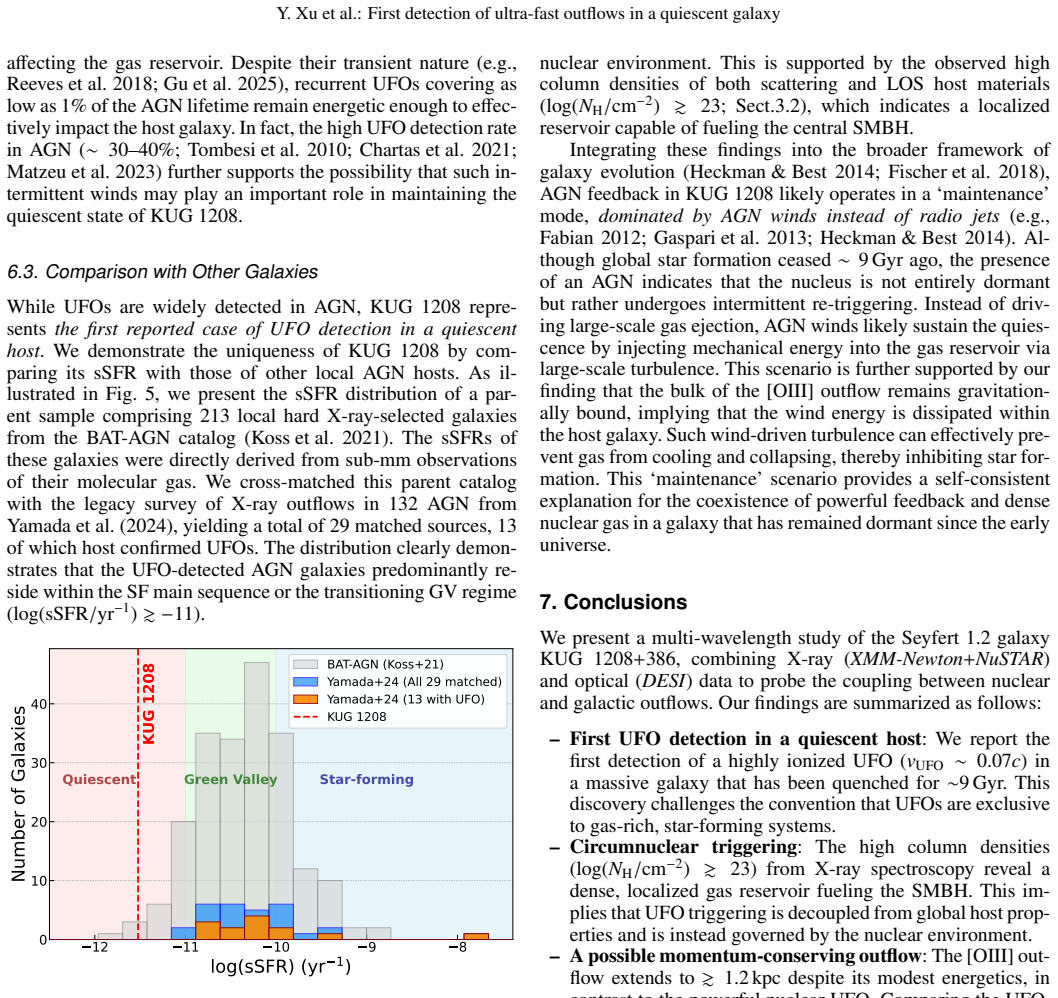
Significance. The paper's core observational claim — a UFO in a quiescent host — is a genuine first and is well-motivated by the BAT-AGN cross-match (Fig. 5), which shows all 13 known UFO hosts in the comparison sample reside in star-forming or green-valley galaxies. The multi-wavelength approach (X-ray spectroscopy, optical line fitting, SED modeling, stellar population analysis) is commendable and provides a self-consistent picture. The Bayesian spectral methodology (nautilus sampling, AICc and Bayesian evidence comparison across Models A–C) is thorough. The transparent reporting of both 1σ and 2σ uncertainties on UFO parameters, and the honest acknowledgment of the N_H–velocity degeneracy from CCD resolution, are strengths. The pPXF stellar population analysis and SFH reconstruction provide solid independent support for the quiescent classification.
major comments (1)
- Section 6.2 and Conclusions: The claim that 'episodic, powerful winds can maintain the quiescent state of KUG 1208+386 over Gyr timescales' is presented as a conclusion but rests on an extrapolation from a single-epoch UFO detection with an assumed AGN duty cycle (0.1–1%) and an entirely unconstrained energy coupling efficiency. The comparison of cumulative UFO energy (E_UFO ~ 10^59 erg) to the gravitational binding energy (E_bind ~ 5×10^55 erg) is not the physically relevant comparison for maintenance-mode feedback: the relevant quantity is the energy that couples to the ISM to prevent halo gas cooling, which depends on the coupling efficiency and the AGN duty cycle over Gyr timescales — neither of which is constrained by the data. The paper acknowledges these gaps in Sec. 6.1–6.2, but the Conclusions (Sec. 7) and Abstract state the maintenance scenario as established rather than as a推测
minor comments (8)
- Abstract: The UFO kinetic power is quoted as (0.8–6.5)×10^43 erg/s, while in Sec. 5.1 the values are 8×10^43 to 6×10^44 erg/s depending on filling factor. Please reconcile and clarify which range corresponds to which assumption.
- Table 2: The Ė_out value for the hot ionized phase is listed as '(0.2–28)×10^4' in units of 10^40 erg/s, which appears inconsistent with the text in Sec. 5.1 (8×10^43 to 6×10^44 erg/s). Please reconcile the ranges and units.
- Section 3.3: The PION model requires an ionizing SED as input. The text states that a potential unmodeled soft X-ray excess only marginally increases log ξ by ~0.15, but it is unclear whether the reported UFO parameters (Table 1) correspond to the fitted SED or the interpolated SED. Please clarify.
- Section 5.1, Eq. (3): The filling factor lower limit f_V^min = r_2/r_1 is derived assuming cos θ ~ 1. For the adopted inclination of 60° (Sec. 3.2), cos θ = 0.5, which would reduce R_min by a factor of 4. Please clarify whether the torus inclination is the same as the outflow inclination, and if so, update the filling factor estimate accordingly.
- Section 4.1: The two DESI pointings ('bright' and 'backup') differ in flux normalization by a factor of ~5, attributed to pointing offsets. Given that the [OIII] outflow properties (W80, electron density) differ between the two pointings, please comment on whether these differences are consistent with a spatially resolved outflow or could partly reflect aperture effects, and how this affects the mass outflow rate estimates in Sec. 5.2.
- Figure 4: The predicted CO outflow momentum (hollow red diamond) is derived by applying a population-based scaling relation (0.1–5% of warm ionized momentum) to an individual source. The authors acknowledge this is speculative (Sec. 6.1), but including it in the figure without error bars may overstate its significance. Please add a note in the figure caption.
- Section 4.3: The SFH reconstruction depends on the adopted SSP library and residual AGN subtraction. The authors note this dependence but do not quantify the systematic uncertainty on the ~9 Gyr quenching timescale. A brief statement of the range obtained with alternative libraries or regularization parameters would strengthen this claim.
- The reference list includes entries dated 2026 (e.g., Reeves et al. 2026a,b; Seebeck et al. 2026; Mizumoto et al. 2026). Please verify these are correctly cited and that no more recent versions exist.
Circularity Check
No significant circularity; the derivation chain is self-contained with independent observational inputs.
full rationale
The paper's central observational claim — first UFO detection in a quiescent galaxy — rests on independent X-ray spectral fitting (XMM-Newton + NuSTAR data, PION photoionization model, ~3σ true significance) and independent host-galaxy characterization (CIGALE SED fitting, pPXF stellar populations, DESI spectroscopy). The UFO velocity, column density, and ionization parameter are all fitted directly from the X-ray data (Sec 3.3, Table 1). The kinetic power (Eq. 5–6) is derived from these fitted parameters via standard, externally established formulae. The quiescence classification (sSFR ~ 3×10⁻¹², quenched ~9 Gyr) comes from independent SED and stellar population analyses. The maintenance-mode conclusion (Sec 6.2) does involve an assumed duty cycle (0.1–1%) and unconstrained coupling efficiency, but these are explicitly stated as assumptions drawn from external literature (Aird et al. 2018), not derived from the paper's own results and then fed back as conclusions. The self-citations (Xu et al. 2021a,b, 2023, 2025) appear in the introduction for context on UFO acceleration mechanisms and in methods for PION implementation details; none are load-bearing for the central claim. The BAT-AGN cross-match (Fig 5) providing the 'first in quiescent galaxy' uniqueness claim uses external catalogs (Koss et al. 2021; Yamada et al. 2024). No step in the derivation chain reduces to its own inputs by construction. The score of 1 (rather than 0) reflects the minor point that the maintenance-mode argument's structure — assume duty cycle → compute cumulative energy → conclude maintenance is feasible — could be seen as partially self-reinforcing, but this is a modeling extrapolation with transparent assumptions, not circularity in the formal sense.
Assumptions & free parameters
free parameters (11)
- Photon index Γ_XMM =
1.51 ± 0.08
- Photon index Γ_NuSTAR =
1.81 ± 0.06
- Host absorption N_H^host =
9.9 × 10^22 cm^-2
- Torus column density N_H^Tor =
10^24.7 cm^-2
- Torus covering factor CF =
0.46 ± 0.14
- Wind ionization parameter log ξ_wind =
3.3 ± 0.2
- Wind column density N_H^wind =
3.5 × 10^23 cm^-2
- Wind LOS velocity z_LOS^wind =
-0.070 ± 0.008
- AGN duty cycle =
0.1–1%
- Volume filling factor f_V =
0.11–1.0
- Opening fraction f_cov =
0.4
assumptions (5)
- domain assumption The absorption feature at 7.25 keV is produced by Fe XXV/XXVI resonance lines blueshifted by a UFO, not by an instrumental artifact or alternative atomic transition.
- domain assumption The UFO and [OIII] outflow are physically associated with the AGN in KUG 1208+386 and not with a background/foreground source.
- domain assumption The delayed SFH model and SSP templates used in pPXF accurately reconstruct the star formation history of KUG 1208+386.
- ad hoc to paper The assumed AGN duty cycle (0.1–1%) is representative of the Gyr-timescale history of KUG 1208+386.
- domain assumption The molecular gas fraction f_gas ≤ 1% is a valid upper limit for this galaxy.
Cite this review
Pith. "Pith review of First detection of ultra-fast outflows in a quiescent galaxy." pith.science (2026). https://pith.science/paper/FH4MNOHH
@misc{pith2026260706844,
  author       = {Pith},
  title        = {Pith review of: First detection of ultra-fast outflows in a quiescent galaxy},
  year         = {2026},
  howpublished = {\url{https://pith.science/paper/FH4MNOHH}},
  note         = {Machine review of arXiv:2607.06844}
}
abstract
Outflows in active galactic nuclei (AGN) are recognized as a fundamental mechanism driving the co-evolution of supermassive black holes (SMBHs) and their host galaxies. Although powerful outflows are frequently detected in gas-rich, active star-forming galaxies, their existence and potential impact within gas-poor, quiescent galaxies remain poorly understood. We report the first detection of a powerful ultra-fast outflow (UFO) in a nearby quiescent galaxy KUG 1208+386, providing a multiscale analysis of AGN winds from nuclear to galactic scales. We detect a nuclear X-ray UFO with a velocity of $v_{out} \approx -0.07c$ and a kinetic power of $\dot{E}_{\rm UFO}=(0.8\mbox{--}6.5) \times 10^{43}$erg/s, sufficient to drive effective AGN feedback ($\dot{E}_{\rm UFO}/L_\mathrm{Edd}=(1\mbox{--}8)\%$) and far exceeding the galactic [OIII] outflow power $\sim 10^{40}$ erg/s. Host galaxy analysis reveals a massive quiescent system (specific star formation rate $\sim3\times10^{-12}\mathrm{yr}^{-1}$) that has been quenched $\sim$9 Gyr ago. The central AGN is obscured by a line-of-sight (LOS) column density of $\log (N_\mathrm{H}^\mathrm{LOS}/\mathrm{cm}^{-2})\sim23$ and the circumnuclear scattering material is Compton-thick $\log(N_\mathrm{H}^\mathrm{scatter}/\mathrm{cm}^{-2})=24.7^{+0.8}_{-0.5}$. The discovery of a nuclear UFO in a long-quenched massive galaxy challenges the paradigm that UFOs are exclusive to gas-rich, star-forming systems, suggesting instead that they are governed by the local circumnuclear environments, rather than the global gas reservoir. Our results indicate that episodic, powerful winds can maintain the quiescent state of KUG 1208+386 over Gyr timescales, supporting a wind-driven `maintenance' mode of AGN feedback that is distinct from the classical jet mode.
Figures


Figures from the paper (2 more)

Reference graph
Works this paper leans on
-
[1]
Chandra Detects Relativistic Broad Absorption Lines from APM 08279+5255
CHANDRA Detects Relativistic Broad Absorption Lines from APM 08279+5255. , keywords =. doi:10.1086/342744 , archivePrefix =. astro-ph/0207196 , primaryClass =
-
[2]
AGN Feedback and Multi-phase Gas in Giant Elliptical Galaxies
AGN feedback and multiphase gas in giant elliptical galaxies. , keywords =. doi:10.1093/mnras/sty2906 , archivePrefix =. 1805.03217 , primaryClass =
-
[3]
AGN-controlled cooling in elliptical galaxies. , keywords =. doi:10.1111/j.1745-3933.2006.00159.x , archivePrefix =. astro-ph/0602171 , primaryClass =
-
[4]
BASS. XXII. The BASS DR2 AGN Catalog and Data. , keywords =. doi:10.3847/1538-4365/ac6c05 , archivePrefix =. 2207.12432 , primaryClass =
-
[5]
Properties of AGN coronae in the NuSTAR era
Properties of AGN coronae in the NuSTAR era. , keywords =. doi:10.1093/mnras/stv1218 , archivePrefix =. 1505.07603 , primaryClass =
-
[6]
NAUTILUS: boosting Bayesian importance nested sampling with deep learning
NAUTILUS: boosting Bayesian importance nested sampling with deep learning. , keywords =. doi:10.1093/mnras/stad2441 , archivePrefix =. 2306.16923 , primaryClass =
-
[7]
The distribution of absorbing column densities among Seyfert 2 galaxies
The Distribution of Absorbing Column Densities among Seyfert 2 Galaxies. , keywords =. doi:10.1086/307623 , archivePrefix =. astro-ph/9902377 , primaryClass =
-
[8]
BAT AGN Spectroscopic Survey. V. X-Ray Properties of the Swift/BAT 70-month AGN Catalog. , keywords =. doi:10.3847/1538-4365/aa96ad , archivePrefix =. 1709.03989 , primaryClass =
Show all 300 references
-
[9]
The demographics, physics, and ecology of growing supermassive black holes
Cosmic X-ray surveys of distant active galaxies. The demographics, physics, and ecology of growing supermassive black holes. , keywords =. doi:10.1007/s00159-014-0081-z , archivePrefix =. 1501.01982 , primaryClass =
- [10]
-
[11]
, keywords =
Is the soft excess in active galactic nuclei real?. , keywords =. doi:10.1111/j.1365-2966.2004.07687.x , archivePrefix =. astro-ph/0312271 , primaryClass =
2004 doi
- [12]
- [13]
-
[14]
and Raftery, Adrian E
Kass, Robert E. and Raftery, Adrian E. , biburl =. Bayes Factors , url =. Journal of the American Statistical Association , keywords =. doi:10.1080/01621459.1995.10476572 , eprint =
1995 doi
-
[15]
Jeffreys, Harold , biburl =
-
[16]
PyXspec: Python interface to XSPEC spectral-fitting program
- [17]
- [18]
- [19]
- [20]
- [21]
-
[22]
X-ray and UV absorption lines from metastable levels in Be-like to C-like ions
Density diagnostics of ionized outflows in active galactic nuclei. X-ray and UV absorption lines from metastable levels in Be-like to C-like ions. , keywords =. doi:10.1051/0004-6361/201731378 , archivePrefix =. 1707.09552 , primaryClass =
-
[23]
Supermassive Black Hole Winds in X-rays -- SUBWAYS. III. A population study on ultra-fast outflows. arXiv e-prints , keywords =. doi:10.48550/arXiv.2403.09538 , archivePrefix =. 2403.09538 , primaryClass =
- [24]
- [25]
- [26]
- [27]
-
[28]
, keywords =
X-Ray Spectra from Two-Phase Accretion Disks. , keywords =. doi:10.1086/173020 , adsurl =
- [29]
-
[30]
, keywords =
A comprehensive range of X-ray ionized-reflection models. , keywords =. doi:10.1111/j.1365-2966.2005.08797.x , archivePrefix =. astro-ph/0501116 , primaryClass =
2005 doi
- [31]
- [32]
-
[33]
, keywords =
Evidence of a high-velocity ionized outflow in a second narrow-line quasar PG 0844+349. , keywords =. doi:10.1111/j.1365-2966.2003.07164.x , archivePrefix =. astro-ph/0305571 , primaryClass =
2003 doi
- [34]
- [35]
- [36]
- [37]
- [38]
- [39]
- [40]
-
[41]
, keywords =
Quasar feedback: more bang for your buck. , keywords =. doi:10.1111/j.1365-2966.2009.15643.x , archivePrefix =. 0904.0649 , primaryClass =
2009 doi
- [42]
-
[43]
, keywords =
The Reflection Grating Spectrometer on board XMM-Newton. , keywords =. doi:10.1051/0004-6361:20000058 , adsurl =
-
[44]
XMM-Newton observatory. I. The spacecraft and operations. , keywords =. doi:10.1051/0004-6361:20000036 , adsurl =
- [45]
- [46]
- [47]
- [48]
- [49]
-
[50]
, keywords =
X-Ray High-resolution Spectroscopy Reveals Feedback in a Seyfert Galaxy from an Ultra-fast Wind with Complex Ionization and Velocity Structure. , keywords =. doi:10.1088/2041-8205/813/2/L39 , archivePrefix =. 1511.01165 , primaryClass =
- [51]
- [52]
- [53]
-
[54]
, keywords =
How the effects of resonant absorption on black hole reflection spectra can mimic high-velocity outflows. , keywords =. doi:10.1111/j.1745-3933.2011.01143.x , archivePrefix =. 1108.5060 , primaryClass =
2011 doi
- [55]
- [56]
- [57]
- [58]
- [59]
-
[60]
Space Telescopes and Instrumentation 2018: Ultraviolet to Gamma Ray , year = 2018, editor =
The ATHENA X-ray Integral Field Unit (X-IFU). Space Telescopes and Instrumentation 2018: Ultraviolet to Gamma Ray , year = 2018, editor =. doi:10.1117/12.2312409 , archivePrefix =. 1807.06092 , primaryClass =
- [61]
- [62]
- [63]
-
[64]
arXiv e-prints , keywords =
Detection of a Multi-Phase Ultra-Fast Wind in the Narrow-Line Seyfert 1 Galaxy Mrk 1044. arXiv e-prints , keywords =
- [65]
- [66]
- [67]
- [68]
- [69]
-
[70]
Application to a hydrodynamical simulation
Multidimensional modelling of X-ray spectra for AGN accretion disc outflows - III. Application to a hydrodynamical simulation. , keywords =. doi:10.1111/j.1365-2966.2010.17215.x , archivePrefix =. 1006.3449 , primaryClass =
2010 doi
- [71]
- [72]
- [73]
- [74]
- [75]
-
[76]
Observational appearance
Black holes in binary systems. Observational appearance. , year = 1973, month = jan, volume =
1973
- [77]
- [78]
- [79]
- [80]
-
[81]
, keywords =
First high-energy observations of narrow-line Seyfert 1s with INTEGRAL/IBIS. , keywords =. doi:10.1111/j.1365-2966.2008.13657.x , archivePrefix =. 0806.4824 , primaryClass =
2008 doi
-
[82]
, keywords =
The host galaxy of a narrow-line Seyfert 1 galaxy, RE J1034+396, with X-ray quasi-periodic oscillations. , keywords =. doi:10.1111/j.1365-2966.2009.15662.x , archivePrefix =. 0909.1078 , primaryClass =
2009 doi
- [83]
- [84]
- [85]
- [86]
-
[87]
Improved virial methods for measuring M _ BH and L/L _ Edd
Black hole growth to z = 2 - I. Improved virial methods for measuring M _ BH and L/L _ Edd. , keywords =. doi:10.1111/j.1365-2966.2012.22056.x , archivePrefix =. 1209.1096 , primaryClass =
2012 doi
- [88]
- [89]
- [90]
-
[91]
, keywords =
Optical-to-X-ray emission in low-absorption AGN: results from the Swift-BAT 9-month catalogue. , keywords =. doi:10.1111/j.1365-2966.2009.15371.x , archivePrefix =. 0907.2272 , primaryClass =
2009 doi
-
[92]
arXiv e-prints , keywords =
Discovery of a Luminosity-dependent Continuum Lag in NGC 4151 from Photometric and Spectroscopic Continuum Reverberation Mapping. arXiv e-prints , keywords =. doi:10.48550/arXiv.2512.18276 , archivePrefix =. 2512.18276 , primaryClass =
- [93]
- [94]
- [95]
- [96]
- [97]
- [98]
- [99]
- [100]
- [101]
- [102]
- [103]
- [104]
- [105]
- [106]
-
[107]
, keywords =
A Suzaku survey of Fe K lines in Seyfert 1 active galactic nuclei. , keywords =. doi:10.1111/j.1365-2966.2012.21868.x , archivePrefix =. 1208.1150 , primaryClass =
2012 doi
-
[108]
, keywords =
On characterizing the variability properties of X-ray light curves from active galaxies. , keywords =. doi:10.1046/j.1365-2966.2003.07042.x , archivePrefix =. astro-ph/0307420 , primaryClass =
2003 doi
-
[109]
, keywords =
The European Photon Imaging Camera on XMM-Newton: The pn-CCD camera. , keywords =. doi:10.1051/0004-6361:20000066 , adsurl =
- [110]
-
[111]
, keywords =
RE J1034+396: the origin of the soft X-ray excess and quasi-periodic oscillation. , keywords =. doi:10.1111/j.1365-2966.2008.14255.x , archivePrefix =. 0807.4847 , primaryClass =
2008 doi
- [112]
- [113]
-
[114]
New insights on the soft X-ray excess, QPO, and the analogy with GRS 1915+105
Re-observing the NLS1 galaxy RE J1034+396 - II. New insights on the soft X-ray excess, QPO, and the analogy with GRS 1915+105. , keywords =. doi:10.1093/mnras/staa3386 , archivePrefix =. 2007.14704 , primaryClass =
-
[115]
Astronomical Data Analysis Software and Systems V , year = 1996, editor =
XSPEC: The First Ten Years. Astronomical Data Analysis Software and Systems V , year = 1996, editor =
1996
-
[116]
, keywords =
Parameter estimation in astronomy through application of the likelihood ratio. , keywords =. doi:10.1086/156922 , adsurl =
- [117]
-
[118]
UV and X-ray Spectroscopy of Astrophysical and Laboratory Plasmas , year = 1996, month = jan, pages =
SPEX: a new code for spectral analysis of X & UV spectra. UV and X-ray Spectroscopy of Astrophysical and Laboratory Plasmas , year = 1996, month = jan, pages =
1996
- [119]
- [120]
- [121]
- [122]
- [123]
-
[124]
, keywords =
Radiation spectra of warm and optically thick coronae in AGNs. , keywords =. doi:10.1051/0004-6361/201937011 , archivePrefix =. 2001.02026 , primaryClass =
2001 doi
-
[125]
, keywords =
Supercritically accreting stellar mass black holes as ultraluminous X-ray sources. , keywords =. doi:10.1111/j.1365-2966.2007.11668.x , archivePrefix =. astro-ph/0609274 , primaryClass =
2007 doi
- [126]
- [127]
- [128]
- [129]
- [130]
- [131]
- [132]
-
[133]
, keywords =
The Cosmic Origins Spectrograph. , keywords =. doi:10.1088/0004-637X/744/1/6010.1086/141956 , archivePrefix =. 1110.0462 , primaryClass =
- [134]
- [135]
- [136]
- [137]
- [138]
- [139]
- [140]
- [141]
-
[142]
Radiation-driven accretion disk winds in a physical context
A global view of the inner accretion and ejection flow around super massive black holes. Radiation-driven accretion disk winds in a physical context. , keywords =. doi:10.1051/0004-6361/201833810 , archivePrefix =. 1904.07341 , primaryClass =
- [143]
-
[144]
, keywords =
Comptonization of X-Rays in Plasma Clouds - Typical Radiation Spectra. , keywords =
-
[145]
, keywords =
Detection of broad iron K lines in active galaxies. , keywords =. doi:10.1093/mnras/272.1.L9 , adsurl =
-
[146]
, keywords =
X-ray fluorescence from the inner disc in Cygnus X-1. , keywords =. doi:10.1093/mnras/238.3.729 , adsurl =
- [147]
- [148]
- [149]
- [150]
-
[151]
, year = 2008, month = sep, volume =
A periodicity of -0.5ex 1hour in X-ray emission from the active galaxy RE J1034+396. , year = 2008, month = sep, volume =. doi:10.1038/nature07277 , adsurl =
2008 doi
- [152]
-
[153]
, keywords =
X-ray reflection from cold matter in Active Galactic Nuclei and X-ray binaries. , keywords =. doi:10.1093/mnras/249.2.352 , adsurl =
- [154]
-
[155]
, keywords =
Intrinsic disc emission and the soft X-ray excess in active galactic nuclei. , keywords =. doi:10.1111/j.1365-2966.2011.19779.x , archivePrefix =. 1107.5429 , primaryClass =
2011 doi
-
[156]
, keywords =
The high-temperature big blue bump in the Seyfert galaxy RE J1034+396. , keywords =. doi:10.1093/mnras/276.1.20 , adsurl =
- [157]
- [158]
-
[159]
, keywords =
Is the X-ray spectrum of the narrow emission line QSO PG1211+143 defined by its energetic outflow?. , keywords =. doi:10.1111/j.1365-2966.2006.11170.x , archivePrefix =. astro-ph/0610112 , primaryClass =
2006 doi
-
[160]
, keywords =
Quantifying the fast outflow in the luminous Seyfert galaxy PG1211+143. , keywords =. doi:10.1111/j.1365-2966.2009.14971.x , archivePrefix =. 0811.3108 , primaryClass =
2009 doi
- [161]
- [162]
- [163]
- [164]
- [165]
- [166]
- [167]
- [168]
- [169]
- [170]
- [171]
- [172]
- [173]
- [174]
- [175]
- [176]
- [177]
- [178]
- [179]
-
[180]
Young radio-loud active galactic nuclei at low redshift
The CORALZ sample - I. Young radio-loud active galactic nuclei at low redshift. , keywords =. doi:10.1111/j.1365-2966.2004.07337.x , adsurl =
2004 doi
-
[181]
, keywords =
A longer XMM-Newton look at IZwicky1: physical conditions and variability of the ionized absorbers. , keywords =. doi:10.1111/j.1365-2966.2007.11646.x , archivePrefix =. astro-ph/0702553 , primaryClass =
2007 doi
- [182]
-
[183]
, keywords =
A longer XMM-Newton look at I Zwicky 1: variability of the X-ray continuum, absorption and iron K line. , keywords =. doi:10.1111/j.1365-2966.2007.11601.x , archivePrefix =. astro-ph/0610283 , primaryClass =
2007 doi
- [184]
- [185]
- [186]
- [187]
- [188]
- [189]
- [190]
-
[191]
, keywords =
PG 1211+143: probing high-frequency lags in a high-mass active galactic nucleus. , keywords =. doi:10.1111/j.1745-3933.2011.01129.x , archivePrefix =. 1108.3503 , primaryClass =
2011 doi
- [192]
-
[193]
MNRAS , eprint =
Full spectrum fitting with photometry in PPXF: stellar population versus dynamical masses, non-parametric star formation history and metallicity for 3200 LEGA-C galaxies at redshift z 0.8. MNRAS , eprint =
-
[194]
, keywords =
The Relationship between Infrared, Optical, and Ultraviolet Extinction. , keywords =. doi:10.1086/167900 , adsurl =
- [195]
-
[196]
Astrophysics of gaseous nebulae and active galactic nuclei
-
[197]
The dependence of colour, star formation and morphology on halo mass
Properties of galaxy groups in the Sloan Digital Sky Survey - I. The dependence of colour, star formation and morphology on halo mass. , keywords =. doi:10.1111/j.1365-2966.2005.09865.x , archivePrefix =. astro-ph/0509147 , primaryClass =
2005 doi
- [198]
- [199]
- [200]
- [201]
- [202]
-
[203]
, keywords =
Revisiting the infrared spectra of active galactic nuclei with a new torus emission model. , keywords =. doi:10.1111/j.1365-2966.2006.09866.x , archivePrefix =. astro-ph/0511428 , primaryClass =
2006 doi
- [204]
- [205]
-
[206]
, keywords =
Rest-frame ultraviolet-to-optical spectral characteristics of extremely metal-poor and metal-free galaxies. , keywords =. doi:10.1111/j.1365-2966.2011.18906.x , archivePrefix =. 1102.5150 , primaryClass =
2011 doi
- [207]
-
[208]
, keywords =
Stellar population synthesis at the resolution of 2003. , keywords =. doi:10.1046/j.1365-8711.2003.06897.x , archivePrefix =. astro-ph/0309134 , primaryClass =
2003 doi
-
[209]
VizieR On-line Data Catalog: II/328
- [210]
- [211]
-
[212]
VizieR Online Data Catalog: II/246
-
[213]
, keywords =
GALEX catalogs of UV sources: statistical properties and sample science applications: hot white dwarfs in the Milky Way. , keywords =. doi:10.1007/s10509-010-0581-x , adsurl =
- [214]
- [215]
- [216]
-
[217]
, keywords =
An explanation for the soft X-ray excess in active galactic nuclei. , keywords =. doi:10.1111/j.1365-2966.2005.09844.x , archivePrefix =. astro-ph/0511457 , primaryClass =
2005 doi
- [218]
- [219]
- [220]
- [221]
- [222]
- [223]
- [224]
- [225]
- [226]
- [227]
-
[228]
Radiative processes in astrophysics
- [229]
- [230]
- [231]
- [232]
- [233]
- [234]
-
[235]
, keywords =
Empirical determination of the shape of dust attenuation curves in star-forming galaxies. , keywords =. doi:10.1111/j.1365-2966.2011.19367.x , archivePrefix =. 1106.1646 , primaryClass =
2011 doi
- [236]
- [237]
- [238]
-
[239]
ENLR size-luminosity relation, ongoing star formation and resolved gas-phase metallicities
Integral field spectroscopy of nearby QSOs - I. ENLR size-luminosity relation, ongoing star formation and resolved gas-phase metallicities. , keywords =. doi:10.1093/mnras/stu1167 , archivePrefix =. 1406.4131 , primaryClass =
- [240]
- [241]
- [242]
- [243]
- [244]
-
[245]
Detection of multiple ultra fast outflow components and a very cold corona
The XMM-Newton and NuSTAR view of IRASF11119+3257: I. Detection of multiple ultra fast outflow components and a very cold corona. , keywords =. doi:10.1051/0004-6361/202449194 , archivePrefix =. 2406.12057 , primaryClass =
- [246]
- [247]
-
[248]
Birth of an ultrafast outflow during a soft flare
Delving into the depths of NGC 3783 with XRISM: III. Birth of an ultrafast outflow during a soft flare. , keywords =. doi:10.1051/0004-6361/202557189 , archivePrefix =. 2512.08448 , primaryClass =
- [249]
-
[250]
Resolving the Multiple Component Outflows in PG 1211+143. II. The Soft X-Ray View of the Ultrafast Outflow. , keywords =. doi:10.3847/1538-4357/ae47e8 , archivePrefix =. 2602.16496 , primaryClass =
-
[251]
Resolving the Multiple Component Outflows in PG 1211+143. I. The Fe─K Absorption Structure and UFO Forest. , keywords =. doi:10.3847/1538-4357/ae2853 , archivePrefix =. 2512.03533 , primaryClass =
-
[252]
, keywords =
Winds of Change: XRISM Resolve X-Ray Spectroscopy of NGC 4051. , keywords =. doi:10.3847/1538-4357/ae5527 , archivePrefix =. 2602.19897 , primaryClass =
- [253]
- [254]
-
[255]
arXiv e-prints , keywords =
Hot, Photoionized X-ray Gas in Two Luminous Type 2 Quasars: Chandra-HST Evidence for a Wind-Driven Sequence. arXiv e-prints , keywords =. doi:10.48550/arXiv.2512.07793 , archivePrefix =. 2512.07793 , primaryClass =
- [256]
-
[257]
The distribution of AGN accretion rates as a function of stellar mass and redshift
X-rays across the galaxy population - II. The distribution of AGN accretion rates as a function of stellar mass and redshift. , keywords =. doi:10.1093/mnras/stx2700 , archivePrefix =. 1705.01132 , primaryClass =
- [258]
- [259]
- [260]
-
[261]
, keywords =
JWST Discovery of High-velocity Mid-infrared Ionized Outflows in Ultraluminous Infrared Galaxies F11119+3257 and F05189-2524. , keywords =. doi:10.3847/1538-4357/ae3c05 , archivePrefix =. 2602.03836 , primaryClass =
- [262]
- [263]
- [264]
- [265]
- [266]
- [267]
- [268]
- [269]
-
[270]
, keywords =
The physics of galactic winds driven by active galactic nuclei. , keywords =. doi:10.1111/j.1365-2966.2012.21512.x , archivePrefix =. 1204.2547 , primaryClass =
2012 doi
- [271]
- [272]
- [273]
- [274]
- [275]
- [276]
- [277]
- [278]
- [279]
- [280]
- [281]
- [282]
- [283]
- [284]
- [285]
- [286]
- [287]
-
[288]
, keywords =
The interaction of supernovae with the interstellar medium. , keywords =. doi:10.1146/annurev.aa.15.090177.001135 , adsurl =
- [289]
- [290]
- [291]
- [292]
-
[293]
Physics of the Interstellar and Intergalactic Medium
- [294]
-
[295]
, keywords =
Properties of spherical galaxies and clusters with an NFW density profile. , keywords =. doi:10.1046/j.1365-8711.2001.04007.x , archivePrefix =. astro-ph/0002395 , primaryClass =
2001 doi
- [296]
- [297]
- [298]
- [299]
- [300]
Reviewed July 10, 2026 · model on record in the stance chip above.
Discussion (0). Sign in to comment.