REVIEW 5 minor 105 references
Late-time cosmological constraints on three holographic dark energy models with DESI DR2 BAO and Type Ia supernovae
T0 review · 0 major / 5 minor · reviewed 2026-07-14 · grok-4.5
Pith's one-line read Late-time DESI DR2 and supernova data leave three holographic dark energy models near ΛCDM and do not ease the Hubble tension.
desk verdict Solid late-time MCMC update of HDE/ADE/RDE with DESI DR2: none raise H0, HDE is the least awkward of the three, and the authors stay inside their data. read the letter →
The pith
A machine-rendered reading of the paper's core claim, the machinery that carries it, and where it could break.
The reading
What carries the argument
The holographic cutoff construction itself: dark energy density is set by an infrared scale (future event horizon for HDE, conformal age for ADE, Ricci scalar for RDE), which fixes the functional form of E(z) and wde(z) once a single dimensionless parameter is chosen, then fitted jointly with free rd via MCMC.
What would settle it
A joint analysis that includes CMB likelihoods plus full linear perturbations for the same three models: if the preferred late-time solutions (especially RDE’s low matter density and high fitted σ8,0) become incompatible with the CMB and growth spectrum, or if holographic dark energy is no longer near c = 1, the claim that late-time data leave them near ΛCDM without easing the Hubble tension would be overturned.
Extended reading notes
Core claim
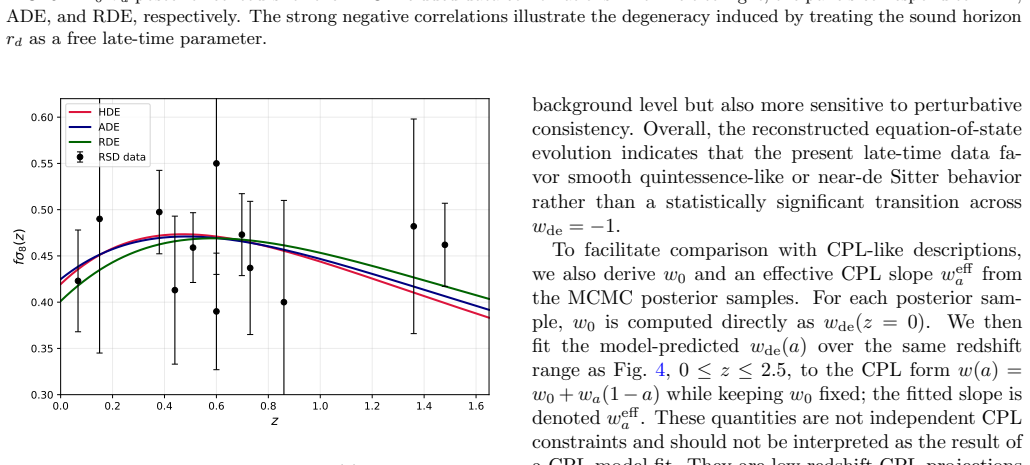
When constrained by late-time H(z), SNe Ia, DESI DR2 BAO, and an RSD growth compilation with free sound horizon, none of the three holographic-inspired models significantly alleviates the Hubble tension. Holographic dark energy is driven to c ≃ 1 (near the de Sitter boundary), agegraphic dark energy to n ≃ 2.8, and Ricci dark energy to γ ≃ 0.53–0.55 with Ωm0 ≃ 0.215–0.219; holographic dark energy is the most balanced of the three, yet current data do not decisively prefer it over ΛCDM.
Load-bearing premise
The growth check uses only the standard general-relativistic linear growth equation with free present-day fluctuation amplitude and is not a full stability analysis of how these dark energy models actually perturb.
Editorial analysis
A structured set of objections, weighed in public.
Referee Report
Summary. The paper presents a late-time Bayesian MCMC analysis of three holographic-inspired dark energy models (HDE, ADE, RDE) using cosmic chronometers, three SNe Ia compilations (Pantheon+, DES-Dovekie, DESY5), DESI DR2 BAO, and an extended RSD fσ8 compilation. Five data combinations are studied, with rd free in BAO-included runs and σ8,0 free only when RSD is included. Posteriors (Table II) show HDE driven to c≃1 with H0≃67–68 km s−1 Mpc−1 and Ωm0≃0.27, ADE with n≃2.8 and slightly lower H0, and RDE with γ≃0.53–0.55 but persistently low Ωm0≃0.215–0.219. The authors reconstruct wde(z), quantify the H0–rd degeneracy, report AIC/BIC relative to ΛCDM, and conclude that none of the models significantly alleviates the Hubble tension and that late-time data do not decisively prefer them over ΛCDM, with HDE the most balanced of the three.
Significance. If the results hold, the paper provides a clean, carefully scoped late-time comparison of three standard holographic DE constructions against current DESI DR2 BAO and modern SNe samples. Strengths include free-rd treatment (avoiding CMB sound-horizon priors), full CC and SN covariance matrices, explicit ΛCDM baselines for the same combinations, transparent reporting of ΔAIC/ΔBIC, and explicit labeling of the RSD analysis as a growth consistency check rather than a full perturbation-level stability test. The work is useful as a phenomenological benchmark for the community and correctly refrains from overclaiming resolution of the Hubble tension or decisive preference over ΛCDM.
minor comments (5)
- In Sec. III.D and IV.C the authors correctly state that the RSD analysis uses the standard GR linear growth equation (Eq. 32) and is not a full perturbative stability analysis, especially for RDE. A single clarifying sentence in the abstract or conclusions restating that the reported σ8,0 values are nuisance amplitudes for the adopted growth data (not model predictions from a complete DE perturbation sector) would further reduce possible misreading.
- Table II: for ADE the Ωm0 column is blank by construction (fixed by flatness and E(0)=1). A brief footnote or table note stating that Ωm0 is derived rather than free would help readers scanning the table.
- Fig. 4 and Table IV: the derived weffa is a low-redshift CPL projection with w0 fixed, not a free CPL fit. The text already says this; ensuring the table caption repeats the caveat would make the comparison with DESI CPL discussions harder to misinterpret.
- Minor typographical/formatting issues: “Observational Data” and “Statistical Methodology” appear with spaced letters in the section heading; “DESI R2” once appears instead of “DESI DR2”; and a few references (e.g. the DES-Dovekie arXiv entry) may need final bibliographic polishing.
- The extended RSD compilation is heterogeneous. A short sentence listing which points enter the covariance (or a reference to the exact compilation used) would improve reproducibility.
Circularity Check
No significant circularity: independently defined holographic models are fitted to late-time data; derived w_de(z) and weff_a are explicit projections of those fits, not tautologies.
full rationale
The paper defines HDE, ADE and RDE from standard holographic constructions (Eqs. 2–19: future-event-horizon cutoff, conformal age, Ricci scalar) that do not depend on the observational data sets. Free parameters (H0, Ωm0 or n/γ/c, rd, σ8,0) are sampled via MCMC against CC+SNe+DESI DR2 BAO (+RSD) combinations; posteriors, AIC/BIC differences, and reconstructed w_de(z) (Fig. 4) are ordinary outputs of that fit. The derived weff_a values (Table IV) are explicitly labeled low-redshift CPL projections of the model trajectories, not independent predictions. The H0–rd anti-correlation (Fig. 5) is the expected geometric degeneracy when rd is left free; the paper quantifies it and does not claim a CMB-calibrated H0. The RSD fσ8 check uses the standard GR growth equation with free σ8,0 and is repeatedly caveated as a consistency test only. No self-definitional loop, fitted-input-as-prediction, load-bearing self-citation of an unproven uniqueness claim, or renaming of a known result appears. The analysis is a conventional late-time phenomenological comparison and is self-contained against external benchmarks.
Assumptions & free parameters
free parameters (7)
- H0 =
≈66.5–68.0 km s⁻¹ Mpc⁻¹ (BAO-included)
- Ωm0 =
HDE ≈0.270–0.272; RDE ≈0.215–0.219
- c (HDE) =
≈0.99–1.09 (BAO-included)
- n (ADE) =
≈2.78–2.81
- γ (RDE) =
≈0.53–0.55
- rd =
≈146.6–147.2 Mpc
- σ8,0 =
HDE 0.875; ADE 0.893; RDE 0.961
assumptions (6)
- domain assumption Spatially flat FRW background with cold dark matter, radiation and dark energy.
- domain assumption Holographic dark-energy density ρde = 3c² Mp² L⁻² with L = future event horizon.
- domain assumption Agegraphic density ρde = 3n² Mp² η⁻² with η conformal time.
- domain assumption Ricci dark-energy density ρde = 3γ Mp² (Ḣ + 2H²).
- domain assumption Linear growth of matter perturbations obeys the standard GR equation (32).
- standard math AIC = χ²min + 2k and BIC = χ²min + k ln N are appropriate model-selection metrics.
Cite this review
Pith. "Pith review of Late-time cosmological constraints on three holographic dark energy models with DESI DR2 BAO and Type Ia supernovae." pith.science (2026). https://pith.science/paper/WB2QNHDB
@misc{pith2026260709732,
  author       = {Pith},
  title        = {Pith review of: Late-time cosmological constraints on three holographic dark energy models with DESI DR2 BAO and Type Ia supernovae},
  year         = {2026},
  howpublished = {\url{https://pith.science/paper/WB2QNHDB}},
  note         = {Machine review of arXiv:2607.09732}
}
abstract
We constrain three holographic-inspired dark energy models, namely holographic dark energy (HDE), agegraphic dark energy (ADE), and Ricci dark energy (RDE), using late-time observations from cosmic chronometers, Type Ia supernovae (SNe Ia), DESI DR2 baryon acoustic oscillations (BAO), and {redshift-space distortion (RSD) growth measurements}. Five data combinations are considered: $H(z)+$Pantheon+, $H(z)+$DESI DR2+Pantheon+, $H(z)+$DESI DR2+DES-Dovekie, $H(z)+$DESI DR2+DESY5, and {$H(z)+$DESI DR2+DES-Dovekie+RSD}. We perform Bayesian Markov chain Monte Carlo parameter estimation and compare the models with AIC and BIC. In the BAO-included combinations, HDE gives $H_0\simeq67.3$--$68.0~\mathrm{~km~s^{-1}~Mpc^{-1}}$, $\Omega_{m0}\simeq0.270$--$0.272$, and $c\simeq1$, indicating an expansion history close to the de Sitter boundary rather than a robust phantom regime. ADE yields a stable agegraphic parameter $n\simeq2.78$--$2.81$, while RDE gives $\gamma\simeq0.53$--$0.55$ and persistently favors a low matter density, $\Omega_{m0}\simeq0.215$--$0.219$. {Treating $r_d$ as a free parameter reveals a strong negative correlation between $H_0$ and $r_d$, and the RSD-included combination provides a growth-level consistency check through $f\sigma_8(z)$ without constituting a full perturbative stability analysis.} None of the three models significantly alleviates the Hubble tension. Overall, HDE shows the most balanced phenomenological behavior among the three models, although current late-time data do not decisively prefer it over $\Lambda\text{CDM}$.
Figures


Figures from the paper (3 more)


Reference graph
Works this paper leans on
-
[1]
A. G. Riess, A. V. Filippenko, P. Challis, A. Clocchi- atti, A. Diercks, P. M. Garnavich, R. L. Gilliland, C. J. Hogan, S. Jha, R. P. Kirshner, et al., Astron. J.116, 1009 (1998), astro-ph/9805201
arXiv 1998
-
[2]
S. Perlmutter, G. Aldering, G. Goldhaber, R. A. Knop, P. Nugent, P. G. Castro, S. Deustua, S. Fabbro, A. Goo- bar, D. E. Groom, et al., Astrophys. J.517, 565 (1999), astro-ph/9812133
arXiv 1999
-
[3]
Lahav, Contemporary Physics61, 132 (2020), 2009.10177
O. Lahav, Contemporary Physics61, 132 (2020), 2009.10177
arXiv 2020
-
[4]
Weinberg, Reviews of Modern Physics61, 1 (1989)
S. Weinberg, Reviews of Modern Physics61, 1 (1989)
1989
-
[5]
P. J. Steinhardt, inCritical Problems in Physics, edited by V. L. Fitch, D. R. Marlow, and M. A. E. Dementi (1997), p. 123
1997
-
[7]
Planck Collaboration, N. Aghanim, Y. Akrami, M. Ash- down, J. Aumont, C. Baccigalupi, M. Ballardini, A. J. Banday, R. B. Barreiro, N. Bartolo, et al., Astron. As- trophys.641, A6 (2020), 1807.06209
arXiv 2020
-
[8]
A. G. Riess, W. Yuan, L. M. Macri, D. Scolnic, D. Brout, S. Casertano, D. O. Jones, Y. Murakami, G. S. Anand, L. Breuval, et al., Astrophys. J. Lett.934, L7 (2022), 2112.04510
arXiv 2022
-
[9]
D. W. Pesce, J. A. Braatz, M. J. Reid, A. G. Riess, D. Scolnic, J. J. Condon, F. Gao, C. Henkel, C. M. V. Impellizzeri, C. Y. Kuo, et al., Astrophys. J. Lett.891, L1 (2020), 2001.09213
arXiv 2020
Show all 105 references
-
[10]
Birrer, A
S. Birrer, A. J. Shajib, A. Galan, M. Millon, T. Treu, A. Agnello, M. Auger, G. C. F. Chen, L. Christensen, T. Collett, et al., Astron. Astrophys.643, A165 (2020), 2007.02941
2020 arXiv
-
[11]
W. L. Freedman, B. F. Madore, T. Hoyt, I. S. Jang, R. Beaton, M. G. Lee, A. Monson, J. Neeley, and J. Rich, Astrophys. J.891, 57 (2020), 2002.01550
2020 arXiv
-
[12]
Di Valentino, L
E. Di Valentino, L. A. Anchordoqui, ¨O. Akarsu, Y. Ali- Haimoud, L. Amendola, N. Arendse, M. Asgari, M. Bal- lardini, S. Basilakos, E. Battistelli, et al., Astroparticle Physics131, 102605 (2021), 2008.11284
2021 arXiv
-
[13]
Abdalla, G
E. Abdalla, G. F. Abell´ an, A. Aboubrahim, A. Agnello, ¨O. Akarsu, Y. Akrami, G. Alestas, D. Aloni, L. Amen- dola, L. A. Anchordoqui, et al., Journal of High Energy Astrophysics34, 49 (2022), 2203.06142
2022 arXiv
-
[14]
Perivolaropoulos and F
L. Perivolaropoulos and F. Skara, New Astronomy Re- views95, 101659 (2022), 2105.05208
2022 arXiv
-
[15]
Poulin, T
V. Poulin, T. L. Smith, T. Karwal, and M. Kamionkowski, Phys. Rev. Lett.122, 221301 (2019), 1811.04083
2019 arXiv
-
[16]
S. M. Feeney, H. V. Peiris, A. R. Williamson, S. M. Nis- sanke, D. J. Mortlock, J. Alsing, and D. Scolnic, Phys. Rev. Lett.122, 061105 (2019), 1802.03404
2019 arXiv
-
[17]
M. G. Dainotti, B. De Simone, T. Schiavone, G. Mon- tani, E. Rinaldi, and G. Lambiase, Astrophys. J.912, 150 (2021), 2103.02117
2021 arXiv
-
[18]
K. Liao, A. Shafieloo, R. E. Keeley, and E. V. Linder, Astrophys. J. Lett.895, L29 (2020), 2002.10605
2020 arXiv
-
[19]
T. Liu, S. Cao, and J. Wang, Phys. Rev. D112, 123539 (2025), 2509.20898
2025
-
[20]
T. Liu, S. Cao, M. Biesiada, and S. Geng, Astrophys. J. 939, 37 (2022), 2204.07365
2022 arXiv
-
[21]
A. L. Lenart, G. Bargiacchi, M. G. Dainotti, S. Na- gataki, and S. Capozziello, Astrophys. J., Suppl. Ser. 264, 46 (2023), 2211.10785
2023 arXiv
- [22]
-
[23]
Di Valentino, O
E. Di Valentino, O. Mena, S. Pan, L. Visinelli, W. Yang, A. Melchiorri, D. F. Mota, A. G. Riess, and J. Silk, Classical and Quantum Gravity38, 153001 (2021), 2103.01183
2021 arXiv
-
[24]
Vagnozzi, Universe9, 393 (2023), 2308.16628
S. Vagnozzi, Universe9, 393 (2023), 2308.16628
2023 arXiv
-
[25]
Jedamzik and L
K. Jedamzik and L. Pogosian, Phys. Rev. Lett.125, 181302 (2020), 2004.09487
2020 arXiv
-
[26]
Efstathiou and S
G. Efstathiou and S. Gratton, Mon. Not. Roy. Astron. Soc.496, L91 (2020), 2002.06892
2020 arXiv
-
[27]
W. L. Freedman, Astrophys. J.919, 16 (2021), 2106.15656
2021 arXiv
-
[28]
A. G. Adame, J. Aguilar, S. Ahlen, S. Alam, D. M. Alexander, M. Alvarez, O. Alves, A. Anand, U. An- drade, E. Armengaud, et al., JCAP2025, 021 (2025), 2404.03002
2025 arXiv
-
[30]
Chevallier and D
M. Chevallier and D. Polarski, Int. J. Mod. Phys. D10, 213 (2001), gr-qc/0009008
2001 arXiv
-
[31]
E. V. Linder, Phys. Rev. Lett.90, 091301 (2003), astro- ph/0208512
2003
-
[32]
Giar` e, M
W. Giar` e, M. Najafi, S. Pan, E. Di Valentino, and J. T. Firouzjaee, JCAP10, 035 (2024), 2407.16689
2024 arXiv
-
[33]
Giar` e, M
W. Giar` e, M. A. Sabogal, R. C. Nunes, and E. Di Valentino, Phys. Rev. Lett.133, 251003 (2024), 2404.15232
2024 arXiv
- [34]
-
[35]
Li and X
Y.-H. Li and X. Zhang, JCAP12, 018 (2025), 2506.18477
2025
-
[36]
Li, P.-J
T.-N. Li, P.-J. Wu, G.-H. Du, S.-J. Jin, H.-L. Li, J.- F. Zhang, and X. Zhang, Astrophys. J.976, 1 (2024), 2407.14934
2024 arXiv
-
[37]
Jiang, W
J.-Q. Jiang, W. Giar` e, S. Gariazzo, M. G. Dainotti, E. Di Valentino, O. Mena, D. Pedrotti, S. S. da Costa, and S. Vagnozzi, JCAP01, 153 (2025), 2407.18047
2025 arXiv
-
[38]
Li, G.-H
T.-N. Li, G.-H. Du, Y.-H. Li, P.-J. Wu, S.-J. Jin, J.-F. Zhang, and X. Zhang, Sci. China Phys. Mech. Astron. 69, 210413 (2026), 2501.07361
2026
-
[39]
R. Shah, P. Mukherjee, and S. Pal, arXiv e-prints arXiv:2503.21652 (2025), 2503.21652
2025 arXiv
-
[40]
T.-N. Li, W. Giar` e, G.-H. Du, Y.-H. Li, E. Di Valentino, J.-F. Zhang, and X. Zhang (2026), 2601.07361
2026
-
[41]
Li and S
J.-X. Li and S. Wang, Eur. Phys. J. C85, 1308 (2025), 2506.22953
2025
-
[42]
Fazzari, W
E. Fazzari, W. Giar` e, and E. Di Valentino, Astrophys. J. Lett.996, L5 (2026), 2509.16196
2026
- [43]
-
[44]
W. J. Wolf, C. Garc´ ıa-Garc´ ıa, T. Anton, and P. G. Fer- reira, Phys. Rev. Lett.135, 081001 (2025), 2504.07679
2025 arXiv
-
[45]
W. J. Wolf, P. G. Ferreira, and C. Garc´ ıa-Garc´ ıa, Phys. Rev. D113, 023551 (2026), 2509.17586
2026 arXiv
- [46]
- [47]
-
[48]
E. M. Teixeira, W. Giar` e, N. B. Hogg, T. Montandon, A. Poudou, and V. Poulin, Phys. Rev. D112, 023515 (2025), 2504.10464
2025 arXiv
-
[49]
van der Westhuizen, A
M. van der Westhuizen, A. Abebe, and E. Di Valentino, Phys. Dark Univ.50, 102121 (2025), 2509.04496
2025
-
[50]
Cheng, E
H. Cheng, E. Di Valentino, L. A. Escamilla, A. A. Sen, and L. Visinelli, JCAP09, 031 (2025), 2505.02932
2025
-
[51]
Silva, M
E. Silva, M. A. Sabogal, M. Scherer, R. C. Nunes, E. Di Valentino, and S. Kumar, Phys. Rev. D111, 123511 (2025), 2503.23225
2025 arXiv
-
[52]
Pedrotti, L
D. Pedrotti, L. A. Escamilla, V. Marra, L. Perivolaropoulos, and S. Vagnozzi (2025), 2510.01974
2025 arXiv
-
[53]
Wang and Y.-S
H. Wang and Y.-S. Piao (2026), 2601.06656
2026
-
[54]
Zhou, T.-N
S.-H. Zhou, T.-N. Li, G.-H. Du, J.-Q. Jiang, J.-F. Zhang, and X. Zhang, Phys. Rev. D112, 123532 (2025), 2509.10836
2025
-
[55]
Zhang, T.-N
Y.-M. Zhang, T.-N. Li, G.-H. Du, S.-H. Zhou, L.-Y. Gao, J.-F. Zhang, and X. Zhang (2025), 2510.12627
2025 arXiv
-
[56]
Roy Choudhury, T
S. Roy Choudhury, T. Okumura, and K. Umetsu, As- trophys. J. Lett.994, L26 (2025), 2509.26144
2025
-
[57]
G. G. Luciano, A. Paliathanasis, and E. N. Saridakis, JHEAp49, 100427 (2026), 2506.03019
2026 arXiv
-
[58]
Paliathanasis (2026), 2601.02789
A. Paliathanasis (2026), 2601.02789
2026
-
[59]
Cheng, S
H. Cheng, S. Pan, and E. Di Valentino (2025), 2512.09866
2025
- [60]
-
[61]
R. E. Keeley, K. N. Abazajian, M. Kaplinghat, and A. Shafieloo, Phys. Rev. D112, 043501 (2025), 2502.12667
2025 arXiv
-
[62]
Gu et al
G. Gu et al. (DESI), Nature Astron.9, 1879 (2025), [Erratum: Nature Astron. 9, 1898 (2025)], 2504.06118
2025
-
[63]
Wang, T.-N
S. Wang, T.-N. Li, T. Liu, and G.-H. Du, European Physical Journal C86, 391 (2026), 2603.21125
2026 arXiv
-
[64]
T. Liu, X. Li, T. Xu, M. Biesiada, and J. Wang, Euro- pean Physical Journal C85, 1351 (2025), 2507.04265
2025
-
[65]
T. Liu, X. Li, and J. Wang, Astrophys. J.988, 243 (2025), 2504.21373
2025
-
[66]
Z. Yang, T. Liu, and X. Li, Astrophys. J.982, 71 (2025), 2505.01661
2025 arXiv
-
[67]
X. Li, T. Liu, T.-N. Li, G.-H. Du, A. Shafieloo, and M. Biesiada, Astrophys. J. Lett.1001, L21 (2026)
2026
-
[68]
’t Hooft, arXiv e-prints gr-qc/9310026 (1993), gr- qc/9310026
G. ’t Hooft, arXiv e-prints gr-qc/9310026 (1993), gr- qc/9310026
1993 arXiv
-
[69]
Susskind, Journal of Mathematical Physics36, 6377 (1995), hep-th/9409089
L. Susskind, Journal of Mathematical Physics36, 6377 (1995), hep-th/9409089
1995 arXiv
-
[70]
Li, Physics Letters B603, 1 (2004), hep-th/0403127
M. Li, Physics Letters B603, 1 (2004), hep-th/0403127
2004 arXiv
- [71]
- [72]
-
[73]
Zhang, L
J. Zhang, L. Zhao, and X. Zhang, Science China Physics, Mechanics, and Astronomy57, 387 (2014), 1306.1289
2014 arXiv
-
[74]
Y.-F. Cai, E. N. Saridakis, M. R. Setare, and J.-Q. Xia, Phys. Rep.493, 1 (2010), 0909.2776
2010 arXiv
-
[75]
S. Wang, Y. Wang, and M. Li, Phys. Rep.696, 1 (2017), 1612.00345
2017 arXiv
- [76]
-
[77]
M. Suwa, K. Kobayashi, and H. Oshima, Journal of Modern Physics6, 327 (2015), 1412.5241
2015 arXiv
-
[78]
A. G. Cohen, D. B. Kaplan, and A. E. Nelson, Phys. Rev. Lett.82, 4971 (1999), hep-th/9803132
1999 arXiv
- [79]
-
[80]
Moresco, R
M. Moresco, R. Jimenez, L. Verde, A. Cimatti, and L. Pozzetti, Astrophys. J.898, 82 (2020), 2003.07362
2020 arXiv
-
[81]
Moresco, L
M. Moresco, L. Amati, L. Amendola, S. Birrer, J. P. Blakeslee, M. Cantiello, A. Cimatti, J. Darling, M. Della Valle, M. Fishbach, et al., Living Reviews in Relativity 25, 6 (2022), 2201.07241
2022 arXiv
-
[82]
Jimenez, L
R. Jimenez, L. Verde, T. Treu, and D. Stern, Astrophys. J.593, 622 (2003), astro-ph/0302560
2003 arXiv
-
[83]
Moresco, L
M. Moresco, L. Verde, L. Pozzetti, R. Jimenez, and A. Cimatti, JCAP2012, 053 (2012), 1201.6658
2012 arXiv
- [84]
-
[85]
Moresco, L
M. Moresco, L. Pozzetti, A. Cimatti, R. Jimenez, C. Maraston, L. Verde, D. Thomas, A. Citro, R. Tojeiro, and D. Wilkinson, JCAP2016, 014 (2016), 1601.01701
2016 arXiv
-
[86]
Scolnic, D
D. Scolnic, D. Brout, A. Carr, A. G. Riess, T. M. Davis, A. Dwomoh, D. O. Jones, N. Ali, P. Charvu, R. Chen, et al., Astrophys. J.938, 113 (2022), 2112.03863
2022 arXiv
- [87]
-
[88]
DES Collaboration, T. M. C. Abbott, M. Acevedo, M. Aguena, A. Alarcon, S. Allam, O. Alves, A. Amon, F. Andrade-Oliveira, J. Annis, et al., Astrophys. J. Lett. 973, L14 (2024), 2401.02929
2024 arXiv
-
[89]
Kaiser, Mon
N. Kaiser, Mon. Not. Roy. Astron. Soc.227, 1 (1987)
1987
-
[90]
A. J. S. Hamilton, Astrophys. Space Sci. Libr.231, 185 (1998), astro-ph/9708102. 15
1998 arXiv
- [91]
-
[92]
Beutler, C
F. Beutler, C. Blake, M. Colless, et al., Mon. Not. Roy. Astron. Soc.423, 3430 (2012), 1204.4725
2012 arXiv
-
[93]
Howlett, A
C. Howlett, A. J. Ross, L. Samushia, W. J. Percival, and M. Manera, Mon. Not. Roy. Astron. Soc.449, 848 (2015), 1409.3238
2015 arXiv
-
[94]
Blake, S
C. Blake, S. Brough, M. Colless, et al., Mon. Not. Roy. Astron. Soc.415, 2876 (2011), 1104.2948
2011 arXiv
-
[95]
Pezzotta, S
A. Pezzotta, S. de la Torre, J. Bel, et al., Astron. As- trophys.604, A33 (2017), 1612.05645
2017 arXiv
-
[96]
Okumura, C
T. Okumura, C. Hikage, T. Totani, et al., Publ. Astron. Soc. Jap.68, 38 (2016), 1511.08083
2016 arXiv
-
[97]
Gil-Marin, J
H. Gil-Marin, J. E. Bautista, R. Paviot, et al., Mon. Not. Roy. Astron. Soc.498, 2492 (2020), 2007.08994
2020 arXiv
-
[98]
J. Hou, A. G. Sanchez, A. J. Ross, et al., Mon. Not. Roy. Astron. Soc.500, 1201 (2021), 2007.08998
2021 arXiv
-
[99]
Neveux, E
R. Neveux, E. Burtin, A. de Mattia, et al., Mon. Not. Roy. Astron. Soc.499, 210 (2020), 2007.08999
2020
-
[100]
J. E. Bautista, R. Paviot, M. Vargas Magana, et al., Mon. Not. Roy. Astron. Soc.500, 736 (2021), 2007.08993
2021 arXiv
-
[101]
S. Alam, M. Aubert, S. Avila, et al., Phys. Rev. D103, 083533 (2021), 2007.08991
2021 arXiv
-
[102]
Wax and T
M. Wax and T. Kailath, IEEE Transactions on Acous- tics Speech and Signal Processing33, 387 (1985)
1985
-
[103]
D. M. Naik, Mon. Not. Roy. Astron. Soc.547, stag365 (2026)
2026
-
[104]
del Campo, J
S. del Campo, J. C. Fabris, R. Herrera, and W. Zimdahl, Phys. Rev. D87, 123002 (2013), 1303.3436
2013 arXiv
-
[105]
A. J. Cuesta, L. Verde, A. Riess, and R. Jimenez, Mon. Not. Roy. Astron. Soc.448, 3463 (2015), 1411.1094
2015 arXiv
-
[106]
Pogosian, G.-B
L. Pogosian, G.-B. Zhao, and K. Jedamzik, Astrophys. J. Lett.904, L17 (2020), 2009.08455
2020 arXiv
-
[107]
Abdul Karim, J
M. Abdul Karim, J. Aguilar, S. Ahlen, S. Alam, L. Allen, C. Allende Prieto, O. Alves, A. Anand, U. An- drade, E. Armengaud, et al., Phys. Rev. D112, 083515 (2025), 2503.14738
2025 arXiv
Reviewed July 14, 2026 · model on record in the stance chip above.
Discussion (0). Sign in to comment.