REVIEW 5 minor 177 references
Ab initio path integral Monte Carlo study of the 2D uniform electron liquid at finite temperatures
T0 review · 0 major / 5 minor · reviewed 2026-07-14 · grok-4.5
Pith's one-line read Path-integral Monte Carlo finds a clear roton-type feature in the strongly coupled two-dimensional electron liquid, read directly from imaginary-time density correlations.
desk verdict Solid, first broad finite-T PIMC reference set for the 2DEG liquid, with a clean imaginary-time roton signature and useful dielectric benchmarks. read the letter →
The pith
A machine-rendered reading of the paper's core claim, the machinery that carries it, and where it could break.
The reading
What carries the argument
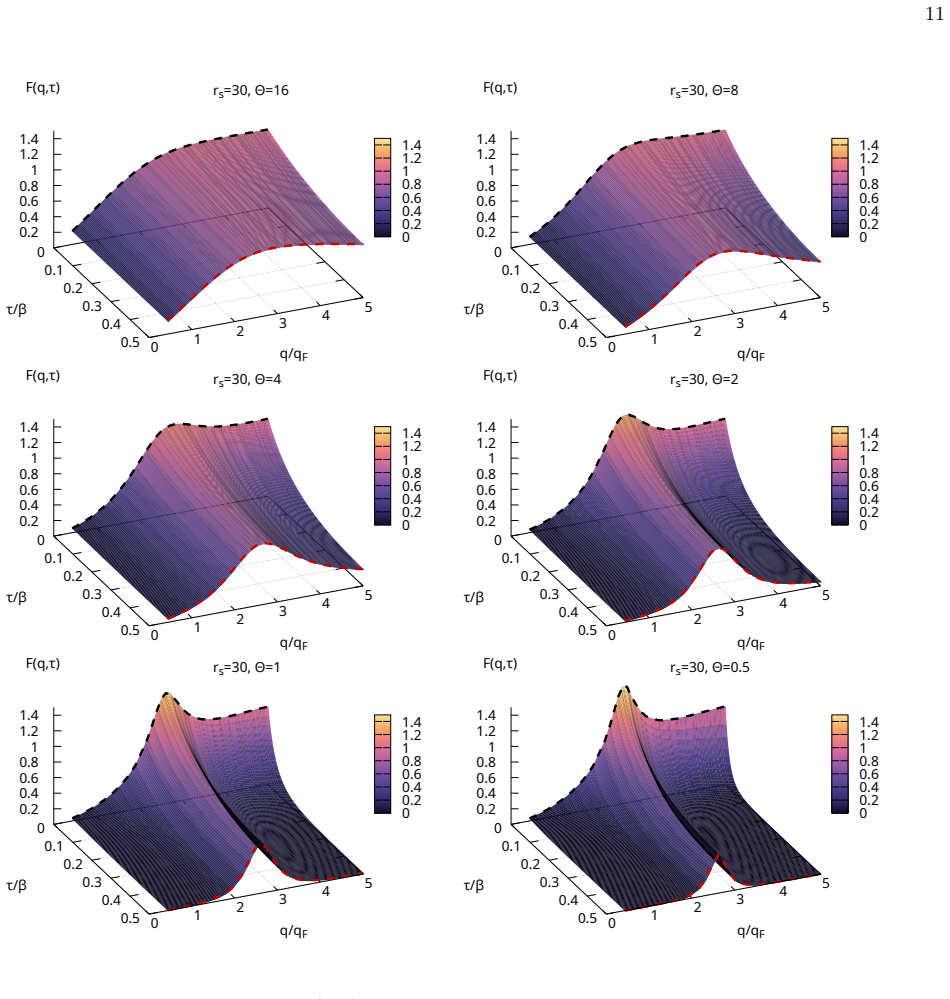
The imaginary-time density–density correlation function F(q,τ) and its relative τ-decay measure ΔFτ(q) (normalised to the ideal Fermi gas). Because F is the two-sided Laplace transform of the dynamic structure factor, a slower decay at fixed τ is an immediate, model-free indicator of a down-shift of spectral weight—the roton.
What would settle it
A larger-system (N≳70–100) path-integral calculation at rs=30–50 and Θ=1 that either erases or shifts the minimum in the relative τ-decay measure ΔFτ(q)/ΔFτideal(q) near 2.5 qF would falsify the reported roton signature.
Extended reading notes
Core claim
At strong coupling and intermediate wave-numbers the two-dimensional electron liquid develops a roton-type feature in its dynamic structure factor. The feature is diagnosed without analytic continuation: the imaginary-time density–density correlation function decays more slowly than the ideal Fermi-gas result, and the relative decay measure exhibits a clear minimum near 2.5 Fermi wave-numbers together with a weaker second feature at twice that wave-number.
Load-bearing premise
The claim that N=34 electrons already removes finite-size effects from all wave-number-resolved observables rests on spot checks at a handful of state points rather than a full thermodynamic-limit extrapolation for every density and temperature.
Editorial extensions
If this is right
- Published PIMC tables of S(q), χ(q) and F(q,τ) become the reference standard against which any new two-dimensional dielectric theory must be tested.
- Static local-field closures that miss the depth or position of the first roton must be revised or replaced by frequency-dependent kernels.
- The same imaginary-time diagnostic can be applied to thin-film experiments and to two-dimensional helium without first performing an analytic continuation.
- Equation-of-state and free-energy calculations for the two-dimensional electron liquid can now be anchored to the same first-principles data set.
Reading between the lines
- Because the relative-decay signature appears already at Θ=1 and strengthens with rs, the roton is expected to survive down to the zero-temperature liquid, offering a concrete target for ground-state quantum Monte Carlo.
- The second, weaker feature at twice the roton wave-number suggests an incipient phonon branch; mapping its temperature dependence would clarify the approach to Wigner crystallisation.
- Two-dimensional exchange–correlation functionals built from these data should improve density-functional descriptions of semiconductor heterostructures and thin metallic films.
Editorial analysis
A structured set of objections, weighed in public.
Referee Report
Summary. The manuscript reports extensive ab initio path-integral Monte Carlo simulations of the two-dimensional uniform electron gas over rs = 0.1–50 and Θ = 0.5–16. After documenting the 2D Ewald implementation, propagator convergence (P = 200), system-size checks (N = 14–70) and the fermion sign problem, the authors present static structure factors S(q), static density responses χ(q) and imaginary-time density–density correlation functions F(q, τ). They diagnose a roton-type feature (and a weaker second feature) from the reduced τ-decay of F(q, τ) relative to the ideal Fermi gas at intermediate wave-numbers, and use the same data to benchmark static STLS and HNC dielectric closures against RPA and the ideal gas. All raw PIMC results are stated to be freely available.
Significance. Quasi-exact finite-temperature data for the 2DEG remain scarce; the present survey fills that gap for structural, linear-response and imaginary-time spectral quantities across the liquid regime. The roton diagnosis is performed directly in the imaginary-time domain (avoiding uncontrolled analytic continuation) and is corroborated by the exact f-sum rule to ≲0.1 %. The open data set and the systematic comparison with the companion dielectric schemes supply a concrete benchmark for future closures and for methods that mitigate the fermion sign problem. These strengths make the work a lasting reference for 2D electron-liquid theory and for related DFT developments.
minor comments (5)
- Sec. III B and Figs. 4–5: the finite-size discussion is limited to a few state points. A short additional sentence noting that the discrete-q-grid effect cannot invent the minimum at q ≈ 2.5 qF would further reassure readers who worry about thermodynamic-limit extrapolation.
- Fig. 11 inset: a few outliers exceed the leave-one-out error bars; a brief remark on residual bias from polynomial truncation would be helpful.
- Eq. (5) and the choice α ≈ 3.5: state the numerical tolerance used to confirm α-independence of the Ewald sums for the densest and most dilute cases.
- Repository link [117] is still a placeholder; ensure the DOI or permanent URL is inserted before final publication.
- Occasional typographic slips (e.g., “quasi-exact (i.e., exact within …)”, missing spaces around “2D-HNC”) should be cleaned in proof.
Circularity Check
No significant circularity: PIMC observables are sampled from the Hamiltonian; the roton diagnostic and dielectric benchmarks are independent of fitted inputs or self-definitional loops.
full rationale
The paper’s load-bearing results are ab initio PIMC estimates of S(q), χ(q) and F(q,τ) obtained by Metropolis sampling of the anti-symmetrized path-integral partition function with the 2D Ewald Hamiltonian (Secs. II B–C, Eqs. 2–10). These quantities are not defined in terms of the claimed roton feature or of the dielectric closures being tested. The roton-type signature is diagnosed a posteriori from the reduced imaginary-time decay measure ΔF_τ(q) relative to the ideal Fermi gas (Eq. 24, Figs. 14–16); the measure is a direct functional of the sampled ITCF and is cross-checked against the exact f-sum rule (Eq. 23, Fig. 11). Dielectric schemes (RPA, STLS, HNC) from the companion paper are compared as external approximations against the PIMC reference; the comparison does not feed back into the PIMC data. Finite-size and propagator-convergence checks (Secs. III A–B) are empirical verifications, not circular constructions. Self-citations supply methodological context (ITCF analysis, prior 3D roton observations) but do not force the 2D results by definition or by uniqueness theorems. Consequently the derivation chain is self-contained and non-circular.
Assumptions & free parameters
free parameters (3)
- Ewald screening parameter α =
≈3.5
- Number of imaginary-time slices P =
200
- Particle number N =
34
assumptions (3)
- domain assumption Primitive Trotter factorization of the density matrix converges as O(P^{-2}) and is adequate for the observables studied.
- standard math The two-sided Laplace transform relating F(q,τ) to S(q,ω) is unique, so reduced τ-decay implies a down-shift of spectral weight (roton).
- domain assumption Finite-size corrections to wavenumber-resolved quantities are negligible beyond the discrete q-grid for N≥34 in the liquid regime.
Cite this review
Pith. "Pith review of Ab initio path integral Monte Carlo study of the 2D uniform electron liquid at finite temperatures." pith.science (2026). https://pith.science/paper/YX7NLPZR
@misc{pith2026260711406,
  author       = {Pith},
  title        = {Pith review of: Ab initio path integral Monte Carlo study of the 2D uniform electron liquid at finite temperatures},
  year         = {2026},
  howpublished = {\url{https://pith.science/paper/YX7NLPZR}},
  note         = {Machine review of arXiv:2607.11406}
}
abstract
We present extensive \emph{ab initio} path integral Monte Carlo (PIMC) simulations of the two-dimensional uniform electron gas (2DEG), covering a broad range of density parameters $r_s=0.1,\dots,50$ and temperatures $\Theta=k_\textnormal{B}T/E_\textnormal{Fermi}=0.5,\dots,16$. This allows us to analyze various structural, linear density response and spectral properties. We find clear evidence of a \emph{roton-type} feature in the dynamic structure factor at strong coupling and intermediate wavenumbers. We also benchmark novel dielectric theory implementations for the 2DEG~[Kalkavouras \emph{et al.}~arXiv:2601.14989] for structural and spectral properties across the liquid phase diagram. The PIMC results can be used to benchmark existing theories and approximations, and guide the development of new methodologies.
Figures


Figures from the paper (11 more)




Reference graph
Works this paper leans on
-
[1]
Giuliani and G
G. Giuliani and G. Vignale,Quantum Theory of the Electron Liquid(Cambridge University Press, Cam- bridge, 2008)
2008
-
[2]
The uniform electron gas,
P.-F. Loos and P. M. W. Gill, “The uniform electron gas,” Comput. Mol. Sci6, 410–429 (2016)
2016
-
[3]
The uniform electron gas at warm dense matter conditions,
T. Dornheim, S. Groth, and M. Bonitz, “The uniform electron gas at warm dense matter conditions,” Phys. Reports744, 1–86 (2018)
2018
-
[4]
Re- cent progress in the theory and simulation of strongly correlated plasmas: phase transitions, transport, quan- tum, and magnetic field effects,
Torben Ott, Hauke Thomsen, Jan Willem Abra- ham, Tobias Dornheim, and Michael Bonitz, “Re- cent progress in the theory and simulation of strongly correlated plasmas: phase transitions, transport, quan- tum, and magnetic field effects,” The European Physical Journal D72, 84 (2018)
2018
-
[5]
Mahan,Many-Particle Physics, Physics of Solids and Liquids (Springer US, 1990)
G.D. Mahan,Many-Particle Physics, Physics of Solids and Liquids (Springer US, 1990)
1990
-
[6]
Ground state of the electron gas by a stochastic method,
D. M. Ceperley and B. J. Alder, “Ground state of the electron gas by a stochastic method,” Phys. Rev. Lett. 45, 566–569 (1980)
1980
-
[7]
Static re- sponse from quantum Monte Carlo calculations,
S. Moroni, D. M. Ceperley, and G. Senatore, “Static re- sponse from quantum Monte Carlo calculations,” Phys. Rev. Lett69, 1837 (1992)
1992
-
[8]
Static response and local field factor of the electron gas,
S. Moroni, D. M. Ceperley, and G. Senatore, “Static response and local field factor of the electron gas,” Phys. Rev. Lett75, 689 (1995)
1995
Show all 177 references
-
[9]
Correlation energy, structure factor, radial distribution function, and momentum dis- tribution of the spin-polarized uniform electron gas,
G. Ortiz and P. Ballone, “Correlation energy, structure factor, radial distribution function, and momentum dis- tribution of the spin-polarized uniform electron gas,” Phys. Rev. B50, 1391–1405 (1994)
1994
-
[10]
Zero temperature phases of the electron gas,
G. Ortiz, M. Harris, and P. Ballone, “Zero temperature phases of the electron gas,” Phys. Rev. Lett.82, 5317– 5320 (1999)
1999
-
[11]
Quantum monte carlo study of the three-dimensional spin-polarized homogeneous electron gas,
G. G. Spink, R. J. Needs, and N. D. Drummond, “Quantum monte carlo study of the three-dimensional spin-polarized homogeneous electron gas,” Phys. Rev. B88, 085121 (2013)
2013
-
[12]
Accurate spin- dependent electron liquid correlation energies for local spin density calculations: a critical analysis,
S. H. Vosko, L. Wilk, and M. Nusair, “Accurate spin- dependent electron liquid correlation energies for local spin density calculations: a critical analysis,” Canadian Journal of Physics58, 1200–1211 (1980)
1980
-
[13]
Self-interaction cor- rection to density-functional approximations for many- electron systems,
J. P. Perdew and Alex Zunger, “Self-interaction cor- rection to density-functional approximations for many- electron systems,” Phys. Rev. B23, 5048–5079 (1981)
1981
-
[14]
Accurate and simple analytic representation of the electron-gas correlation energy,
John P. Perdew and Yue Wang, “Accurate and simple analytic representation of the electron-gas correlation energy,” Phys. Rev. B45, 13244–13249 (1992)
1992
-
[15]
Analytical expressions for the local-field factorg(q) and the exchange-correlation kernelKxc(r)of the homo- geneous electron gas,
M. Corradini, R. Del Sole, G. Onida, and M. Palummo, “Analytical expressions for the local-field factorg(q) and the exchange-correlation kernelKxc(r)of the homo- geneous electron gas,” Phys. Rev. B57, 14569 (1998)
1998
-
[16]
Analytic static structure factors and pair-correlation functions for the unpolarized homoge- neous electron gas,
Paola Gori-Giorgi, Francesco Sacchetti, and Gio- vanni B. Bachelet, “Analytic static structure factors and pair-correlation functions for the unpolarized homoge- neous electron gas,” Phys. Rev. B61, 7353–7363 (2000)
2000
-
[17]
Pair distri- bution function of the spin-polarized electron gas: A first-principles analytic model for all uniform densities,
Paola Gori-Giorgi and John P. Perdew, “Pair distri- bution function of the spin-polarized electron gas: A first-principles analytic model for all uniform densities,” Phys. Rev. B66, 165118 (2002)
2002
-
[18]
Density functional theory: Its origins, rise to prominence, and future,
R. O. Jones, “Density functional theory: Its origins, rise to prominence, and future,” Rev. Mod. Phys.87, 897– 923 (2015)
2015
-
[19]
Roadmap for warm dense matter physics,
Jan Vorberger, Frank Graziani, David Riley, Andrew D. Baczewski, Isabelle Baraffe, Mandy Bethkenhagen, Si- mon Blouin, Maximilian P. B¨ ohme, Michael Bonitz, Michael Bussmann, Alexis Casner, Witold Cayzac, Pe- ter Celliers, Gilles Chabrier, Nicolas Chamel, Dave Chapman, Mohan ...
2025
-
[20]
Toward first principles-based simulations of dense hy- drogen,
Michael Bonitz, Jan Vorberger, Mandy Bethkenhagen, Maximilian B¨ ohme, David Ceperley, Alexey Filinov, Thomas Gawne, Frank Graziani, Gianluca Gregori, Paul Hamann, Stephanie Hansen, Markus Holzmann, S. X. Hu, Hanno K¨ ahlert, Valentin Karasiev, Uwe Klein- schmidt, Linda Kordts...
2024
-
[21]
Path integrals in the theory of con- densed helium,
D. M. Ceperley, “Path integrals in the theory of con- densed helium,” Rev. Mod. Phys67, 279 (1995)
1995
-
[22]
Permutation blocking path integral monte carlo: a highly efficient approach to the simu- lation of strongly degenerate non-ideal fermions,
Tobias Dornheim, Simon Groth, Alexey Filinov, and Michael Bonitz, “Permutation blocking path integral monte carlo: a highly efficient approach to the simu- lation of strongly degenerate non-ideal fermions,” New Journal of Physics17, 073017 (2015)
2015
-
[23]
Ab initio quan- tum Monte Carlo simulation of the warm dense electron gas in the thermodynamic limit,
T. Dornheim, S. Groth, T. Sjostrom, F. D. Malone, W. M. C. Foulkes, and M. Bonitz, “Ab initio quan- tum Monte Carlo simulation of the warm dense electron gas in the thermodynamic limit,” Phys. Rev. Lett.117, 156403 (2016)
2016
-
[24]
Ab initio thermodynamic results for the degenerate electron gas at finite temperature,
T. Schoof, S. Groth, J. Vorberger, and M. Bonitz, “Ab initio thermodynamic results for the degenerate electron gas at finite temperature,” Phys. Rev. Lett.115, 130402 (2015)
2015
-
[25]
On the thermody- namic properties of fictitious identical particles and the application to fermion sign problem,
Yunuo Xiong and Hongwei Xiong, “On the thermody- namic properties of fictitious identical particles and the application to fermion sign problem,” The Journal of Chemical Physics157, 094112 (2022)
2022
-
[26]
Fermionic physics from ab initio path inte- 19 gral Monte Carlo simulations of fictitious identical par- ticles,
Tobias Dornheim, Panagiotis Tolias, Simon Groth, Zhandos A. Moldabekov, Jan Vorberger, and Barak Hirshberg, “Fermionic physics from ab initio path inte- 19 gral Monte Carlo simulations of fictitious identical par- ticles,” The Journal of Chemical Physics159, 164113 (2023)
2023
-
[27]
Restricted configuration path integral monte carlo,
A. Yilmaz, K. Hunger, T. Dornheim, S. Groth, and M. Bonitz, “Restricted configuration path integral monte carlo,” The Journal of Chemical Physics153, 124114 (2020)
2020
-
[28]
Taylor series perspective on ab initio path integral monte carlo simulations with fermi-dirac statistics,
Tobias Dornheim, Alexander Benedix Robles, Paul Hamann, Thomas M. Chuna, Pontus Svensson, Sebas- tian Schwalbe, Zhandos A. Moldabekov, Panagiotis To- lias, and Jan Vorberger, “Taylor series perspective on ab initio path integral monte carlo simulations with fermi-dirac statist...
2026
-
[29]
Density-matrix quantum monte carlo method,
N. S. Blunt, T. W. Rogers, J. S. Spencer, and W. M. C. Foulkes, “Density-matrix quantum monte carlo method,” Phys. Rev. B89, 245124 (2014)
2014
-
[30]
In- teraction picture density matrix quantum monte carlo,
Fionn D. Malone, N. S. Blunt, James J. Shepherd, D. K. K. Lee, J. S. Spencer, and W. M. C. Foulkes, “In- teraction picture density matrix quantum monte carlo,” The Journal of Chemical Physics143, 044116 (2015)
2015
-
[31]
Accurate exchange-correlation en- ergies for the warm dense electron gas,
Fionn D. Malone, N. S. Blunt, Ethan W. Brown, D. K. K. Lee, J. S. Spencer, W. M. C. Foulkes, and James J. Shepherd, “Accurate exchange-correlation en- ergies for the warm dense electron gas,” Phys. Rev. Lett. 117, 115701 (2016)
2016
-
[32]
A phaseless auxiliary-field quantum monte carlo perspective on the uniform electron gas at finite tem- peratures: Issues, observations, and benchmark study,
Joonho Lee, Miguel A. Morales, and Fionn D. Mal- one, “A phaseless auxiliary-field quantum monte carlo perspective on the uniform electron gas at finite tem- peratures: Issues, observations, and benchmark study,” J. Chem. Phys.154, 064109 (2021)
2021
-
[33]
Exchange-correlation effect in the charge response of a warm dense electron gas,
Peng-Cheng Hou, Bao-Zong Wang, Kristjan Haule, Youjin Deng, and Kun Chen, “Exchange-correlation effect in the charge response of a warm dense electron gas,” Phys. Rev. B106, L081126 (2022)
2022
-
[34]
Matsubara-frequency-resolved spin exchange- correlation kernel for the three-dimensional uniform electron gas,
Zhiyi Li, Pengcheng Hou, Youjin Deng, and Kun Chen, “Matsubara-frequency-resolved spin exchange- correlation kernel for the three-dimensional uniform electron gas,” Phys. Rev. B111, 155132 (2025)
2025
-
[35]
First-principles effective mass in the three-dimensional uniform electron gas,
Pengcheng Hou, Daniel Cerkoney, Zhiyi Li, Tao Wang, Xiansheng Cai, Lei Wang, Gabriel Kotliar, Youjin Deng, and Kun Chen, “First-principles effective mass in the three-dimensional uniform electron gas,” (2026), arXiv:2605.02294 [cond-mat.str-el]
2026 arXiv
-
[36]
Ab initio quantum monte carlo simulations of the uniform electron gas without fixed nodes,
S. Groth, T. Schoof, T. Dornheim, and M. Bonitz, “Ab initio quantum monte carlo simulations of the uniform electron gas without fixed nodes,” Phys. Rev. B93, 085102 (2016)
2016
-
[37]
Ab initio quantum monte carlo simulations of the uniform electron gas without fixed nodes: The unpolarized case,
T. Dornheim, S. Groth, T. Schoof, C. Hann, and M. Bonitz, “Ab initio quantum monte carlo simulations of the uniform electron gas without fixed nodes: The unpolarized case,” Phys. Rev. B93, 205134 (2016)
2016
-
[38]
Ab initio exchange– correlation free energy of the uniform electron gas at warm dense matter conditions,
S. Groth, T. Dornheim, T. Sjostrom, F. D. Malone, W. M. C. Foulkes, and M. Bonitz, “Ab initio exchange– correlation free energy of the uniform electron gas at warm dense matter conditions,” Phys. Rev. Lett.119, 135001 (2017)
2017
-
[39]
Path-integral monte carlo sim- ulation of the warm dense homogeneous electron gas,
Ethan W. Brown, Bryan K. Clark, Jonathan L. DuBois, and David M. Ceperley, “Path-integral monte carlo sim- ulation of the warm dense homogeneous electron gas,” Phys. Rev. Lett.110, 146405 (2013)
2013
-
[40]
Accurate homogeneous electron gas exchange-correlation free energy for local spin-density calculations,
Valentin V. Karasiev, Travis Sjostrom, James Dufty, and S. B. Trickey, “Accurate homogeneous electron gas exchange-correlation free energy for local spin-density calculations,” Phys. Rev. Lett.112, 076403 (2014)
2014
-
[41]
Sta- tus of free-energy representations for the homogeneous electron gas,
V. V. Karasiev, S. B. Trickey, and J. W. Dufty, “Sta- tus of free-energy representations for the homogeneous electron gas,” Phys. Rev. B99, 195134 (2019)
2019
-
[42]
Chemical potential of the warm dense elec- tron gas from ab initio path integral monte carlo simu- lations,
Tobias Dornheim, Michael Bonitz, Zhandos A. Mold- abekov, Sebastian Schwalbe, Panagiotis Tolias, and Jan Vorberger, “Chemical potential of the warm dense elec- tron gas from ab initio path integral monte carlo simu- lations,” Phys. Rev. B111, 115149 (2025)
2025
-
[43]
Path in- tegral monte carlo calculation of the momentum distri- bution of the homogeneous electron gas at finite temper- ature,
B. Militzer, E.L. Pollock, and D.M. Ceperley, “Path in- tegral monte carlo calculation of the momentum distri- bution of the homogeneous electron gas at finite temper- ature,” High Energy Density Physics30, 13–20 (2019)
2019
-
[44]
Ab initio path integral monte carlo approach to the momentum distribution of the uni- form electron gas at finite temperature without fixed nodes,
Tobias Dornheim, Maximilian B¨ ohme, Burkhard Mil- itzer, and Jan Vorberger, “Ab initio path integral monte carlo approach to the momentum distribution of the uni- form electron gas at finite temperature without fixed nodes,” Phys. Rev. B103, 205142 (2021)
2021
-
[45]
Momentum distribution of the uniform electron gas at finite temperature: Effects of spin polarization,
Tobias Dornheim, Jan Vorberger, Burkhard Militzer, and Zhandos A. Moldabekov, “Momentum distribution of the uniform electron gas at finite temperature: Effects of spin polarization,” Phys. Rev. E104, 055206 (2021)
2021
-
[46]
Momentum distribution function and short-range correlations of the warm dense electron gas: Ab initio quantum monte carlo results,
Kai Hunger, Tim Schoof, Tobias Dornheim, Michael Bonitz, and Alexey Filinov, “Momentum distribution function and short-range correlations of the warm dense electron gas: Ab initio quantum monte carlo results,” Phys. Rev. E103, 053204 (2021)
2021
-
[47]
Ab initio path integral Monte Carlo approach to the static and dynamic density response of the uniform electron gas,
S. Groth, T. Dornheim, and J. Vorberger, “Ab initio path integral Monte Carlo approach to the static and dynamic density response of the uniform electron gas,” Phys. Rev. B99, 235122 (2019)
2019
-
[48]
The static local field correction of the warm dense electron gas: An ab initio path integral Monte Carlo study and machine learning representation,
T. Dornheim, J. Vorberger, S. Groth, N. Hoffmann, Zh.A. Moldabekov, and M. Bonitz, “The static local field correction of the warm dense electron gas: An ab initio path integral Monte Carlo study and machine learning representation,” J. Chem. Phys151, 194104 (2019)
2019
-
[49]
Effective static approximation: A fast and re- liable tool for warm-dense matter theory,
Tobias Dornheim, Attila Cangi, Kushal Ramakrishna, Maximilian B¨ ohme, Shigenori Tanaka, and Jan Vor- berger, “Effective static approximation: A fast and re- liable tool for warm-dense matter theory,” Phys. Rev. Lett.125, 235001 (2020)
2020
-
[50]
Analytical representation of the local field correction of the uniform electron gas within the effec- tive static approximation,
Tobias Dornheim, Zhandos A. Moldabekov, and Pana- giotis Tolias, “Analytical representation of the local field correction of the uniform electron gas within the effec- tive static approximation,” Phys. Rev. B103, 165102 (2021)
2021
-
[51]
Ab initio path integral monte carlo simulation of the uniform electron gas in the high energy density regime,
Tobias Dornheim, Zhandos A Moldabekov, Jan Vor- berger, and Simon Groth, “Ab initio path integral monte carlo simulation of the uniform electron gas in the high energy density regime,” Plasma Physics and Controlled Fusion62, 075003 (2020)
2020
-
[52]
The uniform electron gas at high temperatures: ab initio path integral monte carlo simulations and analytical theory,
Tobias Dornheim, Jan Vorberger, Zhandos Moldabekov, Gerd R¨ opke, and Wolf-Dietrich Kraeft, “The uniform electron gas at high temperatures: ab initio path integral monte carlo simulations and analytical theory,” High Energy Density Physics45, 101015 (2022)
2022
-
[53]
Spin-resolved density response of the warm dense electron gas,
Tobias Dornheim, Jan Vorberger, Zhandos A. Mold- abekov, and Panagiotis Tolias, “Spin-resolved density response of the warm dense electron gas,” Phys. Rev. Research4, 033018 (2022)
2022
-
[54]
Configuration path integral Monte Carlo approach to the static density response of the warm dense electron gas,
S. Groth, T. Dornheim, and M. Bonitz, “Configuration path integral Monte Carlo approach to the static density response of the warm dense electron gas,” J. Chem. Phys 147, 164108 (2017). 20
2017
-
[55]
Nonlinear electromagnetic response of a uniform electron gas,
S. A. Mikhailov, “Nonlinear electromagnetic response of a uniform electron gas,” Phys. Rev. Lett.113, 027405 (2014)
2014
-
[56]
Second-order response of a uniform three-dimensional electron gas to a longitudinal electric field,
S.A. Mikhailov, “Second-order response of a uniform three-dimensional electron gas to a longitudinal electric field,” Annalen der Physik524, 182–187 (2012)
2012
-
[57]
Nonlinear electronic density response in warm dense matter,
Tobias Dornheim, Jan Vorberger, and Michael Bonitz, “Nonlinear electronic density response in warm dense matter,” Phys. Rev. Lett.125, 085001 (2020)
2020
-
[58]
Den- sity response of the warm dense electron gas beyond linear response theory: Excitation of harmonics,
Tobias Dornheim, Maximilian B¨ ohme, Zhandos A. Moldabekov, Jan Vorberger, and Michael Bonitz, “Den- sity response of the warm dense electron gas beyond linear response theory: Excitation of harmonics,” Phys. Rev. Research3, 033231 (2021)
2021
-
[59]
Unravelling the nonlinear ideal density response of many-body systems,
Panagiotis Tolias, Tobias Dornheim, Zhandos A. Mold- abekov, and Jan Vorberger, “Unravelling the nonlinear ideal density response of many-body systems,” Euro- physics Letters142, 44001 (2023)
2023
-
[60]
Nonlinear density response from imaginary- time correlation functions: Ab initio path integral monte carlo simulations of the warm dense electron gas,
Tobias Dornheim, Zhandos A. Moldabekov, and Jan Vorberger, “Nonlinear density response from imaginary- time correlation functions: Ab initio path integral monte carlo simulations of the warm dense electron gas,” The Journal of Chemical Physics155, 054110 (2021)
2021
-
[61]
Nonlinear density response and higher or- der correlation functions in warm dense matter,
Tobias Dornheim, Jan Vorberger, and Zhandos A. Moldabekov, “Nonlinear density response and higher or- der correlation functions in warm dense matter,” Jour- nal of the Physical Society of Japan90, 104002 (2021)
2021
-
[62]
Green’s function perspective on the nonlinear den- sity response of quantum many-body systems,
Jan Vorberger, Tobias Dornheim, Maximilian P. B¨ ohme, Zhandos A. Moldabekov, and Panagiotis To- lias, “Green’s function perspective on the nonlinear den- sity response of quantum many-body systems,” Journal of Statistical Physics192, 75 (2025)
2025
-
[63]
Density functional theory perspective on the nonlinear response of correlated electrons across tem- perature regimes,
Zhandos Moldabekov, Jan Vorberger, and Tobias Dorn- heim, “Density functional theory perspective on the nonlinear response of correlated electrons across tem- perature regimes,” J. Chem. Theory Comput.18, 2900– 2912 (2022)
2022
-
[64]
General- ized density functional theory framework for the nonlin- ear density response of quantum many-body systems,
Zhandos A. Moldabekov, Cheng Ma, Xuecheng Shao, Sebastian Schwalbe, Pontus Svensson, Panagiotis To- lias, Jan Vorberger, and Tobias Dornheim, “General- ized density functional theory framework for the nonlin- ear density response of quantum many-body systems,” Phys. Rev. B113,...
2026
-
[65]
Reweight- ing estimators for density response in path integral monte carlo: Applications to linear, nonlinear and cross- species density response,
Pontus Svensson, Thomas Chuna, Jan Vorberger, Zhan- dos A. Moldabekov, Paul Hamann, Sebastian Schwalbe, Panagiotis Tolias, and Tobias Dornheim, “Reweight- ing estimators for density response in path integral monte carlo: Applications to linear, nonlinear and cross- species den...
2026 arXiv
-
[66]
Ab initio path integral Monte Carlo results for the dy- namic structure factor of correlated electrons: From the electron liquid to warm dense matter,
T. Dornheim, S. Groth, J. Vorberger, and M. Bonitz, “Ab initio path integral Monte Carlo results for the dy- namic structure factor of correlated electrons: From the electron liquid to warm dense matter,” Phys. Rev. Lett. 121, 255001 (2018)
2018
-
[67]
Dynamic properties of the warm dense electron gas based on abinitiopath integral monte carlo simulations,
Paul Hamann, Tobias Dornheim, Jan Vorberger, Zhan- dos A. Moldabekov, and Michael Bonitz, “Dynamic properties of the warm dense electron gas based on abinitiopath integral monte carlo simulations,” Phys. Rev. B102, 125150 (2020)
2020
-
[68]
A. V. Filinov, J. Ara, and I. M. Tkachenko, “Dynami- cal response in strongly coupled uniform electron liq- uids: Observation of plasmon-roton coexistence using nine sum rules, shannon information entropy, and path- integral monte carlo simulations,” Phys. Rev. B107, 195143 (2023)
2023
-
[69]
Pylit: Reformulation and implementation of the ana- lytic continuation problem using kernel representation methods,
Alexander Benedix Robles, Phil-Alexander Hofmann, Thomas Chuna, Tobias Dornheim, and Michael Hecht, “Pylit: Reformulation and implementation of the ana- lytic continuation problem using kernel representation methods,” Computer Physics Communications319, 109904 (2026)
2026
-
[70]
Dual for- mulation of the maximum entropy method applied to analytic continuation of quantum monte carlo data,
Thomas Chuna, Nicholas Barnfield, Tobias Dornheim, Michael P Friedlander, and Tim Hoheisel, “Dual for- mulation of the maximum entropy method applied to analytic continuation of quantum monte carlo data,” Journal of Physics A: Mathematical and Theoretical58, 335203 (2025)
2025
-
[71]
A scale-shape dual new- ton method for entropic least squares,
Nicholas Barnfield, James V. Burke, Michael P. Fried- lander, and Tim Hoheisel, “A scale-shape dual new- ton method for entropic least squares,” (2026), arXiv:2604.27154 [math.OC]
2026 arXiv
-
[72]
The noiseless limit and improved-prior limit of the maximum entropy method and their implica- tions for the analytic continuation problem,
Thomas Chuna, Nicholas Barnfield, Paul Hamann, Se- bastian Schwalbe, Michael P. Friedlander, and Tobias Dornheim, “The noiseless limit and improved-prior limit of the maximum entropy method and their implica- tions for the analytic continuation problem,” (2025), arXiv:2511.069...
2025
-
[73]
Extraction of the frequency moments of spectral densities from imaginary-time correlation func- tion data,
Tobias Dornheim, Damar C. Wicaksono, Juan E. Suarez-Cardona, Panagiotis Tolias, Maximilian P. B¨ ohme, Zhandos A. Moldabekov, Michael Hecht, and Jan Vorberger, “Extraction of the frequency moments of spectral densities from imaginary-time correlation func- tion data,” Phys. Re...
2023
-
[74]
Physi- cal insights from imaginary-time density–density corre- lation functions,
Tobias Dornheim, Zhandos Moldabekov, Panagiotis To- lias, Maximilian B¨ ohme, and Jan Vorberger, “Physi- cal insights from imaginary-time density–density corre- lation functions,” Matter and Radiation at Extremes8, 056601 (2023)
2023
-
[75]
Correlational and thermodynamic prop- erties of finite-temperature electron liquids in the hypernetted-chain approximation,
S. Tanaka, “Correlational and thermodynamic prop- erties of finite-temperature electron liquids in the hypernetted-chain approximation,” J. Chem. Phys145, 214104 (2016)
2016
-
[76]
Improved equation of state for finite- temperature spin-polarized electron liquids on the basis of singwi–tosi–land–sj¨ olander approximation,
Shigenori Tanaka, “Improved equation of state for finite- temperature spin-polarized electron liquids on the basis of singwi–tosi–land–sj¨ olander approximation,” Contrib. Plasma Phys.57, 126–136 (2017)
2017
-
[77]
Inte- gral equation theory based dielectric scheme for strongly coupled electron liquids,
P. Tolias, F. Lucco Castello, and T. Dornheim, “Inte- gral equation theory based dielectric scheme for strongly coupled electron liquids,” J. Chem. Phys.155, 134115 (2021)
2021
-
[78]
Clas- sical bridge functions in classical and quantum plasma liquids,
F. Lucco Castello, P. Tolias, and T. Dornheim, “Clas- sical bridge functions in classical and quantum plasma liquids,” Europhysics Letters138, 44003 (2022)
2022
-
[79]
Strongly coupled electron liquid: Ab initio path integral monte carlo simulations and di- electric theories,
Tobias Dornheim, Travis Sjostrom, Shigenori Tanaka, and Jan Vorberger, “Strongly coupled electron liquid: Ab initio path integral monte carlo simulations and di- electric theories,” Phys. Rev. B101, 045129 (2020)
2020
-
[80]
Quantum version of the integral equation theory-based dielectric scheme for strongly coupled elec- tron liquids,
Panagiotis Tolias, Federico Lucco Castello, and Tobias Dornheim, “Quantum version of the integral equation theory-based dielectric scheme for strongly coupled elec- tron liquids,” J. Chem. Phys.158, 141102 (2023)
2023
-
[81]
Revisiting the vashishta-singwi dielectric scheme for the warm dense uniform electron fluid,
Panagiotis Tolias, Federico Lucco Castello, Fotios Kalkavouras, and Tobias Dornheim, “Revisiting the vashishta-singwi dielectric scheme for the warm dense uniform electron fluid,” Phys. Rev. B109, 125134 (2024)
2024
-
[82]
Elec- 21 tronic properties of two-dimensional systems,
Tsuneya Ando, Alan B. Fowler, and Frank Stern, “Elec- 21 tronic properties of two-dimensional systems,” Rev. Mod. Phys.54, 437–672 (1982)
1982
-
[83]
Metallicity and its low- temperature behavior in dilute two-dimensional carrier systems,
S. Das Sarma and E. H. Hwang, “Metallicity and its low- temperature behavior in dilute two-dimensional carrier systems,” Phys. Rev. B69, 195305 (2004)
2004
-
[84]
Ground state of the two-dimensional electron gas,
B. Tanatar and D. M. Ceperley, “Ground state of the two-dimensional electron gas,” Phys. Rev. B39, 5005– 5016 (1989)
1989
-
[85]
Diffusion quan- tum monte carlo calculation of the quasiparticle effec- tive mass of the two-dimensional homogeneous electron gas,
N. D. Drummond and R. J. Needs, “Diffusion quan- tum monte carlo calculation of the quasiparticle effec- tive mass of the two-dimensional homogeneous electron gas,” Phys. Rev. B87, 045131 (2013)
2013
-
[86]
Unified vari- ational approach description of ground-state phases of the two-dimensional electron gas,
Conor Smith, Yixiao Chen, Ryan Levy, Yubo Yang, Miguel A. Morales, and Shiwei Zhang, “Unified vari- ational approach description of ground-state phases of the two-dimensional electron gas,” Phys. Rev. Lett. 133, 266504 (2024)
2024
-
[87]
Finite temperature investigations of a two dimensional electron liquid,
H. K. Schweng and H. M. B¨ ohm, “Finite temperature investigations of a two dimensional electron liquid,” Z. Phys. B95, 481 (1994)
1994
-
[88]
Dy- namic correlation effects on the plasmon dispersion in a two-dimensional electron gas,
A. Yurtsever, V. Moldoveanu, and B. Tanatar, “Dy- namic correlation effects on the plasmon dispersion in a two-dimensional electron gas,” Phys. Rev. B67, 115308 (2003)
2003
-
[89]
Spin-dependent correlation in a two-dimensional electron gas: Finite temperature ef- fects,
Nguyen Quoc Khanh, “Spin-dependent correlation in a two-dimensional electron gas: Finite temperature ef- fects,” Physica B396, 187–191 (2007)
2007
-
[90]
Finite-temperature correlations in a two-dimensional electron gas within a dynamical self-consistent mean- field approximation,
Nisha Bhukal, Vinayak Garg, and R.K. Moudgil, “Finite-temperature correlations in a two-dimensional electron gas within a dynamical self-consistent mean- field approximation,” Physica E106, 133–139 (2019)
2019
-
[91]
Dielectric formalism of the 2d uniform electron gas at finite temperatures,
Fotios Kalkavouras, Tobias Dornheim, Paul Hamann, and Panagiotis Tolias, “Dielectric formalism of the 2d uniform electron gas at finite temperatures,” (2026), arXiv:2601.14989 [cond-mat.str-el]
2026 arXiv
-
[92]
2d electron gas at arbitrary spin polarizations and cou- pling strengths: Exchange-correlation energies, distribu- tion functions, and spin-polarized phases,
Fran ¸ cois Perrot and M. W. C. Dharma-wardana, “2d electron gas at arbitrary spin polarizations and cou- pling strengths: Exchange-correlation energies, distribu- tion functions, and spin-polarized phases,” Phys. Rev. Lett.87, 206404 (2001)
2001
-
[93]
Spin- polarized stable phases of the 2d electron fluid at finite temperatures,
M. W. C. Dharma-wardana and Fran ¸ cois Perrot, “Spin- polarized stable phases of the 2d electron fluid at finite temperatures,” Phys. Rev. Lett.90, 136601 (2003)
2003
-
[94]
Spin- dependent correlation in two-dimensional electron liq- uids at arbitrary degeneracy and spin polarization,
Nguyen Quoc Khanh and Hiroo Totsuji, “Spin- dependent correlation in two-dimensional electron liq- uids at arbitrary degeneracy and spin polarization,” Phys. Rev. B69, 165110 (2004)
2004
-
[95]
The classical-map hyper- netted-chain (chnc) method and associated novel density-functional techniques for warm dense matter,
M. W. C. Dharma-Wardana, “The classical-map hyper- netted-chain (chnc) method and associated novel density-functional techniques for warm dense matter,” Int. J. Quant. Chem.112, 53–64 (2012)
2012
-
[96]
Electron correlations at metallic densities,
K. S. Singwi, M. P. Tosi, R. H. Land, and A. Sj¨ olander, “Electron correlations at metallic densities,” Phys. Rev 176, 589 (1968)
1968
-
[97]
Thermodynamics and correlational properties of finite-temperature electron liquids in the Singwi-Tosi-Land-Sj¨ olander approxima- tion,
S. Tanaka and S. Ichimaru, “Thermodynamics and correlational properties of finite-temperature electron liquids in the Singwi-Tosi-Land-Sj¨ olander approxima- tion,” J. Phys. Soc. Jpn55, 2278–2289 (1986)
1986
-
[98]
Uniform electron gas at finite temperatures,
T. Sjostrom and J. Dufty, “Uniform electron gas at finite temperatures,” Phys. Rev. B88, 115123 (2013)
2013
-
[99]
Ewald method for polytropic potentials in arbi- trary dimensionality,
O.N. Osychenko, G.E. Astrakharchik, and J. Boronat and, “Ewald method for polytropic potentials in arbi- trary dimensionality,” Molecular Physics110, 227–247 (2012)
2012
-
[100]
Fermion sign problem in path inte- gral Monte Carlo simulations: Quantum dots, ultracold atoms, and warm dense matter,
T. Dornheim, “Fermion sign problem in path inte- gral Monte Carlo simulations: Quantum dots, ultracold atoms, and warm dense matter,” Phys. Rev. E100, 023307 (2019)
2019
-
[101]
Computational complex- ity and fundamental limitations to fermionic quantum Monte Carlo simulations,
M. Troyer and U. J. Wiese, “Computational complex- ity and fundamental limitations to fermionic quantum Monte Carlo simulations,” Phys. Rev. Lett94, 170201 (2005)
2005
-
[102]
Analysing the dy- namic structure of warm dense matter in the imaginary- time domain: theoretical models and simulations,
Tobias Dornheim, Jan Vorberger, Zhandos A. Mold- abekov, and Maximilian B¨ ohme, “Analysing the dy- namic structure of warm dense matter in the imaginary- time domain: theoretical models and simulations,” Philosophical Transactions of the Royal Society A: Mathematical, Physica...
2023
-
[103]
Bayesian inference and the analytic continuation of imaginary-time quan- tum monte carlo data,
Mark Jarrell and J.E. Gubernatis, “Bayesian inference and the analytic continuation of imaginary-time quan- tum monte carlo data,” Phys. Rep.269, 133–195 (1996)
1996
-
[104]
Dual for- mulation of the maximum entropy method applied to analytic continuation of quantum monte carlo data,
Thomas Chuna, Nicholas Barnfield, Tobias Dornheim, Michael P. Friedlander, and Tim Hoheisel, “Dual for- mulation of the maximum entropy method applied to analytic continuation of quantum monte carlo data,” (2025), arXiv:2501.01869 [physics.comp-ph]
2025
-
[105]
Accurate temperature di- agnostics for matter under extreme conditions,
Tobias Dornheim, Maximilian B¨ ohme, Dominik Kraus, Tilo D¨ oppner, Thomas R. Preston, Zhandos A. Mold- abekov, and Jan Vorberger, “Accurate temperature di- agnostics for matter under extreme conditions,” Nature Communications13, 7911 (2022)
2022
-
[106]
Second roton feature in the strongly coupled electron liquid,
Thomas M. Chuna, Jan Vorberger, Panagiotis To- lias, Alexander Benedix Robles, Michael Hecht, Phil- Alexander Hofmann, Zhandos A. Moldabekov, and To- bias Dornheim, “Second roton feature in the strongly coupled electron liquid,” J. Chem. Phys.163, 034117 (2025)
2025
-
[107]
Model- free interpretation of x-ray thomson scattering measure- ments,
Thomas Gawne, Jan Vorberger, Zhandos Moldabekov, Hannah Bellenbaum, and Tobias Dornheim, “Model- free interpretation of x-ray thomson scattering measure- ments,” (2026), arXiv:2604.25735 [physics.plasm-ph]
2026 arXiv
-
[108]
Kinetic energy from the cubic sum rule of the dynamic structure factor,
Fotios Kalkavouras, Panagiotis Tolias, Sebastian Schwalbe, Thomas Gawne, Alexander Benedix Rob- les, Jan Vorberger, Zhandos Moldabekov, Maximilian B¨ ohme, and Tobias Dornheim, “Kinetic energy from the cubic sum rule of the dynamic structure factor,” (2026), arXiv:2606.30123 [...
2026 arXiv
-
[109]
Electronic pair alignment and roton feature in the warm dense electron gas,
Tobias Dornheim, Zhandos Moldabekov, Jan Vorberger, Hanno K¨ ahlert, and Michael Bonitz, “Electronic pair alignment and roton feature in the warm dense electron gas,” Communications Physics5, 304 (2022)
2022
-
[110]
Short-range excitonic phenomena in low-density met- als,
Jaakko Koskelo, Lucia Reining, and Matteo Gatti, “Short-range excitonic phenomena in low-density met- als,” Phys. Rev. Lett.134, 046402 (2025)
2025
-
[111]
Nonlocal and nonadiabatic effects in the charge-density response of solids: A time-dependent density-functional approach,
Martin Panholzer, Matteo Gatti, and Lucia Reining, “Nonlocal and nonadiabatic effects in the charge-density response of solids: A time-dependent density-functional approach,” Phys. Rev. Lett.120, 166402 (2018)
2018
-
[112]
Emergence of an excitonic collec- tive mode in the dilute electron gas,
Yasutami Takada, “Emergence of an excitonic collec- tive mode in the dilute electron gas,” Phys. Rev. B94, 245106 (2016)
2016
-
[113]
Estimates of the dynamic structure factor for the finite temperature electron liquid via analytic continu- ation of path integral monte carlo data,
Thomas Chuna, Nicholas Barnfield, Jan Vorberger, Michael P. Friedlander, Tim Hoheisel, and Tobias Dorn- heim, “Estimates of the dynamic structure factor for the finite temperature electron liquid via analytic continu- ation of path integral monte carlo data,” Phys. Rev. B 112,...
2025
-
[114]
Predic- tion of a roton-type feature in warm dense hydrogen,
Paul Hamann, Linda Kordts, Alexey Filinov, Michael Bonitz, Tobias Dornheim, and Jan Vorberger, “Predic- tion of a roton-type feature in warm dense hydrogen,” Phys. Rev. Res.5, 033039 (2023)
2023
-
[115]
Observation of a roton collec- tive mode in a two-dimensional fermi liquid,
Henri Godfrin, Matthias Meschke, Hans-Jochen Lauter, Ahmad Sultan, Helga M. B¨ ohm, Eckhard Krotscheck, and Martin Panholzer, “Observation of a roton collec- tive mode in a two-dimensional fermi liquid,” Nature 483, 576–579 (2012)
2012
-
[116]
Correlation energy and spin polarization in the 2d electron gas,
Claudio Attaccalite, Saverio Moroni, Paola Gori-Giorgi, and Giovanni B. Bachelet, “Correlation energy and spin polarization in the 2d electron gas,” Phys. Rev. Lett.88, 256601 (2002)
2002
-
[117]
A link to a repository containing all PIMC results will be made available upon publication
-
[118]
Theory of the local field correction in an electron gas,
A. A. Kugler, “Theory of the local field correction in an electron gas,” J. Stat. Phys12, 35 (1975)
1975
-
[119]
Dif- fusion monte carlo study of electrons in two- dimensional layers,
Francesco Rapisarda and Gaetano Senatore, “Dif- fusion monte carlo study of electrons in two- dimensional layers,” Australian Journal of Physics 49, 161–182 (1996), https://connectsci.au/ph/article- pdf/49/1/161/1131698/ph960161.pdf
1996
-
[120]
Path-Integral Calculation of the Two-Particle Slater Sum for He 4,
Lloyd D. Fosdick and Harry F. Jordan, “Path-Integral Calculation of the Two-Particle Slater Sum for He 4,” Phys. Rev.143, 58–66 (1966)
1966
-
[121]
Calculation of thermodynamic properties of helium using path in- tegral monte carlo simulations in the npt ensemble and ab initio potentials,
Philipp Marienhagen and Karsten Meier, “Calculation of thermodynamic properties of helium using path in- tegral monte carlo simulations in the npt ensemble and ab initio potentials,” The Journal of Chemical Physics 161, 224110 (2024)
2024
-
[122]
Calculation of thermodynamic properties using path integral monte carlo simulations in the canonical ensemble,
Philipp Marienhagen and Karsten Meier, “Calculation of thermodynamic properties using path integral monte carlo simulations in the canonical ensemble,” The Jour- nal of Chemical Physics163, 074116 (2025)
2025
-
[123]
Worm algorithm and diagrammatic Monte Carlo: A new approach to continuous-space path integral Monte Carlo simulations,
M. Boninsegni, N. V. Prokofev, and B. V. Svistunov, “Worm algorithm and diagrammatic Monte Carlo: A new approach to continuous-space path integral Monte Carlo simulations,” Phys. Rev. E74, 036701 (2006)
2006
-
[124]
Ab initio path-integral monte carlo re- sults for the one-particle spectral function of the warm dense electron gas,
Paul Hamann, Michael Bonitz, Jan Vorberger, and To- bias Dornheim, “Ab initio path-integral monte carlo re- sults for the one-particle spectral function of the warm dense electron gas,” (2026), arXiv:2601.14992 [cond- mat.quant-gas]
2026
-
[125]
Structure, superflu- idity, and quantum melting of hydrogen clusters,
F. Mezzacapo and M. Boninsegni, “Structure, superflu- idity, and quantum melting of hydrogen clusters,” Phys. Rev. A75, 033201 (2007)
2007
-
[126]
Exchange monte carlo for continuous-space path integral monte carlo simulation,
Xun Zhao and Synge Todo, “Exchange monte carlo for continuous-space path integral monte carlo simulation,” (2026), arXiv:2602.05500 [cond-mat.stat-mech]
2026 arXiv
-
[127]
Applications of the generalized trotter formula,
Hans De Raedt and Bart De Raedt, “Applications of the generalized trotter formula,” Phys. Rev. A28, 3575– 3580 (1983)
1983
-
[128]
High-order path-integral monte carlo methods for solving quantum dot problems,
Siu A. Chin, “High-order path-integral monte carlo methods for solving quantum dot problems,” Phys. Rev. E91, 031301 (2015)
2015
-
[129]
High order chin actions in path integral monte carlo,
K. Sakkos, J. Casulleras, and J. Boronat, “High order chin actions in path integral monte carlo,” The Journal of Chemical Physics130, 204109 (2009)
2009
-
[130]
Permutation blocking path integral monte carlo sim- ulations of degenerate electrons at finite tempera- ture,
Tobias Dornheim, Simon Groth, and Michael Bonitz, “Permutation blocking path integral monte carlo sim- ulations of degenerate electrons at finite tempera- ture,” Contributions to Plasma Physics59, e201800157 (2019)
2019
-
[131]
Extrapolated high-order propagators for path in- tegral monte carlo simulations,
Robert E. Zillich, Johannes M. Mayrhofer, and Siu A. Chin, “Extrapolated high-order propagators for path in- tegral monte carlo simulations,” The Journal of Chem- ical Physics132, 044103 (2010)
2010
-
[132]
Exploiting the isomorphism between quantum theory and classical sta- tistical mechanics of polyatomic fluids,
David Chandler and Peter G. Wolynes, “Exploiting the isomorphism between quantum theory and classical sta- tistical mechanics of polyatomic fluids,” The Journal of Chemical Physics74, 4078–4095 (1981)
1981
-
[133]
Equation of state calculations by fast comput- ing machines,
Nicholas Metropolis, Arianna W. Rosenbluth, Mar- shall N. Rosenbluth, Augusta H. Teller, and Edward Teller, “Equation of state calculations by fast comput- ing machines,” J. Chem. Phys.21, 1087–1092 (1953)
1953
-
[134]
Path integral monte carlo simulation of degener- ate electrons: Permutation-cycle properties,
T. Dornheim, S. Groth, A. V. Filinov, and M. Bonitz, “Path integral monte carlo simulation of degener- ate electrons: Permutation-cycle properties,” J. Chem. Phys.151, 014108 (2019)
2019
-
[135]
Worm algorithm for continuous-space path integral Monte Carlo simulations,
M. Boninsegni, N. V. Prokofev, and B. V. Svistunov, “Worm algorithm for continuous-space path integral Monte Carlo simulations,” Phys. Rev. Lett96, 070601 (2006)
2006
-
[136]
Data analysis for quantum monte carlo simulations with the negative-sign problem,
Naomichi Hatano, “Data analysis for quantum monte carlo simulations with the negative-sign problem,” Jour- nal of the Physical Society of Japan63, 1691–1697 (1994)
1994
-
[137]
Sign problem in the numerical simulation of many-electron systems,
E. Y. Loh, J. E. Gubernatis, R. T. Scalettar, S. R. White, D. J. Scalapino, and R. L. Sugar, “Sign problem in the numerical simulation of many-electron systems,” Phys. Rev. B41, 9301–9307 (1990)
1990
-
[138]
Path integral molecular dynamics for fermions: Alleviating the sign problem with the bogoliubov in- equality,
Barak Hirshberg, Michele Invernizzi, and Michele Par- rinello, “Path integral molecular dynamics for fermions: Alleviating the sign problem with the bogoliubov in- equality,” The Journal of Chemical Physics152, 171102 (2020)
2020
-
[139]
Attenuating the fermion sign problem in path integral monte carlo simulations us- ing the bogoliubov inequality and thermodynamic inte- gration,
Tobias Dornheim, Michele Invernizzi, Jan Vorberger, and Barak Hirshberg, “Attenuating the fermion sign problem in path integral monte carlo simulations us- ing the bogoliubov inequality and thermodynamic inte- gration,” The Journal of Chemical Physics153, 234104 (2020)
2020
-
[140]
Unraveling elec- tronic correlations in warm dense quantum plasmas,
Tobias Dornheim, Tilo D¨ oppner, Panagiotis Tolias, Maximilian P B¨ ohme, Luke B Fletcher, Thomas Gawne, Frank R Graziani, Dominik Kraus, Michael J MacDon- ald, Zhandos A Moldabekov,et al., “Unraveling elec- tronic correlations in warm dense quantum plasmas,” Nature Communicat...
2025
-
[141]
Electronic density response of warm dense mat- ter,
Tobias Dornheim, Zhandos A. Moldabekov, Kushal Ra- makrishna, Panagiotis Tolias, Andrew D. Baczewski, Dominik Kraus, Thomas R. Preston, David A. Chap- man, Maximilian P. B¨ ohme, Tilo D¨ oppner, Frank Graziani, Michael Bonitz, Attila Cangi, and Jan Vor- berger, “Electronic den...
2023
-
[142]
X-ray thomson scatter- ing in high energy density plasmas,
S. H. Glenzer and R. Redmer, “X-ray thomson scatter- ing in high energy density plasmas,” Rev. Mod. Phys 81, 1625 (2009)
2009
-
[143]
Advances in momentum-resolved eels of phonons, excitons and plasmons in 2d materials and their heterostructures,
Cana Elgvin, Fredrik S. Hage, Øystein Prytz, Khairi Elyas, Katja H¨ oflich, Christoph T. Koch, and Han- nah C. Nerl, “Advances in momentum-resolved eels of phonons, excitons and plasmons in 2d materials and their heterostructures,” Phys. Rev. Mater.10, 020201 (2026)
2026
-
[144]
Static di- electric response of the electron gas,
C. Bowen, G. Sugiyama, and B. J. Alder, “Static di- electric response of the electron gas,” Phys. Rev. B50, 14838 (1994)
1994
-
[145]
Permutation blocking path integral Monte Carlo ap- proach to the static density response of the warm dense electron gas,
T. Dornheim, S. Groth, J. Vorberger, and M. Bonitz, 23 “Permutation blocking path integral Monte Carlo ap- proach to the static density response of the warm dense electron gas,” Phys. Rev. E96, 023203 (2017)
2017
-
[146]
Collective and single-particle excitations in two-dimensional dipolar bose gases,
A. Filinov and M. Bonitz, “Collective and single-particle excitations in two-dimensional dipolar bose gases,” Phys. Rev. A86, 043628 (2012)
2012
-
[147]
A self-consistent mode-coupling theory for dynamical correlations in quantum liquids: Application to liquid para-hydrogen,
David R. Reichman and Eran Rabani, “A self-consistent mode-coupling theory for dynamical correlations in quantum liquids: Application to liquid para-hydrogen,” The Journal of Chemical Physics116, 6279–6285 (2002)
2002
-
[148]
Computation of thermal con- ductivity based on path integral monte carlo methods,
Vladislav Efremkin, Stefano Mossa, Jean-Louis Barrat, and Markus Holzmann, “Computation of thermal con- ductivity based on path integral monte carlo methods,” (2026), arXiv:2602.16405 [cond-mat.stat-mech]
2026 arXiv
-
[149]
ISHTAR - Imaginary-time Stochastic High- performance Tool for Ab initio Research,
Tobias Dornheim, Maximilian B¨ ohme, and Sebastian Schwalbe, “ISHTAR - Imaginary-time Stochastic High- performance Tool for Ab initio Research,” (2024)
2024
-
[150]
CPIMC.jl - Implementation of Configuration path- integral Monte Carlo (CPIMC) in Julia
Kai Hunger, Arif Yilmaz, and Paul Hamann, “CPIMC.jl - Implementation of Configuration path- integral Monte Carlo (CPIMC) in Julia.”
-
[151]
On the existence of vapor-liquid phase transition in dusty plasmas,
M. Kundu, K. Avinash, A. Sen, and R. Ganesh, “On the existence of vapor-liquid phase transition in dusty plasmas,” Physics of Plasmas21, 103705 (2014)
2014
-
[152]
Application of a spherically aver- aged pair potential in ab initio path integral monte carlo simulations of a warm dense electron gas,
Tobias Dornheim, Thomas M. Chuna, Hannah M. Bel- lenbaum, Zhandos A. Moldabekov, Panagiotis Tolias, and Jan Vorberger, “Application of a spherically aver- aged pair potential in ab initio path integral monte carlo simulations of a warm dense electron gas,” Phys. Rev. E112, 035...
2025
-
[153]
Finite-size error in many-body simulations with long-range interactions,
Simone Chiesa, David M. Ceperley, Richard M. Martin, and Markus Holzmann, “Finite-size error in many-body simulations with long-range interactions,” Phys. Rev. Lett.97, 076404 (2006)
2006
-
[154]
Theory of finite size effects for elec- tronic quantum monte carlo calculations of liquids and solids,
Markus Holzmann, Raymond C. Clay, Miguel A. Morales, Norm M. Tubman, David M. Ceperley, and Carlo Pierleoni, “Theory of finite size effects for elec- tronic quantum monte carlo calculations of liquids and solids,” Phys. Rev. B94, 035126 (2016)
2016
-
[155]
Overcoming finite-size effects in electronic structure simulations at extreme conditions,
Tobias Dornheim and Jan Vorberger, “Overcoming finite-size effects in electronic structure simulations at extreme conditions,” J. Chem. Phys.154, 144103 (2021)
2021
-
[156]
Finite-size effects in the reconstruction of dynamic properties from ab ini- tio path integral monte carlo simulations,
Tobias Dornheim and Jan Vorberger, “Finite-size effects in the reconstruction of dynamic properties from ab ini- tio path integral monte carlo simulations,” Phys. Rev. E102, 063301 (2020)
2020
-
[157]
Direct free energy cal- culation fromab initiopath integral Monte Carlo simu- lations of warm dense matter,
Tobias Dornheim, Zhandos A Moldabekov, Sebastian Schwalbe, and Jan Vorberger, “Direct free energy cal- culation fromab initiopath integral Monte Carlo simu- lations of warm dense matter,” Physical Review B111, L041114 (2025)
2025
-
[158]
η-ensemble path integral Monte Carlo approach to the free energy of the warm dense electron gas and the uniform electron liquid,
Tobias Dornheim, Panagiotis Tolias, Zhandos A Mold- abekov, and Jan Vorberger, “η-ensemble path integral Monte Carlo approach to the free energy of the warm dense electron gas and the uniform electron liquid,” Physical Review Research7, 023250 (2025)
2025
-
[159]
Fermionic free energies fromAb Initiopath integral Monte Carlo simulations of fictitious identical parti- cles,
Tobias Dornheim, Zhandos Moldabekov, Sebastian Schwalbe, Panagiotis Tolias, and Jan Vorberger, “Fermionic free energies fromAb Initiopath integral Monte Carlo simulations of fictitious identical parti- cles,” Journal of Chemical Theory and Computation21, 7290–7303 (2025)
2025
-
[160]
Accelerated free energy estimation inab initiopath integral Monte Carlo simulations,
Pontus Svensson, Fotios Kalkavouras, Uwe Hernan- dez Acosta, Zhandos A Moldabekov, Panagiotis Tolias, Jan Vorberger, and Tobias Dornheim, “Accelerated free energy estimation inab initiopath integral Monte Carlo simulations,” The Journal of Physical Chemistry Letters 16, 10639–...
2025
-
[161]
Fourier–matsubara series expansion for imaginary–time correlation functions,
Panagiotis Tolias, Fotios Kalkavouras, and Tobias Dornheim, “Fourier–matsubara series expansion for imaginary–time correlation functions,” J. Chem. Phys. 160, 181102 (2024)
2024
-
[162]
Dynamic exchange correlation effects in the strongly coupled electron liquid,
Tobias Dornheim, Panagiotis Tolias, Fotios Kalka- vouras, Zhandos A. Moldabekov, and Jan Vorberger, “Dynamic exchange correlation effects in the strongly coupled electron liquid,” Phys. Rev. B110, 075137 (2024)
2024
-
[163]
Imaginary-time cor- relation function thermometry: A new, high-accuracy and model-free temperature analysis technique for x-ray Thomson scattering data,
Tobias Dornheim, Maximilian P. B¨ ohme, David A. Chapman, Dominik Kraus, Thomas R. Preston, Zhan- dos A. Moldabekov, Niclas Schl¨ unzen, Attila Cangi, Tilo D¨ oppner, and Jan Vorberger, “Imaginary-time cor- relation function thermometry: A new, high-accuracy and model-free tem...
2023
-
[164]
Berg and A
B.A. Berg and A. Bazavor,Markov Chain Monte Carlo Simulations And Their Statistical Analysis : With Web- based Fortran Code(World Scientific Publishing Com- pany, 2004)
2004
-
[165]
Probing warm dense lithium by inelastic x-ray scatter- ing,
E. Garc´ ıa Saiz, G. Gregori, D. O. Gericke, J. Vor- berger, B. Barbrel, R. J. Clarke, R. R. Freeman, S. H. Glenzer, F. Y. Khattak, M. Koenig, O. L. Lan- den, D. Neely, P. Neumayer, M. M. Notley, A. Pelka, D. Price, M. Roth, M. Schollmeier, C. Spindloe, R. L. Weber, L. van Woe...
2008
-
[166]
X-ray Thomson scattering absolute intensity from the f-sum rule in the imaginary- time domain,
T. Dornheim, T. D¨ oppner, A. D. Baczewski, P. Tolias, M. P. B¨ ohme, Zh. A. Moldabekov, Th. Gawne, D. Ran- jan, D. A. Chapman, M. J. MacDonald, Th. R. Preston, D. Kraus, and J. Vorberger, “X-ray Thomson scattering absolute intensity from the f-sum rule in the imaginary- time ...
2024
-
[167]
Model-free rayleigh weight from x-ray thom- son scattering measurements,
T. Dornheim, H. M. Bellenbaum, M. Bethkenhagen, S. B. Hansen, M. P. B¨ ohme, T. D¨ oppner, L. B. Fletcher, T. Gawne, D. O. Gericke, S. Hamel, D. Kraus, M. J. MacDonald, Zh. A. Moldabekov, T. R. Preston, R. Red- mer, M. Sch¨ orner, S. Schwalbe, P. Tolias, and J. Vor- berger, “M...
2025
-
[168]
Tkachenko, Yuriy V
Igor M. Tkachenko, Yuriy V. Arkhipov, and Adil Askaruly,The Method of Moments and its Applications in Plasma Physics(Akademikerverlag, Saarbr¨ ucken, Germany, 2012)
2012
-
[169]
Sum rules and exact inequalities for strongly coupled one-component plas- mas,
Yu.V. Arkhipov, A.B. Ashikbayeva, A. Askaruly, M. Bonitz, L. Conde, A.E. Davletov, T. Dornheim, D.Yu. Dubovtsev, S. Groth, Kh. Santybayev, S.A. Syz- ganbayeva, and I.M Tkachenko, “Sum rules and exact inequalities for strongly coupled one-component plas- mas,” Contributions to ...
2018
-
[170]
Dynamic ion structure factor of warm dense matter,
J. Vorberger, Z. Donko, I. M. Tkachenko, and D. O. Gericke, “Dynamic ion structure factor of warm dense matter,” Phys. Rev. Lett.109, 225001 (2012)
2012
-
[171]
Statistical physics of dense plasmas: Thermo- 24 dynamics, transport coefficients and dynamic correla- tions,
Setsuo Ichimaru, Hiroshi Iyetomi, and Shigenori Tanaka, “Statistical physics of dense plasmas: Thermo- 24 dynamics, transport coefficients and dynamic correla- tions,” Phys. Rep.149, 91–205 (1987)
1987
-
[172]
Density distribution of strongly quantum de- generate fermi systems simulated by fictitious iden- tical particle thermodynamics,
Bo Yang, Hongsheng Yu, Shujuan Liu, and Fengzheng Zhu, “Density distribution of strongly quantum de- generate fermi systems simulated by fictitious iden- tical particle thermodynamics,” Entropy27(2025), 10.3390/e27050458
2025 doi
-
[173]
A pseudo-fermion propagator approach to the fermion sign problem,
Yunuo Xiong and Hongwei Xiong, “A pseudo-fermion propagator approach to the fermion sign problem,” The Journal of Chemical Physics163, 174107 (2025)
2025
-
[174]
Ab initio path integral Monte Carlo simulations of the uniform electron gas on large length scales,
Tobias Dornheim, Sebastian Schwalbe, Zhandos A. Moldabekov, Jan Vorberger, and Panagiotis Tolias, “Ab initio path integral Monte Carlo simulations of the uniform electron gas on large length scales,” J. Phys. Chem. Lett.15, 1305–1313 (2024)
2024
-
[175]
Fermion nodes,
D. M. Ceperley, “Fermion nodes,” Journal of Statistical Physics63, 1237–1267 (1991)
1991
-
[176]
Quantum delocaliza- tion, structural order, and density response of the strongly coupled electron liquid,
Tobias Dornheim, Panagiotis Tolias, Jan Vorberger, and Zhandos A. Moldabekov, “Quantum delocaliza- tion, structural order, and density response of the strongly coupled electron liquid,” Europhysics Letters 147, 36001 (2024)
2024
-
[177]
From density response to energy functionals and back: An ab initio perspective on matter under extreme conditions,
Zhandos Moldabekov, Jan Vorberger, and Tobias Dorn- heim, “From density response to energy functionals and back: An ab initio perspective on matter under extreme conditions,” Progress in Particle and Nuclear Physics 140, 104144 (2025)
2025
Reviewed July 14, 2026 · model on record in the stance chip above.
Discussion (0). Sign in to comment.