REVIEW 3 major objections 5 minor 49 references
Systems of nonlocal conservation laws: well-posedness and the singular limit for a nonlocal generalized Aw-Rascle-Zhang model
T0 review · 3 major / 5 minor · reviewed 2026-08-01 · deepseek-v4-flash
Pith's one-line read A velocity-averaged nonlocal Aw-Rascle-Zhang traffic system is well-posed, and its solutions converge to the local entropy solution as the nonlocal window shrinks.
desk verdict A serious well-posedness paper for a velocity-nonlocal GARZ system, with a conditional singular-limit theorem whose final entropy-uniqueness step is an unproved adaptation of Bressan–Guerra. read the letter →
The pith
A machine-rendered reading of the paper's core claim, the machinery that carries it, and where it could break.
The reading
What carries the argument
The central object is the nonlocal velocity Vη(t,x) = η⁻¹∫ₓ^∞ e^{(x−y)/η} V(ρ,ω) dy, the one-sided exponential average of the fundamental-diagram velocity. It carries the argument in two ways: because the same Vη appears in both the conservation law and the transport equation, the solution can be reconstructed from characteristics and the map V ↦ F[V] is a contraction on small time horizons; and because Vη obeys the differential identity ∂xVη = (1/η)(Vη − V(ρ,ω)) and a nonlocal transport equation, its spatial total variation can be controlled uniformly in η under sign condition (50). The fixed-point map in Vη is therefore the mechanism for well-posedness, while the differential identity is t
What would settle it
Directly test Theorem 4.2 by taking V(ρ,ω) = ω − αρ with initial data satisfying the paper's condition (52) and computing TV(Vη(t,·)) for several small η: the proof predicts this quantity never increases in time, so any observed increase invalidates the bound. Conversely, data violating (50) that still exhibit convergence as η → 0 would show the condition is sufficient but not necessary.
Extended reading notes
Core claim
The load-bearing discovery is a complete well-posedness and singular-limit package for the velocity-averaged nonlocal GARZ system. The authors prove that for BV initial data there is a unique weak solution on a small time horizon, written explicitly along characteristics of the nonlocal velocity; with traffic-style assumptions the solution exists on any finite horizon and obeys invariant-region or maximum-principle estimates. For the singular limit they derive an identity for the exponential-kernel averaged velocity Vη, namely ∂xVη = (1/η)(Vη − V(ρ,ω)) together with a transport equation, and show that under condition (50) the total variation of Vη is uniformly bounded in η. This yields compa
Load-bearing premise
The singular-limit proof collapses without the solution-dependent inequality (50)—density times the velocity's density-derivative plus the small scale times the slope of the nonlocal velocity stays nonpositive—which the paper verifies only under extra inequalities and only for the exponential kernel.
Editorial extensions
If this is right
- For bounded-variation initial data and C¹ velocity, a unique weak solution exists on a short time horizon and is represented explicitly in terms of characteristics of the nonlocal velocity.
- Under traffic-reasonable assumptions such as a maximal density where velocity vanishes, the solution exists on every finite time horizon and satisfies an L∞ maximum principle or invariant-region bounds with total-variation estimates.
- As the exponential kernel width η tends to zero, a subsequence of nonlocal solutions converges in C([0,T];L¹_loc) to a weak solution of the local GARZ system, preserving the same bounds in the limit.
- When the density is bounded away from zero and the initial data lie in the entropy-semigroup domain, the singular limit is the unique entropy solution, so the nonlocal model has an unambiguous local limit.
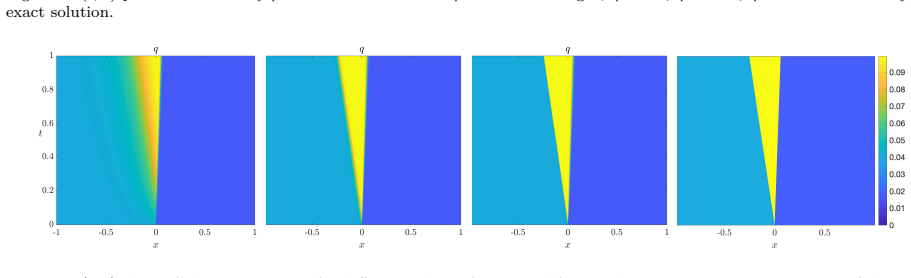
- Numerical experiments for linear and nonlinear velocity diagrams illustrate that smaller η produces solutions approaching the exact local Riemann solution, supporting the convergence claim.
Reading between the lines
- The sign condition (50) is likely not merely technical: the proof ties it directly to monotonicity of the total variation of Vη in time, so data violating it might produce nonlocal-to-local limits with oscillations, or require compensated-compactness techniques instead of TV compactness.
- The exponential kernel is essential to the differential identity used for the TV bound; extending the singular-limit result to finite-support kernels, which are more natural for traffic, would need a different argument and is left open by the paper.
- Because the same nonlocal velocity appears in both equations, the fixed-point-in-velocity strategy and the entropy-semigroup identification could be adapted to other second-order traffic or two-phase systems, provided the local limit system remains a Temple system with a strictly convex entropy.
- Strict monotonicity of V in ρ, needed to recover ρ from limits of Vη and ωη, can fail on plateaus of the fundamental diagram; a testable consequence is that in such plateaus the nonlocal limit might select a different density branch than the classical entropy solution.
Editorial analysis
A structured set of objections, weighed in public.
Referee Report
Summary. The paper studies a nonlocal version of the generalized Aw–Rascle–Zhang traffic model (1), where the velocity is obtained by downstream spatial averaging of V(ρ,ω) against a one-sided kernel. The authors prove existence and uniqueness of weak solutions for BV initial data on a short time horizon via a fixed-point argument in the nonlocal velocity (Theorem 3.13), together with L1 stability with respect to initial data and approximation by smooth solutions (Theorem 3.16, Corollary 3.17). Under additional traffic-modeling assumptions they obtain global existence, a maximum principle, and invariant-region bounds (Theorems 3.18, 3.20). For the singular limit, they consider an exponential kernel scaled by η, derive a uniform total-variation bound on the nonlocal velocity under the solution-dependent sign condition (50), and prove compactness and convergence along subsequences to a weak solution of the local GARZ system (Theorems 4.2, 4.4, 4.7). Section 5 constructs a strictly convex entropy for the local system (Lemma 5.7) and claims uniqueness of entropy weak solutions by adapting a theorem of Bressan–Guerra (Theorem 5.8), leading to the final identification with the semigroup trajectory (Corollary 5.10). Numerical experiments illustrate the behavior for three velocity choices.
Significance. If fully correct, the paper would provide the first well-posedness and nonlocal-to-local convergence result for a velocity-averaged nonlinear GARZ system, a relevant step beyond the existing scalar and density-averaged system results. The fixed-point construction in Section 3 is detailed, largely self-contained, and yields useful stability estimates. The explicit entropy construction in Lemma 5.7 is also a valuable ingredient. However, the central singular-limit claim is conditional in two load-bearing ways: the uniform TV bound relies on the solution-dependent inequality (50), and the passage to the local weak solution rests on an inversion/recovery assumption in Theorem 4.7. Moreover, Theorem 5.8, which provides the uniqueness of the entropy solution, is not actually proved but only asserted to follow by adapting [7]. These gaps prevent the paper, in its present form, from fully establishing the advertised convergence to the unique local entropy solution.
major comments (3)
- [Theorem 5.8 (final paragraph)] Theorem 5.8 asserts uniqueness of entropy weak solutions for the local GARZ system, but the proof is not carried out. It states that the proof of Bressan–Guerra [7, Theorem 1.1] 'can be adapted' and relies on the semigroup from [3], the strictly convex entropy of Lemma 5.7, and the 'viscosity solutions' characterization. None of the following is verified: that the semigroup trajectories on D_M satisfy the hypotheses of [7], that D_M is invariant and compatible with the semigroup, that the entropy is strictly convex on the whole relevant set (Lemma 5.7 works on a fixed rectangle [ρmin,ρmax]×[qmin,qmax]), or that the characteristic fields satisfy the corresponding assumptions. This is a proof gap, not a restrictive assumption. Without uniqueness, Theorem 5.9 only yields an entropy weak solution, and Corollary 5.10's identification with the semigroup trajectory does not follow.
- [Theorem 4.2 / Eq. (50)] The uniform total-variation bound (51), and hence all compactness in Sections 4–5, depends on the solution-dependent inequality (50): ρ_η ∂1V(ρ_η,ω_η)+η ∂x V_η ≤ 0. This is not a closed condition on the initial data; it involves the unknown solution. The paper verifies it only under the additional inequalities (52)–(55), for the exponential kernel and specific velocity classes, and Section 7 lists its removal as an open problem. Consequently the singular-limit results (Theorems 4.7, 5.9, Corollary 5.10) are conditional on a condition that is not shown to hold for the general class of models in Assumption 2.4. The authors should either prove (50) for a well-defined class of data and velocities or explicitly frame the convergence theorems as conditional on (50) and adjust the abstract and claims accordingly.
- [Theorem 4.7 and Remark 4.8] The recovery/inversion assumption in Theorem 4.7 (strong limits of V(ρ_η,ω_η) and ω_η determine ρ_*, and V_* ≡ V(ρ_*,ω_*)) is stated as an assumption; Remark 4.8 claims that strict monotonicity of x ↦ V(x,y) suffices, but no proof is provided. This step is necessary to pass to the limit in the nonlinear flux and to obtain a weak solution of the local system. Without a proof of this implication, the convergence claim of Theorem 4.7 remains conditional and the subsequent identification in Section 5 is not fully justified. The authors should provide a lemma proving the recovery property under explicit hypotheses, or restrict Theorem 4.7 to a class where it is verified.
minor comments (5)
- [Throughout] The text frequently refers to 'Thm. 2.1' and 'Thm. 2.4' when meaning Assumptions 2.1 and 2.4, and to 'Thm. 3.22', 'Thm. 3.23', etc. for lemmas. Cross-references should be corrected.
- [Definition 2.2] Test functions are taken on (−42,T)×R; the constant 42 appears to be arbitrary and should be replaced by a standard notation (e.g., (−a,T)×R with a>0).
- [Definition 3.7] The constant 42 appears in the definitions of V_{1,TV} and Q0(ω0,ρ0) without explanation. If intentional, its role should be clarified; otherwise it is likely a typographical artifact.
- [Section 6] For the third simulation, the exact solution is given only for ρ; since q and ω are also plotted, the corresponding formulas for q (or ω) would help reproducibility.
- [Section 7] The open problems paragraph is useful, but the wording that the singular-limit result requires (50) should be moved closer to the theorem statements to avoid overstating the results in the abstract and introduction.
Circularity Check
No significant circularity: well-posedness is a genuine fixed-point argument, the singular-limit results are conditional on explicit hypotheses, and the abbreviated uniqueness adaptation in Theorem 5.8 is a proof gap rather than a circular reduction.
full rationale
Systematic check of the derivation chain: (i) the well-posedness proof (Thms 3.12-3.13) is a genuine Banach fixed-point argument; the solution formula (25) is derived from characteristics and then verified against the weak formulation, and uniqueness is obtained by proving that every weak solution must be a fixed point of the same map. (ii) The singular-limit TV bound (Thm 4.2) is conditional on the explicit solution-dependent sign hypothesis (50); this hypothesis is not a restatement of the desired convergence, and the paper provides data-checkable sufficient conditions (52)-(55). (iii) The recovery/invertibility assumption in Thm 4.7 is explicitly stated and discussed in Remark 4.8; it is an additional hypothesis, not a hidden consequence of the conclusion. (iv) Section 5's uniqueness argument relies on external results [3,7] and on the strictly convex entropy constructed in Lemma 5.7; it does not invoke a uniqueness theorem of the present authors to force the conclusion. The adaptation of [7, Theorem 1.1] is abbreviated and is a legitimate rigor/correctness concern, and condition (50) is restrictive, but neither reduces the result to its own inputs. Self-citations to [33], [35], [17], [27], and [14] are used as independent prior tools or benchmarks, not as the sole justification of the central claims. No circular step was found.
Assumptions & free parameters
free parameters (3)
- constant 42 in Definition 3.7 =
42
- C̄ in entropy construction (Lemma 5.7) =
large enough
- c, ρ̄ in Assumption 2.4(b1) =
unspecified positive constants
assumptions (7)
- standard math Composition of BV functions with diffeomorphisms (Lemma 3.5)
- standard math Characteristic flow properties (Lemmas 3.3-3.6)
- domain assumption One-sided monotone kernel: supp(η)⊂R≤0, η≥0 increasing, ||η||_L1=1
- domain assumption Velocity conditions: ∂1V≤0, ∂2V≥0, V(0,ω)=ω, V(R(ω),ω)=0, (ρV)_{ρρ}<0
- ad hoc to paper Eq. (50): ρ_η∂1V(ρ_η,ω_η)+η∂xV_η ≤ 0 on Ω_T
- ad hoc to paper Recovery/invertibility: limits of V(ρ_η,ω_η) and ω_η determine ρ_*
- standard math Semigroup uniqueness for Temple systems with convex entropy [3,7]
Cite this review
Pith. "Pith review of Systems of nonlocal conservation laws: well-posedness and the singular limit for a nonlocal generalized Aw-Rascle-Zhang model." pith.science (2026). https://pith.science/paper/B7BSJSRG
@misc{pith2026260715408,
  author       = {Pith},
  title        = {Pith review of: Systems of nonlocal conservation laws: well-posedness and the singular limit for a nonlocal generalized Aw-Rascle-Zhang model},
  year         = {2026},
  howpublished = {\url{https://pith.science/paper/B7BSJSRG}},
  note         = {Machine review of arXiv:2607.15408}
}
abstract
In this paper, we study a system of nonlocal conservation laws motivated by traffic flow: a nonlocal version of the generalized Aw-Rascle-Zhang (GARZ) model. The nonlocality arises from downstream spatial averaging of the velocity by a one-sided kernel. We prove the existence and uniqueness of weak solutions for initial data of bounded variation via a fixed-point argument in the nonlocal velocity. We also establish stability with respect to the initial datum and an approximation of weak solutions by strong solutions in $L^1$. Under additional, physically meaningful assumptions on the velocity and the initial datum, we obtain either a maximum principle for the density or invariant-region estimates. Finally, we study the singular limit as the nonlocal kernel converges to a Dirac distribution. Indeed, under additional assumptions, convergence to the unique local entropy solution can be proved. Some numerical simulations are provided, and the paper concludes with a discussion of open problems.
Figures


Figures from the paper (9 more)




Reference graph
Works this paper leans on
-
[7]
Unique solutions to hyperbolic conservation laws with a strictly convex entropy
Bressan, A., Guerra, G., 2024. Unique solutions to hyperbolic conservation laws with a strictly convex entropy. J. Differ. Equ. 387, 432–447. doi: 10.1016/j.jde.2024.01.005
-
[3]
The semigroup generated by a Temple class system with large data
Baiti, P., Bressan, A., 1997. The semigroup generated by a Temple class system with large data. Differ. Integral Equ. 10, 401–418. doi: 10.57262/die/1367525659
arXiv 1997
-
[1]
Godunov-type approximation for a general resonant balance law with large data
Amadori, D., Gosse, L., Guerra, G., 2004. Godunov-type approximation for a general resonant balance law with large data. J. Differ. Equ. 198, 233–274. doi: 10.1016/j.jde.2003.10.004
-
[2]
Aw, A., Rascle, M., 2000. Resurrection of “second order” models of traffic flow. SIAM J. Appl. Math. 60, 916–938. doi: 10.1137/S0036139997332099
-
[4]
Modeling multilane traffic with moving obstacles by nonlocal balance laws
Bayen, A., Friedrich, J., Keimer, A., Pflug, L., Veeravalli, T., 2022. Modeling multilane traffic with moving obstacles by nonlocal balance laws. SIAM J. Appl. Dyn. Syst. 21, 1495–1538. doi: 10.1137/ 20M1366654
2022
-
[5]
Well-posedness of a conservation law with non-local flux arising in traffic flow modeling
Blandin, S., Goatin, P., 2015. Well-posedness of a conservation law with non-local flux arising in traffic flow modeling. Numer. Math. 132, 217241. doi: 10.1007/s00211-015-0717-6
-
[6]
Hyperbolic systems of conservation laws
Bressan, A., 2000. Hyperbolic systems of conservation laws. The one-dimensional Cauchy problem. volume 20 of Oxford Lect. Ser. Math. Appl. Oxford University Press, Oxford
2000
-
[8]
On traffic flow with nonlocal flux: A relaxation representation
Bressan, A., Shen, W., 2020. On traffic flow with nonlocal flux: A relaxation representation. Arch. Ration. Mech. Anal. 237, 1213–1236. doi: 10.1007/s00205-020-01529-z
Show all 49 references
-
[9]
Entropy admissibility of the limit solution for a nonlocal model of traffic flow
Bressan, A., Shen, W., 2021. Entropy admissibility of the limit solution for a nonlocal model of traffic flow. Commun. Math. Sci. 19, 1447–1450. doi: 10.4310/CMS.2021.v19.n5.a12
2021 doi
-
[10]
Uniqueness & weak-BV stability in the large for isothermal gas dynamics
Cheng, J., 2025. Uniqueness & weak-BV stability in the large for isothermal gas dynamics. J. Differ. Equ. 446, Paper No. 113599, 31. doi: 10.1016/j.jde.2025.113599
2025
-
[11]
Micro-macro limit of a nonlocal generalized Aw-Rascle type model
Chiarello, F.A., Friedrich, J., Goatin, P., Göttlich, S., 2020. Micro-macro limit of a nonlocal generalized Aw-Rascle type model. SIAM J. Appl. Math. 80, 18411861. doi: 10.1137/20m1313337. 53
2020 doi
-
[12]
A non-local traffic flow model for 1-to-1 junctions
Chiarello, F.A., Friedrich, J., Goatin, P., Göttlich, S., Kolb, O., 2019. A non-local traffic flow model for 1-to-1 junctions. Eur. J. Appl. Math. 31, 10291049. doi: 10.1017/s095679251900038x
2019 doi
-
[13]
Global entropy weak solutions for general non-local traffic flow models with anisotropic kernel
Chiarello, F.A., Goatin, P., 2018. Global entropy weak solutions for general non-local traffic flow models with anisotropic kernel. ESAIM: Math. Model. Numer. Anal. 52, 163180. doi: 10.1051/m2an/2017066
2018
-
[14]
On the singular limit problem in nonlocal balance laws: Applications to nonlocal lane-changing traffic flow models
Chiarello, F.A., Keimer, A., 2024. On the singular limit problem in nonlocal balance laws: Applications to nonlocal lane-changing traffic flow models. J. Math. Anal. Appl. 537, 128358. doi: 10.1016/j.jmaa. 2024.128358
2024
-
[15]
Nonlocal conservation laws with p-norm, the sin- gular limit problem and applications to traffic flow
Chiarello, F.A., Keimer, A., Pflug, L., 2025. Nonlocal conservation laws with p-norm, the sin- gular limit problem and applications to traffic flow. URL: https://arxiv.org/abs/2512.18701, arXiv:2512.18701
2025
-
[16]
Coclite, G.M., Colombo, M., Crippa, G., De Nitti, N., Keimer, A., Marconi, E., Pflug, L., Spinolo, L.,
-
[17]
A general result on the ap- proximation of local conservation laws by nonlocal conservation laws: The singular limit problem for exponential kernels
Coclite, G.M., Coron, J.M., De Nitti, N., Keimer, A., Pflug, L., 2022. A general result on the ap- proximation of local conservation laws by nonlocal conservation laws: The singular limit problem for exponential kernels. Ann. Inst. H. Poincaré C Anal. Non Linéaire 40, 12051223....
2022 doi
-
[18]
On a nonlocal regularization of a non-strictly hyperbolic system of conservation laws
Coclite, G.M., De Nitti, N., 2026. On a nonlocal regularization of a non-strictly hyperbolic system of conservation laws. Nonlinear Anal. Real World Appl. 92, 104447. doi: 10.1016/j.nonrwa.2025.104447
2026
-
[19]
Singular limit for a class of nonlocal conservation laws via compensated compactness
Coclite, G.M., De Nitti, N., Huang, K., 2025. Singular limit for a class of nonlocal conservation laws via compensated compactness. Technical Report. https://arxiv.org/abs/2511.15631. arXiv:2511.15631
2025
-
[20]
Local limit of nonlocal traffic models: Convergence results and total variation blow-up
Colombo, M., Crippa, G., Marconi, E., Spinolo, L.V., 2021. Local limit of nonlocal traffic models: Convergence results and total variation blow-up. Ann. Inst. H. Poincaré C Anal. Non Linéaire 38, 1653–1666. doi: https://doi.org/10.1016/j.anihpc.2020.12.002
2021 doi
-
[21]
Nonlocal traffic models with general kernels: Singular limit, entropy admissibility, and convergence rate
Colombo, M., Crippa, G., Marconi, E., Spinolo, L.V., 2023. Nonlocal traffic models with general kernels: Singular limit, entropy admissibility, and convergence rate. Arch. Ration. Mech. Anal. 247. doi:10.1007/s00205-023-01845-0
2023 doi
-
[22]
Analysis of a conservation law modeling a highly re-entrant manufacturing system
Coron, J.M., Kawski, M., Wang, Z., 2010. Analysis of a conservation law modeling a highly re-entrant manufacturing system. Discrete Contin. Dyn. Syst. Ser. B 14, 1337–1359. doi: 10.3934/dcdsb.2010. 14.1337
2010 doi
-
[23]
Hyperbolic conservation laws in continuum physics
Dafermos, C., 2016. Hyperbolic conservation laws in continuum physics. volume 325 of Grundlehren der mathematischen Wissenschaften . Fourth ed., Springer-Verlag, Berlin. doi: 10.1007/ 978-3-662-49451-6
2016
-
[24]
Generalized characteristics uniqueness and regularity of solutions in a hyperbolic system of conservation laws
Dafermos, C.M., Geng, X., 1991. Generalized characteristics uniqueness and regularity of solutions in a hyperbolic system of conservation laws. Ann. Inst. H. Poincaré C Anal. Non Linéaire 8, 231–269. doi:10.1016/S0294-1449(16)30263-3
1991 doi
-
[25]
The Theory of Max-Min and its Application to Weapons Allocation Problems
Danskin, J., 1967. The Theory of Max-Min and its Application to Weapons Allocation Problems. Springer Berlin Heidelberg. doi: 10.1007/978-3-642-46092-0
1967 doi
-
[26]
Comparative model accuracy of a data-fitted generalized Aw- Rascle-Zhang model
Fan, S., Herty, M., Seibold, B., 2014. Comparative model accuracy of a data-fitted generalized Aw- Rascle-Zhang model. Netw. Heterog. Media 9, 239–268. doi: 10.3934/nhm.2014.9.239
2014 doi
-
[27]
Conservation laws with nonlocal velocity: The singular limit problem
Friedrich, J., Göttlich, S., Keimer, A., Pflug, L., 2024. Conservation laws with nonlocal velocity: The singular limit problem. SIAM J. Appl. Math. 84, 497–522. doi: 10.1137/22M1530471. 54
2024 doi
-
[28]
A Godunov type scheme for a class of L WR traffic flow models with non-local flux
Friedrich, J., Kolb, O., Göttlich, S., 2018. A Godunov type scheme for a class of L WR traffic flow models with non-local flux. Netw. Heterog. Media 13, 531547. doi: 10.3934/nhm.2018024
2018 doi
-
[29]
Well-posedness and finite volume approximations of the L WR traffic flow model with non-local velocity
Goatin, P., Scialanga, S., 2016. Well-posedness and finite volume approximations of the L WR traffic flow model with non-local velocity. Netw. Heterog. Media 11, 107–121. doi: 10.3934/nhm.2016.11.107
2016 doi
-
[30]
On the Aw-Rascle-Zhang traffic models with nonlocal look-ahead interac- tions
Hamori, T., Tan, C., 2026. On the Aw-Rascle-Zhang traffic models with nonlocal look-ahead interac- tions. Nonlinear Anal. 262, Paper No. 113930, 20. doi: 10.1016/j.na.2025.113930
2026
-
[31]
Existence and uniqueness of solutions for some hyperbolic systems of conservation laws
Heibig, A., 1994. Existence and uniqueness of solutions for some hyperbolic systems of conservation laws. Arch. Ration. Mech. Anal. 126, 79–101. doi: 10.1007/BF00375697
1994 doi
-
[32]
Composing functions of bounded variation
Josephy, M., 1981. Composing functions of bounded variation. Proc. Amer. Math. Soc. 83, 354–356. doi:10.2307/2043527
1981 doi
-
[33]
Existence, uniqueness and regularity results on nonlocal balance laws
Keimer, A., Pflug, L., 2017. Existence, uniqueness and regularity results on nonlocal balance laws. J. Differ. Equ. 263, 40234069. doi: 10.1016/j.jde.2017.05.015
2017 doi
-
[34]
On approximation of local conservation laws by nonlocal conservation laws
Keimer, A., Pflug, L., 2019. On approximation of local conservation laws by nonlocal conservation laws. J. Math. Anal. Appl. 475, 19271955. doi: 10.1016/j.jmaa.2019.03.063
2019 doi
-
[35]
Discontinuous nonlocal conservation laws and related discontinuous ODEs Existence, uniqueness, stability and regularity
Keimer, A., Pflug, L., 2023. Discontinuous nonlocal conservation laws and related discontinuous ODEs Existence, uniqueness, stability and regularity. C. R. Math. 361, 17231760. doi: 10.5802/crmath.490
2023 doi
-
[36]
On the singular limit problem for nonlocal conservation laws: A general approximation result for kernels with fixed support
Keimer, A., Pflug, L., 2025. On the singular limit problem for nonlocal conservation laws: A general approximation result for kernels with fixed support. J. Math. Anal. Appl. 547, 129307. doi: 10.1016/ j.jmaa.2025.129307
2025
-
[37]
Nonlocal approximation principle for entropy solutions of scalar conserva- tion laws
Keimer, A., Pflug, L., 2026. Nonlocal approximation principle for entropy solutions of scalar conserva- tion laws. URL: https://arxiv.org/abs/2605.00635, arXiv:2605.00635
2026 arXiv
-
[38]
A first course in Sobolev spaces
Leoni, G., 2017. A first course in Sobolev spaces. volume 181 of Graduate Studies in Mathematics . Second ed., American Mathematical Society, Providence, RI. doi: 10.1090/gsm/181
2017 doi
-
[39]
On kinematic waves
Lighthill, M., Whitham, G., 1955. On kinematic waves. I. Flood movement in long rivers. Proc. R. Soc. Lond. A 229, 281–316. doi: 10.1098/rspa.1955.0088
1955
- [40]
-
[41]
Well-posedness results for the generalized Aw-Rascle-Zhang model
Marconi, E., Spinolo, L.V., 2026. Well-posedness results for the generalized Aw-Rascle-Zhang model. Adv. Contin. Discrete Models 2026. doi: 10.1186/s13662-026-04079-y
2026 doi
-
[42]
Structural properties of the stability of jamitons, in: Mathematical descriptions of traffic flow: micro, macro and kinetic models
Ramadan, R., Rosales, R.R., Seibold, B., 2021. Structural properties of the stability of jamitons, in: Mathematical descriptions of traffic flow: micro, macro and kinetic models. Springer, Cham. vol- ume 12 of ICIAM 2019 SEMA SIMAI Springer Ser. , pp. 35–62. URL: https://doi.org/...
2021 doi
-
[43]
Shock waves on the highway
Richards, P., 1956. Shock waves on the highway. Oper. Res. 4, 42–51. URL: https://www.jstor.org/ stable/167515
1956
-
[44]
Systems of conservation laws with discontinuous fluxes and applications to traffic
Rosini, M.D., 2019. Systems of conservation laws with discontinuous fluxes and applications to traffic. Ann. Univ. Mariae Curie-Sklodowska Sect. A 73, 135–173
2019
-
[45]
Compact sets in the space Lp(0;T ;B)
Simon, J., 1987. Compact sets in the space Lp(0;T ;B). Ann. Mat. Pura Appl. (4) 146, 65–96. doi: 10. 1007/BF01762360. 55
1987
-
[46]
Stochastic modeling and simulation of traffic flow: Asymmetric single exclusion process with Arrhenius look-ahead dynamics
Sopasakis, A., Katsoulakis, M.A., 2006. Stochastic modeling and simulation of traffic flow: Asymmetric single exclusion process with Arrhenius look-ahead dynamics. SIAM J. Appl. Math. 66, 921944. doi: 10. 1137/040617790
2006
-
[47]
Systems of conservation laws with invariant submanifolds
Temple, B., 1983. Systems of conservation laws with invariant submanifolds. Trans. Amer. Math. Soc. 280, 781–795. doi: 10.1090/s0002-9947-1983-0716850-2
1983 doi
-
[48]
A non-equilibrium traffic model devoid of gas-like behavior
Zhang, H., 2002. A non-equilibrium traffic model devoid of gas-like behavior. Transp. Res. Part B Methodol. 36, 275290. doi: 10.1016/s0191-2615(00)00050-3 . 56
2002 doi
-
[2024]
Oleinik-type estimates for nonlocal conservation laws and applications to the nonlocal-to-local limit. J. Hyperbolic Differ. Equ. 21, 681–705. doi: 10.1142/S021989162440006X
Reviewed August 1, 2026 · model on record in the stance chip above.
Discussion (0). Continue with ORCID to comment.