REVIEW 4 major objections 5 minor 26 references
HCPG-Flow:Hierarchical Contact-Progress Guidance for Flow-Policy Robot Manipulation
T0 review · 4 major / 5 minor · reviewed 2026-08-01 · deepseek-v4-flash
Pith's one-line read HCPG-Flow shows that ranking flow-policy actions by geometric contact progress beats critic-based ranking, lifting task success by 9.5 points without changing training.
desk verdict A clean, lightweight candidate-selection idea for flow policies with plausible gains, but the mechanism is under-validated and the stats are thin. read the letter →
The pith
A machine-rendered reading of the paper's core claim, the machinery that carries it, and where it could break.
The reading
What carries the argument
The carrying object is the first-order directional progress score D(u, ρ) = u^T ρ / max(‖ρ‖, ε), which measures how much a candidate translation u reduces the distance along a target direction ρ. The full selector combines an approach term and a task-progress term weighted by a contact phase variable, subtracts a small translational penalty, standardizes scores within the candidate set, and blends proposals with a temperature-controlled softmax. It replaces critic-based ranking at rollout time and converts a flow policy's multimodal proposals into one executable action.
What would settle it
Run HCPG-Flow on a pushing or grasping task with a slippery or deformable object where the tool point can move without moving the object, and check whether the selected actions' directional scores track the object's true displacement. If the object-goal distance does not decrease in proportion to the score, the method's advantage over Q-guided selection should vanish or reverse.
Extended reading notes
Core claim
The central claim is that candidate selection in flow policies can be decoupled from value estimation. HCPG-Flow uses state geometry to compute a contact-aware progress score: before contact it rewards translations that reduce tool-to-object distance, and after contact it rewards translations aligned with the object-to-goal direction. The score is a first-order distance-reduction surrogate, standardized within the candidate set, and converted into a temperature-controlled action embedding. With the learning objectives untouched, this rollout-time selector alone accounts for the reported gains; the largest absolute gain appears on a pick-and-place-style task where the phase gate must distingu
Load-bearing premise
The load-bearing premise is that after contact the tool point's displacement transfers to the object, so the post-contact score is a faithful measure of task progress; if the object slips, deforms, or contact is non-rigid, the ranking can select actions that do not actually advance the task.
Editorial extensions
If this is right
- Any flow- or diffusion-based actor that can produce multiple proposals can use the same geometric progress criterion to pick one, provided the task exposes object-goal geometry in its state.
- Because the selector shapes the replay data, training the identical backbone on HCPG-collected transitions yields better final policies than training on single-sample or Q-ranked data.
- The method adds no learned scorer, auxiliary loss, or extra backward pass, so the execution-time overhead is limited to K flow integrations and an analytic weighting.
- The reported step reductions on real hardware imply that even when success rates are already saturated, progress-guided selection can shorten task completion time.
Reading between the lines
- The task adapters are hand-specified for each task family; a natural extension the paper does not test is learning the approach and task vectors from vision or estimated object pose, which could widen the method's coverage.
- Since the score is purely geometric, pairing it with tactile or slip sensing could extend the hierarchy to deformable or slippery objects, where the rigid-transfer assumption breaks.
- The same progress signal could be injected as a reward-shaping term during training, although the paper deliberately keeps it as a rollout-time selector; whether that would compound the gains is an open question.
Signed reviews
Editorial analysis
A structured set of objections, weighed in public.
Referee Report
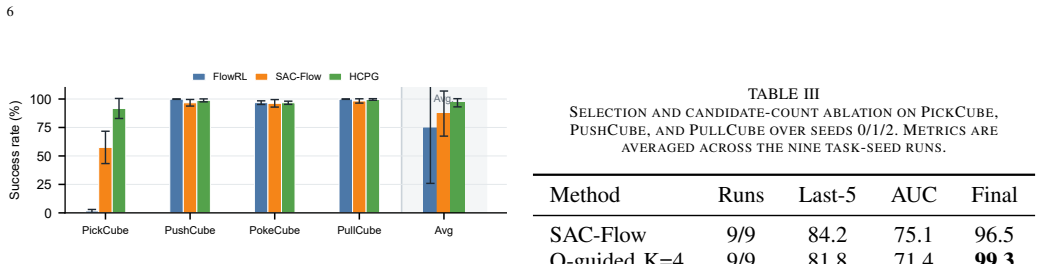
Summary. The paper proposes HCPG-Flow, a rollout-time candidate-selection mechanism for flow-based policies built on the SAC-Flow backbone. The method samples K=4 actions from the flow actor, computes a contact phase (approach vs. post-contact), scores each candidate translation by the first-order reduction of a task-relevant distance (Eqs. 5–8), standardizes these scores within the candidate set, and forms a temperature-weighted action embedding (Eqs. 9–10). The actor and critic objectives are left unchanged. The authors report that HCPG-Flow improves across-task mean success over SAC-Flow on ManiSkill (87.2% to 96.7%) and MetaWorld (94.7% to 97.1%), and on four physical tasks raises pooled success from 91.7% to 98.3% while reducing successful completion steps by 17.4%.
Significance. The contribution is potentially valuable: it is a zero-learned-parameter module that can be dropped into an existing flow-policy training loop to improve data collection, and the first-order distance-reduction derivation in Eqs. (5)–(6) is clean and internally correct. The paper is also honest in distinguishing the local surrogate from global optimality, and it provides ablations showing that the gain is not merely from K>1 or Q-guided ranking. The empirical scope includes ten simulated and four real-robot tasks, which is useful breadth. However, the significance is currently limited by the absence of validation of the post-contact rigid-transfer assumption, by the small number of seeds and lack of significance testing, and by unspecified per-task adapter details. With those addressed, the method would be a solid practical contribution.
major comments (4)
- [§III-C, Eq. (8)] The post-contact score D(u_i, ρ_task) is justified 'under the local approximation that TCP displacement transfers to the object.' This assumption is load-bearing for the claimed mechanism. In Section V there are no contact-force, slip, or post-contact object-pose measurements; rugby-ball grasping is exactly a case where deformation/slipping is plausible. If the assumption fails, the selector ranks TCP motion toward the goal rather than object progress, and the gains could be due to the soft embedding or standardization rather than 'contact-progress guidance.' Please validate by measuring object velocity relative to TCP during contact, add a simulation variant with slip/deformation, or ablate the contact gate (e.g., fixed approach score vs. HCPG).
- [§IV-A, Table II] The headline 9.5-point ManiSkill gain rests on three seeds with no significance tests and is dominated by PickCube, where SAC-Flow has high variance (57.5±14.2 vs. HCPG 91.7±8.8). The across-task mean is computed over task means, not a paired per-task test. With n=3, the evidence is not statistically strong. Report per-task paired differences, confidence intervals, or individual seed values, and ideally add more seeds. The real-robot results also lack trial-level significance testing (15 trials per task, one training run per method).
- [§III-D/E, §IV-B] Several free parameters are fixed without sensitivity analysis: c=0.08, λ_a=0.05, K=4, τ=0.7. Table IV only varies K. Since d_c controls the phase switch and τ controls score sharpness, their values could materially affect performance; without sweeps or a clearly stated selection criterion it is hard to rule out tuning on the evaluation tasks. Add sensitivity analysis for τ, d_c, and λ_a at least on a subset of tasks.
- [§III-B] The task adapter appears to encode substantial per-task semantics (e.g., 'the lift adapter replaces ρ_task with the positive vertical axis', 'articulated tasks use the task axis or goal displacement'). The paper does not specify the adapter for each of the ten tasks, nor the source of the grasp flag and ρ_task in the real-robot observations. Since the adapter is part of the proposed method, missing specifications make the method difficult to reproduce and leave open the possibility that per-task engineering drives the gains. Provide a complete adapter specification table or release code.
minor comments (5)
- [Eq. (7)] Notation inconsistency: the threshold is written as 'dc' in Eq. (7) but as 'd_c' in §III-D and §IV-B.
- [Table V] The row labeled 'Overall / macro mean' mixes two different quantities: pooled success (91.7, 98.3) and macro-mean completion steps (62.4, 51.6). Use separate rows with explicit labels.
- [Table III] The 'Final' metric is not defined. Clarify whether it is the success rate at the final checkpoint or the last evaluation episode.
- [§IV-B] The statement that 'all methods use the same training budget' is not enough for reproducibility; report the baseline hyperparameters (learning rates, batch sizes, update frequencies) or cite a released configuration.
- [Fig. 5] The caption says 'linearly aligning normalized training budgets' but does not explain the alignment procedure; please define it so the learning-progress comparison is interpretable.
Circularity Check
No significant circularity: the geometric score is a transparent first-order expansion and the empirical claims are measured against an external baseline.
full rationale
The derivation chain is self-contained. Eq. (5) defines D(u, ρ) = u^T ρ / max(||ρ||, ε) as a normalized directional projection; Eq. (6) is a direct first-order Taylor expansion, d(x,g) − d(x+αu,g) = αD(u,g−x) + O(α^2), so the selector score is exactly the local distance-reduction term rather than an imported or fitted quantity. Eq. (8) is an explicit convex combination of that geometric score with a regularization term, and the phase gate in Eq. (7) is a stated threshold rule. The main empirical claim is an evaluation against SAC-Flow, an external prior method (ref [5]); no cited result supplies a uniqueness theorem or forbids alternatives, and the authors explicitly disclaim global optimality of the local proxy. The stated limitation 'under the local approximation that TCP displacement transfers to the object' is a physical modeling assumption and a correctness concern for the proposed mechanism, not a circular reduction: the success metrics are measured independently of the score's definition. The constants d_c=0.08, λ_a=0.05, τ=0.7 are reported as fixed across tasks rather than fitted to the reported success rates, and the ablations compare HCPG against Q-guided ranking and different K values using external success rates. Therefore no load-bearing step reduces by construction to its own inputs.
Assumptions & free parameters
free parameters (5)
- d_c =
0.08
- lambda_a =
0.05
- tau =
0.7
- K =
4
- Per-task adapters (ρ_task semantics) =
task-specific directions
assumptions (5)
- domain assumption After contact, the TCP displacement transfers rigidly to the manipulated object
- domain assumption State includes privileged object-centric positions (x_tcp, x_o, x_g) and a grasp/contact indicator
- standard math The SAC-Flow conditional flow actor (Eq. 1) is a valid generative policy that can be sampled multiple times
- standard math The first-order Taylor expansion in Eq. (6) is accurate for the candidate displacements αu
- standard math The within-set standardization and softmax embedding produce an admissible control input
Cite this review
Pith. "Pith review of HCPG-Flow:Hierarchical Contact-Progress Guidance for Flow-Policy Robot Manipulation." pith.science (2026). https://pith.science/paper/XTWTQIUI
@misc{pith2026260717651,
  author       = {Pith},
  title        = {Pith review of: HCPG-Flow:Hierarchical Contact-Progress Guidance for Flow-Policy Robot Manipulation},
  year         = {2026},
  howpublished = {\url{https://pith.science/paper/XTWTQIUI}},
  note         = {Machine review of arXiv:2607.17651}
}
read the original abstract
Flow policies can represent multimodal action distributions for robot manipulation, yet a robot must execute one action at each control step. When several proposals are sampled, critic-based ranking makes data collection depend on value estimates over candidate actions that may be weakly represented in replay. We introduce HCPG-Flow, an analytic rollout-time selector that augments SAC-Flow with hierarchical, object-centric contact-progress guidance while preserving its actor and critic objectives. HCPG switches from end-effector approach to task progress after contact, scores each proposal by the first-order reduction of a task-relevant distance, standardizes scores within the candidate set, and executes a temperature-controlled action embedding. Across ten simulated tasks, HCPG improves mean success over SAC-Flow on both benchmarks, including a 9.5 percentage-point gain on Maniskill. Four physical tasks further show high success with a 17.4% reduction in successful completion steps.Project page: https://hitxraz.github.io/HCPG-Flow/
Figures


Figures from the paper (3 more)


Reference graph
Works this paper leans on
-
[1]
Denoising diffusion probabilistic models,
J. Ho, A. Jain, and P. Abbeel, “Denoising diffusion probabilistic models,” inAdvances in Neural Information Processing Systems, 2020
2020
-
[2]
Flow matching for generative modeling,
Y . Lipman, R. T. Q. Chen, H. Ben-Hamu, M. Nickel, and M. Le, “Flow matching for generative modeling,” inInternational Conference on Learning Representations, 2023
2023
-
[3]
Flow straight and fast: Learning to gen- erate and transfer data with rectified flow,
X. Liu, C. Gong, and Q. Liu, “Flow straight and fast: Learning to gen- erate and transfer data with rectified flow,” inInternational Conference on Learning Representations, 2023
2023
-
[4]
Diffusion policy: Visuomotor policy learning via action diffusion,
C. Chi, Z. Xu, S. Feng, E. Cousineau, Y . Du, B. Burchfiel, R. Tedrake, and S. Song, “Diffusion policy: Visuomotor policy learning via action diffusion,” inRobotics: Science and Systems, 2023
2023
-
[5]
SAC Flow: Sample-efficient reinforcement learning of flow-based policies via velocity-reparameterized sequential modeling,
Y . Zhang, S. Yu, T. Zhang, M. Guang, H. Hui, K. Long, Y . Wang, C. Yu, and W. Ding, “SAC Flow: Sample-efficient reinforcement learning of flow-based policies via velocity-reparameterized sequential modeling,” inInternational Conference on Learning Representations,
-
[6]
Soft actor-critic: Off- policy maximum entropy deep reinforcement learning with a stochastic actor,
T. Haarnoja, A. Zhou, P. Abbeel, and S. Levine, “Soft actor-critic: Off- policy maximum entropy deep reinforcement learning with a stochastic actor,” inInternational Conference on Machine Learning, 2018
2018
-
[7]
Off-policy deep reinforcement learning without exploration,
S. Fujimoto, D. Meger, and D. Precup, “Off-policy deep reinforcement learning without exploration,” inProceedings of the 36th International Conference on Machine Learning, ser. Proceedings of Machine Learning Research, vol. 97. PMLR, 2019, pp. 2052–2062
2019
-
[8]
Diffusion-DICE: In-sample diffusion guidance for offline reinforcement learning,
L. Mao, H. Xu, X. Zhan, W. Zhang, and A. Zhang, “Diffusion-DICE: In-sample diffusion guidance for offline reinforcement learning,” in Advances in Neural Information Processing Systems, vol. 37, 2024
2024
Show all 26 references
-
[9]
Diffusion policies as an expressive policy class for offline reinforcement learning,
Z. Wang, J. J. Hunt, and M. Zhou, “Diffusion policies as an expressive policy class for offline reinforcement learning,” inInternational Confer- ence on Learning Representations, 2023
2023
-
[10]
Trans- porter networks: Rearranging the visual world for robotic manipulation,
A. Zeng, P. Florence, J. Tompson, S. Welker, J. Chien, M. Attarian, T. Armstrong, I. Krasin, D. Duong, V . Sindhwani, and J. Lee, “Trans- porter networks: Rearranging the visual world for robotic manipulation,” inConference on Robot Learning, 2021
2021
-
[11]
Universal manipulation interface: In-the-wild robot teach- ing without in-the-wild robots,
C. Chi, Z. Xu, C. Pan, E. Cousineau, B. Burchfiel, S. Feng, R. Tedrake, and S. Song, “Universal manipulation interface: In-the-wild robot teach- ing without in-the-wild robots,” inRobotics: Science and Systems, 2024
2024
-
[12]
Policy gradient methods for reinforcement learning with function approximation,
R. S. Sutton, D. McAllester, S. Singh, and Y . Mansour, “Policy gradient methods for reinforcement learning with function approximation,” in Advances in Neural Information Processing Systems, 1999
1999
-
[13]
Continuous control with deep reinforcement learning,
T. P. Lillicrap, J. J. Hunt, A. Pritzel, N. Heess, T. Erez, Y . Tassa, D. Silver, and D. Wierstra, “Continuous control with deep reinforcement learning,” inInternational Conference on Learning Representations, 2016. 5 TABLE I METAWORLD LAST-FIVE EPISODE SUCCESS(%). VALUES ARE ...
2016
-
[14]
Addressing function approx- imation error in actor-critic methods,
S. Fujimoto, H. van Hoof, and D. Meger, “Addressing function approx- imation error in actor-critic methods,” inInternational Conference on Machine Learning, 2018
2018
-
[15]
Prox- imal policy optimization algorithms,
J. Schulman, F. Wolski, P. Dhariwal, A. Radford, and O. Klimov, “Prox- imal policy optimization algorithms,”arXiv preprint arXiv:1707.06347, 2017
2017 arXiv
-
[16]
Implicit behavioral cloning,
P. Florence, C. Lynch, A. Zeng, O. A. Ramirez, A. Wahid, L. Downs, A. Wong, J. Lee, I. Mordatch, and J. Tompson, “Implicit behavioral cloning,” inConference on Robot Learning, 2022
2022
-
[17]
Planning with diffusion for flexible behavior synthesis,
M. Janner, Y . Du, J. B. Tenenbaum, and S. Levine, “Planning with diffusion for flexible behavior synthesis,” inInternational Conference ButtonPressDrawerOpen DoorOpen SweepIntoPegInsertSide LeverPull Avg 0 25 50 75 100Success rate (%) Avg. SAC FlowRL QSM SAC-Flow HCPG Fig. 3....
2022
-
[18]
Is conditional generative modeling all you need for decision making?
A. Ajay, Y . Du, A. Gupta, J. B. Tenenbaum, T. Jaakkola, and P. Agrawal, “Is conditional generative modeling all you need for decision making?” inInternational Conference on Learning Representations, 2023
2023
-
[19]
Diffusion policy policy optimization,
A. Z. Ren, J. Lidard, L. L. Ankile, A. Simeonov, P. Agrawal, A. Majum- dar, B. Burchfiel, H. Dai, and M. Simchowitz, “Diffusion policy policy optimization,” inInternational Conference on Learning Representations, 2025
2025
-
[20]
Flow- based policy for online reinforcement learning,
L. Lv, Y . Li, Y . Luo, F. Sun, T. Kong, J. Xu, and X. Ma, “Flow- based policy for online reinforcement learning,” inAdvances in Neural Information Processing Systems, 2025
2025
-
[21]
Learning a diffusion model policy from rewards via q-score matching,
M. Psenka, A. Escontrela, P. Abbeel, and Y . Ma, “Learning a diffusion model policy from rewards via q-score matching,” inInternational 6 PickCube PushCube PokeCube PullCube Avg 0 25 50 75 100Success rate (%) Avg. FlowRL SAC-Flow HCPG Fig. 4. ManiSkill last-five episode succes...
2024
-
[22]
DIME: Diffusion-based maximum entropy reinforcement learning,
O. Celik, Z. Li, D. Blessing, G. Li, D. Palenicek, J. Peters, G. Chal- vatzaki, and G. Neumann, “DIME: Diffusion-based maximum entropy reinforcement learning,” inProceedings of the 42nd International Con- ference on Machine Learning, ser. Proceedings of Machine Learning Resear...
2025
-
[23]
Hindsight experience replay,
M. Andrychowicz, F. Wolski, A. Ray, J. Schneider, R. Fong, P. Welinder, B. McGrew, J. Tobin, P. Abbeel, and W. Zaremba, “Hindsight experience replay,” inAdvances in Neural Information Processing Systems, 2017
2017
-
[24]
RT-1: Robotics transformer for real-world control at scale,
A. Brohan, N. Brown, J. Carbajal, Y . Chebotar, X. Chen, K. Choro- manski, T. Ding, D. Driess, A. Dubey, C. Finnet al., “RT-1: Robotics transformer for real-world control at scale,” inRobotics: Science and Systems, 2023
2023
-
[25]
Learning fine-grained bimanual manipulation with low-cost hardware,
T. Z. Zhao, V . Kumar, S. Levine, and C. Finn, “Learning fine-grained bimanual manipulation with low-cost hardware,” inRobotics: Science and Systems, 2023. TABLE III SELECTION AND CANDIDATE-COUNT ABLATION ONPICKCUBE, PUSHCUBE,ANDPULLCUBE OVER SEEDS0/1/2. METRICS ARE AVERAGED A...
2023
-
[2026]
Available: https://openreview.net/forum?id=zZvWj4JrYj
[Online]. Available: https://openreview.net/forum?id=zZvWj4JrYj
Reviewed August 1, 2026 · model on record in the stance chip above.
Discussion (0). Continue with ORCID to comment.