REVIEW 3 major objections 3 minor
SEAM-V: A Hybrid-Decoupled RISC-V Vector Processor with Backend-Visible Packet Semantics and Source-Lifetime-Aware Scheduling
T0 review · 3 major / 3 minor · reviewed 2026-08-01 · deepseek-v4-flash
Pith's one-line read A hybrid-decoupled vector architecture keeps execute-packet ownership visible to the backend and reports a 1.34x mean speedup over a tightly coupled baseline.
desk verdict Credible incremental microarchitecture paper with honest RTL evaluation; the load-bearing software EP contract is unverified and needs evidence before the speedup claim can be trusted. read the letter →
The pith
A machine-rendered reading of the paper's core claim, the machinery that carries it, and where it could break.
The reading
What carries the argument
The execute packet (EP) is the central construct: a software/hardware-formed bundle of adjacent scalar and vector instructions bounded by p-bit breaks, branch/system boundaries, or an eight-slot maximum width. Each serialized vector request carries two metadata pieces: a one-bit EP identity marking same-EP membership, and request-bound prefetch context (pf_disable and pf_mode). The HINT header, encoded as 'lui x0, imm20', is the software mechanism that sets p-bits, loop markers, and prefetch intent. These pieces let the vector sequencer suppress same-EP candidate hazards and let the vector memory path issue bounded prefetches, while all other dependences, resource conflicts, and memory order
What would settle it
Run a directed RTL test with an intentional RAW dependence between two vector instructions in the same EP while leaving the p-bit set: if results remain correct, the suppression is not truly relying on the contract; if results are wrong, the contract is load-bearing as claimed. Separately, compare a configuration with EP-context propagation disabled against one with only the decoupled front end: if the 1.34x mean speedup does not degrade, then preserving EP identity across serialization is not the source of the gain.
Extended reading notes
Core claim
The central discovery is that EP context can be made backend-visible across the serialization boundary, and that doing so removes conservative dependence stalls and memory-latency exposure that the instruction-at-a-time interface otherwise reintroduces. Same-EP candidate-hazard suppression uses the EP identity to drop RAW/WAR/WAW candidate entries between requests known to be in the same EP, with safety guaranteed by the software p-bit contract; request-bound prefetching uses the pf_mode hint to issue 1X/2X/4X/8X prefetches for eligible unit-stride loads, gated by backend resources and loop-active state. The authors argue that this closes the front-end-backend semantic gap and demonstrate th
Load-bearing premise
The design is safe only if software clears the p-bit at every RAW/WAR/WAW or memory-ordering dependence inside a packet; a missed annotation would make the hardware skip a real hazard check and return wrong results.
Editorial extensions
If this is right
- Tightly coupled RVV designs can close much of the short-vector and loop-tail throughput gap without adopting full out-of-order vector execution.
- Because the ablation shows PF and Haz each add independent gains (0.80 and 0.78 normalized cycles vs 1.0 for the baseline) and together reach 0.68, the two EP-context mechanisms are the main lever; complete-path integration adds little beyond them.
- The speedup persists at large AVL (1.45-1.50x at AVL 1024-4096), so the benefit is not only a fixed-overhead artifact of short vectors.
- Software can express the EP contract through lightweight HINT headers while keeping kernels in standard RVV form, making the approach incrementally adoptable.
- The backend still dynamically enforces all cross-EP dependences and memory ordering, so the architecture preserves RVV computational semantics rather than weakening them.
Reading between the lines
- A compiler pass that analyzes dependence inside basic blocks could generate p-bits automatically, making the annotation burden invisible and possibly extending the same gains to unmodified RVV binaries.
- The 'preserve block ownership across decomposition' principle may transfer to other accelerators, such as systolic arrays or tensor units, where a coarse command is split into narrow operations and metadata is currently discarded.
- The fixed-distance unit-stride prefetch policy could be extended to multi-stream or gather/scatter-friendly prefetching using the same request-bound hint channel; the paper leaves that policy space open.
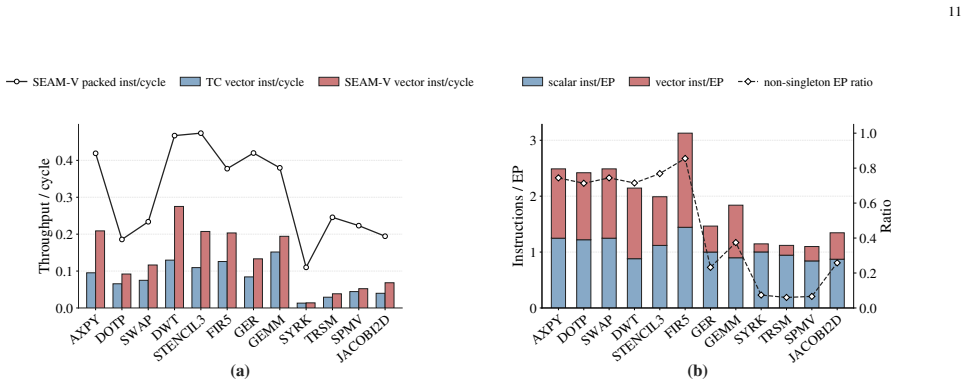
- Because cross-EP overlap stays low in the measured kernels, the architecture's gains come almost entirely from single-EP continuity, suggesting that further benefit may require relaxing the EP contract safely rather than adding more overlap paths.
Editorial analysis
A structured set of objections, weighed in public.
Referee Report
Summary. SEAM-V proposes a hybrid-decoupled RISC-V vector processor that forms execute packets (EPs) using HINT annotations, propagates EP identity and prefetch context into a dynamic vector backend, and uses that context for same-EP candidate-hazard suppression and request-bound prefetching. Compared with an Ara-based tightly coupled baseline, it reports a geometric-mean speedup of 1.34x across 17 kernels, with up to approximately 3x at AVL=32 for six one-dimensional kernels. The paper includes ablation, vector-length sensitivity, microarchitectural counter analysis, and honest reporting of kernel-dependent gains. The central correctness mechanism is a software p-bit contract that declares that vector instructions within the same EP have no RAW/WAR/WAW or memory-ordering conflicts requiring dynamic enforcement.
Significance. If the architecture and the p-bit contract are sound, SEAM-V addresses a real front-end/backend semantic gap in tightly coupled RVV execution and offers a novel way to preserve packet-level information across request serialization. The experimental methodology is a strength: cycle-accurate RTL simulation, systematic ablation, sensitivity sweeps, and an explicit account of workload-dependent results. The reported 1.34x and 3x gains are meaningful and the ablation isolates the contributions of the main mechanisms. However, the correctness of the entire design rests on an annotation contract that is currently unverified; the measured performance does not establish that the contract can be safely satisfied by realistic software. The paper also promises area/power/energy results that are not reported.
major comments (3)
- [§IV.B, §III.E] The safety of the architecture depends entirely on the p-bit contract, but the contract is only stated, not verified. The sequencer suppresses same-EP RAW/WAR/WAW candidates when EP identities match, while §IV.B requires software to clear p-bits for every dependence needing dynamic enforcement. A missed p-bit is not a performance miss; it silently removes a real hazard check and can corrupt architectural state. No formal proof, compiler implementation, or RTL torture tests are provided, and Fig. 7 shows hazard-elimination fractions ranging from 0.04 to 1.00 across kernels, so the benefit is annotation-sensitive. This load-bearing correctness gap must be closed.
- [§V.A, §VI] The paper promises area, power, and energy-efficiency costs of the added hardware, but the manuscript contains no synthesis or physical-design numbers, no table, and no comparison. The claimed cost assessment is therefore unsupported. Add the missing measurements or remove the claims.
- [§V.A] The evaluation is entirely RTL simulation, but no RTL, kernel sources, HINT-annotation scripts, or simulation environment are released, and the TC baseline is not specified beyond 'Ara-based'. Without a precise baseline configuration (scalar core, issue width, vset handling, memory timings) and public artifacts, the 1.34x geometric-mean speedup cannot be independently reproduced. Given the correctness-critical annotation contract, release of RTL and a test suite is particularly important.
minor comments (3)
- [§III.E] Typo: 'W AR' should be 'WAR' (also in the same paragraph as RAW and WAW).
- [Fig. 7] The heatmap row/column labels are hard to read and some metrics are not precisely defined (e.g., 'PF cov.', 'Hazard elim.'). The units and the interval over which fractions are computed should be stated.
- [Listing 1] The pbits values in the HINT headers are not explained in detail, so a reader cannot verify that the annotations correctly place all required boundaries. Please include a walk-through of the bit assignments for the example.
Circularity Check
No significant circularity: performance claims are measured from cycle-accurate RTL simulations; the main self-citation is contextual, not load-bearing.
full rationale
The paper's central speedup claims (1.34x geometric mean over TC; ~3x at AVL=32) are obtained from cycle-accurate RTL simulation comparing SEAM-V against an Ara-based tightly coupled baseline with identical vector-backend scale and memory configurations. There is no fitted parameter that is later renamed as a prediction, and no derived quantity reduces by construction to an input. The HINT p-bit annotations are software inputs that define EP membership and the conditions under which same-EP candidate-hazard suppression is safe; the resulting hazard-elimination fraction is a direct consequence of the annotation, but the speedup itself is measured from task execution cycles, not computed from the p-bit pattern. The paper repeatedly cites the authors' prior work [11] for the inherited hybrid-decoupled architecture, local instruction supply, and HINT-guided EP formation, but the current paper provides its own complete RTL implementation, ablation study (HDV-B, PF, Haz, PF+Haz, Full), and external comparison, so the central claim does not reduce to that citation. The unverified software p-bit contract is a real correctness/verification concern, but the prompt distinguishes correctness risk from circularity: an unsound annotation would produce wrong architectural state, not a circularly derived performance number. No circular step satisfying the required quote-and-reduction standard was found.
Assumptions & free parameters
free parameters (3)
- command window size (12 entries) =
12 entries
- ping-pong buffer size (2 x 512B) =
2 x 512B
- prefetch modes 1X/2X/4X/8X =
distance multiplier chosen by software
assumptions (3)
- domain assumption The p-bit contract is correct: software places p-bit breaks at every dependence inside an EP that requires backend enforcement.
- domain assumption Ara-based TC is a representative tightly coupled RVV implementation and a fair comparison point.
- domain assumption The RTL simulation faithfully models the microarchitecture and the AXI memory system, including prefetch stream-break recovery.
Cite this review
Pith. "Pith review of SEAM-V: A Hybrid-Decoupled RISC-V Vector Processor with Backend-Visible Packet Semantics and Source-Lifetime-Aware Scheduling." pith.science (2026). https://pith.science/paper/JU32AYXZ
@misc{pith2026260717899,
  author       = {Pith},
  title        = {Pith review of: SEAM-V: A Hybrid-Decoupled RISC-V Vector Processor with Backend-Visible Packet Semantics and Source-Lifetime-Aware Scheduling},
  year         = {2026},
  howpublished = {\url{https://pith.science/paper/JU32AYXZ}},
  note         = {Machine review of arXiv:2607.17899}
}
read the original abstract
Data-parallel workloads in deep learning and scientific computing continue to increase the demands on processor throughput, energy efficiency, and scalability. The RISC-V Vector Extension (RVV) supports scalable execution through a vector-length-agnostic model, yet many tightly coupled implementations still rely on the scalar core to supply vector instructions individually and are therefore constrained by instruction supply, scalar-side progress, memory stalls, and conservative dependence management in short-vector, loop-tail, and control/memory-interleaved scenarios. This paper presents SEAM-V, a hybrid-decoupled RVV processor that uses task-level decoupling, local instruction supply, and VLIW-style packing to form a continuous stream of execute packets (EPs). During EP formation and request serialization, SEAM-V preserves the association between prefetch intent and the corresponding load to support request-bound prefetching, while lane-level source-read completion is used to release pure write-after-read (WAR) dependences early; other dependences remain governed by conventional mechanisms. Relative to an Ara-based tightly coupled baseline (TC), SEAM-V achieves a geometric mean speedup of 1.38x across 17 representative kernel configurations. The one-dimensional vector, BLAS and matrix, and fixed-size application workload groups achieve 1.56x, 1.35x, and 1.23x, respectively. Synthesis and power analysis show that SEAM-V increases total cell area by 4.29% and geometric mean runtime power by 17.30%, while reducing task energy by 12.70%, demonstrating improved sustained execution efficiency and task-level energy efficiency with limited area overhead.
Figures


Figures from the paper (4 more)



Reviewed August 1, 2026 · model on record in the stance chip above.
Discussion (0). Sign in to comment.