REVIEW 3 major objections 5 minor 66 references
Orbit-resolved spin holography: role of Coulomb focusing in target-dependent polarization
T0 review · 3 major / 5 minor · reviewed 2026-08-01 · deepseek-v4-flash
Pith's one-line read Spider-like spin fringes in strong-field photoelectron holography arise from interference between p-orbital magnetic subchannels within a single orbit class, not from interorbit interference.
desk verdict A serious theory paper with a plausible new mechanism for PST spider fringes; the single-class claim is well benchmarked but needs an orbit-class sensitivity test before it's fully settled. read the letter →
The pith
A machine-rendered reading of the paper's core claim, the machinery that carries it, and where it could break.
The reading
What carries the argument
The central machinery is the Coulomb quantum-orbit strong-field approximation (CQSFA)—a semiclassical path-integral treatment that keeps the ionic potential during continuum propagation, unlike the plain strong-field approximation. Orbits are sorted into four classes by the signs of Πx = x0pfx and Πy = p0ypfy (tunnel-exit longitudinal position times final longitudinal momentum, and initial transverse momentum times final transverse momentum), which distinguish direct, laser-deflected, forward-scattered, and backward-scattered trajectories. The key identity is the PST formula (Eq. 7), which writes each spin component as the imaginary part of an interchannel product, e.g., ζz ∝ Im[χ(x)*χ(y)],
What would settle it
A decisive calculation would repeat the class-2-only PST extraction using a classification based on the actual trajectory turning point rather than the sign of x0pfx and p0ypfy (e.g., assigning any trajectory that scatters through an angle consistent with class 3 to class 3). If the spider-like fringes in the class-2-only map survive this unambiguous classification, the interchannel claim is robust; if they vanish, the claim is an artifact of the sign-based labeling. On the experimental side, a momentum- and spin-resolved measurement of Xe at 2000 nm with CEP tagging could test the predicted a
Extended reading notes
Core claim
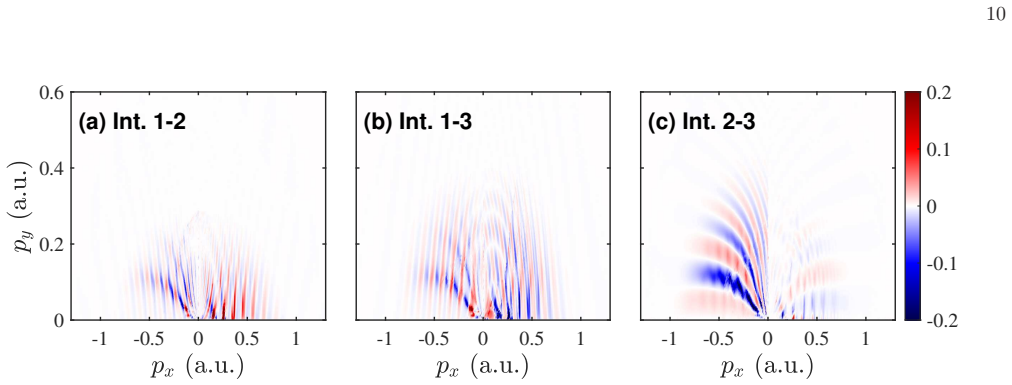
The paper's central claim is that the spider-like fringes in photoelectron spin texture are generated by interference between p-orbital ionization channels with different magnetic quantum numbers within a single orbit class, so interorbit interference is not required. Working in the j=3/2 manifold of an np shell, each PST component is an imaginary part of a product of scalar ionization amplitudes for p0, p+, and p− channels (Eq. 7). Using CQSFA benchmarked against TDSE for He+ and Xe, the paper shows the class-2 contribution alone contains a spider-like PST (sin(ΔSchannel)), whereas the conventional momentum-map spider requires class-2–class-3 interference (cos(ΔSorbit)). It further traces t
Load-bearing premise
The result rests on the assumption that orbit classes 2 and 3 can be cleanly separated by the sign-based classification: if a substantial fraction of forward-scattered trajectories are mislabeled as class 2 (a possibility the paper itself notes for soft-recollision trajectories), then the 'single orbit class' spider would be an artifact of the labeling rather than a genuine interchannel effect.
Editorial extensions
If this is right
- Spin-resolved holography turns the spider from a structure-insensitive pattern into a target-sensitive observable without changing the laser or the geometry.
- The spider-like PST should persist in a class-2-only calculation (as the paper demonstrates), providing a crisp signature that the mechanism is interchannel, not interorbit.
- Interorbit cross terms still modulate the full spin texture, so both coherence levels coexist in the complete observable; they are not mutually exclusive.
- The opposite first-leg polarization for He+ versus Xe is a concrete prediction that can be tested by momentum-resolved spin measurement of Xe with the same pulse parameters.
Reading between the lines
- The same interchannel-coherence logic may apply to other holographic patterns (e.g., fishbone, rings) and to molecules, where orbital magnetic subchannels can be prepared by coherent superposition rather than imposed by spin-orbit coupling.
- A controlled variation of the ionic charge—e.g., an isoelectronic sequence with the same p-orbital structure—could isolate Coulomb focusing from target-specific dipole factors; the He+/Xe comparison alone cannot fully separate them.
- If the sign-based orbit classification is sensitive to soft-recollision trajectories near the class-2–class-3 boundary (the paper notes this ambiguity), a continuous classification parameter (e.g., actual turning-point angle) would provide a quantitative test of the single-class inference.
- Momentum-resolved spin detection with CEP-tagged few-cycle pulses could directly observe the predicted alternating sign of adjacent spider legs; the required statistics are, in principle, within reach of existing Mott polarimetry set-ups.
Editorial analysis
A structured set of objections, weighed in public.
Referee Report
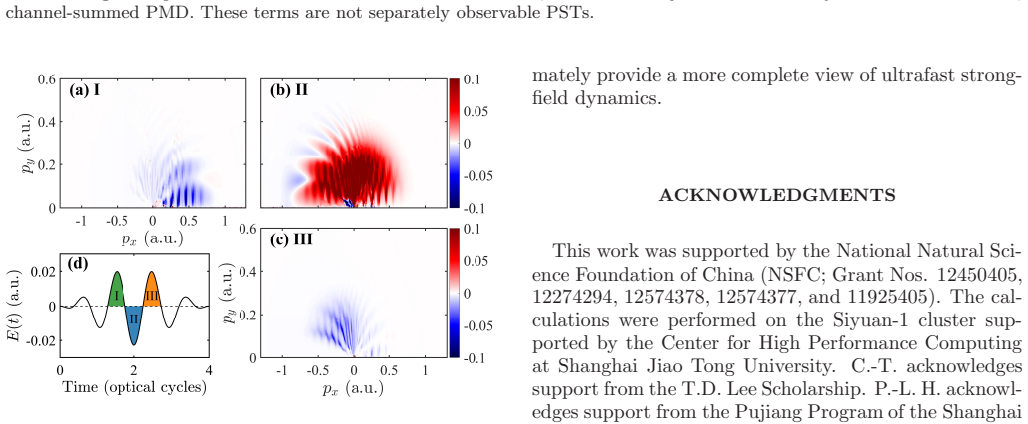
Summary. The paper investigates the orbit-resolved origin of spider-like photoelectron spin textures (PSTs) in strong-field ionization of He+ (2p) and Xe. It combines Coulomb quantum-orbit strong-field approximation (CQSFA) calculations, benchmarked against time-dependent Schrödinger equation (TDSE) simulations, with an orbit-class decomposition based on Ref. [42]. The central claim is that spider-like PST fringes arise from interchannel (m-sublevel) coherence within a single orbit class (class 2) and therefore do not require interorbit interference, in contrast to the conventional PMD spider. The paper further associates the opposite first-leg polarization signs of He+ and Xe with different relative weights of class-2 and class-3 trajectories, attributing this to target-dependent Coulomb focusing. The evidence includes class-restricted PST numerators (Fig. 4), interchannel phase diagnostics (Figs. 5 and 6), pairwise orbit-class cross terms (Fig. 8), and half-cycle decomposition (Fig. 9).
Significance. If the single-class interchannel mechanism is correct, this would revise the usual understanding that spider-like holographic patterns require interference between distinct orbit classes, and would establish spin textures as a target-sensitive probe of Coulomb-driven strong-field dynamics. The paper is commendable for benchmarking CQSFA against TDSE for both targets, for explicitly separating diagnostic decompositions from observable PSTs, and for honestly flagging its own limitations (e.g., the need for a controlled potential scan to isolate Coulomb focusing). The orbital-channel phase diagnostics (Fig. 5) and class-restricted maps (Fig. 4) are a useful methodological contribution. However, the central claim hinges on the purity of the orbit-class assignment, which the paper itself acknowledges is imperfect near class boundaries, and the causal role of Coulomb focusing is not uniquely demonstrated. These issues require strengthening before the headline claims can be considered fully supported.
major comments (3)
- [Sec. IV, Figs. 4 and 6] The central claim that spider-like PST fringes arise 'within an individual orbit class' rests almost entirely on the class-2-restricted diagnostics: the numerator maps in Fig. 4(b,e) and the phase-only diagnostic in Fig. 6(a). The authors explicitly state (Sec. IV, discussion of Fig. 4) that 'soft-recollision trajectories near a class boundary can be assigned to class 2' and that this produces a 'faint ridge at px > 0' in Fig. 4(b). However, no quantitative estimate is given of how many trajectories in the class-2 subset lie near the boundary, and no sensitivity test is performed (e.g., imposing thresholds on p0y or p_fy, or using a stricter classification). The same ambiguity could affect the left-half-plane features that are the main evidence for the single-class spider. I request a sensitivity analysis: re-classifying class-2 trajectories with stricter criteria (e.g., requiring |Πy| >
- [Sec. IV (Fig. 7) and Sec. V] The title and abstract foreground 'the role of Coulomb focusing in target-dependent polarization,' and the abstract states that the decomposition 'associates' the opposite first-leg polarizations with 'different relative weights' of class-2 and class-3 trajectories, 'consistent with target-dependent Coulomb focusing.' However, the authors themselves concede that 'the present comparison cannot isolate the effect of Coulomb focusing' because the two targets differ in bound orbitals, dipole matrix elements, and short-range potentials, and that 'a controlled potential scan would be needed to attribute the reversal uniquely to Coulomb focusing' (Sec. V). The evidence in Fig. 7 is therefore correlational, not causal. I recommend either softening the title/abstract to reflect this (e.g., 'Coulomb-sensitive' rather than 'role of Coulomb focusing') or adding a controlled numerical experiment—for
- [Eq. (7), Abstract, Sec. V] Equation (7) shows by construction that each transverse spin component of the PST is an interchannel coherence (e.g., ζ_y ∝ Im[χ(0)*χ(x)]). Therefore, the statement that 'spider-like fringes arise from interference between p-orbital ionization channels with different magnetic quantum numbers' is, in itself, a corollary of the PST definition rather than a dynamical discovery. The substantive and non-trivial claim is that this interference can occur 'within an individual orbit class' and hence does not require interorbit interference. The manuscript should be explicit about this distinction, both in the abstract and the conclusion, to avoid leaving the impression that the interchannel nature itself is a new result (it is built into Eq. (7)). The current wording in the abstract and Sec. V conflates the definitional interchannel structure with the orbit-class-specific finding.
minor comments (5)
- [Title] The title contains an obvious spacing artifact: 'i n target-dependent polarization' should be 'in target-dependent polarization.'
- [Acknowledgments] The acknowledgments mention 'C.-T. acknowledges support from the T.D. Lee Scholarship,' but no author with those initials appears in the author list. Presumably this refers to Tao Chen; please correct.
- [Sec. IV (text near Fig. 4)] The phrase 'p <2√Up' is missing a space and should be 'p < 2√Up' for consistency with surrounding notation.
- [Sec. II, Eq. (4)] The sentence 'After the incoherent sum over m, the physical PST does not depend on the arbitrary quantization-axis representation' could be clarified: the independence holds only after the incoherent sum over m and within the stated neglect of continuum spin-orbit coupling. The current wording might be read as a more general statement.
- [Fig. 5 caption] The caption says 'The first and second columns show arg χ(0) and arg χ(+), respectively, whereas the third column shows sin[arg χ(+) − arg χ(0)].' However, the figure appears to have two rows (CQSFA and TDSE) and three columns; it would help to explicitly label the rows in the caption as well.
Circularity Check
No significant circularity; the single-orbit-class spider claim is supported by TDSE/CQSFA decompositions rather than by fitted inputs or self-citation.
full rationale
The paper's statement that spin-spider fringes arise from interchannel coherence is partly definitional: Eq. (7) expresses each PST component as Im[chi(0)*chi(y)]/N, so any structure in zeta_z is by construction an interchannel product. The paper states this explicitly ('Equation (7) shows that each transverse spin component probes coherence between different orbital channels'). This is an algebraic identity used as a starting point, not a hidden circularity. The substantive and nontrivial part of the claim is that this interchannel coherence produces the spider geometry within a single orbit class. That is established by restricting the PST numerator to class-2 trajectories (Fig. 4(b,e) and Fig. 6(a)) and by benchmarking the CQSFA against TDSE, an independent numerical propagation method. No parameter is fitted to the target-resolved polarization, and the 'opposite first-leg polarizations' are computed, not adjusted. The paper acknowledges the main weakness: 'soft-recollision trajectories near a class boundary can be assigned to class 2,' which is a classification-ambiguity/correctness caveat, not a circular reduction. Self-citations to Refs. [37,38] introduce the PST framework, but Sec. II re-derives the PST from spinor spherical harmonics, and the orbit-class decomposition does not depend on those citations for its validity. Overall, the derivation chain is self-contained against a different numerical method, so no circularity is present.
Assumptions & free parameters
free parameters (1)
- Xe model 5p orbital scale κ =
4.7212 a.u. (κ = √(5²·2Ip), Ip = 0.4458 a.u.)
assumptions (6)
- domain assumption Continuum spin-orbit coupling and relativistic spin precession are negligible during propagation; the spin is frozen at the tunnel exit (Eq. 22).
- domain assumption Single-active-electron approximation with j=3/2 manifold and equal m-sublevel population; incoherent sum over m (Eq. 4).
- domain assumption CQSFA hydrogenlike model orbital for Xe 5p (Eq. A9) captures the momentum dependence of the ionization dipole; alternate forms mainly scale the rate.
- domain assumption Real tunnel exit obtained by discarding the imaginary part (Eq. 20) and Kepler hyperbola mapping of outgoing trajectories.
- domain assumption Orbit classification by signs of Πx and Πy (Table I, Ref [42]) cleanly separates the four trajectory classes.
- domain assumption QPC-TDSE numerics are converged (5000 B-splines, 112 l-channels, r_max=2200 a.u., dt=10^-3/5×10^-3 a.u.).
Cite this review
Pith. "Pith review of Orbit-resolved spin holography: role of Coulomb focusing in target-dependent polarization." pith.science (2026). https://pith.science/paper/NFQN3JLP
@misc{pith2026260718118,
  author       = {Pith},
  title        = {Pith review of: Orbit-resolved spin holography: role of Coulomb focusing in target-dependent polarization},
  year         = {2026},
  howpublished = {\url{https://pith.science/paper/NFQN3JLP}},
  note         = {Machine review of arXiv:2607.18118}
}
abstract
Strong-field photoelectron holography encodes ultrafast electron dynamics through momentum-space interference. However, the orbit-resolved origin of spider-like spin fringes and the mechanism underlying their target dependence remain unclear. Here, we resolve both issues by analyzing photoelectron spin textures generated during tunneling ionization. We use the Coulomb quantum-orbit strong-field approximation, benchmarked against time-dependent Schr\"odinger equation simulations for $\mathrm{He^+}$ and Xe, to separate orbital-channel and quantum-orbit contributions. Spider-like fringes arise from interference between $p$-orbital ionization channels with different magnetic quantum numbers within an individual orbit class and therefore do not require interorbit interference. The observable polarization along these fringes, however, depends on the balance among orbit-class contributions. The decomposition associates the opposite first-leg polarizations of $\mathrm{He^+}$ and Xe with different relative weights of laser-deflected and forward-scattered trajectories, consistent with target-dependent Coulomb focusing. Photoelectron spin textures thus complement momentum distributions as probes of Coulomb-driven strong-field dynamics.
Figures


Figures from the paper (6 more)


Reference graph
Works this paper leans on
-
[42]
He, Z.-H
P.-L. He, Z.-H. Zhang, K. Z. Hatsagortsyan, and C. H. Keitel, Photoelectron spin texture in tunneling ion- ization induced by a linearly polarized laser pulse, Phys. Rev. Lett. 134, 163201 (2025)
2025
-
[1]
(A4) Substitution into Eq
He+ 2p state For hydrogenlike He + (κ = 2), the exact 2 p orbital is ψ2pm0 (r,θ,φ ) = 1 2 √ 6κ 5 2re−κr/2Y1,m0(θ,φ ). (A4) Substitution into Eq. ( A1) yields d(p) = √ 2 π √ 2π 3 1 2 √ 6κ 5 2Ex ∞∑ l=0 l∑ m=−l (−i)lYl,m( ˆp) ∫ ∞ 0 jl(pr)r4e−κr/2dr ∫ Y ∗ l,m(Y1,−1 −Y1,1)Y1,m0dΩ. (A5) The identity for the integral of three spherical harmonics is ∫ Y ∗ l1m1Yl2...
-
[2]
Through- out this section, |ψ0⟩ denotes one selected spatial orbital, |p0⟩, |p+⟩, or |p−⟩, rather than the full spinor state
and ( 7). Through- out this section, |ψ0⟩ denotes one selected spatial orbital, |p0⟩, |p+⟩, or |p−⟩, rather than the full spinor state. All calculations use a linearly polarized, four-cycle laser pulse with a central wavelength of 2000 nm and vec- tor potential A(t) = A0 sin(ωt +δ) sin2 ( ωt 2Nc ) ˆex, (8) whereA0 is the vector-potential amplitude, ω is t...
2000
-
[3]
direct” and “rescattered
The one-sided features in the following maps are not intrinsic asymmetries: changing the CEP transfers the dominant contribution between momentum half-planes, whereas CEP averaging combines symmetry-related con- tributions. Figure 3 compares ζz for Xe from the SF A, CQSF A, and TDSE. The CQSF A reproduces the domi- nant sign pattern and principal TDSE fri...
-
[4]
The sum therefore contains only j0 and j2. a. l = 0 Substituting j0(pr) = sin pr pr into the radial integral, we obtain ∫ ∞ 0 sin(pr) pr r4e−κr/2dr = 3κ(−4p2 +κ2) (p2 + 1 4κ2)4 . (A7) b. l = 2 Substituting j2(pr) = 3 sin(pr) p3r3 − sin(pr) pr − 3 cos(pr) p2r2 into the radial integral yields three terms, ∫ ∞ 0 3 sin(pr) p3r3 r4e−κr/2dr − ∫ ∞ 0 sin(pr) pr r...
-
[5]
Substitution into Eq
Xe 5p state We approximate the active Xe 5 p orbital using the hydrogenlike model wavefunction ψ5pm0 (r,θ,φ ) = 2 √ 2 15 46875κ 5 2 (−2κ3r4 + 90κ2r3 − 1125κr2 + 3750r)e−κr/5Y1,m0(θ,φ ), (A9) where κ = √ 52 × 2Ip = 4.7212 is chosen to reproduce the Xe ionization potential Ip = 0.4458 a.u. Substitution into Eq. ( A1) gives d(p) = √ 2 π √ 2π 3 2 √ 2 15 46875...
-
[6]
Krausz and M
F. Krausz and M. Ivanov, Attosecond physics, Rev. Mod. Phys. 81, 163 (2009)
2009
-
[7]
Sali` eres, A
P. Sali` eres, A. Maquet, S. Haessler, J. Caillat, and R. Ta ¨ ıeb, Imaging orbitals with attosecond and ˚ Angstr¨ om resolutions: toward attochemistry?, Rep. Prog. Phys. 75, 062401 (2012)
2012
Show all 66 references
-
[8]
P. B. Corkum, Plasma perspective on strong field multi- photon ionization, Phys. Rev. Lett. 71, 1994 (1993)
1994
-
[9]
Lewenstein, P
M. Lewenstein, P. Balcou, M. Y. Ivanov, A. L’Huillier, and P. B. Corkum, Theory of high- harmonic generation by low-frequency laser fields, Phys. Rev. A 49, 2117 (1994)
1994
-
[10]
Lewenstein, K
M. Lewenstein, K. C. Kulander, K. J. Schafer, and P. H. Bucksbaum, Rings in above-threshold ionization: A qua- siclassical analysis, Phys. Rev. A 51, 1495 (1995)
1995
-
[11]
G. G. Paulus, W. Becker, W. Nicklich, and H. Walther, Rescattering effects in above- threshold ionization: a classical model, J. Phys. B: At. Mol. Opt. Phys. 27, L703 (1994)
1994
-
[12]
Becker, X
W. Becker, X. Liu, P. J. Ho, and J. H. Eberly, Theories of photoelectron correlation in laser-driven multiple atomi c ionization, Rev. Mod. Phys. 84, 1011 (2012)
2012
-
[13]
Lein, Attosecond probing of vibrational dynamics with high-harmonic generation, Phys
M. Lein, Attosecond probing of vibrational dynamics with high-harmonic generation, Phys. Rev. Lett. 94, 053004 (2005)
2005
-
[14]
L. He, C. H. Yuen, Y. He, S. Sun, E. Goetz, A.-T. Le, Y. Deng, C. Xu, P. Lan, P. Lu, and C. D. Lin, Ultrafast picometer-resolved molecular struc- ture imaging by laser-induced high-order harmonics, Phys. Rev. Lett. 133, 023201 (2024)
2024
-
[15]
Meckel, D
M. Meckel, D. Comtois, D. Zeidler, A. Staudte, D. Paviˇ ci´ c, H. C. Bandulet, H. P´ epin, J. C. Ki- effer, R. D¨ orner, D. M. Villeneuve, and P. B. Corkum, Laser-induced electron tunneling and diffrac- tion, Science 320, 1478 (2008)
2008
-
[16]
C. I. Blaga, J. Xu, A. D. DiChiara, E. Sistrunk, K. Zhang, P. Agostini, T. A. Miller, L. F. DiMauro, and C. D. Lin, Imaging ultrafast molecular dynamics with laser-induced electron diffraction, Nature 483, 194 (2012)
2012
-
[17]
Rajak, S
D. Rajak, S. Beauvarlet, O. Kneller, A. Comby, R. Cireasa, D. Descamps, B. Fabre, J. D. Gorfinkiel, J. Higuet, S. Petit, S. Rozen, H. Ruf, N. Thir´ e, V. Blanchet, N. Dudovich, B. Pons, and Y. Mairesse, Laser-induced electron diffraction in chiral molecules, Phys. Rev. X 14, 011...
2024
-
[18]
M. G. Pullen, B. Wolter, A.-T. Le, M. Baudisch, M. Hemmer, A. Senftleben, C. D. Schr¨ oter, J. Ullrich, R. Moshammer, C. D. Lin, and J. Biegert, Imaging an aligned polyatomic molecule with laser-induced electron diffraction, Nat. Commun. 6, 7262 (2015)
2015
-
[19]
Huismans, A
Y. Huismans, A. Rouz´ ee, A. Gijsbertsen, J. H. Jung- mann, A. S. Smolkowska, P. S. W. M. Logman, F. L´ epine, C. Cauchy, S. Zamith, T. Marchenko, J. M. Bakker, G. Berden, B. Redlich, A. F. G. van der Meer, H. G. Muller, W. Vermin, K. J. Schafer, M. Spanner, M. Y. Ivanov, O. S...
2011
-
[20]
Huismans, A
Y. Huismans, A. Gijsbertsen, A. S. Smolkowska, J. H. Jungmann, A. Rouz´ ee, P. S. W. M. Logman, F. L´ epine, C. Cauchy, S. Zamith, T. Marchenko, J. M. Bakker, G. Berden, B. Redlich, A. F. G. van der Meer, M. Y. Ivanov, T.-M. Yan, D. Bauer, O. Smirnova, and M. J. J. Vrakking, S...
2012
-
[21]
X.-B. Bian, Y. Huismans, O. Smirnova, K.-J. Yuan, M. J. J. Vrakking, and A. D. Bandrauk, Sub- cycle interference dynamics of time-resolved photo- electron holography with midinfrared laser pulses, Phys. Rev. A 84, 043420 (2011)
2011
-
[22]
Y. Li, Y. Zhou, M. He, M. Li, and P. Lu, Identifying backward-rescattering photoelectron hologram with orthogonal two-color laser fields, Opt. Express 24, 23697 (2016)
2016
-
[23]
A. S. Maxwell, C. F. d. M. Faria, X. Lai, R. Sun, and X. Liu, Spiral-like holographic structures: Unwinding in- terference carpets of coulomb-distorted orbits in strong- field ionization, Phys. Rev. A 102, 033111 (2020)
2020
-
[24]
Khurelbaatar, J
T. Khurelbaatar, J. Heo, S. Yu, X. Lai, X. Liu, and D. E. Kim, Strong-field photoelectron holography in the subcy- cle limit, Light Sci. Appl. 13, 108 (2024)
2024
-
[25]
Werby, A
N. Werby, A. S. Maxwell, R. Forbes, P. H. Bucksbaum, and C. F. d. M. Faria, Dissecting subcycle interference in photoelectron holography, Phys. Rev. A 104, 013109 (2021)
2021
-
[26]
Haertelt, X.-B
M. Haertelt, X.-B. Bian, M. Spanner, A. Staudte, and P. B. Corkum, Probing molecular dynam- ics by laser-induced backscattering holography, Phys. Rev. Lett. 116, 133001 (2016)
2016
-
[27]
H. Kang, A. S. Maxwell, D. Trabert, X. Lai, S. Eckart, M. Kunitski, M. Sch¨ offler, T. Jahnke, X. Bian, R. D¨ orner, and C. F. d. M. Faria, Holographic de- tection of parity in atomic and molecular orbitals, Phys. Rev. A 102, 013109 (2020)
2020
-
[28]
Hasan, P.-H
M. Hasan, P.-H. Tran, J. Gao, V.-H. Hoang, M.- S. Tsai, M.-C. Chen, U. Thumm, C. L. Cocke, C.- D. Lin, A.-T. Le, and M. Han, Strong-field photo- electron interferometry with near-single-cycle yb lasers , Phys. Rev. Lett. 135, 263001 (2025)
2025
-
[29]
Bian and A
X.-B. Bian and A. D. Bandrauk, Attosecond time- resolved imaging of molecular structure by photoelectron holography, Phys. Rev. Lett. 108, 263003 (2012)
2012
-
[30]
D. D. Hickstein, P. Ranitovic, S. Witte, X.-M. Tong, Y. Huismans, P. Arpin, X. Zhou, K. E. Keister, C. W. Hogle, B. Zhang, C. Ding, P. Johnsson, N. Toshima, M. J. J. Vrakking, M. M. Murnane, and H. C. Kapteyn, Direct visualization of laser-driven electron multiple sc at- terin...
2012
-
[31]
Figueira de Morisson Faria and A
C. Figueira de Morisson Faria and A. S. Maxwell, It is all about phases: ultrafast holographic photoelectron imag- ing, Rep. Prog. Phys. 83, 034401 (2020)
2020
-
[32]
Meckel, A
M. Meckel, A. Staudte, S. Patchkovskii, D. M. Vil- leneuve, P. B. Corkum, R. D¨ orner, and M. Span- ner, Signatures of the continuum electron phase in molecular strong-field photoelectron holography, Nat. Phys. 10, 594 (2014)
2014
-
[33]
M. He, Y. Li, Y. Zhou, M. Li, W. Cao, and P. Lu, Direct visualization of valence electron mo- tion using strong-field photoelectron holography, Phys. Rev. Lett. 120, 133204 (2018)
2018
-
[34]
S. G. Walt, N. Bhargava Ram, M. Atala, N. I. Shvetsov- Shilovski, A. von Conta, D. Baykusheva, M. Lein, and H. J. W¨ orner, Dynamics of valence-shell electrons and nuclei probed by strong-field holography and rescatter- ing, Nat. Commun. 8, 15651 (2017)
2017
-
[35]
Fano, Spin orientation of photoelectrons ejected by circularly polarized light, Phys
U. Fano, Spin orientation of photoelectrons ejected by circularly polarized light, Phys. Rev. 178, 131 (1969)
1969
-
[36]
Lambropoulos, Spin-orbit coupling and photoelec- tron polarization in multiphoton ionization of atoms, Phys
P. Lambropoulos, Spin-orbit coupling and photoelec- tron polarization in multiphoton ionization of atoms, Phys. Rev. Lett. 30, 413 (1973)
1973
-
[37]
Barth and O
I. Barth and O. Smirnova, Spin-polarized electrons produced by strong-field ionization, Phys. Rev. A 88, 013401 (2013)
2013
-
[38]
Hartung, F
A. Hartung, F. Morales, M. Kunitski, K. Hen- richs, A. Laucke, M. Richter, T. Jahnke, A. Kalinin, M. Sch¨ offler, L. P. H. Schmidt, M. Ivanov, O. Smirnova, and R. D¨ orner, Electron spin polarization in strong-field ionization of xenon atoms, Nat. Photon. 10, 526 (2016)
2016
-
[39]
Trabert, A
D. Trabert, A. Hartung, S. Eckart, F. Trinter, A. Kalini n, M. Sch¨ offler, L. P. H. Schmidt, T. Jahnke, M. Kunitski, and R. D¨ orner, Spin and angular momentum in strong- field ionization, Phys. Rev. Lett. 120, 043202 (2018)
2018
-
[40]
K. Liu, K. Renziehausen, and I. Barth, Produc- ing spin-polarized photoelectrons by using the mo- mentum gate in strong-field ionization experiments, Phys. Rev. A 95, 063410 (2017)
2017
-
[41]
M.-M. Liu, Y. Shao, M. Han, P. Ge, Y. Deng, C. Wu, Q. Gong, and Y. Liu, Energy- and momentum- resolved photoelectron spin polarization in multipho- ton ionization of xe by circularly polarized fields, Phys. Rev. Lett. 120, 043201 (2018)
2018
-
[43]
X. Mao, F. He, and P.-L. He, Ultrafast ionization dynam- ics encoded in a photoelectron spin torus, arXiv preprint arXiv:2604.02062 (2026)
2026
-
[44]
A. S. Maxwell and L. B. Madsen, Relativistic and spin- orbit dynamics at nonrelativistic intensities in strong- field ionization, Phys. Rev. A 110, 033108 (2024)
2024
-
[45]
X.-Y. Lai, C. Poli, H. Schomerus, and C. F. d. M. Faria, Influence of the coulomb potential on above-threshold ionization: A quantum-orbit analysis beyond the strong- field approximation, Phys. Rev. A 92, 043407 (2015)
2015
-
[46]
M. B. Carlsen, E. Hansen, L. B. Madsen, and A. S. Maxwell, Advanced momentum sampling and maslov phases for a precise semiclassical model of strong-field ionization, New J. Phys. 26, 023025 (2024)
2024
-
[47]
T.-M. Yan, S. V. Popruzhenko, M. J. J. Vrakking, and D. Bauer, Low-energy structures in strong field ionization revealed by quantum orbits, Phys. Rev. Lett. 105, 253002 (2010)
2010
-
[48]
Bargmann, L
V. Bargmann, L. Michel, and V. L. Telegdi, Precession of the polarization of particles moving in a homogeneous electromagnetic field, Phys. Rev. Lett. 2, 435 (1959)
1959
-
[49]
Zhang, Y
Z.-H. Zhang, Y. Li, Y.-J. Mao, and F. He, Qpc-tdse: A parallel tdse solver for atoms and small molecules in strong lasers, Comput. Phys. Commun. 290, 108787 (2023)
2023
-
[50]
X. M. Tong and C. D. Lin, Empirical formula for static field ionization rates of atoms and molecules by lasers in the barrier-suppression regime, J. Phys. B: At, Mol. Opt. Phys. 38, 2593 (2005) . 14
2005
-
[51]
Zhang, P
Q. Zhang, P. Lan, and P. Lu, Empirical for- mula for over-barrier strong-field ionization, Phys. Rev. A 90, 043410 (2014)
2014
-
[52]
E. L. Gr¨ undeman, V. Barb´ e, A. Mart ´ ınez de Velasco, C. Roth, M. Collombon, J. J. Krauth, L. S. Dreis- sen, R. Ta ¨ ıeb, and K. S. E. Eikema, Laser excita- tion of the 1s–2s transition in singly-ionized helium, Commun. Phys. 7, 414 (2024)
2024
-
[53]
Kleinert, Path Integrals in Quantum Mechanics, Statistics, Polymer Physics, and Financial Markets (World Scientific Publishing Company, 2006)
H. Kleinert, Path Integrals in Quantum Mechanics, Statistics, Polymer Physics, and Financial Markets (World Scientific Publishing Company, 2006)
2006
-
[54]
N. I. Shvetsov-Shilovski, M. Lein, L. B. Madsen, E. R¨ as¨ anen, C. Lemell, J. Burgd¨ orfer, D. G. Arb´ o, and K. T˝ ok´ esi, Semiclassical two-step model for strong-field ionization, Phys. Rev. A 94, 013415 (2016)
2016
-
[55]
T. Keil, S. V. Popruzhenko, and D. Bauer, Laser- driven recollisions under the coulomb barrier, Phys. Rev. Lett. 117, 243003 (2016)
2016
-
[56]
A. S. Maxwell, S. V. Popruzhenko, and C. F. d. M. Faria, Treating branch cuts in quantum trajectory models for photoelectron holography, Phys. Rev. A 98, 063423 (2018)
2018
-
[57]
Brennecke, N
S. Brennecke, N. Eicke, and M. Lein, Gouy’s phase anomaly in electron waves produced by strong-field ion- ization, Phys. Rev. Lett. 124, 153202 (2020)
2020
-
[58]
Levit, K
S. Levit, K. M¨ ohring, U. Smilansky, and T. Dreyfus, Fo- cal points and the phase of the semiclassical propagator, Ann. Phys. 114, 223 (1978)
1978
-
[59]
Levit and U
S. Levit and U. Smilansky, The hamiltonian path inte- grals and the uniform semiclassical approximations for the propagator, Ann. Phys. 108, 165 (1977)
1977
-
[60]
Q. Z. Xia, J. F. Tao, J. Cai, L. B. Fu, and J. Liu, Quantum interference of glory rescattering in strong-field atomic ionization, Phys. Rev. Lett. 121, 143201 (2018)
2018
-
[61]
K. W. Ford and J. A. Wheeler, Semiclassical description of scattering, Ann. Phys. 7, 259 (1959)
1959
-
[62]
A. S. Maxwell, A. Al-Jawahiry, T. Das, and C. F. d. M. Faria, Coulomb-corrected quantum interference in above- threshold ionization: Working towards multitrajectory electron holography, Phys. Rev. A 96, 023420 (2017)
2017
-
[63]
Cruz Rodriguez, T
L. Cruz Rodriguez, T. Rook, B. B. Augstein, A. S. Maxwell, and C. Figueira de Morisson Faria, Forward and hybrid path-integral methods in photoelectron hologra- phy: Sub-barrier corrections, initial sampling, and mo- mentum mapping, Phys. Rev. A 108, 033114 (2023)
2023
-
[64]
A. S. Maxwell and C. F. de Morisson Faria, Coulomb-free and coulomb-distorted recollid- ing quantum orbits in photoelectron holography, J. Phys. B: At. Mol. Opt. Phys. 51, 124001 (2018)
2018
-
[65]
G. F. Gribakin and M. Y. Kuchiev, Multipho- ton detachment of electrons from negative ions, Phys. Rev. A 55, 3760 (1997)
1997
-
[66]
Perelomov, V
A. Perelomov, V. Popov, and M. Terent’Ev, Ion- ization of atoms in an alternating electric field, Sov. Phys. JETP 23, 924 (1966)
1966
Reviewed August 1, 2026 · model on record in the stance chip above.
Discussion (0). Sign in to comment.