REVIEW 3 major objections 4 minor 76 references
Exploring the optical properties of redback pulsars: The case of J1717+4308A in the globular cluster M92
T0 review · 3 major / 4 minor · reviewed 2026-08-01 · deepseek-v4-flash
Pith's one-line read A star just 0.02 arcseconds from the radio position of PSR J1717+4308A is its optical companion, and the system's light curve reveals a hot, low-mass companion and a neutron star near 2.3 solar masses.
desk verdict Counterpart identification is convincing, but the headline masses and temperature depend on untested gravity-darkening and prior choices; the system is real, the parameters are conditional. read the letter →
The pith
A machine-rendered reading of the paper's core claim, the machinery that carries it, and where it could break.
The reading
What carries the argument
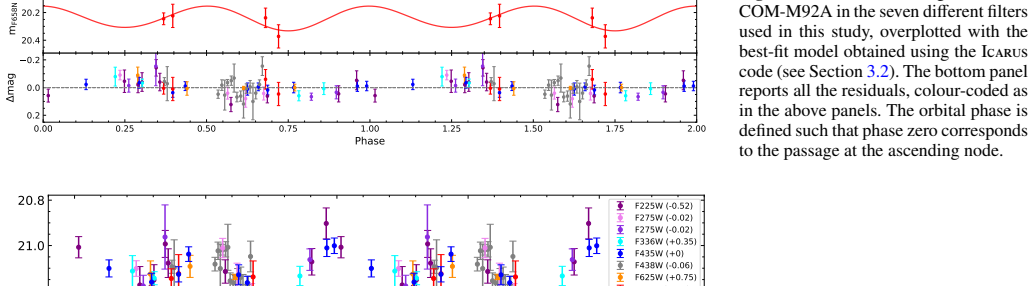
The Icarus binary light-curve synthesis code, using ATLAS9 atmosphere grids, is the central tool: it converts phase-folded multi-filter photometry into physical parameters by modeling the companion as a Roche-lobe-filling, tidally distorted star whose surface is darkened and irradiated by the pulsar wind. The key observed feature is the double-humped ellipsoidal modulation, which encodes inclination and masses. The paper also uses the spin-down-to-companion-flux ratio fsd of about 2.71 to place M92A near the transition between ellipsoidal- and irradiation-dominated light curves.
What would settle it
A phase-resolved optical spectrum of COM-M92A that measures the projected radial-velocity semi-amplitude K2: if K2 is not approximately 433 km/s, or if rotational broadening indicates non-synchronous rotation, the light-curve solution and the derived neutron-star mass of about 2.3 solar masses would be wrong. An independent check would be a precise neutron-star mass from pulsar timing, such as through the Shapiro delay or the rate of periastron advance, which would directly test the massive-neutron-star claim.
Extended reading notes
Core claim
The authors argue that COM-M92A, the star 0.02 arcseconds from the radio timing position of PSR J1717+4308A, is the optical companion to this redback pulsar. They base this on three independent lines of evidence: the star sits within the combined 3-sigma position uncertainty of the radio source; its proper motion matches the cluster M92's bulk motion, ruling out a field interloper; and its flux varies with the binary orbital period in a double-maxima/double-minima pattern typical of a tidally distorted star seen at high inclination. Light-curve modeling with the Icarus synthesis code, assuming tidal locking and a gravity-darkening law for a convective envelope, gives i around 79 degrees, mas
Load-bearing premise
The derived masses and temperature depend on the companion being tidally locked and obeying the assumed gravity-darkening law for a convective envelope (co-rotation factor omega = 1 and beta = 0.08); if the star rotates differently or its envelope is partly radiative, the ellipsoidal light-curve inversion shifts, and with it the companion mass, neutron-star mass, and the claim that 7200 K is anomalously hot.
Editorial extensions
If this is right
- If the parameters are correct, the neutron star mass of about 2.3 solar masses is at the high end for neutron stars in globular clusters, providing a constraint on the dense-matter equation of state.
- The companion temperature of about 7200 K makes M92A an outlier among redbacks, which typically have companions cooler than 6000 K, suggesting an atypical evolutionary history or a special formation channel in a dense cluster.
- The high inclination and low irradiation of the system make it a promising target for future phase-resolved spectroscopy and eclipse timing to verify the orbital geometry and the derived masses.
- Adding M92A to the small sample of cluster redbacks with fully modeled light curves allows for population comparisons with field redbacks and tests of the fsd boundary between ellipsoidal- and irradiation-dominated regimes.
Reading between the lines
- A direct radial-velocity measurement of the companion via phase-resolved spectroscopy could independently confirm the projected semi-amplitude K2 of about 433 km/s; if K2 differs significantly, the inclination and masses derived from the ellipsoidal fit would need revision.
- The second-hottest status hints that redback companion temperatures may not form a single population; if more cluster redbacks are found with hot companions, the assumed relationship between irradiation efficiency and light-curve morphology may need recalibration.
- The best-fit solution leaves a small unrecovered phase-dependent residual; with more epochs, including spots or asymmetric heating in the model could shift the derived base temperature and Roche-lobe filling factor.
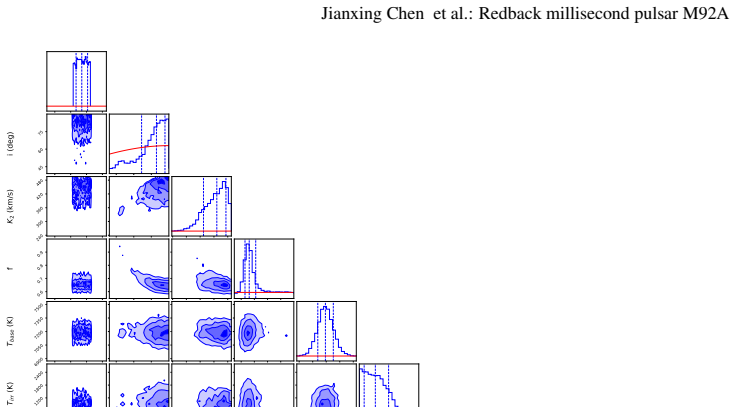
- Because the analysis truncates the neutron-star prior at 3 solar masses, the reported M1 = 2.3 +/- 0.5 solar masses is a lower-tail estimate; a prior extending to higher masses would change the posterior shape, and a future precise mass from pulsar timing would provide a sharp test.
Editorial analysis
A structured set of objections, weighed in public.
Referee Report
Summary. The paper identifies COM-M92A, a star located 0.02 arcsec from the radio position of PSR J1717+4308A in M92, as the likely optical companion of this redback pulsar. The identification is based on astrometric proximity, cluster membership from proper motions, location in the CMD, and phase-folded photometric variability at the radio orbital period. The authors then model the seven-filter HST light curves with the Icarus code, fitting orbital inclination, K2, Roche-lobe filling factor, base/irradiation temperatures, distance, and extinction. The best-fit model gives i≈79 deg, q≈10, M2≈0.23 Msun, M1≈2.3 Msun, and T_base≈7191 K, placing the companion among the hottest redbacks known. The paper concludes that mild irradiation is consistent with the spin-down-to-companion flux ratio f_sd≈2.71, and discusses the system's evolutionary implications.
Significance. If the inferred parameters are robust, the identification is a valuable addition to the small sample of redback pulsar companions in globular clusters, and the system is notable for its hot companion and possibly massive neutron star. The identification itself is strong and multi-probe: the 0.02 arcsec offset, the proper-motion membership, the photometric variability only at the radio period, and the clean PSF subtraction together make a convincing case. However, the quantitative light-curve results — and hence the mass and temperature claims — rest on a fixed gravity-darkening prescription that is in tension with the fitted temperature, and on a quietly imposed neutron-star-mass cap. These issue need to be addressed before the physical claims can be taken at face value.
major comments (3)
- [Sect. 3.2, Table 1] The headline parameters are derived with two fixed assumptions: co-rotation (omega=1) and Lucy (1967) gravity darkening beta=0.08, justified by a convective envelope. The fitted T_base=7191 K (with T_sup/T_inf~7050 K) places the star in a regime where a radiative envelope and beta~0.25 may be more appropriate. Since the ellipsoidal amplitude is converted into (i, f, K2) through the assumed surface-brightness distribution, beta directly affects the derived masses. The posterior is also truncated by a prior M1<3 Msun, which can hide the direction of the shift. Please present a refit with beta=0.25 (or a marginalization over beta), and report the fraction of posterior samples near the mass-cap boundary.
- [Sect. 4] The f_sd~2.71 argument is partially circular: it is computed using T_base from the same Icarus fit and then compared with the empirical transition boundary of Turchetta et al. (2023). This does not independently confirm the 'mild irradiation' interpretation; it is a consistency check with the same model-dependent temperature scale. I request a range of f_sd from the posterior of T_base (and independent estimates of L_sd), and a more cautious wording of the irradation conclusion.
- [Fig. 4, Sect. 4] The paper itself notes an unrecovered phase-dependent residual structure, attributed to limited statistics. Given that the surface-brightness model is the load-bearing part of the parameter inference, this is not merely a cosmetic issue. Please quantify the residuals (per-filter rms, phase-binned residuals) and discuss whether a different beta or an additional physical component could remove them. This is directly relevant to the credibility of the derived masses and temperatures.
minor comments (4)
- [Sect. 3.2] The resampling step that randomly draws 20 data points per filter with replacement discards information and introduces stochasticity into the fit. A weighted likelihood using all data points would be preferable, or at least a seed-independent demonstration that the results are stable.
- [Fig. 6] A_V closely follows its prior and D is prior-dominated; the paper should state explicitly that the HST light curves do not constrain extinction or distance beyond their priors.
- [Table 1] Please clarify the relation between T_base, T_sup, and T_inf: the quoted values are nearly identical, which is surprising for a strongly irradiated redback; a brief explanation of how gravity darkening and irradiation combine would help.
- [References and text] Minor editorial items: 'Turchetta et al 2023' is missing a dot; 'Bobakov et al. 2024, 2025' entries are not uniformly formatted; and the symbol f_sd is written both as f_sd and fsd in places. Also, Fig. 1 mixes '3σ uncertainty' with the quoted 13 mas astrometric accuracy; please define the combined uncertainty explicitly.
Circularity Check
No significant circularity: companion identification and light-curve fit are self-contained; the f_sd argument is a post-fit consistency check, not a forced prediction.
full rationale
The paper's derivation chain does not reduce to its inputs. The companion identification (Sect. 3.1) rests on independent evidence: a 0.02″ offset from the radio timing position, cluster-member proper motion from HACKS, an out-of-sequence CMD position, and photometric variability phased to the radio orbital period; none of these is defined in terms of the fitted light-curve parameters. The light-curve modeling (Sect. 3.2) is a standard forward-model fit with the public Icarus code and ATLAS9 atmospheres, anchored to the radio-derived x1 and Porb and to external distance/extinction priors; the fitted i, K2, f, Tbase, Tirr and derived q, M1, M2 are posterior results, not recycled constraints. The only same-team citation entering the interpretation is the f_sd boundary of Turchetta et al. (2023), used as a post-fit consistency check (f_sd ≈ 2.71 computed from radio L_sd and the fitted Tbase), while Tirr is a separately fitted parameter whose posterior peaks near zero. The agreement is therefore a non-forced consistency statement, not a constructional identity. The fixed tidally-locked/β=0.08 assumption, the M_NS < 3 M☉ prior, and the noted unrecovered phase-dependent residuals (Sect. 4) are model-robustness and correctness caveats, not circular reductions; they do not make the derivation equivalent to its inputs. I find no significant circularity.
Assumptions & free parameters
free parameters (8)
- x1 (pulsar projected semi-major axis) =
≈0.399 lt-s (uniform prior bounded by radio value 0.398703 lt-s)
- orbital inclination i =
79° (+7/−13)
- companion radial-velocity semi-amplitude K2 =
433 (+40/−58) km/s
- Roche-lobe filling factor f =
0.66 (+0.05/−0.03)
- base temperature T_base =
7191 (+88/−85) K
- irradiation temperature T_irr =
754 (+620/−525) K
- distance D =
7.3 (+0.6/−0.5) kpc
- V-band extinction A_V =
0.07±0.04 mag
assumptions (7)
- domain assumption Tidal locking: co-rotation factor ω=1
- domain assumption Gravity darkening β=0.08 (Lucy 1967)
- domain assumption Icarus + atlas9 grids correctly model the distorted, heated surface
- domain assumption Radio ephemeris of Pan et al. (2020) valid at HST epochs 2004-2019
- domain assumption Cluster membership from HACKS proper motions (Libralato et al. 2022)
- domain assumption Neutron-star mass < 3 M☉ constraint
- ad hoc to paper Uniform prior on cos i (detectability prior)
Cite this review
Pith. "Pith review of Exploring the optical properties of redback pulsars: The case of J1717+4308A in the globular cluster M92." pith.science (2026). https://pith.science/paper/2IGCGXND
@misc{pith2026260722289,
  author       = {Pith},
  title        = {Pith review of: Exploring the optical properties of redback pulsars: The case of J1717+4308A in the globular cluster M92},
  year         = {2026},
  howpublished = {\url{https://pith.science/paper/2IGCGXND}},
  note         = {Machine review of arXiv:2607.22289}
}
abstract
Binary millisecond pulsars (MSPs) in globular clusters (GCs) are key for binary and stellar evolution studies under extreme conditions. The identification of their optical companion stars is instrumental in order to characterise these systems and to constrain the possible recycling mechanisms. For this work, we searched for the optical counterpart to PSR J1717+4308A (hereafter M92A) in the GC M92. To this end, we exploited a multi-epoch, multi-wavelength dataset obtained with the Hubble Space Telescope. We constructed colour--magnitude diagrams, investigated proper motions to assess cluster membership, and modelled the observed light curves. We identified an object located at only 0.02 arcsec from the nominal radio position as the likely optical companion to M92A. The star is significantly bluer than the main sequence at the same luminosity level and exhibits clear photometric variability with a periodicity in agreement with the orbital motion of the binary. The light curve displays two maxima and two minima, indicative of strong tidal distortion and only mild irradiation. Such mild irradiation is consistent with the ratio of the pulsar spin-down to the companion flux ($f_\mathrm{sd}$), which for M92A lies close to the boundary between ellipsoidal- and irradiation-dominated regimes ($f_\mathrm{sd} \approx 2.71$). From the light curve modelling we inferred the main physical properties of the companion star. The best-fit model indicates a high-inclination system with a relatively low-mass companion and a massive neutron star. With a base temperature of $\sim7200$ K, the companion ranks among the hottest redbacks known to date. This object therefore adds additional pieces to the puzzle of MSP companion properties and contributes to outlining the characteristics of redbacks across the different classes.
Figures


Figures from the paper (3 more)

Reference graph
Works this paper leans on
-
[1]
A., Cheng, A
Alpar, M. A., Cheng, A. F., Ruderman, M. A., et al. 1982, Nature, 300,
1982
-
[2]
2025, ApJ, 991,
Li, Baoda, Liu, Kuo, Wang, Lin et al. 2025, ApJ, 991,
2025
-
[3]
Barr, E., Dutta, A., Freire, C. C. P., Cadelano, M. et al. 2024, Science, 383, 6680 Bellini, A. & Bedin, L. R. 2009, PASP, 121,
2024
-
[5]
V ., Kirichenko, A
Bobakov, A. V ., Kirichenko, A. Y ., Zharikov, S. V ., et al. 2024, A&A, 690, A173. Bobakov, A. V ., Kirichenko, A., Zharikov, S. V ., et al. 2025, A&A, 702, A256. Breton, R. P., Rappaport, S. A., van Kerkwijk, M. H., et al. 2012, ApJ, 748,
2024
-
[6]
2012, Mem
Knigge C. 2012, Mem. Soc. Astron. Italiana, 83,
2012
-
[11]
R., Dalessandro, E., et al
Cadelano, M., Ferraro, F. R., Dalessandro, E., et al. 2022, ApJ, 941,
2022
-
[19]
P., & Bridges, M
Feroz, F., Hobson, M. P., & Bridges, M. 2009, MNRAS, 398,
2009
-
[25]
2020, ApJ, 905,
Cadelano, M., Chen, J., Pallanca, C., et al. 2020, ApJ, 905,
2020
Show all 76 references
-
[27]
R., Possenti, A., et al
Cocozza, G., Ferraro, F. R., Possenti, A., et al. 2008, ApJ, 679, L105. D’Antona, F. & Tailo, M. 2022, Astrophysics and Space Science Library, 465,
2008
-
[29]
M., Lorimer, D
Pan, Z., Ransom, S. M., Lorimer, D. R., et al. 2020, ApJ, 892, L6. Papitto, A., Ferrigno, C., Bozzo, E., et al. 2013, Nature, 501,
2020
-
[32]
Harris, W. E. 1996, AJ, 112,
1996
-
[36]
R., Mucciarelli, A., Lanzoni, B., et al
Ferraro, F. R., Mucciarelli, A., Lanzoni, B., et al. 2023, Nature Communications, 14,
2023
-
[39]
& Romani, R
Kandel, D. & Romani, R. W. 2023, ApJ, 942, 1,
2023
-
[41]
R., Dalessandro, E., et al
Lanzoni, B., Ferraro, F. R., Dalessandro, E., et al. 2019, ApJ, 887,
2019
-
[42]
J., Strader, J., Chomiuk, L., et al
Swihart, S. J., Strader, J., Chomiuk, L., et al. 2022, ApJ, 941,
2022
-
[44]
Lian, Yujie, Freire P. C. C., Cao, Shuo, Cadelano, Mario, Pallanca, Cristina et al. 2025, ApJ, 981, L3. Lian, Y ., Pan Z., Zhang H., Cao S. et al. 2025, ApJS, 279,
2025
-
[46]
and Hut, P
Pooley, D. and Hut, P. 2006, ApJ, 646,
2006
-
[47]
Lu, T.-N., Kong, A. K. H., Verbunt, F., et al. 2011, ApJ, 736,
2011
-
[51]
2022, ApJ, 934,
Libralato, M., Bellini, A., Vesperini, E., et al. 2022, ApJ, 934,
2022
-
[53]
M., Freire, P
Cadelano, M., Ransom, S. M., Freire, P. C. C., et al. 2018, ApJ, 855,
2018
-
[56]
R., Dalessandro, E., et al
Raso, S., Ferraro, F. R., Dalessandro, E., et al. 2017, ApJ, 839, 1,
2017
-
[59]
Roberts, M. S. E. 2013, Neutron Stars and Pulsars: Challenges and Opportunities after 80 years, 291,
2013
-
[63]
R., et al
Cadelano, M., Pallanca, C., Ferraro, F. R., et al. 2017, ApJ, 844,
2017
-
[64]
Rees, R. F. 1992, AJ, 103,
1992
-
[69]
R., Cadelano, M., et al
Chen, J., Ferraro, F. R., Cadelano, M., et al. 2021, Nature Astronomy, 5,
2021
-
[70]
& Heinke, C
Zhao, J. & Heinke, C. O. 2022, MNRAS, 511,
2022
-
[72]
2026, ApJ, 998, 1,
Turchetta, M., Linares, M., Koljonen, K., et al. 2026, ApJ, 998, 1,
2026
-
[78]
R., et al
Sen, B., Linares, M., Kennedy, M. R., et al. 2024, ApJ, 973,
2024
-
[82]
& van der Klis, M
Wijnands, R. & van der Klis, M. 1998, Nature, 394,
1998
-
[84]
M., et al
Chen, H.-L., Chen, X., Tauris, T. M., et al. 2013, ApJ, 775,
2013
-
[93]
2023, ApJ, 948,
Chen, J., Cadelano, M., Pallanca, C., et al. 2023, ApJ, 948,
2023
-
[115]
2002, ApJ, 574,
Burderi, L., D’Antona, F., & Burgay, M. 2002, ApJ, 574,
2002
-
[121]
J., Benítez, N., et al
Sirianni, M., Jee, M. J., Benítez, N., et al. 2005, PASP, 117,
2005
-
[122]
M., Ferraro, F
Pallanca, C., Ransom, S. M., Ferraro, F. R., et al. 2014, ApJ, 795,
2014
-
[125]
R., Istrate, A
Cadelano, M., Ferraro, F. R., Istrate, A. G., et al. 2019, ApJ, 875,
2019
-
[127]
& Halpern, J
Schroeder, J. & Halpern, J. 2014, ApJ, 793, 2,
2014
-
[150]
2014, ApJ, 795,
Linares, M. 2014, ApJ, 795,
2014
-
[158]
Lucy, L. B. 1967, ZAp, 65, 89 Mata Sánchez, D., Kennedy, M. R., Clark, C. J., et al. 2023, MNRAS, 520, 2,
1967
-
[176]
Lewis, Evan F., Olszanski, Timothy E. E. et al. 2023, ApJ, 956,
2023
-
[191]
Stetson, P. B. 1994, PASP, 106,
1994
-
[201]
R., et al
Dalessandro, E., Lanzoni, B., Ferraro, F. R., et al. 2008, ApJ, 677, 2,
2008
-
[250]
Strader, J., and Swihart, S., and Chomiuk L., 2019, ApJ, 872,
2019
-
[337]
R., Possenti, A., D’Amico, N
Ferraro, F. R., Possenti, A., D’Amico, N. et al. 2001, ApJ, 561, L93–L96. Ferraro, F. R., Possenti, A., Sabbi, E., et al. 2003a, ApJ, 596, L211. Ferraro, F. R., Sills, A., Rood, R. T., et al. 2003b, ApJ, 588,
2001
-
[344]
yun ., Qian, L., et al
Yin, D., Zhang, L.-. yun ., Qian, L., et al. 2024, ApJ, 969, L7. Zhang, P., Xing, Y ., Wang, Z., et al. 2023, ApJ, 945,
2024
-
[380]
Turchetta, M., Linares, M., Koljonen, K., Sen, B., 2023, MNRAS, 525,
2023
-
[393]
R., Lanzoni, B., & Dalessandro, E
Ferraro, F. R., Lanzoni, B., & Dalessandro, E. 2020, Rendiconti Lincei. Scienze Fisiche e Naturali, 31,
2020
-
[395]
2006, Nested sampling for general Bayesian computation, Bayesian Anal
Skilling, J. 2006, Nested sampling for general Bayesian computation, Bayesian Anal. 1 (4) 833 - 859, December
2006
-
[464]
aa60173-26 Ferraro, F
Article number, page 7 of 9 A&A proofs:manuscript no. aa60173-26 Ferraro, F. R., Lanzoni, B., Raso, S., et al. 2018, ApJ, 860,
2018
-
[517]
2020, New A Rev., 91, 101544
Papitto, A., Falanga, M., Hermsen, W., et al. 2020, New A Rev., 91, 101544. Paresce, F., de Marchi, G., & Ferraro, F. R. 1992, Nature, 360, 6399,
2020
-
[549]
2024, Joshspeagledynesty: V2.1.4
Koposov, S., Speagle, J., Barbary, K., et al. 2024, Joshspeagledynesty: V2.1.4. Zenodo, June 25,
2024
-
[553]
W., Filippenko, A
Kandel, D., Romani, R. W., Filippenko, A. V ., et al. 2020, ApJ, 903, 1,
2020
-
[653]
R., Mucciarelli, A., et al
Lanzoni, B., Ferraro, F. R., Mucciarelli, A., et al. 2018, ApJ, 865,
2018
-
[698]
2025, A&A, 704, A261
Ettorre, G., Dalessandro, E., Cadelano, M., Pallanca, et al. 2025, A&A, 704, A261. Ettorre, G., Dalessandro, E., Pallanca, Cadelano, M. et al. 2025, A&A, 697, A215. Ferraro, F. R., Pecci, F. F., Cacciari, C., et al. 1993, AJ, 106,
2025
-
[728]
and Cheng, Z
Bao, T., Li, Z. and Cheng, Z. al. 2023, MNRAS, 521,
2023
-
[768]
R., Beccari, G., Dalessandro, E., et al
Ferraro, F. R., Beccari, G., Dalessandro, E., et al. 2009, Nature, 462,
2009
-
[915]
R., Paltrinieri, B., Rood, R
Ferraro, F. R., Paltrinieri, B., Rood, R. T., et al. 1999, ApJ, 522,
1999
-
[983]
R., D’Amico, N., Possenti, A., et al
Ferraro, F. R., D’Amico, N., Possenti, A., et al. 2001, ApJ, 561,
2001
-
[989]
R., et al
Pallanca, C., Dalessandro, E., Ferraro, F. R., et al. 2010, ApJ, 725,
2010
-
[1028]
R., Lanzoni, B., Dalessandro, E., et al
Ferraro, F. R., Lanzoni, B., Dalessandro, E., et al. 2012, Nature, 492,
2012
-
[1043]
O., Rasio, F
Ivanova, N., Heinke, C. O., Rasio, F. A., et al. 2008, MNRAS, 386, 1,
2008
-
[1049]
Speagle, J. S. 2020, MNRAS, 493,
2020
-
[1069]
S., Torres, D
De Martino, D., Phosrisom, A., Dhillon, V . S., Torres, D. F.,Coti Zelati, F., Bre- ton, R. P., Marsh, T. R., Miraval Zanon, A., Rea, N., Papitto, A. 2024, A&A, 691, A36. Dotter, A., Sarajedini, A., Anderson, J., et al. 2010, ApJ, 708,
2024
-
[1165]
R., et al
Pallanca, C., Dalessandro, E., Ferraro, F. R., et al. 2013, ApJ, 773,
2013
-
[1170]
R., Cadelano, M., et al
Chen, J., Ferraro, F. R., Cadelano, M., et al. 2022, ApJ, 934,
2022
-
[1419]
G., De Vito, M
Benvenuto, O. G., De Vito, M. A., & Horvath, J. E. 2014, ApJ, 786, L7. Benvenuto, O. G., De Vito, M. A., & Horvath, J. E. 2013, MNRAS, 433, L11. Benvenuto, O. G., De Vito, M. A., & Horvath, J. E. 2012, ApJ, 753, L33. Bhattacharya, D. & van den Heuvel, E. P. J. 1991, Phys. Rep., 203,
2014
-
[1487]
O., Rasio, F
Ivanova, N., Heinke, C. O., Rasio, F. A., et al. 2006, MNRAS, 372, 3,
2006
-
[1573]
Ridolfi, A., Freire, P. C. C., Gautam, T., et al. 2022, A&A, 664, A27. Rivera-Sandoval, L. E., van den Berg, M., Heinke, C. O. et al. 2015, MNRAS, 453,
2022
-
[1601]
M., Schlafly, E., Zucker, C., et al
Green, G. M., Schlafly, E., Zucker, C., et al. 2019, ApJ, 887,
2019
-
[2006]
Stetson, P. B. 1987, PASP, 99,
1987
-
[2023]
A., et al
ArXiv e-prints [arXiv:2305.09388] Turchetta, M., Sen, B., Simpson, J. A., et al. 2025, MNRAS, 538,
2025 arXiv
-
[2024]
1993, Robert Kurucz CD-ROM, 13 Lanzoni, B., Ferraro, F
Kurucz, R. 1993, Robert Kurucz CD-ROM, 13 Lanzoni, B., Ferraro, F. R., Dalessandro, E., et al. 2010, ApJ, 717,
1993
-
[2217]
S, 2025, A&A, 693, A314 Nan, R., Li, D., Jin, C., et al
Misra, D., Linares, M., and Ye, C. S, 2025, A&A, 693, A314 Nan, R., Li, D., Jin, C., et al. 2011, International Journal of Modern Physics D, 20,
2025
-
[2324]
R., Paltrinieri, B., Fusi Pecci, F., et al
Ferraro, F. R., Paltrinieri, B., Fusi Pecci, F., et al. 1997, A&A, 324,
1997
-
[2584]
R., Lanzoni, B., Vesperini, E., et al
Ferraro, F. R., Lanzoni, B., Vesperini, E., et al. 2026, Nature Communications, 17, 1,
2026
-
[3132]
Skilling, J. 2004, Bayesian Inference and Maximum Entropy Methods in Sci- ence and Engineering: 24th International Workshop on Bayesian Inference and Maximum Entropy Methods in Science and Engineering, 735,
2004
-
[5964]
Article number, page 8 of 9 Jianxing Chen et al.: Redback millisecond pulsar M92A Appendix A: Dataset summary Table A.1.Summary of the multi-epoch HST dataset used in this work. Proposal ID Observation date Filter Exposure time WFC3 GO-15173 2019 June 28 F225W 800s×2, 805s×3, ...
2019
Reviewed August 1, 2026 · model on record in the stance chip above.
Discussion (0). Sign in to comment.