REVIEW 4 major objections 4 minor 2 cited by
Validation of the DESI DR2 Ly$\alpha$ forest full-shape analysis
T0 review · 4 major / 4 minor · reviewed 2026-08-05 · deepseek-v4-flash
Pith's one-line read The DESI DR2 Lyman-α forest full-shape analysis passes validation for BAO and AP parameters, while the growth-rate fσ8 measurement fails and is excluded.
desk verdict Serious, unusually transparent validation of DESI DR2 Lyα full-shape; AP/BAO case is strong but the unresolved fσ8 mock bias leaves a real gap in the mock-to-data bridge. read the letter →
The pith
A machine-rendered reading of the paper's core claim, the machinery that carries it, and where it could break.
The reading
What carries the argument
The key object is the Alcock–Paczynski distortion parameter φ ≡ q⊥/q∥ = DM H / (DM H)_fid, which rescales separations across and along the line of sight, split into a peak component (φp, from the BAO feature) and a smooth component (φs, from the broadband anisotropy). The analysis jointly fits the two Lyman-α auto-correlations and two Lyman-α–quasar cross-correlations. Two new modeling elements carry the argument: analytic marginalization over the undistorted model at r < rmin (30 h−1 Mpc for the auto-correlation, 40 h−1 Mpc for the cross-correlation) so that continuum-fitting distortion cannot leak small-scale power into the validated scales, and inclusion of ultraviolet-background fluctuat
What would settle it
Run the identical full-shape pipeline on a mock suite in which the density field is fully nonlinear and ultraviolet-background fluctuations are injected with realistic amplitude; if φs shifts by more than the 0.38% (one-third of the statistical uncertainty) threshold across many realizations, the claim that AP is unbiased fails. A sharper test: compare continuum-fitted mocks to true-continuum mocks with the same seeds; a difference in φs larger than the threshold would expose the small-scale marginalization as insufficient.
Extended reading notes
Core claim
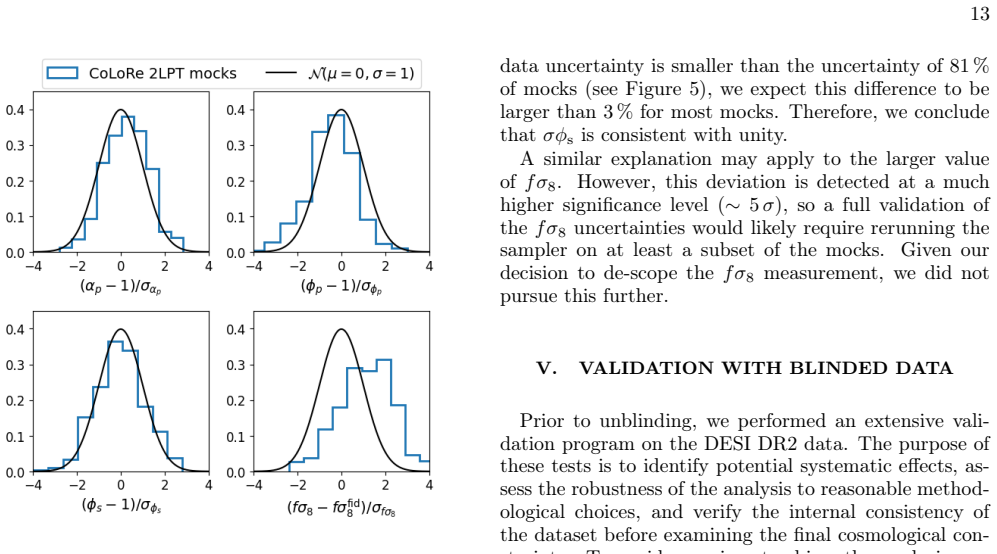
On its own terms, the paper establishes a two-sided validation result. On one side, the BAO parameters αp and φp and the broadband Alcock–Paczynski parameter φs are recovered from stacked mock correlations within one-third of the statistical uncertainty of the real DR2 measurement, and they stay within that tolerance across a large suite of analysis and modeling variations applied to blinded data. The small but statistically significant ~0.6% bias in φp is noted and folded into the systematic budget in the companion analysis. On the other side, the growth-rate parameter fσ8 shows a ~10% bias at ≫5σ significance in the mock stacks, cannot be reconciled by any reasonable modeling variation, an
Load-bearing premise
The mock catalogues used for validation represent the real Lyman-α forest faithfully enough—including small-scale nonlinear clustering, continuum-fitting distortions, and contaminants—that recovering unbiased AP and BAO from them certifies the measurement on the actual data; the large fσ8 bias in the same mocks shows this bridge is imperfect, so it could in principle also fail for AP without being detected.
Editorial extensions
If this is right
- The DR2 Lyman-α forest broadband AP measurement becomes a publishable cosmological result with improved precision over previous Lyman-α full-shape analyses, and can be combined with the companion BAO measurement.
- No fσ8 result will appear from this analysis; the redshift-space-distortion path through the Lyman-α forest is explicitly left for future modeling work.
- The analytic small-scale marginalization and ultraviolet-background fluctuation terms will be carried into future DESI Lyman-α analyses as baseline components.
- The mock-based scale-cut choice (rmin = 30/40 h−1 Mpc) is validated by two independent mock families, so later analyses can adopt it without re-deriving it.
- The pre-registered threshold and de-scoping procedure provides a model for how survey analyses can report which measurements survived validation.
Reading between the lines
- If the fσ8 bias originates in residual small-scale modeling or redshift-error systematics, the same origin could shift φs at a level below current detection; a targeted mock test with ultraviolet-background fluctuations and fully nonlinear small-scale physics would place an upper bound on that hidden shift.
- The φp bias, though within threshold, is anisotropic; propagating it as an equal isotropic uncertainty in the two transverse/line-of-sight dilation parameters could understate the risk.
- The β_HCD prior already sits near the threshold; as DR3 statistical errors shrink, this prior will likely need to be replaced by a direct Lyman-α–DLA cross-correlation measurement.
- The validation design—thresholds fixed before unblinding, a parameter dropped on mock evidence—could serve as a template for other high-precision large-scale structure analyses, but whether it generalizes depends on mock fidelity improving at the same pace as data volume.
Editorial analysis
A structured set of objections, weighed in public.
Referee Report
Summary. This paper presents the validation campaign for the DESI DR2 Lyman-alpha forest full-shape analysis, which combines Lyman-alpha auto-correlations and Lyman-alpha-quasar cross-correlations to measure BAO and the Alcock-Paczynski (AP) parameters, with f_sigma8 as a secondary target. The validation uses 400 CoLoRe 2LPT mock realizations plus AbacusSummit mocks, defines pre-unblinding thresholds set at one-third of the expected statistical uncertainty, and applies a large suite of data splits and analysis/modeling variations to blinded observational data. The central claims are that the BAO parameters (alpha_p, phi_p) and the broadband AP parameter phi_s satisfy the validation criteria and are stable across tests, while f_sigma8 shows a large (~10%, ≫5 sigma) unresolved bias in the mock stack and is therefore excluded from the final cosmological analysis. The paper also describes methodological upgrades relative to DR2 BAO, including analytic small-scale marginalization and the inclusion of ultraviolet background fluctuations.
Significance. If the AP and BAO validation claims hold, this is an important result: it would establish that the DESI DR2 Lyman-alpha full-shape measurement provides a robust broadband AP constraint, a significant step beyond BAO-only analyses. The scale of the mock campaign (400 realizations), the use of blinded data, and the transparent handling of the f_sigma8 failure are genuine strengths; the decision to withhold f_sigma8 is scientifically appropriate and clearly documented. The paper is less novel as a standalone theoretical contribution and is best understood as a validation companion to the DESI DR2 key paper. Its main evidentiary weight depends on the faithfulness of the mocks and on whether the demonstrated stability of phi_s under the tested variations also covers the direction of the model error that produces the f_sigma8 bias.
major comments (4)
- [§IV.B, Fig. 4, Appendix C1] The paper does not quantitatively establish that the unresolved ~10% f_sigma8 mock bias is orthogonal to phi_s. Since phi_s and f_sigma8 are measured from the same anisotropic correlation functions, a model error of the size needed to bias f_sigma8 could in principle shift phi_s by an amount below the 0.38% threshold while leaving f_sigma8 badly biased. The stability of phi_s under the tested variations (Figs. 9-11) is reassuring, but those variations are not targeted along the degeneracy direction of the f_sigma8 bias. I recommend adding a quantitative test: for example, inject the best-fit model difference responsible for the f_sigma8 bias into the mock analysis and measure the induced phi_s shift, or report the posterior correlation between f_sigma8 and phi_s in the mock stack. Without such a test, the claim that the AP measurement is certified by the mock validation is not fully secu
- [§IV.B, §VI.A] The mock stack shows a 0.6% phi_p bias at ~5 sigma significance. The paper states this is within the one-third-of-statistical-uncertainty threshold because the threshold is relative to the DESI DR2 data uncertainty, but the abstract claims that 'BAO and AP parameters satisfy all validation requirements.' Since the final full-shape AP measurement combines phi_s and phi_p into phi_f (stated in §VI.A), the validation should explicitly show that the combined parameter phi_f also satisfies the threshold and that the phi_p bias is propagated into the systematic error budget. As written, the paper defers this to the companion paper [13]; without this demonstration the abstract's claim is stronger than the evidence presented.
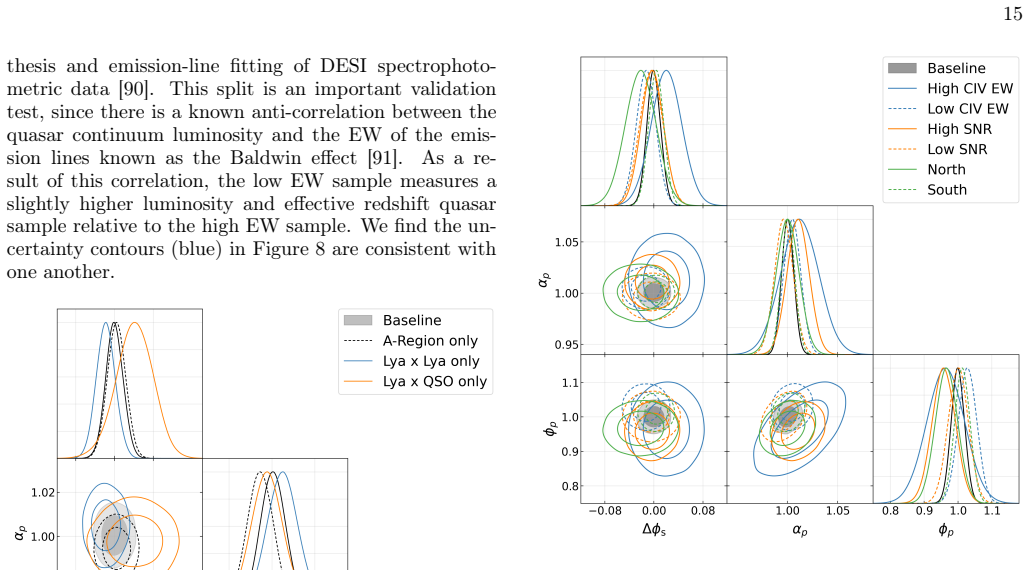
- [§V.B.1, §VI.B, Fig. 9] One analysis variation (Delta_lambda = 2.4 Å) exceeded the predefined 1/3-sigma threshold. The paper attributes this to a statistical fluctuation based on 10 mocks and bootstrap resampling, with a look-elsewhere p-value of about 10% over 19 tests. This is a plausible interpretation, but the decision rule was necessarily post hoc. The abstract's statement that AP parameters 'remain stable across all tests' is therefore too strong; the paper documents one test that exceeded the nominal threshold and was subsequently investigated. Please either temper the summary language or state explicitly the pre-registered criterion under which an exceeded threshold followed by a post hoc fluctuation analysis counts as a pass.
- [§IV.A, §IV.B, §V.B.3] The CoLoRe 2LPT mocks do not include UVB fluctuations, and the model used for mocks removes the UVB component. Consequently, the end-to-end mock validation does not exercise the UVB part of the data model. The data-side variation 'no UVB fluctuations' passes for phi_s, which is helpful, but it is a robustness check rather than a truth test. Because the UVB component was added after evidence from the blinded analysis, it is important to state explicitly how the UVB model's accuracy is constrained independently of the AP result, or to validate the UVB treatment on mocks that include such fluctuations. This is not necessarily fatal, but it is a gap in the 'mocks pass ⇒ data safe' bridge.
minor comments (4)
- [Figure 4 caption] The caption states that f_sigma8 shows 'a ~0.5σ deviation' from the truth, while §IV.B and §VI.A report a ~10% bias at ≫5σ significance and outside the threshold. This is a direct contradiction and should be corrected.
- [Appendix C3 and text] The word 'depreciated' is used repeatedly; the intended term is 'deprecated' (e.g., 'Deprecated Tests' heading and several instances in §VI and Appendix C3).
- [Title page] The arXiv ePrint number is left as 'xxxx.xxxxx'. This is presumably a placeholder and should be updated before publication.
- [§III.E, Fig. 2] The definition of the 1/3-sigma threshold would benefit from an explicit equation or a sentence stating that the threshold is 1/3 of the expected statistical uncertainty of the DESI DR2 combined fit, not of the mock stack; the current text alternates between 'one third of the statistical uncertainty' and the numerical value 0.38% without tying them together for each parameter.
Circularity Check
No significant circularity: the AP/BAO validation is an empirical mock/data check with independent cross-checks; the only mild self-calibration (scale-cut choice) does not reduce to a fitted prediction.
full rationale
This is a validation paper, not a derivation of a cosmological quantity from an input. The central claim is that the recovered AP and BAO parameters pass predefined thresholds when the pipeline is run on mock catalogs with known truth and on blinded data. Those recovered parameters are free parameters of the likelihood; they are not set by the validation criterion. The 1/3-sigma thresholds were fixed before unblinding and are applied to the mock results, and the rmin scale cuts were chosen using the same mock stack and the DR2 data uncertainty. That is a mild self-calibration of the analysis configuration, but it is not circular in the sense of the score rubric: the paper does not rename a fitted input as a prediction, does not define X in terms of Y, and does not invoke a load-bearing self-citation or uniqueness theorem. The model parameters that are calibrated externally (e.g., Arinyo nuisance parameters from ForestFlow simulations, UVB model from the literature) are robustness-tested rather than used to force the AP result. The f-sigma-8 bias found in the same mocks is openly reported and leads to de-scoping that parameter, which is the opposite of circular reasoning. The same conclusions are corroborated with AbacusSummit N-body mocks, population-level pull tests, data splits, and a large suite of blinded analysis variations, so the validation retains independent content. No specific equation is shown to be equivalent to its own input, and no fitted parameter is presented as a prediction. Thus there is no significant circularity.
Assumptions & free parameters
free parameters (7)
- rmin_auto =
30 h^-1 Mpc
- rmin_cross =
40 h^-1 Mpc
- validation_tolerance =
1/3 sigma (about 0.38% in phi_s)
- Arinyo_nonlinear_parameters =
q1=0.303, q2=0.267, k_nu=0.576, a_nu=0.443, b_nu=1.66, kp=11.062
- UVB_response_parameter =
free (no value quoted)
- HCD_priors_beta_HCD_L_HCD =
N(0.5,0.09), N(5.0,2.0)
- distortion_matrix_pixel_fraction =
1%
assumptions (5)
- domain assumption CoLoRe 2LPT and AbacusSummit mocks faithfully represent the real DESI DR2 Lyman-alpha forest and quasar clustering, including small-scale nonlinearities and contaminants.
- domain assumption The Gaussian likelihood with the HEALPix subsampling covariance accurately describes the data vector.
- domain assumption Analytic marginalization over undistorted small scales removes continuum-fitting distortion without biasing larger scales.
- domain assumption The UVB fluctuation model with fiducial parameters and a free response parameter is the correct description of ionizing background fluctuations.
- domain assumption Priors on nuisance parameters (beta_HCD, L_HCD, b_CIV, redshift errors) are calibrated by external measurements.
Cite this review
Pith. "Pith review of Validation of the DESI DR2 Ly$\alpha$ forest full-shape analysis." pith.science (2026). https://pith.science/paper/7Y6FPYWD
@misc{pith2026260727411,
  author       = {Pith},
  title        = {Pith review of: Validation of the DESI DR2 Ly$\alpha$ forest full-shape analysis},
  year         = {2026},
  howpublished = {\url{https://pith.science/paper/7Y6FPYWD}},
  note         = {Machine review of arXiv:2607.27411}
}
abstract
We present the validation of the Dark Energy Spectroscopic Instrument (DESI) Data Release 2 (DR2) Lyman-$\alpha$ (Ly$\alpha$) forest full-shape analysis. This analysis combines three-dimensional Ly$\alpha$ forest auto-correlations and cross-correlations with quasars to extract information from both the baryon acoustic oscillation (BAO) feature and the broadband clustering signal, with primary emphasis on the Alcock-Paczynski (AP) measurement. Compared to the DESI DR1 analysis, the DR2 validation uses substantially larger and more realistic mock datasets, including CoLoRe 2LPT and AbacusSummit Ly$\alpha$ forest simulations. The modeling framework is also improved through analytic marginalization over small scales ($<10$ $h^{-1}$Mpc) and the impact of ultraviolet background fluctuations. The validation program was completed prior to unblinding and defines quantitative requirements for the cosmological parameters of interest, which are evaluated using hundreds of mock realizations. We further test the analysis through independent fits to the auto- and cross-correlations, multiple catalog splits, and a broad suite of analysis and modeling variations applied to both mocks and blinded observational data. We find that the BAO and AP parameters satisfy all validation requirements and remain stable across all tests. In contrast, mock studies reveal a significant bias in the inferred growth-rate parameter $f\sigma_8$, leading us to exclude this measurement from the final analysis. The consistency across mocks, data splits, and robustness tests demonstrates that the DR2 Ly$\alpha$ full-shape analysis provides a reliable and substantially improved broadband AP measurement over previous Ly$\alpha$ forest studies.
Figures


Figures from the paper (14 more)






Forward citations
Cited by 2 Pith papers
-
DESI DR2 Results IV: Alcock-Paczy\'nski Measurements from the Lyman Alpha Forest and Cosmological Constraints
The full shape of DESI DR2 Lyman-alpha forest correlations constrains the distance ratio DM/DH at z=2.33 to 1.0%, twice as precise as BAO alone.
-
DESI DR2 Results IV: Alcock-Paczy\'nski Measurements from the Lyman Alpha Forest and Cosmological Constraints
DESI DR2 Lyman-alpha forest full-shape correlations yield a 1% Alcock-Paczyński measurement at z=2.33 and 0.8% distance ratio constraints.
Reference graph
Works this paper leans on
-
[13]
DESI Collaboration, A. G. Adame, J. Aguilar, S. Ahlen, S. Alam,et al., JCAP2025, 021 (2025), arXiv:2404.03002 [astro-ph.CO]
arXiv 2025
-
[1]
The first group of these variations re- sult in changes to the dataset, and so we expect them to exhibit some statistical fluctuations due to differences in sample size
Variations in the Estimation of the Fluctuations The first set of variations impact how we measure the Lyαfluctuations. The first group of these variations re- sult in changes to the dataset, and so we expect them to exhibit some statistical fluctuations due to differences in sample size. The brown (circle) points in Figure 9 illustrates how the value ofϕ...
-
[2]
The orange (triangle) points in Figure 9 show the shifts in parameters from these alternative analyses
Variations in the Measurement of Correlations The next set of analysis variations includes changes in the measurement of the correlation functions, covariance matrices, or distortion matrices. The orange (triangle) points in Figure 9 show the shifts in parameters from these alternative analyses. The correlation variation tests are as follows: •dmatr ∥ <34...
-
[3]
The first subset of modeling variations are changes to scale cuts, the results of which are shown in Fig- ure 10
Variations in the Modeling of Correlations and Parameter Estimation We also consider variations of the modeling process in order to test the robustness of our baseline analysis. The first subset of modeling variations are changes to scale cuts, the results of which are shown in Fig- ure 10. The baseline analysis utilizes a single maximum fitted scale ofr ...
2024
-
[4]
E. F. Schlafly, D. Kirkby, D. J. Schlegel, A. D. Myers, A. Raichoor,et al., AJ166, 259 (2023), arXiv:2306.06309 [astro-ph.CO]
arXiv 2023
-
[5]
Growth Rate As discussed in §VI, we chose to de-scopef σ8 from the primary analysis because of a significant and unre- solved bias observed in the mock data, as well as a lack of robustness under several blinded analysis variations. Whilef σ8 remains stable within the one-third statistical uncertainty threshold for variations affecting the mea- sured fluc...
-
[6]
Conse- quently, the analysis variations presented throughout the main text are reported in terms ofϕs, which was treated as the blinded parameter during the validation process
BAO Parameters The primary focus of this work is the validation of the smooth anisotropic component of the full-shape model, characterized by the parametersα s andϕ s. Conse- quently, the analysis variations presented throughout the main text are reported in terms ofϕs, which was treated as the blinded parameter during the validation process. The BAO comp...
-
[7]
∆λ= 3.2Å
Deprecated T ests This appendix contains validation tests that we have depreciated, and therefore their consistency with the baseline analysis was not a requirement for unblinding. These include tests that are inferior or redundant relative to the baseline analysis, or are included for comparison with prior conventions that are no longer relevant. The fir...
Show all 103 references
-
[8]
Albrecht, G
A. Albrecht, G. Bernstein, R. Cahn, W. L. Freedman, J. Hewitt,et al., Report of the dark energy task force (2006), arXiv:astro-ph/0609591 [astro-ph]
2006 arXiv
-
[9]
Aghamousa, J
DESI Collaboration, A. Aghamousa, J. Aguilar, S. Ahlen, S. Alam,et al., arXiv e-prints , arXiv:1611.00036 (2016), arXiv:1611.00036 [astro- ph.IM]
2016 arXiv
-
[10]
M. Levi, C. Bebek, T. Beers, R. Blum, R. Cahn,et al., arXiv e-prints , arXiv:1308.0847 (2013), arXiv:1308.0847 [astro-ph.CO]
2013 arXiv
-
[11]
DESI Collaboration, M. A. Karim, J. Aguilar, S. Ahlen, C. Allende Prieto,et al.,Phys. Rev.D 112, 083514 (2025), arXiv:2503.14739 [astro-ph.CO]
2025 arXiv
-
[12]
Collaboration, M
D. Collaboration, M. Abdul Karim, A. G. Adame, D. Aguado, J. Aguilar,et al., The Astronomical Jour- nal171, 285 (2026)
2026
-
[14]
DESI Collaboration, A. G. Adame, J. Aguilar, S. Ahlen, S. Alam,et al., JCAP2025, 028 (2025), arXiv:2411.12022 [astro-ph.CO]
2025 arXiv
-
[15]
DESI Collaboration, A. G. Adame, J. Aguilar, S. Ahlen, S. Alam,et al., JCAP2025, 012 (2025), arXiv:2404.03000 [astro-ph.CO]
2025 arXiv
-
[16]
DESI Collaboration, A. G. Adame, J. Aguilar, S. Ahlen, S. Alam,et al., JCAP2025, 124 (2025), arXiv:2404.03001 [astro-ph.CO]
2025 arXiv
-
[17]
DESI Collaboration, in preparation (2026)
2026
-
[18]
K. S. Dawson, J. A. Bailey, A. J. Cuesta, J. R. Brown- stein, D. J. Eisenstein,et al., The Astronomical Journal 151, 44 (2016), arXiv:1508.04473 [astro-ph.CO]
2016 arXiv
-
[19]
Abdul Karim, J
M. Abdul Karim, J. Aguilar, S. Ahlen, S. Alam, L. Allen,et al.,Phys. Rev.D 112, 083515 (2025), arXiv:2503.14738 [astro-ph.CO]
2025 arXiv
-
[20]
DESI Collaboration et al., in preparation (2026)
2026
-
[21]
McQuinn, Annual Review of Astronomy and Astro- physics54, 313 (2016)
M. McQuinn, Annual Review of Astronomy and Astro- physics54, 313 (2016)
2016
-
[22]
K. S. Dawson, D. J. Schlegel, C. P. Ahn, S. F. Anderson, É. Aubourg,et al., The Astronomical Journal145, 10 (2013), arXiv:1208.0022 [astro-ph.CO]
2013 arXiv
-
[23]
N. G. Busca, T. Delubac, J. Rich, S. Bailey, A. Font- Ribera,et al., Astronomy & Astrophysics552, A96 (2013)
2013
-
[24]
Slosar, V
A. Slosar, V. Iršič, D. Kirkby, S. Bailey, N. G. Busca, et al., Journal of Cosmology and Astroparticle Physics 2013(04), 026–026
2013
-
[25]
S.-F. Chen, Z. Vlah, and M. White, JCAP2021, 053 (2021)
2021
-
[26]
du Mas des Bourboux, J
H. du Mas des Bourboux, J. Rich, A. Font-Ribera, V. de Sainte Agathe, J. Farr,et al., Astrophys. J.901, 153 (2020), arXiv:2007.08995 [astro-ph.CO]
2020 arXiv
-
[27]
B. A. Reid, L. Samushia, M. White, W. J. Percival, M. Manera,et al.,Mon. Not. Roy. Astron. Soc.426, 2719 (2012), arXiv:1203.6641 [astro-ph.CO]
2012 arXiv
-
[28]
S. Alam, M. Ata, S. Bailey, F. Beutler, D. Bizyaev, et al.,Mon. Not. Roy. Astron. Soc.470, 2617 (2017), arXiv:1607.03155 [astro-ph.CO]
2017 arXiv
-
[29]
S. Alam, M. Aubert, S. Avila, C. Balland, J. E. Bautista,et al.,Phys. Rev.D 103, 083533 (2021), arXiv:2007.08991 [astro-ph.CO]
2021 arXiv
-
[30]
McDonald, Astrophys
P. McDonald, Astrophys. J.585, 34 (2003), arXiv:astro- ph/0108064 [astro-ph]
2003
-
[31]
Seljak, JCAP2012, 004 (2012), arXiv:1201.0594 [astro-ph.CO]
U. Seljak, JCAP2012, 004 (2012), arXiv:1201.0594 [astro-ph.CO]
2012 arXiv
-
[32]
T. N. Miller, P. Doel, G. Gutierrez, R. Besuner, D. Brooks,et al., AJ168, 95 (2024), arXiv:2306.06310 [astro-ph.IM]
2024 arXiv
-
[33]
M. M. Ivanov, Phys. Rev. D109, 023507 (2024)
2024
-
[34]
Cuceu, A
A. Cuceu, A. Font-Ribera, B. Joachimi, and S. Nadathur, 26 Monthly Notices of the Royal Astronomical Society506, 5439 (2021)
2021
-
[35]
Cuceu, H
A. Cuceu, H. K. Herrera-Alcantar, C. Gordon, C. Ramírez-Pérez, E. Armengaud,et al., arXiv e-prints , arXiv:2509.15308 (2025), arXiv:2509.15308 [astro- ph.CO]
2025
-
[36]
Aghamousa, J
DESI Collaboration, A. Aghamousa, J. Aguilar, S. Ahlen, S. Alam,et al., arXiv e-prints , arXiv:1611.00037 (2016), arXiv:1611.00037 [astro- ph.IM]
2016 arXiv
-
[37]
Abareshi, J
DESI Collaboration, B. Abareshi, J. Aguilar, S. Ahlen, S. Alam,et al., AJ164, 207 (2022), arXiv:2205.10939 [astro-ph.IM]
2022 arXiv
-
[38]
J. H. Silber, P. Fagrelius, K. Fanning, M. Schubnell, J. N. Aguilar,et al., AJ165, 9 (2023), arXiv:2205.09014 [astro-ph.IM]
2023 arXiv
-
[39]
DESI Collaboration, A. G. Adame, J. Aguilar, S. Ahlen, S. Alam,et al., AJ167, 62 (2024), arXiv:2306.06307 [astro-ph.CO]
2024 arXiv
-
[40]
Poppett, L
C. Poppett, L. Tyas, J. Aguilar, C. Bebek, D. Bramall, et al., AJ168, 245 (2024)
2024
-
[41]
H. Zou, X. Zhou, X. Fan, T. Zhang, Z. Zhou,et al., PASP 129, 064101 (2017), arXiv:1702.03653 [astro-ph.GA]
2017 arXiv
-
[42]
A. Dey, D. J. Schlegel, D. Lang, R. Blum, K. Burleigh, et al., AJ157, 168 (2019), arXiv:1804.08657 [astro- ph.IM]
2019 arXiv
-
[43]
Yèche, N
C. Yèche, N. Palanque-Delabrouille, C.-A. Claveau, D. D. Brooks, E. Chaussidon,et al., Research Notes of the American Astronomical Society4, 179 (2020), arXiv:2010.11280 [astro-ph.CO]
2020 arXiv
-
[44]
Chaussidon, C
E. Chaussidon, C. Yèche, N. Palanque-Delabrouille, D. M. Alexander, J. Yang,et al., Astrophys. J.944, 107 (2023), arXiv:2208.08511 [astro-ph.CO]
2023 arXiv
-
[45]
A. D. Myers, J. Moustakas, S. Bailey, B. A. Weaver, A.P.Cooper,et al.,AJ165,50(2023),arXiv:2208.08518 [astro-ph.IM]
2023 arXiv
-
[46]
Bailey et al., in preparation (2024)
2024
-
[47]
DESI Collaboration, A. G. Adame, J. Aguilar, S. Ahlen, S. Alam,et al., AJ168, 58 (2024), arXiv:2306.06308 [astro-ph.CO]
2024 arXiv
-
[48]
J. Moon, D. Valcin, M. Rashkovetskyi, C. Saulder, J. N. Aguilar,et al.,Mon. Not. Roy. Astron. Soc.525, 5406 (2023), arXiv:2304.08427 [astro-ph.CO]
2023 arXiv
-
[49]
Gordon, A
C. Gordon, A. Cuceu, J. Chaves-Montero, A. Font- Ribera, A. X. González-Morales,et al., JCAP2023, 045 (2023), arXiv:2308.10950 [astro-ph.CO]
2023 arXiv
-
[50]
A. G. Adame, J. Aguilar, S. Ahlen, S. Alam, D. M. Alexander,et al., JCAP2025, 017 (2025), arXiv:2411.12020 [astro-ph.CO]
2025 arXiv
-
[51]
A. G. Adame, J. Aguilar, S. Ahlen, S. Alam, D. M. Alexander,et al., JCAP2025, 008 (2025), arXiv:2411.12021 [astro-ph.CO]
2025 arXiv
-
[52]
J. Guy, S. Bailey, A. Kremin, S. Alam, D. M. Alexan- der,et al., AJ165, 144 (2023), arXiv:2209.14482 [astro- ph.IM]
2023 arXiv
-
[53]
Font-Ribera, J
A. Font-Ribera, J. Miralda-Escudé, E. Arnau, B. Carithers, K.-G. Lee,et al., Journal of Cosmol- ogy and Astroparticle Physics2012(11), 059–059
-
[54]
Anand, J
A. Anand, J. Guy, S. Bailey, J. Moustakas, J. Aguilar, et al., The Astronomical Journal168, 124 (2024)
2024
-
[55]
Brodzeller, K
A. Brodzeller, K. Dawson, S. Bailey, J. Yu, A. J. Ross, et al., The Astronomical Journal166, 66 (2023)
2023
-
[56]
Busca and C
N. Busca and C. Balland, Quasarnet: Human-level spec- tral classification and redshifting with deep neural net- works (2018), arXiv:1808.09955 [astro-ph.IM]
2018 arXiv
-
[57]
Green, D
D. Green, D. Kirkby, J. Aguilar, S. Ahlen, D. M. Alexan- der,et al., Using active learning to improve quasar iden- tification for the desi spectra processing pipeline (2025), arXiv:2505.01596 [astro-ph.IM]
2025 arXiv
-
[58]
D. M. Alexander, T. M. Davis, E. Chaussidon, V. A. Fawcett, A. X. Gonzalez-Morales,et al., AJ165, 124 (2023), arXiv:2208.08517 [astro-ph.GA]
2023 arXiv
-
[59]
K. M. Gorski, E. Hivon, A. J. Banday, B. D. Wandelt, F. K. Hansen,et al., The Astrophysical Journal622, 759–771 (2005)
2005
-
[60]
Martini, A
P. Martini, A. Cuceu, L. Ennesser, A. Brodzeller, J. Aguilar,et al., JCAP2025, 137 (2025), arXiv:2405.09737 [astro-ph.CO]
2025 arXiv
-
[61]
B. Wang, J. Zou, Z. Cai, J. X. Prochaska, Z. Sun,et al., ApJS259, 28 (2022)
2022
-
[62]
M.-F. Ho, S. Bird, and R. Garnett,Mon. Not. Roy. Astron. Soc.507, 704 (2021), arXiv:2103.10964 [astro- ph.GA]
2021 arXiv
-
[63]
Brodzeller, M
A. Brodzeller, M. Wolfson, D. M. Santos, M. Ho, T. Tan,et al.,Phys. Rev.D 112, 083510 (2025), arXiv:2503.14740 [astro-ph.CO]
2025 arXiv
-
[65]
Ángela García, P
L. Ángela García, P. Martini, A. X. Gonzalez-Morales, A. Font-Ribera, H. K. Herrera-Alcantar,et al., Analysis of the impact of broad absorption lines on quasar red- shift measurements with synthetic observations (2023), arXiv:2304.05855 [astro-ph.CO]
2023 arXiv
-
[66]
Filbert, P
S. Filbert, P. Martini, K. Seebaluck, L. Ennesser, D. M. Alexander,et al.,Mon. Not. Roy. Astron. Soc.532, 3669 (2024), arXiv:2309.03434 [astro-ph.CO]
2024
-
[67]
Busca, J
N. Busca, J. Rich, J. Bautista, A. Cuceu, A. Font-Ribera, et al., Journal of Cosmology and Astroparticle Physics 2025(09), 020
2025
-
[68]
Ramírez-Pérez, I
C. Ramírez-Pérez, I. Pérez-Ràfols, A. Font-Ribera, M. A. Karim, E. Armengaud,et al.,Mon. Not. Roy. Astron. Soc.528, 6666 (2024), arXiv:2306.06312 [astro-ph.CO]
2024 arXiv
-
[69]
Aghanim, Y
Planck Collaboration, N. Aghanim, Y. Akrami, M. Ash- down, J. Aumont,et al.,Astron. Astrophys.641, A6 (2020), arXiv:1807.06209 [astro-ph.CO]
2020 arXiv
-
[70]
J. E. Bautista, N. G. Busca, J. Guy, J. Rich, M. Blomqvist,et al., Astronomy & Astrophysics603, A12 (2017)
2017
-
[71]
Cuceu, H
A. Cuceu, H. K. Herrera-Alcantar, C. Gordon, P. Mar- tini, J. Guy,et al., JCAP2025, 148 (2025), arXiv:2404.03004 [astro-ph.CO]
2025 arXiv
-
[72]
J. Guy, S. G. A. Gontcho, E. Armengaud, A. Brodzeller, A. Cuceu,et al., JCAP2025, 140 (2025), arXiv:2404.03003 [astro-ph.CO]
2025 arXiv
-
[73]
Slosar, A
A. Slosar, A. Font-Ribera, M. M. Pieri, J. Rich, J.- M.L.Goff,et al.,JournalofCosmologyandAstroparticle Physics2011(09), 001
-
[74]
Gordon, A
C. Gordon, A. Cuceu, A. Font-Ribera, H. K. Herrera- Alcantar, J. N. Aguilar,et al.,Mon. Not. Roy. As- tron. Soc.545, staf2035 (2026), arXiv:2505.08789 [astro- ph.CO]
2026
-
[75]
The parameters used in this small-scale correction are fixed in the baseline analysis (q1 : 0.303,q 2 : 0.267,k ν : 0.576,a ν : 0.443,b ν : 1.66, kp : 11.062)
in the modeling of the Lyαauto-correlation, with Gaussian priors (q1 :N(1,2),q 2 :N(0,1), kν :N(1,2),a ν :N(0.3,0.5),b ν :N(1.6,0.5),k p : N(14,10)). The parameters used in this small-scale correction are fixed in the baseline analysis (q1 : 0.303,q 2 : 0.267,k ν : 0.576,a ν :...
2018
-
[76]
M. M. Pieri, M. J. Mortonson, S. Frank, N. Crighton, D. H. Weinberg,et al., Monthly Notices of the Royal Astronomical Society441, 1718–1740 (2014)
2014
-
[77]
McQuinn and M
M. McQuinn and M. White, Monthly Notices of the Royal Astronomical Society415, 2257–2269 (2011)
2011
-
[78]
Font-Ribera and J
A. Font-Ribera and J. Miralda-Escudé, Journal of Cos- mology and Astroparticle Physics2012(07), 028. 27
-
[79]
K. K. Rogers, S. Bird, H. V. Peiris, A. Pontzen, A. Font- Ribera, and B. Leistedt, Monthly Notices of the Royal Astronomical Society476, 3716–3728 (2018)
2018
-
[80]
T.Tan, J.Rich, E.Chaussidon, J.M.L.Goff, C.Balland, et al., Modeling of the high column density systems in the lyman-alpha forest (2025), arXiv:2506.13005 [astro- ph.CO]
2025
-
[81]
Youles, J
S. Youles, J. E. Bautista, A. Font-Ribera, D. Bacon, J. Rich,et al.,Mon. Not. Roy. Astron. Soc.516, 421 (2022), arXiv:2205.06648 [astro-ph.CO]
2022 arXiv
-
[82]
Arinyo-i Prats, J
A. Arinyo-i Prats, J. Miralda-Escudé, M. Viel, and R. Cen, Journal of Cosmology and Astroparticle Physics 2015(12), 017–017
2015
-
[83]
Alcock and B
C. Alcock and B. Paczyński, Nature281, 358 (1979)
1979
-
[84]
Gontcho A Gontcho, J
S. Gontcho A Gontcho, J. Miralda-Escudé, and N. G. Busca, Monthly Notices of the Royal Astronomical Soci- ety442, 187–195 (2014)
2014
-
[85]
Gil-Marín, J
H. Gil-Marín, J. E. Bautista, R. Paviot, M. Vargas- Magaña, S. de la Torre,et al.,Mon. Not. Roy. Astron. Soc.498, 2492 (2020), arXiv:2007.08994 [astro-ph.CO]
2020 arXiv
-
[86]
Chaves-Montero, L
J. Chaves-Montero, L. Cabayol-Garcia, M. Lokken, A. Font-Ribera, J. Aguilar,et al., Astron.Astrophys. 694, 10.1051/0004-6361/202452039 (2025)
2025 doi
-
[87]
Chaves-Montero, A
J. Chaves-Montero, A. Font-Ribera, P. McDonald, E. Ar- mengaud, D. Chebat,et al., JCAP2026, 040 (2026), arXiv:2601.21432 [astro-ph.CO]
2026 arXiv
-
[88]
Loureiro, B
A. Loureiro, B. Moraes, F. B. Abdalla, A. Cuceu, M. McLeod,et al., Monthly Notices of the Royal As- tronomical Society485, 326–355 (2019)
2019
-
[89]
R.Andrae, T.Schulze-Hartung,andP.Melchior,Dosand don’ts of reduced chi-squared (2010), arXiv:1012.3754 [astro-ph.IM]
2010 arXiv
-
[90]
Ramírez-Pérez, J
C. Ramírez-Pérez, J. Sanchez, D. Alonso, and A. Font- Ribera, JCAP2022, 002 (2022), arXiv:2111.05069 [astro-ph.CO]
2022 arXiv
-
[91]
Ruiz-Herrera Bernal et al., in preparation (2026)
2026
-
[92]
H. K. Herrera-Alcantar, A. Muñoz-Gutiérrez, T. Tan, A. X. González-Morales, A. Font-Ribera,et al., JCAP 2025, 141 (2025), arXiv:2401.00303 [astro-ph.CO]
2025 arXiv
-
[93]
Casas, H
L. Casas, H. K. Herrera-Alcantar, J. Chaves-Montero, A. Cuceu, A. Font-Ribera,et al.(DESI Collaboration), Phys. Rev.D 113, 023520 (2026), arXiv:2503.14741 [astro-ph.IM]
2026 arXiv
-
[94]
Hadzhiyska, A
B. Hadzhiyska, A. Font-Ribera, A. Cuceu, S. Chabanier, J. Aguilar,et al.,Mon. Not. Roy. Astron. Soc.524, 1008 (2023), arXiv:2305.08899 [astro-ph.CO]
2023 arXiv
-
[95]
Hadzhiyska, R
B. Hadzhiyska, R. de Belsunce, A. Cuceu, J. Guy, M. M. Ivanov,et al.,Mon. Not. Roy. Astron. Soc.540, 1960 (2025), arXiv:2503.13442 [astro-ph.CO]
1960 arXiv
-
[96]
Cuceu, A
A. Cuceu, A. Font-Ribera, and B. Joachimi, JCAP2020, 035 (2020), arXiv:2004.02761 [astro-ph.CO]
2020 arXiv
-
[97]
Moustakas, J
J. Moustakas, J. Buhler, D. Scholte, B. Dey, and A. Khederlarian, FastSpecFit: Fast spectral synthe- sis and emission-line fitting of DESI spectra (2023), ascl:2308.005
2023
-
[98]
J. A. Baldwin, Astrophys. J.214, 679 (1977)
1977
-
[99]
Ennesser, P
L. Ennesser, P. Martini, A. Font-Ribera, and I. Pérez- Ràfols, Monthly Notices of the Royal Astronomical Soci- ety511, 3514–3523 (2022)
2022
-
[100]
Chabanier, C
S. Chabanier, C. Ravoux, L. Latrille, J. Sexton, É. Ar- mengaud,et al., Monthly Notices of the Royal Astronom- ical Society 10.1093/mnras/stae2255 (2024)
2024 doi
-
[101]
N. G. Karaçaylı, P. Martini, J. Aguilar, S. Ahlen, E. Armengaud,et al., JCAP2025, 004 (2025), arXiv:2505.07974 [astro-ph.CO]
2025 arXiv
-
[102]
Ravoux, M.-L
C. Ravoux, M.-L. Abdul-Karim, J.-M. Le Goff, E. Ar- mengaud, J. N. Aguilar,et al., JCAP2025, 079 (2025), arXiv:2505.09493 [astro-ph.CO]
2025
-
[103]
Pontzen, Physical Review D89, 10.1103/phys- revd.89.083010 (2014)
A. Pontzen, Physical Review D89, 10.1103/phys- revd.89.083010 (2014)
2014 doi
-
[104]
Pérez-Ràfols, A
I. Pérez-Ràfols, A. Font-Ribera, J. Miralda-Escudé, M. Blomqvist, S. Bird,et al.,Mon. Not. Roy. Astron. Soc.473, 3019 (2018), arXiv:1709.00889 [astro-ph.CO]
2018 arXiv
Reviewed August 5, 2026 · model on record in the stance chip above.
Discussion (0). Sign in to comment.