REVIEW 3 major objections 5 minor 144 references
Artificial Intelligence for Spatially Reconfigurable Antennas: Movable, Fluid, and Pinching Antenna Systems
T0 review · 3 major / 5 minor · reviewed 2026-08-04 · deepseek-v4-flash
Pith's one-line read Artificial intelligence is the common design framework that can make movable, fluid, and pinching antennas practical.
desk verdict Competent and useful survey with a cross-architecture AI taxonomy, but the 'practical' framing overstates a simulation-only evidence base that the paper itself admits. read the letter →
The pith
A machine-rendered reading of the paper's core claim, the machinery that carries it, and where it could break.
The reading
What carries the argument
The mechanism carrying the argument is the spatial configuration variable, defined differently in each architecture: a continuous position vector for MA, a discrete port index for FAS, and a continuous longitudinal coordinate along a dielectric waveguide for PASS. Because the channel depends on this variable, every design task becomes a joint optimization whose difficulty grows with the configuration space. The paper's taxonomy — grouping studies by the coupling problem they solve, and then by the AI model family used — is what allows the authors to treat the three architectures as instances of one framework. Structure-guided learning is the key bridge: KKT-guided Transformers for PASS learn
What would settle it
A controlled hardware testbed would settle it: train any of the surveyed MA, FAS, or PASS policies on the standard simulation channels, then run them on measured channels in the same deployment. If the learned policy's throughput, secrecy rate, or sensing accuracy is no better than a fixed-position baseline once acquisition overhead and actuator/switching latency are included, the common-framework claim fails. The paper itself pinpoints this gap: most policies are trained and evaluated in simulation, so the test is whether the gains survive transfer.
Extended reading notes
Core claim
The paper's central claim is that AI is not merely an additional technique but a common design framework for making spatial reconfigurability practical. Across the three architectures, antenna configuration is coupled with channel acquisition, beamforming, user scheduling, power control, trajectory design, phase-shift optimization, and task-oriented resource allocation; these problems are high-dimensional, non-convex, mixed discrete-continuous, and time-varying. The survey argues that learned policies — deep learning and Transformers for fast prediction, deep reinforcement learning and multi-agent RL for sequential decisions, graph neural networks for scalability, large language models for c
Load-bearing premise
The load-bearing premise is that offline-trained AI policies, developed largely on simulated channel models, can be robust and fast enough for real-time use; the paper itself notes that measured MA, FAS, and PASS datasets are scarce and sim-to-real gaps remain.
Editorial extensions
If this is right
- Learned inference can cut decision latency from hundreds of milliseconds to a few milliseconds (e.g., 7.89 ms vs 644 ms for a movable-antenna positioning/beamforming example), making real-time reconfiguration feasible within a coherence interval.
- Sparse-observation extrapolation — reconstructing full-port FAS channel state from 5–10% observed ports — can slash pilot overhead, removing a main barrier to port-domain reconfiguration.
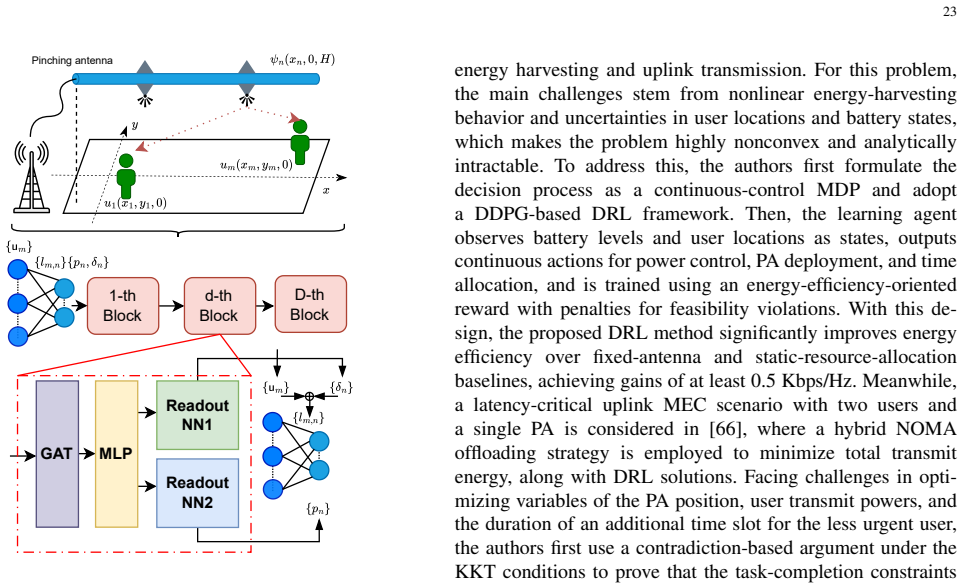
- Structure-guided learning (KKT-embedded Transformers, deep-unfolded WMMSE) can beat both black-box learning and classical optimization in sum rate with millisecond inference, as reported for pinching-antenna systems.
- A unified spatial-variable formulation of MA positions, FAS port states, and PA coordinates would enable transfer learning across architectures, reducing retraining cost for new deployments.
- DRL and MARL can handle dynamic and distributed cases — UAV trajectories, cell-free networks, resilient operation — where repeated optimization is too slow.
Reading between the lines
- If the common-framework thesis holds, the next natural experiment is a single policy that controls a hybrid MA–FAS–PASS aperture; the paper lists hybrid architectures as a future direction but does not test them.
- The reported gains are simulation-based; a measured-channel benchmark could show where the gap to fixed arrays shrinks once channel-estimation overhead, actuator delay, and switching energy are counted.
- The energy cost of large AI backbones (LLMs) may cancel the energy savings of spatial reconfiguration; the paper flags this, implying lightweight models and accelerators are prerequisites, not optional.
- Standardized control interfaces that expose antenna configuration as a programmable network resource would be the concrete route from this framework to deployment.
Editorial analysis
A structured set of objections, weighed in public.
Referee Report
Summary. The paper surveys AI-enabled design for three spatially reconfigurable antenna paradigms—movable antennas, fluid antenna systems, and pinching antenna systems—with a unified taxonomy organized by joint optimization problem (beamforming, channel estimation, ISAC, security, resource allocation, etc.). It summarizes the operating principles and standard channel models for each architecture, reviews a large body of recent learning-based works, compares the roles of DL/DRL/GNN/Transformer/LLM/KKT-guided methods, and closes with open challenges and future directions. The central claim, stated in Section I, is that AI is 'not merely an additional technique, but a common design framework for making spatial reconfigurability practical.'
Significance. The survey fills a genuine gap: prior surveys treat MA, FAS, or PASS separately, while this paper provides a side-by-side treatment of all three under a learning-oriented taxonomy. The channel models quoted in Eqs. (3)–(8), (15), and (19) are standard and appear correctly transcribed, and the summary tables (Tables IV–VIII) give a useful map of recent work. The manuscript is candid about many limitations, especially in Section VI.A.4, which flags the absence of measured datasets and the sim-to-real gap. If the result is taken as a survey of simulation-based AI research, it is a useful reference. However, the load-bearing framing that AI makes spatial reconfigurability 'practical' goes beyond what the surveyed evidence supports, because the evidence base is almost entirely simulation-based and the paper's own caveats undercut the deployability predicate.
major comments (3)
- [Section I vs. Section VI.A.4] The central claim that AI is 'a common design framework for making spatial reconfigurability practical' is not supported by the evidence assembled in the survey. Section VI.A.4 states that 'the limited availability of measured MA, FAS, and PASS datasets means that most policies are trained and evaluated using simulation models,' and Sections III.F, IV.F, and V.D repeat caveats about simplified channel models, perfect CSI, fixed dimensions, and offline training distributions. None of the cited works provides a hardware-validated counterexample. The 'practical' predicate should either be qualified to 'practical in simulation-based design' or the paper should add a dedicated assessment of hardware testbeds, measured channels, and deployment evidence. This is load-bearing because the Introduction's strongest claim rests on it.
- [Section II.D and Section VI.A.5] The paper argues that AI is 'indispensable' because MA/FAS/PASS problems are non-convex, high-dimensional, and time-varying. But it does not compare learned policies against strong classical solvers under equal computational budgets. The claim in Section II.D.a that SCA and AO are 'thwarted' without strong initialization is contradicted by works cited in the survey itself: [88] provides a robust AO solution for MA-enabled vehicular networks, and [12] presents an optimization-based algorithm with provable convergence to stationary points. Many numerical comparisons in Sections III–V use baselines such as FPA, random selection, or WMMSE with random positions, which do not establish that AI is necessary or superior to a well-initialized classical method. The 'necessity' framing should be softened to 'attractive practical/complexity-motivated alternative' unless the survey provides a systema
- [Tables IV–VIII and performance numbers in Sections III–V] The survey repeatedly reports specific numerical gains—e.g., 'from about 2.8 to about 3.5' in Section III.A, '4.23 bits/s/Hz' in Section III.A, '23.7%, 11.7%, and 9%' in Section V.B—without a common benchmark protocol. These numbers come from heterogeneous papers with different channel models, SNRs, system dimensions, and baseline definitions, so their aggregation is not evidence for a 'common design framework.' If the comparative claim is to be load-bearing, the survey should either state explicit inclusion/exclusion criteria for performance numbers, provide a uniform re-evaluation setup, or clearly mark these as illustrative single-paper results rather than cross-paper comparisons.
minor comments (5)
- [Section III.B] The paragraph describing [65] appears twice: the text after the [65] citation in Section III.B is essentially repeated verbatim later in the same subsection. Please remove the duplication.
- [Section II.C, Eq. (19)] Equation (19) contains a typo: 'where where q_{w,m} and u_k denote...' should read 'where q_{w,m} and u_k denote...'.
- [Throughout] The manuscript has several spacing and capitalization inconsistencies: 'UA V' should be 'UAV', 'accross' should be 'across', 'Section' is sometimes capitalized and sometimes not, and 'PASSs' is used as a plural in some places. A copyedit pass would improve readability.
- [Section I and References] The reference list relies heavily on arXiv preprints and very recent '2026' papers. For a survey, it would be helpful to mark which results are peer-reviewed and to note the preprint status more systematically, so readers can gauge maturity.
- [Table III] The 'Representative work' row in Table III cites only a few references per architecture; consider adding cross-references to the corresponding summary tables (Tables IV–VIII) for traceability.
Circularity Check
Survey with no derived predictions; self-citations present but not load-bearing; simulation-data limitations are acknowledged, not circular.
full rationale
This is a survey/tutorial paper, not a derivation-driven research paper. It introduces no new optimization problem, fits no parameters to data, and makes no quantitative prediction that could reduce to its inputs by construction. The central claim that AI is 'not merely an additional technique, but a common design framework for making spatial reconfigurability practical' is a taxonomical and expository claim, supported by a literature review with external benchmarks in Tables IV–VIII, rather than by a chain of equations or fitted parameters. Self-citations appear (e.g., refs [1]–[5], [14]–[16], [49], [139]–[144]), but they are used for background context, waveform-related extensions, and cell-free examples; none is invoked as a load-bearing uniqueness theorem or as the sole justification for the survey's framework. The paper itself flags the main weakness in Section VI.A.4: 'the limited availability of measured MA, FAS, and PASS datasets means that most policies are trained and evaluated using simulation models,' and the lessons-learned sections repeat concerns about simplified channel models, perfect CSI assumptions, and offline training distributions. These are honest limitations affecting the strength of the 'practical' claim, but they are not circularity: the survey does not attempt to derive deployability from assumptions that already assert deployability. No circular step can be exhibited, so no significant circularity is found.
Assumptions & free parameters
assumptions (5)
- domain assumption Spatial configuration is a common optimization dimension across MA, FAS, and PASS sufficient for unified treatment.
- domain assumption AI can learn effective near-optimal policies for high-dimensional, non-convex, mixed discrete-continuous problems.
- domain assumption PASS channels can be modeled with a lossless-waveguide approximation and effective refractive index n_eff ≈ sqrt(epsilon_r).
- domain assumption FAS port correlation follows Clarke's isotropic scattering model with J0 Bessel correlation.
- domain assumption MA channel can be represented by field-response matrices with planar-wave multipath components.
Cite this review
Pith. "Pith review of Artificial Intelligence for Spatially Reconfigurable Antennas: Movable, Fluid, and Pinching Antenna Systems." pith.science (2026). https://pith.science/paper/KSNAZQ33
@misc{pith2026260800255,
  author       = {Pith},
  title        = {Pith review of: Artificial Intelligence for Spatially Reconfigurable Antennas: Movable, Fluid, and Pinching Antenna Systems},
  year         = {2026},
  howpublished = {\url{https://pith.science/paper/KSNAZQ33}},
  note         = {Machine review of arXiv:2608.00255}
}
read the original abstract
Recently, sixth-generation (6G) wireless networks have moved beyond fixed-array designs toward antenna architectures that can adapt their spatial configuration to specific environmental conditions. Movable antenna, fluid antenna, and pinching antenna systems represent this principle in different ways, but they share a common vision: exploiting spatial flexibility as an additional degree of freedom (DoF) to improve communication, sensing, security, and resource efficiency. These new techniques, however, also bring challenging problems, as antenna configuration must be jointly considered with channel acquisition, beamforming, mobility, and network resource management. Therefore, artificial intelligence (AI) has become an important tool for learning fast and adaptive control policies for these highly coupled systems. In this survey, we provide a unified review of AI for spatially reconfigurable antenna systems. We first introduce the basic principles of movable, fluid, and pinching antennas, which is followed by a summary of the latest AI-enabled designs according to their primary optimization objectives. Furthermore, we compare the roles of deep learning (DL), deep reinforcement learning (DRL), multi-agent reinforcement learning (MARL), graph learning, Transformers, large language models (LLMs), and structure-guided learning across different antenna architectures. Finally, we discuss open challenges and future directions toward scalable, robust, and hardware-aware intelligent reconfigurable antenna networks.
Figures


Figures from the paper (4 more)



Reference graph
Works this paper leans on
-
[65]
Learning- based movable-antenna position optimization with implicit CSI,
L. Lu, W. Mei, X. Wei, H. Hua, Z. Chen, and B. Ning, “Learning- based movable-antenna position optimization with implicit CSI,” in Proc. IEEE PIMRC, 2025, pp. 1–6
2025
-
[67]
Deep learning based channel estimation and beamforming in movable antenna systems,
K. Feng, Z. Wan, A. Liao, W. Ma, L. Zhu, Z. Xiao, Z. Gao, and R. Zhang, “Deep learning based channel estimation and beamforming in movable antenna systems,”arXiv preprint arXiv:2602.07870, 2026
arXiv 2026
-
[88]
Movable-antenna enabled robust vehicular consumer networks under imperfect CSI,
X. Zhang, C. Wang, W. Liu, H. Xing, J. Ren, Z. Xing, and Y . Shen, “Movable-antenna enabled robust vehicular consumer networks under imperfect CSI,”IEEE Trans. Consum. Electron., 2026
2026
-
[12]
Joint transmit and pinching beamforming for pinching antenna system (PASS): Optimization-based or learning-based?
X. Xu, X. Mu, Y . Liu, and A. Nallanathan, “Joint transmit and pinching beamforming for pinching antenna system (PASS): Optimization-based or learning-based?”IEEE Trans. Wireless Commun., vol. 25, pp. 11 449–11 464, 2026
2026
-
[1]
Z. Suiet al., “Multi-functional chirp signalling for next-generation multi-carrier wireless networks: Communications, sensing and ISAC perspectives,”arXiv preprint arXiv:2508.06022, 2025
arXiv 2025
-
[2]
Q. Luoet al., “Chirp-based OCDM and AFDM waveforms for 6G and beyond: Principles, recent advances, and future opportunities,” Authorea, vol. 2026, no. 0218, 2026. [Online]. Available: https: //www.authorea.com/doi/abs/10.22541/au.177145233.37871971/v1
arXiv 2026
-
[3]
AFDM: Evolving OFDM towards 6G+,
H. S. Rouet al., “AFDM: Evolving OFDM towards 6G+,”arXiv preprint arXiv:2602.08163, 2026
arXiv 2026
-
[4]
Robust direct posi- tion determination for chirp signal-based underwater acoustic sensor networks,
W. Wang, S. Yan, L. Mao, Z. Sui, and J. Yang, “Robust direct posi- tion determination for chirp signal-based underwater acoustic sensor networks,”Signal Processing, vol. 230, p. 109841, 2025
2025
Show all 144 references
-
[5]
Ambiguity-free broadband DOA estimation relying on parameterized time-frequency transform,
W. Wang, S. Yan, L. Mao, Z. Sui, and J. Yang, “Ambiguity-free broadband DOA estimation relying on parameterized time-frequency transform,”IEEE Signal Processing Letters, 2025
2025
-
[6]
Learning to jointly optimize antenna positioning and beamforming for movable antenna-aided systems,
Y . Wang, Y . Li, Z. Ren, J. Lei, Y .-C. Wu, and R. Zhang, “Learning to jointly optimize antenna positioning and beamforming for movable antenna-aided systems,”arXiv preprint arXiv:2603.16449, 2026
2026
-
[7]
Two-timescale deep optimization of positioning and beamforming in movable antenna arrays,
F. Liang, Y . Cai, A. Liu, and B. Champagne, “Two-timescale deep optimization of positioning and beamforming in movable antenna arrays,”IEEE Trans. Wireless Commun., vol. 25, pp. 14 242–14 258, 2026
2026
-
[8]
Learning-based joint beamforming and antenna movement design for movable antenna systems,
C. Weng, Y . Chen, L. Zhu, and Y . Wang, “Learning-based joint beamforming and antenna movement design for movable antenna systems,”IEEE Wireless Commun. Lett., vol. 13, no. 8, pp. 2120–2124, Aug 2024
2024
-
[9]
Hybrid near-far field 6D movable antenna design exploiting directional sparsity and deep learning,
X. Shao, L. Hu, Y . Sun, X. Li, Y . Zhang, J. Ding, X. Shi, F. Chen, D. W. K. Ng, and R. Schober, “Hybrid near-far field 6D movable antenna design exploiting directional sparsity and deep learning,”IEEE Trans. Wireless Commun., vol. 25, pp. 3736–3749, Sep 2026
2026
-
[10]
A tutorial on fluid antenna system for 6G networks: Encompassing communication theory, optimization methods and hardware designs,
W. K. New, K.-K. Wong, H. Xu, C. Wang, F. R. Ghadi, J. Zhang, J. Rao, R. Murch, P. Ramírez-Espinosa, D. Morales-Jimenezet al., “A tutorial on fluid antenna system for 6G networks: Encompassing communication theory, optimization methods and hardware designs,” IEEE Commun. Surve...
2025
-
[11]
AI- empowered fluid antenna systems: Opportunities, challenges, and future directions,
C. Wang, Z. Li, K.-K. Wong, R. Murch, C.-B. Chae, and S. Jin, “AI- empowered fluid antenna systems: Opportunities, challenges, and future directions,”IEEE Wireless Commun., vol. 31, no. 5, pp. 34–41, Oct 2024
2024
-
[13]
Graph neural network enabled pinching antennas,
X. Xie, Y . Lu, and Z. Ding, “Graph neural network enabled pinching antennas,”IEEE Wireless Commun. Lett., vol. 14, no. 9, pp. 2982–2986, Sep 2025
2025
-
[14]
RIS-assisted cell-free massive MIMO relying on reflection pattern modulation,
Z. Sui, H. Q. Ngo, T. Van Chien, M. Matthaiou, and L. Hanzo, “RIS-assisted cell-free massive MIMO relying on reflection pattern modulation,”IEEE Trans. Commun., vol. 73, no. 2, pp. 968–982, Feb 2024. 28
2024
-
[15]
STAR-RIS-aided cell-free massive MIMO with imperfect hardware,
Z. Sui, H. Q. Ngo, and M. Matthaiou, “STAR-RIS-aided cell-free massive MIMO with imperfect hardware,” inProc. IEEE GLOBECOM, 2024, pp. 5259–5264
2024
-
[16]
Performance analysis and optimization of STAR-RIS-aided cell-free massive MIMO sys- tems relying on imperfect hardware,
Z. Sui, H. Q. Ngo, M. Matthaiou, and L. Hanzo, “Performance analysis and optimization of STAR-RIS-aided cell-free massive MIMO sys- tems relying on imperfect hardware,”IEEE Trans. Wireless Commun., vol. 24, no. 4, pp. 2925–2939, Apr 2025
2025
-
[17]
Opportunistic fluid antenna multiple access via team-inspired rein- forcement learning,
N. Waqar, K.-K. Wong, C.-B. Chae, R. Murch, S. Jin, and A. Sharples, “Opportunistic fluid antenna multiple access via team-inspired rein- forcement learning,”IEEE Trans. Wireless Commun., vol. 23, no. 9, pp. 12 068–12 083, Sep 2024
2024
-
[18]
Learning-induced channel extrapolation for fluid antenna systems using asymmetric graph masked autoencoder,
H. Zhang, J. Wang, C. Wang, C.-C. Wang, K.-K. Wong, B. Wang, and C.-B. Chae, “Learning-induced channel extrapolation for fluid antenna systems using asymmetric graph masked autoencoder,”IEEE Wireless Commun. Lett., vol. 13, no. 6, pp. 1665–1669, Jun 2024
2024
-
[19]
Taaformer: Transposed angular attention for channel estimation with fluid anten- nas,
W. Zhao, Y . Miao, M. Liu, X. Liang, D. Hu, and Y . Zhu, “Taaformer: Transposed angular attention for channel estimation with fluid anten- nas,”IEEE Trans. Cogn. Commun. Netw., vol. 12, pp. 7338–7352, 2026
2026
-
[20]
LLM-based port selection and beamforming for multiuser MISO with fluid antenna systems,
W. Guo, K. Liang, G. Zheng, X. Chu, G. Zhou, K.-K. Wong, and C.- B. Chae, “LLM-based port selection and beamforming for multiuser MISO with fluid antenna systems,”IEEE Trans. Netw. Sci. Eng., vol. 13, pp. 4026–4042, 2025
2025
-
[21]
Graph neural network enabled fluid antenna systems: A two-stage approach,
C. He, Y . Lu, W. Chen, B. Ai, K.-K. Wong, and D. Niyato, “Graph neural network enabled fluid antenna systems: A two-stage approach,” IEEE Trans. Veh. Technol., vol. 74, no. 10, pp. 16 625–16 629, Oct. 2025
2025
-
[22]
Campass-net: A deep learning framework on capacity maximization for MIMO pinching antenna systems in IoT,
J.-M. Kang, S. Yun, and I.-M. Kim, “Campass-net: A deep learning framework on capacity maximization for MIMO pinching antenna systems in IoT,”IEEE Internet Things J., vol. 12, no. 21, pp. 45 917– 45 920, Nov. 2025
2025
-
[23]
A graph neural network for learning beamforming in pinching antenna systems (PASS),
J. Guo, Y . Liu, and A. Nallanathan, “A graph neural network for learning beamforming in pinching antenna systems (PASS),”IEEE Wireless Commun. Lett., vol. 14, no. 12, pp. 3962–3966, Dec 2025
2025
-
[24]
Channel estimation for pinching-antenna systems (PASS),
J. Xiao, J. Wang, and Y . Liu, “Channel estimation for pinching-antenna systems (PASS),”IEEE Commun. Lett., vol. 29, no. 8, pp. 1789–1793, Aug 2025
2025
-
[25]
Deep learning-driven time- varying fading channel estimation for pinching antenna systems,
S. Lv, T. Liu, R. Yang, M. Li, and Y . Liu, “Deep learning-driven time- varying fading channel estimation for pinching antenna systems,”IEEE Wireless Commun. Lett., vol. 15, pp. 2569–2573, 2026
2026
-
[26]
LLM-enabled antenna partitioning and beamforming optimization for segmented pinching,
Q. Gao, R. Zhong, H. Shin, and Y . Liu, “LLM-enabled antenna partitioning and beamforming optimization for segmented pinching,” arXiv preprint arXiv:2604.10372, 2026
2026 arXiv
-
[27]
Movable antennas for wireless communication: Opportunities and challenges,
L. Zhu, W. Ma, and R. Zhang, “Movable antennas for wireless communication: Opportunities and challenges,”IEEE Commun. Mag., vol. 62, no. 6, pp. 114–120, Jun 2024
2024
-
[28]
A tutorial on movable antennas for wireless networks,
L. Zhu, W. Ma, W. Mei, Y . Zeng, Q. Wu, B. Ning, Z. Xiao, X. Shao, J. Zhang, and R. Zhang, “A tutorial on movable antennas for wireless networks,”IEEE Commun. Surveys Tuts., vol. 28, pp. 3002–3054, 2026
2026
-
[29]
Pinching- antenna systems: Architecture designs, opportunities, and outlook,
Y . Liu, Z. Wang, X. Mu, C. Ouyang, X. Xu, and Z. Ding, “Pinching- antenna systems: Architecture designs, opportunities, and outlook,” IEEE Commun. Mag., vol. 64, no. 1, pp. 190–196, Jan. 2026
2026
-
[30]
Pinching antennas: Principles, appli- cations and challenges,
Z. Yang, N. Wang, Y . Sun, Z. Ding, R. Schober, G. K. Karagiannidis, V . W. Wong, and O. A. Dobre, “Pinching antennas: Principles, appli- cations and challenges,”IEEE Wireless Commun., vol. 33, no. 2, pp. 175–184, Apr 2026
2026
-
[31]
Reconfigurable antennas for next-generation mobile communication networks: A comprehensive survey and tutorial,
Y . Zhao, L. Zhang, H. Yang, K. Yang, R. Zhang, L. Song, and Y . Liu, “Reconfigurable antennas for next-generation mobile communication networks: A comprehensive survey and tutorial,”IEEE Commun. Surveys Tuts., vol. 28, pp. 5267–5306, 2026
2026
-
[32]
Advanced deep learning models for 6G: Overview, opportunities, and challenges,
L. Jiao, Y . Shao, L. Sun, F. Liu, S. Yang, W. Ma, L. Li, X. Liu, B. Hou, X. Zhanget al., “Advanced deep learning models for 6G: Overview, opportunities, and challenges,”IEEE Access, vol. 12, pp. 133 245–133 314, 2024
2024
-
[33]
Agentic graph neural networks for wireless communications and networking towards edge general intelligence: A survey,
Y . Lu, S. Zhang, C. Liu, R. Zhang, B. Ai, D. Niyato, W. Ni, X. Wang, and A. Jamalipour, “Agentic graph neural networks for wireless communications and networking towards edge general intelligence: A survey,”IEEE Commun. Surveys Tuts., vol. 28, pp. 4519–4554, 2026
2026
-
[34]
AI reasoning for wireless communications and networking: A survey and perspectives,
H. Luo, Y . Yan, Y . Bian, W. Feng, R. Zhang, Y . Liu, J. Wang, G. Sun, D. Niyato, H. Yuet al., “AI reasoning for wireless communications and networking: A survey and perspectives,”ACM Comput. Surv., vol. 58, no. 13, pp. 1–38, Oct. 2026
2026
-
[35]
Generative AI for the optimization of next-generation wireless networks: Basics, state-of-the-art, and open challenges,
F. Khoramnejad and E. Hossain, “Generative AI for the optimization of next-generation wireless networks: Basics, state-of-the-art, and open challenges,”IEEE Commun. Surveys Tuts., vol. 27, no. 6, pp. 3483– 3525, Dec. 2025
2025
-
[36]
Deep reinforcement learning for pixel-based movable antenna control in a LEO satellite system,
R. Huang, J. Si, Z. Li, Z. Cheng, B. Deng, and J. Wang, “Deep reinforcement learning for pixel-based movable antenna control in a LEO satellite system,” inProc. IEEE Ucom, 2025, pp. 192–197
2025
-
[37]
Modeling and performance analysis for movable antenna enabled wireless communications,
L. Zhu, W. Ma, and R. Zhang, “Modeling and performance analysis for movable antenna enabled wireless communications,”IEEE Trans- actions on Wireless Communications, vol. 23, no. 6, pp. 6234–6250, June 2024
2024
-
[38]
Two-timescale deep- unfolding for joint optimization of antenna position and beamforming in movable-antenna arrays,
F. Liang, Y . Cai, A. Liu, and B. Champagne, “Two-timescale deep- unfolding for joint optimization of antenna position and beamforming in movable-antenna arrays,” inProc. IEEE ICC, 2025, pp. 1–6
2025
-
[39]
Effective rank analysis and optimization of flex- ible antenna-enabled wireless systems: Movable antennas or pinching antennas?
C. Yang and D. Li, “Effective rank analysis and optimization of flex- ible antenna-enabled wireless systems: Movable antennas or pinching antennas?”arXiv preprint arXiv:2603.20629, 2026
2026
-
[40]
En- hancing comp-RSMA performance with movable antennas: A meta- learning optimization framework,
A. Amhaz, S. Khisa, M. Elhattab, C. Assi, and S. Sharafeddine, “En- hancing comp-RSMA performance with movable antennas: A meta- learning optimization framework,”IEEE Trans. Commun., vol. 74, pp. 3802–3813, 2026
2026
-
[41]
Optimizing downlink C-NOMA transmission with movable antennas: A DDPG- based approach,
A. Amhaz, M. Elhattab, C. Assi, and S. Sharafeddine, “Optimizing downlink C-NOMA transmission with movable antennas: A DDPG- based approach,” inProc. IEEE PIMRC, 2025, pp. 1–6
2025
-
[42]
Movable antenna SWIPT systems with STAR-RIS: A meta DRL approach,
M. Amiri, A. Mohammadzadeh, F. Zeinali, M. R. Mili, M. B. Mash- hadi, and P. Xiao, “Movable antenna SWIPT systems with STAR-RIS: A meta DRL approach,”IEEE Trans. Veh. Technol., vol. 75, no. 4, pp. 6864–6869, Apr 2026
2026
-
[43]
Movable-antenna-assisted covert communications with reconfigurable intelligent surfaces,
W. Xie, Z. Li, C. Yu, H. Xu, J. Wang, W. Wu, X. Li, and L. Yang, “Movable-antenna-assisted covert communications with reconfigurable intelligent surfaces,”IEEE Internet Things J., vol. 12, no. 9, pp. 12 369– 12 382, May 2025
2025
-
[44]
Robust optimization for movable antenna-aided cell- free ISAC with time synchronization errors,
Y . Xiu, Y . Zhao, R. Yang, W. Lyu, D. Niyato, D. I. Kim, G. Liu, and N. Wei, “Robust optimization for movable antenna-aided cell- free ISAC with time synchronization errors,”IEEE Trans. Wireless Commun., vol. 25, pp. 10 082–10 097, Jan 2026
2026
-
[45]
Movable antenna-aided cooperative ISAC network with time synchronization error and imperfect CSI,
Y . Xiu, Y . Zhao, R. Yang, D. Niyato, J. Jin, Q. Wang, G. Liu, and N. Wei, “Movable antenna-aided cooperative ISAC network with time synchronization error and imperfect CSI,”IEEE Trans. Commun., vol. 74, pp. 2968–2983, Dec 2026
2026
-
[46]
Meta-reinforcement learning optimization for movable antenna-aided full-duplex CF-DFRC systems with carrier frequency offset,
Y . Xiu, W. Lyu, Y . Li, R. Yang, P. L. Yeoh, W. Zhang, G. Liu, and N. Wei, “Meta-reinforcement learning optimization for movable antenna-aided full-duplex CF-DFRC systems with carrier frequency offset,”IEEE Trans. Commun., vol. 74, pp. 5803–5819, 2026
2026
-
[47]
Unsupervised learning for optimization in movable antenna-enabled integrated sensing and communications,
Z. Wang, G. Zhang, H. Xu, and X. He, “Unsupervised learning for optimization in movable antenna-enabled integrated sensing and communications,” inProc. IEEE ICICN, 2025, pp. 81–84
2025
-
[48]
Crosstalk-resilient beamforming for movable antenna enabled integrated sensing and communication,
Z. Zhang, Y . Xiu, Z. Dong, J. Yin, M. J. Khabbaz, C. Assi, and N. Wei, “Crosstalk-resilient beamforming for movable antenna enabled integrated sensing and communication,”IEEE Wireless Commun. Lett., vol. 15, pp. 1–16, 2026
2026
-
[49]
Beamforming design for physical security in movable antenna- aided ISAC systems: A reinforcement learning approach,
H. Le Hung, N. H. Huy, N. C. Luong, Q.-V . Pham, D. Niyato, and N. T. Hoa, “Beamforming design for physical security in movable antenna- aided ISAC systems: A reinforcement learning approach,”IEEE Trans. Veh. Technol., vol. 74, no. 11, pp. 18 163–18 167, Nov. 2025
2025
-
[50]
Moving or predicting? RoleAware-MAPP: A role- aware transformer framework for movable antenna position prediction to secure wireless communications,
W. Wang, X. Liu, W. Gong, Y . Zhao, Z. Jiang, K. Li, Q. Zhang, Z. Feng, and K. Yu, “Moving or predicting? RoleAware-MAPP: A role- aware transformer framework for movable antenna position prediction to secure wireless communications,”IEEE Trans. Commun., vol. 74, pp. 5519–5533,...
2026
-
[51]
Can movable antenna-enabled micro-mobility replace UA V-enabled macro- mobility? a physical layer security perspective,
K. Li, K. Yu, D. Ma, Y . Zhao, X. Liu, Q. Zhang, and Z. Feng, “Can movable antenna-enabled micro-mobility replace UA V-enabled macro- mobility? a physical layer security perspective,”IEEE Trans. Mobile Comput., vol. 25, no. 3, pp. 4317–4330, Mar. 2026
2026
-
[52]
Deep learning- assisted jamming mitigation with movable antenna array,
X. Tang, Y . Jiang, J. Liu, Q. Du, D. Niyato, and Z. Han, “Deep learning- assisted jamming mitigation with movable antenna array,”IEEE Trans. Veh. Technol., vol. 74, no. 9, pp. 14 865–14 870, Sep. 2025
2025
-
[53]
Movable antenna array design for jamming mitigation,
Y . Guo, J. Luo, Y . Sun, Z. Lin, and S. Wang, “Movable antenna array design for jamming mitigation,” inProc. IEEE ICC, 2025, pp. 19–25
2025
-
[54]
Deep learning enabled slow fluid antenna multiple access,
N. Waqar, K.-K. Wong, K.-F. Tong, A. Sharples, and Y . Zhang, “Deep learning enabled slow fluid antenna multiple access,”IEEE Commun. Lett., vol. 27, no. 3, pp. 861–865, Mar 2023
2023
-
[55]
Switching-cost-aware deep reinforcement learning for dynamic port selection in fluid antenna systems,
J. Liu, K. Liang, L. Zhao, G. Zheng, H. Gu, K.-K. Wong, and C.-B. Chae, “Switching-cost-aware deep reinforcement learning for dynamic port selection in fluid antenna systems,”IEEE Commun. Lett., vol. 30, pp. 1548–1552, 2026
2026
-
[56]
Beamforming for pinching antenna systems (PASS): KKT-guided large model learning,
X. Xu, Y . Liu, X. Mu, D. Gan, and A. Nallanathan, “Beamforming for pinching antenna systems (PASS): KKT-guided large model learning,” inProc. IEEE/CIC ICCC, 2025, pp. 1–6. 29
2025
-
[57]
Deep learning optimization of two- state pinching antennas systems,
O. G. Karagiannidis, V . E. Galanopoulou, P. D. Diamantoulakis, Z. Ding, and O. A. Dobre, “Deep learning optimization of two- state pinching antennas systems,”IEEE Trans. Cogn. Commun. Netw., vol. 12, pp. 4942–4956, 2025
2025
-
[58]
Straggler-resilient federated learning over a hybrid conventional and pinching antenna network,
B. Wu, F. Fang, M. Zeng, and X. Wang, “Straggler-resilient federated learning over a hybrid conventional and pinching antenna network,” IEEE Trans. Veh. Technol., 2026
2026
-
[59]
Joint antenna position and transmit power optimization for pinching antenna-assisted ISAC systems,
Y . Qin, Y . Fu, and H. Zhang, “Joint antenna position and transmit power optimization for pinching antenna-assisted ISAC systems,”IEEE Wireless Commun. Lett., vol. 14, no. 11, pp. 3535–3539, Nov. 2025
2025
-
[60]
Integrated sensing and communication for segmented waveguide-enabled pinching antenna systems,
Q. Gao, R. Zhong, H. Shin, and Y . Liu, “Integrated sensing and communication for segmented waveguide-enabled pinching antenna systems,”arXiv preprint arXiv:2601.20658, 2026
2026
-
[61]
Pinching antenna system (PASS) enhanced covert communications: Against warden via sensing,
H. Jiang, Z. Wang, Y . Liu, A. Nallanathan, and Z. Ding, “Pinching antenna system (PASS) enhanced covert communications: Against warden via sensing,”IEEE J. Sel. Areas Commun., vol. 44, pp. 4254– 4270, 2026
2026
-
[62]
LLM-driven design for fluid antenna systems,
C. Wang, B. Zhang, Z. Li, K.-K. Wong, H. Xu, G. Zheng, and C.-B. Chae, “LLM-driven design for fluid antenna systems,”IEEE Wireless Commun. Lett., vol. 15, pp. 1065–1069, 2025
2025
-
[63]
Reinforcement learning for channel state information acqui- sition in movable antenna,
J. Choi, “Reinforcement learning for channel state information acqui- sition in movable antenna,”IEEE Wireless Commun. Lett., vol. 15, pp. 1–1, Jan 2026
2026
-
[64]
Ssnet: Flexible and robust channel extrapolation for fluid antenna systems enabled by an self-supervised learning framework,
Y . Gao, Y . Liu, R. Yu, S. Liu, Y . Jin, S. Zhang, S. Xu, and X. Chu, “Ssnet: Flexible and robust channel extrapolation for fluid antenna systems enabled by an self-supervised learning framework,”IEEE J. Sel. Areas Commun., vol. 44, pp. 1276–1289, 2026
2026
-
[66]
Joint optimization in pinching-antenna-assisted NOMA-MEC systems via DRL,
Y . Ma, W. Huang, Z. Ding, D. K. So, and V . Bhatia, “Joint optimization in pinching-antenna-assisted NOMA-MEC systems via DRL,”IEEE Wireless Commun. Lett., vol. 15, pp. 2493–2497, 2026
2026
-
[68]
Deep learning enabled multicast beamforming with movable antenna array,
J.-M. Kang, “Deep learning enabled multicast beamforming with movable antenna array,”IEEE Wireless Commun. Lett., vol. 13, no. 7, pp. 1848–1852, Jul 2024
2024
-
[69]
Deep learning for movable antenna precoding in 2D MISO communication system,
C. Xie, Y . Xiu, S. Yang, and Z. Zhang, “Deep learning for movable antenna precoding in 2D MISO communication system,” inProc. IEEE ICCC, 2024, pp. 2500–2504
2024
-
[70]
Deep learning method for movable antenna- enabled multiuser downlink system,
D. Kim and S.-H. Park, “Deep learning method for movable antenna- enabled multiuser downlink system,” inProc. IEEE APCC, 2025, pp. 1–2
2025
-
[71]
Movable cell-free massive MIMO for high-speed train communications: A PPO- based antenna position optimization,
J. Dai, Y . Liu, J. Zheng, R. Zhang, J. Zhang, and B. Ai, “Movable cell-free massive MIMO for high-speed train communications: A PPO- based antenna position optimization,” inProc. IEEE ICC, 2025, pp. 38–43
2025
-
[72]
Deep reinforce- ment learning for movable antenna-assisted cell-free networks,
Q. Li, W. Wang, Y . Li, F. Yu, C. Zhang, and Y . Huang, “Deep reinforce- ment learning for movable antenna-assisted cell-free networks,”IEEE Wireless Commun. Lett., vol. 14, no. 9, pp. 2783–2787, Sep 2025
2025
-
[73]
NMAP-Net: Deep learning-aided near-field multi- beamforming design and antenna position optimization for XL-MIMO communications,
J.-M. Kang, “NMAP-Net: Deep learning-aided near-field multi- beamforming design and antenna position optimization for XL-MIMO communications,”IEEE Internet Things J., vol. 12, no. 11, pp. 18 397– 18 413, Jun. 2025
2025
-
[74]
New view of learning-aided channel estimation for movable antenna systems,
S. Jang and C. Lee, “New view of learning-aided channel estimation for movable antenna systems,”IEEE Trans. Wireless Commun., vol. 24, no. 7, pp. 5694–5708, Jul. 2025
2025
-
[75]
DRL-based antenna position optimization for MA-assisted OTFS system under imperfect CSI,
M. Wang, Q. Zhang, Y . Zhao, X. Cheng, Z. Dong, D. Wang, and Y . L. Guan, “DRL-based antenna position optimization for MA-assisted OTFS system under imperfect CSI,”arXiv preprint arXiv:2604.23611, 2026
2026 arXiv
-
[76]
Meta-learning-driven resource optimization in full-duplex ISAC with movable antennas,
A. Amhaz, S. Khisa, M. Elhattab, C. Assi, and S. Sharafeddine, “Meta-learning-driven resource optimization in full-duplex ISAC with movable antennas,”IEEE Wireless Commun. Lett., vol. 15, pp. 1603– 1607, 2026
2026
-
[77]
A learning-based flexible beamforming method for movable antenna- enabled integrated sensing, communication and power transmission system,
C. Xie, Y . Li, Q. Tu, Y . Xiu, S. Yang, Z. Hu, J. Jin, and Z. Zhang, “A learning-based flexible beamforming method for movable antenna- enabled integrated sensing, communication and power transmission system,”IEEE Commun. Lett., vol. 29, no. 9, pp. 2043–2047, Sep 2025
-
[78]
Movable antenna-enabled secure transmission for active RIS-aided ISAC systems,
H. Bian, F. Zhao, M. Chen, L. Liu, Y . Yao, H. Jiang, and F. Shu, “Movable antenna-enabled secure transmission for active RIS-aided ISAC systems,”IEEE Trans. Netw. Sci. Eng., vol. 13, pp. 6325–6344, 2026
2026
-
[79]
Distributed antenna selection and beamforming for ELAA based downlink ISAC systems,
Q. Gao, R. Zhong, X. Mu, M. Peng, H. Shin, and Y . Liu, “Distributed antenna selection and beamforming for ELAA based downlink ISAC systems,”IEEE Trans. Veh. Technol., vol. 74, no. 11, pp. 17 865–17 878, Nov 2025
2025
-
[80]
Movable antenna design for UA V-aided federated learning via deep reinforcement learn- ing,
M. Ahmadzadeh, S. Pakravan, and G. A. Hodtani, “Movable antenna design for UA V-aided federated learning via deep reinforcement learn- ing,” inProc. IEEE IKT, 2024, pp. 91–95
2024
-
[81]
Joint trajectory, beamforming and antenna deployment design for movable antenna- aided A2G communication: A DRL-based two-stage method,
T. Zhou, K. Xu, G. Hu, X. Xia, C. Wei, and B. Zhang, “Joint trajectory, beamforming and antenna deployment design for movable antenna- aided A2G communication: A DRL-based two-stage method,” inProc. IEEE/CIC ICCC, 2025, pp. 1–5
2025
-
[82]
Joint deployment, power control and beamforming designs for mov- able antenna-aided UA V communication: A DRL-based two-stage approach,
T. Zhou, K. Xu, G. Hu, C. Li, X. Xia, Y . Chen, and C. Wei, “Joint deployment, power control and beamforming designs for mov- able antenna-aided UA V communication: A DRL-based two-stage approach,”IEEE Trans. Commun., vol. 74, pp. 3753–3769, 2026
2026
-
[83]
Movable antenna- equipped UA V for data collection in backscatter sensor networks: A deep reinforcement learning-based approach,
Y . Bai, B. Xie, R. Zhu, Z. Chang, and R. Jäntti, “Movable antenna- equipped UA V for data collection in backscatter sensor networks: A deep reinforcement learning-based approach,” inProc. IEEE ICC, 2025, pp. 6560–6565
2025
-
[84]
Multi-agent reinforcement learning-based joint optimization for mov- able antenna and RIS-assisted systems,
P. Zhuang, Y . Xiong, S. Sun, S. Yang, L. Liu, Z. Zhang, and N. Wei, “Multi-agent reinforcement learning-based joint optimization for mov- able antenna and RIS-assisted systems,”IEEE Commun. Lett., vol. 30, pp. 332–336, 2025
2025
-
[85]
Learning-based STARS-aided communication system with movable antenna,
C. Yu, Z. Li, C. Nie, and X. Fang, “Learning-based STARS-aided communication system with movable antenna,” inProc. IEEE ECIS, 2025, pp. 1–6
2025
-
[86]
Aerial RIS- aided anti-jamming transmission with movable elements,
C. Geng, W. Xie, K. Xu, X. Xia, C. Wei, and Z. Ye, “Aerial RIS- aided anti-jamming transmission with movable elements,” inProc. IEEE ICCT, 2025, pp. 330–335
2025
-
[87]
Weighted sum-rate maximization by joint antenna grouping and movable RIS deployment,
J. Tang, Z. Lv, J. Xiao, J. Wu, and B. Shim, “Weighted sum-rate maximization by joint antenna grouping and movable RIS deployment,” IEEE Trans. Wireless Commun., vol. 25, pp. 3863–3878, 2025
2025
-
[89]
When movable antenna meets URLLC systems: A deep reinforcement learning approach,
J. Liu, J. Guo, J. Xu, Y . Zhang, and X. Liang, “When movable antenna meets URLLC systems: A deep reinforcement learning approach,” IEEE Trans. Veh. Technol., 2026
2026
-
[90]
Toward spectral- efficient URLLC: A novel movable antenna-aided uplink RSMA design for mBRLLC services,
B. Fang, X. Li, Z. Zhu, Q. Cui, C. Gao, and X. Tao, “Toward spectral- efficient URLLC: A novel movable antenna-aided uplink RSMA design for mBRLLC services,”IEEE Wireless Commun. Lett., vol. 15, pp. 1360–1364, 2026
2026
-
[91]
Reinforcement learning-based position optimization for movable antenna-enabled relay communications,
Y . Zhang, L. Zhu, X. Pi, H. Mao, and Z. Xiao, “Reinforcement learning-based position optimization for movable antenna-enabled relay communications,” inProc. IEEE ICC, 2025, pp. 56–61
2025
-
[92]
Deep unfolding jamming mitigation for an integrated movable antennas system,
B. Zhang, K. Xu, G. Hu, T. Zhou, X. Xia, C. Wei, and K. Cheng, “Deep unfolding jamming mitigation for an integrated movable antennas system,” inProc. IEEE VTC-Fall, 2025, pp. 1–7
2025
-
[93]
Partially observable mean field learning for opportunistic FAMA,
H. Gu, K. Liang, L. Zhao, G. Zheng, K.-K. Wong, C.-B. Chae, and W. Guo, “Partially observable mean field learning for opportunistic FAMA,”IEEE Commun. Lett., vol. 30, pp. 462–466, 2025
2025
-
[94]
AI-powered opportunistic FAMA-enabled short packet xURLLC systems: An AoI- based information freshness perspective,
X. Li, Q. Cui, Y . Chen, X. Chen, Y . Hou, and X. Tao, “AI-powered opportunistic FAMA-enabled short packet xURLLC systems: An AoI- based information freshness perspective,”IEEE Trans. Cogn. Commun. Netw., vol. 12, pp. 7545–7558, 2026
2026
-
[95]
AI-driven adaptive port selection for fluid antenna multiple access,
S. Fan, X. Wang, Y . Liu, and J. Zhang, “AI-driven adaptive port selection for fluid antenna multiple access,” inProc. IEEE ICEAA, 2025, pp. 0659–0663
2025
-
[96]
cgan-based slow fluid antenna multiple access,
M. Eskandari, A. G. Burr, K. Cumanan, and K.-K. Wong, “cgan-based slow fluid antenna multiple access,”IEEE Wireless Commun. Lett., vol. 13, no. 10, pp. 2907–2911, Oct 2024
2024
-
[97]
Attentional copula- aided turbo fluid antenna massive access,
N. Waqar, K.-K. Wong, C.-B. Chae, and R. Murch, “Attentional copula- aided turbo fluid antenna massive access,”IEEE Wireless Commun. Lett., vol. 15, pp. 1951–1955, 2026
1951
-
[98]
Fast port selection using temporal and spatial correlation for fluid antenna systems,
S. Zhang, J. Mao, Y . Hou, Y . Chen, K.-K. Wong, Q. Cui, and X. Tao, “Fast port selection using temporal and spatial correlation for fluid antenna systems,” inProc. IEEE SSP, 2023, pp. 95–99
2023
-
[99]
Virtual FAS by learning-based imaginary antennas,
K.-K. Wong, C. Wang, H. Zhang, G. Li, C.-C. Wang, C.-B. Chae, and R. Murch, “Virtual FAS by learning-based imaginary antennas,”IEEE Wireless Commun. Lett., vol. 13, no. 6, pp. 1581–1585, Jun 2024
2024
-
[100]
Comparison of multi-label classification and regression models for port selection in fluid antenna systems,
F. S. D. S. Silveira, A. F. Dos Reis, F. A. De Figueiredo, H. S. Silva, and L. d. O. Almeida, “Comparison of multi-label classification and regression models for port selection in fluid antenna systems,” inProc. IEEE LCIoT, 2025, pp. 198–201
2025
-
[101]
Group relative policy optimization for robust blind interference alignment with fluid antennas,
J. Peng, T. Zhang, S. Wang, M. Shao, H. Xu, and R. Wang, “Group relative policy optimization for robust blind interference alignment with fluid antennas,”arXiv preprint arXiv:2601.13506, 2026. 30
2026 arXiv
-
[102]
Spectral efficiency optimization for fluid antennas via averaged-DQN,
S. Fan, Z. Zhang, Y . Liu, and Y . Wen, “Spectral efficiency optimization for fluid antennas via averaged-DQN,” inProc. IEEE RADIO, 2025, pp. 1–4
2025
-
[103]
Indoor fluid antenna systems enabled by layout-specific modeling and group relative policy optimization,
T. Zhang, Q. Li, S. Wang, W. Ni, J. Zhang, R. Wang, K.-K. Wong, and C.-B. Chae, “Indoor fluid antenna systems enabled by layout-specific modeling and group relative policy optimization,”IEEE Trans. Wireless Commun., vol. 25, pp. 9313–9329, 2025
2025
-
[104]
AI-SEFAS: An AI- driven framework for spectral efficiency optimization in fluid antenna systems for 6G networks,
A. Kharouaa, A. H. Sadek, K. Ghoumidet al., “AI-SEFAS: An AI- driven framework for spectral efficiency optimization in fluid antenna systems for 6G networks,” inProc. IEEE 3ICT, 2025, pp. 1–7
2025
-
[105]
Large language model empowered design of fluid antenna systems: Challenges, frame- works, and case studies for 6G,
C. Wang, K.-K. Wong, Z. Li, L. Jin, and C.-B. Chae, “Large language model empowered design of fluid antenna systems: Challenges, frame- works, and case studies for 6G,”IEEE Wireless Commun., vol. 33, no. 2, pp. 117–125, Apr. 2026
2026
-
[106]
Toward practical fluid antenna systems: Co-optimizing hardware and software for port selection and beamforming,
S. Xu, K.-K. Wong, Y . Du, H. Hong, C.-B. Chae, B. Liu, and K.-F. Tong, “Toward practical fluid antenna systems: Co-optimizing hardware and software for port selection and beamforming,”IEEE Trans. Wireless Commun., vol. 25, pp. 8341–8353, 2026
2026
-
[107]
A unified framework for joint optimization of fluid antenna systems and low-resolution RIS/STAR-RIS in MU-MISO downlink,
J.-C. Chen and T.-J. Lee, “A unified framework for joint optimization of fluid antenna systems and low-resolution RIS/STAR-RIS in MU-MISO downlink,”IEEE Internet Things J., vol. 13, no. 6, pp. 10 898–10 914, Mar. 2026
2026
-
[108]
Ser- vice fairness enhancement for BDRIS assisted fluid antenna systems,
M. Anjum, M. A. Khan, D. Mishra, H. Jung, and A. Seneviratne, “Ser- vice fairness enhancement for BDRIS assisted fluid antenna systems,” inProc. IEEE VTC-Spring, 2025, pp. 1–5
2025
-
[109]
Exploring spatial flexibility and phase design in fluid reconfigurable intelligent surfaces: A physical layer security perspective,
J. Vega-Sánchez, V . G. Pacheco, N. O. Garzón, D. R. Almeida, and D. M. Osorio, “Exploring spatial flexibility and phase design in fluid reconfigurable intelligent surfaces: A physical layer security perspective,”IEEE Open J. Commun. Soc., vol. 7, pp. 965–977, 2026
2026
-
[110]
AI-based fluid antenna design for client selection in over-the-air federated learning,
M. Ahmadzadeh, S. Pakravan, G. A. Hodtani, M. Zeng, Q. J. Ye, J.-Y . Chouinard, and L. A. Rusch, “AI-based fluid antenna design for client selection in over-the-air federated learning,”IEEE Internet Things J., vol. 12, no. 20, pp. 42 549–42 558, Oct. 2025
2025
-
[111]
Enhanced over-the-air federated learning using AI-based fluid antenna system,
M. Ahmadzadeh, S. Pakravan, G. A. Hodtani, M. Zeng, J.-Y . Chouinard, and L. A. Rusch, “Enhanced over-the-air federated learning using AI-based fluid antenna system,” inProc. IEEE WCNC, 2025, pp. 1–6
2025
-
[112]
Energy-efficient port selection and beamforming design for integrated data and energy transfer assisted by fluid antennas,
L. Zhang, Y . Zhao, H. Yang, G. Liang, and J. Hu, “Energy-efficient port selection and beamforming design for integrated data and energy transfer assisted by fluid antennas,”IEEE J. Sel. Areas Commun., vol. 44, pp. 1480–1494, 2026
2026
-
[113]
Joint channel estimation and computation offloading in fluid antenna-assisted MEC networks,
Y . Ju, M. Li, H. Wang, L. Liu, Y . Qu, M. Dong, V . C. Leung, and C. Yuen, “Joint channel estimation and computation offloading in fluid antenna-assisted MEC networks,”IEEE Trans. Mobile Comput., 2026
2026
-
[114]
Model-based multi-agent reinforce- ment learning for joint port and precoding optimization in multi-cell fluid antenna system,
G. Li, C. Wang, and H. Zhang, “Model-based multi-agent reinforce- ment learning for joint port and precoding optimization in multi-cell fluid antenna system,” inProc. IEEE VTC-Spring, 2025, pp. 1–7
2025
-
[115]
FARS: Elevating rate-splitting multiple access in non-territorial networks with intelligent fluid antenna system,
S. Zhang, Z. Li, J. Shi, Y . Mao, S. Zhang, and T. Q. Quek, “FARS: Elevating rate-splitting multiple access in non-territorial networks with intelligent fluid antenna system,”IEEE J. Sel. Areas Commun., vol. 44, pp. 1045–1060, 2026
2026
-
[116]
Fluid antenna-assisted uplink NOMA networks under imperfect SIC,
S. Pakravan, M. Ahmadzadeh, M. Zeng, Z. Yang, G. A. Hodtani, J.- Y . Chouinard, and Q.-V . Pham, “Fluid antenna-assisted uplink NOMA networks under imperfect SIC,”IEEE Trans. Veh. Technol., vol. 75, no. 1, pp. 1689–1694, Jan. 2025
2025
-
[117]
DL-aided channel estimation for fluid antenna systems in IEEE 802.11 p-based vehicular networks,
A. F. Dos Reis, P. M. Pereira, F. A. P. de Figueiredo, H. S. Silva, and R. A. de Souza, “DL-aided channel estimation for fluid antenna systems in IEEE 802.11 p-based vehicular networks,” inProc. IEEE GLOBECOM, 2025, pp. 2126–2131
2025
-
[118]
FAS-LLM: Large language model–based channel prediction for OTFS-enabled satellite– FAS links,
H. Yang, S. Lambotharan, and M. Derakhshani, “FAS-LLM: Large language model–based channel prediction for OTFS-enabled satellite– FAS links,”IEEE J. Sel. Areas Commun., vol. 44, pp. 2952–2963, 2026
2026
-
[119]
Beam alignment for MIMO fluid antenna systems,
H. Jiang, Z. Wang, Y . Liu, A. Nallanathan, and H. Shin, “Beam alignment for MIMO fluid antenna systems,”IEEE J. Sel. Areas Commun., vol. 44, pp. 1193–1208, 2026
2026
-
[120]
Topology-aware quantum graph neural networks for sum-rate maximization in fluid antenna systems,
O. Recy, B. Narottama, and T. Q. Duong, “Topology-aware quantum graph neural networks for sum-rate maximization in fluid antenna systems,”IEEE Commun. Lett., vol. 30, pp. 912–916, 2026
2026
-
[121]
Fluid antenna systems: Redefining reconfig- urable wireless communications,
W. K. New, K.-K. Wong, C. Wang, C.-B. Chae, R. Murch, H. Ja- farkhani, and Y . Hao, “Fluid antenna systems: Redefining reconfig- urable wireless communications,”IEEE J. Sel. Areas Commun., vol. 44, pp. 1013–1044, 2026
2026
-
[122]
Fluid antenna system liberating multiuser MIMO for ISAC via deep reinforcement learning,
C. Wang, G. Li, H. Zhang, K.-K. Wong, Z. Li, D. W. K. Ng, and C.-B. Chae, “Fluid antenna system liberating multiuser MIMO for ISAC via deep reinforcement learning,”IEEE Trans. Wireless Commun., vol. 23, no. 9, pp. 10 879–10 894, Sep 2024
2024
-
[123]
Towards intelligent antenna positioning: Leveraging DRL for FAS-aided ISAC systems,
S. Yang, J. Yao, J. Tang, T. Wu, M. Elkashlan, C. Yuen, M. Debbah, H. Shin, and M. Valenti, “Towards intelligent antenna positioning: Leveraging DRL for FAS-aided ISAC systems,”IEEE Internet Things J., vol. 12, no. 16, pp. 34 615–34 618, Aug. 2025
2025
-
[124]
AI-limited fluid antenna-aided integrated sensing and communication systems,
F. R. Ghadi, K.-K. Wong, F. J. Lopez-Martinez, Z. Zhang, H. Shin, and C. Masouros, “AI-limited fluid antenna-aided integrated sensing and communication systems,”arXiv preprint arXiv:2602.06247, 2026
2026
-
[125]
Fluid antenna-integrated UA V networks: New opportunities for interference mitigation,
R. Fan, J. Zhu, X. Chen, P. Peng, Q. Wu, T. Xu, and M. Jiang, “Fluid antenna-integrated UA V networks: New opportunities for interference mitigation,” inProc. IEEE WCSP, 2025, pp. 1–6
2025
-
[126]
Fluid- antenna-aided AA V secure communications in eavesdropper uncertain location,
Y . Wu, J. Luo, W. Chen, S. Wang, F. Wang, and H. Ding, “Fluid- antenna-aided AA V secure communications in eavesdropper uncertain location,”IEEE Internet Things J., vol. 13, no. 13, pp. 28 940–28 956, Jul. 2026
2026
-
[127]
Joint optimization of fluid antenna port position and UA V trajectory for age of information minimization,
H. Feng, D. Wang, L. Li, W. Yang, Y . Jin, L. Min, and Q. Lv, “Joint optimization of fluid antenna port position and UA V trajectory for age of information minimization,” inProc. IEEE ICICSP, 2025, pp. 810– 814
2025
-
[128]
Joint trajectory and antenna port selection optimization for fluid antenna system-enabled resilient UA V networks,
X. Xu, D. Wei, Y . Hu, Z. Yang, and M. Chen, “Joint trajectory and antenna port selection optimization for fluid antenna system-enabled resilient UA V networks,” inProc. IEEE GLOBECOM, 2025, pp. 2741– 2746
2025
-
[129]
Fluid antenna system (FAS)-assisted 3D UA V positioning performance optimization,
X. Xu, H. Xu, H. Yu, Y . Liu, and M. Chen, “Fluid antenna system (FAS)-assisted 3D UA V positioning performance optimization,” in Proc. IEEE ICC, 2025, pp. 2260–2265
2025
-
[130]
Transformer-based collaborative reinforcement learning for fluid an- tenna system (FAS)-enabled 3D UA V positioning,
X. Xu, H. Xu, D. Wei, W. Saad, M. Bennis, and M. Chen, “Transformer-based collaborative reinforcement learning for fluid an- tenna system (FAS)-enabled 3D UA V positioning,”IEEE J. Sel. Areas Commun., vol. 44, pp. 1128–1143, 2026
2026
-
[131]
Proximal policy optimization for latency minimization in FL-assisted fluid antenna systems with MC-NOMA,
M. C. Ho, T. T. T. Dinh, T. S. Do, and S. Cho, “Proximal policy optimization for latency minimization in FL-assisted fluid antenna systems with MC-NOMA,” inProc. IEEE APCC, 2025, pp. 1–6
2025
-
[132]
Energy-efficient DDPG-based federated learning-assisted fluid antenna systems with MC-NOMA,
M. C. Ho and S. Cho, “Energy-efficient DDPG-based federated learning-assisted fluid antenna systems with MC-NOMA,” inProc. IEEE GLOBECOM, 2025, pp. 6514–6519
2025
-
[133]
Fluid antenna for MEC offloading with game theory-assisted multi- agent DRL,
M. Li, Y . Ju, X. Liu, F. Hou, L. Liu, Q. Pei, S. Mumtaz, and C. Wu, “Fluid antenna for MEC offloading with game theory-assisted multi- agent DRL,” inProc. IEEE GLOBECOM, 2025, pp. 2138–2143
2025
-
[134]
AI- empowered resource allocation for wirelessly powered pinching- antenna systems,
S. Pakravan, M. Ahmadzadeh, M. Zeng, X. Li, and F. Fang, “AI- empowered resource allocation for wirelessly powered pinching- antenna systems,”IEEE Trans. Veh. Technol., 2026
2026
-
[135]
TS-SAC: A novel deep reinforcement learning framework for sum rate optimization in NOMA assisted pinching antenna systems,
S. Pariyal, D. S. Patel, and D. K. Patel, “TS-SAC: A novel deep reinforcement learning framework for sum rate optimization in NOMA assisted pinching antenna systems,” inProc. IEEE NCC, 2026, pp. 90– 95
2026
-
[136]
RL based beamforming optimization for 3D pinching antenna assisted ISAC systems,
Q. Gao, R. Zhong, Y . Liu, H. Shin, and Y . Liu, “RL based beamforming optimization for 3D pinching antenna assisted ISAC systems,”arXiv preprint arXiv:2601.20654, 2026
2026
-
[137]
Wireless context engineering for efficient mobile agentic ai and edge general intelligence,
C. Zhao, J. Wang, Y . Xu, G. Sun, D. Niyato, Z. Li, A. Jamalipour, and D. I. Kim, “Wireless context engineering for efficient mobile agentic ai and edge general intelligence,”arXiv preprint arXiv:2602.07321, 2026
2026
-
[138]
Dual-mind world models: A general framework for learning in dynamic wireless networks,
L. Wang, R. Shelim, W. Saad, and N. Ramakrishnan, “Dual-mind world models: A general framework for learning in dynamic wireless networks,”arXiv preprint arXiv:2510.24546, 2025
2025
-
[139]
Approximate message passing algorithms for low complexity OFDM-IM detection,
Z. Sui, S. Yan, H. Zhang, L.-L. Yang, and L. Hanzo, “Approximate message passing algorithms for low complexity OFDM-IM detection,” IEEE Trans. Veh. Technol., vol. 70, no. 9, pp. 9607–9612, Sep 2021
2021
-
[140]
Error rate analysis and low-complexity re- ceiver design for zero-padded AFDM,
Q. Yi, Z. Sui, and Z. Liu, “Error rate analysis and low-complexity re- ceiver design for zero-padded AFDM,”IEEE Transactions on Vehicular Technology, 2026
2026
-
[141]
Non-orthogonal affine frequency division multiplexing for spectrally efficient high-mobility communications,
Q. Yiet al., “Non-orthogonal affine frequency division multiplexing for spectrally efficient high-mobility communications,”IEEE Transactions on Wireless Communications, 2026
2026
-
[142]
Generalized spatial modulation aided affine frequency division multiplexing,
Z. Sui, Z. Liu, L. Musavian, L.-L. Yang, and L. Hanzo, “Generalized spatial modulation aided affine frequency division multiplexing,”IEEE Trans. Wireless Commun., vol. 25, pp. 4658–4673, 2026
2026
-
[143]
MIMO-AFDM outperforms MIMO-OFDM in the face of hardware impairments,
Z. Sui, Z. Liu, L. Musavian, Y . L. Guan, L.-L. Yang, and L. Hanzo, “MIMO-AFDM outperforms MIMO-OFDM in the face of hardware impairments,”IEEE Transactions on Communications, pp. 1–1, 2026
2026
-
[144]
Towards standardizing affine frequency division multiplexing (AFDM) for future wireless networks,
Q. Luoet al., “Towards standardizing affine frequency division multiplexing (AFDM) for future wireless networks,”arXiv preprint arXiv:2606.13416, 2026
2026 arXiv
Reviewed August 4, 2026 · model on record in the stance chip above.
Discussion (0). Continue with ORCID to comment.