REVIEW 2 major objections 6 minor 37 references
A Phase-Field Method for Curvature Flow of Networks with Triple Junction Drag
T0 review · 2 major / 6 minor · reviewed 2026-08-04 · deepseek-v4-flash
Pith's one-line read A phase-field equation engineered so triple junctions experience a drag that is independent of the junction angles and direction of motion.
desk verdict A genuinely new phase-field method for triple-junction drag with strong numerics, but the central convergence claim rests on an unproved Jacobian-mass identity that needs a much harder look. read the letter →
The pith
A machine-rendered reading of the paper's core claim, the machinery that carries it, and where it could break.
The reading
What carries the argument
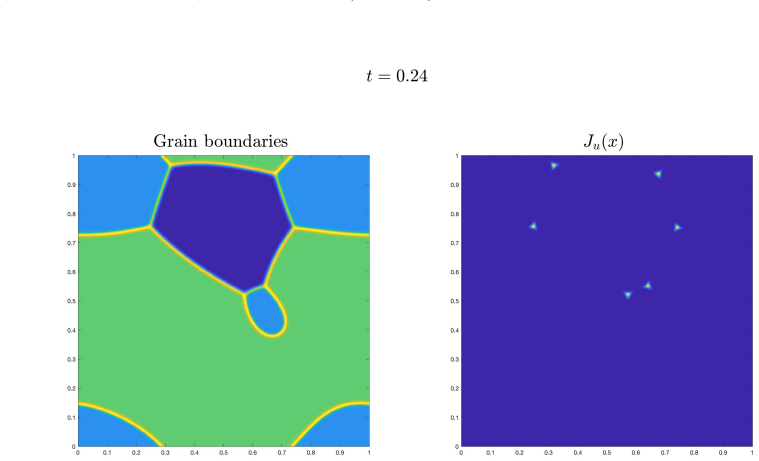
The key mechanism is the Jacobian determinant Ju = sqrt(det(gradient u^T gradient u)) of the order parameter u: Omega -> R^{N-1}. For a diffuse-interface configuration, u maps the interior of each grain to a well of the potential W and the diffuse interfaces to geodesics between wells, so Ju concentrates in small neighborhoods of junctions and its integral over such a neighborhood equals, to leading order, the area A_W of the geodesic triangle bounded by the geodesic arcs connecting the three wells. This constant A_W does double duty: it normalizes the matrix-valued mobility M(gradient u) that retards junction motion, and it converts the integral (1/A_W) integral Ju into the number of juncti
What would settle it
Set up an N=4 phase-field simulation with a single junction whose three angles are made strongly asymmetric, and track (1/A_W) integral over B_eps of Ju dx in a small ball around the junction over time under evolution by (13)-(67); if the value drifts away from 1 by more than O(eps), the geometry-independence assumption fails and the induced junction mobility is angle-dependent. Alternatively, compute u(B_eps) at several times and compare its shape with the equilibrium surface S_ijk of the paper; any visible deviation would contradict the key identity (70).
Extended reading notes
Core claim
The paper's central claim is that the coupled system (13)-(14) converges, as the interface width eps tends to zero, to the sharp-interface model (1)-(2): each interface evolves by curvature with unit mobility, and each triple junction satisfies p_dot(t) = m_TJ (tau_1 + tau_2 + tau_3). The derivation uses matched asymptotics: in a microscopic neighborhood of a junction the leading-order profile is an equilibrium map onto the geodesic triangle, and integrating the profile equation over a large triangle yields exactly the drag law, with a geometry-independent constant inherited from the Jacobian identity integral of Ju dx approx = A_W. The same construction produces the junction counter (1/A_W)
Load-bearing premise
The whole construction hinges on the identity that the integral of the Jacobian determinant over a small neighborhood of a junction is always the same constant A_W, no matter how the angles at the junction change; for N=3 the paper justifies it by a topological degree argument, but for N>=4 it is supported only by numerical simulation.
Editorial extensions
If this is right
- If the convergence result holds, the phase-field method offers quantitative simulations of grain growth with finite junction mobility, including automatic handling of collisions, pinch-offs, and neighbor switches.
- The junction-count formula N_TJ approx (1/A_W) integral Ju dx gives a practical, order-parameter-only diagnostic that works in the new model and likely in other vectorial Allen-Cahn systems.
- The energy-dissipation structure is preserved, and the explicit scheme remains stable under roughly the usual CFL condition, so the method is directly usable in existing codes.
- Because the construction extends to N>=4 phases with numerical convergence to front-tracking benchmarks, the approach is not limited to three-grain junctions.
- The matched-asymptotics argument identifies the exact quantity (the Jacobian mass) that must remain constant for the drag to be configuration-independent, which clarifies why earlier scalar-mobility models failed to converge quantitatively.
Reading between the lines
- The junction-count formula is likely a general diagnostic: any vectorial Allen-Cahn model whose junction profiles map to the geodesic triangle should satisfy the same integral identity, a claim the paper states but does not explore.
- The mobility design suggests a testable way to monitor existing phase-field simulations: if integral Ju near a junction drifts away from A_W during an evolution, that simulation's effective junction mobility is geometry-dependent.
- For N>=4 phases, the identity integral Ju approx A_W rests on numerical evidence only; if a junction configuration ever produced a different image under u, the mobility constant would need to be renormalized, and the convergence proof would need a new input.
- A three-dimensional extension would require a Jacobian-based detector for curves where three or more surfaces meet; the paper leaves that open, and the geometry-independence assumption would need to be re-established in 3D.
Signed reviews
Editorial analysis
A structured set of objections, weighed in public.
Referee Report
Summary. The paper develops a diffuse-interface (phase-field) approximation of planar multiphase curvature motion with triple junction drag. The proposed system (13)-(14) replaces scalar mobility by a matrix-valued factor built from the Jacobian determinant J_u of a vector order parameter. The authors derive the system from a minimizing-movement perspective, give a formal matched-asymptotic analysis leading to the sharp-interface junction law (56), and present numerical convergence studies against exact traveling-wave solutions and front-tracking benchmarks, all showing empirical first-order convergence in the interface width ε. They also introduce an integral formula (21) for counting triple junctions and extend the construction to N≥4 phases in Section 9. The paper is clearly written and the numerical experiments are carefully designed.
Significance. If the claimed convergence holds, this is a valuable step: it offers a quantitative phase-field method for a model of current materials-science interest, in contrast to earlier heuristic methods [21,28]. The numerical results are a genuine strength: the convergence tables exhibit clean first-order rates in ε, the benchmarks include time-varying angles and non-aligned junction motion, and the mobility constant A_W is determined by the potential rather than fitted to the target dynamics. The Jacobian-based junction count is a useful and apparently new observation. The main caveat is that the theoretical support is formal and the essential identity (55) is not proved; the N≥4 extension is explicitly numerical. With additional proof or a targeted numerical test of the Jacobian-mass identity, the contribution would be solid.
major comments (2)
- [§7, Eq. (55)] The derivation of the drag law (56) hinges on the identity ∫_{T_R} J_{u0} dy → A_W. This is not established by the arguments given. Section 5's topological/change-of-variables discussion concerns the signed determinant; the quantity in the PDE and in (15) is the unsigned Jacobian J_u = |det ∇u|. A degree argument controls ∫ det ∇u0, which equals ±A_W if u0 is a covering of the geodesic triangle, but it does not rule out folds that increase the unsigned mass. The profile u0 is defined through the velocity-dependent equation (51), so a fold could make the effective mobility in (56) depend on junction angle and velocity — exactly the failure mode attributed to [21] in Section 3. Section 9 states that the analogous identity for N≥4 is open, but the N=3 case is also only sketched. I request either a proof that u0 is a diffeomorphism onto T (or that (55) holds for solutions of (51)), or a clea
- [§8.5, Figs. 22-25; §9, Figs. 33] The numerical evidence for the geometry-independence of the Jacobian mass is global: Figs. 22 and 33 plot the total integral (21)/(72), which counts the number of junctions, not the per-junction mass. A global near-integer value is consistent with each junction contributing A_W, but it does not isolate a single junction while its angle and velocity are varied, and it cannot detect compensating errors where some junctions contribute more and others less. Please add a focused experiment: a single junction driven through large, controlled angle changes (and, if possible, with velocity direction not aligned with any interface), measuring ∫_{B_ε} J_u dx / A_W as a function of time and of the profile parameters. Alternatively, solve the inner problem (51) numerically for representative p_dot and compute ∫ J_{u0} directly. This would either validate or refute the key assumption (55).
minor comments (6)
- [Abstract and §10] The abstract and conclusion say the convergence is 'verified' by matched asymptotic expansions. Since the analysis is formal and the key identity (55) is not proved, I suggest wording such as 'supported by formal matched asymptotic expansions and numerical convergence studies'.
- [§8, stability argument after Eq. (61)] The energy-stability proof assumes ∇^2 W is bounded, but the potential used in the experiments is the quartic (10). Please clarify whether all experiments use a regularized potential, or provide a stability argument that covers (10).
- [§8.3 and §8.4] The front-tracking reference solutions are described only as 'very fine space and time discretization'. For reproducibility, specify the discretization and solver, and report the error of the front-tracking solution itself if possible.
- [§5, Eq. (20)] The approximation ∫_{B_ε} J_u ≈ Area(u(B_ε)) requires u to be injective on B_ε. This should be stated as an assumption/heuristic before it is used in Section 7.
- [§9] The constants C_β and A_W are given to four significant digits but no numerical method or error tolerance is described; please state how they were computed.
- [§8.1, Eq. (63)] For the traveling-wave solution, specify the admissible range of θ so that the relation (63) is single-valued.
Circularity Check
No significant circularity: the mobility m_TJ is a physical input, A_W is computed from the potential, and the asymptotic analysis is a consistency check; the only self-citation is minor and not load-bearing.
full rationale
The paper's derivation chain is a standard construction-and-verification: a phase-field system (13)-(14) is designed with a matrix-valued mobility that contains the physical parameter m_TJ; formal matched asymptotics then recover the sharp-interface law (56) with the same m_TJ. This is a consistency check, not a prediction derived from fitted data. The constant A_W is defined as the area of the geodesic triangle T of the potential W (eq. 20) and computed directly from W, not tuned to match any simulation. Numerical benchmarks are external: exact traveling-wave solutions from [18] and front-tracking solutions, and the error converges to zero under refinement. The only self-citation is [37], used for well-posedness and the variational principle of the sharp-interface model (1)-(2); this is background for the target PDE and does not support the phase-field construction itself, which is analyzed independently. The unproved identity (55) — that the unsigned Jacobian mass equals A_W — is a genuine mathematical gap (especially for N≥4, where the paper explicitly leaves it to future work), but it is an assumption in the asymptotics, not an input that is renamed as an output. A failure of (55) would change the effective mobility, but that is a correctness concern, not a circularity. No equation reduces to an input by construction, and no fitted parameter is relabeled as a prediction.
Assumptions & free parameters
free parameters (2)
- A_W (Jacobian mass per junction) =
approx 0.86 (N=3); approx 1.026 (N=4)
- Potential normalization constants C_alpha (N=3), C_beta (N=4) =
C_alpha approx 1.837^-2 (text garbled); C_beta approx 0.0322
assumptions (4)
- domain assumption Sharp-interface model (6) is well-posed and equivalent to the geometric evolution (1)-(2)
- ad hoc to paper Formal matched asymptotic expansion u = u0 + eps u1 + ... near junctions, with u0 solving (51) and far-field matching conditions
- ad hoc to paper Jacobian integral identity: integral over B_eps of J_u is approximately A_W, independent of junction angles (eq. 20; for N>=4 eq. 70)
- standard math Away from junctions, M(grad u) is approximately the identity, so the standard Allen-Cahn sharp-interface analysis applies
Cite this review
Pith. "Pith review of A Phase-Field Method for Curvature Flow of Networks with Triple Junction Drag." pith.science (2026). https://pith.science/paper/T5PQ2I6C
@misc{pith2026260800293,
  author       = {Pith},
  title        = {Pith review of: A Phase-Field Method for Curvature Flow of Networks with Triple Junction Drag},
  year         = {2026},
  howpublished = {\url{https://pith.science/paper/T5PQ2I6C}},
  note         = {Machine review of arXiv:2608.00293}
}
read the original abstract
We develop a new phase-field (diffuse interface) approximation of multiphase curvature motion with triple junction drag - an important sharp interface model for the evolution of microstructure in polycrystalline materials during heat treatment. This sharp interface model arises as gradient flow for the total length of the interfacial network with respect to a certain metric. Accordingly, we derive our diffuse interface approximation - a coupled system of partial differential equations that is a variant of the Allen-Cahn system - from a variational perspective, in the style of minimizing movements: starting from a discrete in time approximation that entails a convex optimization problem to advance from one time step to the next. In the process, we propose a simple integral expression that counts the number of junctions using the order parameter that appears to be new even for the standard multiphase Allen-Cahn system. The convergence of the resulting flow to the desired sharp interface limit is then verified via the method of matched asymptotic expansions. Numerical convergence studies against both known exact solutions as well as highly accurate benchmark solutions obtained via front tracking provide clear further evidence for this convergence. Moreover, the method retains the most desirable feature of diffuse interface methods: Automatic handling of topological changes in the network of interfaces.
Figures


Figures from the paper (30 more)




Reference graph
Works this paper leans on
-
[21]
Johnson and P.W
A.E. Johnson and P.W. Voorhees. A phase-field model for grain growth with trijunction drag.Acta Materialia, 67:134–144, 2014
2014
-
[1]
Alikakos, S.I
N.D. Alikakos, S.I. Betelú, and X. Chen. Explicit stationary solutions in multiple well dynamics and non-uniqueness of interfacial energy densities.European Journal of Applied Mathematics, 17(5):525–556, 2006
2006
-
[2]
Alikakos, G
N.D. Alikakos, G. Fusco, and P. Smyrnelis.Elliptic Systems of Phase Transition Type, volume 91 ofProgress in Nonlinear Differential Equations and Their Applications. Birkhäuser, 2018
2018
-
[3]
Allen and J.W
S.M. Allen and J.W. Cahn. A microscopic theory for antiphase boundary motion and its application to antiphase domain coarsening.Acta Metallurgica, 27(6):1085–1095, 1979
1979
-
[4]
S. Baldo. Minimal interface criterion for phase transitions in mixtures of Cahn-Hilliard fluids.Annales de l’Institut Henri Poincaré C, Analyse non linéaire, 7(2):67–90, 1990
1990
-
[5]
Barmak, E
K. Barmak, E. Eggeling, D. Kinderleher, R. Sharp, S. Taasan, A. D. Rollett, and K. R. Coffey. Grain growth and the puzzle of its stagnation in thin films: The curious tale of a tail and an ear.Progress in Materials Science, 58:987–1055, 2013
2013
-
[6]
M Barnacki, R. E. Loge, and T. Coupez. Level set framework for the finite-element modeling of recrystal- lization and grain growth in polycrystalline materials.Scripta Materialia, 64(6):525–528, 2011
2011
-
[7]
Bronsard and F
L. Bronsard and F. Reitich. On three-phase boundary motion and the singular limit of a vector-valued Ginzburg-Landau equation.Archive for Rational Mechanics and Analysis, 124(4):355–379, 1993
1993
Show all 37 references
-
[8]
L. Q. Chen. Phase-field models for microstructure evolution.Annual Review of Materials Research, 32:113– 140, 2002
2002
-
[9]
Chen and W
L.-Q. Chen and W. Yang. Computer simulation of the domain dynamics of a quenched system with large number of nonconserved order parameters: The grain-growth kinetics.Physical Review B, 50(21):15752, 1994
1994
-
[10]
Elsey and S
M. Elsey and S. Esedo¯ glu. Threshold dynamics for anisotropic surface energies.Mathematics of Computa- tion, 87(312):1721–1756, 2018
2018
-
[11]
Elsey, S
M. Elsey, S. Esedo¯ glu, and P. Smereka. Diffusion generated motion for grain growth in two and three dimensions.Journal of Computational Physics, 228(21):8015–8033, 2011
2011
-
[12]
Elsey, S
M. Elsey, S. Esedo¯ glu, and P. Smereka. Large scale simulations of normal grain growth via diffusion generated motion.Proceedings of the Royal Society A: Mathematical, Physical, and Engineering Sciences, 467:2126:381–401, 2011
2011
-
[13]
Epshteyn, C
Y. Epshteyn, C. Liu, and M. Mizuno. Motion of grain boundaries with dynamic lattice misorientations and with triple junctions drag.SIAM Journal on Mathematical Analysis, 53(3):3072–3097, 2021
2021
-
[14]
Esedo¯ glu and F
S. Esedo¯ glu and F. Otto. Threshold dynamics for networks with arbitrary surface tensions.Communications on Pure and Applied Mathematics, 68(5):808–864, 2015
2015
-
[15]
D. Fan, C. Geng, and L.-Q. Chen. Computer simulation of topological evolution in 2-D grain growth using a continuum diffuse-interface model.Acta Materialia, 45(3):1115–1126, 1997
1997
-
[16]
De Giorgi
E. De Giorgi. New problems on minimizing movements. InBoundary value problems for PDE and appli- cations, pages 81–98, Masson, 1993
1993
-
[17]
Gößwein, J
M. Gößwein, J. Menzel, and A. Pluda. Existence and uniqueness of the motion by curvature of regular networks.Interfaces and Free Boundaries, 25, 06 2022
2022
-
[18]
Gottstein and L.S
G. Gottstein and L.S. Shvindlerman. Triple junction drag and grain growth in 2D polycrystals.Acta Materialia, 50(4):703–713, 2002
2002
-
[19]
Herring.The Physics of Powder Metallurgy, chapter Surface tension as a motivation for sintering, pages 143–179
C. Herring.The Physics of Powder Metallurgy, chapter Surface tension as a motivation for sintering, pages 143–179. McGraw Hill, 1951. 33
1951
-
[20]
Jerrard and H.M
R.L. Jerrard and H.M. Soner. The jacobian and the Ginzburg-Landau energy.Calculus of Variations and Partial Differential Equations, 14(2):151–191, 2002
2002
-
[22]
Laux and T.M
T. Laux and T.M. Simon. Convergence of the Allen-Cahn Equation to Multiphase Mean Curvature Flow. Communications on Pure and Applied Mathematics, 71(8):1597–1647, 2018
2018
-
[23]
J. Lira, R. Mazzeo, A. Pluda, and M. Sáez. Short-time existence for the network flow.Communications on Pure and Applied Mathematics, 76(12):3968–4021, 2023
2023
-
[24]
Mantegazza, M
C. Mantegazza, M. Novaga, and V. Tortorelli. Motion by Curvature of Planar Networks.Annali della Scuola normale superiore di Pisa, Classe di scienze, 3, 03 2003
2003
-
[25]
I. M. McKenna, S. O. Poulsen, E. M. Lauridsen, W. Ludwig, and P. W. Voorhees. Grain growth in four dimensions: A comparison between simulation and experiment.Acta Materialia, 78:125–134, 2014
2014
-
[26]
Merriman, J
B. Merriman, J. K. Bence, and S. J. Osher. Diffusion generated motion by mean curvature. In J. Taylor, editor,Proceedings of the Computational Crystal Growers Workshop, pages 73–83. AMS, 1992
1992
-
[27]
E. Miyoshi. Grain growth kinetics under triple-junction drag: Phase-field simulations in two and three dimensions.ISIJ International, advpub:ISIJINT–2025–361, 2026
2025
-
[28]
Miyoshi and A
E. Miyoshi and A. Yamanaka. Phase-field framework for data-driven estimation of finite grain boundary junction mobilities.Computational Materials Science, 259:114161, 2025
2025
-
[29]
Modica and S
L. Modica and S. Mortola. Un esempio di gamma-convergenza.Boll. Un. Mat. Ital. B (5), 14(1):285–299, 1977
1977
-
[30]
W. W. Mullins. Two dimensional motion of idealized grain boundaries.J. Appl. Phys., 27:900–904, 1956
1956
-
[31]
Osher and J
S. Osher and J. Sethian. Fronts propagating with curvature-dependent speed: Algorithms based on Hamilton-Jacobi formulation.Journal of Computational Physics, 79:12–49, 1988
1988
-
[32]
X. Peng, A. Bhattacharya, S. K. Naghibzadeh, D. Kinderlehrer, R. Suter, K. Dayal, and G. S. Rohrer. Com- parison of simulated and measured grain volume changes during grain growth.Physical Review Materials, 6, 2022
2022
-
[33]
G. S. Rohrer, I. Chesser, A. R. Kruse, S. K. Naghibzadeh, Z. Xu, K. Dayal, and E. A. Holm. Grain boundary migration in polycrystals.Annual Review of Materials Research, 53(1):1–23, 2023
2023
-
[34]
Rubinstein, P
J. Rubinstein, P. Sternberg, and J. B. Keller. Fast reaction, slow diffusion, and curve shortening.SIAM Journal on Applied Mathematics, 49(1):116–133, 1989
1989
-
[35]
R. I. Saye and J. A. Sethian. The voronoi implicit interface method for computing multiphase physics. Proceedings of the National Academy of Sciences, 108:19498–19503, 2011
2011
-
[36]
Steinbach and F
I. Steinbach and F. Pezzolla. A generalized field method for multiphase transformations using interface fields.Physica D: Nonlinear Phenomena, 134(4):385–393, 1999
1999
-
[37]
Yang and S
Y. Yang and S. Esedoglu. Curvature flow of networks with triple junction drag and grain rotation, 2025. Available athttps://arxiv.org/abs/2509.06125. 34
2025 arXiv
Reviewed August 4, 2026 · model on record in the stance chip above.
Discussion (0). Continue with ORCID to comment.